

The United Kingdom’s most sought-after universities have long been synonymous with excellence, and with that reputation comes selectivity. Oxford and Cambridge admit fewer than 20% of applicants, while Imperial College London and LSE often record acceptance rates under 15%. These figures reflect limited seats and a careful curation of talent, vision, and potential.
For students aiming to get into the lowest acceptance rate university in the UK, understanding these benchmarks is as important as preparing a strong application. This blog highlights the top 10 UK universities with the strictest admissions in 2026, exploring what drives their selectivity and how aspiring students can approach these opportunities strategically.
Top 10 Hardest UK Universities to get into: At a Glance
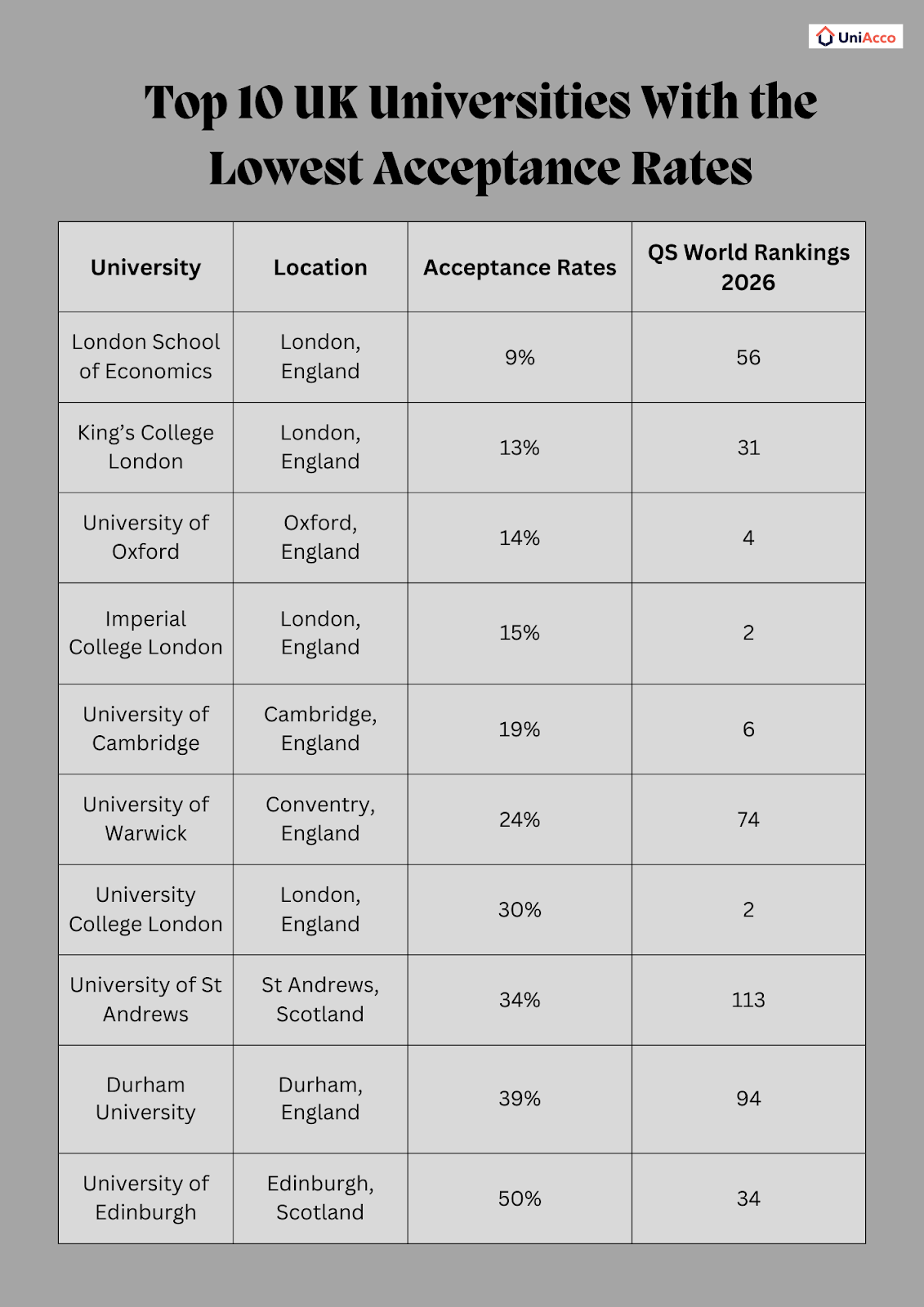
| University | Location | Acceptance Rates | QS World Rankings 2026 |
| London School of Economics | London, England | 9% | 56 |
| King’s College London | London, England | 13% | 31 |
| University of Oxford | Oxford, England | 14% | 4 |
| Imperial College London | London, England | 15% | 2 |
| University of Cambridge | Cambridge, England | 19% | 6 |
| University of Warwick | Conventry, England | 24% | 74 |
| University College London | London, England | 30% | 2 |
| University of St Andrews | St Andrews, Scotland | 34% | 113 |
| Durham University | Durham, England | 39% | 94 |
| University of Edinburgh | Edinburgh, Scotland | 50% | 34 |
Lock in your student accommodation early with UniAcco. Choose a safe, fully furnished space in a prime location, so you can focus on making friends, joining societies, and diving into campus life from day one.
Browse Verified UK AccommodationsWhat Is a University Acceptance Rate?
A university’s acceptance rate is a metric that shows how selective an institution is by indicating the percentage of applicants who are offered admission. It reflects how competitive the application process is and helps students gauge their chances of getting in.
This rate is calculated using the following formula
| (Number of admitted students ÷ Total number of applicants) × 100 |
University acceptance rates are usually influenced by factors such as the university’s capacity, the popularity of specific courses, and growing international demand, all of which affect the number of students admitted each year.
Difference between Acceptance Rates and Entry Requirements
| Acceptance Rates | Entry Requirements | |
| Definition | Indicate how competitive a university is. Represent the percentage of applicants who receive an offer. | Outline the minimum academic qualifications needed for admission (grades, test scores, subjects, portfolios, etc.). Show what a student must achieve to be considered for a course. |
| Purpose | Reflect demand, number of seats, and overall applicant volume, not individual academic strength. | Demonstrate the academic standards a student must meet for eligibility, which can vary by course or program. |
| Key Difference | Measures selectivity | Measures eligibility |
Thus, a university can have a low acceptance rate even if entry requirements are moderate, depending on demand. On the other hand, entry requirements can be high even at universities with moderate acceptance rates, depending on program standards and the quality of applicants.
Why Do Some UK Universities Have Low Acceptance Rates?
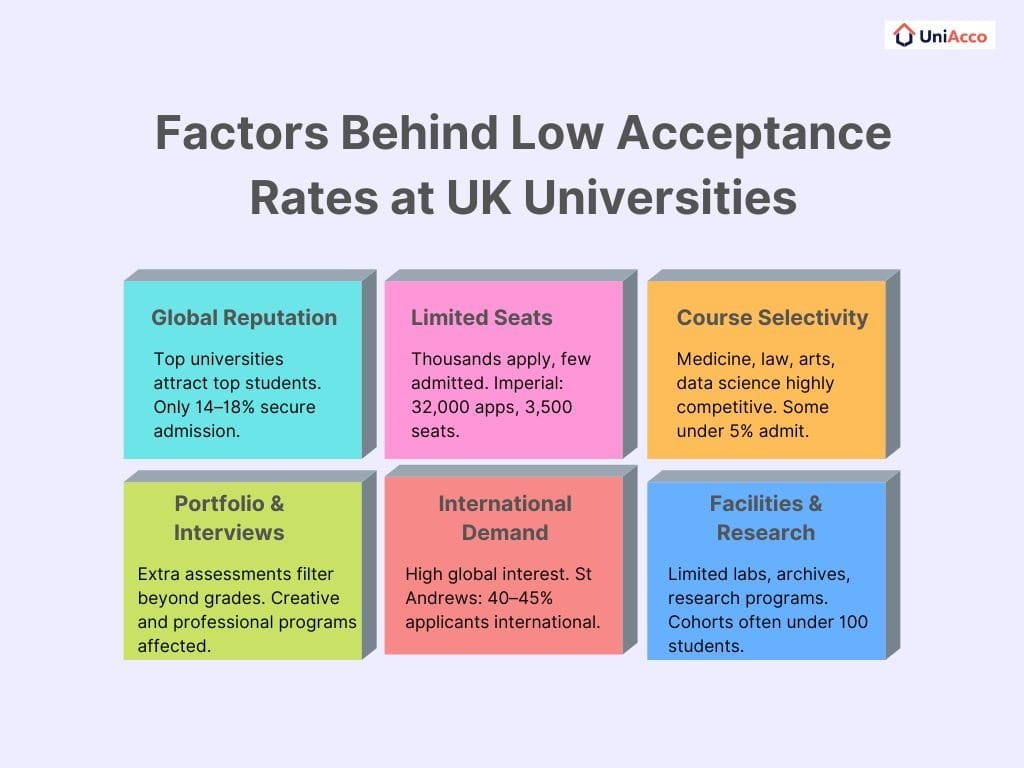
Some UK universities maintain exceptionally low acceptance rates due to a combination of prestige, high demand, and limited capacity. These institutions receive numerous applications every year but admit only a small fraction, often below 15% for highly competitive courses.
Understanding the factors behind these selective admissions helps students tailor their applications strategically and set realistic expectations.
- High global reputation: Universities like Oxford, Cambridge, and LSE attract applications from top students worldwide. Each year, only around 14–18% of applicants secure a spot, reflecting the intense competition driven by international prestige.
- Limited seats and high application numbers: Many programs admit only a few hundred students despite thousands of applications. For example, Imperial College London received over 32,000 applications for roughly 3,500 undergraduate seats in 2024, resulting in an acceptance rate of just 10.6%.
- Course selectivity: Programs in medicine, law, arts, and data science have even stricter thresholds, sometimes admitting fewer than 5% of applicants, due to intensive training, lab access, or professional accreditation requirements.
- Portfolio and interview requirements: Creative and professional courses often require portfolios, auditions, or interviews. These additional layers of assessment filter candidates beyond academic scores, further reducing acceptance rates.
- International student demand: Growing interest from global applicants intensifies competition. At universities like St Andrews, international applications now account for 40–45% of all applicants, while only a small fraction are admitted.
- Facilities and research prestige: Access to specialised labs, historic archives, or leading research programs limits cohort size. High-demand programs in science, engineering, and economics often have fewer than 100 seats per year, even when the number of applications is in the thousands.
UK Universities With the Lowest Acceptance Rates: Detailed Breakdown
1. London School of Economics (LSE)
LSE remains highly selective because it is one of the few universities in the world dedicated entirely to the social sciences. With an unusually small campus, tightly capped class sizes, and departments that influence global policy, finance, and diplomacy, LSE attracts an applicant pool far larger than it can physically or academically accommodate.
The university’s emphasis on analytical rigour, its London location at the centre of political and economic activity, and its reputation for shaping future policymakers create a level of competition that goes beyond traditional academic standards, placing LSE consistently among the toughest universities with low acceptance rates in the UK.
Global Rankings:
| Ranking Body | 2026 |
| QS World University Rankings | 56 |
| Times Higher Education (THE) | 52 |
| The Guardian University Guide (UK) | 4 |
| Complete University Guide (UK) | 3 |
Acceptance Rate:
Current Acceptance Rate (2025/26): Approximately 9% (based on latest cycle insights).
LSE has become increasingly selective over the past five years, largely due to rising global interest in subjects like Economics, Finance, International Relations, and Policy. Earlier in 2019–20, its acceptance rate sat in the low-20% range, but application numbers rose sharply in the following years.
By 2021–22, the rate had moved to around 12%, and Crimson Education reports it reached approximately 6.7% in 2023–24, with more than 26,000 students applying for fewer than 1,800 places. The overall trend is steady: growing international demand paired with a deliberately focused intake has made LSE progressively more selective.
Cost of Studying at the London School of Economics
| Programme Type | Tuition Fees 2025-26 – Home / UK-eligible | Tuition Fees 2025-26 – Overseas / International |
| Undergraduate | £ 9,535 per year | £ 27,500 – £34,000+ per year (varies by course) |
| Postgraduate | Starts from £18,300 | £ 38,000 per year |
| Research / MPhil–PhD | £ 5,006 | £ 23,500 |
2. King’s College London
King’s College London’s selectivity stems from its strong focus on regulated disciplines like law, medicine, psychology, and international affairs, where strict professional requirements limit class sizes and admissions. Its central London setting attracts intense global interest, but available places remain fixed due to clinical training capacity and research commitments. This imbalance makes King’s one of the most competitive universities in the UK, attracting far more applicants than available spots.
Global Rankings:
| Ranking Body | 2026 |
| QS World University Rankings | 31 |
| Times Higher Education (THE) | 38 |
| The Guardian University Guide (UK) | 28 |
| Complete University Guide (UK) | 19 |
Acceptance Rate:
Current Acceptance Rate (2025/26): Approximately 13%
King’s College has seen a sharp rise in demand over the past few years, and its acceptance rates reflect that pressure. Official data shows a 41% undergraduate offer rate in the 2023–2024 cycle, with more than 70,000 applications submitted. But the picture shifts quickly for high-demand courses such as Medicine and Law, where competition is far tighter. Recent estimates place the overall acceptance rate at roughly 13%, signalling how global interest continues to outpace available places. King’s now sits among the UK’s more selective universities, shaped by rising international applications and a consistently strong academic reputation.
Cost of Studying at King’s College London
| Programme Type | Tuition Fees 2025-26 – Home / UK-eligible | Tuition Fees 2025-26 – Overseas / International |
| Undergraduate | £ 9,535 per year | Humanities/ Social sciences: £ 27,100 Science/ Engineering/ CS: up to £ 35,800 |
| Postgraduate | An MSc in Microbiome in Health and Disease costs £ 18,150 | £40,450 |
| Postgraduate / Research | £7,500 | Start from £14,000 |
3. University of Oxford
A big part of what makes the University of Oxford distinctive is the kind of academic environment students step into. Instead of large lectures, much of the learning happens through close, discussion-based tutorials with experienced academics, which is a major draw for applicants.
Oxford’s departments also play a central role in global research, adding to its appeal. Because this teaching style is so personalised and resource-intensive, the university can only admit a limited number of students each year. This is one of the key reasons Oxford consistently has some of the lowest acceptance rates in the UK.
Global Rankings:
| Ranking Body | 2026 |
| QS World University Rankings | 4 |
| Times Higher Education (THE) | 1 |
| The Guardian University Guide (UK) | 1 |
| Complete University Guide (UK) | 2 |
Acceptance Rate:
Current Acceptance Rate (2025/26): Approximately 14% (based on recent admissions patterns).
Oxford’s acceptance rate has remained steady at 13–16% over the past five years, despite a steady rise in applications, particularly from international students and from competitive courses like Computer Science and PPE. This reflects the university’s approach of maintaining small, carefully selected cohorts rather than expanding intake. Some STEM and interdisciplinary courses have seen slightly lower acceptance rates, around 5–9%, due to higher demand, but overall, Oxford’s selectivity has stayed consistent, balancing competitiveness with academic quality.
Cost of Studying at the University of Oxford
| Programme Type | Tuition Fees (2025–26) – Home / UK-eligible | Tuition Fees (2025–26) – Overseas / International |
| Undergraduate (UG) | £ 9,535 per year | ~ £ 35,260 – £59,260 |
| Postgraduate (PG – taught Master’s etc.) | Varies between £12,500 to £29,000 | Typical range ~ £ 27,000 – £40,000+ per year |
| Doctoral (PhD / DPhil / Research degree) | £17,310 | £31,110 |
Also Read: The Ultimate Student’s Guide To Oxford
4. Imperial College London
Unlike broader universities, Imperial College admits students almost entirely into science, engineering, medicine, and business courses, where small lab capacities and intensive supervision limit class sizes. Applicants are not just competing academically; they are competing for access to labs, research opportunities, and specialised programs that few other institutions can match.
This practical constraint, combined with global demand for tech and engineering talent, makes it one of the UK universities with the lowest acceptance rates.
Global Rankings:
| Ranking Body | 2026 |
| QS World University Rankings | 2 |
| Times Higher Education (THE) | 8 |
| The Guardian University Guide (UK) | 6 |
| Complete University Guide (UK) | 6 |
Acceptance Rate:
Current Acceptance Rate (2025/26): Approximately 15%
The acceptance rate at Imperial College has gradually declined over the past five years, primarily due to rising global interest in STEM courses. In 2020, the rate stood at about 13.4% with roughly 25,780 applicants competing for 3,450 places. Applications continued to grow, and by 2022, the rate shifted to around 10.7% despite a similar number of admitted students.
In the 2024 cycle, 32,887 applicants and 3,474 offers brought the rate to 10.6%. Some courses like Computing, Engineering, and Economics & Finance are even more competitive, often sitting below 5%. Overall, Imperial’s selectivity reflects stable intake sizes against consistently increasing demand.
Cost of Studying at Imperial College London
| Programme Type | Tuition Fees 2025-26 – Home / UK-eligible | Tuition Fees 2025-26 – Overseas / International |
| Undergraduate (UG) | £ 9,535 per year | £ 40,700 – £43,300 per year (varies by department/subject) |
| Postgraduate | £7,750 | £22,500 |
| Research / PhD | Ranges from £ 5,006 – £ 7,500 | £ 46,800 |
5. University of Cambridge
The University of Cambridge stands apart for its distinctive blend of intellectual intensity and research-powered innovation. Unlike many global universities, Cambridge bases its teaching on small-group supervisions that demand deep analytical thinking. This approach naturally caps the number of students it can accommodate each year.
Its long-standing culture of academic precision, together with world-leading departments in fields like Mathematics, Engineering, and Natural Sciences, has made Cambridge one of the most fiercely contested universities with low acceptance rates in the UK.
Global Rankings:
| Ranking Body | 2026 |
| QS World University Rankings | 6 |
| Times Higher Education (THE) | 3 |
| The Guardian University Guide (UK) | 3 |
| Complete University Guide (UK) | 1 |
Acceptance Rate:
Current Acceptance Rate (2025/26): Approximately 19% (based on recent cycle patterns and published admissions data).
Cambridge’s acceptance rate has stayed fairly consistent over the past five years, generally falling between 17%–20%. Applications have continued to rise during this period, particularly for subjects like Computer Science, Natural Sciences, and Engineering. However, the university has kept its intake steady to preserve its teaching model.
Some competitive courses, such as Architecture and Medicine, see lower acceptance figures, occasionally dropping into single digits. International demand has grown faster than available places, contributing to increased competition overall. Despite slight year-to-year shifts, Cambridge’s admissions pattern remains selective but stable, reflecting its commitment to academic quality.
Cost of Studying at the University of Cambridge
| Programme Type | Tuition Fees (2025-26) – Home / UK-eligible | Tuition Fees (2025-26) – Overseas / International |
| Undergraduate | £ 9,535 per year | Arts/ Humanities: £29,052Medicine/ Veterinary: Upto £70,554 |
| Postgraduate | Approximately starts from £9,328 | Approximately starts from £21,758 |
| PhD / Research Degrees | Approximately ranges from £10,878 to £19,320 | Approximately ranges from £32,886 to £48,192 |
6. University of Warwick
Warwick consistently ranks among the lowest acceptance-rate universities because of its selective intake strategy across high-demand disciplines such as Economics, Law, and Data Science. From 2020 to 2024, applications, particularly from international and postgraduate aspirants, rose significantly, yet the university retained its preference for academically competitive cohorts.
This deliberate constraint is a defining feature of UK universities, where Warwick’s focus remains on maintaining course quality rather than expanding capacity.
Global Rankings:
| Ranking Body | 2026 |
| QS World University Rankings | 74 |
| Times Higher Education (THE) | 122 |
| The Guardian University Guide (UK) | 7 |
| Complete University Guide (UK) | 9 |
Acceptance Rate:
Current Acceptance Rate (2025/26): 24%
Warwick’s acceptance rate has tightened gradually in recent cycles, reflecting a steady rise in applicant numbers rather than any major shift in intake. Crimson Education reports a 14.4% admit rate in 2021–22, supported by a comparatively generous 67.6% offer rate. But as applications grew, from 43,328 to more than 48,000 for the 2024 entry, the acceptance rate moved down to 12.6%. The number of admitted students has stayed close to 6,000 throughout this period. With demand climbing and intake remaining stable, Warwick has become increasingly selective year after year.
Cost of Studying at the University of Warwick
| Programme Type | Tuition Fees 2025-26 – Home / UK-eligible | Tuition Fees 2025-26 – Overseas / International |
| Undergraduate | £ 9,535 per year | Some courses cost £ 33,520 per year |
| Postgraduate | MA: Starts from £12,300 | MA: Starts from £27,680 |
| Postgraduate Research / MPhil / PhD | £ 5,006 per year | £ 24,450 |
7. University College London (UCL)
University College London consistently appears on the list of the hardest universities to get into in the UK, primarily due to its steep rise in applicants across high-demand disciplines like Economics, Medicine and Law. Despite expanding some departments, UCL maintains tight selection thresholds to preserve academic quality and research output.
Applicant volume surged between 2020 and 2024, but admission numbers rose only marginally. This imbalance positions UCL among the UK’s lowest-acceptance-rate universities, making entry significantly more competitive year after year.
Global Rankings:
| Ranking Body | 2026 |
| QS World University Rankings | 9 |
| Times Higher Education (THE) | 22 |
| The Guardian University Guide (UK) | 10 |
| Complete University Guide (UK) | 13 |
Acceptance Rate:
Current Acceptance Rate (2025/26): Approximately 30%
UCL is driven by strong global demand, and selective admissions have maintained a consistently low acceptance rate over the past five years. In 2024, Uniadmissions reported 79,082 applications, 19,676 offers, and 7,001 students accepted, an acceptance rate of 8.9%. The previous year showed similar competitiveness at 8.5%, with 6,288 students receiving offers from 73,994 applicants. In 2022, the rate stood at 10.4% from 58,362 applications, while in 2021 it was 8.8% from 69,002 applications. Overall, UCL’s trends reflect steady demand and a selective intake, placing it among the UK universities with the lowest acceptance rates.
Cost of Studying at the University College London
| Programme Type | Tuition Fees 2025-26 – Home / UK-eligible | Tuition Fees 2025-26 – Overseas / International |
| Undergraduate | £ 9,535 | £ 37,500 per year |
| Postgraduate | Approximately from £13,640 to £22,010 | Approximately from £23,340 to £28,530 |
| Postgraduate Research / PhD / MPhil | Generally Start from £6,215 | Range from £28,100 to £34,400 |
Read student insights from this Reddit thread to understand which courses at UCL are among the most competitive.
Hardest degrees to get into at UCL by offer rate – r/6thForm from r/6thForm
8. University of St Andrews
St Andrews’ appeal goes beyond rankings. Its historic streets, coastal setting, and centuries-old traditions create a small, immersive academic world where students live and learn in close proximity to faculty.
The university admits very few students per program to maintain its tightly knit environment, making entry highly competitive. The combination of its distinctive structure and high global demand for programs such as International Relations, Economics, and Medicine makes St Andrews one of the UK’s most selective universities, consistently attracting more applicants than it can admit.
Global Rankings:
| Ranking Body | 2026 |
| QS World University Rankings | 113 |
| Times Higher Education (THE) | 162 |
| The Guardian University Guide (UK) | 2 |
| Complete University Guide (UK) | 4 |
Acceptance Rate:
Current Acceptance Rate (2025/26): Approximately 34%
St Andrews has kept its acceptance rate relatively stable over the past five years, maintaining small cohort sizes while applications rose from around 18,500 to 21,700. Offers have stayed within the 1,900–2,000 range, resulting in acceptance rates consistently near 8–10%. High-demand courses such as Economics, International Relations, and Medicine often sit slightly below this average due to limited places. Overall, the university’s steady approach supports its close-knit academic environment, even as interest continues to grow.
Cost of Studying at the University of St Andrews
| Programme Type | Tuition Fees 2025-26 – Home / UK-eligible | Tuition Fees 2025-26 – Overseas / International |
| Undergraduate | £ 9,535 per year | £ 40,700 – £43,300 per year (varies by department/subject) |
| Postgraduate | £5,000 to £12,000 | £25,000 to £40,000 |
| Research / PhD | £ 5,006 | Approximately £21,750 to £26,270 per year |
9. Durham University
Durham University is recognised for its collegiate framework and emphasis on critical, discussion-based learning, setting it apart from many larger UK institutions. Its tutorial-style teaching promotes academic rigour and close faculty engagement, naturally limiting student intake and positioning it among the UK’s universities with the lowest acceptance rates. With its reputation for high-level scholarship and selective admissions, Durham consistently ranks among the hardest universities in the UK for students seeking a research-driven, intellectually demanding environment.
Global Rankings:
| Ranking Body | 2026 |
| QS World University Rankings | 94 |
| Times Higher Education (THE) | 175 |
| The Guardian University Guide (UK) | 5 |
| Complete University Guide (UK) | 5 |
Acceptance Rate:
Current Acceptance Rate (2025/26): Approximately 39%
Before the pandemic, acceptance rates at Durham University typically sat in the mid-40% range, supported by a balanced flow of applications. But once interest surged in subsequent cycles, the rate fell to roughly 41% by 2021–22. Durham continues to safeguard its collegiate model and focused academic setting. As applications rise each year, that choice keeps acceptance rates gradually edging downward.
Cost of Studying at Durham University
| Programme Type | Tuition Fees 2025-26 – Home / UK-eligible | Tuition Fees 2025-26 – Overseas / International |
| Undergraduate | £ 9,535 per year | Starts from £31,000 |
| Postgraduate | Varies by programme and fee-status | MSc Economics: £27,000 MA History: £27,500MSc Biotechnology: £32,900 |
| Postgraduate Research / PhD / MPhil | Ranges from £5,006 to £29,500 | Ranges from £12,750 to £34,000 |
10. University of Edinburgh
The University of Edinburgh’s competitiveness stems from its research-intensive programs across medicine, law, informatics, and social sciences, where limited cohort capacity is dictated by supervision-heavy teaching and specialised facilities. This structure naturally restricts intake, making Edinburgh one of the hardest universities to get into in the UK. Its consistent global demand and limited academic resources place it among the lowest acceptance-rate universities UK candidates encounter, where entry is as much about research potential as academic scores.
Global Rankings:
| Ranking Body | 2026 |
| QS World University Rankings | 34 |
| Times Higher Education (THE) | 29 |
| The Guardian University Guide (UK) | 13 |
| Complete University Guide (UK) | 18 |
Acceptance Rate:
Current Acceptance Rate (2025/26): Approximately 50%
Edinburgh’s admissions trend over the last five years is more about steady pressure from an oversized applicant pool. The university consistently attracts lakhs of applications each cycle, 66,293 in 2024 alone. Yet its intake stays relatively fixed. This balance keeps acceptance rates tight, ranging from 11.8% in 2020 to 11.7% in 2021, before dipping to 8.1% at the height of application peaks in 2022. By 2024, the rate returned to around 11%, showing that competition rises and settles, but rarely loosens.
Cost of Studying at the University of Edinburgh
| Programme Type | Tuition Fees 2025-26 – Home / Scottish-eligible / UK-eligible* | Tuition Fees 2025-26 – Overseas / International |
| Undergraduate | £ 1,820 per year | Starts from £ 24,500 per year |
| Postgraduate | Part-time courses cost from £6,850 | Part-time courses cost £10,670 |
| Research / MPhil / PhD / MRes | Approximately starts from £5,006 | Approximately starts from £29,900 |
Discover student accommodation close to George Square, Kings Buildings, and key study spots. Settle into Edinburgh with confidence and start your course on the right note with UniAcco.
Browse Edinburgh Student AccommodationCompetitive UK universities often offer competitive programs. Let’s break down the most challenging courses to secure a place in across the UK.
Hardest Courses to Get Into in the UK
1. Medicine
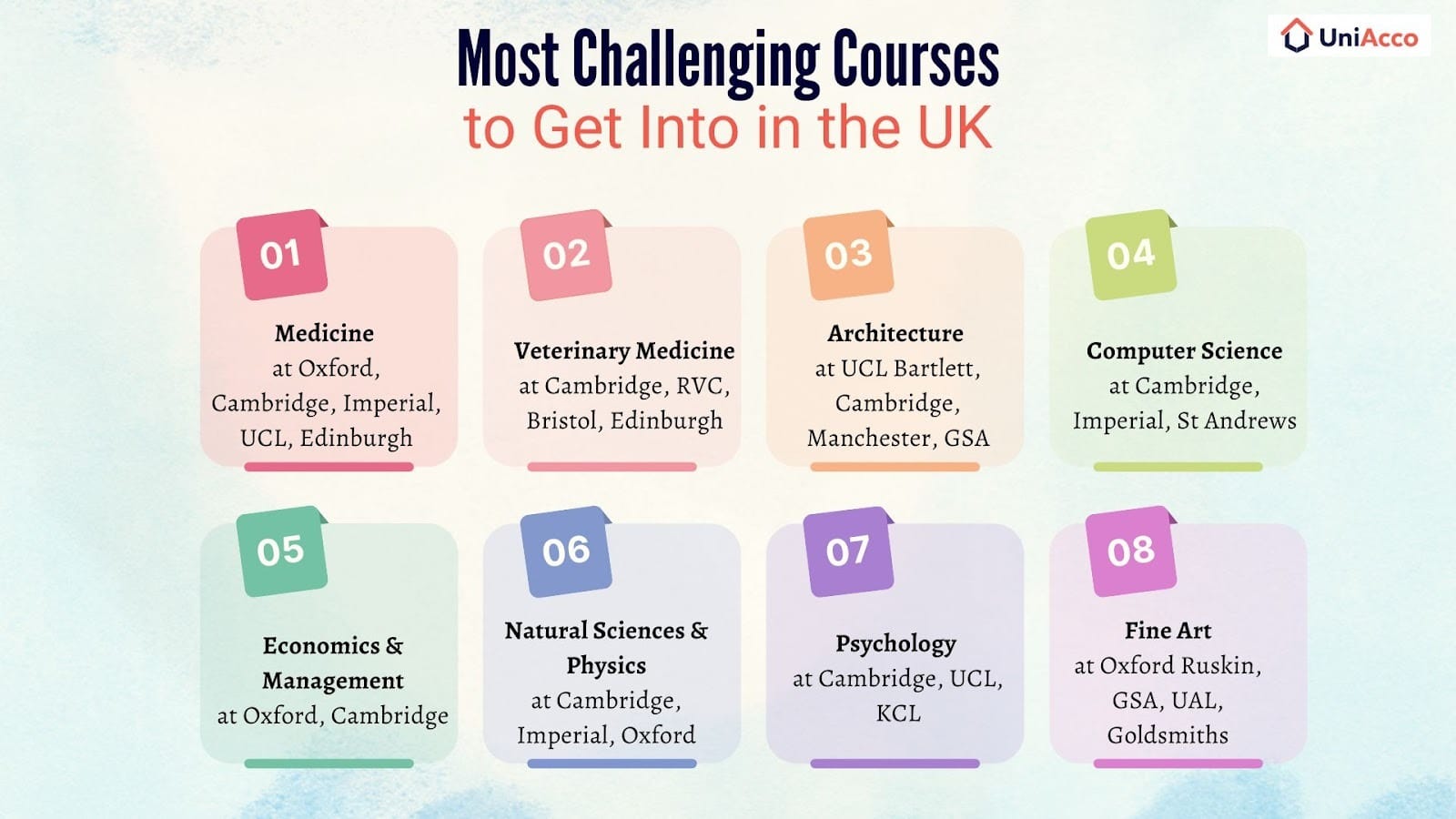
Medicine remains one of the toughest courses to study in the UK because intake is capped nationally, so even top-ranked applicants compete for very few seats. Selection relies heavily on UCAT/BMAT scoring, multi-stage MMIs, and verified clinical exposure. At the UK’s toughest universities to get into, medicine often receives 15–20 applicants per seat. This pushes acceptance rates far below the overall acceptance rate UK universities publish, sometimes dipping into single digits.
Top Universities to study Medicine: University of Oxford, University of Cambridge, Imperial College, University College London, University of Edinburgh.
2. Veterinary Medicine
VetMed has even smaller class sizes, and applicants must demonstrate documented multi-species handling hours, which many international students struggle to obtain. Because most schools have strict capacity limits, VetMed receives high-quality applications but can only admit a fraction. Acceptance rates can shrink to 5–10% at top universities, making it one of the UK’s most filtered degrees by volume and experience requirements.
Top Universities to study Veterinary Medicine: University of Cambridge, Royal Veterinary College, University of Bristol, University of Edinburgh.
Also Read: Top 10 Vet Schools in the UK for 2026 Intakes
3. Architecture
Architecture admissions revolve around a portfolio that must showcase technical drawing, conceptual exploration, and spatial reasoning. However, schools like Bartlett reject the majority at the portfolio-screening stage itself. Because seats are limited in studio-based programmes, acceptance rates often fall two to three times lower than the university average, sometimes hovering around 10–15%.
Top Universities to study Architecture: University College London, Bartlett School of Architecture, University of Cambridge, and University of Manchester.
4. Computer Science
Top CS departments prioritise Olympiad-level problem-solving, advanced maths, and independent coding work beyond school syllabi. With applicant volumes rising yearly, tests and interviews eliminate a large portion early. Courses like Imperial Computing see acceptance rates much lower than the general university rate, often around 7–12%, due to extremely strong STEM competition.
Top Universities to study Computer Science: University of Cambridge, Imperial College London, University of St Andrews, University of Edinburgh, University of Warwick.
5. Economics & Management
Interdisciplinary social-science courses at Oxbridge have very small cohorts and rely on difficult admissions tests such as TSA, alongside analytical interviews. The challenge is that thousands of high-performing applicants compete for only a few dozen seats. As a result, E&M and PPE are known for sub-10% acceptance rates, making them statistically harder to enter than many STEM programmes.
Top Universities to study Economics & Management: University of Oxford, University of Cambridge.
6. Natural Sciences & Physics
These courses are challenging because they depend heavily on problem-solving assessments, unseen questions, and high-intensity interviews that test raw mathematical reasoning. Departments intentionally keep class sizes small to maintain the quality of research supervision. Acceptance rates can dip to 8–12%, with interview invite rates significantly lower.
Top Universities to study Natural Sciences & Physics: University of Cambridge, Imperial College London, and University of Oxford.
7. Psychology
Although widely popular, top psychology degrees function like STEM programmes, requiring strong backgrounds in biology, statistics, and research methods. Many applicants underestimate the scientific rigour, leading to early-stage filtering. Acceptance rates at elite universities can fall to 10–15%, far below their mainstream humanities subjects.
Top Universities to study Psychology: University of Cambridge, University College London, and King’s College London.
8. Fine Art
Fine Art admissions revolve almost entirely around portfolio depth, experimentation, and conceptual reasoning, skills that require years of practice. Oxford Ruskin and GSA admit only a few dozen students annually, creating severe bottlenecks. Portfolio rejection rates are high, resulting in final acceptance rates of 5–12% across institutions.
Top Universities to study Fine Art: University of Oxford, Ruskin School of Art, Glasgow School of Art, University of the Arts London (UAL), and Goldsmiths, University of London.
How to Improve Your Chances of Getting Into a Competitive UK University?
1. Start applications early
Begin planning your university choices and UCAS applications well in advance, ideally a year before deadlines. Early preparation gives you time to research competitive courses, complete required tests like BMAT, UCAT, TSA, or LNAT, and avoid last-minute stress. It also allows you to revisit and refine your Personal Statement, CV, and portfolio multiple times. Missing early deadlines can automatically eliminate you from highly selective programmes.
2. Build a strong SOP/Personal Statement
Your Personal Statement should focus on specific academic interests and achievements, not generic passion statements. Mention concrete projects, research, competitions, or papers that demonstrate your subject expertise. Tailor it to show why the chosen course and university fit your goals. Avoid repeating CV points; use this as a narrative to highlight your analytical skills, curiosity, and commitment.
3. Secure strong Letters of Recommendation
Choose referees who know you academically and can provide evidence of critical thinking, problem-solving, or research potential. Give them a clear idea of the universities and courses you’re applying to, along with your achievements, so they can write tailored, impactful letters. Early requests give them time to write thorough recommendations rather than rushed, generic letters. Strong LORs can tip the balance in tight admission pools.
4. Create a standout CV
Your CV should focus on relevant academic and extracurricular achievements, Olympiads, research projects, internships, lab experience, or competitions. Highlight outcomes, responsibilities, and skills gained, not just participation. Organise it in a clean, easy-to-read format, and update it regularly as you gain new experiences. A strong CV can complement your Personal Statement and help interviewers see a fuller picture of your preparation.
5. Prepare for interviews
Practice articulating your reasoning, problem-solving approach, and subject-specific ideas in mock interviews or with mentors. Review typical interview questions for your chosen course, but focus on thinking aloud and demonstrating structured analysis. Reflect on past projects or research and be ready to discuss challenges and outcomes. For Oxbridge and other elite universities, interview performance can outweigh minor differences in grades.
6. Build a competitive portfolio for creative courses
Showcase progression, experimentation, and technical skill in your portfolio rather than just polished final pieces. Include drafts, sketches, or development work that illustrate your creative process. Tailor your portfolio to reflect the course’s specific focus or methodology. Admissions committees look for originality and evidence of commitment to the discipline.
7. Apply to a mix of ambitious and safe choices
Balance reach schools with realistic and backup options based on past offer rates and your predicted grades. This strategy reduces the risk of rejection from top-tier programs while maintaining your ambitious goals. Research course-specific competitiveness, as some programs have <10% acceptance rates. Diversifying applications ensures you have multiple options without compromising on ambition.
8. Meet English language score requirements
Aim to exceed minimum IELTS, PTE, or TOEFL scores rather than just meeting them. Some top courses, especially at Oxbridge or for competitive programs like Medicine and Law, have stricter thresholds or consider high language scores as a tie-breaker. Early preparation allows you to retake tests if needed. Documenting your proficiency accurately avoids last-minute hurdles that could block admission.
9. Show extracurricular depth
Include activities that are directly relevant to your course, like lab volunteering for Medicine, coding projects for Computer Science, or debate and research for PPE. Emphasise outcomes, leadership roles, and skills gained. Admissions teams favour applicants who demonstrate commitment and initiative in areas connected to their academic focus. Shallow or unrelated extracurriculars carry little weight in competitive applications.
10. Use university-approved deadlines and UCAS key points
Follow all official deadlines carefully, including early UCAS deadlines for Oxbridge, Medicine, Dentistry, and VetMed (15 October). Keep track of supporting documents, test scores, and reference submissions. Missing any small requirement can automatically disqualify an applicant from highly selective programs. Being meticulous signals professionalism and readiness to manage rigorous academic expectations.
Check out this Quora discussion for tips on how to stand out and boost your chances of getting into top UK universities.

UniAcco offers options ranging from premium student accommodation in London to quiet, study-friendly residences across top UK university cities. Start your accommodation search today!
Start Your Accommodation Search Now!Conclusion
Every year, applicants aim for the lowest acceptance rate university in the UK, knowing the odds are slim, yet thousands succeed because their preparation meets the moment. These universities reward depth, discipline, and direction. When your profile tells a coherent story, when your choices reflect intent, and when your application shows effort rather than embellishment, even the most selective institutions take notice. Ambition deserves a stage, and with the right approach, these hardest universities to get into in the UK can become part of your story.
If the offer letter is your first milestone, securing the right home is the next. UniAcco simplifies the search for student accommodation near top UK universities with trusted listings, quick comparisons, and guidance tailored to international students.


 LinkedIn








0 Comments