

The idea of getting world-class education at prices far below global norms has pushed Europe into the spotlight for cost-conscious international students. Public universities in Germany, Italy, Poland, and Hungary routinely keep tuition under EUR 2,500 a year, while the global average now sits well above EUR 9,000. Recent mobility data shows that nearly one in four international students actively seek institutions recognised for affordability and academic credibility. With fees rising sharply across the US and UK, Europe’s mix of accessible tuition, research-driven campuses, and lower living costs offers a practical alternative.
This guide highlights the ten cheapest universities in Europe, breaking down fees, living expenses, programme quality, and what applicants should know before applying.
Most Affordable Universities in Europe for International Students: An Overview
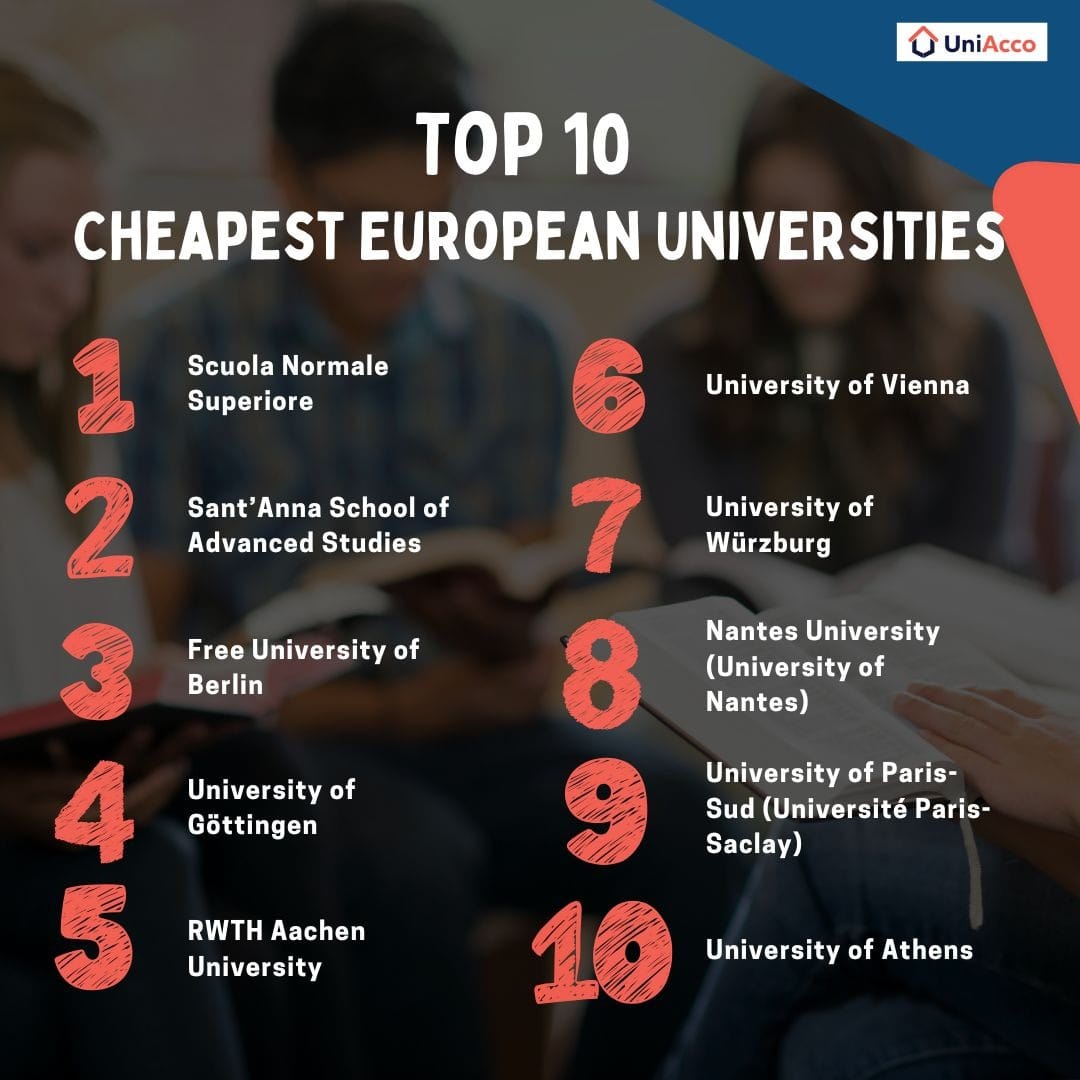
| University Name | Country | Popular Courses | Approx Annual Tuition Fee (for International Students) |
| Scuola Normale Superiore | Italy | B.Sc., UG Diploma, M.Phil, MS in sciences & humanities | UG: No fees PG approx. EUR 260 |
| Sant’Anna School of Advanced Studies | Italy | Master’s in applied & experimental sciences, social sciences, economics, and law. | Specialised Master’s: EUR 7,500 |
| Freie Universität Berlin (FU Berlin) | Germany | Dentistry, Pharmacy, Natural Sciences, Computer Science, Economics, Psychology, Education | UG: No Fees; PG: EUR 0–12,000 |
| University of Göttingen | Germany | Law, Humanities, Natural Sciences, Engineering-related programmes | UG: No Fees; PG: 7,800 |
| RWTH Aachen University | Germany | BE/BTech, BSc, MS, M.Sc., MBA/PGDM in Engineering, Architecture, Data Science, Design | UG: 0-39,000 PG: EUR 11,000–39,000 |
| University of Vienna | Austria | LL.M., MS, M.Sc., MBA/PGDM, UG Diploma across humanities, social sciences, and engineering | UG & PG: EUR 727–13,800 |
| University of Würzburg | Germany | Science, Engineering and IT and Software | UG & PG: No Fees |
| Nantes University (University of Nantes) | France | MS, M.Sc., MA in engineering, science, business and humanities | EUR 243–7,500 first-year tuition depending on programme |
| University of Paris-Sud (Université Paris-Saclay) | France | MS and other PG programmes in STEM and related fields | First-year tuition fees: EUR 250; MS programmes: EUR 236 |
| University of Athens | Greece | MA/MSc/MS in business, economics and related areas | Many graduate programmes: EUR 6,900–12,000 |
Low-cost education works best when your housing is stress-free. Explore fully verified student accommodations and keep your budget under control focus on learning and living your best student life.
🏠 Browse Verified Student HousingWhy Choose a Low-Cost European University?
Affordable degrees without compromising quality: Low-cost European universities deliver strong academic standards at fees often under EUR 3,000 per year. Many of the cheapest universities in Europe still rank within the top 500 globally, offering serious value for money.
A richer student experience for less: Studying at budget-friendly institutions allows access to Europe’s cultural diversity, multilingual campuses, and inexpensive cross-border travel. These benefits make your study abroad experience more holistic without adding financial strain.
Scholarships and fee waivers that truly help: Several governments offer tuition reductions or fully subsidised semesters for international applicants, lowering costs even further for those seeking affordable pathways.
Living costs supporting long-term budgeting: Cities in Central and Eastern Europe often average EUR 600–900 per month, giving students predictable, manageable expenses compared to the UK and the US.
Part-time work aligning with your goals: Many countries permit 20–30 hours of weekly work and paid internships, allowing students to offset costs while gaining European work exposure.
Also Read: Why Study in Europe?
Detailed List of Affordable Universities in Europe for International Students
Scuola Normale Superiore
Scuola Normale Superiore offers an elite academic environment grounded in small cohorts and intensive mentorship. Its fully funded model covers tuition and living expenses, attracting highly driven students worldwide. The university maintains a student-to-faculty ratio of nearly 7 to 1, supporting personalised research growth. Its focus on intellectual rigour and merit-based selection makes it one of the top chosen cheapest universities in Europe, especially for students seeking a strong academic community built around discipline and depth.
Global Rankings:
| Ranking Body | Rank |
| QS WUR Ranking By Subject 2025 | 8 |
| Times Higher Education (THE) 2026 | 137 |
| US News & World Report Best Global Universities | 374 |
Location and Accessibility:
Located at Piazza dei Cavalieri 7, 56126 Pisa, Italy, Scuola Normale Superiore sits in the historic heart of Pisa, within walking distance of major city landmarks and amenities. Its buildings are integrated into the medieval city centre rather than a secluded campus, giving students daily access to city life.
| Popular Places Nearby | Distance (approx) | Travel Time | How to Reach? |
| Leaning Tower of Pisa / Piazza dei Miracoli | ~0.3 miles | ~5–7 min walk | On foot through the historic centre |
| Pisa Centrale Railway Station | ~0.6 miles | ~10–15 min walk | Walk or take the local bus from a nearby stop |
| Galileo Galilei Airport (Pisa Airport) | ~2 km | ~15–25 min | Take bus (e.g. LAM Rossa) or shuttle to the city centre, then walk or local bus to Piazza dei Cavalieri |
Why study at Scuola Normale Superiore?
- Elite tutorial mentorship: Students receive personalised guidance from top Italian scholars right from year one, fostering deep research skills in small groups. This hands-on approach builds critical thinking faster than larger lecture formats. With just 700 total students, it creates unmatched faculty access.
- Full financial support: Selected admits often get tuition waivers plus housing and meal stipends, easing costs completely. This model attracts global talent without financial barriers. Around 76 international students benefit annually from these perks.
- Pisa’s historic inspiration: The campus sits amid Renaissance landmarks, blending daily life with cultural immersion. Walking to classes past medieval architecture sparks creativity. Pisa’s compact size keeps everything walkable and vibrant.
- Research from day one: Undergrads join cutting-edge projects early, gaining publications and networks ahead of peers elsewhere. This accelerates PhD or career paths in the sciences and humanities. The institution’s focus ensures practical outputs over theory.
Sant’Anna School of Advanced Studies
Sant’Anna stands out for its strong emphasis on applied sciences and innovation, supported by competitive scholarships that cover full tuition for top achievers. Around 90% of students participate in interdisciplinary research projects, giving them early exposure to real-world problem-solving. Its tight industry partnerships strengthen employability outcomes. With its subsidised education model, it continues to represent one of the cheapest universities in Europe for students pursuing high-impact scientific fields.
Global Rankings:
| Ranking Body | Rank |
| QS WUR Ranking By Subject 2025 | 251-300 |
| Times Higher Education (THE) 2026 | 201-250 |
Location and Accessibility:
Sant’Anna School of Advanced Studies sits at Piazza Martiri della Libertà 33, 56127 Pisa, Italy. It is located in the historic centre, giving students easy access to cultural sites, cafes, and public transport.
| Popular Places Nearby | Distance (Miles) | Travel Time | How to Reach |
| Piazza dei Miracoli (Leaning Tower of Pisa) | ~0.37 miles | 7–10 minutes | Walk through the old town streets |
| Pisa Centrale Railway Station | ~1 mile | 20 minutes walking or 5–10 minutes by bus | Bus Line 2 or 4, or taxi |
| Galileo Galilei Airport (Pisa Airport) | ~1.24 miles | 15 minutes | Taxi or airport shuttle to the station, then take a bus |
Why study at Sant’Anna School of Advanced Studies?
- Interdisciplinary innovation hubs: Programmes merge engineering, economics, and policy for real-world problem-solving. Students tackle cross-field challenges like sustainability tech. About 20% of 1,900 students are international, enriching discussions.
- Honours college intensity: Top achievers enter a selective system with stipends and no tuition for many tracks. This rewards excellence with tailored challenges. Employment rates exceed 90% post-graduation.
- Pisa’s collaborative ecosystem: Proximity to Scuola Normale fosters joint events and resources in Tuscany’s academic heart. Shared facilities boost networking. The duo makes Pisa a powerhouse for young researchers.
- Practical skills emphasis: Courses prioritise internships and startups over exams, building entrepreneurial mindsets. Graduates launch ventures or join elite firms quickly. This applied edge sets Sant’Anna apart in advanced studies.
Freie Universität Berlin (FU Berlin)
The Freie Universität Berlin blends academic freedom with a tuition-free model for most programs, with students paying only minimal semester fees. Over 20% of its population consists of international students, creating a vibrant multicultural environment. Known for human rights research and social sciences excellence, it offers exceptional library resources and global partnerships. Its public funding structure keeps it among the cheapest universities in Europe while maintaining strong global rankings and research output.
Global Rankings:
| Ranking Body | Rank |
| QS World University Rankings 2026 | 88 |
| Times Higher Education (THE) 2026 | 113 |
| US News & World Report Best Global Universities | 59 |
Location and Accessibility:
FU Berlin is located at Kaiserswerther Straße 16-18, 14195 Berlin, in the leafy district of Dahlem. Its campus is surrounded by gardens, research institutions and public-transport links, creating a peaceful yet well-connected environment.
| Popular Places Nearby | Distance (Miles) | Travel Time | How to Reach |
| Berlin Botanical Garden & Museum | ~1.2 miles | ~5–10 minutes | Walk or use U-Bahn: Freie Universität/Thielplatz → short walk |
| Schlachtensee (lake & Studentendorf) | ~3.5 miles | ~15 minutes by bike or 20–25 min by public transport | U3 or S-Bahn + bus, or cycle through Dahlem woods |
| Berlin city centre (Mitte / Brandenburg Gate) | ~7–8 miles | ~25–35 minutes by U-Bahn / S-Bahn | U3 (Thielplatz → Westkreuz) then transfer to S-Bahn or U-Bahn towards central Berlin |
Why study at the Freie University of Berlin?
- Zero tuition advantage: Most programs here charge no tuition, only a modest semester fee that covers public transport and student services. This makes top-tier education accessible to a wider range of students. With more than 34,000 learners on campus and 21% coming from abroad, the environment feels genuinely global.
- Berlin’s global pulse: The university sits in a city known for its creativity, startups, and political energy, giving students constant cultural exposure. From museums to music nights, learning extends well beyond classrooms. The U-Bahn connects every corner, making daily life fast and seamless.
- Strong liberal arts core: The institution excels in humanities and social sciences, supported by respected faculty and vibrant academic clubs. Multiple English-taught programs help international students settle academically without language barriers. Graduates often move into research, media, public policy, and cultural sectors.
- Vast research networks: Collaborations with Max Planck Institutes and leading European research centres open doors to advanced labs and competitive funding. Even undergraduates often contribute to real research projects early in their studies. This reach, combined with its status among the cheapest universities in Europe, builds a strong foundation for future academic and professional growth.
Also Read: Cost Of Living In Berlin for Students
University of Göttingen
The University of Göttingen offers a rich research legacy supported by state-funded tuition policies that keep annual academic costs extremely low. With more than 30% of its research output coming from international collaborations, students gain early access to high-level academic networks. The campus atmosphere blends tradition with modern facilities, particularly in natural sciences. Its accessible fee structure places it firmly within the cheapest universities in Europe, especially appealing to research-focused learners.
Global Rankings:
| Ranking Body | Rank |
| QS World University Rankings 2026 | 243 |
| Times Higher Education (THE) 2026 | 122 |
| US News & World Report Best Global Universities | 182 |
Location and Accessibility:
The University of Göttingen is located in Göttingen, Lower Saxony, Germany, with its main address at Wilhelmsplatz 1, 37073 Göttingen. The city and university are centrally placed in Germany, making the campus and city easy to reach by train, bus or car.
| Popular Places Nearby | Distance (Miles) | Travel Time | How to Reach |
| Old Botanical Garden of Göttingen University | ~0.6 miles | ~10 minutes walk | Follow the signs to “Alter Botanischer Garten” from the city centre |
| Historic City Centre & Gänseliesel fountain | ~0.7 miles | ~12 minutes walk or 5 minutes by bike | Walk or cycle through cobbled streets from the campus |
| Main Train Station (Göttingen Bahnhof) | ~1.2 miles | ~15 minutes by bus | Bus lines 21, 22 or 23 to “Tammannstraße / Goldschmidtstraße”, then 5 5-minute walk to campus |
| Nearby Lakes & Outdoor Spots (like Kiessee) | ~2.5 miles | ~10–15 minutes by bike or 5–10 minutes by bus | Local bus or bike along the city cycle paths toward the southern outskirts |
Why study at the University of Göttingen?
- Compact campus-city life: Everything sits within a walkable academic town where labs, libraries, cafés, and study spaces stay closely connected. Well-marked bike routes link the university’s historic buildings with its modern research centres, keeping daily life simple and stress-free. The community feels vibrant, with more than 4,500 international students from 130 countries studying alongside 31,000 local students.
- Nobel legacy inspiration: With 45 Nobel-affiliated scholars in its history, the university offers an atmosphere shaped by scientific breakthroughs and intellectual rigour. Students often attend guest lectures and seminars led by globally recognised researchers. This environment nurtures curiosity and pushes learners to aim higher in their fields.
- Broad subject flexibility: Students can shift between programs in sciences, humanities, social sciences, or law with minimal procedural hurdles. Academic advisors support these transitions, helping students explore new interests without losing progress. This flexibility is ideal for those refining their long-term academic or career direction.
- Supportive international office: Dedicated teams assist with visas, housing guidance, language classes, and integration activities, making the transition smoother for newcomers. Buddy programmes and cultural events help students build friendships quickly. The low-fee structure strengthens its appeal among universities with low tuition fees for international students in Europe, adding real value to the overall experience.
Low-cost education works best when your housing is equally stress-free. Explore fully verified student accommodations with UniAcco and keep your overall budget truly in check — so you can focus on studying, not spending.
🏠 Explore Verified Student Housing with UniAccoRWTH Aachen University
RWTH Aachen is known for engineering and technology programs that consistently rank among Europe’s strongest. Students pay low administrative fees while accessing advanced labs and industry-linked research centres. Over 50% of engineering graduates secure internships with leading firms in Germany’s industrial hub. The university’s strong integration of theory and practical application, combined with its low-cost structure, positions it as a leading option among the cheapest universities in Europe for technical disciplines.
Global Rankings:
| Ranking Body | Rank |
| QS World University Rankings 2026 | 105 |
| Times Higher Education (THE) 2026 | 92 |
| US News & World Report Best Global Universities | 225 |
Location and Accessibility:
RWTH Aachen University is located in the northwestern city of Aachen, Germany. Its main campus buildings are spread across Midtown and the Melaten district.
| Popular Places Nearby | Distance (Miles) | Travel Time | How to Reach |
| Aachen Central Station (Hauptbahnhof) | ~1.2 miles | ~20 minutes by bus | Bus lines 3A or 3B from the station to Halifaxstraße or a nearby stop, then a short walk. |
| Aachen West Railway Station | ~1.5 miles | ~6–10 minutes by bus or 15–20 min by suburban train + bus | From Westbahnhof, take bus lines 33 or 73 to Halifaxstraße or use short local trains, then the bus |
| City centre / Aachen Old Town (shops, cafés) | ~0.6–1.0 miles | ~10–15 minutes by bus or bicycle | Bus or bike easily from most campus points; the city is compact and accessible |
Why study at RWTH Aachen University?
- Engineering industry gateway: Co-op programs and industry fairs create direct recruitment pathways to major employers like Siemens and Bosch, often resulting in offers before graduation. Its border location enhances access to wider EU job markets. With over 47,000 students, the ecosystem thrives as one of Europe’s strongest engineering hubs.
- Hands-on maker spaces: State-of-the-art labs allow students to build and test projects from their first semester, covering robotics, materials science, and automation. Facilities such as cleanrooms and rapid-prototyping studios operate around the clock. The emphasis remains firmly on applied engineering rather than theory alone.
- Multilingual programme variety: More than 180 English-taught programs support a truly international student mix, while German-language immersion is available for those aiming at local industry roles. Academic mentors help bridge language or technical gaps. The flexibility draws high-achieving STEM students from across the world.
- Sustainable campus design: Energy-efficient buildings, carbon-reduction projects, and student-led environmental groups reflect the university’s commitment to sustainability. Learners gain exposure to real-world green engineering challenges. As one of the cheapest universities in Europe, RWTH pairs affordability with cutting-edge innovation.
The University of Vienna
The University of Vienna pairs centuries-old academic tradition with accessible tuition fees for international students. More than 180 programs allow learners to explore diverse fields, supported by a research output exceeding 7,000 publications annually. The city’s relatively moderate living costs enhance the overall affordability. This combination of cultural richness, academic breadth, and financial accessibility places the university among the cheap universities in Europe, especially for those drawn to the humanities and social sciences.
Global Rankings:
| Ranking Body | Rank |
| QS World University Rankings 2026 | 152 |
| Times Higher Education (THE) 2026 | 95 |
| US News & World Report Best Global Universities | 212 |
Location and Accessibility:
The University of Vienna is located at Universitätsring 1, 1010 Vienna, Austria. Set in the city’s historic first district, it sits among grand boulevards, museums, and political landmarks, giving students immediate access to Vienna’s cultural core.
| Popular Places Nearby | Distance in Miles | Travel Time | How to Reach |
| Vienna City Hall (Rathaus) | ~0.2 miles | 3–5 minutes | Walk across Rathausplatz |
| Hofburg Imperial Palace | ~0.4 miles | 8–10 minutes | Walk or take Tram D |
| MuseumsQuartier | ~0.7 miles | 12–15 minutes | Walk or take the U2 metro to Museumsquartier |
| St. Stephen’s Cathedral | ~0.6 miles | 10–12 minutes | Walk or take the U1 metro to Stephansplatz |
| Wien Mitte Station (main transit hub) | ~1.2 miles | 10–15 minutes | Metro U3 from Volkstheater or U2/U4 connections |
Why study at the University of Vienna?
- Historic yet modern facilities: Founded in the 14th century, the University of Vienna blends heritage with state-of-the-art libraries and research spaces in the heart of the city. Students move easily between campuses using Vienna’s efficient tram network, surrounded by cafés and academic hubs. With nearly 33% of its 90,000 students coming from abroad, the environment feels both global and welcoming.
- Humanities and social sciences strength: The university is internationally recognised for philosophy, cultural studies, and political thought, attracting scholars and visiting EU policymakers for specialised lectures. Debate forums and research groups offer space to refine ideas and challenge perspectives. It remains a training ground for influential thinkers across Europe
. - Unmatched cultural access: Students enjoy discounted entry to iconic institutions like the Vienna State Opera, Albertina, and dozens of museums, allowing cultural immersion beyond the classroom. Daily life is enriched by views of the Ringstrasse and historic districts. The city’s artistic energy naturally complements academic growth.
- Flexible academic pathways: A versatile credit system allows students to combine courses across faculties, making it ideal for double majors or interdisciplinary study. This freedom encourages exploration without strict program boundaries. Its affordability continues to attract diverse international applicants, reinforcing its place among the cheapest universities in Europe.
University of Würzburg
The University of Würzburg in Germany delivers high-quality education at minimal cost, with its public funding model and modest semester fees for international students. It offers strong programs in medicine, natural sciences, and humanities, supported by historic campuses and modern research facilities. Around 22% of its international student cohort enriches the campus with global perspectives. While living costs remain reasonable compared to many European cities, the low tuition helps international students stretch their budgets.
Global Rankings:
| Ranking Body | Rank |
| QS World University Rankings 2026 | 416 |
| Times Higher Education (THE) 2026 | 179 |
| US News & World Report Best Global Universities | 221 |
Location and Accessibility:
The University of Würzburg is located at Sanderring 2, 97070 Würzburg, Germany. Its main facilities span across different campuses, especially the central Sanderring campus and the larger hub campus area (Hubland), offering a blend of historic buildings and modern university infrastructure.
| Popular Places Nearby | Distance (Miles) | Travel Time | How to Reach |
| Würzburg Main Station (rail hub, city transport) | ~1.2 miles (≈ 2 km) | ~5–10 min by tram or bus | Use tram lines 1, 3, 4 or 5 to “Sanderring” or “Uni-Hbf West” stop |
| Historic city centre & Old Town (shops, cafés, Old Main Bridge) | ~1–1.5 miles (≈ 1.5–2.5 km) | 10–15 min by tram/bus or ~20 min bicycle | Tram/bus to Sanderring + short walk, or bike downtown |
| Hubland Campus (main university campus) | ~2–3 miles (≈ 3–5 km) | ~15–20 min by bus | Bus lines 14, 114 or 214 from Hauptbahnhof/ZOB to “Campusbrücke” or “Hubland TGZ” stop |
| University Hospital / Medical Faculty areas | ~1–2 miles | ~10–15 min by public transport or taxi | Tram line 5 or local bus to “Uni-Klinikum / Bereich D” stop |
| Recreational areas along Main River & green zones | ~1–2 miles | 10–15 min by tram/bus or bike | From city centre, walk or cycle; public transport widely available |
Why study at the University of Würzburg?
- A leading German research hub: The University of Würzburg is known for its strengths in medicine, natural sciences, and innovation-driven research. Students benefit from modern facilities, active research groups, and opportunities to contribute to projects early in their studies.
- Low-cost education: As a public institution, the university does not charge tuition fees. Students only pay a small semester contribution of around EUR 150, making it an accessible choice for budget-conscious international applicants. Several master’s programmes are also offered in English.
- Historic yet modern atmosphere: Set near the famous Würzburg Residenz, the campus blends classical architecture with contemporary labs and libraries. The city’s cultural heritage, green spaces, and relaxed lifestyle add to the overall student experience.
- Strong career pathways: Close ties with industries, especially in healthcare, technology, and biotech, provide practical training, internships, and solid employment prospects. Companies like Siemens Healthineers and regional tech firms frequently collaborate with the university, supporting a smooth transition from study to career.
Nantes University
Nantes University offers one of France’s most accessible tuition structures at just a few hundred euros per year, supported by a thriving research ecosystem with over forty accredited laboratories. International students benefit from exchange agreements and project-based learning. The university’s balanced mix of affordability, innovation, and supportive learning culture places it among the cheapest universities in Europe, especially for multidisciplinary study paths.
Global Rankings:
| Ranking Body | Rank |
| QS World University Rankings 2026 | 851-900 |
| Times Higher Education (THE) 2026 | 601-800 |
| US News & World Report Best Global Universities | 445 |
Location and Accessibility:
Nantes Université’s main address is 1 Quai de Tourville, 44035 Nantes, France. Its various campuses are spread across the city along the Erdre River, blending academic buildings with urban living.
| Popular Places Nearby | Distance (Miles) | Travel Time | How to Reach |
| Château des Ducs de Bretagne (historic castle) | ~0.8 miles | ~15–20 min walk or 5–10 min by tram/bus | Walk or take tram/bus to the central station, then walk 5 min |
| Jules Verne Museum | ~1.0 mile | ~20–25 min | Public transport or city tram + short walk |
| Old Town / Riverside area (historic centre, Loire riverbank) | ~0.7 miles | ~15 min walk or 7 min by bike/tram | Walk, bike, or use city tram/bus from campus |
Why study at Nantes University?
- One-stop welcome service: Nantes simplifies the entire arrival process through its Guichet Unique, where international students can complete visa, residence, health, and housing formalities in just a few days. This streamlined system removes the stress of navigating multiple offices and helps more than 4,200 international students settle smoothly every year.
- Western France balance: The region’s mild climate and nearby Atlantic beaches offer a refreshing break from academic routines, giving students a healthy study-life balance. With the TGV connecting Nantes to Paris in around two hours, cultural trips, internships, and networking opportunities remain easily accessible. This overall liveability supports better focus and well-being.
- Diverse faculty mix: Nantes brings together students and professors from over 140 nationalities, creating a globally enriched academic environment. Courses blend engineering, arts, sciences, and humanities, encouraging cross-disciplinary thinking. Group projects mirror real workplace collaboration, preparing students for multicultural careers.
- Innovation incubators: Entrepreneurial students benefit from on-campus incubators offering grants, workshops, and mentorship for early-stage ventures. The support system accelerates idea development into viable projects. As one of the cheapest universities in Europe, Nantes enables students to innovate without heavy financial pressure.
University of Paris-Sud
The University of Paris-Sud is recognised for excellence in mathematics, physics, and life sciences, contributing significantly to France’s Nobel Prize legacy. Annual tuition remains remarkably low due to government subsidies, while research facilities rank among Europe’s strongest. Over 30% of postgraduate students join funded research teams. Its blend of rigorous scientific training, accessible fees, and extensive research opportunities secures its reputation as one of the cheapest universities in Europe for science-driven learners.
Global Rankings:
| Ranking Body | Rank |
| QS World University Rankings 2026 | 70 |
| Times Higher Education (THE) 2026 | 68 |
| US News & World Report Best Global Universities | 78 |
Location and Accessibility:
University of Paris-Sud is located at 15 Rue Georges Clemenceau, 91400 Orsay, France, in the southern suburbs of Paris, within the broader Université Paris‑Saclay network.
| Popular Places Nearby | Distance (Miles) | Travel Time | How to Reach |
| Orsay-Ville RER Station | ~0.6 miles | ~10–13 min walk | Walk from the station through campus paths |
| Parc botanique de Launay (campus botanical garden) | ~0.2 miles | ~4–6 min walk | Walk from the central campus entrance |
| Central Paris (Châtelet–Les Halles) | ~15 miles | ~35–50 min by RER B | RER B (direction Saint-Rémy-lès-Chevreuse / Orsay-Ville) then walk/bus to campus |
Why study at the University of Paris-Sud?
- STEM global leadership: The university excels in physics and mathematics, consistently ranking among the strongest programs worldwide. Students gain access to research pathways connected to CERN, giving them exposure to real experimental work. Its diverse campus also stands out, with international students making up nearly 25% of the 32,800-student community.
- Bilingual track abundance: With more than 120 French-English program options, the university supports smooth academic transitions for students from different educational systems. The convenient RER connection to major Paris laboratories allows easy access to research environments. This flexibility makes it an appealing choice for students seeking both linguistic support and academic depth.
- Saclay Plateau resources: Located on the Saclay innovation hub, the university benefits from one of Europe’s largest research clusters. Students gain internship opportunities at top institutes and industry labs right on the plateau. This ecosystem encourages collaboration and helps students accelerate their academic and career growth.
University of Athens
The University of Athens offers low tuition fees supported by Greece’s public education framework, making it highly attractive for budget-conscious international students. It is particularly strong in fields like philosophy, archaeology, and Mediterranean studies, with over 15% of its enrolment coming from abroad. The combination of cultural depth, academic heritage, and affordability places Athens comfortably within the cheapest universities in Europe, especially for humanities enthusiasts.
Global Rankings:
| Ranking Body | Rank |
| QS World University Rankings 2026 | 355 |
| Times Higher Education (THE) 2026 | 801-1000 |
| US News & World Report Best Global Universities | 216 |
Location and Accessibility:
The University of Athens is located at 30 Panepistimiou (Eleftheriou Venizelou) Avenue, 106 79 Athens, Greece. It occupies a historic neoclassical building right in the city centre, making cultural sites, transport, and daily amenities easily reachable.
| Popular Places Nearby | Distance (Miles) | Travel Time | How to Reach |
| Academy of Athens / National Library of Greece | ~0.1 miles | ~2–3 min walk | Walk along Panepistimou Street |
| Plaka (old city quarter) / Monastiraki / Psiri neighbourhood | ~0.4–0.6 miles | 8–12 min walk or 5 min by metro/bus | Walk or metro from nearby stations |
| Acropolis / Acropolis Museum | ~1 mile | ~15–20 min by metro + walk | Metro + short walk from the city centre |
Why study at the University of Athens?
- Mediterranean academic vibe: Lectures unfold within sight of the Acropolis, creating a rare blend of classical heritage and contemporary scholarship. Students move easily between ancient landmarks and modern classrooms thanks to strong metro connectivity. The campus atmosphere feels culturally rich without being overwhelming.
- English postgraduate surge: With more than 140 English-taught master’s programs across law, sciences, and humanities, the university welcomes students who don’t speak Greek. Growing bilateral exchange agreements make semester mobility smoother. The rising number of international applicants reflects its increasing global accessibility.
- Vibrant student unions: Student groups shape the social pulse of campus through festivals, debates, and activism. Sunny courtyards become hubs for community building and leadership development. It’s a place where friendships and ideas grow naturally alongside academics.
- Affordable capital access: Athens remains one of Europe’s more budget-friendly capitals, with modest rents and inexpensive local dining. Public universities keep higher education accessible regardless of background. The city’s mix of culture and affordability gives students the chance to explore widely without stretching their finances.
Also Read: 10 Easiest Universities To Get Into In Europe
Pros & Cons of Low‑Fee European Universities
| Pros | Cons |
| Tuition often €500–€3,000 per year, saving up to 70% vs UK/US universities | Limited English-taught programs. Local language know-how may be required |
| History, museums, art, and easy travel enhance global awareness | Smaller universities may lack sports facilities, dorms, or extracurricular options |
| Central/Eastern European cities average €600–€900/month | High-cost cities like Northern/Western Europe (Oslo, Copenhagen, Zurich) can offset low tuition benefits |
| 20–30% international students for networking | Administrative & visa processes can be complex and time-consuming |
| Merit-based or government grants often cover tuition and sometimes living expenses | Local language adjustment is needed for daily life, bureaucracy, and social integration |
| Up to 20 hours/week allowed, enhancing employability | Smaller or newer universities may have limited alumni networks |
Admission & Eligibility for International Students to Study in Europe
- Academic Credentials
Most low-cost European universities accept students with a recognised secondary school certificate for bachelor’s entry or a completed bachelor’s degree for postgraduate programmes. Institutions review transcripts, subject prerequisites, and overall academic consistency. With 72% of public universities using centralised application systems, early submission increases your chances at the cheapest universities in Europe.
- Language Proficiency
Applicants usually need IELTS, TOEFL, or PTE scores for English-taught programmes. Countries like Germany, France, and Austria may also require local-language proficiency for specific courses. Around 36% of European bachelor’s degrees are now fully English-taught, and some universities offer conditional admission with pre-sessional language courses.
- Visa and Permit Requirements
A long-term study visa requires proof of admission, financial documents, and health insurance. Countries set minimum annual funds, for eg, Germany’s benchmark sits at roughly EUR 11,000. Processing often takes 4–12 weeks, so early preparation is essential.
- Scholarship and Financial Aid
Students can apply for government, university, and country-specific scholarships that reduce tuition or living costs. Some require separate applications with essays or recommendations, while others are automatic. Nearly 30% of applicants miss funding due to late submissions, making early research important.
- Required Documents
Typical submissions include transcripts, passport copies, language scores, letters of recommendation, a statement of purpose, and financial proof. Certain programmes may request portfolios or entrance exams. Deadlines differ across countries, with many universities closing applications between January and April for autumn intake.
- Proof of Funds and Living Costs
Students must show financial capacity for tuition and living expenses. Nordic countries often have higher annual cost requirements, while Central and Eastern Europe remain more affordable. Clear, verifiable financial documents help avoid delays in visa approvals.
- Health Insurance Requirements
Most destinations ask students to secure national or private health insurance before enrolment. Countries like Germany, Austria, and the Netherlands have strict coverage rules, so selecting the right plan is essential.
- Accommodation Confirmation
Some visa applications require proof of housing through a dorm confirmation or rental agreement. Since university housing fills quickly, early booking supports smoother visa processing and an easier arrival.
Check out this Reddit discussion for real-life experiences and tips from students navigating admissions in Europe:
I desperately want to study in Europe but I’m… – r/studyAbroad from r/studyAbroad
How to Choose the Right Affordable University in Europe?
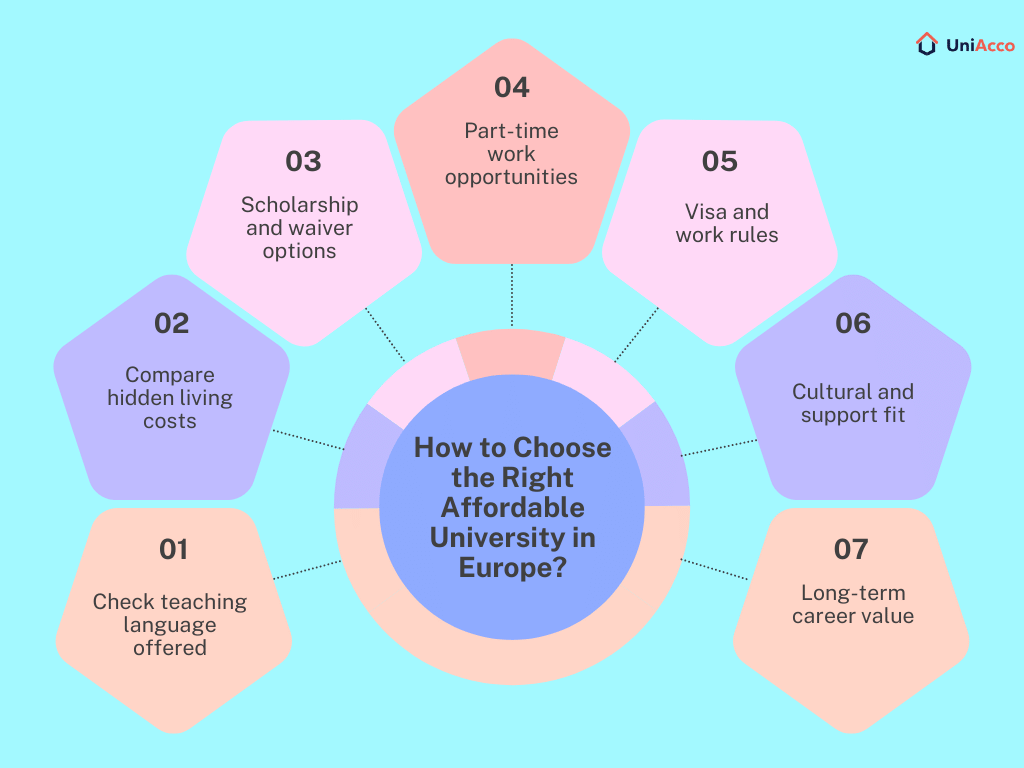
- Choose a Language of Instruction You Can Handle
Ensure your program is taught in English or a language you’re comfortable with. About one-third of European bachelor’s programs are fully in English. Picking the right language reduces the need for extra courses and makes learning smoother.
- Factor in Hidden Costs Alongside Tuition
Don’t just look at low tuition fees. Consider living costs, including rent, food, transport, and utilities. Monthly expenses typically range from €800–€1,200. Early budgeting prevents financial surprises.
- Prioritise Universities with Scholarships and Waivers
Look for merit-based or government-supported funding. Some programs cover partial or full tuition and, occasionally, living costs. Scholarships can make an already affordable university even cheaper.
- Leverage Part-Time Work and Internship Opportunities
Most countries allow students to work 16–20 hours per week. Internships not only help cover living expenses but also boost employability after graduation.
- Understand Visa Rules and Work Permits
Check student visa requirements and part-time work regulations in your chosen country. Knowing the rules upfront helps avoid compliance issues and ensures realistic budget planning.
Also Read: Schengen Visa 101: Your Gateway to Exploring Europe
- Assess Cultural Fit and Student Support Services
Consider the country’s climate, lifestyle, and cultural norms. Evaluate student support services like housing assistance, counselling, and orientation programs to ensure smooth adaptation.
- Evaluate Long-Term Value and Career Opportunities
Check the university’s reputation, industry links, and alumni network. Combining low tuition with strong employability maximises the overall return on your education.
Cost of Living & Hidden Expenses to Watch Out For
Studying at the cheapest universities in Europe often means low tuition, but living expenses can quickly add up. International students need to budget carefully for accommodation, food, transport, health insurance, and other hidden costs. Here’s a breakdown of the main areas to consider.
Student Accommodation
Even at universities with low tuition fees for international students in Europe, rent can be one of the highest monthly costs. Choosing the right type of housing can significantly reduce expenses.
| Type of Accommodation | Description | Average Monthly Cost (EUR) |
| Student Dormitory / University Housing | On-campus or university-managed halls, often shared rooms or small studios | 250–500 |
| Shared Flat / Apartment | Renting a room in an apartment shared with other students | 300–600 |
| Private Studio / One-Bedroom Apartment | Independent apartment with own kitchen and bathroom | 500–900 |
| Homestay / Host Family | Living with a local family, meals sometimes included | 350–650 |
| Short-Term Rentals / Sublets | Temporary contracts for few months, often furnished | 400–700 |
Food, Transport, Books, Health Insurance
Monthly groceries typically cost €150–€250 if cooking at home. Public transport ranges between €30–€100 per month, depending on the city, and books or printing can add another €20–50. Health insurance is mandatory in most countries, adding roughly €50–€100 monthly. Together, these essential costs can often match or exceed accommodation expenses.
Travel & Visa Expenses
One-time expenses such as visa fees, airport transfers, and occasional trips home or around Europe can range from €200–€600. Planning these early avoids surprises and helps students manage budgets efficiently.
Miscellaneous Expenses
Students should also account for leisure, clothing, mobile/internet bills, and optional language courses. Small monthly costs of €50–€150 can accumulate over a semester or year if not tracked.
Utilities & Seasonal Costs
Some cities, particularly in Northern or Central Europe, have higher heating and electricity costs during winter. Students should budget an extra €50–€150 per month for utilities if not included in rent to avoid unexpected charges.
For firsthand insights into expenses and lifestyle costs, check out this Quora thread where international students share their experiences:

Conclusion
Affordability meets quality at the cheapest universities in Europe. Institutions like the University of Göttingen, Freie Universität Berlin, and Nord University offer minimal or zero tuition fees, letting students prioritise learning, experience, and career-building over finances. Beyond fees, success comes from weighing living costs, program relevance, and long-term goals.
Pairing these choices with UniAcco’s verified, utility-inclusive student accommodation options ensures predictable costs, comfortable living, and easy access to campus life, allowing international students to fully embrace their educational journey without financial distractions.


 LinkedIn







0 Comments