

The United Kingdom offers a unique combination of tradition, innovation, and global recognition for aspiring veterinarians worldwide. Its leading vet schools provide state-of-the-art labs, on-campus animal hospitals, and immersive clinical training programs. Degrees such as BVetMed and BVM&S, endorsed by the RCVS, allow graduates to practice internationally, giving them a significant career edge.
With applications from international students rising over 20%, competition is fierce, making informed choices crucial. This blog highlights the top 10 vet schools in the UK for 2026, covering entry requirements, degree offerings, and the practical experiences that set these institutions apart for students aiming to excel in veterinary medicine.
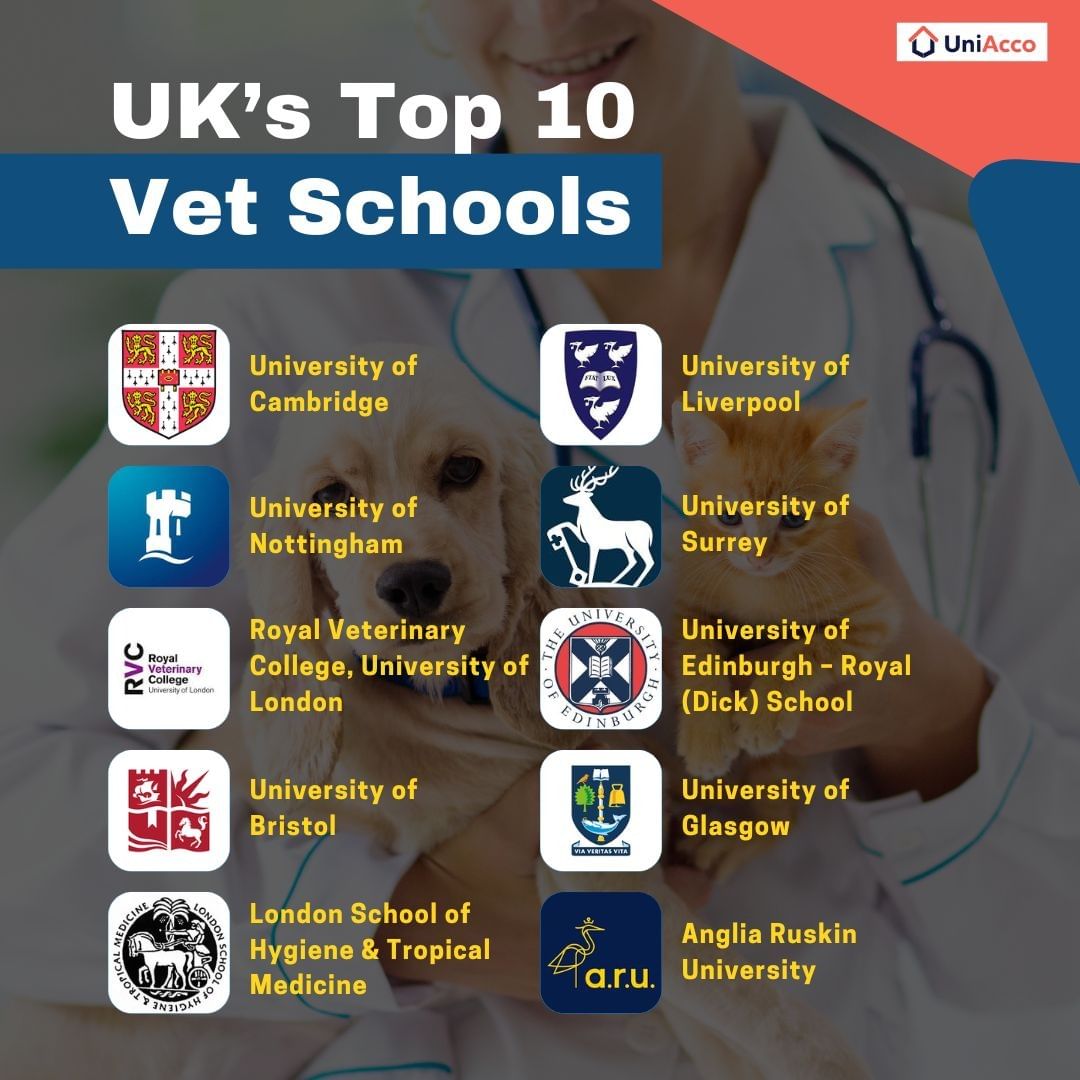
Top 10 Veterinary Schools in the UK: At a Glance
| School | Location | Degree Offered | Typical Entry Requirements |
| University of Cambridge | Cambridge, England | VetMB (6 years) | A*AA at A-level including Chemistry + one of Biology/Physics/Maths |
| University of Liverpool | Liverpool / Leahurst, England | BVSc Veterinary Science (5 yrs) | A-levels: Biology & Chemistry required; IB 36 points (HL Biology & Chemistry grade 6) |
| University of Nottingham | Nottingham, England | BVetMedSci / BVMBVS (5 yrs) | AAB, including A in Biology and Chemistry and a B in a third subject. A minimum of five GCSEs at grade A (level 7), including Chemistry and Biology (or Double Science), with at least a B (level 6) in Maths and a C (level 4) in English Language. |
| University of Surrey | Guildford, England | BVMSci Veterinary Medicine & Science (5 yrs) | Entry: AAA at A-level (including Chemistry & Biology/Physics/Maths) |
| Royal Veterinary College (RVC, University of London) | London & Hertfordshire, England | BVetMed (Hons) (5 yrs) | Entry grades not explicitly cited in retrieved pages |
| University of Edinburgh – Royal (Dick) School | Edinburgh, Scotland | BVM&S (5 yrs) | AAA grades including Chemistry, Biology, and one other approved science subject. BTEC National Extended Certificate in Applied Human Biology at grade D is accepted in place of A-Level Biology. Critical Thinking is not accepted for this degree. |
| University of Bristol | Bristol / Langford, England | BVSc Veterinary Science (5 yrs) | A-levels: ABB including Chemistry + one of Biology/Physics/Mathematics (per their page) |
| University of Glasgow | Glasgow, Scotland | BVMS (5 yrs) | A-levels: AAA including Biology & Chemistry (minimum) |
| London School of Hygiene & Tropical Medicine | London, England | MSc Veterinary Epidemiology (1 year) | A-levels: AAA including Biology & Chemistry (minimum); plus A-level Mathematics or Statistics desirable for numeracy skills. A first- or second-class university degree in relevant subjects, or an equivalent, is required. |
| Anglia Ruskin University | England | BSc (Hons) Animal Science | A-Level qualifications with grades around BBB to CCC, depending on specific course requirements, or equivalent qualifications such as BTEC Extended Diploma with relevant grades. |
Why Study Veterinary Medicine in the UK?
1. Globally Recognised Degrees:
UK veterinary programmes are accredited by the Royal College of Veterinary Surgeons (RCVS), allowing graduates to practise not only in the UK but also in countries such as Australia, New Zealand, Singapore, South Africa, and parts of North America. This makes vet schools in the UK a top choice for students aiming for international mobility.
2. Hands-On Clinical Training from Year One:
Most veterinary universities in the UK integrate early clinical exposure, with students spending time in teaching hospitals, diagnostic labs, animal shelters, and farm facilities. On average, UK vet students complete 38–42 weeks of EMS (Extra-Mural Studies), providing one of the most practical training models in the world.
3. Strong Employability & Career Outcomes:
According to the UK’s Graduate Outcomes data, over 95% of veterinary graduates secure employment or further study within 15 months. Many enter companion-animal practice, equine care, public health, or research roles, with growing demand across both the UK and global markets.
4. Cutting-Edge Research & Innovation:
Veterinary schools in the UK are globally known for research in zoonotic diseases, animal welfare, antimicrobial resistance, and food security. Institutions like Edinburgh, RVC, and Glasgow rank among the world’s top research centres, offering students access to multi-million-pound laboratories and research farms.
5. Diverse, Multicultural Learning Environment:
UK vet programmes attract students from 100+ countries, with a consistent rise in Indian student enrolments over the past five years. Collaborative projects, international placements, and culturally diverse peer groups foster a global learning environment ideal for future veterinarians.
As you plan your veterinary studies in the UK, securing comfortable accommodation early can make your move way smoother. UniAcco lets you compare trusted student housing near major university cities—quick, simple, and hassle-free.
📍 Explore Student AccommodationA Detailed Look at the Top 10 Veterinary Universities in the UK
1. University of Cambridge
The University of Cambridge offers a six-year VetMB programme and is consistently ranked among the top veterinary schools in the UK due to its blend of rigorous science education, personalised teaching, and clinical excellence.
Why Study Veterinary Medicine at the University of Cambridge?
- Highly Selective and Intimate Cohort – Only 70–75 students are admitted annually, ensuring personalised learning and close mentorship from leading veterinary academics.
- Hands-On Clinical Experience from Day One – Access to a 24-hour Clinical Skills Centre, simulators, and live animal handling prepares students for real-world veterinary practice early.
- Integrated Academic Flexibility – Students earn a BA in Year 3, with options to specialise in biological sciences or explore alternative disciplines alongside veterinary studies.
- Financial Support for Clinical Placements – Cambridge offers £150 termly grants during External Clinical Studies (EMS), supporting students throughout demanding placements.
- State-of-the-Art Veterinary Facilities – Includes small-animal theatres, MRI for equine cases, and a linear accelerator for oncology, giving students exposure to advanced clinical treatments.
What You’ll Study
| Years 1–3 (Preclinical) | Core scientific foundations: anatomy (120 hours of dissection), physiology, biochemistry, molecular biology. Student-led supervision in small groups for hands-on learning. |
| Year 3 (Tripos) | Complete a Cambridge BA in a subject of choice (e.g., biology, management) to broaden academic depth and perspective. |
| Years 4–6 (Clinical) | Rotations in small animal, farm animal, equine medicine & surgery, diagnostic imaging, public health, and emergency care. |
| Extra-Mural Studies (EMS) | Minimum 26 weeks of external clinical placements in first-opinion and specialist practices, fully supported by the university. |
| Final Year Project (Elective) | 8-week research or clinical project tailored to student interests, plus case-based rotations in clinics. |
Cost of Studying
| Fee Type | Home Students (UK) | International Students |
| Tuition Fee (VetMB) | £9,250/year | £67,194/year (fixed for course duration) |
Lab coats, protective overalls, and basic equipment typically cost £150–£300 per year, with some universities offering limited support. Students may also spend £2,000–£2,500 on travel and accommodation for EMS placements over the full duration of the course.
2. University of Liverpool – School of Veterinary Science
As one of the oldest and most respected veterinary schools in the UK, Liverpool’s School of Veterinary Science has built a reputation for excellence over its 120-year history. It consistently ranks among the top veterinary schools in the UK, thanks to its cutting-edge research, world-class clinical facilities, and a curriculum designed to train vets ready for modern global challenges.
Why Study Veterinary Medicine at the University of Liverpool – School of Veterinary Science?
- Top-Ranked Research Excellence – Ranked 1st in REF 2021 (Agriculture, Food & Veterinary Sciences) for 4* research quality, reflecting cutting-edge veterinary scholarship.
- Global Accreditation – Fully accredited by RCVS, AVMA, EAEVE, and other key veterinary bodies, enabling international recognition of your degree.
- Extensive Clinical Training Facilities – Two referral hospitals, teaching farms (beef, dairy, pigs, sheep), and a small-animal teaching clinic provide hands-on experience across species.
- International Outreach & Collaboration – Liverpool actively partners globally, including helping establish a veterinary college in Sharjah, UAE, reflecting strong global ambitions.
- State-of-the-Art City-Centre Teaching Hub – Opened in 2023, offering advanced digital classrooms and clinical training spaces for modern, practical learning.
What You’ll Study
| Years 1–3 (Liverpool Campus) | Core foundations: anatomy, physiology, animal welfare, infectious disease, public health, and professional skills. |
| Year 3 Project | Research project exploring a veterinary science topic of interest; develops analytical and scientific skills. |
| Years 4–5 (Leahurst Campus) | Clinical rotations in small animals, production animals, equine, and exotic species. |
| Elective / Intercalation (Year 5) | Option for a 3-week elective, intercalated degree (e.g., research), or study abroad at partner schools in the USA or Europe. |
| Professional Skills Training | Client communication, business management, and clinical techniques (suturing, injections, lab diagnostics) via simulations and real-life practice from day one. |
Cost of Studying
| Fee Type | UK / Home Students | International Students |
| Tuition (BVSc) | £9,535 / year | £44,850 / year |
Beyond tuition, students should also consider EMS (Extra-Mural Studies) costs, as Liverpool’s course requires 38 weeks of EMS over five years. The university’s own guidance notes that students may spend £2,000–£2,500 cumulatively on travel and accommodation for these placements.
3. University of Nottingham
Ranked consistently among the most innovative vet schools in the UK, the University of Nottingham’s School of Veterinary Medicine & Science is known for its modern curriculum, strong student satisfaction scores, and evidence-based teaching. As one of the newest veterinary schools the UK has established, it has quickly risen in global rankings due to its practical learning model, award-winning facilities, and strong graduate outcomes.
Why Study Veterinary Medicine at the University of Nottingham
- Exceptional Student Satisfaction – First UK vet school to repeatedly achieve 100% satisfaction in the National Student Survey (NSS).
- Integrated Teaching Approach – Combines theory, lab work, clinical rotations, and real-world case exposure from the earliest years.
- Specialist Facilities Access – Includes the Centre for Dairy Science Innovation and Nottingham Veterinary Tissue Bank for practical, advanced learning.
- Strong Graduate Employability – 95–98% of graduates secure employment within months, reflecting excellent career outcomes.
- Hands-On EMS Partnerships – Collaborates with commercial farms, equine centres, and industry research bodies to ensure practical, workplace-ready experience.
What You’ll Study
| BVetMed / 5-Year Structure | Divided into Animal Health & Disease, Clinical Practice, and Professional Skills pathways. |
| Pre-Clinical Modules | Physiology, microbiology, pathology, epidemiology, animal handling, welfare science, and food safety. |
| Clinical Modules | Small animal medicine, farm animal health, equine practice, surgery, imaging, anaesthesia, and clinical reasoning. |
| Extra-Mural Studies (EMS) | Mandatory 38+ weeks: Pre-Clinical EMS (farm, equine, small animal handling) and Clinical EMS (practices, hospitals, research centres). |
| Final-Year Rotations | Hands-on rotations in small animal hospitals, equine clinics, farm practices, and diagnostic centres to ensure practice-ready graduates. |
Cost of Studying
| Fee Type | UK / Home Students | International Students |
| Undergraduate BVMBVS + BVMedSci | ~ £9,535 per year | ~ £33,250 per year |
| Postgraduate Research (DVetMed / DVetSurg – PhD) | £5,006 | £28,200 for low-cost research projects; up to £44,000 for specialised lab-intensive projects. |
At the University of Nottingham, students budget around £300 for essential kit such as boiler suits, waterproofs, scrubs, and a stethoscope. During EMS placements, students may also incur travel and accommodation costs depending on their host location; Nottingham provides a £300 travel allowance for shared placement transport.
4. University of Surrey
Among the UK’s leading vet schools, the University of Surrey stands out for its modern, hands-on curriculum and state-of-the-art facilities. As one of the newer veterinary medicine institutions, Surrey blends scientific rigour with clinical realism, preparing students not just for veterinary medicine in the UK, but for a global veterinary career.
Why Study Veterinary Medicine at the University of Surrey?
- RCVS & EAEVE Accredited – Graduates can register as veterinary surgeons in the UK and Europe.
- Top-Ranked School – 4th in the UK for veterinary medicine (Complete University Guide 2026) and 4th for student satisfaction (NSS 2025).
- Outstanding Graduate Outcomes – 100% of veterinary medicine and science graduates secure employment or further study (HESA 2025).
- State-of-the-Art Facilities – Includes a Clinical Skills Centre, Pathology Centre, and Innovation-for-Health labs for hands-on practical learning.
- Focused Student Experience – Small class sizes ensure personalised teaching and closer engagement with faculty and clinical cases.
What You’ll Study:
| Year 1 | Fundamentals, anatomy, physiology, cells & genes, animal husbandry, professional skills. |
| Year 2 | Epidemiology, infectious disease, pathology; practical sessions at external sites (e.g., Surrey Wildlife Trust, Merrist Wood). |
| Year 3 | Clinical medicine & surgery, diagnostics, pharmacology, evidence-based veterinary medicine, research, and critical appraisal. |
| Year 4 | Species-based modules, anaesthesia, surgery, patient care; One Health topics (sustainability, public health, zoological medicine); weekly practical workshops. |
| Year 5 | Intramural rotations (IMR) across partner veterinary practices; supervised clinical exposure to achieve day-one competence. |
Cost of Studying
| Fee Type | Home / UK Students | International Students |
| Tuition (BVMSci, per year) | £9,535 | £43,200 |
Students typically spend £150–£300 per year on essentials like lab coats, protective clothing, and clinical equipment. Surrey’s distributed teaching model also means some students may incur £1,500–£2,500 across the programme for travel and accommodation during EMS and off-site clinical placements.
5. Royal Veterinary College (RVC), University of London
The Royal Veterinary College (RVC) is one of the most prestigious vet schools in the UK, consistently leading in both education and research. As part of the University of London, RVC offers a rigorous Bachelor of Veterinary Medicine (BVetMed) curriculum that balances strong scientific foundations with immersive clinical training. It’s a top choice for students seeking a veterinary medicine university in the UK with global reach and professional credibility.
Why Study Veterinary Medicine at Royal Veterinary College (RVC), University of London?
- A Progressive Spiral Curriculum – Key veterinary concepts are revisited with increasing depth, strengthening long-term clinical understanding.
- Extensive Clinical Exposure – Years 4–5 are spent in rotations across RVC’s own hospitals and partner practices, ensuring strong case-handling experience.
- Robust EMS Structure – 30 weeks of Extra-Mural Studies, including 10 weeks of Animal Husbandry EMS before Year 3, prepare students for real-world practice early.
- Two Clear Pathways – Choose between the standard 5-year BVetMed or the 4-year Graduate Accelerated BVetMed if you already hold a bioscience degree.
- Intercalated Degree Option – A 6-year BVetMed + BSc route for those who want deeper scientific training.
- Global Accreditation – Recognised by RCVS, AVMA, and AVBC, giving graduates international mobility.
What You’ll Study
| Pre-clinical Years (1–2) | Animal anatomy, physiology, neurology, reproduction, endocrinology; animal handling, husbandry, and evidence-based medicine. |
| Year 3 | Introduction to clinical skills, Population Medicine & Veterinary Public Health, research project, and Clinical EMS placements. |
| Years 4–5 | Full immersion in intramural clinical rotations, off-campus clinical enterprises, and a significant research project. |
| Graduate Accelerated Route | Starts with a Graduate Transition Year (form & function, infection response, animal husbandry), then merges into standard clinical years. |
Cost of Studying
| Fee Type | UK / Home Students | International Students |
| Standard 5-year BVetMed | £9,535 /year | £47,960 /year |
| Graduate Accelerated BVetMed (4-year) | £9,535 /year | £47,960 /year |
| BVetMed with Intercalated BSc (6-year) | £9,535 /year | £47,960 /year |
Students should budget for £600 (approx) for specialist clothing and equipment over the course. Travel and accommodation during AHEMS and EMS placements are not covered by tuition; costs vary depending on placement location.
6. University of Edinburgh – Royal (Dick) School of Veterinary Studies
The Royal (Dick) School of Veterinary Studies at the University of Edinburgh is one of the most historic and highly respected veterinary medicine universities in the UK. Combining a rich legacy (founded in 1823) with world-class facilities at its Easter Bush campus, this UK vet school offers students both deep tradition and cutting-edge scientific training.
Why Study Veterinary Medicine at the University of Edinburgh – Royal (Dick) School of Veterinary Studies?
- RCVS-Accredited Programme – Offers a 5-year BVM&S degree recognised for UK veterinary practice.
- Top-Ranked Research & Teaching – 1st in the UK for veterinary science research (REF 2021) with 97% teaching satisfaction (NSS 2023/24).
- Purpose-Built Campus – £300M invested at Easter Bush for teaching, research, and clinical facilities.
- Extensive Clinical Exposure – Three on-site hospitals provide hands-on experience across small and large animals.
- Intercalation Options – BSc (Hons) Veterinary Science available after Years 2, 3, or 4 for deeper academic focus.
What You’ll Study
| Years 1–2 (Foundation Phase) | Animal biology at cellular and systems level, clinical & professional skills, live animal handling in practical classes. |
| Years 3–5 (Clinical Phase) | Disease management, treatment, pathology, pharmacology, and veterinary public health. |
| Final Year | Clinical rotations in on-campus hospitals and affiliated veterinary practices. |
Cost of Studying
| Fee Type | Annual Tuition – Home (Scotland) | Annual Tuition – International / Overseas |
| 5-Year BVM&S / BVMS | £1,820 (fixed rate) | £41,700 |
Students typically spend £150–£300 per year on essentials like lab coats, boots, overalls, and protective clothing. EMS placements (which total 38–40 weeks) can add further expenses, with many students spending £2,000–£3,000 across the full programme for travel, accommodation, and subsistence during placements.
Managing tuition and EMS placement expenses can feel overwhelming, but securing convenient housing can lighten the load. UniAcco lets you compare student-friendly accommodation near Edinburgh’s key academic hubs, helping you plan your budget with more confidence.
🏘️ Browse Edinburgh Student Stays7. University of Bristol
Nestled between its historic Clifton campus and the rural Langford site, the University of Bristol Veterinary School offers an ideal blend of city vibrancy and countryside tranquillity. It delivers a modern, evidence-driven curriculum rooted in high-quality research and clinical training, truly one of the standout veterinary universities in the UK for students who want hands-on experience, academic rigour, and global opportunities.
Why Study Veterinary Medicine at the University of Bristol?
- Globally Accredited – Recognised by RCVS, AVMA, and EAEVE for international veterinary practice.
- Dual-Campus Model – Clifton campus for pre-clinical learning; Langford campus for clinical training and placements.
- Extensive EMS Programme – At least 20 weeks of hands-on placements across practices, farms, charities, and labs.
- Top-Tier Research – Only UK vet school with 100% “4*” research impact in REF 2021.
- Career-Ready Graduates – 93% in employment or further study within 15 months of graduation.
What You’ll Study
| Years 1–3 (Preclinical) | Anatomy, physiology, disease mechanisms, species husbandry; case-based learning, flipped-classroom sessions, early hands-on clinical labs. |
| Years 4–5 (Clinical) | Rotations at Langford Vets Hospital and partner clinics; surgical exposure, diagnostics, and practical clinical work. |
| Vacations | EMS placements in small-animal practices, farms, equine centres, zoos, or labs for real-world learning. |
| Curriculum Themes | Scientific foundations, clinical & professional reasoning, practical skills, lifelong learning, animals & society. |
Cost of Studying
| Fee Type | Home / UK Students | International Students |
| Annual Tuition (BVSc D100) | £9,535 | £41,900 |
| Accelerated Graduate Entry (D102) | £9,535 (per year) | £40,700 (per year) |
Students typically spend £150–£350 per year on essentials like lab coats, boots, stethoscopes, and protective clothing. Bristol’s EMS requirements may also lead to £1,500–£2,500 in cumulative travel and accommodation expenses across the duration of the programme.
8. University of Glasgow
The University of Glasgow’s veterinary programme stands out among the vet schools in the UK for its integration of science, clinical practice, and One Health philosophy. With over 150 years of history and accreditations from bodies like RCVS and the AVMA, Glasgow offers a rigorous yet forward-looking curriculum that shapes future veterinary leaders.
Why Study Veterinary Medicine at the University of Glasgow?
- Spiral Curriculum for Progressive Learning – Early focus on core sciences, transitioning to clinical practice in later years.
- Global Accreditation – RCVS, AVMA, EAEVE, and other international bodies recognise the degree.
- State-of-the-Art Facilities – Small-animal hospital with MRI & CT, equine centre, and food-animal research farm.
- Hands-On EMS Training – Mandatory Extra-Mural Studies provide real-world experience in veterinary practices.
- Highly Selective – Only ~72 UK spots from ~800 applicants; interviews for 250 candidates ensure a top cohort.
- Research Excellence – Leading REF 2021 ratings in Biodiversity, One Health & Veterinary Medicine.
What You’ll Study
| Foundation Phase (Years 1–2) | Basic biomedical sciences, anatomy, physiology, cell biology, professional skills. |
| Clinical Phase (Years 3–4) | Case-based learning, diagnostics, surgery, and medicine; gradually increasing responsibility in practical settings. |
| Professional Phase (Year 5) | Full immersion in clinics, hospitals, and EMS placements; optional focus on niche areas such as wildlife or exotic animals. |
| Optional Intercalated Year(s) | Opportunity to pursue a BSc, MSc, or MRes in related fields before returning to complete the BVMS. |
Cost of Studying
| Fee Type | Home / UK Students | International Students |
| BVMS (5-year programme) | £9,535 per year (RUK) / £1,820 (Scotland) | £36,230 per year |
Additional expense for veterinary-specific kit (e.g., scrubs, dissection set, gloves) is around £150–£200/year. EMS placements across Scotland and the UK can add further costs, with many students spending £1,500–£2,500 on travel, accommodation, and subsistence over the five-year programme.
9. London School of Hygiene & Tropical Medicine (LSHTM)
LSHTM may not be a traditional UK vet school for clinical veterinary medicine. Still, it plays a crucial role in veterinary science by partnering with the Royal Veterinary College (RVC) to deliver world-class postgraduate programmes in epidemiology and One Health. Its strength in public health research and global health makes it a key institution for those interested in disease ecology and the human-animal-environment interface.
Why Study Veterinary Medicine at the London School of Hygiene & Tropical Medicine (LSHTM)?
- Joint Programmes with RVC – MSc Veterinary Epidemiology and MSc One Health combine LSHTM’s epidemiology expertise with RVC’s veterinary science strengths.
- Global Health Focus – Faculty from over 100 countries provide a truly international perspective, preparing students for global challenges.
- High Research Impact – Ranked 1st in the UK for research impact in REF 2021, with annual research income exceeding £190 million.
- Multidisciplinary Learning – Modules co-taught by epidemiologists, ecologists, economists, and policy experts foster well-rounded, applied knowledge.
What You’ll Study
| MSc Veterinary Epidemiology | Advanced epidemiological methods, disease modelling, surveillance, and risk analysis. |
| MSc One Health: Ecosystems, Humans & Animals | Cross-species disease emergence, systems thinking, socio-ecological drivers of health. |
| Research Project / Dissertation | Substantial independent project, often in collaboration with public-health or animal-health organisations. |
Cost of Studying:
| Fee Type | UK / Home Students | International Students |
| MSc Veterinary Epidemiology | ~ £13,970 / year | ~ £32,370 / year |
| MSc One Health | ~ £15,990 (via RVC-LSHTM collaboration) | ~ £28,920 (via RVC-LSHTM collaboration) |
Students may incur £300–£600 annually for laboratory coats, protective equipment, and fieldwork essentials, depending on course requirements. Field visits, research projects, and external placements can add £1,000–£2,000 over the duration of the programme, especially for modules involving public health surveys or international research travel.
10. Anglia Ruskin University
Instead of a traditional veterinary medicine course, ARU specialises in allied animal health programmes that can serve as a springboard into UK veterinary medicine courses or related fields. Their hands-on and science-rich approach makes ARU a unique and accessible option for students interested in animal welfare, research, and rehabilitation.
Why Study Veterinary Medicine at Anglia Ruskin University?
- Specialised Allied Programmes – Offers degrees in Animal Science, Equine Bioveterinary Science, and Veterinary Physiotherapy for focused career paths.
- Hands-On Veterinary Physiotherapy – The 4-year MVetPhys combines theory with practical rehabilitation experience in equine and canine therapy centres.
- Practical Animal Science Exposure – Laboratory work, animal-unit visits, and modules in immunology, pathology, and animal welfare ensure applied learning.
- RCVS-Accredited Veterinary Nurse Training – Through collaborations with the College of West Anglia, students gain recognised veterinary nurse qualifications.
What You’ll Study
| Animal Science / Bioveterinary Science | Biochemistry, ethics, reproduction, immunology, microbiology, lab sessions, and animal-unit visits. |
| Equine Bioveterinary Science | Horse anatomy, welfare, breeding, pathophysiology, veterinary microbiology, plus hands-on stables, therapy barns, and riding arenas. |
| Veterinary Physiotherapy (Canine & Equine) | Anatomy, rehabilitation techniques, hydrotherapy, electrotherapy, and real-client work in dedicated therapy clinics. |
| Veterinary Nursing & Animal Behaviour | 1,800 hours of placements, plus extensive classroom and practical learning. |
Cost of Studying
| Fee Type | UK / Home Students | International Students |
| BSc Animal Science / Animal Management | £9,535/year | £16,700/year for some animal-science courses |
| BSc Equine Bioveterinary Science | ~£9,535/year (home) | ~£16,700/year |
| MVetPhys (Veterinary Physiotherapy, 4 yrs) | £9,535 / year for UK students | £17,500/year |
Students typically spend £150–£250 per year on essentials such as lab coats, boots, and protective clothing. Depending on placement locations, EMS travel and accommodation can add an estimated £1,000–£2,000 over the duration of the course.
Check out this Reddit thread for firsthand insights from students on which UK vet school might be the best fit for you.
Admission Requirements for Vet Schools in the UK

Getting into vet schools in the UK is a rigorous and highly selective process. Each year, universities receive thousands of applications for a limited number of seats, which means applicants must demonstrate strong academic ability, a genuine understanding of the veterinary profession, and the resilience needed for a demanding five-year degree.
- Academic Requirements:
Most universities look for top-tier science performance. A-level applicants are generally expected to have A*AA-AAA, with Biology and Chemistry compulsory subjects. IB programmes usually require 36–38 points, including 6, 6, 6 at Higher Level in relevant sciences. International boards such as CBSE and ISC typically need 85–90% in Class 12, especially in Biology, Chemistry, and English. These benchmarks reflect the scientific intensity of the curriculum and the profession.
- Minimum Grades in Core Subjects
Across institutions, Biology and Chemistry must be at grade A or A*, with supporting subjects such as Maths or Physics often needing A–B. Most traditional veterinary programmes do not accept foundation year pathways, reinforcing their preference for strong, direct academic preparation.
- English Language Proficiency:
Since communication is central to clinical practice, universities set high language standards. IELTS scores usually need to reach 7.0 overall, with 6.5–7.0 in each band. TOEFL iBT requirements often sit at 100+, and many schools also accept PTE Academic with a typical minimum score of 67–70.
- Mandatory Work and Animal Experience:
Work experience is a defining part of veterinary admissions. Applicants are expected to complete at least 4–6 weeks of animal-related experience, though competitive candidates often present 8–12 weeks. A balanced mix is essential, time in veterinary clinics paired with non-clinical environments like farms, equine yards, kennels, or shelters. Leading veterinary universities in the UK look for applicants who can reflect on real-world challenges, animal handling, teamwork, and the emotional realities of the profession.
- Interview Requirements
Once shortlisted, students usually attend an MMI (Multiple Mini Interview), a format designed to assess more than academic knowledge. Over several short stations, applicants navigate scenarios involving ethics, animal welfare, communication, problem-solving, and role-play. Some universities add situational judgement tests or written reflections on work experience to evaluate maturity and decision-making.
- Application & Deadline Requirements
All veterinary programmes follow the UCAS early deadline of 15 October, nearly three months earlier than typical UK undergraduate courses. International students are encouraged to submit documents well in advance, as some institutions require pre-interview forms, supplementary questionnaires, or additional verification of experience.
Scholarships for Veterinary Students in the UK
While scholarships for veterinary programmes are limited compared to other fields, several meaningful funding routes exist for both undergraduate and postgraduate students. Many awards focus on academic excellence, global engagement, or contributions to veterinary research, making early preparation essential.
1. RCVS Knowledge Grants
These grants support students involved in evidence-based veterinary research. They are primarily aimed at projects focusing on animal welfare, clinical improvement, or public health. Awards typically range from small research bursaries to larger project grants, making them a strong option for students pursuing data-driven or scientific veterinary work.
2. University-Specific Scholarships
Many top institutions offer competitive scholarships for high-achieving international students:
- Edinburgh Global Undergraduate Scholarship: Provides partial tuition support for outstanding international applicants entering veterinary and life science programmes.
- Cambridge Trust Scholarship: Awarded to students with exceptional academic records; supports tuition and sometimes maintenance for select veterinary and medical courses.
- RVC International Excellence Scholarship: Offered by the Royal Veterinary College to academically exceptional international students, covering significant portions of tuition fees.
3. Commonwealth and Chevening Scholarships
Although these schemes primarily fund postgraduate studies, they remain valuable pathways for students pursuing advanced veterinary training, public health, or research. These awards fully cover tuition fees, travel costs, and living expenses, making them among the most prestigious and competitive options.
Did You Know?
Veterinary scholarships tend to have early deadlines and limited seats. Apply as soon as applications open, prepare strong academic evidence, and highlight any research or clinical experience for the best chance of success.
Explore this Quora discussion to hear from students about the best scholarship opportunities for studying in the UK.

Career Opportunities After Studying Veterinary Medicine in the UK
Graduating from vet schools in the UK opens doors to a wide range of clinical, scientific, and global career pathways. With RCVS-accredited degrees recognised internationally, UK-trained veterinarians are in high demand across sectors that extend beyond traditional small-animal practice.
| Job Role | Top Employers | Key Skills Required | Growth Outlook |
| Veterinary Surgeon (Small animal, equine, farm, mixed practice) | Private clinics, referral hospitals, farm practices, emergency care centres | Clinical diagnosis, surgical skills, communication, client management | High demand across UK & global markets; projected growth fuelled by rising pet ownership + rural vet shortages |
| Animal Nutritionist | Pet food companies, livestock feed producers, research institutes, agricultural organisations | Animal physiology, diet formulation, data analysis, research skills | Steady growth due to expanding pet nutrition market and sustainable livestock initiatives |
| Wildlife Conservationist | Zoos, wildlife centres, NGOs, government conservation bodies | Wildlife biology, fieldwork, ecology, population management | Growing relevance as biodiversity conservation and habitat protection rise globally |
| Clinical Researcher | Universities, biotech companies, pharmaceutical firms, public health organisations | Research methodology, laboratory skills, data interpretation, scientific writing | Strong growth, driven by One Health research, zoonotic disease surveillance, and veterinary innovation |
| Public Health & Food Safety Officer | Government agencies (DEFRA, APHA), food production companies | Epidemiology, risk assessment, policy knowledge, inspection skills | Increasing demand due to global focus on disease prevention and food security |
| Veterinary Pathologist | Diagnostic labs, universities, government services | Histopathology, diagnostic expertise, lab techniques | Consistent demand in diagnostics, research, and disease surveillance |
| Zoo/Exotic Animal Vet | Zoos, aquariums, wildlife rehabilitation centres | Specialist species knowledge, anaesthesia, behaviour science | Niche but competitive; growth tied to wildlife conservation and zoo medicine advancements |
Newly qualified vets in the UK typically start with salaries between £32,000 and £38,000, depending on the practice type and region. With experience, earnings rise significantly, mid-career veterinarians often make £45,000–£60,000, and specialists or practice owners can exceed £80,000–£100,000 annually.
Conclusion
The UK offers one of the most comprehensive and future-focused veterinary education systems anywhere in the world. With rigorous training, world-class research, and early clinical exposure, vet schools in the UK consistently produce graduates who are confident, compassionate, and globally employable. Their RCVS-accredited degrees, accepted across multiple continents, give students the freedom to pursue careers in clinical practice, research, wildlife conservation, public health, and beyond.
For aspiring veterinarians, early preparation is essential. Strong academic scores, meaningful work experience, and a clear understanding of the profession significantly improve your chances of securing a place in these top-tier programmes.
As you plan your journey to the UK, finding a comfortable, well-located home plays an important role in your student experience. UniAcco offers a range of student accommodation options near major universities, making your transition smoother, stress-free, and study-focused.

 LinkedIn










0 Comments