
If you’re a Swiftie or if your friends are Taylor Swift fans, you must have seen them break down her song lyrics by decoding those metaphors, referencing them with her old albums, trying to build wild but low-key genius theories, and even posting those theories with evidence. That is literally describing dissertation behaviour. Just swap those Insta reel slides for academic journals.
A dissertation is a big, independent research project where you deep-dive into one topic, analyse evidence properly, and prove your point in a structured way. In this blog, we’ll help you figure out what a dissertation is, its types, a standard dissertation structure, how to write a dissertation and what mistakes you can avoid in a dissertation.
What is a Dissertation?
The word “dissertation” sounds scary the first time you hear it. It might seem like a huge challenge waiting for you at the end of your studies. But honestly, writing a dissertation isn’t an impossible task. You just need to know what goes into a dissertation and how to write a dissertation correctly, and it becomes way less dramatic than you ever made it to be.
You basically get a chance to pick a topic, depending on your field of study, but make sure to get the topic approved by the concerned professor or supervisor. Sometimes the topic is given to you. All you have to do is do thorough research on it, analyse what you found, and form your own argument and conclusion based on your topic, simple, isn’t it? This is one way to let your university know you are able to work and think independently and can write like someone who (almost) has their life together.
In the UK, a dissertation is what you write for your undergraduate or Master’s degree, while a thesis is the big, serious research project you tackle at the PhD level.
Lock in your student accommodation early in the UK so you can focus on writing your dissertation, not stressing about rent, contracts, or last-minute housing chaos.
🔍 Explore UK Student HousingTypes of Dissertations
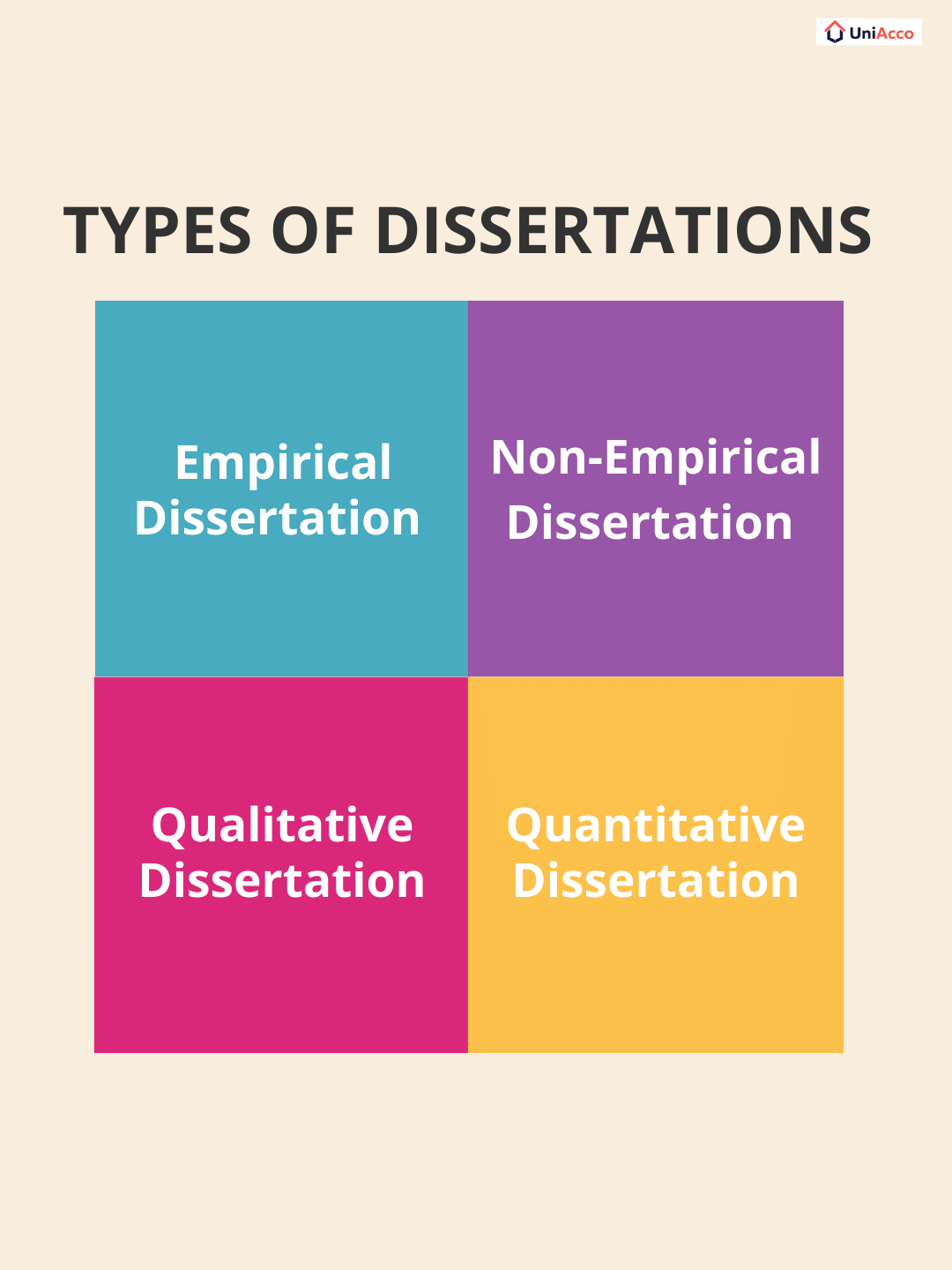
Empirical Dissertation
Let’s say you’re arguing with your friends about how watching these quick 15 to 30 seconds insta reels is ruining our attention span. But instead of saying “I swear it is”, you go ahead and create a survey, ask about 200 of your peers about their screen time, compare it with their study hours and study the results. This is basically how to write a Empirical dissertation. You are not guessing, you’re collecting your own data by using surveys, interviews or even case studies. Like running your own investigation. An Empirical dissertation is commonly used in psychology, business, sociology, and science degrees.
Non-Empirical Dissertation
If you want to understand productivity culture, but instead of conducting a survey, you read academic papers on burnout, compare expert opinions, and analyse how hustle culture works and compare expert opinions. You aren’t collecting new data, but you’re working with what already exists and creating a structured argument around that. So what you are saying is that I’ve read all there is on this topic, and this is my conclusion. This is generally how to write a dissertation for non-empirical research and is commonly used in philosophy, literature, law, and history.
Qualitative Dissertation
Let’s say your friend moved away from home to the UK, and you are asking them open-ended questions like “ how did it affect your confidence” or “did it change your independence”. You’re trying to study their words, emotions behind them, and experience. Its less of numbers and more of depth. It’s about understanding why people think or feel the way they do. This is how Qualitative research works.
Quantitative Dissertation
We all love sipping on our coffee, whether it’s a classic cappuccino, an iced latte or a triple-shot flat white during revision week. But let’s say you genuinely want to know: Does drinking more coffee actually improve exam performance? Now, instead of guessing, you turn it into quantitative research. You first collect data:
How many cups of coffee do students drink each day during exams? How much sleep do they get? What are their final exam scores? You might collect this information, put it into a spreadsheet, and make some graphs. Then you look for patterns. For example, you could find that students who drink two cups of coffee score a bit higher, but those who drink five or more cups do worse because they get less sleep. This is what quantitative data looks like. If you’re working with numbers, averages, charts, and comparisons, you’re dealing with quantitative data.
Check out this Reddit thread where students share smart tips on choosing a dissertation topic that builds on past work or matches your career goals.
Choosing a dissertation/thesis topic (undergrad) – r/AskAcademia from r/AskAcademia
The Standard Dissertation Structure
We hope we’ve at least cleared the different types of dissertation worries for you. We know you are still worried about how to write a dissertation properly. Don’t worry, we’ve got you covered. So your dissertation doesn’t just make sense in your head, but also looks polished. This structure is common in UK universities and around the world, but you should always check your university’s guidelines, as formatting and chapter requirements can vary.
1. Title Page:
Since you’ll be adding your dissertation title, your name, your course details, university, and submission date, the page must be neat and presentable. Keep it formal.
2. Abstract:
Just like how Netflix gives you a preview of a series or a movie, an abstract is basically a preview of your dissertation. If your professor reads your abstract, they should understand what your project is about. Its generally 150-300 words.
3. Acknowledgements (Optional but wholesome)
Thank your supervisor, your parents, and most importantly, your roomies who heard you rant about this topic in the middle of the night. Keep it sincere, keep it brief, and keep it professional. Just like how Netflix credits the actors and the entire staff in the series.
4. Table of Contents:
The TOC should list all your topic headers and page numbers, so readers can easily find their way through the document. And before you start worrying, know that Microsoft Word creates a table of contents for you automatically. Just make sure that you’ve added the correct heading styles and let the program do the rest.
5. Introduction:
Imagine your introduction is the first episode of your Netflix series. In this part, explain why you picked your topic, clearly state your research question, and show why it matters. You should also give a brief outline of what your dissertation will cover. A strong introduction sets the scene and gets the reader ready for what comes next.
6. Literature Review:
Think of your literature review like the “Previously on…” segment before a new season drops on Netflix. Before you continue, remind them what happened last season, who said what, which theories were already floating around, and where the tension started. No plot twist yet.
7. Methodology:
Show how you collected your footage, who you interviewed, where your data came from, and why you chose these sources. Be sure to mention any limitations, such as a small sample size or time limits. Just like how people record “behind the scenes” footage to show you the many efforts that went into making the movie or documentary.
8. Results:
Just present what you found out during your research. Let’s say if If 70% of students said social media affects their focus, you state that. Basically, telling them, “Here’s what came out of my investigation.”
9. Discussion:
You can call this your “plot twist or confirmation” moment. Here is where the real breakdown begins. You compare your results with what other researchers said in the literature review. You mention what these findings actually mean. Whether or not they support those early theories. Did something unexpected happen? You are explaining it all rather than just stating the obvious.
10. Conclusion:
Even though you wish your favourite Netflix series would drop season after season, eventually, it has to end. No more cliff-hangers. No more plot twists. Just the final episode tying everything together.
Your dissertation conclusion is exactly that final episode. You’ve come a long way from Googling “how to write a dissertation” in mild panic to actually finishing the whole thing. This is where you step back and say, “Right, here’s what we found.” You’ll simply summarise your key findings, clearly answer your research question, and bring your main arguments together. It’s basically your closing scene.
11. References:
So your university knows you didn’t just wake up one day and invent all this data, cite your sources clearly. Give credit to avoid plagiarism issues. Follow the referencing style your university requires, whether that’s Harvard, APA, MLA or another format. Stick to it consistently, format it correctly, and make sure every source you used is listed.
12. Appendices:
Think of this as if you’re giving bonus content to your audience. In your dissertation, this will generally include survey questions, Interview transcripts, extra graphs or tables.
Doing your dissertation in France? Find student accommodation now and give yourself the space to research, write, and breathe properly.
🔎 Explore Student Housing in FranceHow to Actually Write a Dissertation
Step 1: Choose a Topic You Genuinely Care About
If you’ve been googling how to write a dissertation, take a breather. We are here to help you out. Follow these steps, and you’ll understand how to start a dissertation. You are going to spend months with this topic. MONTHS. If you pick something just because it “sounds academic”, you’ll regret it by week three. Choose something that actually interests you, annoys you, fascinates you, or makes you curious. If you can rant about it to your friends, it’s probably a good sign.
Step 2: Create a Clear Research Question
A strong research question makes everything easier. Your research question guides your entire project. If this part is messy, the rest will be too. For example, instead of picking “Is social media bad? as a topic, pick something which is more niche, focused and researchable, like “To what extent does daily Instagram usage affect academic performance among UK undergraduates?”. This clarity helps you and saves you from chaos later.
Step 3: Plan Before You Write
If you’re confused about how to structure a dissertation, think of it like building blocks. We’ve already listed the structure above; refer to that. Break each section into small tasks and set deadlines to achieve them in a timely manner. Good planning saves you from staring at a blank screen at 2 in the night when you’re already questioning your life choices.
Step 4: Start Early
You must have heard the phrase “Make hay while the sun shines.” Use this motto if you’re working on your dissertation. Nothing beats starting early and being prepared. Research takes time, writing takes time, and editing takes even more. Your future self will thank you for starting your preps early.
Step 5: Edit Properly
Getting stuck is a normal while writing your dissertation. It helps if you understand each section before you write. When it comes to how to write methodology for a dissertation, keep it simple. We’ve explained it for you in a simpler manner above. If you’re stuck on how to write a good abstract for a dissertation, just remember, it’s just a short summary of your whole project. Your first draft need not be perfect. You’ll only get better if you keep researching and writing till you know you’ve done your best.
Common Mistakes to Avoid While Writing a Dissertation
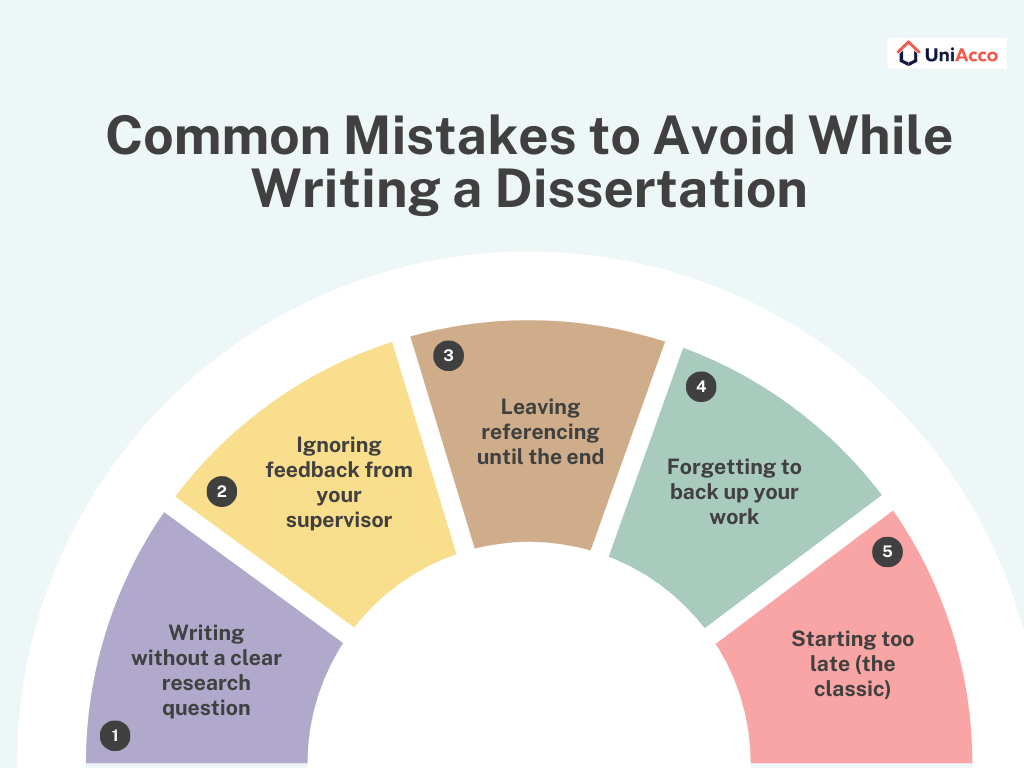
Writing without a clear research question
If you want to know how to write a dissertation, here’s what you should not do. Have a solid research question in mind. Start by googling topics that would actually interest you, match your academic course, excite you and help you be more knowledgeable at the end of your dissertation journey. Writing a dissertation without a solid thesis is like writing a Netflix series without a plot.
Ignoring feedback from your supervisor
A part of learning how to write a dissertation means genuinely listening to people who are helping you achieve this goal. Your supervisors are there to help you from going off track. In fact, we’d suggest keeping your supervisors in the loop throughout your dissertation process. Whenever you’re feeling stuck, reach out to them.
Leaving referencing until the end
Never, we repeat NEVER, leave referencing until the end. Keep referencing as you go. A bad, nay, worse idea is thinking “I’ll leave citations for the end”. What ends up happening is you lose page numbers, maybe even forget your sources, since you’re under a lot of stress. You can simply add comments on your doc and add your source there, if that helps, and in the end, you can properly add the citations with proper formatting under the “References” section.
Forgetting to back up your work
This might hurt a little. But, as much as our generation relies on technology, we should know that it can fail us at times. At all times, email drafts to yourself. Save previous versions of your document. Use cloud storage. Maybe even email a copy by adding your friends in CC, so they too have a version of your dissertation with them.
Starting too late (the classic)
Don’t be one of those students who wait until the shoe drops to start with your dissertation. If you truly want to understand how to write a dissertation, the first step is to START EARLY. Firstly, it’s impossible and panic-writing 10,000 words rarely leads to greatness.
Dissertation mode activated? Let UniAcco sort your student accommodation. Compare, shortlist, and book verified rooms in minutes.
🔍 Find Student Accommodation NowWrapping Up!
To wrap up, you can prove yourself if you set your mind to it. A dissertation is just one way you can show your research, writing and grasping knowledge skills. These skills are easily transferable to your work life in the real world. Finishing your dissertation is basically a level-up moment. You’re not the same person who started it. We don’t want your student accommodation stress to interfere with your mind when you’re focusing on working on your dissertation. Leave that on UniAcco.









0 Comments