Introduction
If you’re planning to study abroad, the odds are that the TOEFL iBT has crossed your radar at some point. Regardless of whether it’s for a bachelor’s, master’s, or even just a student visa, this English proficiency test is one of the first steps in most application processes. Recognised by more than 13,000 universities and institutions in more than 160 countries, the TOEFL iBT is among the most trusted tests of English language proficiency for higher education globally.
But what exactly is the TOEFL iBT, who should take it, and why is it accepted by thousands of universities worldwide? In this guide, we’ll walk you through everything you need to know, from the latest 2026 updates and exam format to scoring, fees, preparation tips, and how to use your TOEFL score to strengthen your study abroad application.
What is TOEFL iBT?
The TOEFL iBT, or Test of English as a Foreign Language Internet-Based Test, is a well-known exam that measures the reading, listening, speaking, and writing skills of students whose first language is not English. It is mainly for students who want to study at universities where classes are taught in English. More than 13,000 universities and colleges in over 160 countries accept the TOEFL iBT, including the USA, UK, Canada, Australia, New Zealand, Germany, Ireland, and Singapore. The test is run by ETS (Educational Testing Service) and is offered in two ways: at a test centre or at home.
Latest TOEFL iBT Updates
The TOEFL iBT has undergone several updates for 2026, designed to be shorter, more efficient, and better aligned with the English skills used in university studies. The changes-including a revised exam format and adaptive testing, and a new CEFR-aligned scoring system-aim to offer a more authentic assessment of language abilities while enhancing the overall testing experience.
New Test format
The TOEFL iBT now features a redesigned format with new task types that better reflect how students use English in real university settings, making the assessment more relevant to academic success.
Shorter Test Duration
The updated TOEFL iBT takes approximately 85–90 minutes, making it significantly shorter while continuing to assess Reading, Listening, Speaking, and Writing.
Updated Question Types
Several question formats have been refreshed to better evaluate practical communication, critical thinking, and academic English skills.
Adaptive Reading and Listening
The Reading and Listening sections now use multistage adaptive testing, adjusting question difficulty based on your performance to provide a more personalised and accurate assessment of your English proficiency.
New CEFR-aligned scoring
From January 2026, TOEFL iBT scores are reported on a 1–6 scale in 0.5-point increments, aligned with the CEFR. During the two-year transition period, score reports also include an equivalent 0–120 TOEFL score to help universities and students compare results.
Faster Score Reporting
Most candidates receive their official TOEFL iBT scores within 72 hours, making it easier to meet university application deadlines.
Here’s a quick scoop of the TOEFL iBT 2026 exam, including its conducting body, exam mode, duration, sections, score validity, and global acceptance.
TOEFL iBT 2026 Highlights
| Feature | Details |
| Conducting Body | Educational Testing Service (ETS). |
| Exam Mode | Computer-based; available at authorised test centers and as the TOEFL iBT Home Edition. |
| Duration | About 2 hours (approximately 85 minutes of test time plus directions/check-in). |
| Sections | Reading, Listening, Writing, and Speaking. |
| Test Availability | Offered multiple times throughout the year worldwide at test centers and online (Home Edition). |
| Score Validity | 2 years from the test date |
| Accepted By | Accepted by 13,000+ universities and institutions across 160+ countries, including the USA, Canada, the UK, Australia, New Zealand, and many European and Asian institutions. |
TOEFL iBT Eligibility Criteria 2026
Before you sign up for the TOEFL iBT 2026 Exam, it’s important to know the basic eligibility criteria. The TOEFL iBT is open to a wide range of test-takers as ETS sets very few restrictions, so there are no limits based on your age, education, or nationality.
Minimum Age
ETS has no minimum or maximum age restriction to appear for the TOEFL iBT test. Age does not play any part in registering for this test.
Educational Qualification
No educational qualifications are required for candidates applying to take the TOEFL iBT test. However, the TOEFL is generally for those intending to work or study abroad.
ID Requirements
Students taking the TOEFL test must present a valid, acceptable ID, such as a passport, for identity verification at the testing centre on test day. It’s at the ETS’s discretion to approve any type of identification document provided by the student on test day.
Nationality Requirements
No nationality restrictions apply to taking the TOEFL iBT test. Anyone, irrespective of his/her country, is eligible to apply for the TOEFL iBT test.
TOEFL iBT Registration 2026
Candidates can register for TOEFL iBT 2026 online on the ETS website. The online registration process is very simple and allows candidates to select their preferred test mode, dates, and locations based on their preferences and available seats. Here is a step-by-step process to register for TOEFL iBT:
Step 1: Register/Log in to ETS
You can visit the ETS website and log in with your account, or create a new one by filling in the required information.
Step 2: Choose Test Format
You can choose either the Test Centre or the Home Edition for the TOEFL iBT (the Home Edition may not be available in all locations).
Step 3: Choose Date and Location
You can pick your desired TOEFL iBT test dates and locations near your preferred test centre or test day.
Step 4: Fill in Personal Information
Make sure you enter all personal and identifying information exactly as it appears on your valid photo ID or passport.
Step 5: Make Payment.
You can register for the TOEFL iBT by paying the required examination fee using any payment method accepted by ETS.
Step 6: Download the Registration Confirmation.
Once you have paid the fee, make sure to download and save the registration confirmation.
TOEFL iBT Registration Deadline
Regular registration is available up to 7 days before the test. Express (late) registration may be available within 7 days of the test date for an additional fee, subject to seat availability.
TOEFL iBT Reschedule and Cancellation Policy
Candidates may reschedule and/or cancel their TOEFL iBT test via their ETS Account. These may be done with 4 days’ prior notice to the test date.
Common TOEFL Registration Mistakes
A few simple registration errors could easily make you anxious or even stop you from sitting for the test. Review the details carefully and strategise ahead of time to prevent future hassles.
- Booking Too Late: Popular test dates fill up quickly, especially during university admission seasons. Register early to get your preferred date and test centre.
- Entering Incorrect Passport Details: Ensure your name, date of birth, and other details exactly match your passport or accepted ID. Even small errors can cause problems on test day.
- Choosing the Wrong Test Centre: Pick a test centre that is convenient to reach and verify the date, location, and reporting time before confirming your booking.
- Ignoring Score Reporting Deadlines: Schedule your test early enough so your scores reach universities before their application deadlines.
- Not Checking Home Edition Requirements: If you’re taking the TOEFL iBT Home Edition, check your computer, internet connection, webcam, microphone, and testing environment in advance to avoid technical issues on exam day.
TOEFL Fee Structure
The TOEFL iBT fee structure includes the registration fee as well as additional charges for services such as late registration, rescheduling, score reports, and score reviews. The registration fee varies by country, while the service fees are standardised by ETS.
| Fee Type | Details |
| Registration Fee | Varies by country. In India, the TOEFL iBT registration fee is ₹15,254. Candidates should check the ETS website for the applicable fee in their country. |
| Late Registration | Available in eligible locations for an additional fee of ₹3,305.08 in India (or the applicable local equivalent). |
| Rescheduling | Candidates can reschedule their test by paying a ₹5,000 fee in India (US$69 globally or local equivalent). |
| Additional Score Reports | Additional score reports can be sent to institutions for ₹2,300 per recipient in India (US$29 globally or local equivalent). |
| Score Review | ETS offers Speaking or Writing Section Score Review for ₹6,694.92 per section in India (US$80 globally). A review of both Speaking and Writing costs US$160 (local equivalent where applicable). |
Got your TOEFL sorted? Let UniAcco help you with the next big step. Explore verified and affordable student accommodation abroad with fully furnished rooms, all-inclusive bills, and modern amenities. Book your student home with confidence before you fly.
🔍 Explore Student AccommodationTOEFL iBT Exam Dates 2026
The TOEFL iBT is offered throughout the year, providing flexibility to candidates to pick a test date according to university application deadlines. Whether you choose to appear for your TOEFL iBT test at a test centre or from home using the Home Edition, picking the exam date early will help you avoid scheduling issues and ensure that your scores are reported on time.
Available Year-round
You can appear for the TOEFL iBT exam throughout the year. TOEFL iBT exams are administered at thousands of authorised test centres worldwide. Test centre exams are administered more than 170 times a year, but exact test dates differ according to location.
Test Centre vs. Home Edition Scheduling
You can take the TOEFL iBT at a test centre or through the TOEFL iBT Home Edition. Appointments for test centre exams are available throughout the year according to scheduled test dates, while Home Edition appointments can be booked 24 hours a day, 4 days a week, and, in some cases, with as little as 24 hours’ notice, subject to availability.
Choosing Your Best Exam Date
Your test date should be well in advance of university or visa application deadlines so you can receive your scores on time. Consider taking your first test at least a couple of months before your earliest deadline in case you need to retake the exam. ETS recommends scheduling your test 2–3 months before your earliest application deadline.
TOEFL iBT Exam Pattern 2026
The TOEFL iBT 2026 follows an adaptive testing model for the Reading and Listening sections only. The overall test takes about 2 hours to complete, including directions, although the actual test time is approximately 90 minutes and may vary slightly based on the adaptive format.
| Section | Skills Tested | Approx. Duration | Question Types | Adaptive Testing |
| Reading | Reading comprehension, vocabulary, and understanding of academic and everyday texts | ~30 minutes | Complete the Words, Read in Daily Life, Read an Academic Passage (about 50 questions) | Yes. Difficulty adapts based on the candidate’s performance. |
| Listening | Understanding conversations, announcements, and academic talks | ~29 minutes | Listen and Choose a Response, Listen to a Conversation, Listen to an Announcement, Listen to an Academic Talk (about 47 questions) | Yes. Difficulty adapts based on the candidate’s performance. |
| Writing | Grammar, sentence construction, written communication, and academic discussion | ~23 minutes | Build a Sentence, Write an Email, Write for an Academic Discussion (12 tasks/items) | No. Uses a fixed format for all candidates. |
| Speaking | Pronunciation, fluency, and spoken communication | ~8 minutes | Listen and Repeat, Take an Interview (11 tasks/items) | No. Uses a fixed format for all candidates. |
TOEFL iBT Syllabus 2026
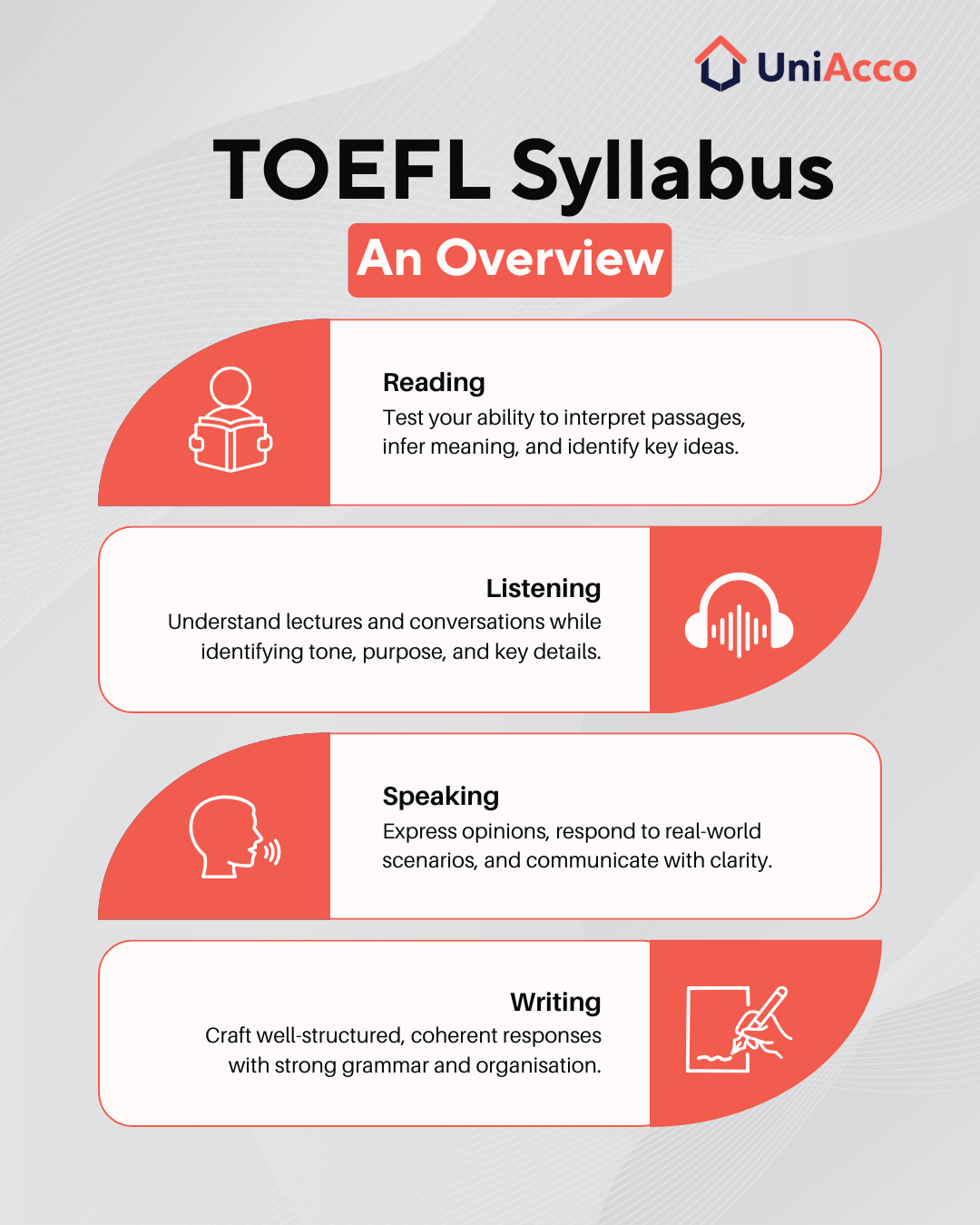
The TOEFL iBT 2026 syllabus examines a candidate’s competency in the English language within 4 fundamental areas: reading, listening, speaking, and writing. The test focuses on practical, everyday, and university-level communication, as seen through a selection of task types to determine a candidate’s ability to understand, reason critically, and articulate thoughts in spoken and written form.
Reading
This section assesses how well you can understand written English, both in academic situations and the real world. It tests your skills through texts and questions that assess understanding of information, vocabulary, and the ability to infer meaning.
- Academic Passages: Read academic texts and answer questions based on the content.
- Vocabulary: Understand the meaning of words and phrases from the context.
- Inference: Draw logical conclusions using information provided in the passage.
- Main Idea: Identify the central theme and supporting details of a passage.
- Sentence Completion: Complete missing words or phrases accurately based on context.
Listening
The Listening section measures your ability to understand spoken English used in academic and campus settings. It tests comprehension, note-taking, and interpretation skills.
- Classroom Lectures: Listen to classroom lectures and answer questions based on the content.
- Campus Conversations: Listen to conversations that commonly occur in a university or campus setting.
- Note-Taking: Identify and note the key ideas and supporting details while listening.
- Understanding Tone and Purpose: Identify the speakers’ attitude and purpose.
Speaking
The Speaking section assesses your ability to communicate clearly and effectively in spoken English through practical tasks.
- Independent Speaking: Express your ideas and opinions on familiar topics.
- Campus Scenarios: Respond to situations commonly encountered in a university environment.
- Interviews: Answer questions in an interview style about different topics to gauge your ability to speak smoothly and to pronounce things properly.
- Opinion-based Responses: Present and justify your viewpoints with relevant reasons and examples.
Writing
The Writing section evaluates your ability to produce clear, organised, and grammatically accurate written responses for academic and practical situations.
- Email Writing: Respond to the provided emails appropriately and professionally, in a context-relevant manner.
- Academic writing prompt responses: Respond to the given academic writing prompts using supporting ideas and information.
- Editing and organising ideas: Reorganise the ideas in an appropriate order.
- Grammar and coherence: Show evidence of correct grammar and vocabulary use and coherence of written text.
TOEFL iBT Scoring System 2026
ETS implemented a new 1-6 scoring system (in 0.5-point increments) for TOEFL iBT, effective 21 January 2026. For each test, you get an individual score for every section and an overall score. Score reports from 2026-2028 will also include a comparable score on the old 0-120 scale.
TOEFL iBT Section-wise Scoring
Each of the four sections—Reading, Listening, Speaking, and Writing—is scored on a 1–6 scale in 0.5-point increments. Higher scores indicate stronger English language proficiency in that skill area.
Overall Score
The overall score on TOEFL iBT is obtained by taking the average of the four section scores, which is then rounded to the nearest 0.5 band. If your four sections averaged 5.25, the final reported score would be 5.5.
CEFR Alignment
With the new scoring system aligned with the CEFR, universities and employers worldwide can easily interpret a candidate’s English language ability, and there will be an appropriate score band within the 1-6 range. CEFR levels from A1 to C2 each have an equivalent score range within the new 1-6 system.
Transition Reporting
The new 1-6 scores will be provided on the official score report, as will a comparative score in the 0-120 score range for exams taken from Jan 2026 to Jan 2028. From January 2028, only the new 1-6 scale score, along with the CEFR Level, will appear on score reports.
What Is Considered a Good TOEFL Score?
A good TOEFL iBT score depends on the requirements of the institution you are applying to. In general:
- 5.0-6.0: Strong to excellent English proficiency and accepted by many competitive universities.
- 4.0-4.5: Good proficiency suitable for many undergraduate and postgraduate programs.
- Below 4.0: This score may meet the requirements for admission to some schools, but is likely insufficient for admission to top programmes.
Score Interpretation Table
| TOEFL Score (1–6) | Approx. CEFR Level | Score Interpretation |
| 6.0 | C2 | Exceptional English proficiency |
| 5.0–5.5 | C1 | Advanced proficiency; suitable for most top universities |
| 4.0–4.5 | B2 | Upper-intermediate proficiency; accepted by many institutions |
| 3.0–3.5 | B1 | Intermediate proficiency |
| 2.0–2.5 | A2 | Basic English proficiency |
| 1.0–1.5 | A1 | Beginner-level English proficiency |

TOEFL Results & Score Reporting 2026
Your official TOEFL iBT scores are available online through your ETS account. They are accessible after you take the test, and you can print your scores and have them sent to universities. You can use TOEFL scores for admission up to 2 years after taking the test.
Result time:
Your official TOEFL iBT scores will be available within 72 hours (3 days) of taking the test.
How to check your scores:
After taking the test, log into your ETS account to check your section and overall scores.
Downloading your score reports:
You can print your score reports from your ETS account after the scores are released to you.
How to send scores to universities:
You may send your scores to up to four institutions for free if you select them during registration. Otherwise, you can order your score reports to be sent for an extra fee.
Validity of TOEFL scores:
TOEFL iBT scores are valid for two years from the test date.
TOEFL vs IELTS
Both TOEFL and IELTS are the most commonly accepted English language skills tests in the world for education, work, and immigration. The test which one is better to apply for depends on the format of the test and scoring method and the requirements of the institution you’re applying to.
| Feature | TOEFL iBT | IELTS |
| Test Mode | Computer-based (Test Centre or Home Edition). | Computer-delivered or Paper-based. |
| Speaking | Conducted on a computer using a microphone. | Face-to-face interview with an examiner. |
| Scoring | 1–6 scale (CEFR-aligned; 0–120 equivalent during the transition period) | Band score of 0–9. |
| Popular In | USA, Canada, and universities worldwide. | UK, Australia, New Zealand, Canada, and globally. |
TOEFL iBT Preparation Tips
It’s not just about practising English but also about understanding the TOEFL iBT pattern to score high on the test. It is ideal to start preparing a month before the exam and to practice and cover all four skills. Here are some tips that will help you prepare better.
- Understand the Exam Pattern: Know the format, question types, and time limits so there are no surprises on test day.
- Practice with Official Mock Tests: They give you the closest experience to the actual exam and help you manage your time better.
- Build Your Vocabulary: Learn new academic words every day and try using them while reading, speaking, and writing.
- Improve Your Listening Skills: Watch English lectures, podcasts, TED Talks, or news channels to get comfortable with different accents and speaking styles.
- Speak in English Every Day: Record yourself answering sample questions or practice with a friend to improve fluency and confidence.
- Practice Timed Writing: Get used to writing clear, well-organised responses within the allotted time.
- Learn from Your Mistakes: Don’t just take mock tests—review every mistake to understand where you need to improve.
Also Read: TOEFL iBT Test – Tips For Every Section
Best TOEFL Preparation Resources
Good-quality TOEFL materials will ensure that you can prepare for TOEFL much better, without feeling frustrated or overloaded with options. Instead of grabbing any and every book that you can find for your TOEFL preparation, try to stick to a couple of resourceful materials that you might find useful from the list below:
Official ETS Practice Tests
Start with official TOEFL practice tests to understand the exam pattern and measure your progress.
Vocabulary Books
Build your academic vocabulary with books like The Official Guide to the TOEFL iBT or Barron’s Essential Words for the TOEFL.
Practice Apps
Use a variety of apps on your phone or tablet to master new vocabulary words, take quick quizzes, and drill the material while you’re commuting to school or between classes.
Mock Exams
Go through as many full-length practice tests as possible. They will help you build stamina and develop effective test-taking strategies.
YouTube Videos
Take advantage of the tons of free TOEFL preparation courses that are available online, especially the instructional videos that explain writing strategies, speaking tricks, and other TOEFL hacks.
Study Plan
Make a schedule for the week of how many hours you are going to spend studying for TOEFL, including time between classes or during breaks from work. Don’t wait until the last minute!
From preparing for your TOEFL to finally moving to the UK, UniAcco is with you every step of the way. Explore affordable and 100% verified student accommodation across the UK with fully furnished rooms, all-inclusive bills, and modern amenities to help you settle into your new home with ease.
🔍 Explore Student Accommodation in the UKConclusion
If going abroad is in the cards, consider the TOEFL iBT your initial hurdle. The sooner you prepare for it, the sooner you can take advantage of the widest range of possibilities when selecting and applying for schools. You can’t get a good TOEFL score by cramming vocabulary lists just before you’re scheduled to take the test; you earn it through preparation and intelligent practice. With an awareness of current trends in the test format, effective test-taking strategies, and guidance to avoid critical errors in registration, you can confidently register and sit for the test.












0 Comments