

High acceptance rates don’t always mean low quality and the United Kingdom is the perfect proof. Some universities combine solid academic credibility with admission chances far above the national average, offering students a realistic shot at building their future in one of the world’s most respected education systems. With institutions like Aberystwyth University crossing a 90% acceptance rate and others comfortably sitting above 80-85%, the UK’s admissions landscape in 2026 is far more accessible than many applicants imagine.
Students planning their next move need to know which UK universities with high acceptance rates offer the best balance of opportunity and academic value, as this can reshape an entire application strategy. This blog highlights the best UK universities with high acceptance rate, exploring what makes their admissions process more flexible and how students can make the most of these opportunities.
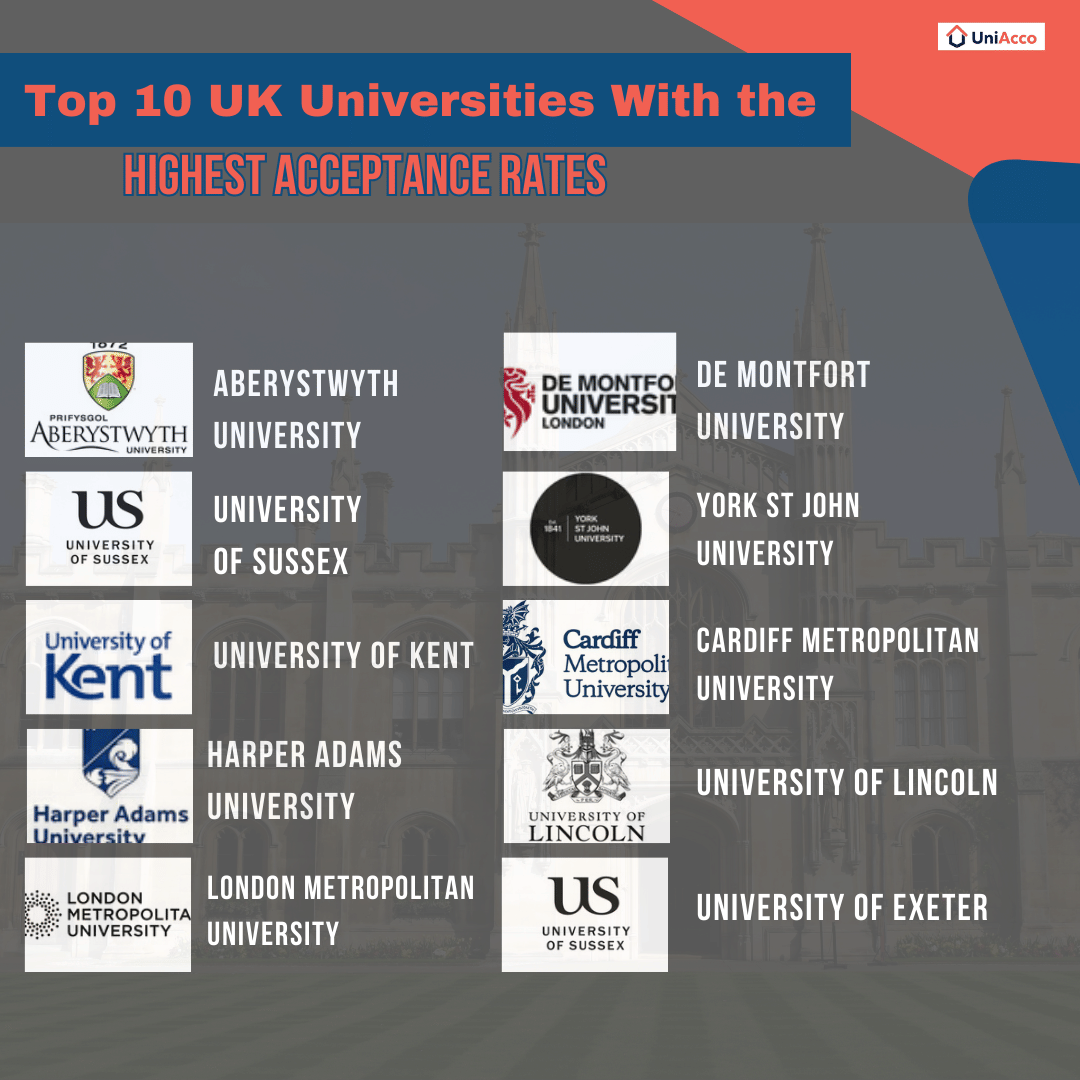
UK Universities With the Highest Acceptance Rate: An Overview
| University Name | Acceptance Rate | QS World University Ranking 2026 | Approx Annual Tuition Fees |
| Aberystwyth University | 92.60% | 741-750 | GBP 14,700 – 21,220 |
| University of Sussex | 92.20% | 278 | GBP 20,750 – 46,700 |
| University of Kent | 89.80% | 397 | GBP 5,800 – 47,900 |
| Harper Adams University | 87% | 1401 | GBP 7,875 – 19,750 |
| London Metropolitan University | 86.90% | 1001-1200 | GBP 4,545 – 20,500 |
| De Montfort University | 86.70% | 801-850 | GBP 11,000 – 20,300 |
| York St John University | 86.60% | – | GBP 10,000 – 15,500 |
| Cardiff Metropolitan University | 86.10% | 181 | GBP 3,150 – 19,500 |
| University of Lincoln | 84.90% | 711-720 | GBP 9,250 – 28,000 |
| University of Exeter | 73.00% | 155 | GBP 6,200 – 45,700 |
Also Read: Top 10 UK Universities With Low Entry Requirements
A comfortable, well-located home helps you settle in fast, meet new people, and stay focused on your academic journey. Secure your student accommodation in the UK early with UniAcco and set yourself up for a strong start at one of the country’s most accessible universities.
🔑 Find UK Student HousingWhat Is a University Acceptance Rate?
A university acceptance rate is a measure of an institution’s accessibility, indicating the percentage of applicants who receive an offer of admission. It helps students understand the level of competition and evaluate their likelihood of securing a place.
The acceptance rate is determined using a simple formula
| (Number of admitted students ÷ Total number of applicants) × 100 |
Acceptance rates at universities are shaped by factors such as student capacity, course availability, institutional growth, and overall demand. These elements influence how many students each university can accommodate in a given year.
What does “High Acceptance Rate” mean?
A high acceptance rate indicates that a university admits a larger proportion of its applicants than more selective institutions do. For students, a high acceptance rate typically means a smoother, less competitive admissions process and a greater chance of receiving an offer. Universities with higher acceptance rates usually have larger campuses, flexible entry requirements for certain courses, and wider program availability, allowing them to accommodate more applicants each year.

High Acceptance Rate Universities in the UK: Top 10
1. Aberystwyth University
Aberystwyth University offers one of the highest acceptance rates in the UK, making it a strong option for students seeking an accessible admissions process. Established in 1872, the university is located in Aberystwyth, Wales, nestled between the Cambrian Mountains and Cardigan Bay, offering a peaceful and scenic academic environment. Its graduate outcomes are impressive, with around 95% of graduates employed or in further study within six months of graduating.
Global Rankings
| Ranking Body | 2026 |
| QS World University Rankings | 741-750 |
| Times Higher Education (THE) | 601-800 |
| The Guardian University Guide (UK) | 62 |
| Complete University Guide (UK) | 45 |
Acceptance Rate
Current Acceptance Rate (2025/26): Approximately 92.6%
Aberystwyth University has maintained a consistently high acceptance rate over the last five years, driven by stable applicant volumes and sufficient capacity across its academic departments. The rate was approximately 93% in 2021 and remained close to that level through 2023, supported by steady demand in areas such as international politics and environmental studies. By 2025, the acceptance rate adjusted slightly to 92.6% as international applications increased, but overall accessibility remained unchanged.
Cost of Studying at Aberystwyth University
| Popular Courses | Tuition Fees (2025-26) |
| B.E. / B.Tech | £ 15,179 – £ 20,675 |
| B.Agri | £ 20,863 |
| LL.B. | £ 16,495 – £ 18,144 |
| MBA/PGDM | £ 14,680 – £ 21,183 |
| LL.M. | £ 19,668 |
Students often praise both the town and the university for their welcoming atmosphere, with Vikram Kittagali Mahadevaiah, MSc Livestock Science, noting that Aberystwyth has made him more confident as a student and taught him to work independently.
2. University of Sussex
The University of Sussex combines a high acceptance rate with a strong global reputation and academic quality. It was granted its university charter in 1961 and is located at Falmer, near Brighton, in East Sussex, England, just outside the South Downs National Park. The campus blends tranquil green surroundings with easy access to the city.
Global Rankings
| Ranking Body | 2026 |
| QS World University Rankings | 278 |
| Times Higher Education (THE) | 201-250 |
| The Guardian University Guide (UK) | 52 |
| Complete University Guide (UK) | 43 |
Acceptance Rate
Current Acceptance Rate (2025/26): Approximately 92.2%
The University of Sussex has recorded consistently high acceptance rates over the last five years, supported by stable capacity across its research-directed programs. The rate stood around 92% in 2021 and shifted only slightly to 92.2% by 2025 despite growing applicant interest, particularly in interdisciplinary fields. The minimal variation reflects balanced enrollment management and steady international demand.
Cost of Studying at the University of Sussex
| Popular Courses | Tuition Fees (2025-26) |
| M. Sc. | £ 23,000 |
| BBA | £ 21,466 – £ 26212 |
| MBA/ PGDM | £ 22,965 – £ 26,212 |
| MBBS | £ 46,650 |
| B.Ed | £ 22232 |
Sussex reports a graduate employment (or further study) rate of about 92.9% within 15 months of graduation, ranking among the top UK universities for employer outcomes. With robust research output and strong employability, the University of Sussex remains a preferred choice among universities in the UK, with high acceptance.
3. University of Kent
The University of Kent strikes a rare balance, welcoming with its generous acceptance rate, yet intensely rigorous across science, business, and the liberal arts. Established in 1965, it is based primarily in Canterbury, with an additional campus in Medway, offering students two distinct learning environments.
Global Rankings
| Ranking Body | 2026 |
| QS World University Rankings | 397 |
| Times Higher Education (THE) | 401-500 |
| The Guardian University Guide (UK) | 80 |
| Complete University Guide (UK) | 49 |
Acceptance Rate
Current Acceptance Rate (2025/26): Approximately 89.8%
Over the past five years, Kent’s overall acceptance has generally ranged from the low 80s to the high 80s, depending on the year and programme, with many recent estimates clustering around the mid to high 80% range. This suggests that while demand has grown steadily, the university has continued to expand or sustain intake across its undergraduate and postgraduate offerings, keeping entry comparatively accessible for qualified applicants.
Cost of Studying at the University of Kent
| Popular Courses | Tuition Fees (2025-26) |
| BBA | £ 12,455- £ 20,481 |
| B.Sc. | £ 16,809 – £ 22,704 |
| B.Arch | £ 21,156 |
| M.Sc. | £ 13,346- £ 23,862 |
| LL.M. | £ 16,809 – £ 19,324 |
With consistent intake capacity and a wide spectrum of programmes, Kent stands as a dependable choice for students seeking accessible entry into a well-established, academically respected UK institution.
4. Harper Adams University
Established in 1901, Harper Adams University is located in Shropshire, England, where students have access to dedicated farms, research units, and applied laboratories. With a high acceptance rate, it is known for its specialised training in agriculture, food production, veterinary sciences, and land management. Strong employer partnerships support practical learning and help graduates transition into technical and land-based industries.
Global Rankings
| Ranking Body | 2026 |
| QS World University Rankings | 1401 |
| Complete University Guide (UK) | 47 |
Acceptance Rate:
Current Acceptance Rate (2025/26): Approximately 87%
Harper Adams University has maintained a gradual upward trend in its acceptance rate during the past five years. It stood around 86.5% in 2021 and reached 87% by 2025 as interest in agriculture, food production and environmental disciplines increased within the university’s specialised facilities. The consistent rise is linked to focused academic demand in land-based sectors.
Cost of Studying at Harper Adams University
| Popular Courses | Tuition Fees (2025-26) |
| B.E / B.Tech | £ 16,476 |
| BSN | £ 16,476 |
| M.Sc. | £ 19,715 |
| MBA / PGDM | £ 19,715 |
| M.A. | £ 19,715 |
5. London Metropolitan University
London Metropolitan University is a modern institution with long-standing foundations, formally established in 2002 and now recognised among the high acceptance rate universities in the UK. Its main campus on Holloway Road in north London, along with specialist facilities in Aldgate, places students close to major creative, business and professional hubs. London Met reports that approximately 90–97% of its graduates enter work or further study within 6–15 months, reflecting strong employment outcomes and a clear focus on career readiness.
Global Rankings
| Ranking Body | 2026 |
| QS World University Rankings | 1001-1200 |
| Times Higher Education (THE) | 601-800 |
| The Guardian University Guide (UK) | 89 |
| Complete University Guide (UK) | 128 |
Acceptance Rate
Current Acceptance Rate (2025/26): Approximately 86.9%
London Metropolitan University’s acceptance rate was near 86% in 2021 and rose to 86.9% by 2025, as applications in fields such as business, law, and architecture exceeded the university’s intake capacity. The trend demonstrates reliable accessibility for both domestic and international candidates.
Cost of Studying at London Metropolitan University
| Popular Courses | Tuition Fees (2025-26) |
| BBA | £ 13,179 – £ 19,465 |
| B.Ed | £ 15,977 – £ 19,465 |
| BFA | £ 17,467 |
| M.Com | £ 16,476 |
| PG Diploma | £ 7,984 – £ 19,965 |
Give your London study plans a head start by securing student accommodation through UniAcco. Settle into a neighbourhood you love, skip the last-minute scramble, and step into uni life with the city at your doorstep.
🏠 Explore London Student Housing6. De Montfort University
De Montfort University, established in 1870 and located in the centre of Leicester, is widely recognised among UK universities with a high acceptance rate for international students, admitting around 45% of global applicants. The university reports a strong 97% graduate employment rate within six months, placing it among the top performers in the UK. Its modern labs, industry-linked internships and global exchange programmes support career development across business, computing, arts and health. Leicester’s innovative learning environment and inclusive pathways create accessible routes for students while maintaining strong real-world outcomes.
Global Rankings
| Ranking Body | 2026 |
| QS World University Rankings | 801-850 |
| Times Higher Education (THE) | 601-800 |
| The Guardian University Guide (UK) | 118 |
| Complete University Guide (UK) | 120 |
Acceptance Rate
Current Acceptance Rate (2025/26): Approximately 86.7%
De Montfort University’s acceptance rate has shown a gradual upward trend over the last five years, influenced by expansion in technology, arts and related academic areas. In 2021, the acceptance rate was 86% with 25,600 applicants and 22,020 offers. The 2023 cycle recorded 26,800 applications and 23,170 offers, resulting in an 86.5% offer rate. By 2025, the university processed 27,500 applications and issued 23,840 offers, resulting in an acceptance rate of 86.7%. Its emphasis on employability and industry-aligned programs continues to support steady demand.
Cost of Studying at De Montfort University
| Popular Courses | Tuition Fees (2025-26) |
| BSN | £ 15,810 – £ 17,217 |
| B.ED | £ 15,727 – £ 26,227 |
| LL.B. | £ 13,369 – £ 18,416 |
| M.A | £ 14,079 – £ 18,341 |
| M.Arch | £ 14,578 – £ 17,068 |
7. York St John University
Founded in 1841 in the heart of historic York, York St John University is one of the UK universities with high acceptance rates, welcoming students from diverse backgrounds into a close-knit and dynamic community. With nearly 95% of graduates moving into work or further study, students benefit from hands-on learning and strong industry connections. Modern facilities and personalised support, combined with the charm of York, create an environment where students can grow, explore, and launch meaningful careers with confidence.
Global Rankings
| Ranking Body | 2026 |
| Times Higher Education (THE) | 1001-1200 |
| The Guardian University Guide (UK) | 115 |
| Complete University Guide (UK) | 105 |
Acceptance Rate
Current Acceptance Rate (2025/26): Approximately 86.6%
York St John University’s acceptance rate was approximately 86% in 2021 and saw small increases through 2024 as the university expanded offerings in health, business and related professional degrees. The 2025/26 rate of 86.6% is consistent with its long-term admissions trend and reflects predictable applicant inflow.
Cost of Studying at York St John University
| Popular Courses | Tuition Fees (2025-26) |
| BBA | £ 9,982 – £ 13,979 |
| B.Sc. | £ 13,979 – £ 14,678 |
| B.J.M.C | £ 12,080 – £ 13,979 |
| MBA / PGDM | £ 9,982 – £ 15,477 |
| M.Sc | £ 9,982 – £ 15,477 |
8. Cardiff Metropolitan University
Established in 1865 from Cardiff’s original School of Art, Cardiff Metropolitan University has evolved into a forward-focused institution in Wales’s capital. With an acceptance rate of approximately 64–86%, the university provides accessible entry into practice-oriented programmes across art, design, sport sciences and business. Strong industry partnerships and active research centres reinforce experiential learning, contributing to a graduate employment or further-study rate of 94.4–96.3% within 15 months. Cardiff Met remains a credible choice for students seeking professionally aligned, skills-driven education with clear career pathways.
Global Rankings
| Ranking Body | 2026 |
| QS World University Rankings | 181 |
| Times Higher Education (THE) | 1001-1200 |
| The Guardian University Guide (UK) | 37 |
| Complete University Guide (UK) | 66 |
Acceptance Rate
Current Acceptance Rate (2025/26): Approximately 86.1%
Cardiff Metropolitan University has maintained a high and stable acceptance rate over the five-year period due to ongoing interest in sport sciences, management and design programs. The rate was close to 85.5% in 2021 and adjusted to approximately 86% by 2025 as applicant numbers increased at a manageable pace. The stability reflects consistent admissions demand aligned with the university’s program strengths.
Cost of Studying at Cardiff Metropolitan University
| Popular Courses | Tuition Fees (2025-26) |
| B.E / B.Tech | £ 12,980 – £ 15,977 |
| B.Sc | £ 14,478 – £ 5,977 |
| LL.M. | £ 15,477 – £ 17,492 |
| M.Arch | £ 14,079 |
| MFA | £ 17,492 |
9. University of Lincoln
The University of Lincoln, established in 1861 and gaining university status in 1992, is located in the heart of Lincoln, Lincolnshire. Known for its modern campus and strong industry connections, it offers programs in engineering, business, arts, and social sciences with ample research and practical learning opportunities. Over 90% of recent graduates move into employment or further study, highlighting its focus on career readiness. As one of the universities in the UK with high acceptance rates, Lincoln provides an accessible and supportive environment for students seeking practical, career-focused education.
Global Rankings
| Ranking Body | 2026 |
| QS World University Rankings | 711-720 |
| Times Higher Education (THE) | 601-800 |
| The Guardian University Guide (UK) | 64 |
| Complete University Guide (UK) | 52 |
Acceptance Rate:
Current Acceptance Rate (2025/26): Approximately 84.9%
The University of Lincoln’s acceptance rate has shown minor fluctuations over the past five years as increases in applications were balanced by expanded program capacity. In 2021, the rate stood at 84% with approximately 22,000 applicants and 18,480 offers. By 2023, applications rose to 23,200, and the university issued 19,700 offers, resulting in an acceptance rate of 85%. In 2025, with 24,000 applicants and 20,380 available places, the rate stabilised at 84.9%.
Cost of Studying at the University of Lincoln
| Popular Courses | Tuition Fees (2025-26) |
| B.E. / B.Tech | £ 15,577 – £ 17,867 |
| B.Ed | £ 15,128 – £ 15,877 |
| B.Pharma | £ 15,877 – £ 17,867 |
| M.Sc. | £ 9,233 – £ 19,266 |
| M.Phil | £ 9,233 – £ 18,866 |
10. University of Exeter
The University of Exeter, officially established by royal charter in 1955 with roots dating back to 1851, is located in the scenic city of Exeter, Devon, with additional campuses in Penryn, Cornwall. With a 73% acceptance rate, it attracts a diverse applicant pool of over 25,000 students annually for programs in science, business, and humanities. Exeter combines research-led teaching with industry-linked learning, offering modern facilities alongside historic charm.
Global Rankings
| Ranking Body | 2026 |
| QS World University Rankings | 155 |
| Times Higher Education (THE) | 170 |
| The Guardian University Guide (UK) | 11 |
| Complete University Guide (UK) | 17 |
Acceptance Rate
Current Acceptance Rate (2025/26): Approximately 73%
The University of Exeter’s acceptance rate has declined gradually over the last five years, driven by surging interest in its research-intensive offerings. In 2021, it stood at about 75.1% with roughly 32,400 applicants for 24,350 places. Applications rose steadily, shifting the rate to 74.2% by 2023 with 34,100 applicants and 25,300 offers. The 2025 cycle saw 35,800 applicants and 26,130 spots, for a 73% acceptance rate. Selective programs like law and environmental science often fall below 60%, highlighting balanced growth against heightened competition.
Cost of Studying at the University of Exeter
| Popular Course | Tuition Fees (2025-26) |
| B.Sc. | £ 21,414 – £ 24661 |
| M.A. | £ 17,542 – £ 29,748 |
| MBA / PGDM | £ 11,781 – £ 38,931 |
| M.Sc. | £ 6,186 – £ 33,295 |
| MPA | £ 19,465 |
Reasons to Choose a UK University with a High Acceptance Rate
1. Higher chances of admission
These universities admit a larger percentage of applicants, giving students a more predictable and less competitive path to securing a place. This creates a practical advantage for those aiming to enter reputable UK institutions without intense selection pressure.
2. More flexibility on eligibility criteria
Entry requirements are often broader, allowing students with varied academic backgrounds to qualify. This flexibility supports applicants who may not meet the stricter thresholds of highly selective universities but still want strong academic opportunities.
3. Good for backup or safety applications
High acceptance rate universities serve as reliable backup options during the UCAS application process. They help students balance their application strategy by adding choices with a higher likelihood of offers.
4. Diversity and broader course options
These institutions typically provide a wide selection of programs across vocational, creative, applied, and theoretical fields. This variety attracts students from different academic interests and supports more personalised degree pathways
5. Greater support for international students
Many of these universities offer structured support services, such as orientation programs and academic guidance. This helps international applicants transition smoothly into the UK education system.
6. Larger campus capacity and modern facilities
High-acceptance-rate universities often have expanded infrastructure, enabling them to accommodate more students without affecting learning quality. Updated labs, studios and teaching spaces support both practical and academic training.
Check out student accommodation near the University of Exeter on UniAcco to find options around Streatham and St Luke’s. Enjoy easy access to lecture halls, cafés, and study spaces so you can ease into campus life with confidence.
🏘️ Explore Exeter Student HousingAlso read: Understanding The Cost Of Living In The UK: A Comprehensive Guide
Eligibility and Application Process for UK Universities with High Acceptance Rates
1. Standard academic requirements (A-levels or equivalent)
Most UK universities with high acceptance rate set moderate grade thresholds, often ranging from CCC to BBB at A-level or comparable international qualifications. These criteria ensure accessibility while still maintaining academic standards for course readiness.
2. English language proficiency
International students typically need IELTS scores between 6.0 and 6.5, depending on the program. Some universities accept alternatives such as PTE or TOEFL and may offer pre-sessional English courses if scores fall slightly below the required level.
3. Course-specific prerequisites
Programs in areas such as engineering, health sciences, computing or design may require subject-specific backgrounds or portfolios. Universities usually provide detailed criteria to help applicants understand precisely what is needed for specialist degrees.
4. Personal statement and reference submission
Even with high acceptance rates, a clear personal statement that shows motivation and course fit is essential. A credible academic reference is also required to validate the applicant’s readiness for university-level study.
5. UCAS application process
Applications are submitted through UCAS, where students list up to five choices. High acceptance universities allow applicants to strengthen their overall profile by including options with a higher likelihood of receiving offers.
6. Additional documents for international students
Some applicants may need to submit academic transcripts, passport copies, financial proof for visa purposes, or supplementary assessments, depending on their home country. This ensures compliance with both academic and UKVI visa standards.
Also Read: Essential Documents Required for Abroad Study In 2026
7. Flexible admission timelines
Many high-acceptance-rate universities in the UK offer rolling admissions, allowing quicker responses than highly selective institutions. This benefits students who want fast confirmation to plan accommodation, visas or financial arrangements.
Tips To Strengthen Your Application at UK Universities With High Acceptance Rate
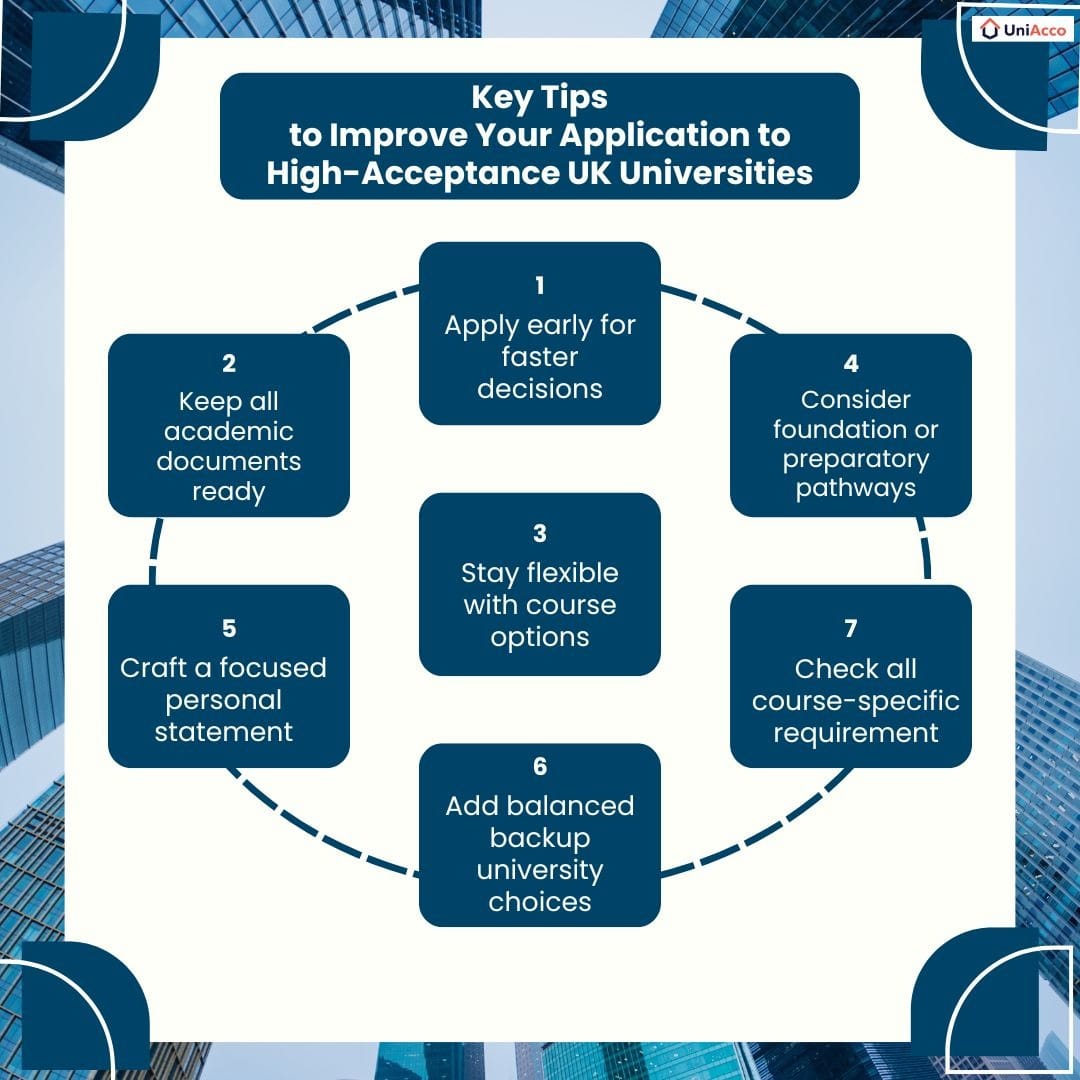
Even though universities in the UK with high acceptance rates are more accessible, a well-prepared application increases your chances of receiving offers quickly and securing preferred courses. The tips below focus on practical steps students can take to submit a strong and complete application.
1. Apply early
Submitting your UCAS application ahead of peak deadlines increases the likelihood of receiving quicker decisions and wider course availability. Early applicants often benefit from smoother documentation review.
2. Keep academic documents ready
Prepare transcripts, predicted grades, English proficiency scores and identity documents in advance. Verified records accelerate the evaluation process and reduce delays during admission checks.
3. Be open to a broad range of courses
Many universities offer multiple course variations, such as joint degrees or applied pathways. Staying flexible with course choices improves your chances of receiving offers in competitive subject areas.
4. Consider foundation or preparatory programs
If you fall slightly below entry requirements, foundation courses provide structured pathways into undergraduate degrees. These programs strengthen academic skills and help meet subject prerequisites.
5. Work carefully on your personal statement
Even at universities with high acceptance rates, a focused personal statement that explains your motivation and skills helps demonstrate course fit. Clear structure and specific examples add credibility.
6. Include backup choices in the same application
Use UCAS to select a mix of aspirational and safety universities to ensure you receive at least one secure offer. This balanced approach is especially effective when applying to a range of institutions.
7. Check course-specific requirements
Some programs may ask for portfolios, interviews or subject prerequisites. Ensuring you meet these expectations reduces the risk of rejection due to incomplete submissions.
Conclusion
Universities in the UK with high acceptance rates combine accessibility with quality, offering modern facilities, strong academic frameworks, and vibrant student communities. For international applicants, these institutions provide a realistic pathway to reputable degrees while maintaining valuable learning and career opportunities. Beyond numbers, it’s the alignment with your goals, course content, and campus experience that truly defines success. Strategically leveraging these universities enables students to secure a place, thrive academically, and build global networks.
Once you shortlist your preferred universities, complement your academic journey with student accommodation in the UK close to your university with UniAcco.


 LinkedIn










0 Comments