
A score that lets individuals who want to pursue business, finance or management get into their dream colleges is the GMAT (Graduate Management Admission Test). This test is widely accepted by some of the top colleges in the world. Students pursuing courses such as Master of Business Administration, Master of Finance and other management-related courses will be eligible for this test.
This article talks about all the colleges that accept GMAT scores, what students should expect when getting into an MBA abroad and what comes with it.
Overview: List Of Colleges That Accept GMAT Scores
| University Name | QS Ranking 2027 | Average GMAT Score Required | Average Tuition Fees |
| Massachusetts Institute of Technology | 1 | Median 730 on the previous GMAT scale. There is no published minimum score | US$91,892 per academic year |
| Imperial College London | 2 | Minimum 555 on the current GMAT. The current average is 666 | £78,000 for the full-time MBA |
| Stanford University | 2 | Average 689 on the current scale. 738 was the score on the previous scale | US$89,187 per academic year |
| University of Oxford | 4 | Median 690. Again, no published minimum | £88,800 for the 2026–27 MBA |
| Harvard University | 5 | Median 685 on the current scale. 730 on the previous scale | US$84,760 per academic year |
| University of Cambridge | 6 | Mean average 625 – 635 on the current scale. 680 – 690 on the previous scale | £80,000 for the 2026 MBA |
| University College London | 8 | GMAT is not required for the UCL Flex MBA. | £42,500 for the full programme |
| National University of Singapore | 10 | Approximately 615 on the current scale or 670 on the previous scale | S$106,849.76, inclusive of GST |
| Peking University | 13 | Approximately 670 based on previous cohorts. | RMB 188,000 for the full-time Global MBA |
| Tsinghua University | 14 | Average GMAT score of approximately 690 | RMB 198,000 for the Global MBA |
What is the GMAT?
The Graduate Management Admission Test, aka GMAT, is an online computer-based test taken by students pursuing their postgraduate studies in the field of business, finance or management. It contains assessments that measure the skills of quantitative reasoning, verbal reasoning and data interpretation.
The score ranges for this test can vary between 205 and 805, with scores reported in 10-point intervals. Each section is designed to contribute to the total score. With a strong, high score, students can apply for a more competitive MBA. This score supports your total application; however, colleges that accept GMAT scores also look at the students’ overall performance, experience they hold, references, essays, leadership potential they show and how well they perform in the interview.
Top 10 Colleges That Accept GMAT Scores 2026/27
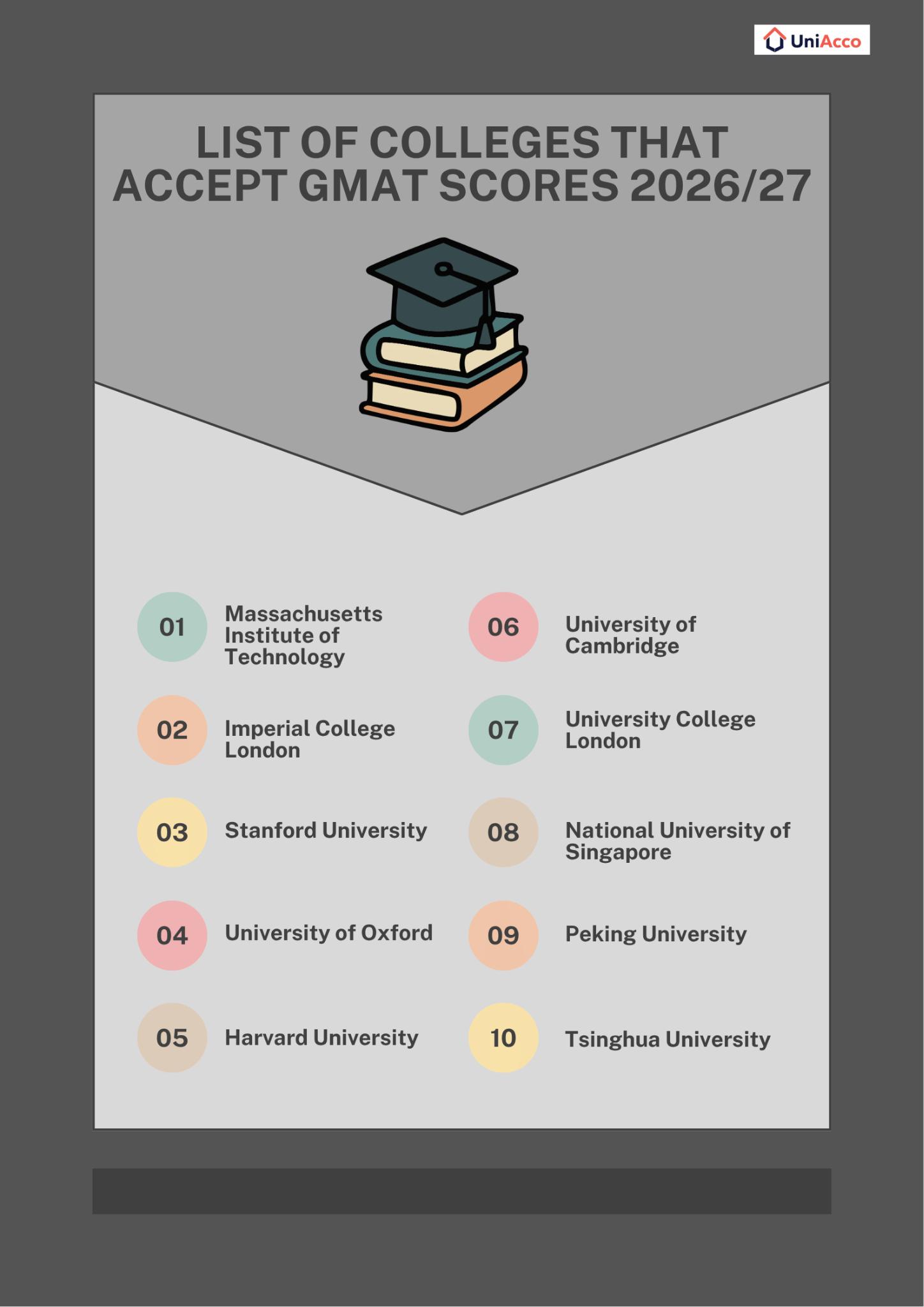
The colleges that accept GMAT scores are also among the top 20 institutions in the QS World University Rankings 2027. While these scores are extremely crucial, students should also remember that this is not the only selection criterion for them to get admission.
Massachusetts Institute of Technology (MIT)
MIT Sloan is one of the most competitive courses for students looking to study business, technology, entrepreneurship, and innovation. This is a 2-year MBA programme and is suitable for students with professional experience, and it studies and evaluates its students through academic ability, leadership potential, career achievements and personal qualities.
However, MIT Sloan does not provide a specific band number or a GMAT score. The median score for its recent MBA class was 730 on the previous GMAT scale. So students landing a number close to it or higher than this have a good chance of getting in. The school also looks at candidates’ impact and their problem-solving skills to get considered.
| Course / Level | Minimum GMAT Scores |
| Undergraduate (All courses) | Not applicable. The GMAT is not used for general undergraduate admission. |
| Postgraduate (Regular degree programmes) | No published minimum. The recent MBA class reported a median score of 730 on the previous GMAT scale. |
Imperial College London
When it comes to technology, innovation, entrepreneurship and global business, Imperial College London is one of the colleges that accept GMAT scores. This is a 12-month full-time MBA that accepts students from different industries. However, students need to show 3 years of relevant work experience.
The current GMAT score requirement for Imperial College is a minimum overall score of 555. Applicants who took the previous GMAT version needed a score of at least 600. The school reports a current average GMAT score of 666, so meeting the minimum should be viewed as the starting point rather than a guaranteed score to get into this university.
| Course / Level | Minimum GMAT Scores |
| Undergraduate (All courses) | Not applicable. GMAT scores are not part of Imperial’s general undergraduate admissions process. |
| Postgraduate (Regular degree programs) | The current GMAT requires a minimum score of 555. The previous GMAT scale required a minimum of 600. The current reported average is 666. |
Secured your desired GMAT score? It’s time to look for your student accommodation now. With UniAcco, find verified student accommodation in the UK and compare rooms, amenities, prices and locations to book a student home that suits your needs.
🔍 Explore Student Accommodation in the UKStanford University
Stanford University is one of the elite universities. It is known for its highly selective and competitive MBA programmes – with a strong focus on leadership. Its close connections with Silicon Valley attract students with a desire to study subjects such as technology, finance, consulting, healthcare, social impact and entrepreneurship.
The MBA Class of 2027 reported an average score of 738 on the previous GMAT scale and 689 on the current scale. Stanford looks at applications through a holistic point of view, so students need to focus on other aspects of their academic and personal life just as much as they should on their academics.
| Course / Level | Minimum GMAT Scores |
| Undergraduate (All courses) | Not applicable. The GMAT is not a general undergraduate entrance test at Stanford. |
| Postgraduate (Regular degree programs) | No published minimum. MBA Class of 2027 average: 689 on the current GMAT scale or 738 on the previous scale. |
University of Oxford
Another top-tier name on the list. The University of Oxford offers a one-year MBA programme at Saïd Business School. This course combines core business education with electives, practical projects and opportunities in finance, consulting, entrepreneurship and social impact.
The 2025–26 MBA class recorded a median GMAT score of 690. Since the programme is competitive, an extremely strong statement of purpose that showcases your readiness to study at Oxford should be explained. Relevant work experience and clear career goals are main aspects to be considered to be a successful applicant here.
| Course / Level | Minimum GMAT Scores |
| Undergraduate (All courses) | Not applicable. GMAT scores are not required for Oxford’s general undergraduate courses. |
| Postgraduate (Regular degree programs) | No published minimum. The 2025–26 MBA class reported a median GMAT score of 690. |
Harvard University
Harvard University is one of the many colleges that accept GMAT scores. The MBA offered by them is a 2-year course that is a combination of case studies, classroom discussion, and real-world challenges. This programme is designed to build students from the inside-out. Students from a wide range of academic and professional backgrounds are encouraged to apply. However, if you hold strong leadership values, analytical ability and the ability to impact, you may be selected.
Harvard also, like Stanford, looks at applications from a holistic view. Its recent class profile reports a median score of 685 on the current GMAT scale and 730 on the previous scale, with the middle 80% of current GMAT scores ranging from 645 to 735.
| Course / Level | Minimum GMAT Scores |
| Undergraduate (All courses) | Not applicable |
| Postgraduate (Regular degree programs) | No universal published minimum. Median: 685 on the current scale or 730 on the previous scale. |
University of Cambridge
Among the colleges that accept GMAT scores, the University of Cambridge is one of them. The Cambridge MBA at Cambridge Judge Business School. This core management programme mixes practical projects and electives. This university opens its doors to the community for freshers studying here.
This university looks at academic achievement, work experience, career progress, and the student’s will to continue to contribute to the collaborative cohort. It also asks its students to submit a valid GMAT, GMAT Focus Edition or GRE score. A score of 625–635 on the current scale is required, while it was 680–690 on the previous scale.
| Course / Level | Minimum GMAT Scores |
| Undergraduate (All courses) | Not applicable |
| Postgraduate (Regular degree programmes) | A valid GMAT, GMAT Focus Edition or GRE score is required. Mean average: 625–635 on the current scale or 680–690 on the previous scale. |
University College London
Management, business and leadership are UCL’s main MBA programmes. It is also one of the colleges that accepts GMAT scores. UCL School of Management is designed for working professionals and its programme flexibility allows students to complete it in 2-5 years.
Unlike many traditional full-time MBA programmes, the UCL Flex MBA does not require a GMAT, GRE or equivalent standardised test. Applicants who have taken the GMAT can still submit their score if they believe it will strengthen their application.
| Course / Level | Minimum GMAT Scores |
| Undergraduate (All courses) | Not applicable |
| Postgraduate (Regular degree programs) | No GMAT required. |
Your Master’s should be an exciting and comfortable period of your life. With UniAcco, explore student accommodation near University College London, compare room options and prices, and find a home that fits your budget.
🔍 Explore Housing Near UCLNational University of Singapore
One of the top universities accepting GMAT scores, NUS has a strong Asia-Pacific focus. Professionals with experience in various industries are welcome to apply. This university evaluates academic background, leadership, career development and professional goals alongside test scores.
You need to submit a valid GMAT score sheet. While the college does not set a minimum GMAT score, recent programme profiles commonly report an average of approximately 670 on the previous scale, or around 615 on the current scale.
| Course / Level | Minimum GMAT Scores |
| Undergraduate (All courses) | Not applicable |
| Postgraduate (Regular degree programs) | No published minimum. Applicants usually submit a valid GMAT, GRE or Executive Assessment score. Reported average: approximately 615 on the current scale or 670 on the previous scale. |
Peking University
This university is for students who want to understand China’s markets a bit better. Peking University’s Guanghua School of Management consists of a 2-year Global MBA which is taught in English.
Guanghua requires a competitive GMAT, GMAT Focus Edition or GRE score for its Global MBA, although students are also free to take the university’s alternative entrance examination. The average GMAT scores from previous cohorts were around 670; students should not stick to this number and aim to score higher.
| Course / Level | Minimum GMAT Scores |
| Undergraduate (All courses) | Not applicable |
| Postgraduate (Regular degree programmes) | No published minimum. A competitive GMAT, GMAT Focus Edition or GRE score is expected. Previous cohort average: approximately 670. |
Tsinghua University
Tsinghua University is one of the colleges that accept GMAT scores. Tsinghua University’s Global MBA is delivered by the School of Economics and Management in partnership with MIT Sloan School of Management. Students can expect to gain an understanding of China’s business environment and management education, which is covered in English. Students who need assistance with the Chinese language and cultural learning can get assistance.
The admissions team considers academic performance, work experience, leadership qualities and the overall application. However, students can submit their GMAT or GRE scores. International applicants who cannot take either test may be able to use Tsinghua’s alternative entrance examination. The Global MBA flyer reports an average GMAT score of 690.
| Course / Level | Minimum GMAT Scores |
| Undergraduate (All courses) | Not applicable |
| Postgraduate (Regular degree programs) | No universal minimum published. Average GMAT score: approximately 690. GMAT, GRE or the alternative entrance examination may be accepted. |
Found your dream university? Now let’s work for a dream GMAT score; explore this Reddit thread and learn how students boosted their score from 555 to 705.
How I Boosted My GMAT Score from 555 to 705 – r/GMAT
Tips for Applying to GMAT-Accepting Colleges
Start Early and Plan Ahead
All of the colleges that accept GMAT scores may have different additional requirements. We recommend that you start early and understand the requirements, and then proceed further. Prepare well for the test and collect additional documents as mentioned by them. Many top universities accepting GMAT scores may also have multiple interview rounds, so applying early gives you the time to know your matter, prepare references, and interviews, and if needed, land a good scholarship opportunity.
Focus on Your Strengths
If you truly are a good candidate, show it to them on paper. Create a strong personal statement and CV that highlights your achievements, career progression, leadership skills, and mention instances they have come to use as well. GMAT scores can just be the icing on the cake.
Use Official GMAT Prep Materials
Familiarise yourself with the 3-format test, use official GMAT prep materials and understand how the 205-805 scoring scale works. Put yourself under a timer and review your progress and mistakes at the end of the test.
Leverage GMAT Prep Courses
GMAT prep courses exist for students who need a clear-cut how-to and what to study right in front of them. Leverage these, and use them to their full potential. This can help with time management, quantitative reasoning or building a consistent study routine. Before signing up for this, make sure you compare course content, tutor experience, and speak to students regarding a review and their experience with it.
Seek Feedback on Your Application
Always ask for feedback – this opens up and points out trouble spots when it comes to your CV, essays and career goals. Quality feedback will help you make the correct changes and prepare you to not go the generic way.
Apply to a Range of Schools
There are multiple colleges that accept GMAT scores, so apply to a range of them. We understand having a preferred few only, but to widen your chances of getting into a good school, you have to put your eggs in all the baskets. Mix up your applications – ambitious, realistic and safer options- while checking each school’s course content, work-experience expectations, location, tuition fees and career outcomes.
Find a stay that’s close to your university as well as the nightlife. With UniAcco’s services, including verified stays, multiple room options and transparent prices, you can compare your choices and find a student home that suits your needs.
🔍 Explore UniAccoThe top universities accepting GMAT scores are many, as mentioned above. While each of them may have its own score requirements, a few of them also focus on a holistic approach when they look for the right candidate to admit to their premises. The top colleges that accept GMAT scores are among the great leagues such as Harvard, Stanford, Oxford, and many more – preparing for your test and making sure you have all the required documents are confirmed ways of getting ahead.


 LinkedIn










0 Comments