
Some decisions hit your wallet long before they shape your future, and choosing between Canada and the United Kingdom is one of them. As you compare the cost of living in Canada vs the UK, you’ll notice why these countries keep drawing massive student crowds. In 2024 alone, Canada crossed 997,000 international students, while the UK welcomed over 730,000, proving that students are watching every metric, every opportunity, every return on investment.
But popularity doesn’t pay rent. The real difference shows up in monthly budgets, grocery bills, transport passes, and the quiet maths before hitting Submit Application. This blog breaks down the essential expenses and what it all means for your long-term goals, so you can choose a country that supports both your ambition and your bank balance.
Cost of Living in Canada vs the UK: Key Differences at a Glance
| Expense Head | Canada (CAD) | UK (GBP) | Which Is Cheaper? |
| Student Accommodation (University Halls) | C$700 – 1,200 (shared) | £400 – 900 (shared) | UK (usually lower for shared halls) |
| Private Student Accommodation | C$1,200 – 2,200+ (studio) | £800 – 1,800+ (studio) | UK (lower studio averages) |
| Tuition Fees | Generally C$20,000 – C$35,000/ year | Generally £15,000 – £25,000 /year | UK (shorter courses reduce total cost) |
| Food and Groceries | C$250 – 350/month | £120 – 180/month | UK (lower grocery costs) |
| Dining Out | C$25 low-costC$100 mid-range | £15 low-cost£65 mid-range | UK(cheaper meals overall) |
| Transportation | C$100–160/month | £50–£90/month | UK (lower city pass costs) |
| Utilities | C$150–250/month | £100–£200/month | UK (on the lower end) |
| Entertainment and Leisure | C$15–25 (cinema) | £10–£15 (cinema) | UK |
| Healthcare | C$650–900/year (insurance) | £776/year (IHS) | Canada (slightly cheaper depending on province) |
Breaking Down the Cost of Living in Canada vs the UK
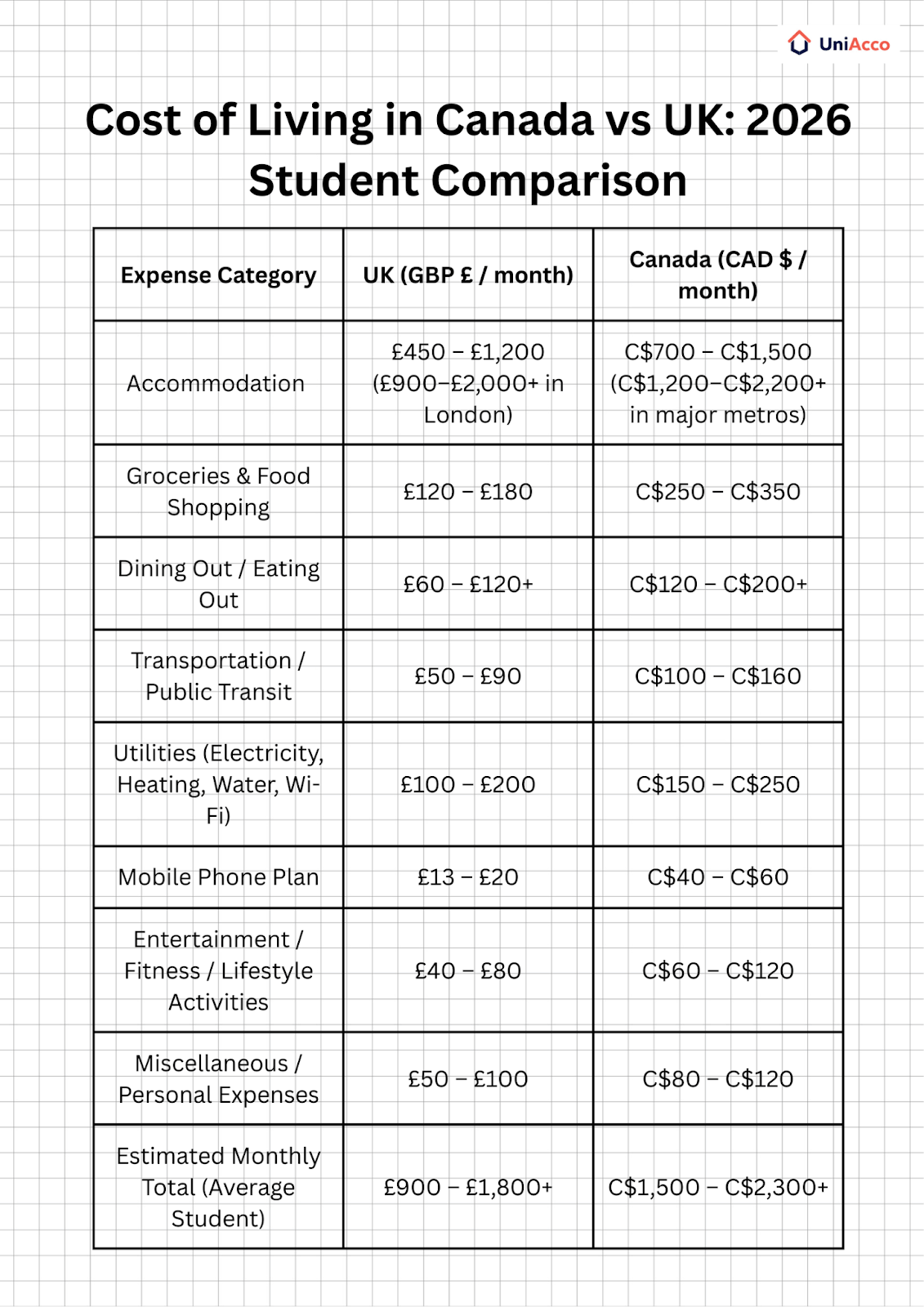
For international students, the cost of living is a major deciding factor when choosing between Canada and the UK. On average, students in the UK spend between £900–£1,800+ per month, depending on the city, lifestyle, and accommodation type. In comparison, students in Canada typically spend around C$1,500–C$2,300 per month, influenced largely by housing, insurance, and transportation costs.
While both destinations offer high-quality education and strong job prospects, the UK generally presents higher variability across cities, particularly in premium hubs like London, whereas Canada tends to show more stable pricing, especially in mid-sized cities.
Cost Of Student Accommodation: Canada vs the UK
Accommodation costs vary by city and housing type in both Canada and the UK. Shared housing and on-campus halls are typically the most affordable, while PBSA and private studios sit at the premium end. Canada is generally slightly cheaper overall, whereas the UK costs fluctuate more sharply, especially in cities like London.
Compare verified student accommodation in the UK with UniAcco and discover rooms that match your budget, lifestyle, and location needs — from shared apartments to premium studios.
🔍 Browse UK Student HousingRent Variation Across Major Student Cities: UK & Canada (2025–26)
| City | Avg Student Rent Range (per month) | Market Insight / Trend |
| London, UK | £900 – £2,000+ | Premium market; PBSA & suburbs offer better affordability |
| Manchester, UK | £600 – £1,000 | Steady increases; shared flats are the best value |
| Bristol, UK | £650 – £1,200 | Limited supply; premium studios in high demand |
| Edinburgh, UK | £650 – £1,100 | Competitive market; early bookings recommended |
| Leeds, UK | £450 – £800 | Oversupply lowering rents — strong deals |
| Vancouver, Canada | CAD 600 – 1,200 | One of Canada’s most expensive student markets |
| Toronto, Canada | CAD 700 – 1,300 | Strong demand; central locations are premium priced |
| Montréal, Canada | CAD 600 – 1,000 | More affordable student city with a strong housing supply |
| Calgary, Canada | CAD 600 – 1,100 | Lower-cost metro; good value for students |
| Ottawa, Canada | CAD 650 – 1,150 | Stable rental environment near major universities |
Overall, student accommodation in the UK shows sharper city-to-city variance, with some markets experiencing steep rent increases due to tight supply, while others are seeing rare price drops driven by oversupply.
In contrast, Canada’s rent landscape is more stable, with prices largely influenced by city size rather than sudden year-on-year swings. Major hubs like Toronto and Vancouver remain the most expensive, while cities such as Montreal and Calgary offer more affordable options.
For students planning 2025–26 budgets, the UK rewards flexible location choices and early booking strategies, while Canada rewards choosing mid-sized cities and shared housing to manage costs more effectively.
Cost of Studying in Canada vs the UK
Canada and the UK are leading choices for international students, but costs differ based on program type and duration. Canada offers longer programs with higher annual fees, while the UK’s shorter 1-year Master’s and 3-year undergraduate degrees can lower total study costs.
Undergraduate Programs in Canada
Canada offers globally recognised four-year undergraduate degrees and a welcoming international student environment. International UG fees average around CAD 40,000–42,000 per year, with lower ranges starting at CAD 18,800 in more affordable provinces and premium programmes in provinces like Ontario exceeding CAD 49,000 annually.
| Program/Field | Average Fee (CAD/year) |
| Business, Management & Public Admin | 36,631 |
| Mathematics, Computer & Info Sciences | 41,163 |
| Engineering & Engineering Tech | 37,377–43,606 |
| Social & Behavioural Sciences | 36,480 |
| Visual & Performing Arts | ~35,000 |
Undergraduate Programs in The UK
The UK offers highly reputable three-year undergraduate degrees, allowing students to complete their studies faster than in Canada’s four-year system, reducing the overall cost of study. Official university fee schedules indicate that international UG tuition typically ranges from £15,000 to £44,000 per year, with arts and humanities on the lower end and lab-based subjects such as engineering and sciences toward the higher end.
| Program/Field | Average Fee (£/year) |
| Business & Economics | 24,000–29,000 |
| Computer Science | 31,000–44,214 |
| Engineering | 30,000–44,214 |
| Humanities & Social Sciences | 22,000–32,406 |
| Natural Sciences | 31,800–44,214 |
Also Read: Guide To The Cost Of Studying In The UK
Postgraduate Programs in Canada
Canadian Master’s programs typically run for 1–2 years, offering opportunities for co-ops, funding, and assistantships across leading research universities nationwide. They are highly valued for their research-driven structure, industry-integrated learning, and strong employment pathways, especially in STEM and professional fields.
International Master’s tuition generally ranges from CAD 18,000–35,000 per year, though specialised programs such as Engineering, Computer Science, Data Science, and Healthcare can exceed CAD 45,000+ depending on the institution and province.
| Program/Field | Average Fee (CAD/year) |
| Business & Management | 19,000 – 31,500 |
| Computer Science & IT | 16,000 – 25,000 |
| Engineering | 17,000 – 28,000 |
| Health Sciences | 18,000 – 22,000 |
| Social Sciences/Humanities | 14,000 – 19,000 |
Postgraduate Programs in the UK
The UK is globally known for its one-year accelerated Master’s programs, enabling students to complete postgraduate education more quickly and cost-effectively. Based on official university fee bands, international PG/Masters fees usually range from £17,000 to £32,000 annually, with specialised STEM and business programs reaching £35,000–£40,000.
| Program/Field | Average Fee (£/year) |
| Business & Economics | 18,000 – 30,000 |
| Computer Science | 22,000 – 30,000 |
| Engineering | 24,000 – 29,000 |
| Health & Medical Sciences | 20,000 – 25,000 |
| Social Sciences | 17,000 – 22,000 |
PhD Programs in the UK vs Canada
PhD tuition is generally lower due to funding, research grants and assistantships. Canada typically offers more funded doctoral pathways, while the UK has shorter 3-4 year PhD structures, helping reduce overall study duration.
| Program Category | Canada (CAD/year) | UK (£/year) |
| Average PhD Tuition | 7,000 – 20,000 | 18,000 – 28,000 |
| Research-Intensive / STEM | 15,000 – 28,000 | 20,000 – 40,000 |
MBA Programs in the UK vs Canada
MBA programs in Canada and the UK are popular for career acceleration and global business exposure. Tuition varies widely by university ranking and format. Canada typically offers 1–2 year MBAs, while the UK is known for its 1-year accelerated structure, reducing total cost and time.
| Program Category | Canada (CAD, full program) | UK (£, full program) |
| Average MBA Tuition | 30,000 – 60,000 | 30,000 – 60,000 |
| High-Ranked Universities | 60,000 – 90,000 | 70,000 – 100,000+ |
STEM Programs in the UK vs Canada
STEM postgraduate programs tend to have higher tuition due to lab resources and industry demand. Canada offers 1–2 year applied and research-oriented STEM PG options, while most UK STEM Masters are 1 year, making them time-efficient.
| Program Category | Canada (CAD/year) | UK (£/year) |
| Average STEM Tuition | 28,000 – 45,000 | 26,000 – 35,000 |
| Premium/Technical Programs | 45,000 – 55,000+ | 35,000 – 40,000 |
If you’re weighing your next academic move, this video breaks down the big picture: goals, countries, careers, and everything in between.
Cost Of Food & Groceries: Canada vs the UK
On average, students in the UK spend around £120–£180 per month on groceries, whereas students in Canada typically spend around C$250–C$350 per month, depending on the city and dietary choices. While both the UK and Canada offer affordable supermarket chains and student-friendly options, the overall cost of groceries tends to be higher in Canada due to import pricing, transportation costs, and sales taxes.
| Item | Canada (CAD C$) | UK (GBP £) |
| Milk (Regular, 1 Liter) | C$3.08 | £1.25 |
| Fresh White Bread (500 g) | C$3.68 | £1.24 |
| White Rice (1 kg) | C$5.04 | £1.63 |
| Eggs (12, Large) | C$4.84 | £2.98 |
| Local Cheese (1 kg) | C$15.45 | £7.20 |
| Chicken Fillets (1 kg) | C$16.71 | £6.67 |
| Beef Round (1 kg) | C$20.97 | £10.72 |
| Apples (1 kg) | C$5.72 | £2.22 |
| Bananas (1 kg) | C$2.01 | £1.22 |
| Oranges (1 kg) | C$5.38 | £2.11 |
| Tomatoes (1 kg) | C$5.64 | £2.54 |
| Potatoes (1 kg) | C$3.73 | £1.26 |
| Onions (1 kg) | C$3.62 | £1.17 |
| Lettuce (1 head) | C$3.57 | £0.87 |
| Bottled Water (1.5 L) | C$2.45 | £1.18 |
Popular Budget Supermarket Chains in the UK
- Tesco – Widely preferred by students; Clubcard discounts offer big savings on daily essentials and fresh food.
- Aldi & Lidl – Known for lowest prices and weekly deals; great for bulk buying and affordable fresh produce.
- Asda – Competitive pricing with frequent online delivery offers, ideal for students in shared accommodation.
- Sainsbury’s – Offers Nectar reward points that can be redeemed for future shopping discounts.
- Morrisons – Good range of fresh groceries and seasonal discounts across bakery, vegetables, and ready meals.
Popular Budget Supermarket Chains in Canada
- No Frills – Extremely budget-friendly; strong on fresh produce and pantry staples with weekly flyer deals.
- Walmart – Everyday low pricing on groceries + household items; convenient one-stop shop for students.
- Costco – Best for bulk buying and shared accommodation savings; membership required.
- FreshCo – Known for price-match guarantees, helping students get the best rates across competing stores.
- Superstore / Loblaws – Large selection with PC Optimum reward points, students can redeem for discounts.
Canada vs the UK: Cost Of Dining Out
Dining out is a regular part of student life, whether it’s a quick meal between classes or a weekend dinner with friends. While most students cook at home to save money, understanding average restaurant costs helps balance budgets and plan social spending across Canada and the UK.
| Item | Canada (CAD C$) | UK (GBP £) |
| Meal at an Inexpensive Restaurant | C$25.00 | £15.00 |
| Meal for Two at a Mid-Range Restaurant (3-course, no drinks) | C$100.00 | £65.00 |
| Combo Meal at McDonald’s (or equivalent fast-food meal) | C$15.00 | £8.00 |
Cost Of Transportation in Canada vs the UK
For most students, commuting is the thread running through classes, part-time shifts, and weekend plans. Both countries offer reliable public transport, but Canada typically costs more each month.
The reason is simple: longer travel distances and wider city layouts often push up monthly pass prices, whereas the UK’s compact cities and frequent connections help keep costs lower.
Commuting Costs in Canada
Public transport in Canada varies by city, but a typical single ride costs around C$3.30–C$3.80, with discounted fares available for students through youth passes or university programs like U-Pass.
| Mode of Transport | Price (CAD) |
| TTC Single Fare (Toronto – PRESTO) | C$3.30 |
| TTC Day Pass (Toronto) | C$13.50 |
| TTC Monthly Pass (Adult – Toronto) | C$156.00 |
| TTC Post-Secondary Monthly Pass | C$128.15 |
| TransLink Single (Compass Card – Vancouver) | from C$2.70 |
| TransLink Cash Bus Fare (Vancouver) | C$3.35 |
| U-Pass BC (University students – Vancouver) | Included in student fees |
| Calgary Transit Cash Fare | C$3.80 |
Did you know?
- In Toronto, post-secondary students need a student photo ID to access discounts. Youth fares (13–19 yrs) are cheaper.
- U-Pass BC offers unlimited transit across Metro Vancouver and is included in tuition fees.
Commuting Costs in the UK
Public transport in the UK is generally affordable, especially with student discounts. Single bus fares typically start from £1.75–£2, and student Oyster and term passes can significantly reduce costs in cities like London and Manchester.
| Mode of Transport | Price (GBP £) |
| TfL Bus/Tram Pay As You Go (London) | £1.75 |
| TfL Bus/Tram Daily Cap | £5.25 |
| TfL Bus/Tram 7-Day Pass | £24.70 |
| TfL 18+ Student Oyster (30% off Travelcards) | Varies by zone |
| Manchester Single Bus Fare Cap | £2.00 |
| Bee Network Student Term Bus Ticket (Manchester) | £105 (Jan–Mar) |
| Tube Peak Zones 1–2 (London) | £2.80–£2.90 |
Find verified, affordable options near top universities — from budget-friendly shared flats to premium studios in Zones 1 & 2. UniAcco helps you lock in secure and student-ready accommodation across London.
📍 Explore Student Accommodation in LondonDid you know?
- In London, 18+ Student Oyster gives 30% off Travelcards and bus/tram passes; can be combined with Railcards for extra savings.
- Bee Network student term passes in Manchester offer unlimited bus travel, and students need a valid university ID.
Cost Of Utilities in the UK vs Canada
Understanding utility costs is crucial when budgeting for student accommodation abroad, especially because what’s included in rent varies widely. In many student accommodations and PBSA properties, utilities such as electricity, heating, water, and sometimes internet are bundled into the rent. In contrast, in private apartments, students often pay these bills separately.
On average, students in the UK typically spend around £100–£200 per month on utilities, while students in Canada generally spend around C$150–C$250 per month, depending on usage, city and weather conditions (heating/cooling significantly affects costs).
| Utilities (Monthly) | UK (GBP £) | Canada (CAD C$) |
| Basic Utilities for 85 m² Apartment (Electricity, Heating, Cooling, Water, Garbage) | £239.92 | C$212.13 |
| Mobile Phone Plan (10GB+ Data) | £13.44 | C$61.32 |
| Broadband Internet (Unlimited, 60 Mbps+) | £31.51 | C$85.39 |
If you’re staying in a UniAcco-listed PBSA, most essentials, like electricity, heating, water, and internet, are already part of your rent. It keeps your monthly budget predictable and removes the hassle of tracking separate bills, especially during peak winters or exam months.
Healthcare & Insurance Costs in the UK vs Canada
Healthcare is a critical consideration for international students, and both the UK and Canada require mandatory health coverage. In the UK, students pay an Immigration Health Surcharge (IHS) upfront as part of their visa, giving them access to the NHS, which covers most services at no additional cost. In Canada, healthcare is run provincially, and international students must purchase provincial or university health insurance, with costs varying by region.
| Healthcare Expense | UK (GBP £) | Canada (CAD C$) |
| Mandatory Health Insurance / Surcharge | £776/year (IHS fee) | ~C$650–C$900/year (private insurance) |
| Provincial Health Plan Fee | Included via IHS | ~C$75/month (e.g., BC MSP) |
| GP / Doctor Visits | Included via NHS | Covered under provincial/university plans |
| Emergency / Hospital Treatment | Included via NHS | Covered depending on plan & province |
In the UK, students pay an Immigration Health Surcharge (IHS) upfront as part of their visa, giving them access to the NHS, which covers most services at no additional cost. In Canada, healthcare is run provincially, and international students must purchase provincial or university health insurance, with costs varying by region.
Entertainment, Fitness, and Lifestyle Costs in Canada vs the UK
Leisure, fitness, and social activities play a substantial role in a student’s overall well-being. Understanding the typical costs of movies, gyms, and weekend outings helps you plan your monthly budgets more accurately and maintain a balanced lifestyle.
| Activity | UK (GBP £) | Canada (CAD C$) | Notes |
| Monthly Fitness Club Membership | £34.88 | C$58.90 | Gyms are generally cheaper in the UK; both countries offer discounted university gyms. |
| Tennis Court Rental (1 Hour, Weekend) | £13.48 | C$27.08 | UK has more low-cost public sports facilities. |
| Cinema Ticket (International Release) | £10.00 | C$15.99 | UK cinemas offer student deals from £5–£7; Canada is pricier, especially IMAX. |

Hacks To Cut Down Student Cost of Living
1. Cook at home instead of eating out
Meal prepping is one of the simplest ways to cut expenses. Eating out daily can easily cost £10–£15 / C$15–C$22 per meal, while cooking at home brings the cost down to £2–£4 / C$3–C$6 per meal. Students can save 50–60% per month by planning meals, sharing groceries, or batch cooking for the week.
2. Use student discount platforms everywhere
Platforms like UNiDAYS, TOTUM, Student Beans, SPC (Canada) and university ID discounts offer 10–30% off on essentials like laptops, clothing, food, travel, streaming apps, and entertainment. Even transportation and museum tickets have student pricing small savings that add up across the year.
3. Choose accommodation with utilities included
Hidden utility charges add up fast bills for electricity, water, heating, Wi-Fi and waste management can cost £100–£200/month in the UK and C$150–C$250/month in Canada. Choosing PBSAs or student residences with all-inclusive bills allows predictable budgeting and avoids surprise payments every month.
4. Use public transport and student passes
Instead of paying per ride, students can benefit from monthly discount passes. In the UK, 18+ Student Oyster and Railcards save up to 30%, while in Canada, programs like U-Pass provide unlimited travel and save 20–25% on transport costs. Walking and cycling can further reduce commuting costs and improve wellbeing.
5. Buy second-hand or rent books & essentials
Instead of buying new textbooks or furniture, students can use library rentals, Facebook Marketplace, Depop, thrift stores, or campus exchange groups. This can save 60–80% compared to buying new items and keeps the process sustainable and student-friendly.
6. Split costs with roommates & friends
Sharing groceries, cleaning supplies, streaming subscriptions, and ride-sharing can significantly reduce monthly expenses. Students can save £20–£40 / C$30–C$50 monthly through smart sharing. Buying in bulk is even more cost-effective when costs are divided.
Additional Ways to Cover Living Expenses
1. Securing Scholarships
Scholarships can significantly reduce overall study expenses by covering tuition, accommodation, or monthly living costs. Many UK and Canadian universities offer merit-based, need-based, and country-specific awards that international students frequently qualify for. Applying early, preparing strong essays, and tracking deadlines can meaningfully lighten your financial load.
| Scholarship Name | Offered by | Coverage & Benefits |
| Lester B. Pearson International Scholarship | University of Toronto | Full tuition, books, fees, and residence for 4 years (undergraduate) |
| Emerging Leaders in the Americas Program | Government of Canada | Short-term study/research funding for Latin America/Caribbean students |
| Study in Canada Scholarships | Government of Canada | Short-term exchanges for students from Asia, Europe, MENA, Sub-Saharan Africa |
| Chevening Scholarship | UK Government | Full funding for 1-year master’s, including fees and living stipend |
| Commonwealth Scholarship | UK Government (Commonwealth countries) | Tuition, living costs for postgraduate study |
| Gates Cambridge Scholarship | University of Cambridge | £17,500 stipend, health insurance, up to £2,000 development funding (master’s/PhD) |
Also Read: Scholarships for International Students in the UK
2. Engaging in Part-Time Jobs
Part-time work helps students stretch their budget without compromising their study goals. Whether it’s campus roles, retail shifts, or industry-linked student jobs, both countries offer structured work-hour allowances that make earning manageable. It’s a straightforward way to support living expenses while building confidence and experience.
Popular Part-Time Jobs in Canada
International students can work up to 24 hours per week off-campus during academic terms, with unlimited hours during scheduled breaks. Average hourly wages range from CAD 15-25, depending on role and province.
| Job Role | Average Hourly Pay (CAD) |
| Retail/Customer Service | $15-18 |
| Hospitality (Server/Barista) | $15-20 + tips |
| Tutoring/Research Assistant | $20-25 |
| Campus Jobs (Library/Admin) | $16-22 |
Popular Part-Time Jobs in the UK
Degree-level international students may work up to 20 hours per week during term time, with no limit during vacations; below-degree students are limited to 10 hours. Hourly rates align with National Minimum Wage: £10.42 (23+), £10.18 (21-22).
| Job Role | Average Hourly Pay (£) |
| Retail/Customer Service | £8-10 |
| Hospitality (Waiter/Barista) | £9-12 + tips |
| Administrative Roles | £10-13 |
| Campus/Tutoring | £10-15 |
Also Read: 11 Ways You Can Find A Part-Time Job While Studying
Conclusion
The real difference in the cost of living in Canada vs the UK becomes clear once you look beyond tuition fees. One offers broader cities with higher earning potential and generally steadier monthly expenses; the other delivers shorter degrees, tight-knit urban convenience, and academic ecosystems recognised worldwide. Both countries carry their own financial rhythm, one shaped by space and opportunity, the other by structure and proximity.
What ultimately matters is how well that rhythm matches your priorities, your budget, and the lifestyle you see yourself thriving in. With UniAcco, you can secure student accommodation that aligns with your financial plan and lifestyle, ensuring your stay in Canada or the UK is comfortable, predictable, and hassle-free.











0 Comments