
So you’ve decided to pursue a master’s or MBA abroad. You’ve got the universities shortlisted, the motivation is very much there, and then you hit one very specific requirement sitting quietly in the admissions checklist: the GRE General Test is required.
And suddenly you’re down a rabbit hole at 11 pm trying to figure out what sections it has, whether the old prep books still apply, what a “section-adaptive” test even means, and why there seem to be seventeen different score ranges floating around the internet.
The truth is that the GRE test isn’t as hard as the internet makes it seem. Since the 2023 update, it’s actually gotten shorter and easier to handle. Less than two hours. Three sections. Combine scoring system. It’s the most adaptable test for getting into graduate school. It is accepted for MBAs, select law school applications, and PhDs in more than 90 countries. Note that most US law schools still primarily require the LSAT rather than the GRE, not just for STEM master’s programs. That’s why so many students pick the GRE test over tests that are more focused.
This guide has everything you need: what the exam is, how it’s structured, what it costs, how to register, and how to actually prepare for it without losing your mind in the process.
What is the GRE Exam & Who Can Take It
The GRE exam (Graduate Record Examination) is a standardised admissions test developed and administered by ETS (Educational Testing Service). It exists because universities worldwide need a consistent way to compare applicants coming from completely different academic systems, countries, and backgrounds. Your GPA from one university means something different to your GPA from another. Your GRE score is the common language that bridges that gap.
Who accepts it? Pretty much everyone relevant. Over 1,400 business schools accept the GRE test for MBA admissions, including Harvard, Stanford, MIT, Oxford, and Cambridge. If you’re not 100% sure whether you want an MBA or an MS, or you’re applying to a mix of programmes, the GRE is almost always the smarter, more versatile choice.
Who can actually take it? Almost anyone. ETS hasn’t built a wall of eligibility requirements around this exam. No mandatory degree, no work experience requirement, no nationality restrictions.
GRE Exam Pattern, Syllabus and Scoring Breakdown
The current GRE exam runs for 1 hour and 58 minutes, about half the time of the old format, with 55 scored questions across five sections in three measures. Yes, five sections for three subjects, Verbal and Quant each have two sections, and Analytical Writing has one.
Here’s what makes it section-adaptive: how you perform in the first Verbal or Quant section determines how difficult your second section will be. Nail the first Verbal section, and the second one gets harder, but it also unlocks access to higher scores. It’s not question-by-question like some exams, which gives you a bit more room within each section to find your footing.
| Section | What This Section Asks | What It Tests | Score Range | Duration |
| Quantitative Reasoning | 27 questions across two sections: Problem Solving and Quantitative Comparison | Arithmetic, algebra, data analysis, geometry; applying mathematical reasoning to real problems; calculator available | 130–170 per section | ~47 mins total |
| Verbal Reasoning | 27 questions across two sections: Reading Comprehension, Text Completion, Sentence Equivalence | Vocabulary in context: understanding, evaluating and drawing inferences from written material | 130–170 per section | ~41 mins total |
| Analytical Writing | 1 essay task: Analyse an Issue | Critical thinking: constructing a clear, well-reasoned written argument | 0–6 (half-point increments) | 30 mins |
| Total Score | Combined Verbal + Quant | Overall academic readiness for graduate study | 260–340 | 1 hr 58 mins |
For scoring, Verbal and Quant each get a score of 130 to 170, which adds up to a total of 260 to 340. The score for Analytical Writing is given as a separate 0–6 score and is not included in the total score. A score of 320 or more usually puts you in the running for top-ranked programmes. A score of 310 to 320 is good for a wide variety of mid- to upper-tier colleges. Your GRE scores are good for five years after you take the test.
GRE Eligibility Criteria
There is no big list of qualifications here, so you don’t have to worry about that. ETS makes sure that anyone can take the GRE exam, which is one reason why so many individuals from all backgrounds and professional stages do.
- Age
ETS has no age requirement for the GRE, no minimum, no maximum. You can be 19 or 52, and nothing about your eligibility changes.
- Educational Qualifications
You don’t need a specific degree, a minimum GPA, or a particular subject background to register for the GRE. ETS doesn’t ask for any of that. What’s worth keeping in mind is that the programmes you’re applying to will have their own academic requirements, and most graduate programmes do expect a bachelor’s degree as part of your application.
- Who Can Take the GRE
Nationality, professional background, undergraduate subject, none of it matters as far as ETS is concerned. The GRE measures reasoning and analytical ability, not what you happened to study before this point, which is exactly why people from such different fields end up taking it.
- ID Proof
Ensure you have a valid, government-issued photo ID on test day. For most international test-takers, a passport is the most reliable option. One thing to sort out well before exam day: make sure the name on your ID is identical to the name on your ETS account.
- Number of Attempts and Gap Between Attempts
You can retake the GRE whenever you feel ready, but ETS requires a minimum of 21 days between each attempt. If your first sitting doesn’t go as planned, you’ll need to wait at least three weeks before you can go back, so it’s worth using that time to actually identify what went wrong rather than just booking the next available slot out of frustration.
- Annual Attempt Limit
You’re allowed up to five attempts within any rolling 12-month period, and this limit applies regardless of whether you cancelled your scores from a previous sitting. It’s enough attempts for most people, but it does mean you can’t treat every sitting as a low-stakes trial run, be intentional about when you book and how prepared you actually are before you go in.
- Work Experience
ETS has no work experience requirement for the GRE whatsoever. You can register and sit the exam straight out of university, mid-career, or anywhere in between. If a specific programme you’re applying to has its own professional experience expectations, which some do, particularly for executive-level courses, that’s a conversation between you and that programme, and it has no bearing on your eligibility to take the exam itself.
Planning to study in the UK? Start with where you’ll live. UniAcco helps students find verified and affordable student accommodation across the UK, with fully furnished rooms, all-inclusive bills, 24×7 support, and a lowest price guarantee to make your study abroad journey smoother.
🔍 Explore Student Accommodation in the UKGRE Registration Process
Registration is all online through ETS’s official site at ets.org/gre. You can book up to six months in advance.
Step 1: Create an account on the official ETS GRE website
Head to ets.org/gre and set up a free account. Use the exact name that appears on your passport; this is one of those small things that causes big problems if you get it wrong.
Step 2: Choose your test mode
You can choose between taking the GRE at home or at a test centre. The best part is that both versions are the same with respect to the format, questions and scoring. At Home needs a stable internet connection, a quiet area, a device that works with it, and a remote proctor to watch the session.
Step 3: Select your preferred date and location
You can make use of the scheduling tool to find available dates at a test centre near you. You can also pick a convenient time slot for the GRE at Home. Test centres are available in 160+ countries.
Step 4: Enter your personal details
The next step is for you to fill out all your required personal and academic details on the registration form.
Step 5: Confirm your test slot
Check everything carefully before confirming: date, time, test mode.
Step 6: Pay the exam fee
You can choose to pay via credit/debit cards (Visa, Mastercard, Amex), PayPal in select regions, and UPI in India.
Step 7: Receive your confirmation email
Your appointment details and exam day instructions will land in your inbox. Save it somewhere you’ll actually find it.
GRE Exam Fees and Dates
The GRE exam fee for the General Test is USD 220 in most parts of the world. In India, this works out to approximately INR 22,000–22,550 depending on the exchange rate. Subject Tests cost USD 175. When you register for the GRE, ETS provides two free POWERPREP Online practice tests.
| Category | Details |
| GRE Registration Fee (General Test) | USD 220 (most countries) / ~INR 22,000 (India) |
| Rescheduling Fee | USD 50 (must reschedule at least 4 days before test date) |
| Cancellation Refund | 50% of the fee if cancelled at least 4 days before the test |
| Additional Score Report Fee | USD 40 per institution (beyond the first four, which are free) |
| GRE at Home Fee | Same as test centre, USD 220 |
| Mode of Exam | Computer-based at test centre, or GRE at Home (remotely proctored) |
| Exam Dates | Available year-round; book up to six months in advance |
| Slot Availability | Test centres: 7 days a week; GRE at Home: flexible timing |
| Result Availability | Official scores within 8–10 days of test date |
“The GRE General Test gives you the opportunity to showcase skills that are valued in virtually all fields of study; skills developed over a lifetime.” – ETS, official GRE programme
Crushed the GRE? Now it’s time to plan your move to Australia. Find verified, fully furnished, and affordable student accommodation with UniAcco. Book your room before you land and enjoy a hassle-free transition with 24×7 support, all-inclusive bills, and student-friendly amenities.
🔍 Explore Student Accommodation in AustraliaTop GRE Preparation Tips, Resources and Courses
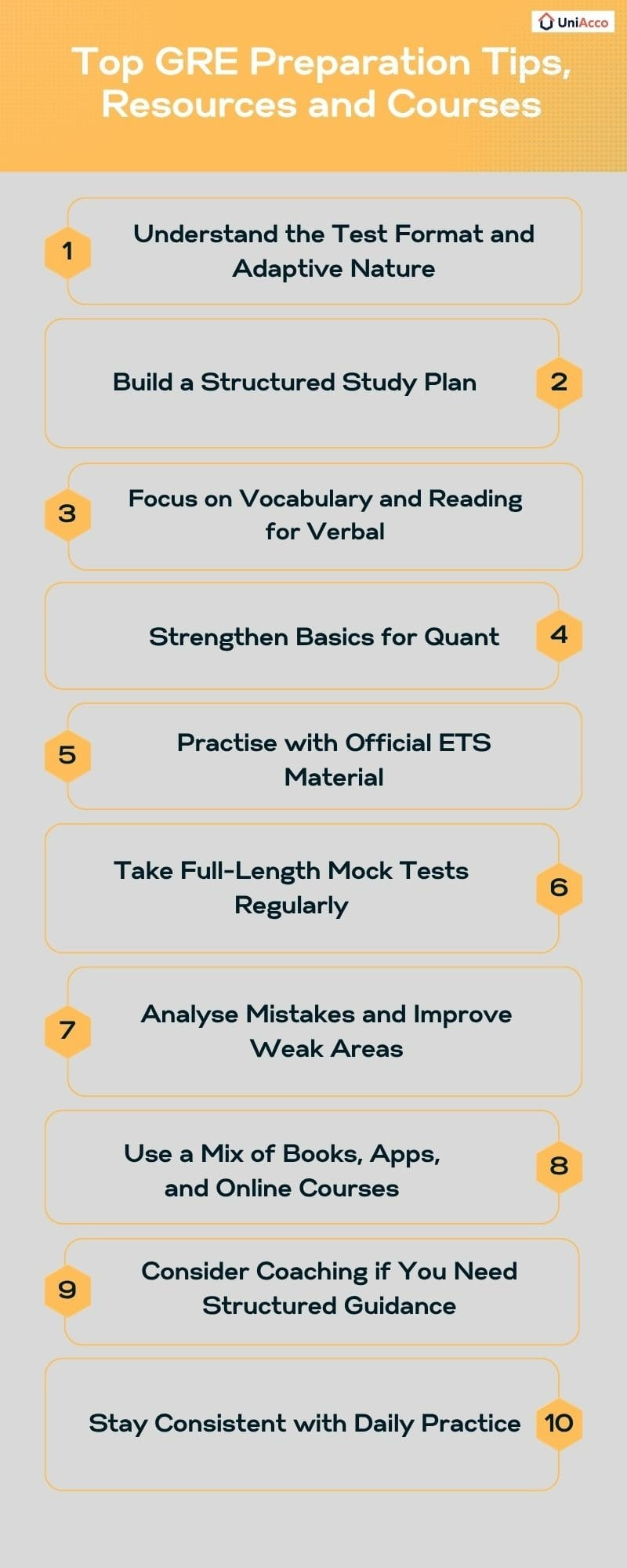
Most people need to study for the GRE for two to four months, about an hour a day, to attain the score they want. Here is what really makes a difference:
- Understand the Test Format and Adaptive Nature
The first thing you need to wrap your head around before you attempt a single practice question is how the section-adaptive structure actually works. Your performance in the first Verbal and Quant sections directly determines how difficult your second sections will be, and your second sections determine your score ceiling. Going in without understanding this means you could be making strategic mistakes without even realising it, so spend time on this before anything else.
- Build a Structured Study Plan
The most common mistake people make at the start of GRE preparation is building a study plan based on assumptions. They assume what they are good at and what they are not. But that’s not the right way. The right way is to take a free diagnostic test on ets.org before you plan anything. The goal is to find out where you genuinely stand across each section, and then build your schedule around closing those specific gaps.
- Focus on Vocabulary and Reading for Verbal
You need to understand how words function within Text Completion and Sentence Equivalence questions. The best way to build this skill is to read widely and consistently. Focus on quality journalism, academic essays, and long-form non-fiction; they all help. Pair that with a flashcard app to steadily expand your vocabulary. You’ll soon start to notice the difference in how you approach these questions over time.
- Strengthen Basics for Quant
The maths on the GRE sits at roughly GCSE standard — up to high school level — and does not extend to A-level complexity. You will need to cover arithmetic, algebra, geometry, and data analysis. However, the concepts themselves aren’t advanced. What catches people out is how the questions are framed under time pressure. It’s not the difficulty of the maths itself. Go back to the basics, make sure your foundational understanding is solid, and then practise working through problems quickly rather than carefully.
- Practise with Official ETS Material
POWERPREP Online is ETS’s free practice test tool, and it uses real questions, the real interface, and real scoring, which means it’s the most accurate preparation experience available to you outside of sitting the actual exam. When you register for the GRE, you get access to two free POWERPREP Online practice tests. POWERPREP PLUS tests are separate paid products available for purchase on ets.org. These are your most valuable preparation resources, so use them deliberately and strategically rather than burning through them at the beginning before you’ve done any serious preparation.
- Take Full-Length Mock Tests Regularly
When you sit a mock test, replicate the actual exam conditions as closely as you can, same time of day, phone away, for one hour and 58 minutes, no stopping halfway through because something came up. The reason for this is that you’re not just practising your knowledge of the content; you’re training your ability to sustain focus across the full length of the exam, and that’s something your brain genuinely needs to build up to rather than assuming it will just happen on the day.
- Analyse Mistakes and Improve Weak Areas
If you have taken enough mocks but your scores aren’t improving, the problem is that you aren’t analysing. Each incorrect answer has a reason behind it, whether that’s a vocabulary gap, a misread question, a rushed calculation, or a concept you haven’t fully understood yet.
- Use a Mix of Books, Apps, and Online Courses
Start with official ETS materials and treat everything else as supplementary. Once your solid foundation is built, you can focus on other platforms like Magoosh, Manhattan Prep, and Kaplan.
- Consider Coaching if You Need Structured Guidance
Self-directed preparation works well for a lot of people, but it doesn’t work for everyone, and if you’ve been studying consistently for several weeks without seeing meaningful score improvement, that’s a sign you might benefit from structured support rather than just doing more of the same. A good coach or structured course can identify exactly where your preparation is falling short and give you targeted feedback.
- Stay Consistent with Daily Practice
GRE will always reward those students who consistently practice towards their goal. If you are cramming everything at the last minute, the chances of success go lower. An hour of focused, deliberate practice every day for three months will more likely give you better results.
Got an offer from an Irish university? Secure your home away from home with UniAcco. Explore verified, top-rated, and affordable student accommodation in Ireland featuring fully furnished rooms, all-inclusive bills, and 24×7 student support for a smooth start to your study abroad journey.
🔍 Explore Student Accommodation in IrelandConclusion
The truth is that the GRE test isn’t as hard as it seems from the outside. It’s less than two hours long, there are easy steps to follow, and there is a lot of information about it. Go to ets.org/gre and take a free diagnostic GRE practice test. Then, based on your schedule, make a study plan that is realistic and gives you two to four months to consistently progress. After you acquire your score, the next thing to do is plan out where you’re going to stay when you get there.
UniAcco helps international students find verified, affordable accommodation near the world’s top universities, with 24×7 personal support and a lowest price guarantee. No guesswork, no nasty surprises. Browse Student Accommodation on UniAcco


 LinkedIn








0 Comments