
You just moved into your first house share, and you’re still trying to find the local Tesco. Then a letter from the council comes through the door. It’s official, it has numbers on it, and it asks about council tax. Brilliant.
Council tax is a charge paid to local councils across the UK to fund things like rubbish collection, street lighting, local schools, and emergency services. Most adults living in the UK are expected to pay it, and the bills are not small, often running into hundreds of pounds a year, depending on where you live.
However, if you’re a full-time student, you’re almost certainly exempt. But a lot of students don’t realise the exemption isn’t automatic, don’t apply for it on time, and end up getting chased for money they don’t actually owe. Others assume they’re covered when they’re not, because they moved in with a non-student flatmate, or because they finished their course and didn’t realise the exemption stopped the day their course ended.
So, do students pay council tax in the UK? If you are a full-time student, the quick answer is no. But, as always, the longer answer is “it depends.” This article explains what council tax is, who can get the student council tax exemption, when students have to pay, and how to properly claim the exemption so you don’t get an unexpected surprise halfway through the term.
What Is Council Tax in the UK?
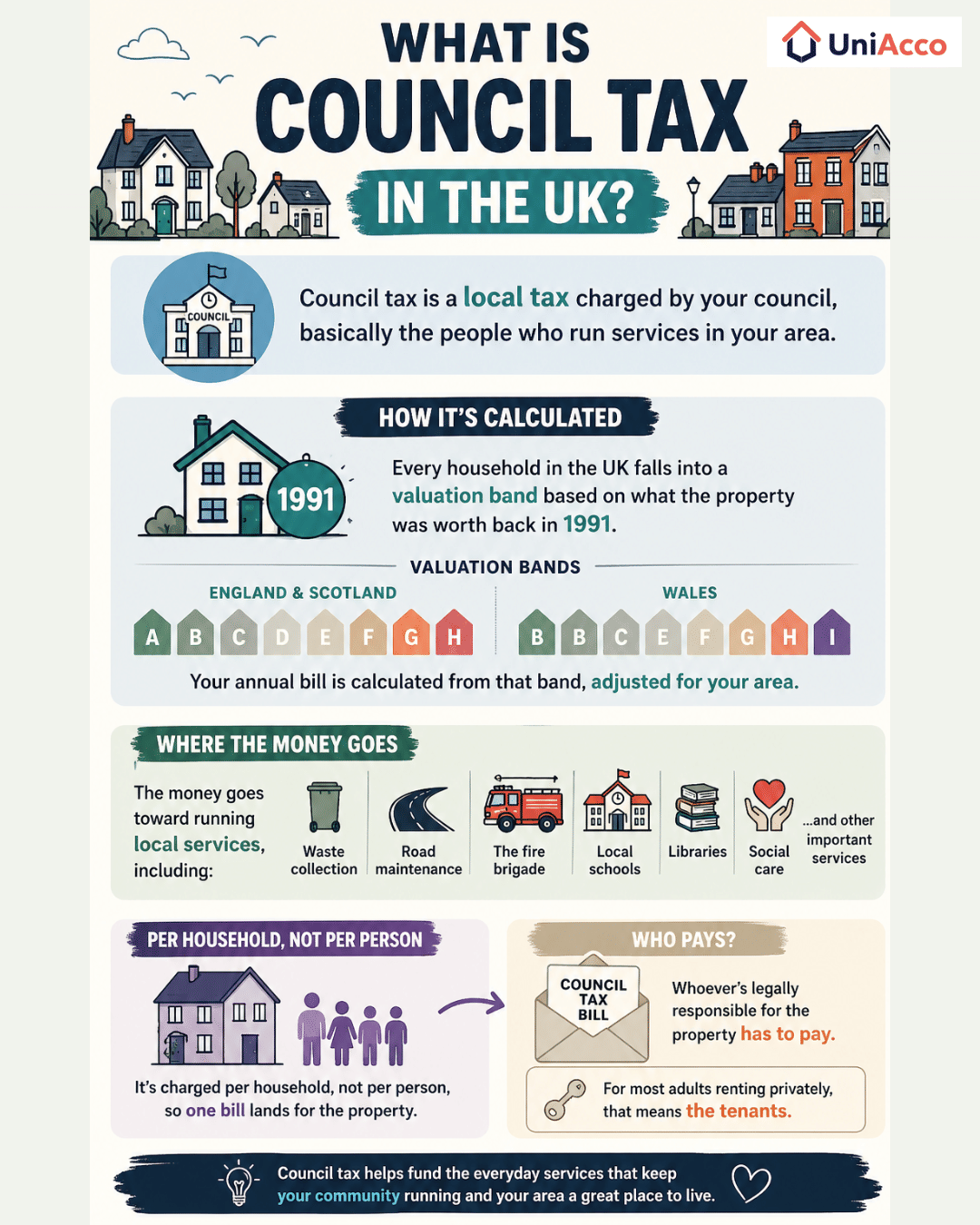
Council tax is a local tax charged by your council, basically the people who run services in your area. Every household in the UK falls into a valuation band (A through H in England and Scotland, A through I in Wales) based on what the property was worth back in 1991. Your annual bill is calculated from that band, adjusted for your area.
The money goes toward running local services: waste collection, road maintenance, the fire brigade, local schools, libraries, and social care, among other things. It’s charged per household, not per person, so one bill lands for the property, and whoever’s legally responsible for it has to pay. For most adults renting privately, that means the tenants.
Moving to the UK for university? UniAcco’s verified student properties come with support for all the essential paperwork, including council tax exemption guidance, so you can settle in with ease.
🔍 Explore UK Student HousingWho Is Exempt from Council Tax in the UK?
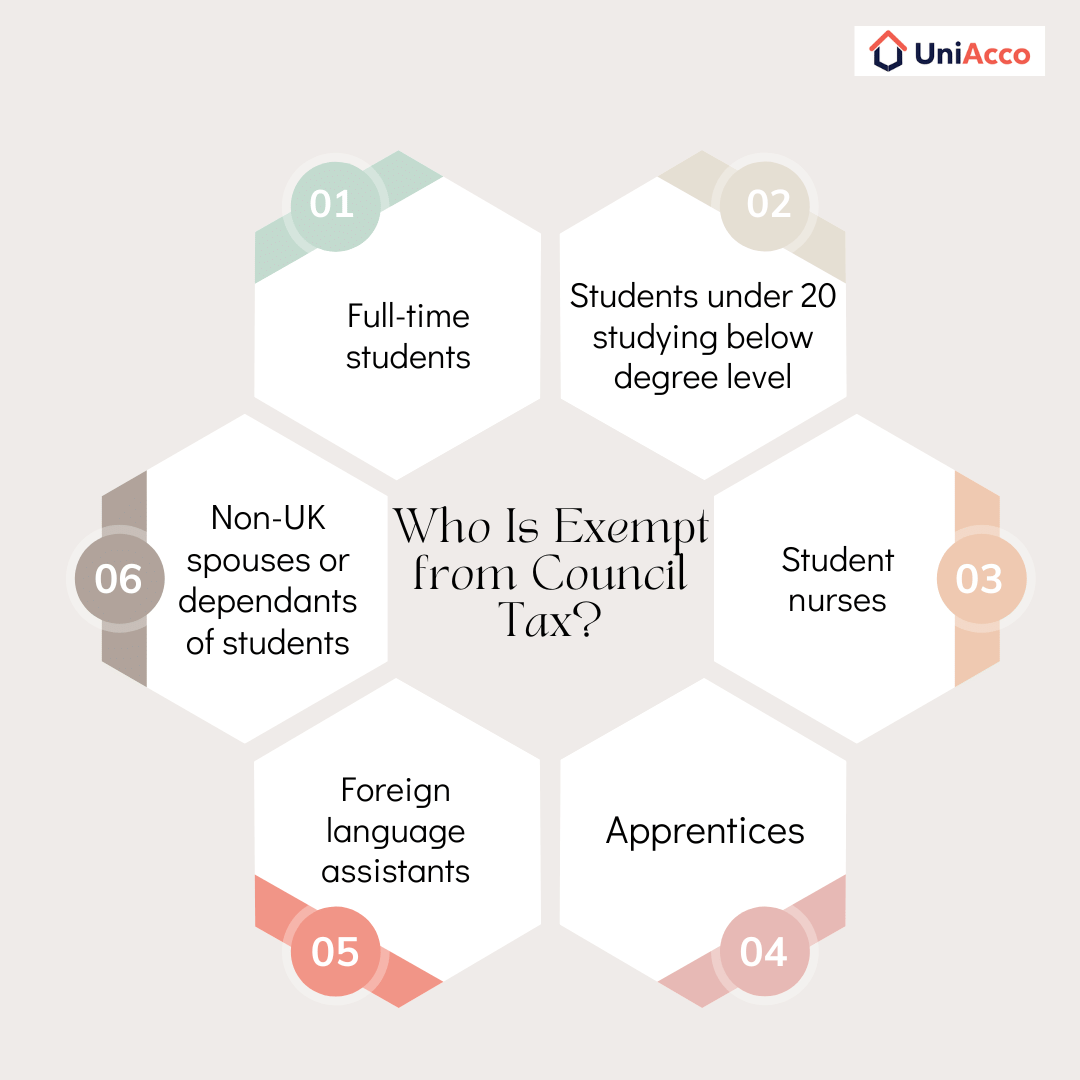
Here’s where students catch a break. Under UK law, certain groups are classified as “disregarded persons”, which means the council acts as though they don’t exist when calculating who owes what. Full-time students are one of those groups.
- Full-time students
If their course lasts at least one academic or calendar year, runs for at least 24 weeks of the year, and includes at least 21 hours of study, tuition, or work experience per week during term time, they don’t have to pay council tax.
Those 21 hours include independent study; it’s not just contact hours. As long as you’re enrolled and actively studying, you’re covered for the duration of your official course dates. This applies whether you’re an undergraduate, a postgraduate, or an international student; the rules are the same regardless of nationality.
“Households where everyone’s a full-time student do not have to pay Council Tax. If you do get a bill, you can apply for an exemption.” – GOV.UK
Other groups who are also disregarded include:
- Students under 20 studying below degree level
If you’re on an A-Level equivalent course lasting at least three months and studying at least 12 hours a week, you’re also exempt.
- Student nurses
If your course would lead to your first registration with the Nursing and Midwifery Council, you may qualify as either a full-time student or as a disregarded person in your own right, even if your programme isn’t classified as a standard full-time degree.
- Apprentices
If you’re on a formal apprenticeship working toward a qualification and earning no more than £195 a week, you can be disregarded.
- Foreign language assistants
If you’re registered with the British Council and working in a UK school or college as a foreign language assistant, you also qualify for the council tax exemption for students (or its equivalent disregard).
- Non-UK spouses or dependants of students
If you’ve brought a partner to the UK on a visa that restricts them from working or claiming benefits (“no recourse to public funds”), they can also be disregarded, as long as you provide proof of their visa conditions to the council.
When Do Students Have to Pay Council Tax in the UK?
The exemption is real, but it’s not unconditional. There are several situations where a student can end up on the hook for council tax, or where someone in their household will be.
- Part-time students
Part-time students are not exempt. If your course doesn’t meet the 21-hours-per-week or 24-weeks-per-year threshold or if it’s officially classified as part-time by your institution, you don’t qualify for the student council tax exemption. You may be able to apply for Council Tax Reduction if you’re on a low income, but you won’t be automatically disregarded.
- Living with non-students
This is where things get complicated. If even one adult in your household is not a full-time student, the property is no longer fully exempt. The non-student(s) become liable for the bill, but not legally. The other roommates might ask you to contribute. However, if there’s only one non-student living with full-time students, they’ll get a 25% discount because everyone else in the house is disregarded. It’s worth knowing this so your non-student housemate isn’t blindsided either.
- Course completion or withdrawal
This ends your exemption immediately. Your exemption runs from your official course start date to your official course end date, the one on your student record, not your graduation ceremony date.
The day after your course officially ends, you’re liable. If you withdraw from your course, the same applies from the date of withdrawal. If you’re between finishing one degree and starting another, you’ll need to pay council tax in that gap, even if it’s just a few months over summer.
- Postgraduate writing-up periods
This is a grey area. Some councils will extend exemptions for students who are completing their thesis but are no longer formally registered, others won’t. It depends on whether your institution has officially extended your course end date. If your department gives you extra time to submit but doesn’t formally update your course end date, don’t assume you’re still covered.
Living Situations and Council Tax Rules in the UK
- All students in one property
If every adult living in the property is a full-time student, the property is entirely exempt. No bill, no payment, done. But you all need to apply individually and provide proof. The exemption doesn’t apply until the council has confirmed it.
- Mixed households
If you live with even one non-student adult, that person becomes liable for the council tax bill. Students in the house are still disregarded, which may reduce the bill (particularly if there’s only one non-student), but someone is paying. Make sure your non-student housemates are aware of this before you all move in together.
- Private rentals vs university accommodation
Most university-managed halls are classed as properties “occupied only or mainly by students” and are automatically exempt. You generally won’t need to do anything. Private rentals, however, are a different story; you will almost always need to apply yourself and submit your student certificate. Some private student accommodation providers (PBSAs) handle the exemption on your behalf, but don’t assume. Check with your landlord or accommodation provider first.
Tired of worrying about council tax bills? Find verified student accommodation in Edinburgh with UniAcco and get support with student council tax guidance and complicated housing paperwork.
🔍 Explore Edinburgh Student HousingStep-by-Step Guide to Apply for Student Council Tax Exemption in the UK
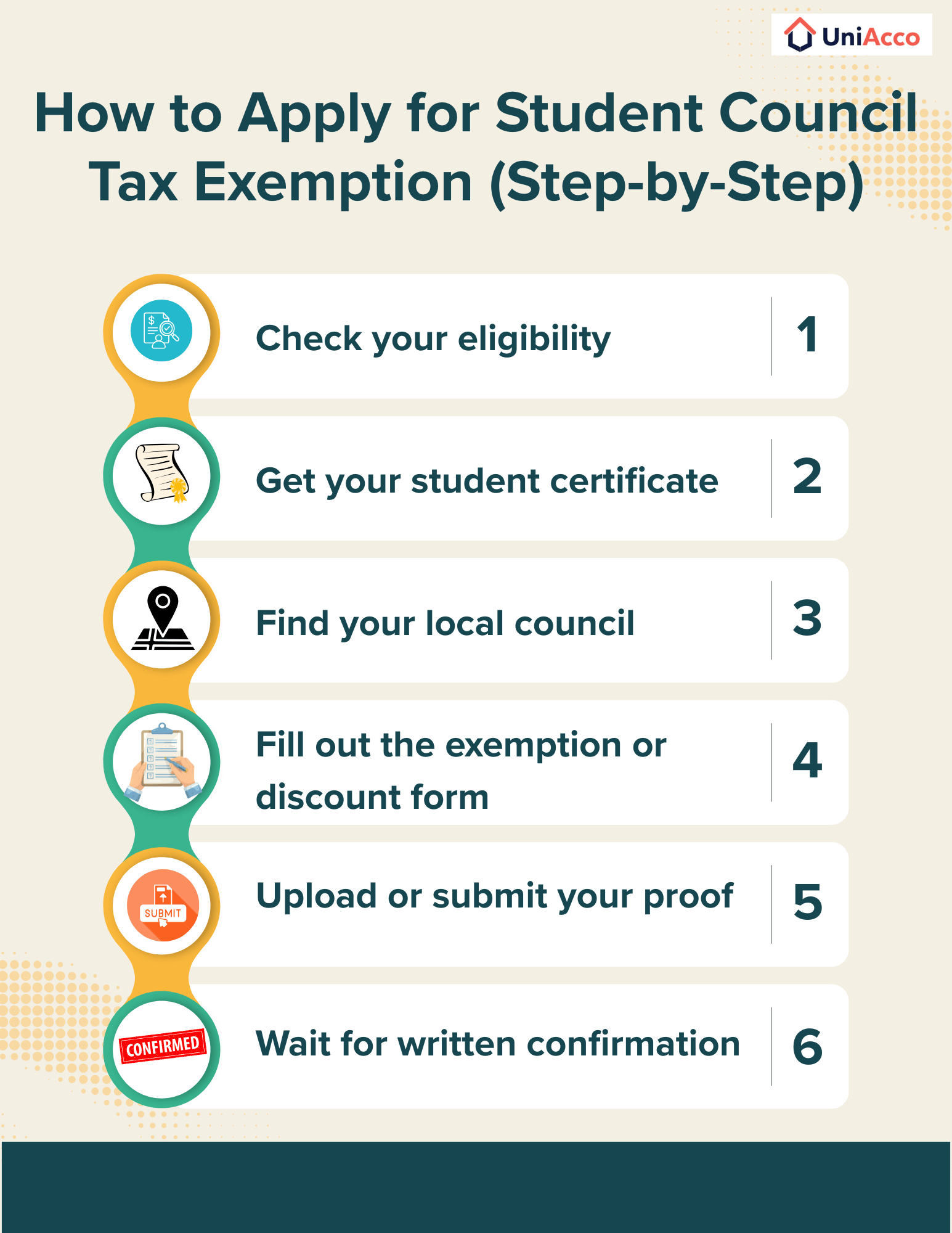
The process is not complicated; it just needs to actually happen. Here’s how to do it.
Step 1: Check your eligibility
Confirm you’re enrolled on a full-time course that meets the criteria, at least one year in length, at least 24 weeks of the year, and at least 21 hours of study per week during term time. If you’re unsure, contact your university’s student services team.
Step 2: Get your student certificate
You can get a ‘council tax student certificate’ or ‘confirmation of student status’ letter from your university. Most colleges and universities have this available through their student portal, register office, or student services department. Your name, the name of your school, the start and end dates of your course, and proof that you are a full-time student should all be on it.
Step 3: Find your local council
Use the GOV.UK “Find your local council” tool to locate the correct council for your address. Your university’s council and your home address council may be different; make sure you’re contacting the right one for where you’re actually living.
Step 4: Fill out the exemption or discount form
Most councils feature a form on their website just for people who want to apply for a student council tax exemption. Some will want to know about everyone who lives in the property, so have your housemates’ information ready if they ask for it.
Step 5: Upload or submit your proof
Attach your student certificate. Some councils accept it by email or online upload; others prefer post. Keep a copy for yourself regardless.
Step 6: Wait for written confirmation
After the council looks over your application, they will send you a letter saying that you are exempt. Keep that proof. You will have to apply again for your new address if you move while you are taking the course.
Do this as soon as you move in, not when a bill arrives.
Wanna know how students applied for the student council tax exemption? Explore this Reddit thread to learn.
Anyone managed to get council tax exemption? – r/OpenUniversity
Common Mistakes Students Make
- Assuming the exemption is automatic
It is not. Even if your entire house is full of full-time students, you still need to apply and submit your student certificates. The council will not assume you’re exempt; they’ll send a bill.
- Not telling the council when you move
Your exemption is tied to a specific address. If you move mid-year, you need to inform your old council that you’ve left and apply fresh at your new address.
- Ignoring letters from the council
This is a big one. If you receive a council tax bill and you believe you’re exempt, don’t bin it and hope for the best. Write to the council to explain the situation and submit your student certificate. Ignoring formal correspondence can escalate to enforcement action, including debt collectors, even if the original bill was wrong.
- Not checking the household status carefully enough
A lot of students think they’re fine because they’re full-time students. But if one housemate is part-time, has dropped out, or finished their course, the household’s status changes. The do students have to pay council tax question isn’t just about you; it’s about everyone living under the same roof.
Now that you know what Council Tax is in the UK, it’s time to sort your student accommodation in London with UniAcco. Explore verified properties with flexible bookings and no complicated contracts.
🔍 Explore Student Housing in LondonConclusion
So, do students pay council tax? Most of the time, no, but only if you’re enrolled full-time, you actually apply for the exemption, and your living situation qualifies. Full-time students, including international students and postgrads, are disregarded under UK council tax law. But part-time students, anyone living with non-student adults, and anyone whose course has officially ended are in a different territory.
The exemption is genuinely straightforward to claim. Get your student certificate from your university, find your local council online, and submit the form. The problem is that most students who end up with unexpected bills simply didn’t do it on time, or didn’t realise the rules had changed when something in their situation shifted.
Check your eligibility, apply early, keep copies of everything, and if in doubt, go straight to GOV.UK or call your local council directly. They’d rather sort it out before it escalates. Already sorted your exemption, but still need somewhere to live? UniAcco connects students with affordable, verified accommodation across the UK, no hidden bills, no surprises. Start your search now.


 LinkedIn








0 Comments