
At some point in the MBA journey, most people have a moment where they type “what is GMAT exam” into a search bar at 11 pm, discover there’s an entire updated version they didn’t know about, and spend the next hour reading things that contradict each other.
So let’s fix that upfront.
The GMAT test is now different. The original four-section format is no longer in use as of February 2024. You’re taking the GMAT Focus Edition right now. It is now shorter, sharper, and tailored to test the skills that modern business schools really care about.
This guide covers everything you need, what the GMAT test is, who can take it, what’s on it, what it costs, how to register, how to prepare, and whether you should take the GRE instead. By the end of this, you’ll have a clear picture of what you’re walking into and exactly how to prepare for it.
What is the GMAT Exam & Who Can Take It
The GMAT exam, full form: Graduate Management Admission Test, is a standardised computer-adaptive test administered by the Graduate Management Admission Council (GMAC). Its purpose is straightforward: to give business schools a consistent, globally comparable measure of a candidate’s readiness for rigorous graduate-level education.
What is the GMAT exam, in a 40-word definition? The GMAT is a standardised graduate admissions test administered by GMAC that assesses quantitative reasoning, verbal reasoning, and data analysis skills. Accepted by over 7,700 programmes at 2,400+ universities globally, it is the primary entrance exam for MBA and other graduate business programmes.
As for who accepts it, the list is long. Harvard, Wharton, INSEAD, London Business School, ISB, IIM (for Executive MBA), and thousands of other programmes worldwide all accept GMAT scores. In fact, 9 out of every 10 new MBA enrolments are made based on GMAT scores, according to GMAC data. Beyond MBA programmes, many MiM (Master’s in Management) and MFin (Master’s in Finance) programmes now accept the GMAT as well.
Who can take it? Almost anyone. There are no strict academic prerequisites from GMAC’s side, no specific degree requirement, no minimum grade threshold, and no mandatory work experience needed to sit the exam. Students in their final year of undergraduate study take it. Mid-career professionals take it. People who graduated a decade ago take it.
GMAT Exam Syllabus and Scoring Breakdown
The current GMAT Focus Edition is built around three sections, each lasting exactly 45 minutes and carrying equal weight in the final score.
One particularly useful feature is that you can choose the order in which you complete the three sections. If Quantitative Reasoning is your strongest area and you want to start with confidence, you can do so. You can also bookmark questions within each section and go back to change up to three answers per section. There’s no penalty for guessing, and the test adapts in difficulty based on how you’re performing.
Here’s the full breakdown:
| Section | What This Section Asks | What It Tests | Score Range | Duration |
| Quantitative Reasoning | 21 multiple-choice problem-solving questions | Algebraic and arithmetic reasoning; applying numerical logic to solve problems; no calculator allowed | 60–90 | 45 minutes |
| Verbal Reasoning | 23 questions across Reading Comprehension and Critical Reasoning | Reading and understanding written arguments; evaluating logical structures; identifying flaws and assumptions | 60–90 | 45 minutes |
| Data Insights | 20 questions across 5 question types (incl. Data Sufficiency, Multi-Source Reasoning, Table Analysis) | Interpreting complex data sets; combining verbal, mathematical, and graphical information; on-screen calculator available | 60–90 | 45 minutes |
| Total Score | Combined performance across all three sections | Overall readiness for graduate business education | 205–805 | 2 hrs 15 mins |
A note on scoring: Total scores always end in a 5 (e.g., 615, 705, 755). Score validity is five years from your test date.
GMAT Eligibility Criteria
GMAC has kept the requirements deliberately open, so you’re not going to hit a wall of conditions before you’ve even registered. Here’s everything you need to know:
- Age Requirements
The minimum age to take the GMAT is 18, and there is no upper age limit whatsoever, so whether you’re a fresh graduate or someone returning to education after 15 years in the workforce, age is not something you need to worry about. If you’re between 13 and 17 and want to take it early, you can, but you’ll need written consent from a parent or legal guardian before you register, and you’ll need to sit the exam at a test centre rather than online.
- Educational Qualifications
GMAC doesn’t ask for any minimum academic qualification to sit for the GMAT. No specific degree, no minimum GPA, no particular subject background; if you want to take it, you can take it. The thing worth keeping in mind is that the universities you’re applying to will have their own requirements, and most MBA programmes do expect a bachelor’s degree at the point of application, so while the GMAT itself won’t turn you away, the programme you’re aiming for might if you don’t have a degree to go with it.
- Who Can Take the GMAT
Honestly, almost anyone. It doesn’t matter where you’re from, what you currently do for work, or what you studied. GMAC also makes proper accommodations for candidates with documented disabilities, things like extended time, screen magnification, and additional breaks, as long as you submit the relevant documentation before you register rather than trying to sort it out on the day.
- ID Proof Requirements
You’ll need to bring a valid, government-issued photo ID on exam day. If you are an international test-taker, a passport is the standard option. The one thing to double-check before you book is that the name on your ID exactly matches the name on your GMAT registration. Remember that even a small discrepancy can cause issues on test day. And honestly, it’s the kind of thing that’s much easier beforehand.
- Number of Attempts and Gap Between Attempts
You can take the GMAT up to five times within any rolling 12-month period, and a minimum gap of 16 calendar days is required between each attempt, regardless of whether you’re sitting it at a test centre or from home. If by some chance you hit a perfect 805, you’ll need to wait at least five years before you can retake it, which, realistically, is probably not the most pressing concern for most people sitting down to register.
- Lifetime Attempt Limit
GMAC removed the old lifetime cap, so there’s no longer a fixed limit on how many times you can take the GMAT over the course of your life. The five-attempts-per-year rule and the 16-day gap between sittings still apply, but beyond that, you’re not being cut off after a certain number of tries.
- Work Experience
GMAC doesn’t require any work experience to sit the exam, so you can take it straight out of university or even before you graduate if you want to get it done early. That said, if you’re planning to apply to a top MBA programme, most of them will expect somewhere between two and five years of professional experience by the time you actually apply, so it’s worth factoring that into your timeline even if it doesn’t affect whether you can register for the test.
Planning your MBA in the UK? Start by securing the right place to live. UniAcco helps students find verified and affordable student accommodation across the UK, backed by 24/7 support and a guaranteed lowest price.
🔍 Explore UK Student HousingGMAT Registration Process
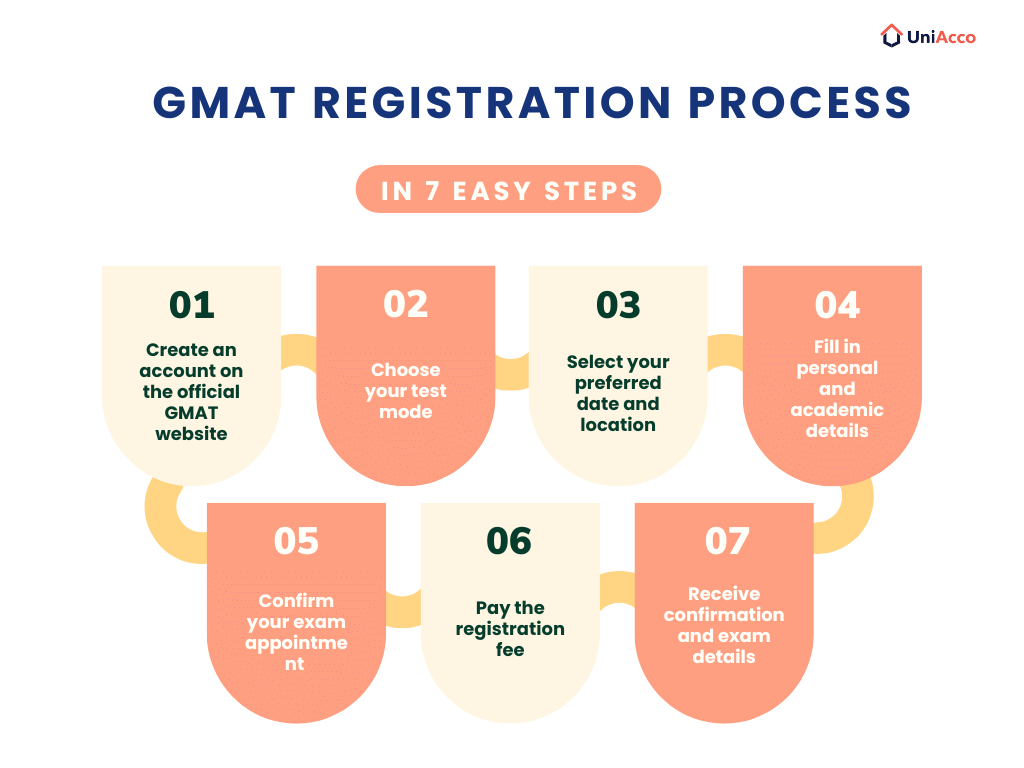
It’s easy to sign up, and you can do it all on the official GMAT website, mba.com. You can book your test up to six months in advance. Since slots at popular test centres fill up quickly around application deadlines, it’s really worth it to register early.
Here’s the step-by-step:
Step 1: Create an account on the official GMAT website
To make a free account on mba.com, use your name (just as it appears on your ID), email address, and phone number. This account will keep track of your registration, score history, and all emails related to the test.
Step 2: Choose your test mode
You can either take the test at an official test centre or online from home. The content, structure, and scoring of both versions are the same. The online version costs a little more (USD 300 instead of USD 275) and needs a strong internet connection, a quiet environment, and a device that works with it. There are test centres in more than 600 locations in 114 countries.
Step 3: Select your preferred date and location
Use the scheduling tool to look for open dates and test centre locations (or online time slots). You can take online tests any time of day or night, seven days a week. There are several time slots when test centres are open.
Step 4: Fill in personal and academic details
Fill out your profile using the personal information that is asked for during registration.
Step 5: Confirm your exam appointment
Review all details like name, DOB, test mode, date and place carefully before confirming your selected date, time, and test mode.
Step 6: Pay the registration fee
You can pay with a credit or debit card (Visa, Mastercard, American Express, Discover Network) or PayPal (only accessible in some areas). You can register by phone with Pearson VUE, but it costs an extra $10.
Step 7: Receive confirmation and exam details
A confirmation email will follow with your appointment details and exam day instructions. Keep this for reference.
“The GMAT is a lot more than just applying to business school. I learned a lot of practical stuff from a verbal perspective: reading a complex text, understanding it, and reading it in a structured way. It’s really helpful for me now at work and also in university.”– Enrico Tritto, MBA student (mba.com)
Scored well on the GMAT and planning your move to Australia? Explore verified, fully furnished, and affordable student accommodation with UniAcco. Book your room before you land and enjoy 24/7 support throughout your journey.
🔍 Explore Student Housing in AustraliaTop GMAT Preparation Tips, Resources & Courses
- Understand the Exam Pattern and Scoring System
Before you open a single practice book or attempt a single question, you should sit down and actually understand how the GMAT works. You need to understand the scoring pattern, the types of questions and the meaning of computer adaptive. A lot of people skip this step because it feels like admin rather than real preparation, but going in without understanding the format is like trying to win a game without knowing the rules first.
- Build a Realistic Study Plan
Start by taking a diagnostic test on mba.com so you know where you actually stand right now, not where you think you stand; these are two very different things. Most people need somewhere between 8 and 16 weeks, depending on their starting point, so work backwards from your exam date and build your schedule around the sections that need the most work, not the ones you’re already comfortable with.
- Focus on Concept Clarity, Not Memorisation
The GMAT barely cares whether you can recall your syllabus; it cares whether you actually understand what you are doing. When you are working on Quant, you need to know why a formula works. When you are focusing on verbal, you should understand the argument structure. In Data Insights, it means pulling meaning from graphs, tables, and multiple sources at the same time. If something isn’t clicking, go back to the concept rather than just piling more practice questions.
- Practise with Official GMAT Questions
Official questions from mba.com are in a different category from everything else, and the reason is simple: they’re made by the same people who write the actual test. The free practice tests use the same algorithms as the real exam, which means the experience you get from them is as close as it gets without actually sitting the test. Use them consistently throughout your preparation, not just at the end.
- Take Regular Mock Tests
Taking a full-length mock test every two to three weeks does two things for you. It gives you an honest picture of where your score actually is, and it trains your brain to maintain concentration across the full length of the exam, because the GMAT is a stamina test just as much as it is a knowledge test, and that’s something you have to specifically prepare for.
- Analyse Your Mistakes, Not Just Your Scores
If your mock scores aren’t improving between tests, the problem almost certainly isn’t that you need to do more questions. The problem lies in not checking what went wrong. Every incorrect answer is telling you something specific. It tells you whether it’s a concept gap or if you have just misread a question due to time constraints. Track your mistakes, look for patterns, and address those directly.
- Use Official GMAT Guides and Question Banks
The official GMAT Focus Edition prep materials on mba.com include two free full-length practice tests, a question bank, and an adaptive prep tool that adjusts to your performance over time. These should be your primary resource throughout your preparation; they’re free, accurate, and they’re made by the people who set the exam.
- Explore Online Prep Platforms and Coaching Courses
If you want more structured support, platforms like e-GMAT, Magoosh, and Manhattan Prep are good options. Most of these give you free trials, so you should explore a couple before you commit to paying for anything. If you prefer learning from video explanations, an online platform is a better option for you.
- Combine Free Resources with Paid Courses if Needed
You don’t have to invest a lot of money initially. You have free access to mba.com, GMAT Club forums and YouTube explanations. These alone cover a considerable practice ground. You can opt for paid courses when a specific section isn’t improving despite consistent self-study.
- Work on Time Management and Accuracy Together
Time management is something a lot of students plan to focus on later in their preparation. But that’s usually a mistake because the habits form early, whether you’re paying attention to them or not. Each section gives you 45 minutes. This is actually tight for 21 Quant questions, slightly more forgiving for 23 Verbal questions, and variable for Data Insights depending on complexity. You need to practice pacing from the very beginning, so it becomes second nature rather than something you’re still figuring out on exam day.
- Join Study Groups or Forums for Support
GMAT Club at gmatclub.com is one of the most active communities of GMAT test-takers in the world, and it’s completely free. You’ll find verified explanations for thousands of official questions, score improvement stories from people who’ve already been through the process, and a community going through exactly the same preparation you are. When studying starts to feel isolating, and at some point it usually does, having somewhere to ask questions and share strategies makes a real difference.
Received an offer from an Irish university? Secure your accommodation with UniAcco and explore verified, top-rated, fully furnished student housing across Ireland with all-inclusive bills and 24/7 student support.
🔍 Explore Student Housing in IrelandConclusion
For most people, the GMAT exam is one of the first big steps on the way to getting an MBA, and you should treat it like one. Not because the score is important, but because studying for the GMAT promotes the kind of analytical, data-savvy thinking that you need for business school and a career in business.
UniAcco helps international MBA students find verified, affordable accommodation near the world’s top business schools, before you land, with 24×7 personal support and a lowest price guarantee.


 LinkedIn










0 Comments