
Introduction
Carrying a suitcase full of dreams across the globe requires research beyond glossy brochures and campus tours. The country you choose to study in influences everything: the classroom, curriculum, and ultimately the first job you get upon graduation. For instance, a one-year master’s in London will yield a very different experience from a research-led degree in Boston.
While both countries host elite institutions, world-class degrees, and a million opportunities, the decision between the UK and the USA comes down to your ambitions, budget, learning style, and long-term career plans. For instance, the UK has shorter programs and a lower cost of living than the US, but the US has more scholarship opportunities than the UK. Here, we have curated this guide around Study in the UK vs. the USA, comparing factors such as the cost of living, tuition fees, program structures, the scholarship landscape, post-study work opportunities, and visa regulations to help you pick a destination that fits your goals.
UK vs USA at a Glance
| Feature | UK | USA |
| Bachelor’s Degree | 3 years (4 in Scotland with placement) | 4 years |
| Master’s Degree | 1 year (Most Programmes) | 1.5 – 2 years (Most programmes) |
| Tuition Fees | £10,000–£30,000/year | $20,000–$60,000+/year |
| Living Costs | £10,000–£18,000/year | $12,000–$25,000/year |
| Scholarships | Moderate; competitive but available | More abundant, especially merit-based and assistantships |
| Curriculum | Specialised from the start; less flexibility | Flexible with electives, majors, minors, and interdisciplinary options |
| Post-Study Work | Graduate Route Visa is limited to 2 years (3 years for PhD) | OPT is limited to 1 year (3 years total for eligible STEM graduates) |
| Visa | Student Visa; generally straightforward | F-1 Visa; stricter process with additional financial documentation |
| Best For | Faster ROI, shorter programmes and lower living costs. | Research & Flexibility, wider course choices, and stronger funding opportunities. |
Why Study in the UK?
The United Kingdom is home to the world’s oldest universities, like Oxford and Cambridge, along with other prestigious institutions that make up the highly regarded Russell Group. Known for scholarly excellence and research-driven learning, the UK boasts a diverse student body from around the world. A melting pot of cultures, the UK welcomes students with its wider accessibility, shorter degree durations (3-year undergraduate and 1-year master’s), lower overall education costs, and internship opportunities.
Advantages
Internationally recognized universities
The name of your university is sometimes pivotal in opening doors for you. The UK treasures universities like Oxford, Cambridge, and other Russell Group institutions, which are recognised by employers, universities, and professional bodies worldwide. From breaking the ice at networking events to making your elevator pitches memorable, a globally recognised university helps you in more ways than you can imagine.
Post-study work opportunities
To be honest, the most important factors in pursuing education are cost and ROI. The Graduate Visa is a highly beneficial route that allows international students to remain in the UK for at least 2 years after graduation (3 years for doctoral students) to find employment and gain work experience.
Strong research infrastructure
A scoop from the most recent Research Excellence Framework (REF) reveals that 30% of UK university research is classified as ‘world-leading’ and 46% as ‘internationally excellent’. Studying in the same intellectual milieu while learning from the very people creating ripples across the world in science, technology, and the arts will help you jumpstart your career ambitions, especially if you’re inclined towards research.
Challenges
Shorter Program Durations
Working part-time shifts, attending social events, running to university lectures, completing assignments, and securing a job is a little difficult to achieve in just one year of study. Most postgraduate programs in the UK run for one year. For students who wish to pursue a long-term career, a longer-duration course helps them settle down, understand local culture, and set aside time to search for work opportunities without compromising their attendance at the university lectures they literally blow their wallets on.
Competitive Admissions
Due to their global appeal, UK universities have a highly competitive admissions process, with limited spaces available for international students. Acceptance rates dip below 10% at some universities. It is advised that you assess your profile’s strengths and check whether you meet the academic standards and other requirements before blindly spending money on filing applications to universities. A chat with an alumnus or a current student on LinkedIn or by email could help you get a realistic view of your application’s strength.
Unpredictable weather
Apart from Oxford, Harry Styles, and Buckingham Palace, the UK is also known for its bipolar weather. The rotation of hours between a sunny morning, a gloomy afternoon, and a rainy night could leave students feeling a little sick, especially if they come from tropical countries. However, it totally depends on the student whether they wish to stay in during the gloomy weather or enjoy a rainy Pride and Prejudice confession in Wiltshire’s gardens.
Why Study in the USA?
We’ve all romanticised the American college experience on screen while watching Rory Gilmore and Blair Waldorf cross world-famous ivy-covered campuses of Harvard, Columbia, and Yale. The USA boasts a robust academic connection and unique institutions, with unmatched academic flexibility. For instance, Brown is known for its unique grading system and structure, in which students can choose their own combination of majors and minors. Moreover, generous research funding creates endless opportunities to help you explore your interests. With talent flowing in from all across the world, the USA definitely stirs a melting pot of cultures when it comes to curating its classrooms at these institutions.
Advantages
Academic Flexibility
If you’re unsure of whether you want to major in Economics, Computer Science, or Psychology, the US education system gives you ample time to figure it out. Typically, students explore different disciplines as a part of general modules in their first year before picking a major. The freedom to add a minor, pursue a double major, or even switch academic paths allows students to tailor their education closely to their interests and goals.
Research & Innovation
The US remains at the forefront of breakthrough discoveries, be it in artificial intelligence, biotechnology, space exploration, or renewable energy. Annually, universities invest billions of dollars in research, giving students access to cutting-edge laboratories and opportunities to collaborate with faculty at the forefront of their fields. So, if research is your calling, the United States might just be the best place to study.
Scholarships and financial aid options
It’s a known fact that studying in the USA is no chump change. However, the landscape around scholarships, grants, and assistantships definitely helps students reduce their burden. About 50% of undergraduates at the Ivy League receive some form of scholarship. With merit-based, need-based, leadership-centred, and other scholarships, the USA offers a wide range of scholarships to offset its high cost of living.
Challenges
Visa restrictions
The student visa in the US (usually an F1 visa) comes with a set of stringent rules. Students can work up to 20 hours per week on campus, but off-campus employment is severely limited, with certain programs such as CPT (Curricular Practical Training) and OPT (Optional Practical Training) as exceptions. Even so, the opportunities are fleeting and competitive. Going home to study is also complicated because visa renewal is required and entry checks are strict.
High Costs & Financial Burden
Hollywood may make campus life look effortless, but in addition to tuition, which usually costs between $40,000 and $80,000 a year, international students must budget for accommodation, health insurance, transportation, and other living expenses. While scholarships and part-time work can help, careful financial planning is key
Healthcare Costs
The only thing scarier than finals is a hospital bill without health insurance. Lacking the universal healthcare nets found in other student destinations around the world, US medical care is notoriously expensive, making mandatory health insurance a significant ongoing expense that usually costs around $20,000 if not covered in your university scholarship package.
UK vs USA Education System
There are a number of differences between the UK and US education systems, beyond simply how many years a degree will take. The curriculum, teaching approaches, levels of academic flexibility, and methods of examination all play a part in determining how education is structured in each country. Here’s a look at the top ones to help you work out the ideal system for you.
Undergraduate Structure
A typical bachelor’s degree in the UK lasts three years, whereas in the US it lasts four. However, the biggest difference between them lies in how you begin your degree. In the UK, students dive straight into their chosen subject from the first year, whereas in the US, universities encourage students to explore their interests in the first year before declaring a major. This gives them the flexibility to choose their specialisation according to their evolving interests, compared with students studying in the UK, who are already laser-focused on what they want to pursue from the start.
Master’s Programs
If you want to save some time, the UK has an advantage. Most taught master’s degrees are completed in just one year, allowing students to graduate sooner and enter the workforce faster. In the US, degree duration is around two years, allowing more time for research, internships, electives, and professional development.
Teaching Style
Both countries adopt very different styles of teaching. UK universities emphasise independent learning, allocating more time to self-study and research, with assessment through end-of-semester examinations. In contrast, US universities adopt a more interactive approach where everyday presentations, projects, and continuous assessments keep class participation high.
Decided to study in the UK after comparing the UK and US education systems? Let UniAcco help you find your ideal student home. Compare up to 4 properties side by side across 80+ parameters, including price, location, room type, amenities, and more, to choose the accommodation that best fits your needs and budget.
🔍 Compare & Find Student Accommodation in the UKTuition Fees Comparison
Tuition fees are the most expensive part of studying abroad. The United Kingdom, however, often comes out cheaper in total cost because its degree programs are shorter than those in America. For both UK and USA universities and for undergraduate, postgraduate, and PhD programs, tuition fees vary depending on the institution and course you take. Here is an estimation of general tuition fees for international students.
| Course | UK | USA |
| Undergraduate | £11,000–£38,000/year | $20,000–$50,000/year |
| Master’s | £12,000–£35,000/year | $20,000–$60,000/year |
| MBA | £25,000–£70,000 | $40,000–$100,000+ |
Tuition fees may vary depending on the university, course, location, whether the institution is public or private, and the level of study. Professional programs such as Medicine, Law, and MBAs generally have higher tuition fees.
Cost of Living in the UK vs the USA
The cost of living has a big bearing on deciding where to live. As everyday expenses add up, they should never exceed your budget, an important factor to keep in mind since living costs vary from city to city and country to country. Here’s a quick comparison to walk you through the cost of living in both the UK and the USA.
| Expense | United Kingdom | United States |
| Accomodation | £500–£1,500 | $700–$2,000 |
| Food & Groceries | £150–£350 | $250–$500 |
| Transportation | £50–£150 | $50–$200 |
| Entertainment | £100–£300 | $150–$400 |
| Utilities and Internet | £80–£200 | $100–$250 |
| Estimated Monthly Total | £900–£2,550 | $1,350–$3,650 |
Best Universities in the UK vs the USA
Top UK Universities
Home to some of the world’s oldest and most prestigious universities, the UK has long been a cradle of academic excellence, groundbreaking research, and cultural influence. From Nobel Prize-winning discoveries to literary masterpieces, the Russell Group universities continue to shape global education and innovation. Here’s a list of the top 5 universities that lead the global charts.
- University of Oxford
The s truly one of the highest-ranked and oldest universities in the world has educated over 30 British prime ministers, as well as literary giants like J.R.R. Tolkien and Lewis Carroll. Placed #4 in the QS World Ranking 2026, Oxford excels in humanities, medicine, law, and the sciences. Its centuries-old colleges and libraries have served as the backdrop for everything from discoveries to Harry Potter films.
- University of Cambridge
The second-oldest university in the UK, the University of Cambridge, has shared a centuries-long rivalry with Oxford since the thirteenth century. Ranked #6 in the QS World University Rankings 2026, it has produced over 126 Nobel Prize laureates and nurtured greats like Isaac Newton and Stephen Hawking, who conducted groundbreaking research that continues to influence science and innovation today.
- Imperial College London
Imperial College London stands as a global STEM powerhouse. Ranked #2 in the QS World University Rankings 2026, it has overtaken both Oxford and Cambridge in the global rankings. Home to penicillin pioneer Sir Alexander Fleming and musician-astrophysicist Sir Brian May, it majorly focuses on STEM and business degrees as its researchers continue to drive breakthroughs in AI, climate science, medicine, and space technology.
- University College London
UCL was the first university in England to welcome students regardless of religion and among the first to admit women on equal terms. Placed #9 in the QS World University Rankings 2026, its alumni include Mahatma Gandhi, Alexander Graham Bell, and Chris Martin, reflecting a legacy that spans politics, science, and the arts.
- University College London (UCL)
Ranked #9 in the QS World University Rankings 2026, UCL was among the first universities in England to admit students regardless of religion and later to welcome women on equal terms. The university’s alumni list ranges from Mahatma Gandhi and Alexander Graham Bell to Coldplay’s Chris Martin, reminding us that innovation isn’t confined to one discipline.
- University of Edinburgh
Ranked in the Top 50 of the QS World University Rankings 2026, the University of Edinburgh is renowned for its research excellence in medicine, artificial intelligence, and life sciences. The institution has educated minds like Sir Arthur Conan Doyle and Alexander Graham Bell, while its researchers made history by cloning Dolly the Sheep (the world’s first mammal cloned from an adult cell).
Top US Universities
We’ve all dreamed of walking in the footsteps of Elle Woods in Legally Blonde, Mark Zuckerberg in The Social Network, or Rory from Gilmore Girls. But outside of their celebrity status and picturesque campuses, the best universities in the USA make breakthrough discoveries and art. Here’s a look at five American institutions that are constantly breaking boundaries, inspiring innovation and producing some of the world’s most influential people.
- Harvard University
Harvard is the oldest university in the USA and is ranked #5 in the QS World University Rankings 2026. It has educated over eight US Presidents, 160 Nobel laureates, and business leaders like Bill Gates and Mark Zuckerberg, who famously dropped out to build global empires. From medicine to law and business, Harvard’s research continues to shape industries worldwide.
- Stanford University
Stanford is ranked #3 in the QS World University Rankings 2026 and is located in Silicon Valley. Many of its students have gone on to found companies such as Google, Netflix, Nike, and LinkedIn. Ideas from its classrooms often become Fortune 500 companies, as students focus on technology, engineering, entrepreneurship, and artificial intelligence.
- Massachusetts Institute of Technology (MIT)
MIT is ranked #1 in the QS World University Rankings 2026 for the fourteenth consecutive year. The university is known for scientific innovation, with research in robotics, AI, aerospace, and quantum computing that has changed modern technology. Its graduates have started companies that now earn trillions of dollars each year.
- Princeton University
With its ivy-covered grounds and gothic buildings immortalised in A Beautiful Mind, Princeton is home to some of the world’s most influential research in mathematics, theoretical physics, and public policy. Ranked #25 in the QS World University Rankings 2026, the university has nurtured Nobel Prize-winning discoveries and educated leaders such as Jeff Bezos and Michelle Obama.
- Yale University
Ranked #21 in the QS World University Rankings 2026, Yale is renowned for its liberal arts education, prestigious law school, and influential alumni network. It has educated five US Presidents, including George H. W. Bush and Bill Clinton. Its iconic Gothic campus has become as recognisable as the university’s reputation for academic excellence, thanks to TV shows.
Wondering whether to study in the UK or the US? Take a look at this Reddit thread where students have shared their first-hand experiences, comparisons, and insights to help you make an informed decision.
What are the differences between the UK and US university experience? – r/UniUK
Admission Requirements
United Kingdom
Applications to a UK university are relatively easy, though there will be academic and English-language entry requirements to meet. Unlike many other countries, the majority of UK universities will look more closely at the marks you’ve obtained and whether you have the right subject skills than at your extracurricular interests, so the aim should be to have a strong, comprehensive application. Here’s a list of application materials you might require while applying to a UK university:
- UCAS
Most undergraduate applications in the UK are handled through UCAS. With a single application, students can apply to up to 5 courses. UCAS makes the process simple by letting students track offers and deadlines in one place.
- Academic Transcripts
Universities look closely at your academic transcripts, including predicted or final grades, to decide if you are a good fit for the course. In the UK, doing well in subjects related to your chosen course is usually more important than extracurricular activities.
- IELTS/PTE
Since the UK is an English-speaking country, international students must demonstrate their English proficiency by taking exams such as IELTS or PTE Academic, unless they are exempt. Each university and course sets its own minimum score.
- Personal Statement
Your personal statement is your chance to explain why you’re passionate about your chosen subject and why you’re a good fit. UK universities value academic motivation and your “why” over a list of achievements. A personal statement is pivotal in turning admissions decisions around in your favour.
- Letters of Recommendation
Most universities in the UK require two academic references from a teacher or counsellor who can comment on your academic ability and potential or one academic and one professional referral (if you’re applying for postgraduate studies). This depends on the programme. A strong recommendation adds credibility to your application.
United States
American universities take your grades into account but look for more than just this to create a rounded view of who you are as a student. In addition to these elements, they will consider the rest of your application to help them form an overall understanding of you.
- Common Application
If you wish to apply to a number of U.S universities, it’s possible to do this using a single online application, the Common Application. All you have to do is input your details, documents, and essays once, and the Common Application will pass them on to the universities of your choice.GPA. Your GPA is a numerical representation of your overall achievement in high school.
- Personal Statement
Your application will also provide space to share more of yourself by explaining your experiences, your dreams, and your uniqueness.
- Recommendation Letters
Your teachers, mentors, and even school counsellors can provide you with an official letter of recommendation. They may include aspects of your personality and strengths which are not so apparent through your other applications and would therefore shed new light on who you are.
- Standardised Tests (if applicable)
Many universities do not require the SAT or ACT, but a small percentage still do, so please check each university’s specific admission requirements to see what they require.
- English Language
Most universities will require you to have taken an English proficiency test (i.e., IELTS, TOEFL, or PTE) if you have not grown up in a predominantly English-speaking country.
Scholarships in the UK vs the USA
Studying in the USA and the UK can become significantly more affordable with scholarships and financial aid. Although both countries offer scholarships to students from around the world, the types, eligibility criteria, and amounts of funding will differ. Below are some of the most common types of scholarships available in the USA and UK for international students.
UK Scholarships
- Chevening
This is a well-known UK government scholarship for future leaders seeking to pursue a one-year master’s degree. It pays for tuition, living expenses, and travel.
- Commonwealth Scholarships
The UK government funds these scholarships for students from eligible Commonwealth countries who want to do postgraduate studies. They help talented students who need financial support.
- GREAT Scholarships
UK universities and the British Council jointly offer these scholarships to international students. They help with part of the tuition fees for many different subjects.
- University-specific Awards
Many UK universities offer scholarships for students who demonstrate strong academic performance and leadership, or who need financial help. Each university has its own rules and award amounts.
USA Scholarships
- Fulbright
This highly competitive program funds graduate study, research, and cultural exchange in the United States, promoting academic excellence and international collaboration.
- Merit Scholarships
Awarded to students with exceptional academic, athletic, artistic, or leadership achievements. These scholarships may cover part or all of the tuition fees.
- Assistantships
Graduate students can receive tuition waivers and stipends by working as teaching or research assistants. These opportunities are common in master’s and PhD programs.
- University Grants
Many U.S. universities provide institutional grants to help reduce tuition costs. Awards may be based on academic merit, financial need, or a combination of both.
- Need-based Aid
Financial aid is awarded based on a student’s or family’s financial circumstances. Eligible students may receive grants, scholarships, or other forms of assistance to make education more affordable.
Student Visa Comparison
Securing a student visa is an essential step in studying abroad. Understanding the key requirements beforehand can help you avoid unnecessary application delays.
| UK | USA | |
| Visa Type | Student Route Visa is available for full-time study at a licensed institution. | F-1 Student Visa is granted for full-time study at SEVP-approved institutions. |
| Post-study Work | Graduate Route: 2 years (Bachelor’s/Master’s, 3 years (PhD). | (Bachelor’s/Master’s), 3 years (PhD).OPT: 12 months; STEM OPT: up to 36 months total. |
| Processing Time | Usually around 3 weeks, though timelines may vary by country and season. | Usually 2–8 weeks (varies). |
| Work During Studies | Up to 20 hrs/week during term and full-time during vacations (degree-level courses). | Up to 20 hrs/week on campus during term and full-time during breaks. |
Key Visa Requirements
The visa application process: you should begin once you receive an offer of admission, fill out your visa application form online, and pay the application fee. Attend a biometric appointment or visa interview depending on where you apply from.
- Required documents:
These include your passport, university admission letter, proof of financial support, educational documents, country-specific forms, and more.
- Proof of finances:
You will have to show that you have enough money in your account to take care of your tuition and living expenses throughout the entire length of study.
- Duration of visa:
Most student visas cover the length of the study course, but there may be a few weeks before the start and after the end of your studies, depending on the immigration laws of that country.
Most students worry about visa approvals, but your accommodation booking doesn’t have to be another concern. Book verified student accommodation in the USA with UniAcco and enjoy free cancellation if your visa is rejected or your university offer letter doesn’t arrive. Find fully furnished rooms with all-inclusive bills and book with confidence.
🔍 Explore Student Accommodation in the USAWork Opportunities During Study
If you end up Skyping home whenever you need a fancy latte or last-minute gig tickets, it probably isn’t the dream you’re living. Of course, having a part-time role is good for meeting your rent, but having that little extra bit for treats feels pretty rewarding. Not to mention that many student jobs and placements can be a great addition to your CV before you even leave university.
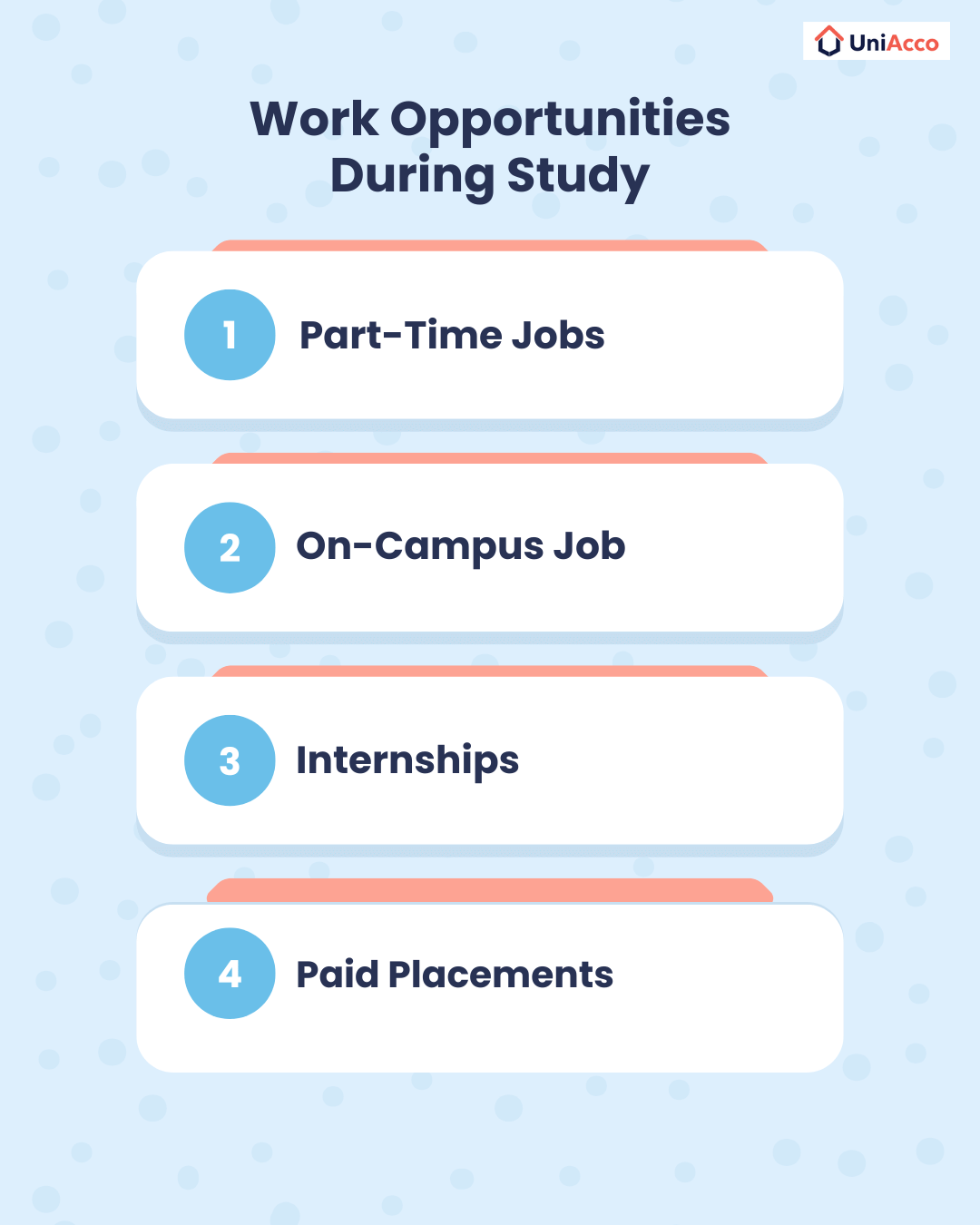
Part-Time Jobs
Most undergraduate students pursuing higher degrees in the UK are permitted to work 20 hours a week when school is in session. F-1 students in the U.S. can also work up to 20 hours a week on campus while attending school.
On-Campus Job
Opportunities abound at U.S. Universities for part-time roles ranging from assisting in the library and dining hall to helping out in student services. In the UK, opportunities at the universities are plentiful as well, though often you may find work on and off the campus.
Internships
These provide students with the opportunity to acquire practical, on-the-job training and develop contacts in the field. The U.S. Curricular Practical Training (CPT) allows eligible students to gain work experience during their studies by participating in an internship as part of their program.
Paid Placements
In many instances, the sandwich course structure of a U.S. Degree incorporates a paid work year; some U.S. Universities have co-op programs and internship opportunities that involve working with an established organisation.
Research Assistant Positions: Research assistantships are typical among postgraduate students, enabling them to engage in applied work and research in their field of study. These can sometimes provide compensation for the cost of study and stipends.
Post-Study Work Opportunities
You don’t have to jump on a plane as soon as your graduation ceremony is finished. International students can also make the most of the post-study work opportunities available in both the UK and the USA to get their careers off to a flying start and potentially turn them into longer-term opportunities.
| Factor | UK | USA |
| Post-study Visa | Graduate Route | Optional Practical Training (OPT) |
| Work After Graduation | Work in almost any job without employer sponsorship. | Work must be directly related to your field of study. |
| Eligibility | Complete an eligible degree and hold a valid Student Route visa. | Complete a degree and receive approval for OPT on an F-1 visa. |
| Duration | 2 years (Bachelor’s/Master’s), 3 years (PhD). | 12 months of Standard OPT; eligible STEM graduates can extend to 36 months total. |
| Transition to Employment | Can switch to a Skilled Worker visa if sponsored by an employer. | Many graduates transition to an H-1B work visa through employer sponsorship. |
Job Market & Career Opportunities
Everyone checks on Glassdoor for the “Which job pays the most?” question before making any study decision. Money is not everything, but knowing where you will be placed, what graduates typically earn, and which sectors are currently expanding can help you make a well-informed study abroad decision.
- Technology
Graduate salaries typically range from £30,000–£45,000 in the UK and $85,000–$110,000 in the USA. Consider that developers, cloud engineers, and cybersecurity professionals make technology a highly employable sector.
- Finance
Finance graduates can expect starting salaries of £35,000–£60,000 in the UK and $70,000–$100,000 in the USA. Opportunities are strong in investment banking, asset management, consulting, and the growing fintech sector. An aging workforce and ongoing workforce shortages ensure excellent long-term employability.
- Engineering
Engineering graduates typically earn £28,000–£42,000 in the UK and $75,000–$95,000 in the USA. Demand is steady across civil, mechanical, electrical, manufacturing, and renewable energy industries.
- Business
Business graduates usually start with salaries of £30,000–£40,000 in the UK and $65,000–$85,000 in the USA. Those with internship experience and strong communication skills have excellent employability in consulting, marketing, operations, and management.
- Artificial Intelligence
All AI graduates can earn £35,000–£50,000 in the UK and $100,000–$130,000 in the USA at entry level. AI is one of the fastest-growing fields, with employers seeking talent in technology, finance, healthcare, and manufacturing,
- Data Science
Entry-level data scientists usually earn between £32,000 and £50,000 in the UK, and $85,000 to $110,000 in the USA. As more businesses use data to make decisions, the need for skilled data professionals continues to grow across many industries.
Research Opportunities
If you want to be a researcher, an innovator, or a future academic, research experience could potentially make an enormous difference to your career path. You can find funding and industry links at globally renowned universities in both the UK and the USA.
- Research Funding
UK and US universities support students through scholarships, research grants, and assistantships. In 2023, the UK invested £72.6 billion in R&D, and US universities received billions in federal research funding annually.
- Innovation
The UK and the USA possess some of the most innovative university systems in the world, with universities in both countries leading technological breakthroughs. Students can participate in the groundbreaking innovation occurring in AI, biotechnology, clean energy, and medicine.
- Laboratories
Top universities provide access to world-leading laboratories, supercomputing facilities, and specific research centers. By using such facilities, students can engage with the latest technological advancements in their research projects.
- PhD Opportunities
Globally renowned PhD programs in both the USA and the UK can offer full or partial funding. For USA PhDs, funding often comes from research assistantships, whereas many UK PhD programs are funded by UKRI (the UK’s principal research funder), research councils, and scholarships offered by universities.
- Industry Connections
Often, universities partner with major firms such as Google, Microsoft, Rolls-Royce, AstraZeneca, and Pfizer to create and drive innovation through their students’ work. This grants access to real-world industry projects and internships, improving students’ career prospects.
Student Life in the UK vs the USA
There may be world-class academics in a top university, but unless you actually enjoy living there, you won’t have a well-rounded experience. It’s the food, lifestyle, student societies, accommodation, and weekend adventures that make up day-to-day university no matter where you stay. Here’s what everyday life looks like in the UK and the USA.
- Campus Life
UK universities offer greater independence in the classroom, whilst American campuses are famous for the social life fostered by residential living and a strong sense of community. In either location, you will have plenty of opportunities to socialise and discover new interests.
- Sports
Collegiate sports play an enormous role in student life in the USA, where American football matches draw enormous crowds. UK university sport is organised on a more informal basis through student-run leagues, and football, rugby, cricket, and rowing are particularly popular.
- Clubs & Societies
There are hundreds of student societies in the USA and the UK, from entrepreneurship, coding, and dance to debate; you’ll be able to find something that sparks your interest. A fantastic way to make friends, societies offer great opportunities for personal development outside of the lecture hall.
- Diversity
Both the UK and the USA have international student populations, with students welcomed from around the world to experience their educational systems and cultural landscapes. As an international student, you will be exposed to a variety of cultures, beliefs, and backgrounds.
- Living Arrangements
In both the UK and the USA, you will probably live in campus halls your first year, and after that, many move out into private flats or houseshares. You will have the option of low-cost halls or higher-quality student accommodation.
- Travel
Public transport in the UK is well connected, and as a student, you won’t need a car to get around by train or bus. In major US cities like New York and Boston, you can get around by public transport, but in most other regions, students are required to own a vehicle.
- Lifestyle
Beyond the classroom, festivals, campus activities, gigs, cafes, and outings to local cities are available to students in both the US and the UK. You can get involved in some of the best nightlife or keep things casual with events and day trips.
- Weather
The UK usually has mild weather and moderate rainfall year-round. The USA has a much wider range of climates, from cold winters to hot, humid summers.
- Travel Opportunities
From the UK, it’s easy and affordable to travel around Europe because of many short flights and good train connections. In the USA, you can explore a large country with national parks, different states, cities, and coastlines during your breaks.
Which Country Is Better for Different Students?
If you’ve gotten this far in the blog, you will understand there’s no single “best” solution between the UK and the USA. Choosing the best destination depends on whether you wish to graduate sooner, spend less, take advantage of more flexible programs, start your career in STEM, or live and study on a lively campus. Ultimately, with return on investment and potential careers in mind, don’t base your decision solely on university rank and tuition. The UK vs USA comparison table outlines how well each country aligns with individual students’ interests:
| If You Want… | Choose |
| Lower overall cost | UK |
| Shorter master’s | UK |
| Flexible curriculum | USA |
| Strong research opportunities | USA |
| Faster graduation | UK |
| Broad campus experience | USA |
| STEM careers | USA |
| Faster ROI | UK |
UK vs USA Pros and Cons
No country is perfect. Some will shave off time from your journey, others will add flexibility, and some will simply put you over your budget. Just be clear on what tradeoffs you’re willing to accept before you take the plunge. Here’s a quick run-through below.
UK
From student-favourite meal deals to historic universities that have educated geniuses for centuries, the UK stands out from anywhere else in the world. Here are the main pros and cons to consider before you start packing:
Pros
- Shorter degree: Most degrees are shorter, so you can finish school sooner and start your career earlier.
- Lower total study cost: Because courses are shorter, you usually spend less on tuition and living costs overall.
- Strong global recognition: UK universities are well respected, and employers around the world value their degrees.
- Simpler academic structure: You focus on your main subject from the start and don’t have to take many unrelated courses.
Cons
- Less curriculum flexibility: After you pick your course, it can be hard to switch majors or explore other subjects.
- Competitive admissions for top universities: Getting into the top universities is tough and usually means you need excellent grades and strong extracurriculars.
USA
If you go by Hollywood, college in the USA is all about football games, parties, late-night pizza, and fraternities. While movies get some things right, there are still areas where the real college experience stands out. We’ll show you where the US leads and where you might need to work a bit harder.
Pros
- Flexible learning: You can try out different subjects before choosing a major, so you have more time to find what interests you.
- Exceptional research ecosystem: Universities offer lots of research opportunities, with access to top professors, labs, and funding.
- Wide program choices: With so many schools and courses, you’re more likely to find a program that fits your goals.
- Strong alumni networks: Big alumni networks can help you find mentors, internships, and job opportunities after you graduate.
Cons
- Higher tuition and living costs: Studying in the USA usually costs more for tuition and living expenses than in the UK.
- Longer degree duration: Most bachelor’s degrees take four years, so you’ll spend more time in school before starting your career.
- More complex immigration pathways: After you finish studying, getting a job or staying long-term usually means more visa steps and employer sponsorship.
The right support can make all the difference. Just as alumni networks help you find mentors and internships, UniAcco helps you find safe, verified student accommodation in Massachusetts. Explore fully furnished rooms with all-inclusive bills, modern amenities, and convenient locations near leading universities.
🔍 Explore Student Accommodation in MassachusettsConclusion
Studying in both the UK and the USA offers robust networking opportunities, world-class infrastructure, and an academic milieu. If you’d like shorter, more specialised courses and a globally respected degree that still fits within your budget, the UK offers great value. If flexibility in the curriculum, large campuses, and opportunities for a longer stay will make your plan more realistic, then the USA can be a good option. Whether you study in the UK or the USA, your future will depend more on the opportunities you pursue, the people you meet, and the effort you put in than on the stamp in your student visa.









0 Comments