
You know that scene in every American college movie where someone opens a thick envelope, and their entire family loses their minds? That’s fiction, but the reason US universities carry that kind of cultural weight isn’t.
Over 1.1 million international students enrolled in US universities in 2024. This is proof enough that the US is the world’s most popular study destination by a strong margin. Also, several of the highest-ranked universities in the QS World University Rankings are American. The research infrastructure, the faculty, and the breadth of programmes available here are genuinely hard to replicate.
The best universities in the USA aren’t just prestigious, they’re ecosystems. This guide covers the top 10 universities in USA for international students, what they’re known for, what they cost, what it takes to get in, and everything you need to know before you start your application.
USA’s Top 10 Universities at a Glance
| University Name | QS Ranking 2026 | Key Highlights | Approx Annual Tuition (Intl.) |
| MIT | #1 | #1 globally 14 consecutive years; perfect Academic + Employer Reputation scores | USD 64,310 |
| Stanford University | #3 | Rose from #6; Stanford Research Park; Silicon Valley pipeline | USD 67,731+ |
| Harvard University | #5 | #1 Academic Reputation globally; USD 50bn endowment; need-blind aid | USD 59,320 |
| Caltech | #10 | 2,400 students; 46 Nobel affiliates; highest faculty-to-student ratio | USD 60,816 |
| University of Chicago | #13 | Back in the global top 20, an economic powerhouse, an intense core curriculum | USD 62,292 |
| University of Pennsylvania | #15 | Perfect Employment Outcomes score; Wharton is consistently ranked among the world’s top business schools. | USD 61,710 |
| Cornell University | #16 | Only upstate Ivy League; 14 colleges across entirely different disciplines | USD 61,015 |
| UC Berkeley | #17 | Best public university in the US; Bay Area tech recruitment pipeline | USD 48,726 |
| Yale University | #21 | Perfect Academic + Employer Reputation; Oxford-style residential college system | USD 57,700 |
| Johns Hopkins University | #24 | World’s largest public health school; home of American medicine | USD 59,630 |
Why Choose to Study in the USA?
- World-Renowned Universities and Academic Excellence
Five of the world’s top 10 universities are American, and the US has more institutions in the QS top 100 than any other country in the world. When people talk about the US being the gold standard for higher education, this is what they’re actually pointing to.
- Wide Range of Courses and Flexible Education System
One of the things that genuinely sets the US education system apart is that you’re not locked into a single subject from day one. The liberal arts model lets you major in computer science while taking philosophy, film, or economics alongside it. If you’re not completely certain about your direction yet, that flexibility is worth more than most people give it credit for.
- Strong Career Opportunities and Global Recognition
A degree from any of the universities on this list is a credential that employers and graduate schools in every country recognise and take seriously. You’re getting a signal on your CV that opens doors in industries and countries you might not even be thinking about yet.
- Access to Cutting-Edge Research and Innovation.
US universities collectively spend around USD 80 billion on research every year, and that number shows up in the labs, the equipment, the faculty you get access to, and the kinds of projects you can be part of before you even graduate. If you want to work on research that actually matters, the scale of what’s available here is genuinely hard to find anywhere else.
- Diverse and Multicultural Environment.
Over 1.1 million international students were studying in the US in 2024, which means regardless of where you’re coming from, you’re going to find your community here without having to look very hard for it. You’re not the outsider navigating a foreign environment; you’re one of over a million people doing exactly the same thing.
- Internship Opportunities (OPT/CPT)
Curricular Practical Training lets you work in your field while you’re still a student. Optional Practical Training gives you 12 months of work authorisation after you graduate, and if you’re in a STEM field, that extends to 36 months. That’s a meaningful amount of time to build real experience in the US before you have to make decisions about what comes next.
- Extensive Campus Facilities and Resources
Harvard’s USD 50 billion endowment, MIT’s world-class research labs, Stanford’s Research Park with 150+ companies on its doorstep- the infrastructure at these universities is genuinely exceptional. It shows up in the quality of your day-to-day experience as a student in ways that are hard to fully appreciate until you’re actually there.
- Global Networking Opportunities
Being a Harvard, Stanford, or MIT graduate means something specific in most industries and in most countries, and the people you study alongside are the ones who go on to run companies, lead institutions, and make decisions in fields you care about. That network is genuinely one of the most valuable things you take with you when you leave.
10 Best Universities in the USA for Students
The USA has some of the world’s best universities, with strong courses, research facilities and career opportunities. Here are 10 universities that international students can consider.
Massachusetts Institute of Technology (MIT)
MIT is one of the world’s leading universities for science, technology, engineering and business. It has around 11,500 students and a campus of about 168 acres.
Students at MIT work closely with professors and other students on research and projects. The university is a good choice for students who enjoy STEM subjects, engineering, technology and business.
Address: 77 Massachusetts Avenue, Cambridge, MA 02139
Acceptance Rate: ~3.5%
Location and Accessibility
| Where to Visit | Distance | Travel Time | How to Reach |
| Harvard Square | 1.5 miles | 10 mins | Red Line (T) |
| Boston Downtown | 3 miles | 15 mins | Red Line / Bus |
| Logan Airport | 5 miles | 20 mins | Silver Line |
UG & PG Courses to Study
| Course | Key Highlights | Eligibility | Average Fees (International Students) |
| BSc Computer Science & Engineering | AI, robotics, software and research | High school transcripts, SAT/ACT optional, IELTS/TOEFL | USD 60,000–62,000/year |
| BSc Mechanical Engineering | Manufacturing, robotics and aerospace | Strong Maths and Physics background, SAT/ACT, English test | USD 60,000–62,000/year |
| MSc Electrical Engineering & Computer Science | Machine learning, semiconductors and research | Relevant bachelor’s degree, GRE may be required, TOEFL/IELTS, SOP, LORs | USD 58,000–65,000/year |
| MBA – Sloan School of Management | Business, leadership, entrepreneurship and analytics | Bachelor’s degree, GMAT/GRE, work experience preferred, TOEFL/IELTS | USD 84,000–88,000/year |
Notable Alumni: Buzz Aldrin, astronaut, and Richard Feynman, Nobel Prize-winning physicist.
Student Accommodation: UniAcco helps students find verified and affordable student accommodation near top USA universities, with 24/7 support from searching to move-in.
Stanford University
Stanford University is well known for technology, business and entrepreneurship. It has strong links with companies in Silicon Valley, including Google, HP and other major technology companies.
The university is a good choice for students who want to study technology, business, entrepreneurship or subjects connected to innovation.
Address: 450 Serra Mall, Stanford, CA 94305
Acceptance Rate: ~3.7%
Location and Accessibility
| Where to Visit | Distance | Travel Time | How to Reach |
| Palo Alto Downtown | 2 miles | 10 mins | Bus / Bike |
| San Francisco | 35 miles | 45 mins | Caltrain |
| Google HQ | 8 miles | 20 mins | Bus / Car |
UG & PG Courses to Study
| Course | Key Highlights | Eligibility | Average Fees (International Students) |
| BA Computer Science | AI, software and technology innovation | High school transcripts, SAT/ACT optional, TOEFL/IELTS | USD 63,000–65,000/year |
| BS Biology | Biology research and biotechnology | Strong science background, English test | USD 63,000–65,000/year |
| MS Data Science | Data, AI, analytics and computing | Bachelor’s degree, GRE may vary, TOEFL/IELTS, SOP | USD 57,000–62,000/year |
| MBA – Stanford Graduate School of Business | Entrepreneurship, leadership and business | Bachelor’s degree, GMAT/GRE, work experience, TOEFL/IELTS | USD 82,000–86,000/year |
Notable Alumni: Larry Page and Sergey Brin, Google founders, and Reed Hastings, Netflix co-founder.
Harvard University
Harvard University is one of the most recognised universities in the world. It offers courses across subjects such as business, law, economics, computer science, medicine and public policy.
Harvard also provides financial aid to eligible students. Students should check the university’s official financial aid information to understand what support they may qualify for.
Address: Massachusetts Hall, Cambridge, MA 02138
Acceptance Rate: ~3.6%
Location and Accessibility
| Where to Visit | Distance | Travel Time | How to Reach |
| Harvard Square | On campus | Walk | — |
| Boston Downtown | 3 miles | 20 mins | Red Line (T) |
| MIT Campus | 1.5 miles | 10 mins | Red Line / Walk |
UG & PG Courses to Study
| Course | Key Highlights | Eligibility | Average Fees (International Students) |
| BA Economics | Economics, policy and finance | High school qualification, SAT/ACT optional, TOEFL/IELTS | USD 59,000–61,000/year |
| BS Computer Science | AI, computing and technology | Strong Maths background, English test | USD 59,000–61,000/year |
| Master of Public Policy | Public policy, government and global affairs | Bachelor’s degree, GRE recommended, TOEFL/IELTS | USD 57,000–60,000/year |
| MBA – Harvard Business School | Business, leadership and case-study learning | Bachelor’s degree, GMAT/GRE, work experience, TOEFL/IELTS | USD 76,000–80,000/year |
Notable Alumni: Barack Obama and Mark Zuckerberg.
California Institute of Technology (Caltech)
Caltech is a small university with around 2,400 students. It is known for science, engineering and research.
The university has strong links with NASA’s Jet Propulsion Laboratory (JPL), which is located nearby in Pasadena. Students also get opportunities to work on research projects and use advanced laboratories.
Address: 1200 E California Blvd, Pasadena, CA 91125
Acceptance Rate: ~3.8%
Location and Accessibility
| Where to Visit | Distance | Travel Time | How to Reach |
| Pasadena Old Town | 1 mile | 10 mins | Walk |
| Downtown LA | 10 miles | 25 mins | Metro Gold Line |
| JPL (NASA) | 3 miles | 10 mins | Bus / Car |
UG & PG Courses to Study
| Course | Key Highlights | Eligibility | Average Fees (International Students) |
| BS Physics | Theoretical and practical physics | Strong Maths and Science scores, TOEFL/IELTS | USD 63,000–66,000/year |
| BS Aerospace Engineering | Space research, aerodynamics and NASA-linked projects | High school transcripts, SAT/ACT optional, English test | USD 63,000–66,000/year |
| MS Applied Physics | Advanced research and laboratory work | Relevant bachelor’s degree, GRE may vary, TOEFL/IELTS | USD 58,000–63,000/year |
| PhD Chemical Engineering | Energy, materials and chemical research | Strong academic profile, GRE may vary, TOEFL/IELTS, research experience | USD 58,000–63,000/year |
Notable Alumni: Gordon Moore, Intel co-founder, and Linus Pauling, Nobel Prize-winning scientist.
University of Chicago
The University of Chicago is known for its strong focus on research, economics and academic learning. Undergraduate students study a wide range of subjects through the university’s core curriculum.
Students can study subjects such as philosophy, science, literature and history before focusing more deeply on their chosen field.
Address: 5801 S Ellis Avenue, Chicago, IL 60637
Acceptance Rate: ~5.4%
Location and Accessibility
| Where to Visit | Distance | Travel Time | How to Reach |
| Downtown Chicago | 7 miles | 25 mins | Metra Train |
| O’Hare Airport | 20 miles | 40 mins | Blue Line |
| Museum of Science & Industry | 0.5 miles | 5 mins | Walk |
UG & PG Courses to Study
| Course | Key Highlights | Eligibility | Average Fees (International Students) |
| BA Economics | Economics, data and research | High school qualification, SAT/ACT optional, TOEFL/IELTS | USD 67,000–70,000/year |
| BA Political Science | Politics, policy and global affairs | Academic transcripts, English test | USD 67,000–70,000/year |
| MSc Financial Mathematics | Finance, risk management and mathematics | Bachelor’s degree, GRE preferred, TOEFL/IELTS | USD 65,000–72,000/year |
| MBA – Booth School of Business | Finance, analytics and business | Bachelor’s degree, GMAT/GRE, work experience, TOEFL/IELTS | USD 80,000–84,000/year |
Notable Alumni: Milton Friedman, Nobel Prize-winning economist, and Barack Obama, who taught law at the university.
University of Pennsylvania
The University of Pennsylvania (Penn) is an Ivy League university in Philadelphia. The city gives students access to businesses, cultural attractions and other major cities on the US East Coast.
Wharton School is one of Penn’s best-known schools and is popular for business and finance. Students can also combine business with areas such as engineering, nursing and arts.
Address: 3451 Walnut Street, Philadelphia, PA 19104
Acceptance Rate: ~5.7%
Location and Accessibility
| Where to Visit | Distance | Travel Time | How to Reach |
| Centre City Philadelphia | 4 miles | 15 mins | SEPTA |
| Philadelphia Airport | 8 miles | 20 mins | SEPTA Regional Rail |
| Penn Museum | On campus | Walk | — |
UG & PG Courses to Study
| Course | Key Highlights | Eligibility | Average Fees (International Students) |
| BS Economics – Wharton | Finance, business and entrepreneurship | High school qualification, SAT/ACT, TOEFL/IELTS | USD 66,000–69,000/year |
| BS Nursing | Clinical training and healthcare | Science background, English test | USD 66,000–69,000/year |
| MSc Robotics | AI, robotics and automation | Relevant bachelor’s degree, GRE may be optional, TOEFL/IELTS | USD 52,000–58,000/year |
| MBA – Wharton School | Finance, consulting and leadership | Bachelor’s degree, GMAT/GRE, work experience, TOEFL/IELTS | USD 84,000–88,000/year |
Notable Alumni: Elon Musk and Sundar Pichai.
Cornell University
Cornell University is an Ivy League university in Ithaca, New York. The campus is surrounded by natural areas, including gorges and waterfalls.
The university has a large campus community and offers courses across technology, business, hospitality, science, engineering and many other fields.
Address: Day Hall, Ithaca, NY 14853
Acceptance Rate: ~6.9%
Location and Accessibility
| Where to Visit | Distance | Travel Time | How to Reach |
| Ithaca Commons | 1.5 miles | 10 mins | Campus Bus |
| Taughannock Falls | 8 miles | 20 mins | Car / Bus |
| New York City | 240 miles | 4 hrs | Bus / Car |
UG & PG Courses to Study
| Course | Key Highlights | Eligibility | Average Fees (International Students) |
| BS Computer Science | Technology, engineering and research | High school transcripts, SAT/ACT optional, TOEFL/IELTS | USD 65,000–68,000/year |
| BS Hotel Administration | Hospitality and hotel management | Academic records, English test | USD 65,000–68,000/year |
| MEng Computer Science | Software, AI and data | Relevant bachelor’s degree, GRE may be optional, TOEFL/IELTS | USD 58,000–63,000/year |
| MBA – Johnson Graduate School | Business, leadership and practical learning | Bachelor’s degree, GMAT/GRE, work experience, TOEFL/IELTS | USD 77,000–82,000/year |
Notable Alumni: Bill Nye and Ruth Bader Ginsburg.
University of California, Berkeley (UC Berkeley)
UC Berkeley is a leading public university in California. It is close to San Francisco and has strong links with the technology industry and Silicon Valley.
Students can study subjects such as computer science, engineering, business, data science and many other fields. The university also has a large campus of around 1,232 acres.
Address: University of California, Berkeley, CA 94720
Acceptance Rate: ~11.4%
Location and Accessibility
| Where to Visit | Distance | Travel Time | How to Reach |
| San Francisco | 14 miles | 25 mins | BART |
| Silicon Valley | 30 miles | 45 mins | BART / Car |
| SFO Airport | 20 miles | 35 mins | BART |
UG & PG Courses to Study
| Course | Key Highlights | Eligibility | Average Fees (International Students) |
| BA Computer Science | Technology, research and startup opportunities | High school qualification, TOEFL/IELTS | USD 48,000–52,000/year |
| BS Civil Engineering | Infrastructure, sustainability and engineering | Strong Maths and Science scores, English test | USD 48,000–52,000/year |
| Master of Information & Data Science | Data, machine learning and cloud technology | Bachelor’s degree, GRE not mandatory, TOEFL/IELTS | USD 70,000–78,000 total |
| MBA – Haas School of Business | Business, innovation and leadership | Bachelor’s degree, GMAT/GRE, work experience, TOEFL/IELTS | USD 78,000–84,000/year |
Notable Alumni: Steve Wozniak, Apple co-founder, and Gordon Moore, Intel co-founder.
Yale University
Yale University is an Ivy League university known for subjects such as law, arts, medicine, social sciences and public policy.
The university has a residential college system. Students live and study within smaller college communities while also being part of the wider Yale campus.
Address: 105 Wall Street, New Haven, CT 06520
Acceptance Rate: ~4.6%
Location and Accessibility
| Where to Visit | Distance | Travel Time | How to Reach |
| New Haven Green | 0.5 miles | 5 mins | Walk |
| New Haven Train Station | 1.5 miles | 10 mins | Walk / Bus |
| New York City | 80 miles | 1.5 hrs | Metro-North |
UG & PG Courses to Study
| Course | Key Highlights | Eligibility | Average Fees (International Students) |
| BA Global Affairs | International relations, diplomacy and policy | High school qualification, SAT/ACT optional, TOEFL/IELTS | USD 64,000–67,000/year |
| BS Biomedical Engineering | Healthcare technology and research | Strong STEM background, English test | USD 64,000–67,000/year |
| Master of Public Health | Public health, healthcare and policy | Bachelor’s degree, GRE may vary, TOEFL/IELTS | USD 50,000–58,000/year |
| MBA – Yale School of Management | Business, leadership and social impact | Bachelor’s degree, GMAT/GRE, work experience, TOEFL/IELTS | USD 82,000–86,000/year |
Notable Alumni: Hillary Clinton and Anderson Cooper.
Johns Hopkins University
Johns Hopkins University is particularly well known for medicine, public health and international relations.
The university has strong links with Johns Hopkins Hospital and offers students opportunities to study healthcare, research and public policy. Its School of Advanced International Studies (SAIS) also has a campus in Washington, D.C.
Address: 3400 N Charles Street, Baltimore, MD 21218
Acceptance Rate: ~6%
Location and Accessibility
| Where to Visit | Distance | Travel Time | How to Reach |
| Baltimore Inner Harbour | 3 miles | 15 mins | Bus / Car |
| Washington DC | 40 miles | 50 mins | MARC Train |
| BWI Airport | 12 miles | 25 mins | Light Rail |
UG & PG Courses to Study
| Course | Key Highlights | Eligibility | Average Fees (International Students) |
| BS Biomedical Engineering | Biomedical research and healthcare technology | High school transcripts, SAT/ACT optional, TOEFL/IELTS | USD 62,000–65,000/year |
| BS Public Health Studies | Healthcare, epidemiology and global health | Strong science background, English test | USD 62,000–65,000/year |
| MSc Biotechnology | Biotechnology research and industry | Relevant bachelor’s degree, TOEFL/IELTS, GRE optional | USD 50,000–57,000/year |
| MBA/MPH Dual Degree | Business, healthcare management and public health | Bachelor’s degree, GMAT/GRE, work experience preferred, TOEFL/IELTS | USD 65,000–75,000/year |
Notable Alumni: Woodrow Wilson, former US President, and Michael Bloomberg, businessman and former New York City mayor.
Cost of Studying in Top USA Universities
Harvard, MIT, Yale, and Penn all meet 100% of demonstrated financial need for international students, and families earning under USD 200,000 may pay nothing for tuition.
| Degree Level | Average Annual Tuition (USD) | Why Fees Vary | What This Means for You |
| Undergraduate (Private) | USD 54,000–63,000 | Prestige, endowment level, and facilities | Budget ~USD 85,000/yr total (tuition + living); check financial aid eligibility first |
| Undergraduate (Public — UCB) | USD 44,000–57,000 | Public funding partially offsets the cost | Lower fees without sacrificing ranking or career quality |
| Postgraduate (Coursework) | USD 55,000–85,000 | MBA at the high end; STEM Master’s lower | Teaching and research assistantships can significantly offset |
| PhD / Research | Often fully funded | Stipends and assistantships are standard | Many STEM PhDs cost nothing and include a monthly stipend |
Admission Requirements for Top Universities in the USA
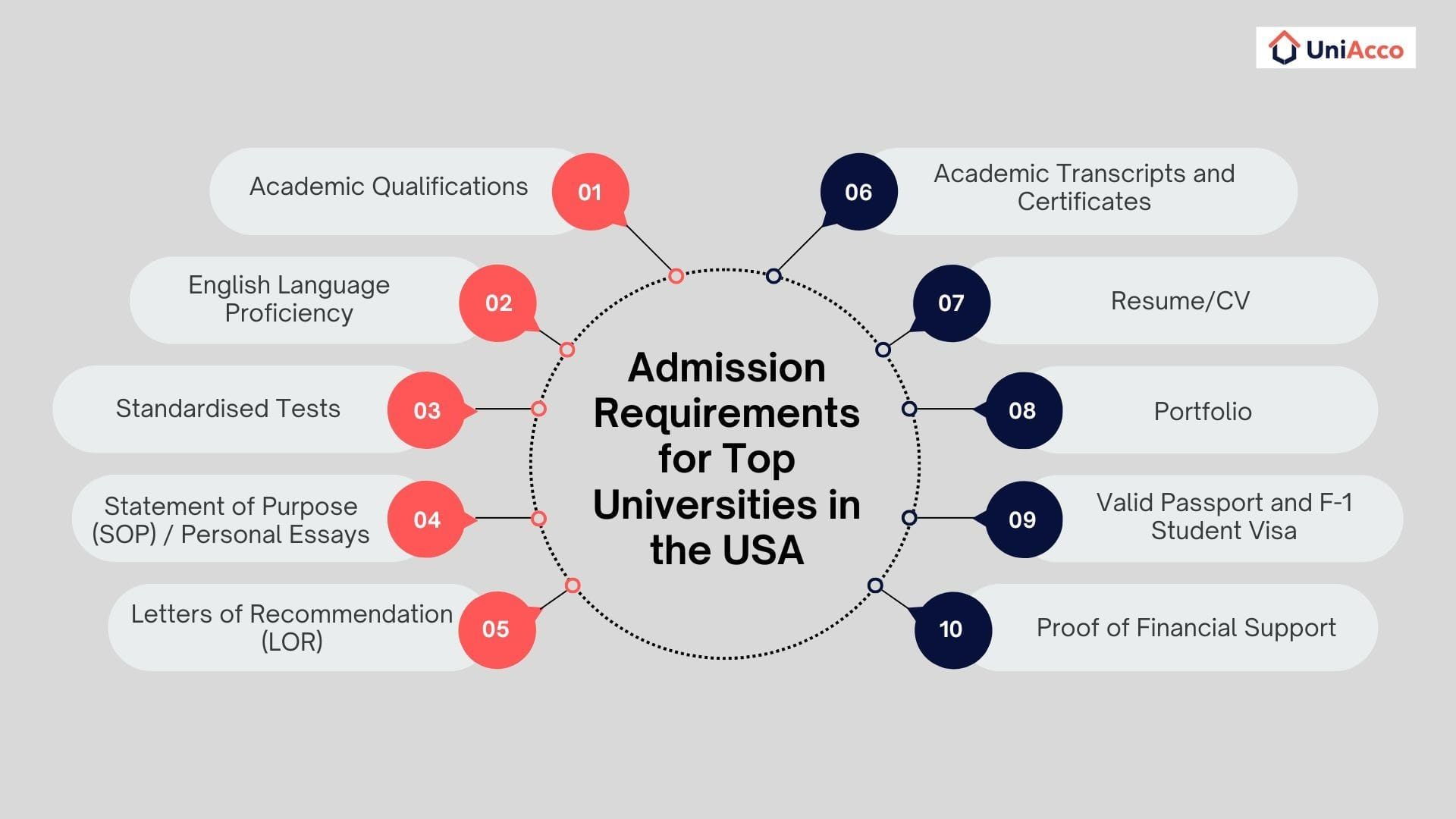
- Academic Qualifications
For undergraduate courses, you need a good high school record and GPA. For postgraduate courses, you need a good bachelor’s degree. Top US universities are highly competitive, so strong academic results can improve your chances of admission.
- English Language Proficiency
International students may need to take IELTS, TOEFL, PTE Academic, or the Duolingo English Test. The required score depends on the university and course. Always check the exact English language requirements before taking the test.
- Standardised Tests
Some universities require SAT or ACT scores for undergraduate admission. For postgraduate courses, some universities may require GRE or GMAT scores. Test requirements can differ by university and course.
- Statement of Purpose (SOP) / Personal Essays
Undergraduate students usually write personal essays as part of their application. These essays should explain who you are, your interests, and why you want to study the course. Postgraduate SOPs should explain your academic background, career goals, and research interests.
- Letters of Recommendation (LOR)
You may need recommendation letters from teachers, professors, or employers. Choose people who know your work well and can explain your skills and achievements clearly.
- Academic Transcripts and Certificates
You need copies of your previous academic records and certificates. If your documents are not in English, you may need to get them translated. Some universities may also ask for an evaluation of your qualifications.
- Resume/CV
A resume or CV is mainly required for postgraduate applications. Include your education, internships, work experience, research, publications, and other relevant achievements.
- Portfolio
Students applying for architecture, design, fine arts, and some creative courses may need to submit a portfolio. The requirements can be different for each university, so check the course guidelines before preparing it.
- Valid Passport and F-1 Student Visa
International students need a valid passport and an F-1 student visa to study in the USA. You can apply for the visa after receiving your I-20 from the university. Start the visa process early and check the latest requirements from official US government sources.
- Proof of Financial Support
You need to show that you can pay for your studies and living costs in the USA. This can include bank statements, scholarship letters, or financial aid documents. Some universities may ask for proof covering the full duration of your course.
Tips for Students Applying to USA Universities
- Register Early for Required Standardised Tests.
The SAT, ACT, GRE, GMAT, and TOEFL all have something in common; the dates you actually want fill up faster than you’d expect. What catches most people off guard is that registering early is about giving yourself enough time to retake the test if the first attempt doesn’t go the way you planned. Build that buffer in from the start rather than hoping you’ll nail it in one sitting.
- Prepare Strong SOPs and Personal Essays.
US universities, particularly at the undergraduate level, are genuinely trying to understand who you are beyond your grades and test scores, and the Common App essay is where that happens. The mistake most applicants make is writing about an impressive achievement when the prompt is actually asking about something far more personal.
At the postgraduate level, your SOP needs to show that you’ve thought seriously about your research direction, not just that you’re enthusiastic about the subject.
- Apply to a Mix of Safe, Moderate, and Ambitious Universities.
The acceptance rates at several universities on this list are so low that even the strongest applicants get rejected regularly. The students who navigate this well are the ones who build a shortlist that gives them genuine options at every level rather than putting everything into a handful of programmes where rejection is statistically more likely than acceptance.
- Explore Scholarships, Assistantships, and Financial Aid.
Before you decide a university is out of your budget, look at what it actually offers in financial aid. Some of the most expensive-looking universities on this list have endowments large enough to make them more affordable in practice than institutions that charge lower headline fees.
- Keep Track of Deadlines and Application Portals.
US university applications run across multiple platforms, the Common App for most undergraduate programmes, individual portals for postgraduate, and each one has its own set of requirements, deadlines, and document specifications. A simple spreadsheet with every deadline, every login, and every document status takes an hour to set up and saves an enormous amount of stress across the months the process runs.
- Prepare for Interviews (if required).
MBA programmes at Wharton, HBS, and Booth, along with several competitive research programmes, include interviews as part of the process. What interviewers at this level are genuinely trying to assess is whether you can talk about your goals and your background in a way that’s clear, specific, and honest. The preparation that actually helps is thinking carefully about why you want this specific programme at this specific university.
- Check Visa Requirements and Documentation Carefully.
The F-1 student visa process has specific requirements around financial documentation, health insurance, and the timing of your I-20 that vary depending on your country of origin. The official USCIS website and your nearest US embassy or consulate are the only sources you should be relying on for current requirements.
- Be Ready for a Holistic Admission Process.
These universities are not just looking at whether your numbers clear a threshold; they’re trying to build a class of people who will contribute to the university community and to their fields in meaningful ways. That means your essays, your recommendations, your extracurricular involvement, and even the specific programmes and professors you mention in your application all feed into how your file is read.
Conclusion
The top universities in the USA aren’t just universities; they’re ecosystems created over decades. Once you have applied, the next step is to figure out where you are going to reside. UniAcco assists international students to locate verified and cheap accommodation near major US university cities with 24×7 personal service, lowest price guarantee and fully confirmed bookings before you visit.


 LinkedIn






0 Comments