

The UK remains one of the world’s most desired study destinations, and not just for its universities. The experience of living in cities like London, Manchester, or Edinburgh offers a cultural pulse few places can match. But behind that excitement lies a practical question every student must answer: what does it actually cost to live here?
In 2023-24, 732,285 international students called the UK their academic home, making up nearly a quarter of the country’s higher-education population. Yet, the living expenses in UK for international students can differ sharply from one city to another, shaped by inflation, lifestyle, and local expenses.
This blog breaks down everything you need to know about the cost of living in the UK, including average rent, utilities, food, and transport, so you can plan your budget with clarity and confidence.
Breaking Down the Cost of Living in UK for Students in 2026
Understanding the average cost of living in the UK helps students plan their monthly budget effectively and avoid unexpected expenses. While tuition fees are a significant part of studying abroad, everyday costs like accommodation, groceries, and transportation also make up a considerable portion of a student’s budget.
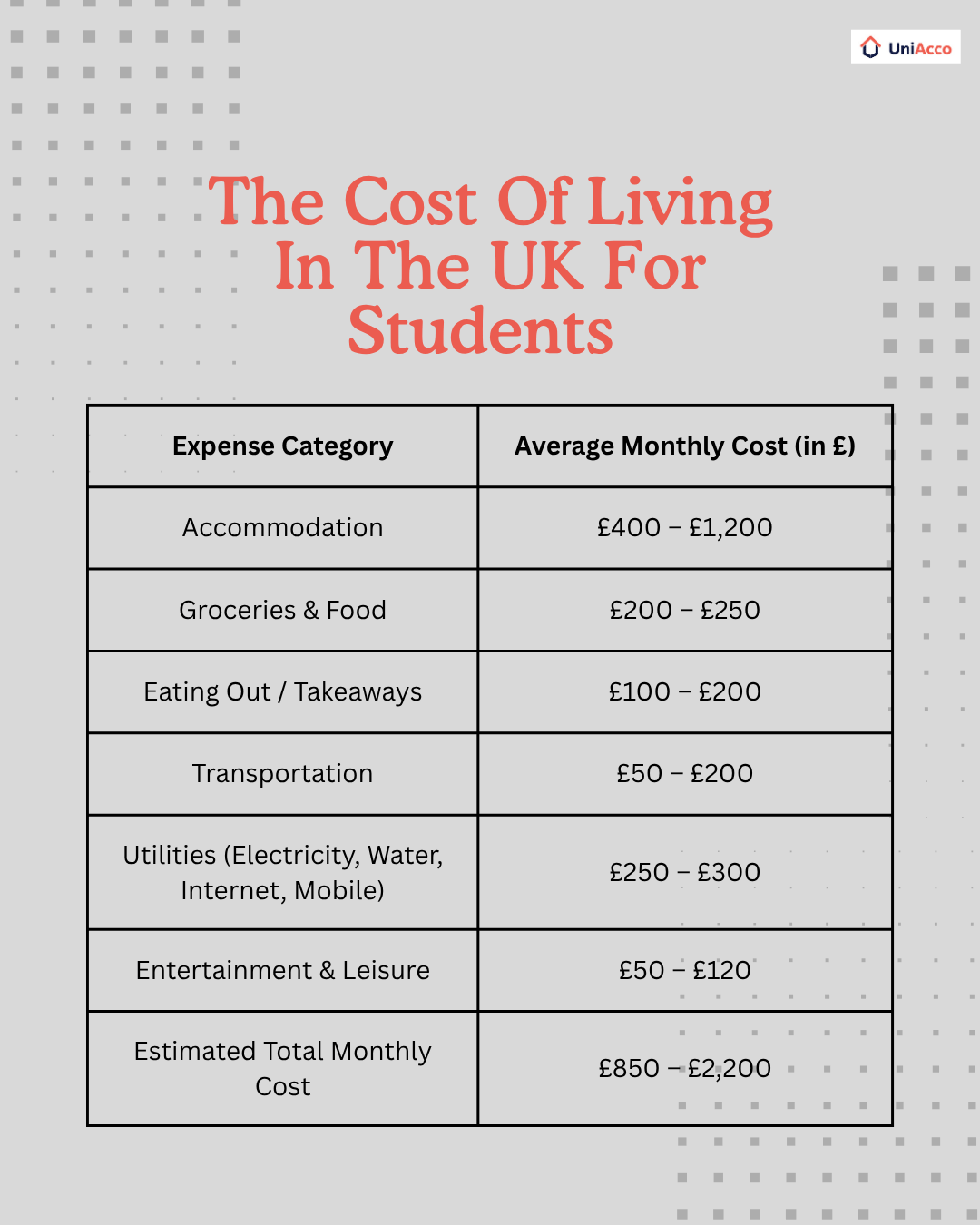
On average, international students in the UK spend between £850 and £2,200 per month, depending on their city, lifestyle, and type of accommodation.
Here’s a quick overview of the typical monthly expenses you can expect:
| Expense Category | Average Monthly Cost (in £) | Notes / Inclusions |
| Accommodation | £400 – £1,200 | Depends on city & type (University halls, PBSA, shared or private flats). Utilities often included in PBSA. |
| Groceries & Food | £200 – £250 | Based on shopping at affordable supermarkets like Aldi, Tesco, or Sainsbury’s. |
| Eating Out / Takeaways | £100 – £200 | Occasional dining, coffee, or weekend meals at mid-range restaurants or cafés. |
| Transportation | £50 – £200 | Public transport passes, occasional taxis or trains; higher in London. |
| Utilities (Electricity, Water, Internet, Mobile) | £250 – £300 | Often covered in student accommodation rent; varies for private flats. |
| Entertainment & Leisure | £50 – £120 | Gym memberships, shopping, movies, and social activities. |
| Estimated Total Monthly Cost | £850 – £2,200 | Varies by lifestyle and location (higher in London, lower in regional towns). |
Find verified student accommodation with rent, utilities, and internet all included. Focus on studying while we handle the hassle.
🔎 Browse Verified PropertiesCost Of Student Accommodation in the UK
The cost of student accommodation in the UK can range anywhere between £400 – £1,200 per month or even higher, depending on the location and the type of housing. In major cities like London, you can expect higher rent prices compared to other cities in the UK, while smaller cities and towns have relatively more affordable options.
The table below provides a detailed breakdown of the accommodation types for students and the average rent in the UK.
| Accommodation Type | Average Rent Range (UK) |
| University Halls of Residence (On-Campus) | £100 – £300+ per week |
| Purpose-Built Student Apartments (PBSA) | £150 – £300 per week (outside London)£180 – £1,200 per week (London) |
| Shared Student Housing (HMOs) | £400 – £900 per month |
| Private Apartments | £200 – £450 per week(London: £250 + per week) |
University Halls of Residence
University-managed halls are dormitory-style accommodations typically reserved for first-year students. They can be catered or self-catered, with room options ranging from shared flats to private en suite rooms. These halls offer a strong sense of community and provide easy access to campus facilities, making them ideal for students new to the UK.
Average Rent: £100 – £300+ per week
Purpose-Built Student Accommodation (PBSA)
Purpose-Built Student Accommodation (PBSA) refers to modern, privately owned residences designed specifically for students. They come equipped with en-suite rooms, study areas, and shared amenities such as gyms, cinemas, and social lounges. Platforms like UniAcco help students find verified PBSAs across the UK, ensuring safety, comfort, and proximity to major universities.
Average Rent:
- London: £180 – £1,200 per week
- Other cities (e.g, Bath): £150 – £300 per week
Shared Apartments
Shared apartments or houses are one of the most budget-friendly and social options for students. Living with peers allows you to split rent and bills, build friendships, and enjoy a communal atmosphere. However, shared responsibility for cleaning and maintenance is part of the experience, a great way to build independence and teamwork skills.
Average Rent:
- £400 – £900 per month
Private Apartments
Private studios or one-bedroom flats are ideal for students seeking maximum privacy and independence. These often come fully furnished and provide a quiet, personal space to study and relax. However, they are the most expensive option, and utilities may not always be included, so checking the lease details is essential.
Average Rent:
- London: £250 + per week
- Other Cities: £200 – £450 per week
Also Read: Exploring Student Off-Campus Housing: Your Guide to Flexible Living Options
Rent Variation Across Different UK Cities
The Cushman & Wakefield Student Accommodation Report 2025 shows that rent trends for students now vary widely across UK cities. While the national average rent growth sits around 1.5%, some cities have seen major jumps due to tight supply, while others are becoming more affordable thanks to new housing stock.
If you’re planning to study in the UK, here’s how rents are shifting and what that means for your student budget in 2025–26:
| City | Rent Growth(2024–25 →2025–26) | What It Means for Students |
| Colchester | +6.6% | Rents rising fastest; limited supply.. |
| Cardiff | +6.3% | Strong student demand; expect higher costs for city-centre rooms. |
| Chester | +6.1% | Prices climbing; smaller city with limited new housing. |
| Durham | +5.9% | High demand and low availability driving prices up. |
| Guildford | +5.2% | Tight rental market; on-campus or early bookings recommended. |
| Loughborough | +4.4% | Student-heavy area; moderate rent hikes likely. |
| Newcastle | +4.1% | Recovery mode; steady rent increases but still affordable options. |
| Manchester | +3.7% | Moderate growth; shared flats remain cost-effective. |
| London | +3.5% | Prices stable but high; suburbs and PBSA (Purpose-Built Student Accommodation) may offer better value. |
| Leicester | +3.2% | Above-average growth; still relatively affordable. |
| Bristol | +2.8% | Tight housing supply; premium studios in high demand. |
| Edinburgh | +2.7% | Slight rise; expect competition for central housing. |
| Liverpool | +2.7% | Moderate increases; good value for larger student groups. |
| York | +0.4% | Rents stable; minimal price change expected. |
| Leeds | -3.4% | Oversupply lowering rents — great for budget-conscious students. |
| Southampton | -4.8% | Falling rents; good time to find affordable accommodation. |
| Swansea | -4.5% | Rents dropping; increased availability across student areas. |
| Belfast | -5.3% | Noticeable decline in demand; more housing choices at lower costs. |
| Sheffield | -5.5% | Largest rent drop; good deals likely in most neighbourhoods. |
Cost Of Studying In The UK
Studying in the UK is a valuable investment that offers world-class education and globally recognised degrees. However, the cost can vary depending on the level of study, university, and course type. Here’s a quick overview of average tuition fees across different degree levels.
Undergraduate
| Course Specialisation | Typical Annual Fees (GBP) |
| Medicine | £30,000 – £63,990 |
| Engineering/Science | £25,000 – £46,650 |
| Law & Social Science | £18,000 – £38,000 |
| Business/Finance | £20,000 – £40,000 |
| Humanities/Arts | £15,000 – £30,000 |
Postgraduate
Postgraduate programmes in the UK usually range between £17,000 and £22,000 per year. Courses such as MBA or specialised master’s degrees may cost more, especially at top universities.
| Course Specialisation | Tuition Fee Range (GBP) |
| Engineering/ Science | £32,000 – £45,000 |
| Law and Social Science | £26,400 – £50,000 |
| Engineering/ Politics | £29,000 – £48,000 |
| Economics/ History | £23,000 – £40,000 |
PhD
PhD tuition fees in the UK generally starts from £22,000 per year. Research-based programmes may offer funding or stipends, reducing the overall financial burden for international students.
| Course Specialisation | Approximate Annual Fees |
| STEM / Life Sciences / Engineering | £30,950 |
| Arts & Social Sciences | £24,500 |
| Animal, Rural & Environmental Sciences | £18,650 |
Cost Of Groceries In The UK
The UK offers a wide selection of supermarkets and grocery stores to suit every lifestyle and budget. From affordable chains like Aldi and Lidl to mid-range favourites such as Tesco, Sainsbury’s, and Asda, and premium options like Waitrose and Marks & Spencer, there’s something for everyone.
The cost of food in the UK is generally stable, though it can vary slightly depending on the city, store, or individual shopping habits. On average, a person spends around £200–£250 per month on groceries. Understanding the average prices of staple items helps you plan and maintain your monthly food budget effectively.
| Item | Price (£) |
| Milk (regular), (1 litre) | £1 |
| Loaf of Fresh White Bread (500g) | £1 |
| Rice (white), (1kg) | £2 |
| Eggs (regular) (12) | £3 |
| Local Cheese (1kg) | £7 |
| Chicken Fillets (1kg) | £7 |
| Apples (1kg) | £2 |
| Banana (1kg) | £1 |
| Oranges (1kg) | £2 |
| Tomato (1kg) | £3 |
| Potato (1kg) | £1 |
| Onion (1kg) | £1 |
| Lettuce (1 head) | £1 |
| Water (1.5 litre bottle) | £1 |
| Bottle of Wine (Mid-Range) | £8 |
How To Save Money On Groceries In The UK?
Groceries often make up a major part of a student’s or household’s monthly expenses, but a few mindful habits can help you cut costs without compromising on quality. Here are some simple yet effective ways to save money on groceries in the UK:
| Tip | How It Helps |
| Plan Your Meals and Shop Smart | Creating a weekly meal plan and sticking to a shopping list helps you avoid impulse purchases and overspending. |
| Use Discounts and Loyalty Programmes | Take advantage of reward cards like Tesco Clubcard and Nectar (Sainsbury’s), and explore apps like Groupon or Student Beans for exclusive student offers. |
| Buy in Bulk | Stocking up on long-lasting essentials such as rice, pasta, and canned items often comes at a lower price per unit, saving money over time. |
| Reduce Food Waste | Check what you already have before shopping, store perishables correctly, and use leftovers creatively to make your groceries last longer. |
Cost Of Dining Out In The UK
Dining out in the UK can be both a social and cultural experience. Whether you enjoy traditional pub food or diverse international cuisine, there’s something for every palate. On average, students spend £100–£200 per month on takeaways and dining out. Factoring these expenses into the cost of living in the UK for international students ensures you strike the right balance between eating out and cooking at home.
| Item | Price (£) |
| Meal, Inexpensive Restaurant | £15 |
| Meal for 2 People, Mid-range Restaurant, Three-course | £65 |
| McMeal at McDonald’s (or Equivalent Combo Meal) | £8 |
| Domestic Beer (0.5 litre draught) | £5 |
| Imported Beer (0.33 litre bottle) | £5 |
| Cappuccino (regular) | £4 |
| Coke/Pepsi (0.33 litre bottle) | £2 |
| Water (0.33 litre bottle) | £1 |
Cost Of Transportation In The UK
Transportation expenses in the UK typically range between £50 and £200 per month, depending on where you live and how you travel. Public transport in London and other major cities is efficient and well-connected. In smaller towns and regional areas, commuting tends to be more affordable.
| Category | Cost in Pounds (£) |
| Buses (One way) | £1.75 – 3 |
| Monthly Pass (Regular Price) | £70 – £100 |
| Taxi Start (Normal Tariff) | £4 |
| Taxi 1 hour Waiting (Normal Tariff) | £17 |
Utility Costs In The UK
Creating a well-balanced budget means accounting for all your monthly utility expenses in advance. These essential utility bills typically include electricity, water, heating, internet, and mobile phone bills. Understanding what to expect each month helps you manage your finances efficiently and ensures you set aside enough funds for every necessity.
| Category | Cost in Pounds (£) Monthly |
| Basic Utilities (Electricity, Heating, Cooling, Water, and Waste services) | £250 |
| Mobile Phone Monthly Plan | £13 |
| Home Internet | £32 |
However, when you book your student accommodation in the UK with UniAcco, you don’t have to worry about paying your utility bills separately; they are all included in your rent.
Also Read: Cheapest Energy Suppliers In The UK: Energy Comparison
Entertainment/ Fitness and Leisure Costs In The UK
Rent, groceries, and travel form the bulk of expenses, but living costs for international students in the UK also include smaller, everyday items that often go unnoticed. Below is a quick look at these additional costs to help you plan better.
| Category | Cost in Pounds (£) |
| Fitness and Leisure (Gym Membership) | 35 |
| Shopping (Stores like Zara or H&M) | 30 – 75 |
| Entertainment (Cinema Tickets) | 10 |
Book an all-inclusive student accommodation with UniAcco and simplify your UK living experience. Rent, utilities, and internet — all in one place.
🏠 Browse All-Inclusive RoomsHealthcare Costs in the UK
The UK’s healthcare system is primarily delivered through the National Health Service (NHS), a publicly funded service offering comprehensive medical care to all legal residents. Most NHS services, such as GP visits, hospital treatment, and emergency care, are free at the point of use.
However, there are some exceptions, such as:
- Prescription charges (England only): £9.90 per item
- Dental treatments and eye tests: Partially subsidised or fully paid, depending on eligibility
- Mental health and specialist services: Generally free but may involve waiting times
Immigration Health Surcharge (IHS) for International Students & Graduates
If you are coming to the UK as an international student or staying after graduation on a Post-Study Work (PSW) visa, you will need to pay the Immigration Health Surcharge (IHS). This gives you full NHS access during your stay.
| Visa Type | Typical Duration | IHS Fee per Year | Approximate Total IHS Fee |
| Bachelor’s Degree | 3 years | £776 | £2,328 |
| Master’s Degree | 1 year (rounded) | £776 | £1,164 (incl. extra months) |
| Post-Study Work (PSW) | 2 years | £776 | £1,552 |
Also Read: Health Insurance For International Students In The UK 2025: Complete Guide
Why Knowing the Cost of Living in the UK Matters for Students?
- Enables realistic financial planning
The average international student in the UK spends between £1,000 and £1,500 per month, depending on their location and lifestyle. With student accommodation often accounting for up to 60% of total monthly expenses, understanding your likely costs enables you to budget accurately for essentials such as rent, food, travel, and study materials, and avoid unexpected shortfalls during the semester.
- City choice significantly impacts affordability
Living costs differ sharply across the UK. Cities such as London, Bristol, and Edinburgh are notably higher in rent and transport, while places like Cardiff, Sheffield, and Aberdeen offer similar academic quality at a lower cost. Selecting your study destination with cost in mind can improve your financial comfort and overall quality of life.
- Budget awareness enhances student well-being
Effective budgeting not only supports financial stability but also contributes to a better academic and personal experience. Students who manage their expenses proactively are better positioned to participate in social activities, explore local culture, and maintain a balanced lifestyle without financial strain.
- Accounting for hidden or seasonal costs prevents surprises
Beyond visible expenses, students should factor in additional costs such as heating during winter, Council Tax exemptions, broadband, and mobile plans. These can collectively add £100–£200 monthly and should be built into your budget from the outset to ensure year-round stability.
- Informs smarter housing and lifestyle decisions
Since living expenses in UK for international students differ across regions, understanding these variations helps you assess accommodation options better. Shared housing outside city centres can save 25–30% on rent, while on-campus living can reduce travel costs.

How Living Costs Differ Across UK Cities?
Living costs in the UK vary widely depending on where you study. While cities like London and Bristol offer unmatched opportunities, they also come with steep expenses. Smaller and regional cities such as Aberdeen, Sheffield, or Cardiff, on the other hand, provide excellent universities and a comfortable lifestyle at lower monthly costs, which is perfect for students who want to balance quality with affordability.
Below is a quick comparison of average monthly living expenses across popular UK student cities, along with what you can expect in each:
| City | Estimated Monthly Cost Range (£) | Student Insight |
| London | £1,300 – £1,800 | The most expensive UK city for students. Rent and transport costs dominate budgets, so sharing accommodation is common. |
| Aberdeen | £970 – £1,200 | Among the most affordable cities. Great for budget-conscious students seeking good value and a tight-knit community. |
| Sheffield | £900 – £1,300 | Known for affordable student housing and a lively university environment. Ideal for those who want city life without high costs. |
| Cardiff | £1,038 – £1,293 | Balanced expenses and excellent student amenities. Offers a mix of affordability and modern campus living. |
| Belfast | £1,100 – £1,400 | Lower rent and utilities compared to other UK capitals. A welcoming atmosphere for international students. |
| Nottingham | £1,000 – £1,500 | Mid-range costs with strong student culture and diverse housing options. |
| Glasgow | £1,060 – £1,310 | Slightly higher transport and utilities, but student discounts are abundant. |
| Newcastle | £1,200 – £1,400 | Moderate living costs, a large student population, and vibrant nightlife. |
Hacks to Cut Down the Cost of Living in the UK for Students
1. Choose All-Inclusive Accommodation
Opt for student housing that includes utilities such as electricity, water, internet, and maintenance in the rent. Platforms like UniAcco list verified all-inclusive student accommodations, which help you avoid fluctuating utility bills and hidden costs every month.
2. Make the Most of Student Discounts
From transport to groceries, clothing to entertainment, almost every brand in the UK offers student deals. Get an NUS Totum card, UNiDAYS, or Student Beans membership to enjoy discounts on food, travel, tech, and lifestyle purchases.
3. Cook Your Meals Instead of Eating Out
Cooking at home can save you up to £100–£150 per month. Buy groceries from budget stores like Aldi, Lidl, or Asda, and plan weekly meals to minimise waste. Batch cooking or meal prepping for the week can also save time and money.
4. Shop Smart and Buy in Bulk
Supermarkets often offer value packs or “2 for 1” deals. Buying essentials like rice, pasta, or toiletries in bulk helps you save in the long run. Use cashback apps and supermarket loyalty cards (e.g., Tesco Clubcard or Sainsbury’s Nectar) for extra savings.
5. Save on Transportation
If you travel frequently, consider investing in a 16–25 Railcard or a Student Oyster card (for London) to receive up to 30% off train and bus fares. Walk or cycle for shorter distances many universities offer free bike storage or rental schemes.
6. Share Costs With Roommates
Living with others is a great way to reduce expenses. Split bills for groceries, cleaning products, and subscriptions like Netflix or Spotify. You can even coordinate grocery runs to avoid duplicate purchases.
Also Read: Benefits Of Living In A Shared Accommodation
Scholarships & Part-Time Jobs to Cover Living Expenses in the UK
Studying in the UK can be expensive, but a combination of scholarships and part-time jobs helps many international students manage their living costs.
Top Scholarships for International Students:
Each year, the Chevening Scholarship offers over 1,500 fully funded awards, while the Commonwealth Scholarship has supported 31,000 students with tuition and living expenses.
| Scholarship Name | Funding Body / Partner | Coverage & Benefits | Eligibility |
| Chevening Scholarship | UK Foreign, Commonwealth & Development Office (FCDO) | Full tuition fees, monthly living allowance, airfare, visa, and arrival/departure allowances. | Must be from a Chevening-eligible country, have a bachelor’s degree, two years of work experience, an offer from a UK university, and agree to return home for two years after study. |
| Commonwealth Scholarship | Commonwealth Scholarship Commission (UK) | Full tuition, living stipend and airfare | Must be a citizen or permanent resident of a Commonwealth country, hold at least a 2:1 undergraduate degree (and a master’s for PhD applicants), and be unable to afford study in the UK without the scholarship. |
| GREAT Scholarships | British Council + UK universities | Minimum £10,000 tuition fee waiver | Must hold an undergraduate degree, meet UK university English requirements, show motivation and interest in the chosen field, engage with UK academic life, attend GREAT scholar networking events, and serve as a UK education ambassador during and after the scholarship. |
| Marshall Scholarship | UK Government (for US citizens) | Full funding for tuition, living expenses | Must be a U.S. citizen with a minimum GPA of 3.7, hold a four-year undergraduate degree from an accredited U.S. institution (earned after April 2023), and have no prior degree or schooling in the UK. |
| British Council Scholarships | British Council | Various grants and funding options | Must be a woman from an eligible country with an undergraduate degree, English proficiency, and financial need, applying for a one-year UK master’s from September 2026, with plans to contribute to her home country’s development after study. |
Part-Time Jobs In The UK
For many international students, working part-time is a practical way to manage day-to-day expenses while gaining valuable experience in the UK.
Work Hour Restrictions
- Degree-level and PhD students: Allowed to work up to 20 hours per week during term time.
- Vacation periods (e.g Christmas, Easter, Summer): Students may work full-time.
- Part-time course students: Not permitted to work (paid or unpaid) while studying in the UK.
- National Living Wage: In the UK, the National Living Wage is £12.21 per hour for workers aged 21 and above.
Popular Student Jobs In The UK
Many international students in the UK take up part-time jobs alongside their studies to gain experience, build transferable skills, and manage living expenses. Universities often have dedicated student career hubs or employment centres that help students find on-campus and local job opportunities, from library assistants to student ambassadors. Additionally, online job portals like Indeed, StudentJob, and LinkedIn make it easier to explore flexible roles that fit around class schedules.
| Job Role | Average Hourly Pay (£) |
| Tutor | £25 – £26.67 |
| Retail Assistant | £9.88 – £11.58 |
| Library Assistant | £10 – £15 |
| Receptionist | £8.97 – £11.48 |
| Customer Service Executive | £11.79 |
| Barista / Waiter | £11.28 – £12.40 |
| Delivery Agent | £13.33 |
Wrapping Up!
There’s more to student life in the UK than lectures and late-night study sessions. The cost of living in the UK can shape your experience as much as your university itself. From housing and groceries to transport and leisure, every choice adds up. Planning ahead and spending wisely can make your stay both rewarding and financially balanced.
And if accommodation is still on your checklist, UniAcco makes the search effortless, helping you find verified student housing near top universities that fits your needs and budget perfectly.











0 Comments