
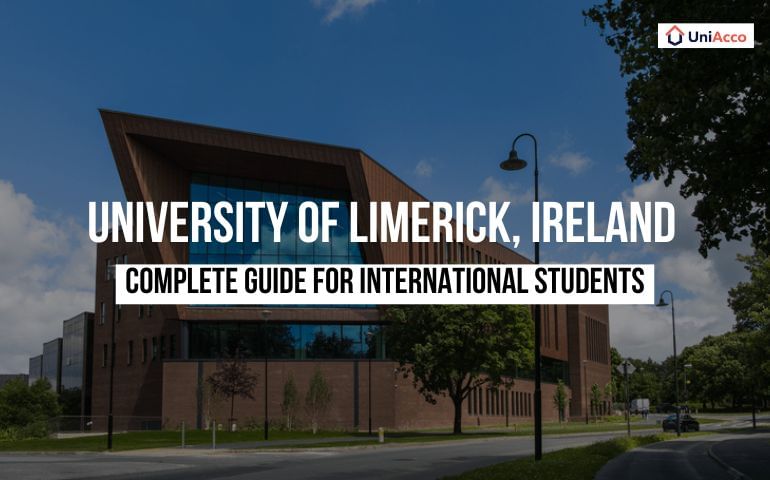
One of Ireland’s most respected higher education institutions, the University of Limerick has been on a whim of growth and consistently attracting students from across the globe with its dynamic academic culture and warm campus community. Known for its extensive placement programmes, renowned faculty, and student-friendly location, UL is a prime choice for those seeking high-quality education among universities in Ireland. Its moderate acceptance rate and steady global reputation make it especially appealing for international applicants.
This article covers everything associated with the University of Limerick, including its history, cost of living, admission requirements, and tips for a successful application.
About The University Of Limerick
Overview
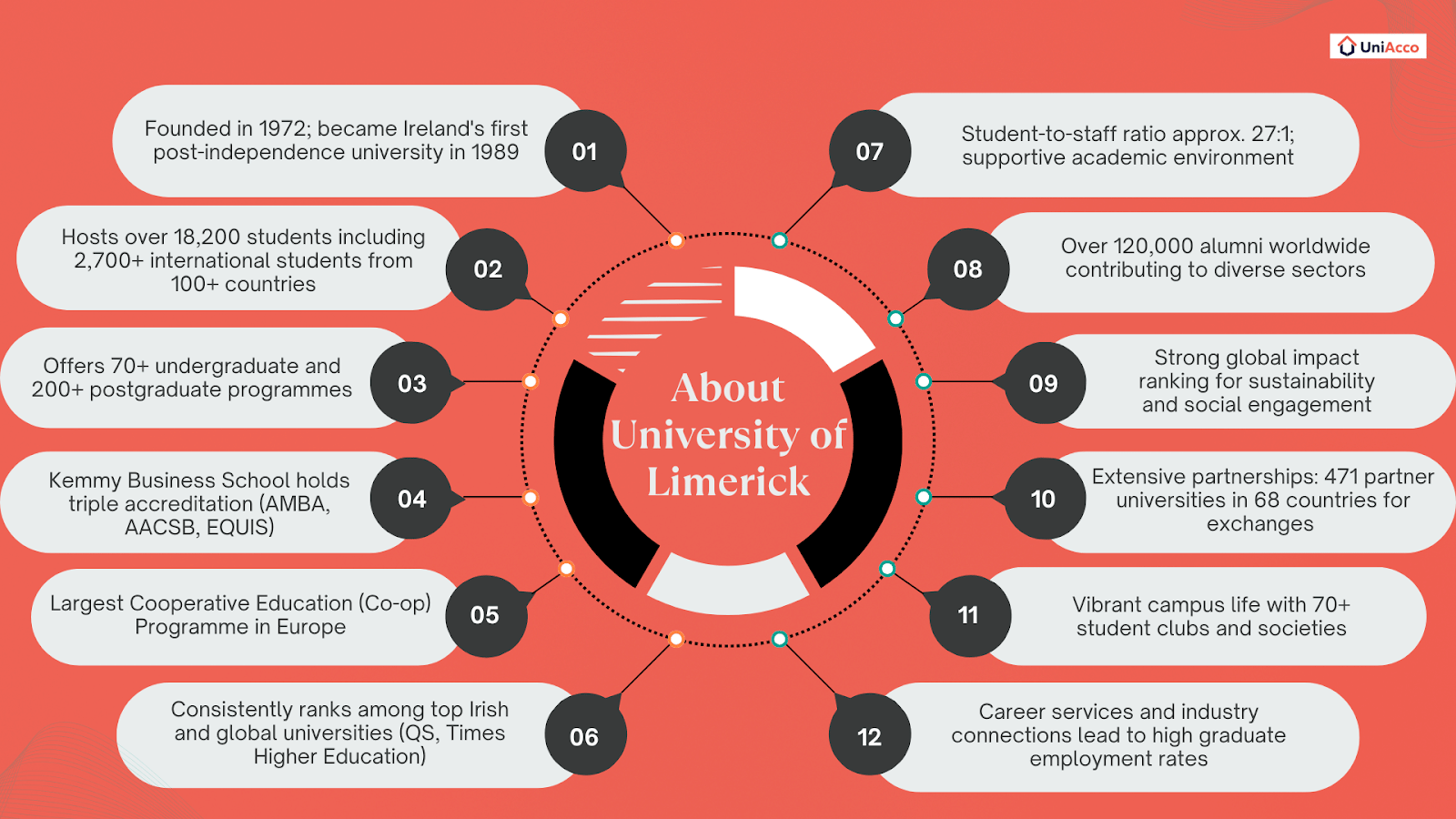
Founded in 1972 as the National Institute for Higher Education, Limerick, UL became a full university in 1989, marking a historic milestone as Ireland’s first new university after independence. The 340-acre campus along the River Shannon offers a scenic academic and community environment just 5 km from Limerick City centre. With over 17,000 students annually, including 2,000+ internationals from 100+ countries, UL promotes diversity and global engagement.
Rankings
| Ranking Type | University of Limerick Position | Notes |
| QS World University Rankings | #401 (2026) | Improved ranking, top tier Irish university |
| Times Higher Education (THE) | #501 | Reflects overall global university performance |
| THE Young University Ranking | 72nd | Among world’s best young universities |
| Global Impact Ranking | 61st | Based on sustainable development goals (SDGs) |
Why Study at the University of Limerick?
- The acceptance rate is around 70%, making UL accessible while still maintaining competitive standards.
- Vibrant campus life with a brand new Student Centre that serves as the hub for socialisation, clubs, and societies.
- Modern facilities include the state-of-the-art Glucksman Library, Olympic-sized swimming pool, fitness centres, and performance venues.
- Strong support system offering mental health services, academic guidance, career counselling, and accommodation assistance.
- Diverse student community with over 2,700 international students from 100+ countries, fostering a global cultural experience.
- Pioneering Co-op work placement programme with over 2,000 students undertaking paid 6-8 month placements each year.
- Kemmy Business School holds triple accreditation (AMBA, AACSB, EQUIS), ranking it among the top global business schools.
- Extensive Erasmus and international exchange opportunities with hundreds of partner universities worldwide.
- High graduate employability supported by collaborations with 1,600+ employers, including major corporations and public sector bodies.
- Limerick’s scenic location offers a perfect mix of vibrant city life and natural beauty, enriching student life beyond academics.
- Active student sports and cultural scene includes over 70 clubs and societies, regular festivals, and Ireland’s only indoor powered rowing tank.
Courses Offered
UL delivers 70+ undergraduate and 100+ postgraduate programmes covering:
- Kemmy Business School (Accounting, Finance, HR, Marketing, etc.)
- Science & Engineering (Engineering, Computer Science, Physics, Biology)
- Education & Health Sciences (Nursing, Clinical Science, Psychology)
- Arts, Humanities & Social Sciences (Law, History, Languages, Sociology)
Entry Requirements
Standard entry conditions include:
| Level | Academic Requirement | English Test Minimum Scores |
| Undergraduate | High school diploma, 2.5 GPA | IELTS 6.5, TOEFL 90, Duolingo 110 |
| Postgraduate | Bachelor’s degree, 2:2 honours | IELTS 6.5, TOEFL 90, Duolingo 110 |
| Business/MBA | Degree + relevant experience | IELTS 6.5, TOEFL 90, Duolingo 110 |
Life at the University of Limerick
The University of Limerick (UL) is renowned for its welcoming atmosphere, secure campus, and robust academic support. Its award-winning facilities, inclusive culture, and globally recognised business school make it a preferred choice for students worldwide. With over 118,000 alumni across industries, UL’s impact extends far beyond Ireland.
Vibrant and Inclusive Campus Life
UL offers over 70 clubs and societies covering sports, culture, volunteering, debating, and professional networking. This variety allows students to explore their passions, meet like-minded peers, and gain valuable soft skills for their careers. With 20% of students coming from 100+ countries, UL provides a truly global student experience.
World-Class Sports and Fitness Facilities
- UL is home to one of Ireland’s most advanced sports complexes, featuring:
- Olympic-standard 50m swimming pool
- Multi-sport courts for basketball, badminton, and volleyball
- Extensive running tracks and floodlit pitchesGym access free for on-campus residents
- Ireland’s only indoor powered rowing tank
Regular tournaments, training programmes, and fitness classes promote a healthy, active lifestyle.
Safe and Supportive Environment
Safety and student well-being are top priorities at UL. The university maintains high safety standards, provides 24/7 support services, and ensures an inclusive atmosphere. Students have access to:
- Mental health counselling
- Academic guidance
- Career support
- Accommodation assistance
This ensures a balanced and stress-free learning experience.
Cultural and Social Experience
Life at UL is more than academics. Students enjoy international food fairs, cultural festivals, music nights, and volunteering initiatives such as the Good Deeds Society. Proximity to Limerick city allows students to experience Ireland’s rich history, art, and nightlife alongside their studies.
Career Opportunities & Industry Connections
UL’s Co-op work placement scheme is the largest in Europe, with over 2,000 students annually undertaking mandatory 6 – 8 month placements. This provides invaluable hands-on experience, bridging academic theory with industry practice.
The university collaborates with more than 1,600 diverse employers, including leading organisations such as:
| Employer | Sector |
| Health Service Executive | Healthcare |
| An Garda Síochána | Public Service/Law |
| Regeneron | Pharmaceuticals/Biotech |
| Analog Devices | Semiconductor/Electronics |
| Dell Technologies | Technology/IT |
UL maintains a placement rate around 95%, with most graduates securing employment within six months. The university’s dedicated Career Development Centre supports students with CV workshops, interview preparations, networking events, and alumni connections.
Did you know?
The Kemmy Business School ranks within the top 1% globally for business education and holds triple accreditation (AMBA, AACSB, EQUIS). Together with the engineering faculty, these departments excel in industry placements, backed by strong employer relationships and tailored professional development.
Also read: Ireland Student Visa Requirements
How to Get to the University of Limerick?
UL’s location offers seamless connectivity, making it accessible whether arriving by air, rail or road.
- By Air:
Shannon Airport (24km from campus) is the nearest international hub, with regular bus and taxi connections to Limerick City. The university provides a free airport pickup service during peak arrival days for students flying into Shannon. Dublin Airport is also an option, with direct bus routes via Dublin Coach connecting to UL’s Stables bus stop; the journey typically takes under three hours.
- By Rail:
Limerick Colbert Train Station in the city centre links with national rail routes. While there’s no direct train to the campus, frequent local buses bridge the gap.
- By Bus:
Routes 304, 304A, and 310 run regularly between Limerick City Centre and UL, with journeys costing €1.90–€2.20. The Limerick BusConnects initiative is rolling out new, high-frequency services, including a dedicated 24-hour line serving UL, city hospitals, and key suburbs.
- By Car/Taxi:
The campus is just 5km from the city centre; taxis from Shannon cost around €50–€70.
With robust transport links, international students find UL particularly easy to access, whether arriving directly from abroad or via other Irish cities.
What Is The Cost of Living In Limerick?
Accommodation
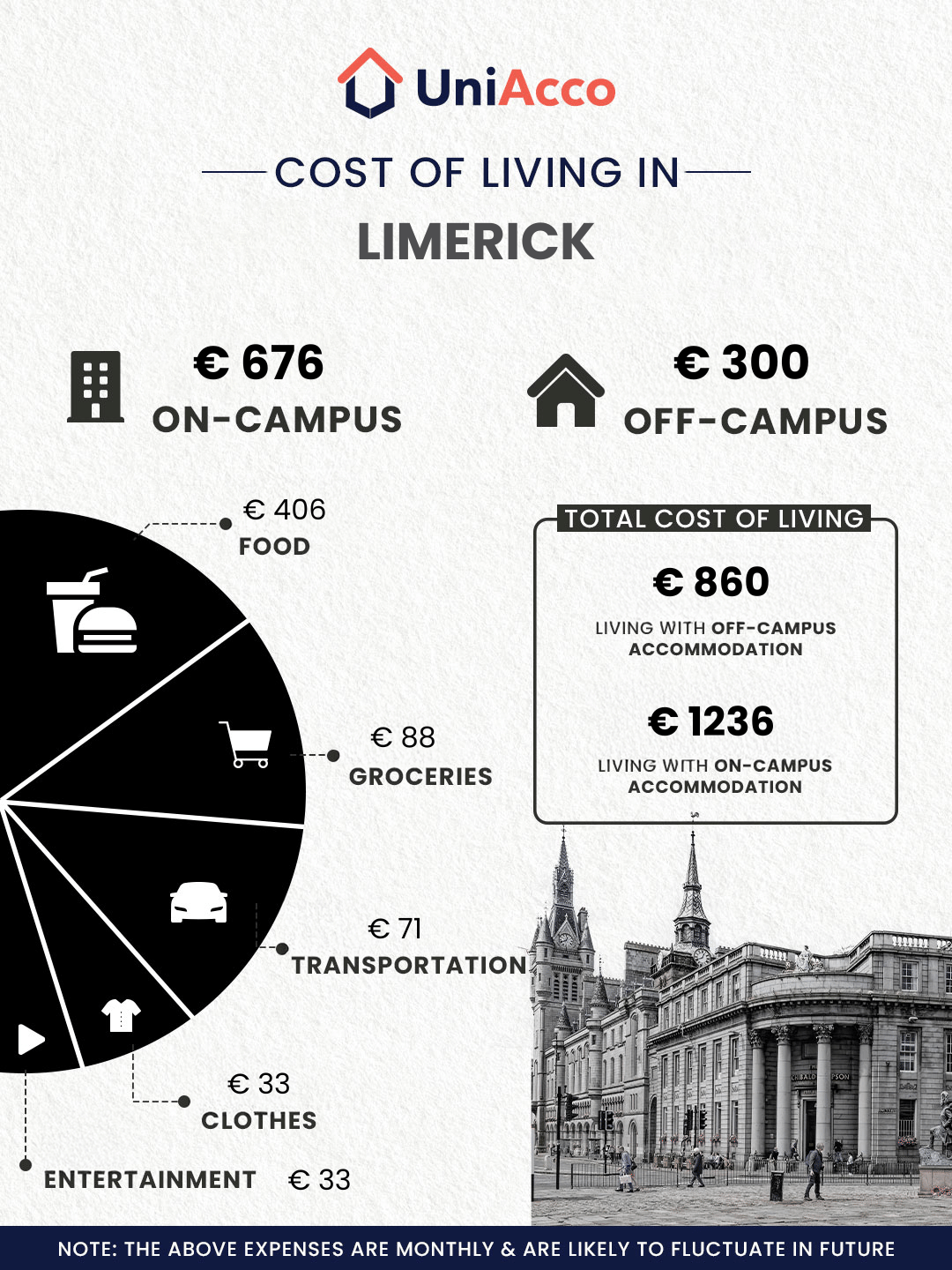
- On-campus: En-suite rooms range from €600 – €900/month. Bills such as electricity, internet, and water may be included, reducing budgeting stress and making campus life more convenient. On-campus demand is high, so early applications are vital.
- Off-campus: Renting a room or shared apartment off-campus typically costs €250–€500/month. The price depends on location, facilities, and the number of tenants in a flat. Always use trusted platforms or university-verified listings to avoid scams.
- Utility bills: For private rentals, utilities can add €90 – €130/month. Factoring for bills is important to avoid unexpected costs.
Food & Groceries
- Monthly groceries: International students typically spend €60 – €100 per month on food. Popular supermarkets – Aldi, Lidl, and Tesco help maintain budgets.
- Dining out: Meals at campus cafés or local restaurants generally cost €10 – €15 each. Eating out 3 – 4 times a week can raise monthly food budgets to €400.
- Student kitchens: Most halls and apartments provide shared kitchens, allowing bulk meal prep and significant savings.
Transport
- Bus: Limerick’s bus network is extensive, with discounted student travel cards. Monthly passes typically cost €50 – €80.
- Bike hire: UL operates a campus bicycle scheme; cycling is popular due to flat terrain and safe city routes.
- Shared taxis: Splitting short taxi rides for shopping or socialising is common, but should be used sparingly to avoid extra costs.
Utilities
- For off-campus students, expect €90 – €130/month for basic utilities (electricity, internet, heating).
- Most student apartments provide Wi-Fi; data plans for mobile phones typically cost €15 – €25/month.
Estimated Monthly Total
- Conservative estimate: €1,030 – €1,650/month, depending on lifestyle, housing choice, and social habits.
- Annual range: €8,000 – €15,000 per year, making Limerick notably more affordable than Dublin and most other large Irish cities.
8 Tips For Higher Chances Of Success At UL
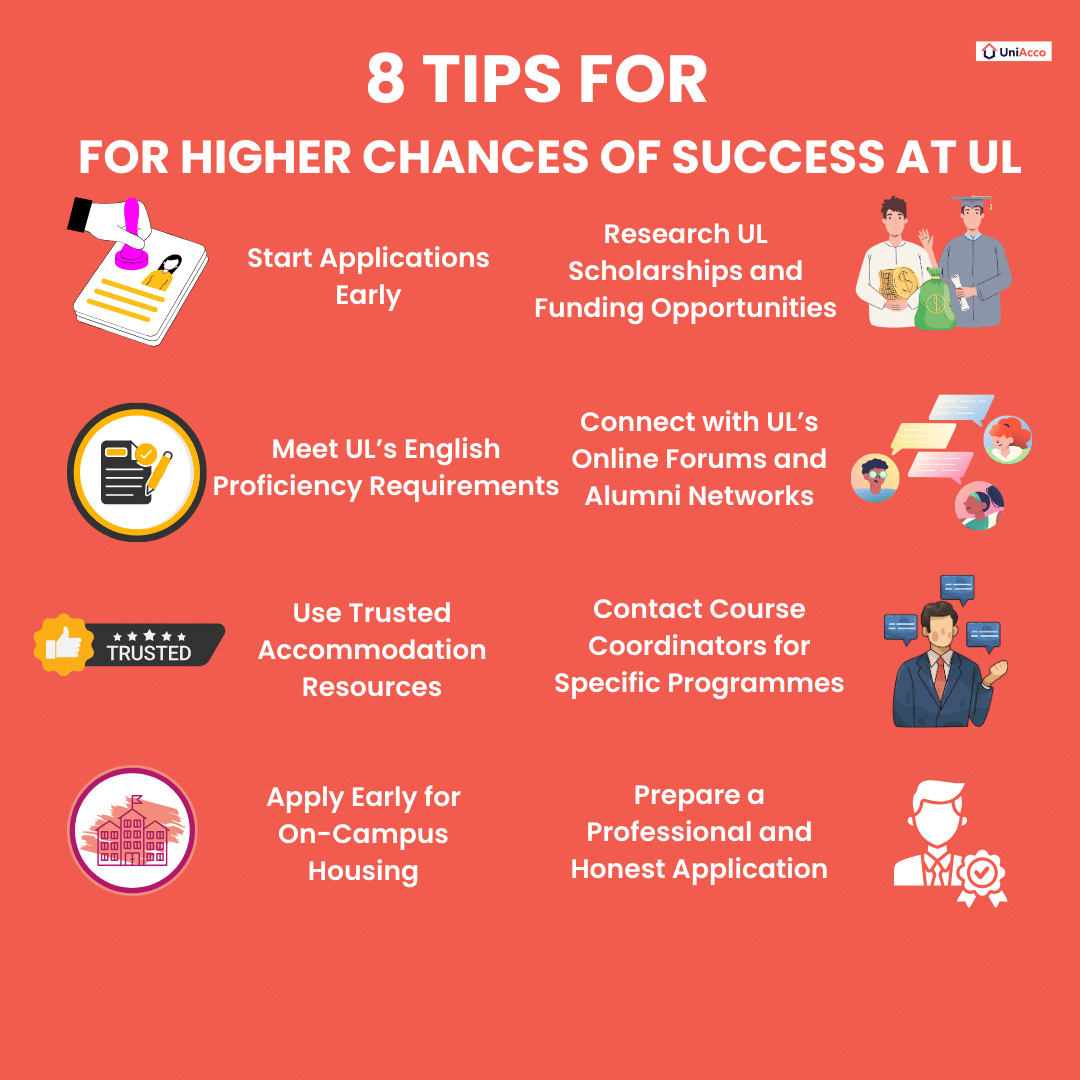
- Start Applications Early
Begin your application process well ahead of the deadlines – Autumn intake closes by July 10, and Spring intake by mid-December, to ensure ample time to collect required documents like academic transcripts, references, personal statements, and passport copies. Applying early also reduces last-minute stress and increases your chances.
- Meet UL’s English Proficiency Requirements
Prepare thoroughly for English proficiency exams accepted by UL: IELTS (minimum 6.5 overall), TOEFL IBT (minimum 90), or Duolingo (minimum 110). If your scores fall short, consider retaking tests, since meeting these requirements is mandatory for admission and visa processing.
- Use Trusted Accommodation Resources Before or After Acceptance
For safe and verified student accommodation near UL with UniAcco, which provides verified listings and expert support. Always verify listings personally or seek guidance from UL’s international student support or alumni communities to avoid scams.
- Apply Early for On-Campus Housing
UL’s on-campus residences fill quickly, especially during peak admission periods. Sending your housing application promptly alongside your admissions application improves your chances of securing a spot in the riverside residences and enjoying campus convenience.
- Research UL Scholarships and Funding Opportunities
Explore UL’s scholarship programmes awarding up to 60% tuition fee waivers to eligible international students. Also, investigate external scholarships and government student aid schemes to help reduce your financial burden.
- Connect with UL’s Online Forums and Alumni Networks
Engage with current students, alumni, and international student communities through UL’s official forums, social media groups, and Erasmus networks. These platforms provide practical advice, mentorship, and emotional support throughout your application and study journey.
- Contact Course Coordinators for Specific Programmes
Reach out to UL course leaders and faculty departments to clarify course structures, career pathways, and entry specifics. Demonstrating this proactive approach via your application or interviews can strengthen your candidacy.
- Prepare a Professional and Honest Application
Craft a polished and personalised personal statement reflecting your passion for your chosen programme and how UL’s offerings support your academic and career goals. Ensure all supporting documents are accurate, complete, and submitted on time.
The University of Limerick stands out as a leading institution among universities in Ireland, offering international students a blend of academic rigour, affordable living, vibrant campus life, and global work opportunities. With strong rankings, a moderate acceptance rate, and highly rated business courses, UL continues to attract students seeking a truly rewarding study-abroad experience in the heart of Europe.
Get a smooth sailing experience and settle near the University of Limerick and the city centre only with UniAcco’s student accommodation in Limerick. Contact us now.
Also read: 6 Must-Visit Places To Visit In Ireland As Students
FAQs
Q1. What is the University of Limerick acceptance rate?
Ans: University of Limerick acceptance rate stands around 70% for international students, making entry competitive but accessible.
Q2. How is the University of Limerick ranking globally and in Ireland?
Ans: University of Limerick ranking stands at #401 in the QS World University Rankings 2026, #501 by THE, and consistently among the top five universities in Ireland.
Q3. How do students at the University of Limerick review it?
Ans: The University of Limerick reviews from various students are typically positive, highlighting friendly faculty, a safe campus, active societies, and an affordable cost of living. Some note accommodation and placement support as areas for improvement.
Q4. What is the University of Limerick application fee?
Ans: The standard international application fee is €35–€50, depending on undergraduate or postgraduate course.
Q5. What are the University of Limerick requirements for international students?
Ans: Applicants must provide academic transcripts, English proficiency test scores (IELTS 6.5/TOEFL 90), a statement of purpose, and references; see the requirements table above for details.












0 Comments