
Ireland is having a moment. Tech giants, world-class universities, a post-study work scheme that actually lets you stay and build something, it’s become one of the smarter moves for international students who want more than just a degree at the end of it.
But if you’re a non-EEA student, there’s one thing standing between you and your first week in Ireland: the student visa. And unlike the excitement of getting your offer letter, the visa process is the part that requires actual organisation.
The rules for getting a student visa for Ireland are not hard to understand, but they are specific. The improper format for your bank statement, a lump sum that showed up in your account last month, and a rushed SOP are all elements that might slow down otherwise excellent applications.
This guide has everything you need to know about the two types of visas and what you need to do to get one. It includes the checklist of papers you need, the step-by-step application process, the current fees, the processing timeframes, and tips to help you get your visa approved instead of getting an email asking for more documents.
Types & Duration of an Irish Student Visa
There are two types of Ireland study visa, and which one you need comes down to a single question: how long is your course?
- Short Stay ‘C’ Visa
This is for anything under 90 days, short English language courses, summer schools, or professional training. It can’t be extended once you’re in Ireland. If you’re doing a degree, this isn’t your visa.
- Long Stay ‘D’ Visa
This is what the vast majority of international students need. If your programme runs longer than three months, which covers every undergraduate degree, master’s, and PhD, this is the one. It’s renewed annually for your course duration, and once you’re in Ireland and registered with immigration, you get Stamp 2 permission. That’s the stamp that lets you work up to 20 hours a week during term and 40 hours a week during college holidays (June to September, mid-December to mid-January). Not nothing.
The D Visa is typically issued for the full length of your course and renewed each year. After you arrive, you register with your local immigration officer and collect your Irish Residence Permit (IRP) card, your official proof that you’re legally here.
EU, EEA, and Swiss nationals don’t need a student visa at all. Everyone else heading for a course longer than three months needs to register with immigration on arrival, visa or not.
Eligibility Criteria for an Irish Student Visa
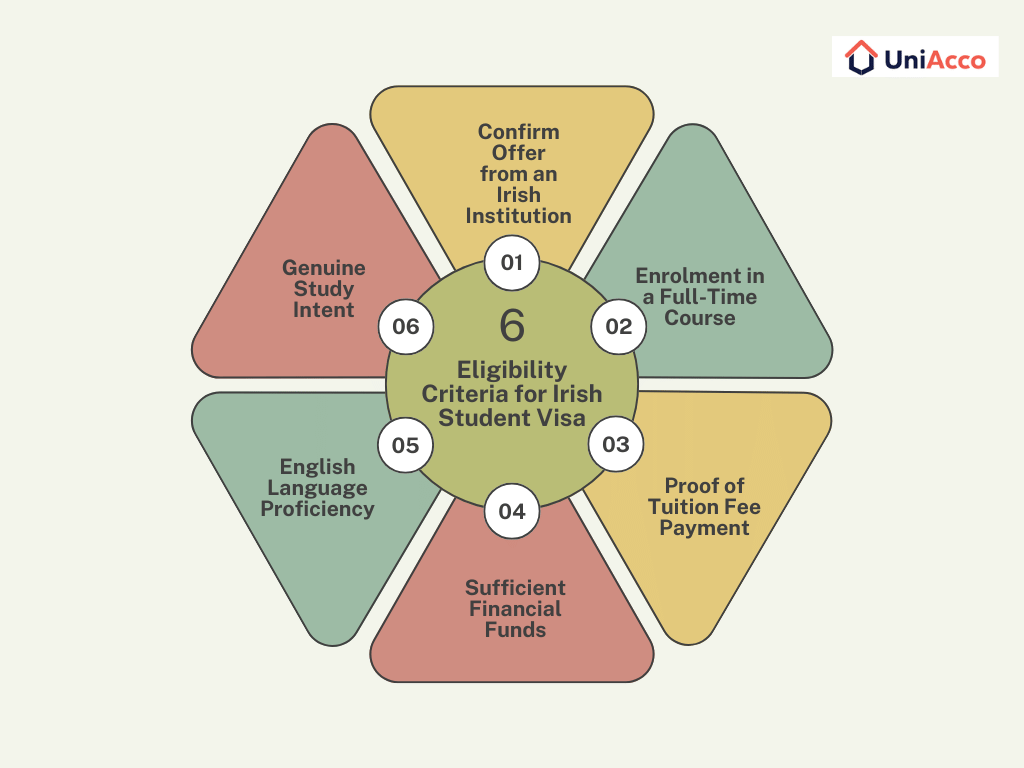
There is a simple criterion for the qualifying requirements for an Irish student visa: Irish immigration officers want to be sure that you are a real student who can pay their own expenses and has a good reason to be in Ireland. That’s the way every document is analysed.
- Confirmed Offer from an Irish Institution
Your course needs to come from a recognised Irish institution on the Interim List of Eligible Programmes (ILEP) or the newer TrustEd Ireland framework. A conditional offer won’t do; it needs to be unconditional, or conditional only on things you’ve already satisfied.
- Enrolment in a Full-Time Course
Part-time programmes and distance learning don’t qualify. Your course has to be full-time, in-person, and on the approved programme list. No exceptions.
- Proof of Tuition Fee Payment
Courses under €6,000 in fees need to be paid in full before you apply. For higher-fee programmes, first-semester payment is typically what’s required. The payment has to go directly to the institution’s Irish bank account; an EFT receipt or invoice is what you’ll present.
- Sufficient Financial Funds
You must be able to verify that you have access to at least €10,000 for courses that last a year or more by June. That’s for living costs, which are not the same as tuition. Shorter courses of six to eight months need €833 per month instead. The money needs to be sitting in six months’ worth of bank statements, ready to be used right away, not locked up in a fixed deposit.
- English Language Proficiency
Most undergraduate programmes require an IELTS score of at least 6.0. Some graduate programmes require a score of 6.5. The certificate you have can’t be more than 2 years old from the start of your programme. If your last degree was taught entirely in English, some colleges may not require this. It’s best to check with your school directly instead of assuming.
- Genuine Study Intent
Does this course make sense for you based on what you’ve studied before? Have you not explained any gaps in your schooling or work history? Have you ever been turned down for a visa by a country? All of this is looked at. The more coherent your story is, the easier the procedure will be.
Visa sorted? Now sort your accommodation. Find verified and affordable student accommodation near University College Dublin with UniAcco. Enjoy fully furnished rooms, modern amenities, 24×7 support, and a lowest price guarantee.
🔍 Explore Accommodation Near UCDDocuments Required for an Irish Student Visa
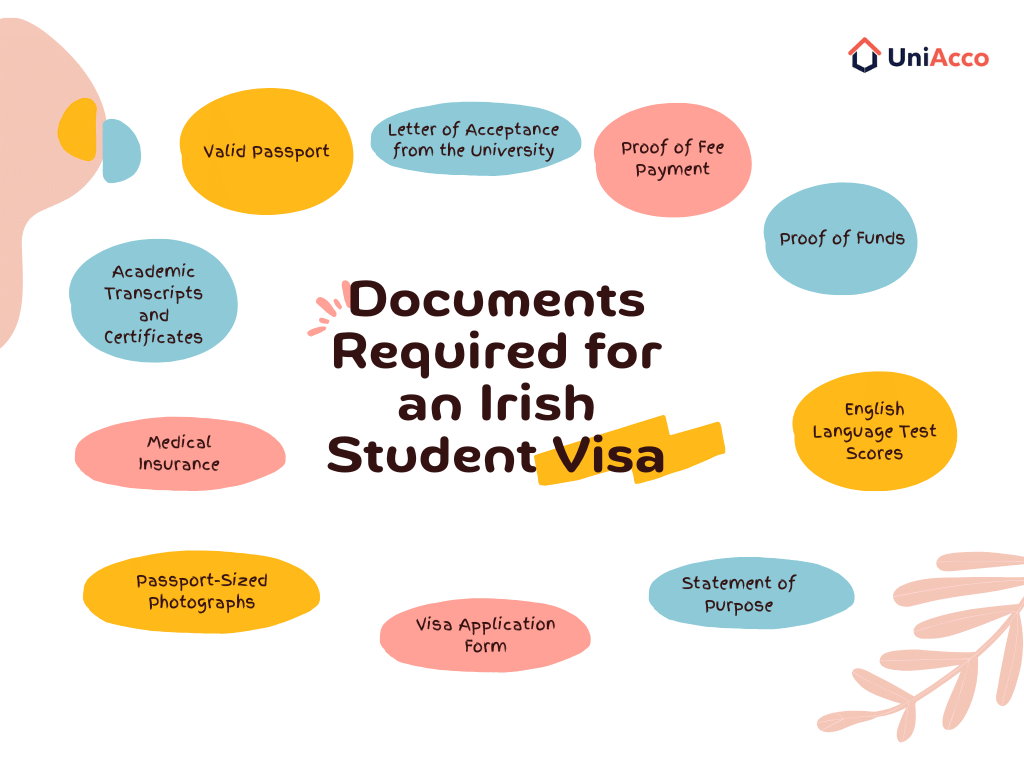
Here’s the full Ireland student visa checklist. Work through it one item at a time. A missing document is the most common reason applications get returned or delayed, and it’s entirely avoidable.
- Valid Passport
Submitting a passport isn’t enough if it doesn’t sit with their guidelines. But how would you know what a valid passport is? It must be valid for at least six months after you arrive and have at least two blank pages. Include copies of every page that has a stamp or a visa already on it.
- Letter of Acceptance from the University
Saying “I got into Dublin University” is not enough. You need proof to prove that. You will need to submit the letter of acceptance from the university, and it should be unconditional; anything else is not valid. You have to show the name of your course, when it starts and ends, and the complete cost of tuition.
- Proof of Fee Payment
Every day, thousands of students make payments, so how would they know if you have really made the payment? No one has time to check the account, that’s why, after paying the fees, you will get an EFT receipt or invoice showing you made the payment to the university. And that’s what you will need to submit. Keep the EFT receipt or invoice showing payment went to the institution’s Irish bank account ready.
- Proof of Funds (Bank Statements)
If you are going to study abroad, the Irish government will need to know that you can take care of yourself and pay all the bills on time. A verbal agreement would not work; you will need to provide statements from the last six months showing at least €10,000 in funds that can be accessed immediately. If someone is paying for you, submit their statements and a signed letter saying they are sponsoring you.
- English Language Test Scores
You will need to prove that you can speak English and understand what they’ll be teaching you in the university. And no, you don’t need to go there and have a conversation with them in English to prove that you can speak and understand. All you need is either an IELTS, TOEFL iBT, or PTE English language test score. Must be dated within two years of your course start date.
- Statement of Purpose (SOP)
When you decide to study abroad, you don’t do it out of the blue. You decide to study abroad because it aligns with your future career plans. And that’s what you have to show in your SOP. Let them know why this course, why this institution, why Ireland, and what you’re going to do afterwards. Be specific. Vague SOPs are readable as vague applications.
- Visa Application Form
This is the most important document, because without a Visa application form, how can you get a Visa? It should be completed via the AVATS portal at irishimmigration.ie.
- Passport-Sized Photographs
Photos are the most important document in any application. So, they are important for Irish Visa applications as well. And, no, random passport-size photographs won’t work. The size, the background, and even when it was taken should all be specific. The size should be 35 x 45 mm, white background only and shouldn’t be older than the last six months.
- Medical Insurance
Travelling to a new country is not easy; you will have to take care of everything. And the medical services abroad will be different from those in your home country. That’s why they make sure you have medical insurance, and this is one of the very important documents. Don’t skip it; keep it handy. Private health cover for your full stay. Some universities handle this for you; if so, your offer letter should explicitly state that.
- Academic Transcripts and Certificates
When applying for a student visa, you will need to submit everything related to your studies, which includes your certified copies of all relevant qualifications. If there’s a gap between your last period of study and this application, you need to account for it.
Planning to study in Dublin? Discover verified student accommodation with UniAcco and enjoy fully furnished rooms, modern amenities, great locations, and all-inclusive bills—perfect for international students.
🔍 Explore Student Housing in DublinIreland Student Visa Process
The Ireland study visa process is fully online, with no embassy queues and no in-person appointments unless biometrics are required. Here’s how it actually goes:
Step 1: Apply to an Irish University
Before even starting an Irish student Visa process, make sure you have applied to an Irish University. The whole process starts here. You can’t apply for a visa without something to show for it. So, apply to the university before applying for a Visa, because that’s where everything starts to take shape.
Step 2: Receive Your Offer Letter
Once you have applied to an Irish University with excellent academic records, you will receive an offer letter from the University. Make sure it’s unconditional and includes all the details of your name, course, duration and fees. If something’s missing, ask the admissions office to reissue it before you do anything else.
Step 3: Pay Tuition Fees (Partial or Full)
Now comes the step that can make or break your study-abroad dream. After you receive the offer letter, you have time to make the payment. Once you make the payment, you become a student of that Irish University for the next academic year. Transfer the right amount of money straight to the university’s Irish bank account. Keep all of the paperwork handy, including the invoice and the EFT confirmation. They will be very useful in the Visa application process.
Step 4: Gather Required Documents
Now comes the step where you actually start preparing for an Irish student visa for real. Gather all the documents that were listed above this section. This is where most problems start. Take your time, but make sure every document is ready and handy.
Step 5: Complete Online Visa Application
After getting the confirmation, documents, and everything else, comes the step where you need to pay attention and take the step. Visit irishimmigration.ie and log in to the AVATS system. Fill out the form and upload your papers. But, before you hit submit, make sure everything that you have filled out and uploaded is right.
Step 6: Submit Biometrics (If Required)
Sometimes, submitting the application isn’t enough. You will need to submit the biometrics as well, but it depends on your nationality. For this, you may need to visit a VFS Global centre to give fingerprints and a photo. In India, this is available in Delhi, Mumbai, and Bangalore.
Step 7: Submit Documents to the Visa Office
Once you have submitted the application online, you will need to submit the physical documents as well. These physical documents go to your Irish Embassy, VFS centre, or by post, depending on where you’re applying from.
Step 8: Wait for Decision
After finishing your application, you might feel exhausted and overwhelmed. This is the last step, and we know it can be the toughest, even tougher than submitting documents. But worry not, if you have done everything as we said, then the decision will be positive. You can track your application using the reference number from your AVATS summary sheet at irishimmigration.ie. The system typically updates within 48 hours of any review action.
Not sure how long you should wait for the decision? Read this Reddit thread and find out how long it takes for other students to get the confirmation.
What exactly is a GPA? – r/AskAnAmerican
Ireland Student Visa Processing Time and Updates
- Average Processing Time
Four to eight weeks after your application is completed. Some move quicker. Applications that are missing documentation, have unusual financial histories, or undisclosed refusals take longer.
- Factors Affecting Processing
The main reason for delays is papers that are missing information or don’t make sense. Things get difficult when there are gaps in education that can’t be explained, large deposits that haven’t been used before, and papers that haven’t been signed. You will not have to ask as many questions if your application is clear and complete from the start.
- How to Track Your Application
Use the reference number from your AVATS summary sheet on irishimmigration.ie. Updates appear on the system within 48 hours of any action. There’s no priority processing track for student visas in India as of 2026.
“Missing or unclear documents are a common reason for visa delays or refusals. Make sure all documents are complete and translated if necessary.” -VisaVerge, Ireland Student Visa Guide
2025 Updates: From 30 June 2025, the financial proof requirements were officially updated, €10,000 for year-long courses, and €833 per month for six to eight-month programmes. Ireland is also transitioning from ILEP to the TrustEd Ireland framework, which tightens the institutional eligibility criteria for non-EEA student visas going forward.
Cork or Galway, wherever you’re headed, start here. UniAcco offers verified, bills-inclusive student accommodation across Ireland. Book your stay before you land and enjoy 24×7 support from day one.
🔍 Explore Student Housing in IrelandPro Tips for an Irish Student Visa Application
- Apply Early
Start three to four months before your class starts. From July to September, when volumes are highest and wait times are longest, is the peak season. The AVATS system lets you apply up to three months before you fly. Make sure to use the whole timeframe.
- Ensure Financial Proof is Clear
The €10,000 needs to be in your account or your sponsor’s account for at least six months, with the correct paperwork. This is proof that you are making routine, stable transactions. A big deposit that came in a few weeks earlier is a warning sign. You can’t count fixed deposits either.
- Write a Strong SOP
This is the element that most students don’t think is important. In your Statement of Purpose, you explain why this course is a good next step for you academically, why Ireland is a good place for you to go, and what you plan to do after you get your visa. Everything is about being specific; imprecise explanations lead to vague results.
- Double-Check All Documents
Don’t use a blog summary or a consultant’s list. You should use the official Ireland student visa checklist at irishimmigration.ie. Check the spellings of names against your passport, the dates on your certificates, and see if anything needs to be translated.
- Be Honest in Your Application
If you’ve been denied a visa in the past, had pauses in your career or schooling, or both, say so. Irish immigration officers check things very carefully, and if they find something that doesn’t match what you said, it’s a lot worse than if you had told them about it ahead of time.
- Keep Copies of Everything
Before you transmit anything, make sure you scan it all. If something gets lost in the mail or a mistake is found during processing, having your own full copy really helps.
Conclusion
The requirements for an Irish student visa aren’t meant to keep you from getting one; they’re meant to make sure you’re ready. And for those who really study, the approval percentages are good.
Organise your papers correctly. Be sure that your evidence of income goes back at least six months. Make a SOP that says something real. Apply early enough that a two-week delay in processing doesn’t turn into a problem. That’s really the whole plan.
The process is worth it for Ireland. It is a great place to study since the universities are world-class, the work rights for students are among the best in Europe, and the Third Level Graduate Programme means that for the appropriate student, it’s a great long-term move.
Once your visa is through, UniAcco can help you sort out where you’ll actually live, verified, affordable student accommodation across Ireland, with 24×7 personal support and a lowest price guarantee.


 LinkedIn






0 Comments