
Introduction
Spoiler Alert. If you are scrolling the internet to figure out which is the hardest university to get into in the UK, it’s not Oxford or Cambridge. The latest 2026 admission data reveals that the elite ‘G5’ institution, the London School of Economics and Political Science (LSE), is the hardest university to get into in the UK. What’s G5? It is an official alliance of 5 highly prestigious, research-intensive universities in the United Kingdom. These institutions consistently dominate global rankings. LSE currently has an Acceptance Rate of 6% to 16%.
The UK has always been a giant weight in global higher education. From its historical architecture to its state-of-the-art research hubs, the UK is undoubtedly not for the faint-hearted. Why? First of all, imagine not having to see the sun shine almost through the year! Secondly, if your goal is to get into the top-ranked hardest UK universities, you are competing with the brightest students. Having said that, it’s equally important to know that just because a university is the hardest to get into doesn’t make it the only choice. Understand what your requirements are and apply based on that.
In this blog, we will be breaking down the 10 most competitive universities in the UK. We’ll be sharing their acceptance rate, tuition fees, latest QS rankings, and what makes these universities the hardest to get into.
Quick Overview: The Hardest Universities To Get Into in the UK
| University Name | QS Ranking 2026 | Approx Annual Tuition Fees | Acceptance Rate |
| London School of Economics (LSE) | 56 | £26,000 – £30,000 | ~6% – 16% |
| University of Oxford | 4 | £35,000 – £48,000 | ~14% – 20% |
| University of St Andrews | 113 | £30,000 – £36,000 | ~8% – 10% |
| Imperial College London | 2 | £38,000 – £44,000 | ~10% – 11% |
| University of Cambridge | 6 | £37,000 – £67,000 | ~16% – 22% |
| University College London (UCL) | 9 | £31,000 – £41,000 | ~9% – 15% |
| University of Edinburgh | 34 | £28,000 – £38,000 | ~11% – 22% |
| King’s College London | 31 | £26,000 – £35,000 | ~13% – 20% |
| University of Warwick | 74 | £25,000 – £32,000 | ~14% – 22% |
| Durham University | 94 | £27,000 – £34,000 | ~16% – 20% |
Why Are Some Universities In The UK Hard To Get Into
- High Academic Standards
The elite institutions like the G5 absolutely don’t compromise on their entry requirements. Words like ‘please, let me get in…’ don’t mean a thing to them. Achieving straight A-stars at A-level or 40+ points in the International Baccalaureate is the minimum expectation. This is strictly followed for STEM subjects.
- Large Number of Applicants
Everybody wants to go to the UK! Some want to go for fish and chips, others want to go for serious studies, and the latter are the ones who actually make it to the elite institutions. The most competitive UK universities receive thousands of applications for a few hundred thousand seats. It is a terrible number game. UCL and Edinburgh process over 60,000 applications annually from international students. Reality check!
- Strong Global Reputation
A degree from a top-ranked UK university means the whole wide world wants to hire you. You have a high rep! Top-tier employers from Silicon Valley biggies to investment bank biggies like Morgan Stanley, the Big Five are actively hunting on-campus.
- Competitive Courses
Courses in Medicine, Veterinary Science, Finance, AI, Cyber Security, Law, and Computer Science are always in demand. And so there is huge competition to apply for these courses in elite institutions. That’s why they have capacity limits.
- Holistic Admission Process
These top-ranked universities go beyond grades; they evaluate personal statements, references, interviews, admissions tests, and sometimes portfolios or written work submissions. Any extra-curricular activities bring that extra smile to their faces. So one has to be a jack of one trade and master of all to get in!
Getting into the top universities in the UK may be hard, but finding a home doesn’t have to be. UniAcco makes it easy to find verified and affordable student accommodation across the UK. Choose from fully furnished rooms with all-inclusive bills, modern amenities, and convenient locations near leading universities.
🔍 Explore Student Accommodation in the UKTop Hardest Universities to get into in the UK
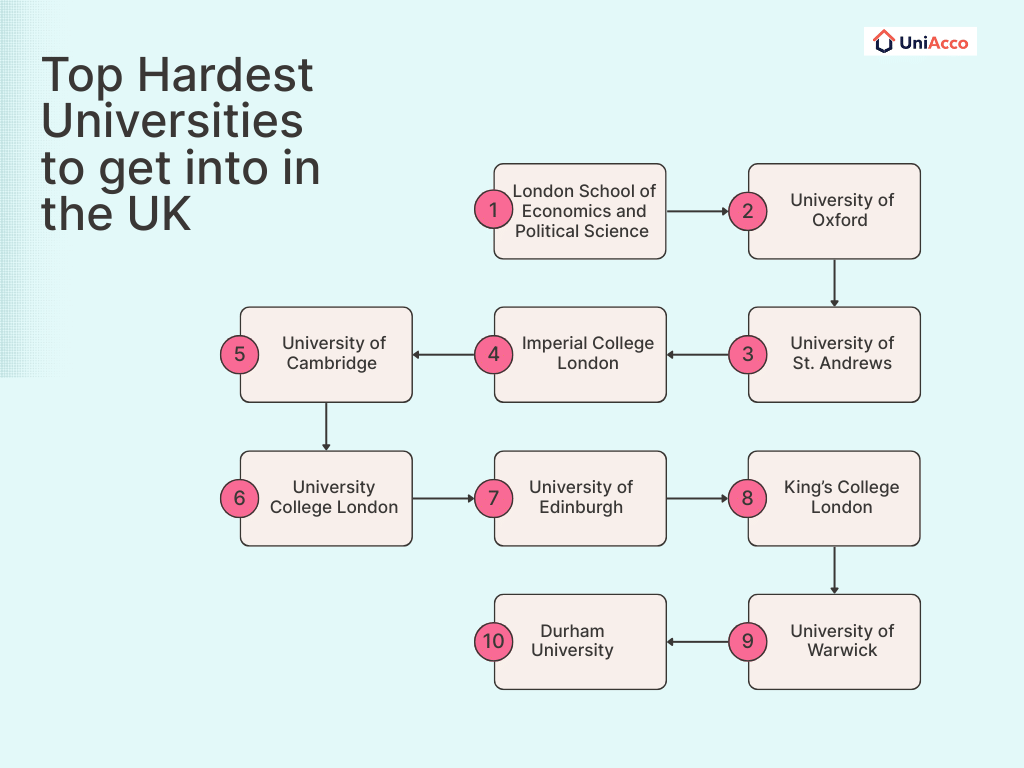
Now, we get into deep waters of the mighty river Thames. What makes these universities the hardest to get into?
- London School of Economics and Political Science (LSE)
Overview:
Located in the heart of central London, LSE, with a 2026 QS ranking of 56, is for the one who wants to be the commander-in-chief of high finance, corporate law, global policy, and so on. It is a G5 institution specialising in Social Sciences, Economics, and Political Strategy. It holds an acceptance rate of 6% to 16%, which means it’s a bottleneck situation. Tuition fees? £26,000 to £30,000 annually. Some big names who entered the gates of LSE are Mick Jagger, David Rockefeller, and so many other global billionaires, economists, and world leaders. LSE students are members of one of the largest economic and social science libraries in the world. The student-led Houghton Street Press is one of many ways LSE students engage with the world.
Why is it the hardest:
Whether you’re interested in Humanities, Social Science or Mathematics, the London School of Economics is one of the top universities in the UK for students. However, it’s a highly competitive university, with over 25,000 applicants competing for fewer than 2,000 available places each year. Unlike Oxford or Cambridge, LSE does not conduct interviews for its undergraduate programs. This means your grades and UCAS personal statement (SOP) have to be kick-ass!
- University of Oxford
Overview:
The oldest university in England, Oxford is located in and around the medieval city centre of Oxford, dubbed “that sweet City with her dreaming spires ” by the 19th-century poet Matthew Arnold, and comprises 44 colleges and halls as well as the largest library system in the UK. There are more than 22,000 students at Oxford, including 12,460 undergraduates and 13,755 postgraduates. With a 2026 QS ranking of 4, Oxford has an acceptance rate of 14% to 20%. The fees? Ranges from £ 33,000 to £ 48,000 annually. There are four academic divisions within Oxford University: Humanities, Mathematical, Physical and Life Sciences, Medical Science, and Social Science. Stephen Hawking, Malala Yousafzai, and countless UK Prime Ministers have all been a part of the Oxford legacy.
Why is it the hardest:
The application process involves unique challenges, such as the UCAS limit of applying to only 5 UK universities per academic cycle and the rule that applicants must choose between Oxford and Cambridge, not both. Oxford University hunts for well-rounded candidates who demonstrate intellectual curiosity, critical thinking, and a deep passion for their chosen field.
- University of St. Andrews
Overview:
To start with, this is where Prince William and Kate Middleton met! St Andrews is a unique and captivating place, and the University is a key part of its charm. 7 centuries of history link the students with the town, leading to the ancient and yet modern institution. Located in Fife, Scotland, it is ranked 113th in the 2026 QS rankings. The university offers over 900 degree courses across 4 faculties: Arts, Divinity, Medicine, and Science. The acceptance rate is between 8% and 10%, which is shockingly low. And the fees? £30,000 to £36,000.
Why is it the hardest:
St. Andrew’s has incredible popularity, particularly among affluent North American international students who are looking for academic excellence and the legacy of the UK. As the town and university infrastructure is limited, there is no extra room to accommodate a massive surge of students. Due to this demand-supply mismatch, it is difficult to get in!
- Imperial College London
Overview:
A world-leading university for Science, Technology, Engineering, Medicine and Business (STEMB), Imperial College is where scientific imagination drives world-changing impact. With a QS 2026 ranking of 2, it has an acceptance rate of 10% to 11%. Located in the neighbourhood of South Kensington, surrounded by world-class museums, the environment is collaborative but competitive. It is an elite hub for future tech CEOs, software engineers, and medical researchers. Some famous alumni include Alexander Fleming, Brian May (the Queen guitarist), Cyrus Mistry, the former chairman of the Tata Group. How much would you need to pay to get in? £44,000.
Why is it the hardest:
With an admission rate of ~10%, why wouldn’t it be difficult to get into Imperial College London? It is incredibly difficult because of its ultra-selective, hyper-competitive programs and focus on STEM. With a limit of 5 UK university choices, applicants are heavily self-selected, which means you are competing against the world’s highest-achieving students for a limited number of spots. Your competition is with international Olympiad winners, advanced coders, and highly driven STEM prodigies from across continents.
What’s tougher than getting into a UK university? Finding a room in London. With UniAcco, you can discover affordable student accommodation in London featuring fully furnished rooms, 24/7 security, all-inclusive bills, and convenient locations close to leading universities and student hotspots.
🔍 Explore Student Accommodation in London- University of Cambridge
Overview:
The academic rival of Oxford, the University of Cambridge is ranked 6th for the 2026 QS rankings. Cambridge University is known for its STEM fields. Your life at the University of Cambridge will revolve around historic colleges like Trinity, King’s, St John’s, as the university follows a collegiate system. The acceptance rate for Cambridge is somewhere between 16% and 21%. And the international fees are eye-watering. £67,000 for clinical medicine! If you get in, you will probably be sitting on the same bench as Isaac Newton, Charles Darwin, and Alan Turing, and many other legendary alumni.
Why is it the hardest:
Cambridge is one of the hardest universities to get into in the UK because it selects students based on profound analytical reasoning and academic potential over rote memorisation. With an acceptance rate of around 16%, you are required to navigate through intense academic conditions, rigorous pre-interview assessments, and subject-specific interviews.
- University College London (UCL)
Overview:
Founded in 1826 in the heart of London, UCL is London’s leading multidisciplinary university, with approximately 51,000 students from over 150 different countries. They have challenged orthodoxy and applied themselves to making the world better by application of ‘useful’ knowledge, with a particular focus on leading interdisciplinary discussion and debate. It has been ranked 9th on the 2026 QS ranking, and has an acceptance rate of 9% to 15%. The tuition fee ranges from £31,000 to £41,000 depending on the course you choose. Some of the visionary alumni that UCL has produced are Mahatma Gandhi, Christopher Nolan, and Alexander Graham Bell.
Why is it the hardest:
Due to its world-class global prestige and a high volume of global applications, getting into UCL requires high grades such as A*AA or AAA in A-levels, or 39+ points in the IB. Moreover, UCL receives 75,000 and 80,000 undergraduate applications, way more than Oxford or Cambridge.
- University of Edinburgh
Overview:
As one of Scotland’s four ancient universities, Edinburgh has been influencing the world for more than 4 centuries. Founded in 1583 by the Town Council, the university is the 6th oldest university in the UK. The university is known for its research in Artificial Intelligence, Informatics and Classical Literature. Ranked 34th globally by QS for 2026, it has an acceptance rate of about 11% to 22%, and the annual fees range from £28,000 to £38,000. Charles Darwin and Sherlock Holmes creator Arthur Conan Doyle have passed out from the University of Edinburgh.
Why is it the hardest:
The overall offer rate is around 50% to 53%, but many of these spots are heavily skewed by domestic quotas. This creates fierce competition for the most demanding programs. While the arts and humanities programs are fairly accessible, dentistry, medicine, business and law have a low acceptance rate.
- King’s College London (KCL)
Overview:
Established in 1829, KCL is a prestigious public research university. It is globally renowned for its clinical research, law, and humanities programs. Expect a fast-paced and urban energy vibe at KCL, with its main campus situated on the historic Strand. It is ranked 31st globally on QS in 2026 and has an acceptance rate between 13% and 20%. Fees range from £26,000 to £35,000. John Keats and Archbishop Desmond Tutu have been alumni of this reputed university!
Why is it the hardest:
With an acceptance rate between 13% and 20% for UK students, KCL is extremely difficult to get into. And for international students, it is even lower at 8%. The top reasons for being the hardest university to get into in the UK are: exceptional global ranking, high application volumes, and highly competitive programs.
- University of Warwick
Overview:
Founded in 1965, the University of Warwick is located on the outskirts of Coventry, England. Known for its academic excellence, it attracts students for their business, economics, and quantitative programs. It is home to approx 28,000 students from about 150 countries. Ranked 74th in QS 2026 rankings, it has an acceptance rate of approx 14% to 22% and fees up to £32,000. Some notable alumni include Sting, Nobel Laureate Oliver Hart, Stephen Merchant, and Emmy-winning actor Brett Goldstein.
Why is it the hardest:
Approx 50,000 students are applying for only 6000 undergraduate spots. This makes it extremely competitive, with an overall acceptance rate of about 24%. Degrees in Economics, Computer Science, and Law have the highest number of applicants, making these programs the toughest to get a spot.
- Durham University
Overview:
Durham University, founded in 1832, is the 3rd oldest university in England. It has a picturesque campus centred around a UNESCO World Heritage Site. It has a 2026 QS global ranking of 94, and it consistently ranks in the top 10 UK universities. It features 27 academic departments from Arts and Humanities, Science, and Social Sciences. It has an acceptance rate between 16% and 20% and fees up to £34,000. Some of the well-known alumni include Harold Evans, Nasser Hussain, Gabby Logan, and Helen Grace.
Why is it the hardest:
Durham University is considered one of the UK’s most selective universities. It holds a high academic reputation and consistently has high entry requirements like A*AA to AAA at A-level.
Top UG and PG Competitive Courses
| Course Name | Key Course Highlights | Eligibility Criteria | Avg Fees (for international students) |
| LSE:BSc Economics | Scientific Focus: Economic modelling and testing hypotheses.Core Foundation: Microeconomics, Macroeconomics, Econometrics, Quantitative Methods.Integrated Curriculum: Dedicated courses for Economics students with coding/Python workshops. Skill Development: Video projects, policy report writing, applied data analysis. | AAA (with A in Math)Further Math heavily preferredTMUA exam | £28,000 |
| Oxford:BA in Philosophy, Politics, & Economics | Core Foundation: Study all three disciplines simultaneously.Specialisation: Flexibility to continue all three subjects or drop one and focus on a specialisation.Tutorial System: Participate in Oxford’s signature weekly tutorials.No Prerequisites: Not required to have prior background in the subjects. | AAA minimumExceptionally high TSA exam scoreAcademic interviews | £37,000 |
| St. Andrews:MA in International Relations | Core Foundation: Covers modules such as Concepts in Global Politics and Foreign Policy and DiplomacyHonours: Advanced, research-driven modules.Research Centres: Access to specialised facilities and expertise, including the Centre for Peace and Conflict Studies.Flexible Degrees: Single Honours degree or combined with subjects like Economics, Modern History, Management, or Philosophy. | AAA at A-Level or 38 points in IB | £32,000 |
| Imperial College:Medicine (MBBS) | Integrated BSc: Allows for deep dives into medical research, surgical design, or global health.Clinical Exposure: Patient contact and clinical skills training begin in the very first year.Hospital Placements: Clinical years are based across multiple major NHS teaching hospitals in London.Case-Based Learning: Taught through real-world clinical scenarios. | A*AA in vital SciencesHigh UCAT percentile scorePassing the MMI Interview | £53,000 |
| Cambridge:BA in Computer Science | Year 1: Algorithms, Discrete & Continuous Mathematics, Digital Electronics, and Machine Learning. Practical classes in languages such as OCaml, Java, and Python.Year 2: Advanced theory and systems. Students also complete a group software project replicating real industrial practices.Year 3: Offers high flexibility to specialise through advanced modules. Students conclude the year with a significant individual research project or dissertation. | AAA*, high Step Exam requirementsTop percentile in TMUA assessment | £40,000 |
| UCL:BSc in Architecture | Studio-Based Learning: Roughly 70% of the program focuses on hands-on studio work. The Bartlett Design Units: Join specific design units led by practising architects and specialists. B-Made Workshops: Access to state-of-the-art facilities and digital fabrication tools through The Bartlett’s dedicated manufacturing workshops. | AAB minimum, but the highly creative visual portfolio is the deciding factor. | £34,000 |
| Edinburgh:BSc in Informatics/AI | World-Class Reputation: Top-ranked Informatics departments with a deep respect for the global tech industry.Flexible Curriculum: Allows you to tailor your focus or even take modules outside the School of Informatics.Specialised Topics: Machine Learning, Vision and Robotics, Natural Language Processing, and Computational Cognitive Science. | AAA in core STEM subjectsAdvanced mathematical focus | £35,000 |
| KCL:LLB Law | Prime Location: Situated in Somerset House, students are within walking distance of the Royal Courts of Justice, the Inns of Court, and major global law firms.Global Opportunities: Students can apply to 4-year options for study abroad, trans-national legal studies, or dual degree.Resources: Access to the Maughan Library. | A*AALNAT (Law National Aptitude Test) score | £33,000 |
| Warwick:BSc Mathematics | High Flexibility: The 3rd year is fully optional, allowing you to take up to 50% of your modules outside the department.Diverse Pathways: Explore the full breadth of the mathematical sciences, spanning pure mathematics, computational analysis, climate science, mathematical biology, and finance.Research-Integrated Teaching: Modules in the latter half of the degree offer direct insight into the latest cutting-edge research and open problems. | AAA + highly strong performance in STEP, MAT, or TMUA exams. | £28,000 |
| Durham:BA in English Literature | Core Foundation: Includes – Introduction to Drama, Novel, and Poetry.Historical & Critical Core: Mandatory modules include Shakespeare and Theory and Practice of Literary Criticism.Specialist Optional Modules: Old English and Arthurian Literature to American Fiction, Sexology and the Novel, and The Rise of Popular Music.The Final-Year Dissertation: Allows you to explore a specific literary topic in depth with one-to-one supervisor support. | A*AA, supported by a well-read personal statement (SOP) | £27,000 |
What’s the eligibility criteria to find comfort in Manchester? With UniAcco, it’s simple. Explore verified, fully furnished, and affordable student accommodation in Manchester designed to suit every budget. Enjoy modern amenities, all-inclusive bills, and convenient locations close to universities and city attractions.
🔍 Explore Student Accommodation in ManchesterTips to get into the hardest universities in the UK
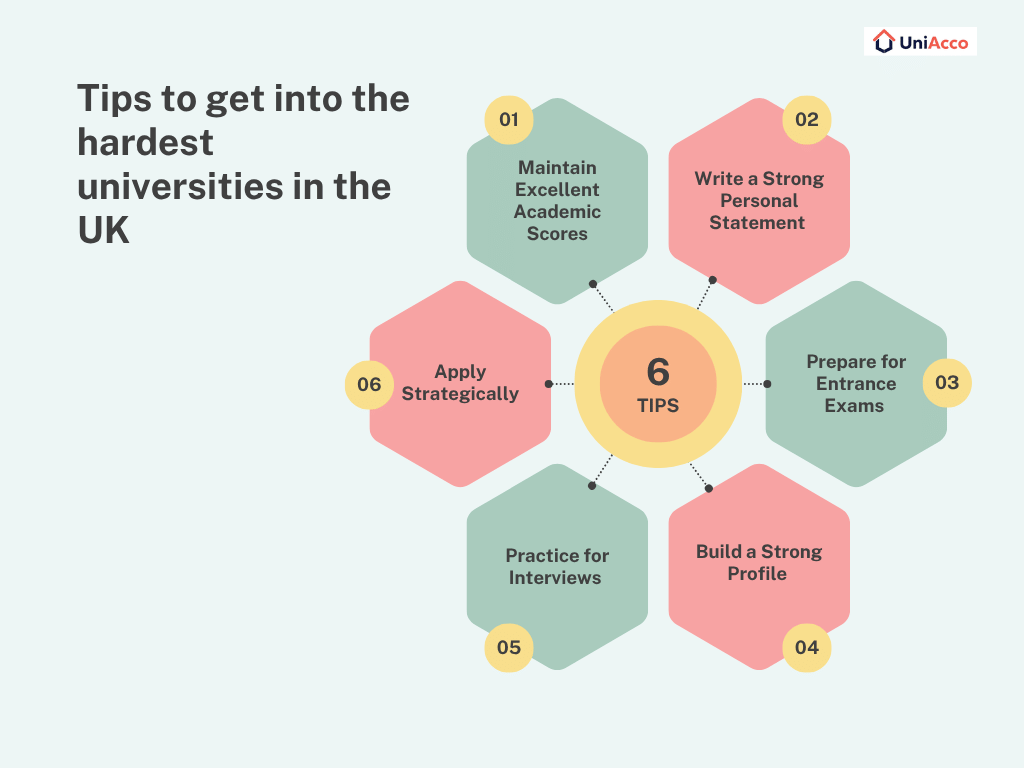
- Maintain Excellent Academic Scores
Your grades decide your destiny, period. The most competitive UK universities and institutions strictly use your predicted high school grades as a gatekeeper. You need to hit top grades in your A-Levels, perfect 5s in your Advanced Placement (AP) exams, or score 40+ points in your IB Diploma. Top UK universities mainly focus on academic excellence.
- Write a Strong Personal Statement
The standard UK UCAS personal statement differs from the US. The admissions officers do not care about your childhood interests. They want to get straight to the point. At least 80% of your personal statement must talk about your curricula. Talk about the public lectures you’ve attended and research projects you’ve completed.
- Prepare for Entrance Exams
Your high school grades aren’t enough. What sets you apart are the time-pressured entrance exams. Whether it is the UCAT for Medicine, the LNAT for Law, the TMUA for Math and Economics, or the TSA for Oxford, these exams decide the course of your future. Start practising for these exams way ahead of time to stand a chance against the Olympiad winners and top-tier students who apply to UK universities.
- Build a Strong Profile
Work on building a relevant academic profile. If you want to grab the hardest uni courses to get into the UK, think advanced Engineering, Medicine, Law, you need to build a solid case for yourself. Build a profile that has a backup of the big statements that you make. Otherwise, the admissions team will simply reject you if there’s no proof!
- Practice for Interviews
Face value is real. And more than that, in the UK, intellectual value is all the more real. Everything is about academic excellence and your skill set. The key is to converse mindfully and not give quick, memorised answers. No knee-jerk moments! They observe how you think, process, and adapt when you are given a complex problem to solve. Practice the thinking aloud method with yourself and your teachers or smart friends. It helps!
- Apply Strategically
There are only 5 choices on the UCAS portal. Do not make the mistake of applying to all the hardest UK universities. Balance your choices with options that include 3 hardest and 2 not-so-hard units to get into. Or choose 2 biggies like LSE or Oxford, 2 realistic matches based on your score predictions, and 1 guaranteed, low-risk option.
Want extra tips from students and professors? Read this Reddit thread and get valuable insights on how to improve your chances of getting into the UK’s most competitive universities.
How to get into top UK universities like UCL? – r/Indians_StudyAbroad
Conclusion
Keep a keen eye on the acceptance rates and surging international demand from highly qualified applicants. Getting into UK universities might seem like a nightmare, but if you apply the right strategy and put in the right effort, you will get through. Whether you are aiming for LSE or Oxford or St Andrews, competition is a bottleneck everywhere.
We have covered major points that need your attention; from the top 10 hardest UK universities to get into, to what makes them the hardest, and how to prepare for warfare, you have your armour sorted.
Now, the only thing that’s left to look for is a home! Find verified and affordable student accommodation in England and get a fully-furnished room with all-inclusive bills without stress at UniAcco.


 LinkedIn






0 Comments