

Every few weeks, a new dataset declares the end of international education.
UK study visas down a third from the peak. Canada’s permits for Indian students collapsed. US F-1 issuances to Indians down sharply. Net migration numbers falling everywhere.
The numbers are real. The conclusion isn’t.
Here is the distinction almost everyone misses: visas, permits and arrivals are channel data. They measure how wide a door is open. They tell you nothing about how many people want to walk through it.
I run a company that guides students through admissions, financing and housing. I have every incentive to talk this market up. So let me start with what the pessimists get right.
The correction is real
Indian departures for study abroad fell from ~9.1 lakh in 2023 to ~6.3 lakh in 2025. Education remittances hit their lowest level in years. The cost of studying abroad rose an estimated 10–12% in 2025 alone, tuition inflation in destination countries stacked on a depreciating rupee. And the post-study payoff became less certain in exactly the markets that charge the most.
Families responded the way rational investors respond when a purchase gets costlier and the return gets less certain. They repriced. Some deferred. Some chose differently.
That is not retreat. That is discipline.
But check the base year
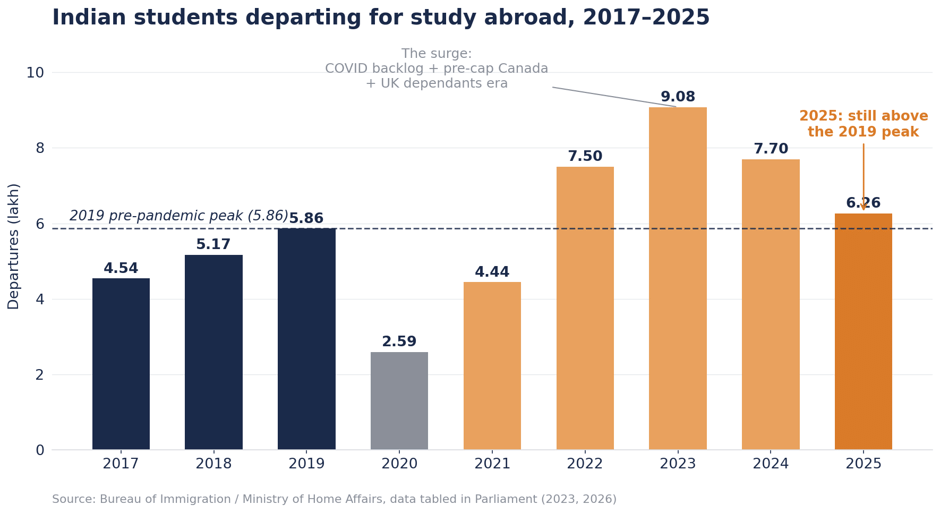
Chart 1 — Indian student departures, 2017–2025
The surge from ~4.4 lakh departures in 2021 to ~9.1 lakh in 2023 was not structural growth. It was three temporary forces stacked on top of each other: two COVID-deferred cohorts leaving at once, Canada’s pre-cap permissiveness, and the UK’s dependants era. No income trend, no demographic shift, no education driver doubles a market in two years.
Measured against that artificial peak, 2025 looks like a bust.
Measured against 2019, the last normal year, 2025 departures are still above the pre-pandemic peak. After the harshest visa environment in a decade, the most expensive cost base on record, and open hostility in two of the four largest destinations and the most hostile geopolitical environment in recent times..
That is not a collapsing market. That is a floor being tested and holding.
What the visa rules actually filter
Read the policy mechanisms closely, not the headlines, and a pattern appears.
When the UK banned most dependants, study visas for actual students rose ~9% while dependant visas fell. When you look at where refusals concentrate, they cluster in markets and segments where funding and intent credibility were weakest, not uniformly across all applicants. And the trigger for all of it: study-to-work switching in the UK went from a few thousand cases a year in the late 2010s to over two lakh in 2024. For a segment of the market, the visa had become the product and the degree incidental.
The filters are blunt instruments, genuine students get caught in them too, and I won’t pretend otherwise. But what they are pricing out, in every sending market including India, is an arbitrage: a study route being used as an immigration route, and an agent ecosystem that packaged and sold it that way.
What remains after the filter is demand anchored in education outcomes. Smaller today. Far more durable tomorrow.
Why India’s demand is structural, not cyclical
Three forces are compounding underneath the visa noise. None of them care about policy cycles.
Income. Goldman Sachs projects ~100 million Indians earning US$10,000+ by 2027 — roughly double today’s affluent cohort. Longer-range projections see India adding ~75 million middle-class and ~25 million rich households by 2030. At these income levels, families systematically over-index on one category: their children’s education.
The quality gap at scale. India’s higher education enrolment ratio is ~28% against a national target of 50% by 2035. The 23 IITs offer ~18,000 BTech seats for 16 lakh+ aspirants, an admit rate under 2%, more selective than the Ivy League, driven by scarcity rather than quality. And no Indian university ranks in the global top 100. A top-decile family whose child misses a sub-2% cut faces a genuine quality cliff at home. That gap cannot be closed quickly, however fast we build.
The K12 pipeline. This is the force nobody prices in.
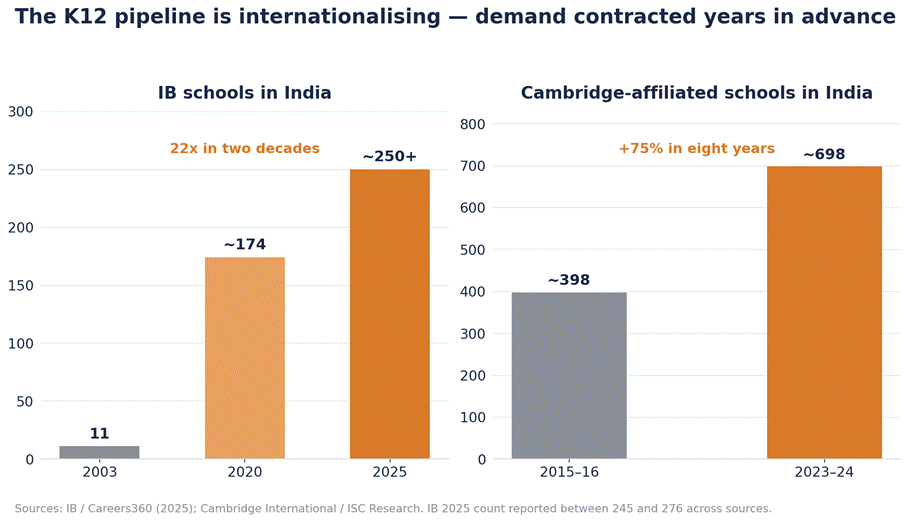
Chart 2 — International curricula in Indian K12
IB schools in India have grown from 11 in 2003 to roughly 250+ today and the growth is now in tier 2 and tier 3 cities, not just the metros. Cambridge-affiliated schools grew ~75% in eight years. NEP 2020 made these qualifications formally equivalent to Indian boards.
Hundreds of thousands of Indian children are now in globally benchmarked classrooms from age five. For these families, internationally oriented higher education is not an aspiration someone sells them at 17. It is the default continuation of a decision they made a decade earlier. This demand is contracted years in advance and it is structurally indifferent to any one country’s visa cycle.
China ran this movie first
China was the engine of global student mobility for twenty-five years driven by exactly India’s profile today: a rising middle class and a gap between demand and elite domestic capacity. Chinese outbound numbers peaked around 2019 and have since drifted ~19% lower. Analysts there call it what it is: a maturing market, not a collapsing one.
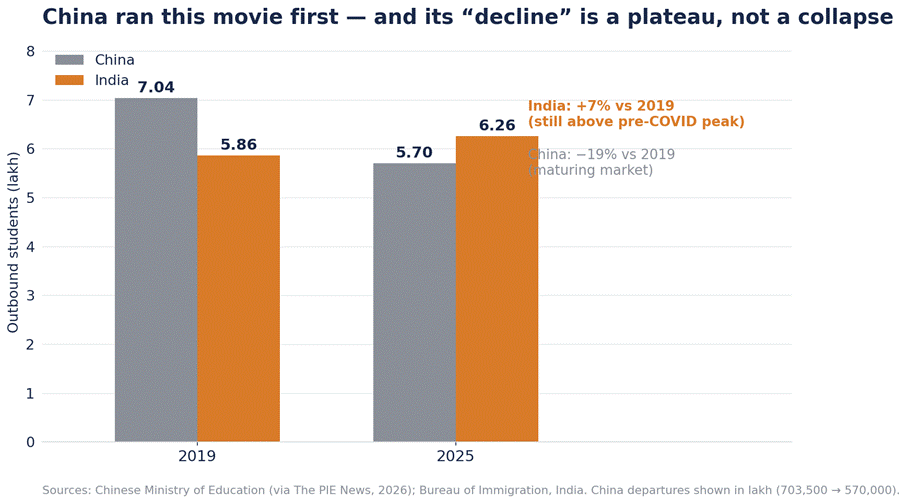
Chart 3 — China vs India outbound, 2019 vs 2025
Look at what drove China’s plateau. Domestic quality: 72 mainland universities now sit in the QS rankings, third in the world. Demographics: China’s university-age population shrank by roughly a third from its 2010 peak. And 1,000+ international education ventures now operate inside China.
Now run India against each variable. Our college-age population is still growing. Our elite capacity gap is far wider than China’s was at the same stage. Our foreign-campus story is just beginning. On the sending-market maturity curve, India is 10–15 years behind China.
And here is the part worth sitting with: China at full maturity with world-class domestic universities and a shrinking youth population still sends ~5.7 lakh students abroad every year.
The destinations need students more than they admit
The piece almost nobody puts in the same frame: while source markets grow, destination systems are running out of domestic students.
The US “enrolment cliff” begins this year, the pool of American high school graduates shrinks by ~13% (nearly half a million a year) by 2041, and most US institutions now rank international recruitment as a strategic priority. In the UK, sector analysts note that for many universities, international fees are effectively the only surplus-generating line that cross-subsidises everything else. Germany, Japan, Spain and South Korea are explicitly recruiting international students to offset ageing populations.
Restriction is a political cycle. Dependence is a structural condition. Policy runs in years; demographics run in decades and demographics win. The doors will not stay closed. They will reopen on stricter, more selective terms. Families who plan for quality will clear that bar. Volume plays will not.
Where the demand goes
Global student mobility is projected to grow from ~6 million (2019) to 8–9 million by 2030. What changes is the map, not the direction. The Big Four’s share is projected to fall from ~40% to ~35%. UAE grew their international enrolments five to six times over in a decade. Germany now hosts ~59,000 Indian students; Europe’s share of Indian students grew by double digits last year. Applying to multiple destinations is no longer a hedge, it is the default strategy.
Chart 4 — Global mobility growth and Big Four share
And some of the demand is coming home. Around 18–19 foreign universities now hold approval to operate in India, with the first campuses open and fees running 25–40% below the same degree abroad. It is early, the first cohorts were tiny and a degree earned in Gurugram does not carry post-study work rights in London. Direction, not substitution. China built 1,000+ such ventures and still sends 5.7 lakh students abroad; international campuses expand access more than they replace mobility.
What actually ended
The era of undifferentiated volume. The arbitrage. The agent selling a visa dressed as a degree.
What replaces it is a more rational, quality-weighted, multi-destination market and families asking a better question. Not “should we go abroad?” but “what is the right route to a global education for this child, and at what price?”
That is a better question. And a better market.
Data sources: Bureau of Immigration / MEA (Parliament replies, 2023–2026); UK Home Office & ONS; IRCC; Australian Dept of Education; Chinese Ministry of Education; Goldman Sachs; PRICE ICE 360; AISHE; JoSAA; IB / Cambridge International / ISC Research; QS Global Student Flows; HolonIQ / Navitas; WICHE; UGC / IFSCA.


 LinkedIn




0 Comments