
Few places make getting dressed feel like a statement quite like London. One day it’s Shoreditch streetwear, the next it’s Savile Row tailoring or a wild look outside London Fashion Week. The city can feel like one giant source of inspiration, especially for a fashion enthusiast. Then comes the less glamorous part of choosing where to study. The most famous name on your list might not offer the course, budget or industry exposure you need. Maybe you care about styling, sustainable fashion, fashion business or designing clothes from scratch. Your choice should reflect that.
This blog covers the top 10 fashion schools in London, with their courses, fees, strengths and key details.
Best Fashion Schools in London: An Overview
| Fashion School | Best Known For | Popular Courses |
| London College of Fashion, UAL | Fashion design, fashion business, buying, marketing, communication and specialist areas such as footwear and tailoring | BA Bespoke TailoringBA Fashion Design and DevelopmentBA Fashion Buying and MerchandisingBA Fashion MarketingBA Cordwainers Footwear and Accessories |
| Central Saint Martins, UAL | Experimental fashion design and fashion communication, with a strong focus on creative practice and ideas | BA Fashion Design: KnitBA Fashion Communication: Fashion DesignBA Fashion Communication: JournalismBA Fashion Communication: Image and PromotionMA Fashion Communication: Fashion Image |
| Royal College of Art | Postgraduate fashion and textiles education with an emphasis on critical, experimental and research-led practice | MA FashionMA TextilesGraduate Diploma in Art & Design with Fashion & Textiles specialism |
| University of Westminster | Fashion design, fashion business, marketing, promotion and photography, with strong links to the fashion industry | BA Fashion DesignBA Fashion Business Management with Professional ExperienceBA Fashion Marketing and PromotionBA Fashion PhotographyMA Fashion Business ManagementMA Fashion Manufacturing |
| Kingston School of Art, Kingston University | Fashion design with a balance of creative exploration and professional practice | BA FashionMA Fashion |
| Istituto Marangoni London | Fashion design, luxury, accessories and fashion business within an international fashion-school setting | BA Fashion DesignBA Fashion Design & MarketingBA Fashion Design & AccessoriesMA Fashion DesignFoundation in Fashion & Design |
| Vogue College of Fashion | Fashion communication, media, styling, luxury and fashion business | BA (Hons) Fashion Communication & Industry PracticeMA Fashion & Beauty CommunicationsMA International Luxury BusinessMA Fashion Design, Brand & Business Creation |
| University of East London | Practical fashion education with an emphasis on industry projects, collaborations and sustainability | BA Fashion DesignBA Fashion Cultures and BusinessBA Fashion Marketing and CommunicationBA Fashion Studies Top Up |
| Middlesex University | Fashion communication, styling, marketing and industry-focused creative practice | BA Fashion Communication and StylingBA Fashion Marketing |
| Ravensbourne University London | Fashion design, buying, brand management, promotion and digital fashion | BA (Hons) FashionBA (Hons) Fashion Buying and Brand ManagementBA (Hons) Fashion Promotion and CommunicationMBA Fashion: Business and Entrepreneurship |
How London Helps Fashion Students Build Industry Experience?
- London Fashion Week
London Fashion Week can give you a closer look at how the industry operates beyond classroom projects. Some events are invite-only, while others are open to the public.
- Internships and placements
Some London fashion degrees include placements or structured work experience. LCF, for example, offers eligible students accredited placements and longer professional experience options. Other universities also run career fairs, guest sessions and industry events. Westminster students, for example, can find work experience through networking events, careers fairs and guest speakers.
- Fashion exhibitions and museums
Your classroom can extend to London’s museums. The V&A holds a major collection of fashion and textiles spanning thousands of years. It also runs fashion tours, exhibitions and live fashion events. That matters if you study design, styling, fashion history, curation or communication. Seeing garments up close can add context that a screen simply cannot provide.
- Flagship stores and fashion districts
London’s retail scene gives you another way to study fashion in real time. Spend an afternoon around areas such as Soho, Mayfair, Covent Garden or Shoreditch. Look at window displays, customer behaviour, visual merchandising and how brands present themselves. You do not need an internship to start learning from the industry around you.
- Fashion events and graduate shows
Graduate shows, talks, exhibitions and careers events can help you see how students present their work professionally. LCF, for example, runs industry events, guest sessions and graduate-focused activities through its careers team. These events can also help you understand what employers expect from emerging talent.
- Networking and industry talks
A useful conversation can sometimes teach you more than another hour of scrolling through job listings. Universities across London invite designers, recruiters, alumni and other industry professionals to speak with students. The important bit is knowing what your university actually offers. Studying in London does not guarantee access to specific brands, internships or jobs. Your course, university connections and your own effort all matter.
Top 10 Fashion Schools in London
London College of Fashion, UAL
A fashion career can take you far beyond the design studio. LCF reflects this through courses covering tailoring, styling, buying, marketing, and fashion management. You can build your degree around the part of fashion that genuinely interests you. Its place within UAL adds a wider creative community to the experience.
Key Highlights:
- A huge choice of fashion specialisms
LCF offers courses across fashion design, business, communication, styling, footwear, accessories, textiles, making and more. Few students need to force their interests into one narrow route.
- Industry work can form part of your degree
Several LCF courses offer placements or industry work opportunities. BA Fashion Marketing, for example, includes a short industry placement and an optional placement year.
- Real projects with fashion businesses
LCF has featured student projects with FARAH and Salomon. Its 2026 opportunities also include a Burberry student competition that asks students to rethink materials and their use in fashion.
- Strong links beyond the classroom
LCF brings visiting speakers, industry professionals and external projects into its courses. Its Graduate Futures programme also supports students with careers, internships, events and industry opportunities.
- A strong 2026 academic profile
UAL, which includes LCF, ranks second globally for Art and Design in the QS World University Rankings by Subject 2026. LCF describes itself as a global leader in fashion education.
Popular fashion courses at LCF
| Course | Tuition Fees |
| BA (Hons) Fashion Design and Development | £30,890 |
| BA (Hons) Fashion Buying and Merchandising | £30,890 |
| BA (Hons) Fashion Marketing | £30,890 |
| MA Fashion Design Technology: Womenswear | £30,890 |
| MA Fashion Futures | £30,890 |
| MA Strategic Fashion Marketing | £30,890 |
Also Read: Student Guide to the University Of The Arts London 2026
Central Saint Martins, UAL
Some fashion schools teach you how to make clothes. Central Saint Martins pushes you to question what fashion can become. Its Fashion Programme brings design, communication, research and experimentation into the same creative community. That makes CSM especially interesting if you want your work to have a clear point of view. Its current programme spans five BA Fashion Design pathways and several postgraduate routes.
Key Highlights:
- Five distinct BA Fashion Design pathways
You can choose Womenswear, Menswear, Knit, Print or Communication within the BA Fashion Design programme.
- The course encourages cross-course collaboration
Fashion Design students work with peers across the Fashion Programme, including Fashion Communication students.
- Real industry collaboration forms part of the course
Previous collaborations have included Dior, LVMH, Nike, Puma, Louis Vuitton and the V&A. These are past collaborations, not guaranteed opportunities.
- CSM has a strong experimental and responsible-fashion focus
Its Fashion Programme explores new technologies, sustainable production and changing ideas around fashion, identity and society.
- The 2026 BA Fashion Show keeps the CSM spotlight firmly on emerging talent
The 2026 show featured graduating students, while the programme highlights alumni such as John Galliano, Stella McCartney, Daniel Lee and Grace Wales Bonner.
Popular fashion courses at CSM
| Course | Tuition Fees |
| BA (Hons) Fashion Design: Womenswear | £30,890 per year |
| BA (Hons) Fashion Design: Menswear | £30,890 per year |
| BA (Hons) Fashion Design: Knit | £30,890 per year |
| BA (Hons) Fashion Design: Print | £30,890 per year |
| BA (Hons) Fashion Design: Communication | £30,890 per year |
| MA Fashion | Year 1: £27,720Year 2: £16,630 |
| MA Fashion Communication | £34,885 |
Royal College of Art
RCA suits students who want fashion to raise bigger questions, rather than stop at the finished garment. Its Fashion MA examines fashion through social, environmental, geopolitical and economic issues. That makes the course a strong fit for designers interested in changing how fashion works. RCA also offers a closely related Textiles MA, with work spanning fashion, materials, craft and fine art.
Key Highlights:
- A postgraduate-only fashion route
The RCA Fashion MA is a one-year, full-time postgraduate programme worth 180 credits. It suits applicants ready for advanced design study.
- Fashion is treated as a wider design problem
The MA examines environmental responsibility, social issues and the economic forces shaping fashion. Your work can move beyond traditional collection-making.
- Interdisciplinary study is part of the course
Fashion students take part in the School of Design’s Grand Challenge. The project brings students together around major contemporary issues.
- RCA2026 put graduating fashion work on public display
The 2026 School of Design EXPO featured MA Fashion at the Kensington campus from 16 to 18 July. The event was free and open to the public.
- International students can apply for selected scholarships
Paying for an RCA Fashion MA can be a big commitment. The 2026/27 course page lists several scholarships, including a £10,000 GREAT Scholarship for selected overseas students.
Popular fashion courses at RCA
| Course | Tuition Fees |
| Fashion MA | £39,200 |
| Textiles MA | £39,200 |
University of Westminster
Westminster takes a practical route into fashion, with options spanning design, business, marketing, photography and manufacturing. Its fashion offering suits students who want creative study with a clear industry focus. The university’s Harrow Campus houses its fashion courses alongside other creative subjects, creating plenty of scope for cross-disciplinary work.
Key Highlights:
- Its Fashion Design BA made London Fashion Week history
Westminster became the first undergraduate course to show students on the official London Fashion Week schedule. The first appearance came in 2018.
- A dedicated studio supports hands-on fashion design
Fashion Design students use industrial sewing machines, pattern-cutting tables and mannequins.
- The Westminster Menswear Archive is a serious research resource
The archive holds more than 1,800 pieces, including work from Alexander McQueen, Vivienne Westwood and Jean Paul Gaultier.
- 2026 brings a new “careers and enterprise” base
Zone29 opened in May 2026 beside the Marylebone Campus. It offers career appointments, mentoring, workshops and employer connections.
- Several fashion degrees offer direct professional experience
Fashion Business Management with Professional Experience includes a full-year industry placement. Fashion Design also offers an extended internship route.
Popular fashion courses at the University of Westminster
| Course | Tuition Fees |
| Fashion Design BA (Hons) | £17,600 per year |
| Fashion Business Management with Professional Experience BA (Hons) | £17,600 per year |
| Fashion Marketing and Promotion BA (Hons) | £17,600 per year |
| Fashion Photography BA (Hons) | £17,600 per year |
| Fashion Manufacturing MA | £16,000 per year |
Kingston School of Art
Kingston School of Art has spent more than 140 years teaching art and design. That history still feels relevant in its fashion offering. The school puts strong emphasis on making, technical skills and professional practice. Its Fashion BA covers the design process from research through garment construction, while its postgraduate courses push further into responsible fashion and industry practice. For students who want to make clothes, question how they are made and build a strong portfolio, Kingston deserves a serious look.
Key Highlights:
- Top 4 in the UK for Fashion and Textiles
The Guardian University Guide 2026 ranks Kingston among the UK’s top four for Fashion and Textiles.
- Business of Fashion has given Kingston four excellence badges
Kingston is among a small group of institutions worldwide with badges for overall performance, global influence, learning experience and long-term value.
- The course takes making seriously
Fashion BA students work through research, design development, cutting, construction and garment creation. The course also supports individual style and creative direction.
- Industry briefs can become part of your portfolio
Kingston’s Fashion MA includes briefs from industry sources and practitioners. Students develop work towards professional portfolio standards.
- Sustainability runs through its postgraduate fashion study
The Fashion MA explores responsible garment production and slower, small-scale production. Its Sustainable Fashion MA focuses on the social and environmental impact of fashion systems.
Popular fashion courses at Kingston School of Art
| Course | Tuition Fees |
| Fashion BA (Hons) | £21,400 per year |
| Fashion MA | £28,000 per year |
| Sustainable Fashion: Business and Practices MA | £23,700 full-time |
Istituto Marangoni London
Fashion Street is an interesting address for a fashion school. Istituto Marangoni London sits in East London, close to the city’s creative energy. Its courses bring fashion design, accessories, marketing, business and communication together. The school also puts strong emphasis on industry-facing learning and professional presentation. That combination can suit students who want a distinctly fashion-focused education in London.
Key Highlights:
- A 2026 student survey shows strong satisfaction
The London school recorded an 89.43% overall positivity score in its 2026 student survey. Its response rate reached 92%.
- Industry talks go beyond classroom teaching
The Career Service organises seminars, workshops, industry talks and networking opportunities. Past company presentations have included Vogue UK, Dior, Burberry, WGSN and Ralph Lauren
- Selected final-year designers can show their collections
The school holds a Fashion Show for selected third-year Fashion Design students. Industry experts, press and buyers attend the event.
- The London campus includes specialist fashion spaces
Students can use pattern-cutting rooms, sewing equipment, photo studios, computer rooms and drawing spaces.
- Fashion study can combine creative and commercial skills
Its Fashion Design & Marketing BA covers design, production, marketing, buying, range planning and consumer analysis.
Popular fashion courses at Istituto Marangoni London
| Course | Tuition Fees |
| BA (Hons) Fashion Design | £22,700 per year |
| BA (Hons) Fashion Design & Marketing | £22,700 per year |
| BA (Hons) Fashion Design & Accessories | £22,700 per year |
| BA (Hons) Fashion Business & Buying | £22,700 per year |
| Foundation in Fashion & Design | £14,100 |
| MA Fashion & Luxury Brand Management | £29,450 |
| MA Fashion Styling, Creative Direction & Digital Content | £29,450 |
Vogue College of Fashion
Vogue College of Fashion takes a different route into the industry. Its London offering centres on fashion communication, media, business and creative practice. The BA brings styling, image-making, journalism, branding and fashion business into one course. That makes it particularly relevant for students who see themselves behind the campaign, editorial or brand strategy.
Key Highlights:
- The BA covers several sides of fashion in one degree
You study fashion media, styling, image-making, branding, marketing, journalism and business. You can build a broader creative portfolio across these areas.
- The course includes a live industry project
Year two includes a 30-credit Live Industry Project. You also complete a Careers & Placement module during the same year.
- You learn with Vogue and Condé Nast industry input
The BA draws on Vogue and Condé Nast expertise alongside academics and fashion professionals. The course includes practical workshops and industry-led learning.
- The London campus sits at Bedford Square
Vogue College brings its Vogue and Condé Nast expertise into the BA alongside academic teaching. The course also includes practical workshops and sessions led by fashion professionals.
- You can test the subject before committing to a full degree
The college runs short courses and a four-week London summer programme. The 2026 summer programme offers Fashion Business and Fashion Media options.
Popular fashion courses at Vogue College of Fashion
| Course | Tuition Fees |
| BA (Hons) Fashion Communication & Industry Practice | £25,000 per year |
| MA Fashion & Beauty Communications | £34,950 |
| Fashion Branding & Communication | £850 |
| Vogue Summer Programme: Fashion Business | £5,500 |
| Vogue Summer Programme: Fashion Media & Styling | £5,500 |
University of East London
Fashion at UEL has a distinctly hands-on feel. The university combines studio work with live briefs, digital technology, sustainability and business. That mix suits students who want more than garment construction alone. You can move towards design, fashion marketing, cultural research or international fashion business. The department also gives you access to specialist making spaces, including sewing and textile print workshops.
Key Highlights:
- Live briefs put your ideas under real-world pressure
UEL’s fashion programmes include industry-linked projects and briefs. You can build work that reflects professional expectations.
- London Fashion Week has featured UEL student work
UEL has showcased emerging designers through London Fashion Week activity. Recent work has explored sustainability, gender-neutral clothing and new fashion artefacts.
- The facilities go beyond sewing machines
Students can use sewing workshops, textile print spaces, a Mac lab and digital production tools. The university also highlights laser cutting and 3D printing.
- Industry links cover recognisable fashion names
UEL lists projects and placement opportunities involving ASOS, Paul Smith, Net-a-Porter, Vivienne Westwood and Alexander McQueen. These opportunities depend on the course and student selection.
- Sustainability and fashion technology are active research areas
UEL researchers work on sustainable materials, decorative methods and digital technology. Its fashion team also explores augmented reality within fashion promotion.
Popular fashion courses at UEL
| Course | Tuition Fees |
| Fashion Design BA (Hons) | £17,000 per year |
| Fashion Cultures and Business BA (Hons) | £16,020 per year |
| Fashion Studies Top Up BA (Hons) | £16020 per year |
| Fashion MA | £16,620 per year |
| International Fashion Business MA | £16,620 per year |
| Fashion Entrepreneurship MBA | £18,900 per year |
Middlesex University
Middlesex makes sense for students who see fashion as more than designing clothes. Its courses cover marketing, communication, styling, photography, art direction and emerging technology. That mix can suit creative students who want several career routes within fashion. The Hendon campus also puts specialist studios, visiting professionals and practical projects into the weekly study routine.
Key Highlights:
- London Fashion Week can become part of your course experience
Fashion Communication and Styling students can assist at London Fashion Week as part of their studies. The course also offers an optional year-long industry placement.
- You can build skills across styling, photography and art direction
The Fashion Communication and Styling BA covers photography, styling, film and art direction. You can later focus on roles such as stylist, photographer or creative director.
- The course uses current fashion technology
Students explore tools such as CLO3D, 3D scanning, green screen and video editing. These skills can strengthen your digital fashion portfolio.
- Fashion Marketing crosses design and business
The Fashion Marketing BA sits across the School of Design and the School of Business. Students work with both fashion and marketing perspectives.
- Recent student work has earned industry recognition
The Fashion Communication and Styling course won the Best Stand at the D&AD New Blood Awards in 2024. Its graduates have also received coverage from SHOWstudio.
Popular fashion courses at Middlesex University
| Course | Tuition Fees |
| Fashion Communication and Styling BA (Hons) | £17,200 per year |
| Fashion Marketing BA (Hons) | £17,200 per year |
| Digital Fashion, Innovation and AI MA | £21,200 |
Ravensbourne University London
Ravensbourne is a strong pick for students who want fashion and technology in the same room. Its fashion courses cover design, buying, branding and promotion. Digital tools are also heavily featured across the curriculum. The result suits students who want to experiment with how fashion gets designed, presented and sold today. Its Greenwich Peninsula campus adds another advantage, with London’s creative and cultural scene close by.
Key Highlights:
- Digital fashion has its own dedicated pathway
The BA Fashion includes a Digital Technology for Fashion pathway from the second year. It introduces advanced digital techniques during the first year.
- Live briefs start from the first year
Fashion Buying and Brand Management students work on briefs set by industry professionals from Year 1. Partners listed by Ravensbourne include NEXT, Whistles/Hobbs and Harvey Nichols.
- Its fashion courses show strong 2026 student satisfaction
Ravensbourne’s fashion subject courses recorded 85.2% overall positivity in the 2026 National Student Survey. Assessment and feedback scored even higher, at 90.4%.
- Students have already shown work at London Fashion Week
Ravensbourne’s fashion page features work from students who exhibited at London Fashion Week in 2023. The examples include Fashion and Fashion Promotion students.
- Sustainability is built into the fashion curriculum
Ravensbourne brings sustainability into its fashion courses, alongside practical work and new approaches to materials. Its 2026 updates also highlight denim innovation and student projects using Zandra Rhodes’ archives.
Popular fashion courses at Ravensbourne University London
| Course | Tuition Fees |
| BA (Hons) Fashion | £17,500 per year |
| BA (Hons) Fashion Buying and Brand Management | £17,500 per year |
| BA (Hons) Fashion Promotion and Communication | £17,500 per year |
| BSc (Hons) Business Management with Fashion | £17,500 per year |
| BA (Hons) Fashion Business, Brand and Marketing with Integrated Foundation Year | £17,500 per year |
| MBA Fashion: Business and Entrepreneurship | £19,950 per year |
Also Read: 10 Best Universities in London for Students in 2026
Admission Requirements for Fashion Schools in London
Undergraduate requirements
- Class 12 or equivalent: Most universities accept recognised international school qualifications. Required grades depend on your country and chosen course.
- Subject requirements: Some courses ask for specific subjects or an art and design qualification. Check your course page before applying.
- UCAS application: Most undergraduate applications go through UCAS. Each university sets its own course requirements and deadlines.
- Portfolio: Creative courses often ask for a portfolio. Show your ideas, research, experimentation and finished work.
- Personal statement: Explain your interest in fashion, relevant experience and reasons for choosing the course. Use specific examples from your work.
- English proficiency: Studying in London means meeting your university’s English requirement. IELTS is widely accepted, but some universities accept other tests too. Check your course page for the exact score.
Postgraduate requirements
- Bachelor’s degree: You’ll need a recognised undergraduate degree or an equivalent qualification that meets the university’s entry standard.
- Relevant academic background: Fashion courses often prefer previous study in fashion, art, design or a related subject.
- Portfolio: Design-focused master’s courses usually expect recent creative work. Your portfolio should show development, skills and independent thinking.
- Statement of purpose: Explain your academic interests, reasons for applying and plans after graduation.
- References: Some universities request academic or professional references. Check the requirements for your specific course.
- English proficiency: Universities set their own English requirements for master’s applicants. Check the course page before booking a test.
How to Apply to Fashion Schools in London?
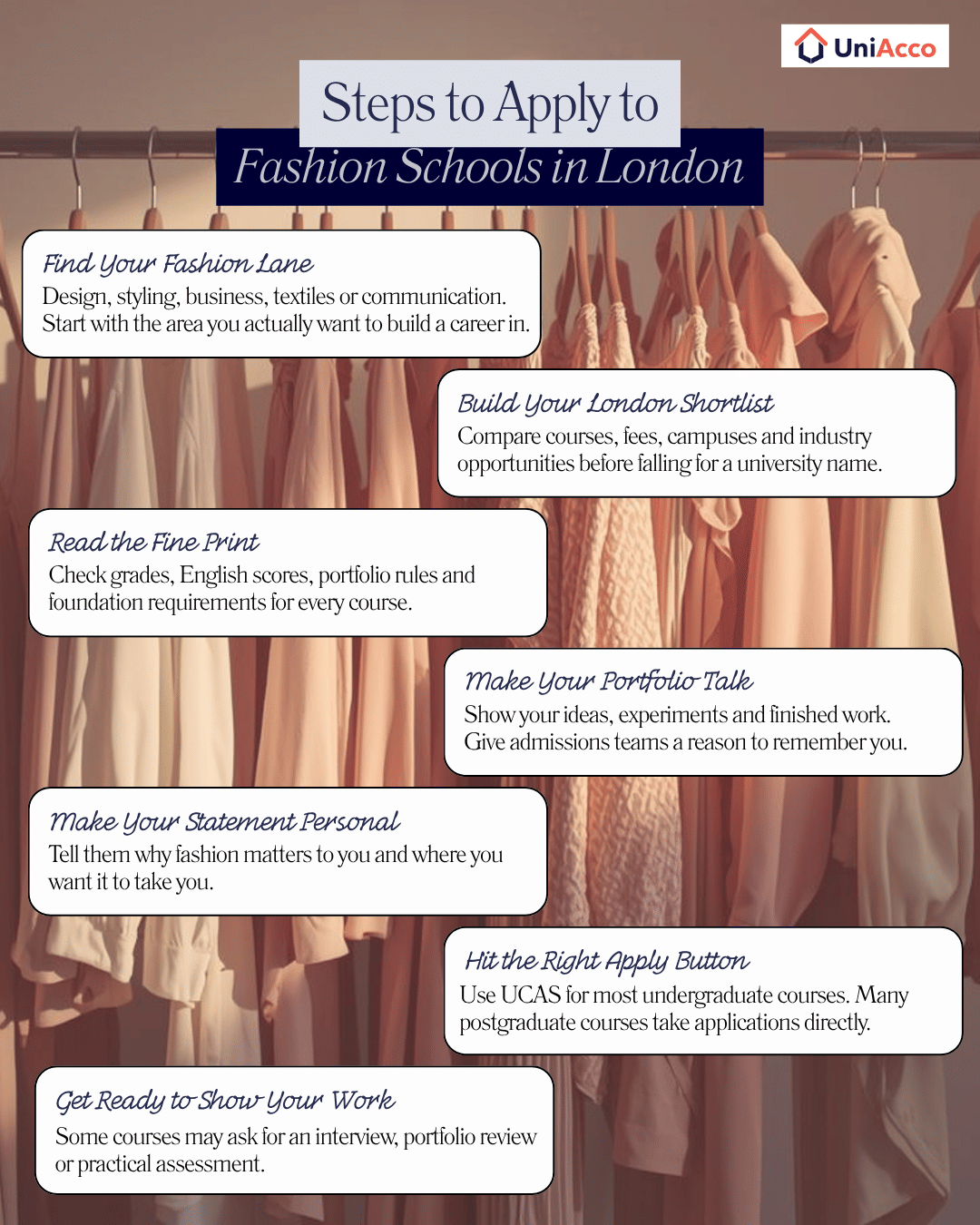
Step 1: Choose your fashion specialisation
Start with the part of fashion you enjoy most. Choose from design, styling, textiles, communication, business or fashion technology.
Step 2: Shortlist universities
Compare courses, fees, locations, facilities, placements and career support. Keep your budget and career plans in mind.
Step 3: Check course-specific requirements
Every fashion course has its own entry rules. Check the course page for the grades, English score and portfolio you need. Some courses may also ask for a foundation year. It is worth checking this before you start your application.
Step 4: Prepare your portfolio
Show your ideas, research and development process. Include finished work that reflects your skills and creative direction.
Step 5: Prepare your personal statement
Explain why you chose the course and what drives your interest in fashion. Keep your examples specific and personal.
Step 6: Apply through UCAS or the institution’s application portal
For most undergraduate courses, your application goes through UCAS. Postgraduate applications usually work differently and often go straight to the university. Before you start filling anything in, check your course page. It will tell you where to apply, what to send and when to send it.
Step 7: Attend interview/assessment if required
Some fashion courses invite shortlisted applicants for interviews, portfolio reviews or practical assessments. Check your course page carefully.
Step 8: Apply for your UK Student Visa
Once you receive an unconditional offer, check your CAS, financial evidence and visa requirements. Start this process early to avoid last-minute stress.
Tips to Choose the Right Fashion School in London
Your specialisation: Decide what you want to study first. Design, styling, business and textiles need different course structures.
Course modules: Read the modules before judging a course by its title. They show what you will actually study.
Portfolio requirements: Check the portfolio format early. Some schools expect specific projects, creative research or technical work.
Tuition fees: Compare international fees across your shortlisted schools. Add materials, equipment and other course costs to your budget.
Location: Check the campus location and your likely travel time. Rent can also vary significantly across London.
Industry exposure: Look for live briefs, guest speakers, industry projects and fashion events. Check what the course officially offers.
Placement/internship opportunities: Check the placement structure, duration and eligibility rules. A course with a placement year can add valuable work experience.
Scholarships and funding: Check university scholarships, eligibility rules and application deadlines. Apply early when funding has a separate deadline.
Wrapping Up!
London can give your fashion degree a serious setting, but the city alone will not build your career. The best fashion schools in London differ in courses, teaching styles, fees and industry opportunities.
A design student may want strong studios and technical training. A future stylist might value shoots, image-making and creative direction. Fashion business students may prioritise buying, branding and placements.
So, look past the logo. Read the modules. Check the fees. Study the portfolio requirements. Find out how students gain industry experience. Then ask yourself: Can I see myself doing this course on a random Tuesday in London? That answer may tell you more than a ranking ever will.
Also Read: Ultimate Guide To London Travel Zones 1 to 9
And for the part nobody puts on the moodboard: finding somewhere to live. Your campus location, weekly rent, and daily commute can shape your London experience too. Compare student accommodation in London on UniAcco and find a stay that fits your budget, location, and lifestyle.
🏡 Explore London Student Accommodation

 LinkedIn









0 Comments