
Thinking of going abroad to study but not sure about which country has the best education system in the world? Answering this question requires simply looking beyond the number of degrees awarded. Experts assess the overarching quality of education, academic rigor, cutting-edge research, and support frameworks. Some of the key parameters include employability, university reputation, and performance metrics like OECD education rankings. In 2026, educational systems have been innovating to new heights, especially with the advent of AI.
This comprehensive study abroad guide explores the top education systems in the world, how rankings are calculated, and what makes international student destinations appealing.
Best Education Systems in the World at a Glance
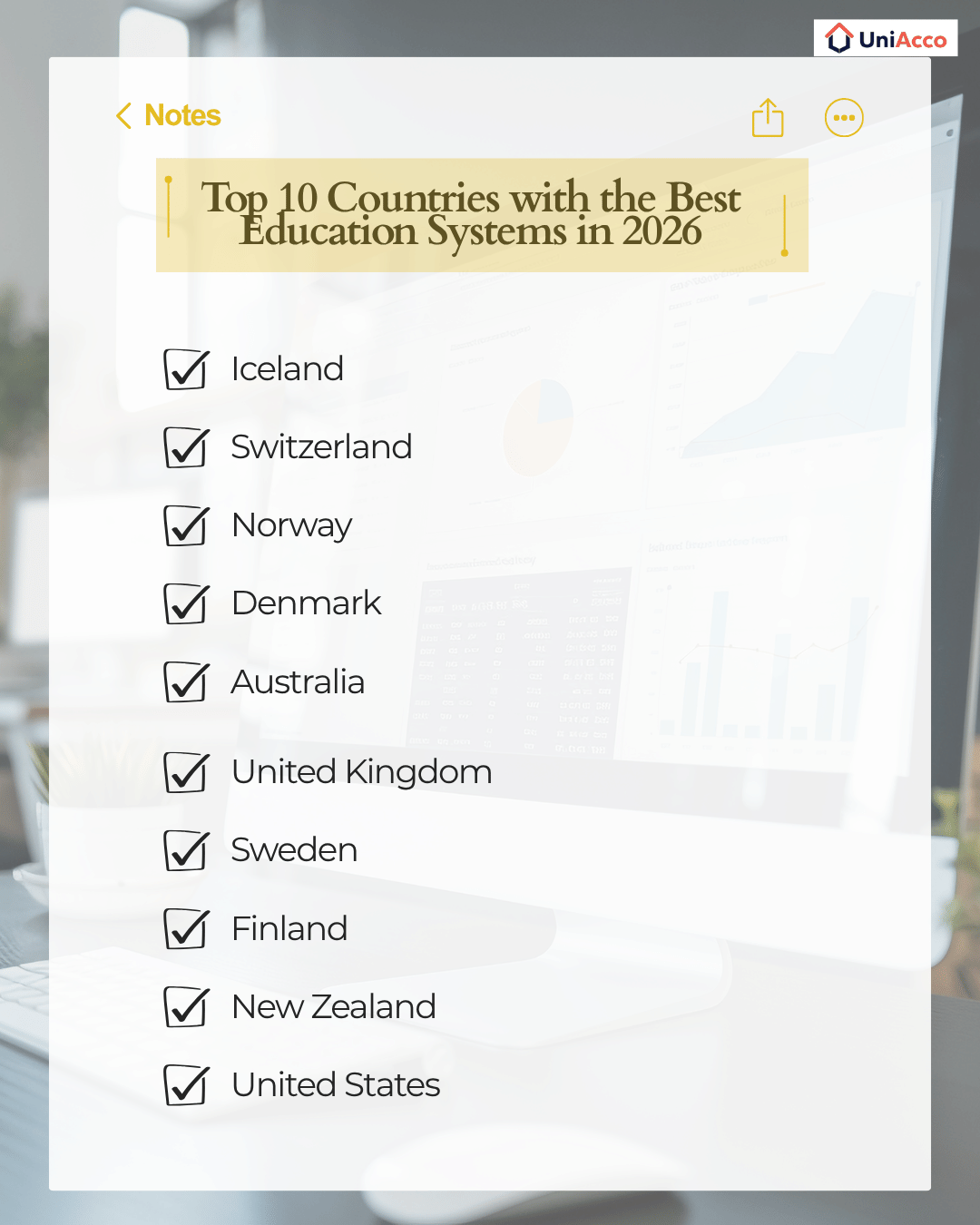
So which country has the best education system in the world? As per the latest data from U.S. News ranking metrics for public education systems, Iceland secures the top spot because of its well-developed, highly equitable public schooling model. Followed by Switzerland and Norway, which have high per-capita education funding and seamless integration between academic and vocational training.
| Country | Known For | Top Institutions | Popular Courses to Study |
| Iceland | Public education, equity, high literacy | Reykjavik University, University of Iceland | Environmental Science, Renewable Energy, Geoscience |
| Switzerland | Vocational integration, Innovation, Precision research | EPFL, ETH Zurich | Hospitality, Banking & Finance, Physics |
| Norway | Tuition-free public university model, Sustainability | NTNU, University of Oslo | Environmental Studies, Marine Technology, Energy |
| Denmark | Collaborative, student-centred learning | DTU, University of Copenhagen | Architecture, Green Tech, Social Sciences |
| Australia | Research-oriented, high standard of living, student protection | ANU, University of Melbourne | Data Science, Marine Biology, Healthcare |
| United Kingdom | Academic tradition, Research-oriented | Cambridge, Oxford, Imperial | Medicine, Law, Finance |
| Sweden | Flat hierarchy, Critical thinking, Sustainability | Lund University, Karolinska Institute | Life Sciences, Sustainability, Industrial Design |
| Finland | Highly qualified teaching corps, Stress-free pedagogy | Aalto University, University of Helsinki | Computer Science, Education Policy, Environmental Tech |
| New Zealand | Safe environment, Supportive culture, Experiential learning | University of Otago, University of Auckland | Environmental Management, IT, Veterinary Science |
| United States | Research endowments, Ivy League | Harvard, MIT, Stanford | Computer Science, Engineering, Business Analytics |
How Are Education Systems Ranked?
To know how the best education systems by country are assessed, we must look at the evaluating bodies. Below is a list of the evaluating bodies that are responsible for global education rankings.
OECD
OECD stands for the Organisation for Economic Co-Operation and Development, which influences OECD education rankings. It evaluates the member nations based on adult literacy, educational quality, and the economic impact of tertiary education, which ensures the world’s best education system provides societal benefits.
PISA
PISA stands for Programme for International Student Assessment, which dictates the PSA rankings. It is administered by the OECD. It tests applicants globally on the basis of mathematics, science, and reading. While its main focus is on secondary schooling, PISA rankings signal strong support for the highest-ranked education systems in higher education.
QS World University Rankings
This is a well-known ranking body in the higher education rankings system. QS assesses universities based on academic reputation, faculty-to-student ratio, employer reputation, and international research network.
Times Higher Education
Acronymed as THE, Times Higher Education puts significant importance on research environments, citations, teaching quality, and international outlook. It produces employability data which highlights the best education for international students to secure jobs after they complete their PG.
UNESCO indicators
UNESCO tracks access to education, gender parity, and education expenditure as a percentage of GDP. It tracks global progress primarily through the Sustainable Development Goal 4 (SDG 4) monitoring framework, which is managed by the UNESCO Institute for Statistics (UIS).
Top 10 Countries with the Best Education Systems in 2026
Iceland
Iceland leads the global table in 2026 with its universal, state-funded education system. Iceland prioritises accessibility, equity, and critical enquiry from a very stage of education up to higher education. It is known for its specialisation in renewable energy, geology, and environmental studies, which makes it one of the top countries for higher education in scientific research.
| Factor | Details |
| Education System | Equitable public model, fully state-funded |
| Top Universities | Reykjavik University, University of Iceland |
| Global Ranking | #1 |
| Popular Subjects | Renewable Energy, Geosciences, Environmental Studies |
| Tuition Fees | Public universities charge only nominal registration fees. |
| International Student Support | English proficiency and community integration |
| Key Strength | Universal access, specialised green-tech research |
Switzerland
Switzerland is known for its precision, economy, and leadership in hospitality and STEM courses. It is one of the best education systems in the country, as it provides a multilingual learning atmosphere that breeds global leaders. It is known for pairing an elite public school network with a world-renowned dual vocational training system.
| Factor | Details |
| Education System | Innovation-driven, Multilingual, dual-track academic and vocational system |
| Top Universities | EPFL, ETH Zurich, University of Zurich |
| Global Ranking | #2 |
| Popular Subjects | Finance, Physics, Hospitality Management |
| Tuition Fees | £1000 to £3000+ per year |
| International Student Support | Global network, High standard of living, Multilingual academic setting |
| Key Strength | Quality of life, Vocational excellence, Scientific research |
Norway
Norway’s education system focuses on active student participation, social equality, and environmental sustainability. The public universities in Norway are admired globally for providing high-quality and research-oriented education without charging tuition fees to domestic or EU scholars, which makes it an international student destination.
| Factor | Details |
| Education System | Inclusive, publicly funded, Student-centric |
| Top Universities | NTNU, University of Bergen, University of Oslo |
| Global Ranking | #3 |
| Popular Subjects | Petroleum & Energy, Marine Technology, Environmental Science |
| Tuition Fees | Moderate for EU students, Free to low for EU/EEA students |
| International Student Support | English-taught Master’s studies |
| Key Strength | State funding, Equality, Energy research |
Denmark
Denmark is known for its collaborative project-based learning system with a heavy focus on green tech. As a leader in Nordic education, Denmark is widely popular for offering the best education for international students in terms of an interactive, real-world problem-solving curriculum.
| Factor | Details |
| Education System | Interactive, Progressive, and project-oriented |
| Top Universities | DTU, University of Copenhagen |
| Global Ranking | #4 |
| Popular Subjects | Renewable Energy, Architecture, Social Sciences |
| Tuition Fees | £6000 to £14,000+ per year for non-EU students, Free for EU/EEA students |
| International Student Support | English proficiency, safe environment |
| Key Strength | Collaborative learning and green innovation |
Australia
When you study in Australia, you get an added benefit of a phenomenal lifestyle and world-class universities that focus on global research. It is undoubtedly one of the best countries to study abroad because of its warm climate, diverse cities, and a regulated education system.
| Factor | Details |
| Education System | Research-based, Regulated |
| Top Universities | ANU, University of Sydney, University of Melbourne |
| Global Ranking | #5 |
| Popular Subjects | Environmental Sciences, Marine Biology, Nursing |
| Tuition Fees | £15,000 to £28,000+ per year |
| International Student Support | Work rights and student protection |
| Key Strength | High employability and student lifestyle |
| Australia has some of the most beautiful backdrops to live in. Explore affordable student accommodation in Australia with fully furnished rooms and all-inclusive bills. |
United Kingdom
When you study in the UK, you immerse yourself in a legacy of education and academic brilliance. The UK is home to some of the oldest and highly respected universities around the globe. The UK is known to offer shorter and more intensive degree courses. As it holds the title of one of the top countries for higher education, the UK guarantees a globally respected qualification. When you choose to study in the UK, you choose to experience high academic standards with a rich cultural heritage.
| Factor | Details |
| Education System | Specialised, research-oriented, and intensive |
| Top Universities | Cambridge, Oxford, Imperial College London |
| Global Ranking | #6 |
| Popular Subjects | Medicine, Law, Finance, Humanities |
| Tuition Fees | £11,000 to £35,000+ per year |
| International Student Support | International societies, pastoral care |
| Key Strength | Shorter degree durations of up to 3 years for a bachelor’s |
Looking for a student room that fits your budget? Explore some of the most affordable student accommodation in the UK with UniAcco, featuring fully furnished rooms and all-inclusive bills for a more convenient stay.
🔍 Explore Affordable Student Accommodation in the UKSweden
Sweden is known for its sustainable living and egalitarian system of education. These principles are deeply embedded in its academic culture. When comparing the highest-ranked education systems in the world, Sweden stands out for its emphasis on critical thinking over mere memorisation.
| Factor | Details |
| Education System | Student-centric, collaborative and informal |
| Top Universities | Lund University, Karolinska Institute |
| Global Ranking | #7 |
| Popular Subjects | Design, Sustainability, Life Sciences |
| Tuition Fees | £7000 to £12,000+ per year |
| International Student Support | English proficiency |
| Key Strength | Innovation, sustainability, equality |
Finland
Finland is known for its stress-free, professionalised schooling system. It has eliminated standardised testing in the primary stages, because of which Finland frequently tops PISA rankings and maintains one of the highest-ranked education systems in the world.
| Factor | Details |
| Education System | Professionalised system, Test-free education model |
| Top Universities | Aalto University, University of Helsinki |
| Global Ranking | #8 |
| Popular Subjects | Computer Science, Education Technology, Environmental Engineering |
| Tuition Fees | £8000 to £15,000+ per year for non-EU students, Free for EU/EEA students |
| International Student Support | Student well-being and research independence |
| Key Strength | Pedagogical excellence, Equality |
New Zealand
New Zealand has an experiential, student-focused education system backed by modern research and a safe environment for students. It attaches special importance to practical application in environmental and agricultural sciences.
| Factor | Details |
| Education System | Inquiry-oriented, Flexible, Practical framework |
| Top Universities | University of Otago, University of Auckland |
| Global Ranking | #9 |
| Popular Subjects | Veterinary Science, Environmental Management, Agriculture |
| Tuition Fees | £12,000 to £22,000+ per year |
| International Student Support | Code of Practice for pastoral care of international students |
| Key Strength | Hands-on field research |
United States
Studying in the USA gives you access to an ecosystem that is designed with cutting-edge technology, massive funding, and flexibility of choice in its curriculum. Students have the choice to explore multiple disciplines before choosing a major, which is the US education system’s hallmark of the world’s best education system. To study in the USA is equivalent to positioning yourself at the forefront of global technological innovation.
| Factor | Details |
| Education System | Flexible liberal arts model which is based on decentralisation |
| Top Universities | Harvard, Stanford, MIT, and other Ivy League institutions |
| Global Ranking | #10 |
| Popular Subjects | Computer Science, Engineering, Business Analytics |
| Tuition Fees | £20,000 to £45,000+ per year |
| International Student Support | Widespread alumni network, Diverse career opportunities |
| Key Strength | Funding and Flexibility |
Wanna hear from students about which country has the best education system? Read this Reddit thread and discover opinions on the best education system in the world by students studying around the world.
Which country has the best education system in the world? – r/AskTheWorld
Graduate Employability Around the World
Getting a degree isn’t enough; landing the right employability is the ultimate goal. Below is a list of international education systems published by The Times Higher Education Global University Employability Ranking, which points out the nations that produce the most career-ready graduates.
| Country | Graduate Employment Outlook | Top Hiring Industries |
| United States | Exceptionally high — 5 universities in the global top 10, led by MIT at #1 | Big Tech, Finance, Healthcare |
| United Kingdom | Outstanding — 3 universities in the global top 10, led by Cambridge at #4 | Legal Services, Banking, Pharma |
| Switzerland | Very high — led by ETH Zurich at #10, with 6 more institutions in the top 250 | Private Banking, Pharma, Engineering, Hospitality |
| Australia | Very strong — 8 universities in the ranking, led by Melbourne at #38 | Healthcare, Mining, IT, Environmental Engineering |
| Sweden | High — led by KTH Royal Institute of Technology at #72 | Automotive Tech, Telecommunications, Sustainability |
| Denmark | High — led by DTU at #84 | Life Sciences, Renewable Energy, Maritime Transport, Design |
| Norway | Strong — led by University of Oslo at #106 | Aquaculture, Clean Energy, Marine Tech, Software Development |
| Finland | Strong — led by University of Helsinki at #101 | Education Technology, Software Development, CleanTech |
| New Zealand | Moderate to high — University of Auckland at #90, its only entry in the ranking | Forestry, Agriculture, IT, Tourism |
| Iceland | Not ranked by THE — but a genuinely tight labour market, with skills shortages driving strong hiring conditions* | Geothermal & Renewable Energy, Technology & Data Centres, Tourism, Fisheries |
How to Choose the Best Education System for Your Goals?
| If You Want To… | Choose… | Because |
| Study Engineering | USA/Switzerland | US research hubs and ETH Zurich offer world-class laboratories and research funding |
| Pursue Research | United States | Unmatched scholarships and access to world-class laboratories |
| Minimise Costs | Iceland/Norway | Public universities offer free tuition fees or very low administrative fees |
| Maximise Employability | United Kingdom | Shorter degrees with global prestige, which is highly favoured by employers |
| Settle Abroad | Australia/New Zealand | Transparent post-study work visa policies |
| Study in English | UK/AustraliaUSA | Native English-speaking environments with deep-rooted international communities |
Living in the UK, the US or Australia can be expensive, but finding the right student accommodation can make budgeting easier. Explore affordable stays with UniAcco, including fully furnished rooms and all-inclusive bills for a more convenient student experience.
🔍 Explore Affordable Student AccommodationConclusion
Education plays an important role in the progress of a country. In 2026, the best education systems in the world show both stability and change. Countries like Iceland, the UK, and Norway continue to have strong education systems because they invest in teachers, maintain high standards, and give students equal opportunities. Countries like Switzerland and Finland are also doing well by using new ideas, technology, and inclusive teaching methods.
There is no single way to create a successful education system. However, the best systems have some things in common. They value education and keep working to improve it. They also adapt to new challenges, such as using AI in education and supporting students’ mental health. The main goal is not to decide which country is number one, but to make sure that students everywhere have the education and skills they need to succeed.


 LinkedIn









0 Comments