
1,177,766, as per the Open Doors Report 2025 on International Education Exchange, that’s the number of international students hosted by the United States at its colleges and universities during the 2024/2025 academic year.
Going to fascinating America is clearly a powerful aspiration for students. However, the Trump administration has introduced an array of policies in 2026, affecting the education sector and immigration. With the reinstatement of travel bans, temporary pauses on student visa interviews, and the introduction of mandatory social media checks, temporary visa approvals fell by 11%, while international student visas dropped by more than 30% in 2026. The competition is tough, and that is precisely why your ACT exam preparation is crucial.
Don’t let the numbers put you under pressure. In this blog on how to prepare for the ACT exam, we’ll help you with all the material to achieve your target score.
What is the ACT Exam & What are its Types?
The American College Testing (ACT) exam is a standardised test primarily for undergraduate admissions in the United States and for international admissions to measure college readiness. It measures the eligibility of students across core academic areas — English, Mathematics, Reading, and Science. Students may opt to take an optional multiple-choice science section and/or an optional writing section. Some colleges and universities require or accept ACT science or writing scores, so you may consider taking the science and writing sections. Whether you are an international or domestic student, ACT exam preparation is a must, as it is widely accepted in prestigious programmes worldwide.
Now that you know what the ACT is, it’s time to sort your student accommodation in the UK with UniAcco. Explore verified listings, affordable rents, and comfortable living spaces tailored for students.
🔍 Explore UK Student HousingTypes of ACT Tests
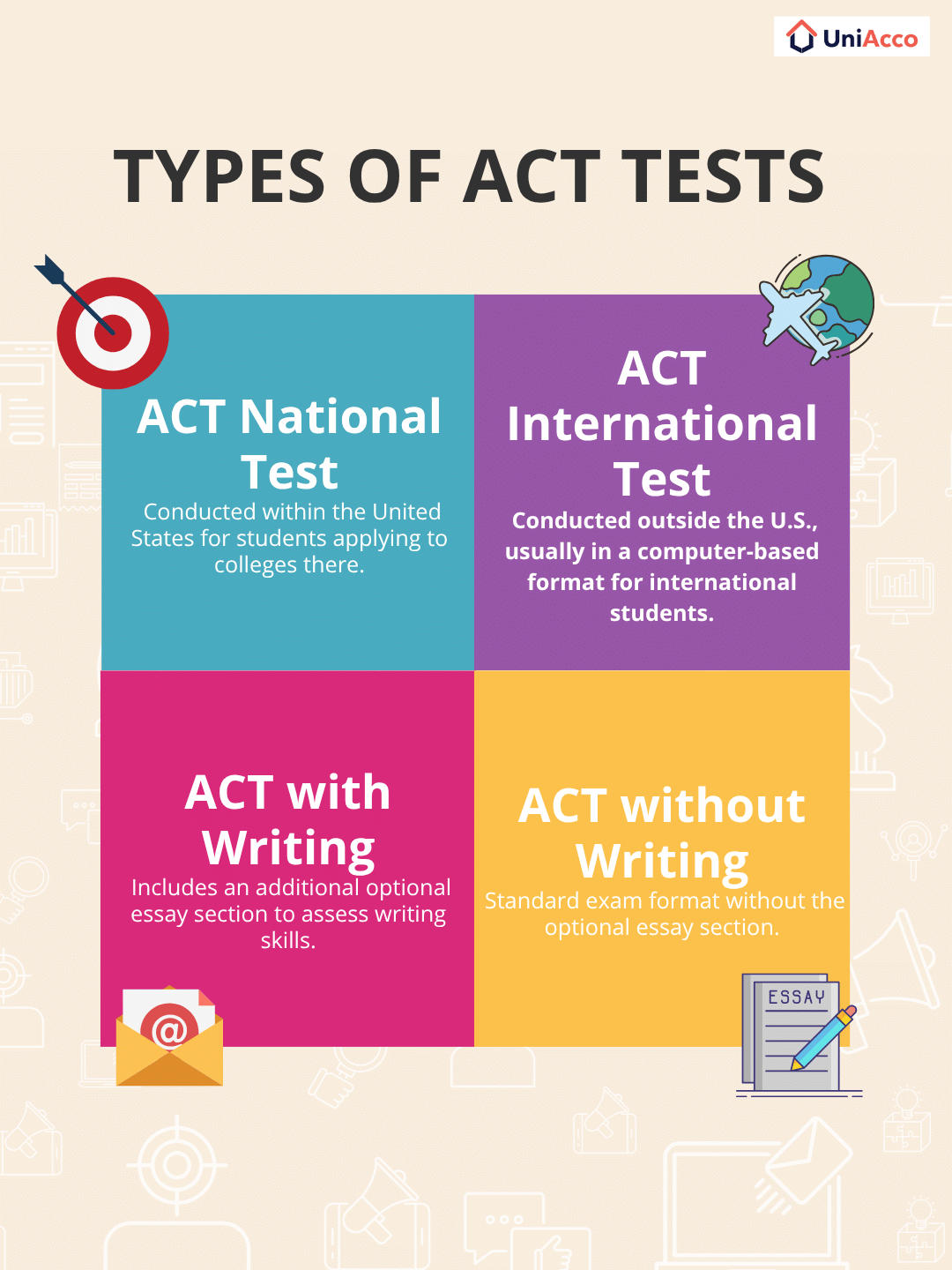
Depending on your location preference and university requirements, there are 4 tests that you may take as a foundational step in your ACT exam preparation. It is available as a National test (US-based) or an International test (computer-based abroad), offering formats both with writing and without writing, typically completed in under 4 hours.
- ACT National Test
This is a standard paper-and-pencil test administered to students residing within the United States, US territories, and Puerto Rico. It is typically held on Saturday mornings at designated high schools and testing centres.
- ACT International Test
This test is administered to international students residing outside the United States. The ACT International Test is entirely a computer-based version, unlike the ACT National Test. Students can consider taking an ACT practice test online to familiarise themselves with the digital medium. This test is typically offered over multiple days, providing more flexibility for students outside the US.
- ACT with Writing
This test is to assess a candidate’s ability to construct a well-reasoned argument. It includes an optional essay section at the end of the multiple-choice questions (MCQs). The test lasts for a total time of 3 hours and 35 minutes.
- ACT without Writing
This test includes only the core multiple-choice sections (English, Mathematics, Reading, and Science). If the university you’ve applied to doesn’t require an essay, then this version of the test can save you time and also reduce your registration fees. The test lasts for a total time of 2 hours and 55 minutes.
Shortlisted your ACT test type? Now shortlist your student accommodation in London with UniAcco. Get access to verified properties, 24/7 assistance, and the best rooms without any complicated contracts.
🔍 Explore London Student HousingACT Pattern, Syllabus and Scoring
| ACT Section | ACT Exam Syllabus | No. of Questions | Time Limit | Score Range |
| English | Grammar, Punctuation, Sentence Structure, and Rhetorical Skills. Focuses on the production of Writing and Knowledge of Language. | 75 | 45 minutes | 1–36 |
| Mathematics | Pre-Algebra, Elementary Algebra, Intermediate Algebra, Coordinate Geometry, Plane Geometry, Trigonometry, Statistics, Probability. | 60 | 60 minutes | 1–36 |
| Reading | Reading Comprehension based on Passages from Prose Fiction, Social Sciences, Passage Analysis, Humanities, and Natural Sciences. | 40 | 35 minutes | 1–36 |
| Science | Data Representation, Conflicting Viewpoints, Scientific Reasoning, Research Summaries. | 40 | 35 minutes | 1–36 |
| Writing (Optional) | Measures writing skills taught in high school English classes. Requires evaluating multiple perspectives on a complex issue. | 1 Essay | 40 minutes | 2–12 |
ACT Exam Eligibility Criteria for Students in 2026-27
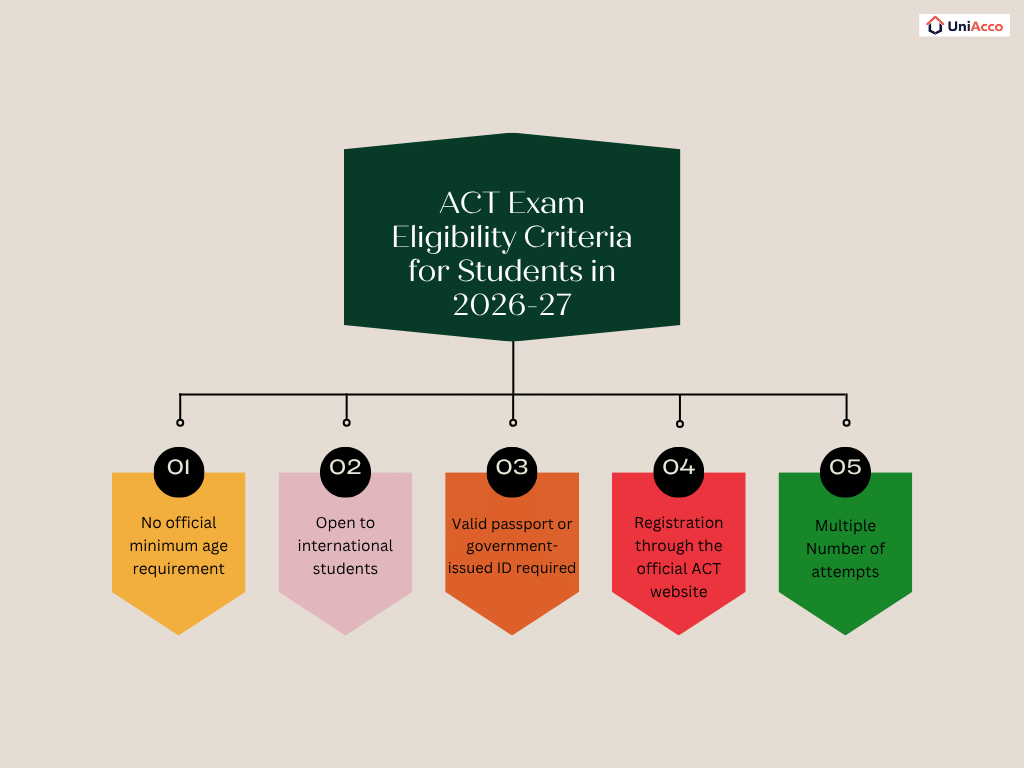
The ACT examination is designed for high school graduates, but students in grades 6 through 9 are also eligible. It is an entrance examination for college and university admissions, with no specific academic criteria for scores and courses. Let’s deep dive into the ACT exam preparation to ensure that you meet all the necessary eligibility parameters.
No official minimum age requirement
While no official minimum age limit, it is recommended for students aged 13 and older, mainly in grades 11-12. Students under 16 need parental consent. It is a standardised test for university admissions, especially in the US and Canada, and is open to international students. The ACT exam syllabus aligns closely with the curriculum taught during the years of grades 11-12.
Open to international students
There are no barriers when it comes to application. Students from across the globe are encouraged to apply for the ACT exam. The ACT exam is available worldwide, with international testing offered 5 times a year (September, October, December, February, and April) in various locations. It is primarily taken for admission to universities in the US and Canada, but it is accepted by institutions in roughly 85 countries.
Valid passport or government-issued ID required
To ensure the highest levels of quality control, international test-takers must present a valid, unexpired passport or an acceptable national identity card on test day.
Registration through the official ACT website
All students are expected to create an official MyACT account online to select their test date, choose their testing centre, and manage their score reports.
Number of attempts
There is no restriction on the number of times a student can take the exam.
Still confused about ACT eligibility criteria? Explore this Quora discussion and learn from students how they gave the ACT after high school.

ACT Exam Dates & Fees in 2026-27
The ACT exam is conducted 5 times a year (September, October, December, February, and April) in various locations. It is primarily taken for admission to universities in the US and Canada, but it is accepted by institutions in roughly 85 countries. Below is the table outlining the ACT International Test dates, registration deadlines, and the respective fees for non-US applicants in the 2026-2027 academic year.
| ACT Test Dates | Registration Deadline | Fees (USD) |
| 18-19 September, 2026 | 14 August, 2026 | $186.50 (without Writing) / $211.50 (with Writing) |
| 16–17 October, 2026 | 11 September, 2026 | $186.50 (without Writing) / $211.50 (with Writing) |
| 11–12 December, 2026 | 6 November, 2026 | $186.50 (without Writing) / $211.50 (with Writing) |
| 26–27 February, 2027 | 22 January, 2027 | $186.50 (without Writing) / $211.50 (with Writing) |
| 9–10 April, 2027 | 5 March, 2027 | $186.50 (without Writing) / $211.50 (with Writing) |
| 11–12 June, 2027 | 7 May, 2027 | $186.50 (without Writing) / $211.50 (with Writing) |
| 9–10 July, 2027 | 4 June, 2027 | $186.50 (without Writing) / $211.50 (with Writing) |
Note: Late registration will incur an additional fee. Always check the official MyACT portal to confirm your local test centre’s availability, as dates can be subject to regional adjustments.
Practical tips for ACT exam preparation
Achieving the required score needs more than just intelligence; it requires the right strategy, endurance, and methodical planning. If you are searching for how to prepare for the ACT exam, the following ACT preparation tips will be handy.
Start Preparation Early
Start at least 3-6 months in advance. The ACT exam is conducted 5 times a year — September, October, December, February, and April. So, prepare as per these timelines to stay ahead. Starting early gives you ample time to comprehensively cover the entire ACT exam syllabus without burning out.
Understand the Test Format
There are 4 tests that you may take as a foundational step in your ACT exam preparation. It is available as a National test (US-based) or an International test (computer-based abroad), offering formats both with writing and without writing, typically completed in under 4 hours. For example, preparing for MCQs versus preparing for an essay needs a different strategy. Knowing that the science section is more about data interpretation than advanced biology will fundamentally shift how to prepare for the ACT exam modules.
Create a Study Plan
Make a weekly timetable where you dedicate specific days to specific subjects. Consistency with a touch of timeline is the foundation for your ACT exam preparation. For example, assign a specific day for a specific subject. Algebra on Mondays, Reading comprehension on Tuesdays, and so on. A structured study plan prevents procrastination.
Take Full-Length Practice Tests
Add an ACT practice test to your fortnightly routine. Sitting down for a continuous 3-hour session builds the mental stamina required for the actual day of the test. It also helps in reducing performance pressure. Most importantly, since international students take a computer-based exam, taking an ACT practice test online will help you get accustomed to digital highlighting tools, on-screen timers, and scrolling through reading passages.
Focus on Weak Areas
While preparing for an exam like the ACT, we tend to run away from the difficult topics or the ones we are weak at. However, know that this is the biggest mistake one can make. Tackle the topics that you find most difficult first. After taking an ACT practice test, spend time reviewing your mistakes. Identifying these weak spots is central to ACT exam preparation or any kind of preparation for that matter.
- Improve Time Management
Typically, the ACT test is completed in under 4 hours. However, this test is known for its harsh time constraints, particularly in the Reading and Maths sections, where you have just 60 minutes for 60 questions. One of the most useful ACT preparation tips is to learn when to skip a difficult question and return to it later. Practice with a timer during your online ACT practice tests.
- Use Official ACT Resources
Official ACT study resources, primarily from ACT.org, offer the most accurate practice. Key tools include the annual “Official ACT Prep Guide” (containing 6–9 real, full-length tests), official subject guides, and free online practice questions. These materials provide authentic, timed practice for English, Math, Reading, Science, and Writing sections
- Revise Key Concepts
Memorise certain foundational concepts like essential grammar rules for the English section and critical formulas for the Mathematics section. Highlight the key concepts on a sticky note and paste them around you, so that you can memorise it everytime you see them.
Wanna know how students prepared for the ACT? Read this Reddit thread and discover what students say about the ACT test.
What are the things that you wish you knew before you took the ACT? – r/ACT
from r/ACT
Conclusion
Let’s do a quick recap of what this comprehensive guide covers for the ACT exam preparation 2026. We started by underscoring exactly why a high standardised test score is needed, because of the number of international students hosted by the United States at its colleges and universities during the 2024/2025 academic year. We provided the important timelines to keep in mind for 2026-27 that include test dates, fees, and eligibility criteria.
The most important takeaway for students figuring out how to prepare for the ACT exam excellence is that consistency and strategic practice are your greatest allies. The ACT is a highly predictable test; once you understand its patterns through rigorous ACT exam preparation, you can confidently conquer it. And once you conquer your test, conquer your accommodation also. Finding student accommodation in the UK is very stressful, but UniAcco makes it easy with flexible lease terms, fully furnished rooms, and 24/7 customer service.
Prepared for your test? Stay ahead by sorting your accommodation too. Explore top student housing options in Manchester with UniAcco and find the perfect stay that fits your budget.
🔍 Explore Manchester Student Housing











0 Comments