

A Master’s in the UK can start with one course and end with 15 university tabs open. One university looks perfect until the fees appear. Another has the course you want, but the city feels too expensive. Then there are rankings, placement rates, graduate salaries, student life and the endless Reddit threads telling you something different.
By this point, picking a university can feel harder than picking the course itself. The right choice depends on more than a university’s name. Your subject, budget, career plans and preferred city all count.
This list of universities in the UK for a master’s puts those choices side by side, covering popular universities, courses, fees and locations to help you build a shortlist that fits your plans.
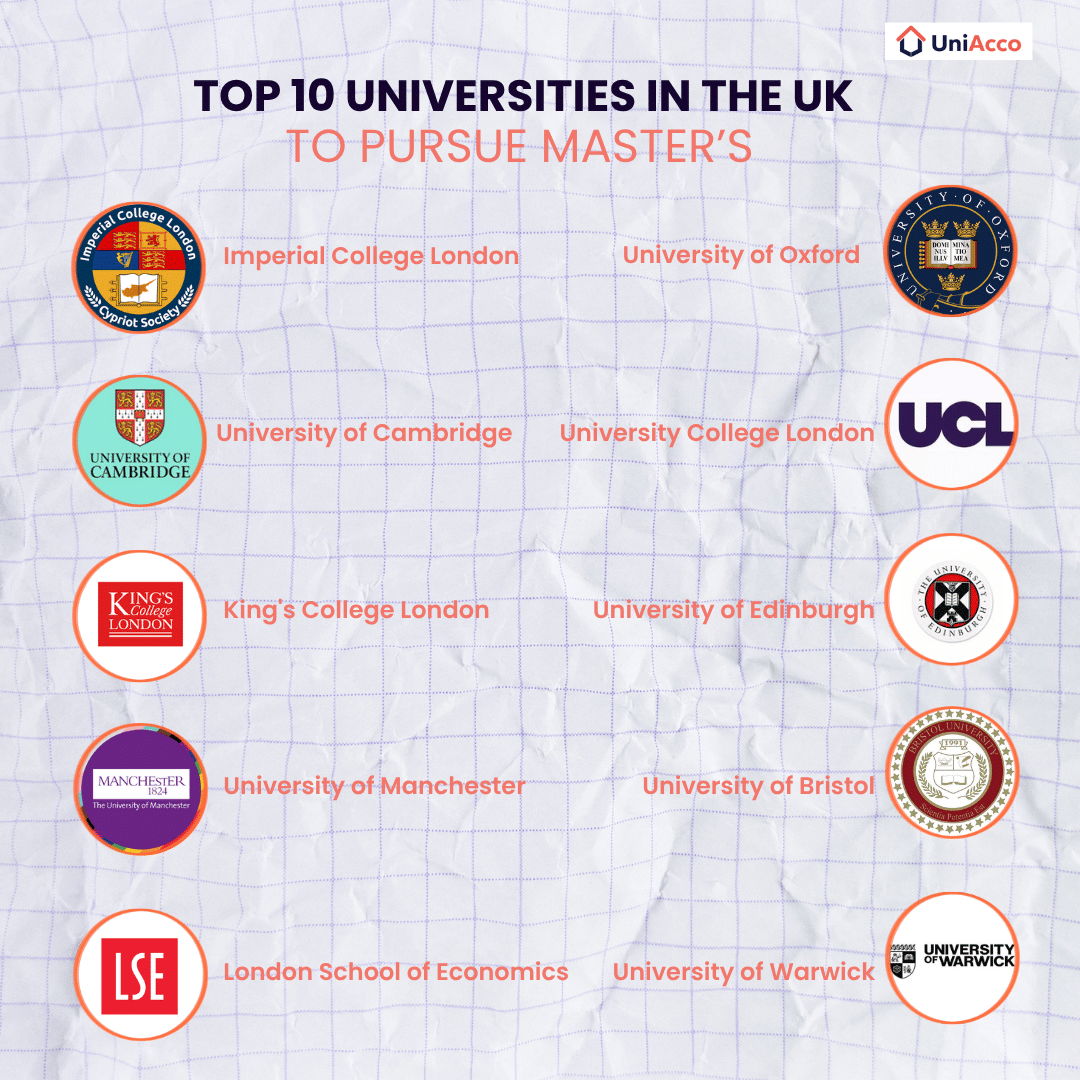
List of Universities in the UK for Master’s: Quick Overview
| University | City | QS World Ranking 2027 | Popular Master’s Areas |
| Imperial College London | London | 2 | Engineering, Computing & AI, Business, Medicine, Natural Sciences |
| University of Oxford | Oxford | 4 | Business & Management, Computer Science, Engineering, Law, Social Sciences |
| University of Cambridge | Cambridge | 6 | Engineering, Computer Science, Business, Natural Sciences, Social Sciences |
| UCL | London | 8 | Computer Science, Engineering, Finance, Management, Data Science, Health |
| King’s College London | London | 37 | Business, Computing & AI, Law, Health Sciences, Arts & Humanities |
| University of Edinburgh | Edinburgh | 35 | Computing & AI, Business, Engineering, Medicine, Data Science |
| University of Manchester | Manchester | 40 | Business, Engineering, Computer Science, Data Science, Life Sciences |
| University of Bristol | Bristol | 57 | Engineering, Computer Science, Business, Data Science, Health Sciences |
| LSE | London | 62 | Economics, Finance, Management, Social Sciences, Politics, Law |
| University of Warwick | Coventry | 68 | Business & Management, Economics, Finance, Computer Science, Engineering |
Top 10 Universities in the UK for Master’s
Imperial College London
Some universities give you a degree. Imperial puts you in a place where science, technology, business and research meet every day. Its focus is unusually concentrated, covering STEM and business rather than trying to be everything to everyone. That makes a difference if your Master’s plans sit close to technology, data, engineering, healthcare or finance. Imperial’s South Kensington campus also puts you in central London, with the city’s employers, events and professional networks close by.
| QS World University Ranking 2027 | 2 |
| Location | London, UK |
Why study a Master’s at Imperial College London?
Research here has real weight outside the classroom
Imperial College London reports the highest proportion of 4* world-leading research among UK universities. It also ranks first in the UK for research outputs and research environment.
London becomes part of your career plan
South Kensington gives you access to companies, interviews, industry events and professional networks across London. Imperial specifically highlights the concentration of nearby businesses and industry links.
Your Master’s can connect with real business problems
Several Imperial courses include practical work, projects and industry-facing learning. Its Business Analytics and AI MSc, for example, combines technical training with hands-on coursework and external expert seminars.
Startup support goes well beyond a university society
Imperial’s Enterprise Lab works with more than 2,000 students and postgraduates each year. Over the previous five years, it supported 214 startups that went on to raise £504.4 million.
The Master’s portfolio suits students chasing specialist careers
Imperial offers focused postgraduate routes across computing, engineering, medicine, natural sciences and business. That gives you room to specialise instead of choosing a broad degree by default.
Popular courses to study
| Course | Tuition Cost |
| MSc Finance | £51,000 |
| MSc Business Analytics & AI | £47,000 |
| MSc Artificial Intelligence | £46,000 |
| MSc Computing | £46,000 |
| MSc Statistics (Data Science and Machine Learning) | £39,900 |
University of Oxford
Oxford can be a surprisingly serious choice for a Master’s. Its graduate community spans more than 150 countries, and its courses attract applicants from diverse academic and professional backgrounds. The scale of demand also tells you something important before applying. Oxford received 42,065 graduate applications for the 2024-25 entry, with 68.6% targeting taught degrees.
| QS World University Ranking 2027 | 4 |
| Location | Oxford, England |
Why study a Master’s at the University of Oxford?
Oxford’s graduate model gives you a second academic home
Your course places you within an academic department and an Oxford college. That college membership adds another layer to your graduate experience, with its own community and academic setting.
You get serious academic depth in a relatively short degree
Many Oxford-taught Master’s programmes run for around one year. The MSt, for example, normally involves three terms followed by examinations. Several MSc programmes combine intensive teaching with independent research or a dissertation.
The course selection gets very specific
Oxford has Master’s options for students with highly focused career plans. Mathematical and Computational Finance combines mathematics, machine learning, computer science and financial applications. Oxford describes it as one of its most popular MSc programmes.
Some courses sit right where emerging fields are changing
The MSc in Social Data Science combines machine learning, statistics and social science. It also examines ethical, legal and policy questions around AI and data.
Scholarship funding can be worth planning around your application deadline
Oxford expects to offer more than 1,100 full or partial graduate scholarships for 2026-27 entry. Many scholarships assess eligible applicants automatically after they submit by the relevant deadline.
Popular courses to study
| Course | Tuition Cost |
| MSc in Law and Finance | £56,540 |
| MSc in Mathematical and Computational Finance | £51,560 |
| MSc in Applied Digital Health | £47,000 |
| MSc in Advanced Computer Science | £43,730 |
| MSc in Energy Systems | £40,710 |
University of Cambridge
Cambridge makes a strong case for students who want their Master’s to feel deeply academic, rather than simply career-focused. The choice is huge too. Its postgraduate directory currently lists more than 300 courses, including 224 Master’s programmes. Some are highly specialised, such as Data Intensive Science and Advanced Chemical Engineering. Others sit closer to careers in economics, management, technology and finance.
| QS World University Ranking 2027 | 6 |
| Location | Cambridge, England |
Why study a Master’s at the University of Cambridge?
Your Master’s can be built around serious research
Many Cambridge Master’s programmes use the MPhil format, with taught study, specialist training and research work. The university says its MPhil programmes can prepare students for further PhD research. That matters if you already have a research topic in mind or plan to stay in academia.
The course list gets remarkably specific
Cambridge currently lists over 300 postgraduate courses. You can choose from 224 Master’s programmes across a wide range of subjects. That includes niche options such as AI Ethics and Society, Data Intensive Science, Advanced Materials for the Energy Transition and Biotechnology.
Some courses connect advanced theory with industry problems
The MPhil in Data Intensive Science teaches statistics, machine learning, AI, high-performance computing and software development. Students also work on data analysis projects and hear from academic and industry speakers. It’s a combination that can suit students targeting data-heavy research or commercial roles.
Cambridge gives you a route into a strong research environment
The MPhil in Data Intensive Science involves several departments, including Physics, Applied Mathematics, Theoretical Physics and the Institute of Astronomy. For students interested in science and technology, that cross-department structure can be a major advantage.
Funding deserves attention before you submit your application
The Cambridge fee can make funding a major factor in your decision. Start with the Postgraduate Funding Competition, then check your department for additional studentships. You may also find industry-backed opportunities. The important bit is timing. Some funding deadlines come before the deadline for your Master’s application.
Popular courses to study
| Course | Tuition Cost |
| MPhil in Advanced Computer Science | £48,192 |
| MPhil in Economics | £43,516 |
| MPhil in Management | £42,468 |
| MPhil in Finance | £48,192 |
| MPhil in Technology Policy | £42,468 |
| Cambridge may tick the academic boxes. Make sure the living costs work too. Compare student accommodation in Cambridge with UniAcco. |
UCL
Your Master’s choice gets harder when your interests cross subjects. UCL has plenty of room for that. Its 700+ graduate programmes cover areas from AI and data to finance, engineering and healthcare. You’re also based in London, with UCL’s main campus in Bloomsbury and other teaching sites at Canary Wharf and UCL East. For students weighing course options and career plans, that mix is worth exploring.
| QS World University Ranking 2027 | 8 |
| Location | London, England |
Why study a Master’s at UCL?
Your degree can sit between several industries
UCL encourages work across disciplines, which can matter when your career goal does not fit one traditional subject. Its AI for Sustainable Development MSc combines AI with environmental and humanitarian issues.
London can become part of your learning
UCL’s main campus sits in Bloomsbury, central London. The university also runs specialist postgraduate teaching from Canary Wharf and UCL East. So if you’re studying finance, consulting, technology, media or policy roles, this matters.
Employer access is built into the wider student experience
UCL says it has connections with thousands of employers in the UK and worldwide. Its careers service also reported 11,000 vacancies on myUCLCareers and 264 employer events during 2024/25.
UCL has serious research strength behind its teaching
UCL ranks second in the UK for research power, based on the 2021 Research Excellence Framework. That matters when your Master’s includes substantial research or technical work.
Some courses give you a direct project to solve a real problem
UCL’s Business Analytics MSc includes a Term 3 dissertation based on a real business problem. The AI for Sustainable Development MSc also includes an individual project with stakeholders facing sustainability challenges.
Popular courses to study
| Course | Tuition Cost |
| MSc Finance | £48,250 |
| MSc Finance with Data Science | £48,250 |
| MSc Data Science | £46,700 |
| MSc Business Analytics | £46,700 |
| MSc Computer Science | £42,700 |
King’s College London
King’s is the sort of university where the address can change the value of your Master’s. Four of its five campuses sit in central London, close to institutions, companies and major public bodies. That matters if your plans involve finance, policy, law, healthcare or technology. King’s also has a strong international reach, with students and staff from more than 190 countries. Its current academic offer spans areas from digital culture and engineering to business, health and politics.
| QS World University Ranking 2027 | 37 |
| Location | London, England |
Why study a Master’s at King’s College London?
Employers are paying more attention to King’s
King’s reached its highest position yet in the Graduate Market in 2026, ranking 11th among UK universities targeted by major graduate recruiters. It also ranks 6th in the UK for graduate employability in the Times Higher Education Global Employability Ranking 2026. Employer visibility is worth taking seriously, especially for students paying international tuition fees.
Your campus puts you close to London’s professional hubs
King’s describes itself as London’s most central university. Four of its five campuses sit in central London, alongside the River Thames. Location can be particularly useful for students targeting London-based careers in finance, consulting, law, policy, healthcare and technology.
King’s has unusually strong links across health and medicine
King’s strength in health goes well beyond a single department. The university ranked first in the world for Nursing in the QS World University Rankings by Subject 2025. It also ranked among the world’s leading universities across 41 other subjects. This makes King’s especially interesting if your Master’s sits around healthcare, biomedical science, public health or related fields.
The international network is genuinely large
King’s has students and staff from more than 190 countries and a global alumni network of more than 300,000 people. It also has over 150 partner institutions worldwide.
Some Master’s students can access sizeable fee reductions
King’s Business School offers postgraduate scholarships worth up to 50% of tuition fees, alongside awards worth up to £10,000. The university also offers the 2026-27 Vice-Chancellor’s Awards, including 40 awards worth £5,000 each for eligible students from India.
Popular courses to study
| Course | Tuition Cost |
| MSc Artificial Intelligence | £40,450 |
| MSc Artificial Intelligence for Science | £40,450 |
| MSc International Marketing | £38,300 |
| MSc Digital Marketing | £38,300 |
| MSc Economics & Finance | £42,800 |
University of Edinburgh
Edinburgh is a strong pick if your Master’s interests sit around technology, finance, business or research. The university’s subject range is broad, but some areas stand out. Its School of Informatics has a long history in artificial intelligence, while the Business School offers specialist degrees in finance, analytics and sustainability. The city itself adds another useful angle. Edinburgh ranks among Europe’s leading student cities, while the university has a large international community.
| QS World University Ranking 2027 | 35 |
| Location | Edinburgh, Scotland |
Why study a Master’s at the University of Edinburgh?
AI here has serious academic roots
Edinburgh’s AI MSc is taught through the university’s School of Informatics. The university describes it as the UK’s longest-established academic centre for studying artificial intelligence.
Research strength is a genuine selling point
Edinburgh ranks 4th in the UK for research power, based on the 2021 Research Excellence Framework. That matters for students who want a research-heavy Master’s or plan to continue towards a PhD.
You can combine business with fast-moving subjects
The university offers specialist programmes such as AI for Business and Finance, Technology and Policy. These degrees bring business study closer to technology and changing financial services. For career switchers, that can be more useful than taking another broad business degree.
Edinburgh gives Indian students a specific funding option
The India Merit Scholarship can take £5,000 off your first-year tuition fees at Edinburgh. It applies to eligible Indian students joining an on-campus postgraduate taught course in 2026/27. There’s another useful detail here: eligible students with an unconditional offer do not need to submit a separate scholarship application.
Industry exposure features across several Business School degrees
Edinburgh Business School highlights industry links across its postgraduate programmes. Its Finance and Investment MSc combines current theory with practical application. Business Analytics also combines analytical theory with practical work. That can matter if you want your Master’s to support a move into finance, consulting or analytics.
Popular courses to study
| Course | Tuition Cost |
| MSc Data Science | £45,410 |
| MSc Finance and Investment | £36,310 |
| MSc Accounting and Financial Management | £36,310 |
| MSc Business Analytics | £39,600 |
| MSc Management | £39,600 |
University of Manchester
Manchester makes sense for students who want a big-name university without paying London prices for every part of student life. The university sits at the centre of a city built around industry, research and innovation. Its story includes the first stored-program computer and the isolation of graphene. Today, that research culture continues through major facilities such as the National Graphene Institute and the £420 million Engineering Campus.
| QS World University Ranking 2027 | 40 |
| Location | Manchester, England |
Why study a Master’s at the University of Manchester?
Your degree sits inside a serious research ecosystem
Manchester reports that 96% of its research impact activity received a world-leading or internationally excellent rating in REF 2021. That matters if your Master’s includes substantial research or technical work.
The university has a genuine connection with graphene
Graphene was first isolated in Manchester. More than 400 researchers now work across graphene and 2D materials research. The university also runs the National Graphene Institute and Graphene Engineering Innovation Centre.
Graduate employers already know Manchester
The University of Manchester was named the most targeted UK university by the country’s top graduate employers in The Graduate Market 2026. QS 2027 also places Manchester 28th globally for employer reputation. So career-focused students have a concrete reason to look beyond rankings.
You get access to a £1 billion campus investment
Manchester says it has invested £1 billion in teaching and research facilities over the past decade. This includes the £420 million Engineering Campus and the £105 million Henry Royce Institute. That investment becomes more relevant when your course depends on specialist labs, equipment or research facilities.
Manchester can make your overall budget easier to manage
The university highlights Manchester’s lower average accommodation costs compared with many major UK cities. It also points to a large South Asian community and more than 200 languages spoken across the city.
Popular courses to study
| Course | Tuition Cost |
| MSc Finance | £37,800 |
| MSc Advanced Computer Science | £39,400 |
| MSc Quantitative Finance | £37,800 |
| MSc Business Analysis and Strategic Management | £32,600 |
| MSc Business Analytics and Artificial Intelligence | £32,600 |
University of Bristol
Bristol is worth a closer look if your shortlist goes beyond the usual London-heavy choices. The university has a strong research identity, yet its appeal extends well beyond traditional academic routes. Its current strengths include AI, data science, engineering, finance and sustainability. Bristol also ranks 6th among UK universities targeted by top graduate employers, according to High Fliers Research 2026. You get a globally ranked university in a city known for technology, aerospace, creative industries and independent businesses.
| QS World University Ranking 2027 | 57 |
| Location | Bristol, England |
Why study a Master’s at the University of Bristol?
Bristol has become a serious name for AI and data science
Bristol ranks among the top 100 universities worldwide for Data Science and AI in the QS subject rankings. Its postgraduate portfolio reflects that focus, with dedicated Master’s courses in Artificial Intelligence, Data Science, Financial Technology with Data Science and Cyber Security.
Graduate recruiters already have Bristol on their radar
Bristol ranks 6th among UK universities targeted by leading graduate employers in High Fliers Research 2026. Hence, career-focused students have a useful reason to consider Bristol beyond its QS position.
Your Master’s can include direct industry work
The MSc Management offers students a group project with an industry partner. The university also cites graduates working at firms including L’Oréal, Deutsche Bank, Huawei and the NHS. You’re likely to get evidence of applied work alongside your degree.
Bristol has a serious funding option for international students
The Think Big postgraduate scholarships offer awards of £6,500, £13,000 or £26,000 towards the first year of an eligible Master’s. For 2026, Bristol also introduced the Think Big Career Accelerator, which adds a £3,000 tuition award and career-focused workshops.
The university has research strength behind its specialist courses
Bristol ranks among the top five UK universities for research quality, based on Times Higher Education’s REF 2021 quality ratings. This is particularly relevant for students choosing research-heavy courses in engineering, computing, science or health.
Popular courses to study
| Course | Tuition Cost |
| MSc Data Science | £36,500 |
| MSc Artificial Intelligence | £34,000 |
| MSc Computer Science | £36,600 |
| MSc Finance and Investment | £39,000 |
| MSc Financial Technology with Data Science | £36,500 |
LSE
LSE makes more sense when your Master’s plans involve money, markets, policy, politics or social change. It has a narrower academic focus than many large UK universities, and that is part of the appeal. You are surrounded by people studying subjects that shape governments, businesses and financial markets. The Houghton Street campus also puts you in central London, close to the City, Westminster and organisations that regularly feature in the subjects you study. For a student choosing a Master’s in 2026, LSE offers a fairly clear proposition: specialise deeply, study in London and build your degree around the issues shaping the real world.
| QS World University Ranking 2027 | 62 |
| Location | London, England |
Why study a Master’s at LSE?
LSE specialises in the subjects behind major decisions
LSE focuses on social sciences rather than covering every academic field. Its strengths include economics, finance, politics, law, management and social policy. That focus can work well if your career already points towards banking, consulting, policy, government or international organisations.
London is part of the academic experience
The Houghton Street campus sits in central London. You study close to the financial district, government institutions, courts and major organisations. For some Master’s subjects, that location can give your studies a useful real-world context.
LSE courses can get seriously quantitative
This matters if you are considering economics or finance. The MSc Economics has a strong mathematical focus covering economic theory and econometrics. LSE also expects applicants without a UK economics degree to submit a GRE. So, check the academic requirements before applying. A strong interest in economics alone may not be enough.
Your graduate career options extend far beyond one sector
LSE publishes graduate outcomes by department, programme and sector. Its data covers what graduates do around 15 months after completing their studies. That makes the data useful when comparing courses. You can check where graduates from your specific programme actually go.
International students get access to dedicated funding support
LSE has several funding options for international students, including the Graduate Support Scheme, which considers financial need. The School also offers scholarships across different Master’s programmes. If you’re applying from India, LSE has a dedicated page covering funding, careers and practical support, so it’s worth checking before you finalise your budget.
Popular courses to study
| Course | Tuition Cost |
| MSc Finance | £51,000 |
| MSc Finance and Private Equity | £51,000 |
| MSc Accounting and Finance | £43,000 |
| MSc Economics | £41,000 |
| MSc Finance and Risk | £46,100 |
| LSE puts you in central London, so rent deserves a spot on your budget sheet. Check student accommodation in London with UniAcco before you commit. |
University of Warwick
Warwick is an interesting option if you want a strong UK university without choosing a London campus by default. Its appeal becomes clearer once you look at what happens after the degree. Warwick ranks 4th among UK universities targeted by leading graduate employers, according to The Graduate Market in 2026. Its research record is strong too, with 92% of its research rated world-leading or internationally excellent in REF 2021.. The campus also sits between Coventry and Birmingham, giving you access to two major UK cities without paying central London living costs.
| QS World University Ranking 2027 | 68 |
| Location | Coventry, England |
Why study a Master’s at the University of Warwick?
Employers already know the Warwick name
Warwick ranks 4th among UK universities targeted by the country’s top graduate employers in The Graduate Market in 2026. That matters if your Master’s plans centre around consulting, finance, technology or other graduate careers.
Warwick Business School has serious career links
WBS CareersPlus gives Master’s students access to one-to-one guidance, CV checks and mock interviews. Its graduates have gone on to employers including Amazon, Barclays, Deloitte, EY, KPMG and PwC. For a career-focused Master’s, that support can prove more useful than another generic careers portal.
Computer Science gives you room to specialise
From 2026-27, Warwick’s MSc Computer Science lets students choose specialist routes in AI and Machine Learning, Data Analytics or Cyber Security. The department also ranked 4th in the UK for Computer Science research in REF 2021.
Warwick Economics goes beyond textbook theory
Its MSc Economics covers microeconomics, macroeconomics, econometrics and research methods. You also complete an 8,000-word dissertation and choose from specialist options. The department ranked 36th globally for Economics and Econometrics in the QS subject rankings 2025.
The 2026 course changes are worth knowing
Warwick relaunched its Business Analytics MSc as MSc Business Analytics & Artificial Intelligence for 2026 entry. The course now combines AI, machine learning, statistics, optimisation and business analysis. That makes it a particularly relevant option if your career plans sit between business and data.
Popular courses to study
| Course | Tuition Cost |
| MSc Finance | £43,300 |
| MSc Business Analytics & Artificial Intelligence | £36,000 |
| MSc Management | £35,950 |
| MSc Economics | £32,960 |
| MSc Computer Science | £36,000 |
Also Read: Top UK Universities Offering Pre-Masters Programs: 2026 Guide
Scholarships for Master’s Students in the UK
Chevening Scholarships
Chevening is one of the UK’s best-known scholarships for international students. It funds one-year Master’s degrees in the UK and offers full financial support to successful scholars. The award can cover your tuition fees, living costs and travel expenses. Chevening also expects scholars to return to their home country for at least two years after completing the award.
For the 2027-28 entry, Chevening’s timeline shows interviews taking place between March and April 2027. Successful applicants must submit an unconditional UK university offer by 8 July 2027.
Good fit if: you have professional experience, clear career goals and a strong reason for studying your chosen Master’s.
Commonwealth Scholarships
A Commonwealth scholarship can make the cost of a UK Master’s much easier to manage. Students from eligible low and middle-income Commonwealth countries, including India, can apply for selected awards. Funding can cover approved tuition fees, travel to the UK and a monthly allowance during your full-time Master’s.
For 2027-28, applications open on 8 September 2026 and close at 16:00 BST on 20 October 2026.
Good fit if: your academic plans connect clearly with development priorities and you can show how your UK degree could benefit your home country.
University-specific scholarships
| University | Scholarship | Value |
| UCL | Global Master’s Scholarship | Up to £15,000 towards tuition fees |
| Imperial College London | President’s PhD Scholarship* | Full tuition fee and maintenance support |
| University of Edinburgh | India Merit Scholarship | £5,000 towards tuition fees |
| University of Bristol | Think Big Postgraduate Scholarship | Up to £26,000 |
| King’s College London | Vice-Chancellor’s Awards | £5,000 |
Admission Requirements for a Master’s in the UK
Academic Requirements
Most UK universities expect a relevant undergraduate degree before you start a Master’s. The grade you need varies as per your chosen university and course. Some accept a 2:2, while competitive programmes may expect a 2:1 or higher.
Your subject background can matter too. A Finance MSc may expect previous study in finance, economics or another quantitative subject. A Computer Science Master’s may require programming or mathematics knowledge.
Check the individual course page first. A university’s general entry requirement does not guarantee eligibility for your chosen Master’s.
English Language Requirements
International students usually need to prove their English ability if their previous education does not meet the university’s language criteria.
IELTS Academic remains one of the most widely accepted tests. Many universities also accept TOEFL iBT, PTE Academic and other approved tests.
The required score can vary considerably. A university may ask for an overall IELTS score of 6.5, while a particular course could require 7.0 or higher.
Some universities waive the test if you have completed a degree taught entirely in English. Do not assume this applies to you. Check the exact wording on your course page.
Work Experience
Work experience depends heavily on the Master’s you choose.
Many academic Master’s programmes accept fresh graduates without professional experience. Some business and management courses, however, may prefer or require relevant work experience. An MBA usually expects substantial professional experience. A standard MSc in Computer Science may focus far more on your academic background.
So, don’t add work experience to your checklist just because someone told you every UK master’s requires it. The course decides.
GRE/GMAT
GRE or GMAT scores are not a standard requirement for every UK Master’s.
Some universities request them for specific courses, particularly programmes in economics, finance, business or other quantitative fields. For example, LSE requires the GRE General Test for applicants to its MSc Economics if they do not hold a UK undergraduate degree in economics.
Other courses may make the test optional or ignore it completely. Check before booking the test. You could spend time and money preparing for an exam your course does not require.
Documents Required
| Document | Why you may need it |
| Academic transcripts | Shows your subjects, marks and academic performance |
| Degree certificate | Confirms your completed undergraduate qualification |
| Personal statement | Explains your academic interests, career plans and reason for choosing the course |
| CV / Résumé | Summarises your education, experience, skills and achievements |
| Reference letters | Gives the university an academic or professional view of your suitability |
| English language test score | Proves you meet the university’s language requirement |
| GRE/GMAT score | Required for selected courses and universities |
| Portfolio | May be required for subjects such as design, architecture or creative disciplines |
| Research proposal | Often required for research-focused Master’s programmes |
How to Apply for a Master’s in the UK?
Step 1: Choose your course
Your university shortlist starts with one question: what do you actually want to study? Check the modules, course duration, assessments and skills you’ll gain. Then look at the careers linked to the degree. This makes it easier to spot courses that genuinely match your plans.
Step 2: Shortlist universities
Don’t build your shortlist around rankings alone. Put the course, tuition fee, city and career prospects side by side. Check what graduates from the university actually go on to do. You may find a less famous university fits your plans far better.
Step 3: Check entry requirements
Read the exact requirements for your chosen course. Check the required degree, grades, English score and subject background. Some courses also ask for work experience, GRE or GMAT scores. Do this before preparing your application. It can save you a lot of time.
Step 4: Prepare documents
A missing document can hold up an application, so get your paperwork sorted early on. You’ll customarily need academic transcripts, your degree certificate, a personal statement and references. You may also be needed to submit a CV, portfolio or research proposal. Non-English documents may need certified translations.
Step 5: Submit your application
Once your documents are ready, fill in the university’s application portal and give everything one last check. Look for missing files, spelling mistakes and incorrect details. Some courses charge an application fee too. Try submitting a few days early. You’ll have time to fix anything that goes wrong.
Step 6: Receive your offer
An offer email is exciting. Check what the university needs from you next. A conditional offer comes with requirements you must meet before your place is confirmed. These could involve your degree result, English language score or another course-specific condition.
Step 7: Meet conditions and receive CAS
Make sure you’ve met every condition on your offer before applying for your UK Student visa. Your university may also ask you to complete a pre-CAS process. Once that’s done, it can issue your Confirmation of Acceptance for Studies (CAS), which you’ll need for your visa application.
Step 8: Apply for your Student Visa
Once you have your CAS, check the current UK Student visa requirements and prepare your application. You may need to show proof of funds, your passport and other supporting documents. Some students also need to provide a TB test certificate. Check the latest requirements on the official UK government website before submitting your visa application.
Also Read: How to Check UK Student Visa Status Online: Step-by-Step Tracking Guide
Step 9: Arrange accommodation
The rent you’ll pay can seriously alter your UK study budget. Compare university halls with private options. Check what the rent includes, along with deposits, bills and contract terms. Also, check the journey to campus. A cheaper room across town may cost more overall.
Step 10: Prepare for departure
The big paperwork is done. Now sort the things you’ll need from day one. Book your flight, arrange travel insurance and keep your passport, CAS and visa documents handy. Check your university’s enrollment dates too. Before leaving, sort your airport transfer, mobile connection, money and first-night essentials.
Conclusion
There’s no shortage of UK universities, but finding the right one takes more than checking a league table. The list of universities in the UK for a master’s gives you a useful starting point. Your final shortlist should go a step further.
Compare the course, tuition fees, living costs, location and career prospects. Check scholarships too. A university that looks expensive at first could make sense after funding. Another may offer a better course in a city that costs less to live in.
The right choice comes down to your plans, budget and career goals. So before you click “Apply”, take another look at your shortlist. Does each university earn its place, or does its name simply look good on paper?
A good university shortlist also needs a realistic living plan. Compare student accommodation in top UK cities with UniAcco and find options that fit your preferred location, room type and budget.
🔍 Compare Student Accommodation in the UK

 LinkedIn










0 Comments