
“Your UK student visa has been approved” is a line every student yearns to read once in their lives. But what is the UK student visa? For a student, this is their green light to study in this stunning destination that houses multiple renowned universities. So, if you’re a student looking to study in the UK for more than 6 months, you will need a student visa.
To get an approved visa, you first need to understand the visa requirements that determine whether you fit financially and academically to study there, and apply accordingly, making sure you’ve submitted said documents in a timely manner. The requirements also vary as per different countries.
This article will help students get a deeper understanding of the UK student visa from India, the eligibility, documents required, fees and the application process for faster and smoother approval.
What Is a UK Student Visa?
The UK Student Visa (Student Route), previously known as Tier 4 General Visa, is permission granted by higher education institutions and licensed providers to study in the UK. The student visa issued to students explains which students can study there, for how long and what conditions apply while you are there.
Non-UK nationals who hold an unconditional offer letter from their university of choice and a valid CAS can apply for the student visa. Applicants need to fit the age requirements, which are 16 and above, the English requirement score, and financial requirements that show you have the required funding to sustain you in the UK.
Not to be confused with the Child Student Visa, which applies for students aged between 4 and 17 years of age attending boarding or independent schools in the UK. Sponsors and documentary requirements will be different, and parental consent will be required for them.
UK Student Visa Eligibility Criteria 2026
Confirmation of Acceptance for Studies (CAS)
A CAS is your acceptance of admission into the university. This is an electronic reference number given by your licensed UK education provider. This confirms you have a genuine offer, which has all your details such as your selected course, mentions when your course starts and ends, tuition fees, and details used in your visa application. A CAS is valid for six months, and you must apply for your visa before it expires.
Offer from a Licensed Student Sponsor
You’re eligible for the UK student visa from India only when you receive offers from UK institutions licensed by UK Visas and Immigration (UKVI). Most UK universities, colleges, state schools for younger students, and private institutions are licensed sponsors.
English Language Requirement
Most UK universities ask for an IELTS score of 6.0 to 7.0 or a TOEFL iBT score of 79 to 110. Some universities also accept other proof of English, such as a degree taught in English or equivalent qualifications. Since the requirements vary by university and course, always check with your chosen university before applying.
Financial Requirement
The most crucial document is your proof of financial stability. For your visa acceptance or rejection, this is something students need to look at carefully. You must prove you can pay your tuition fees and maintenance fees while in the country. Your CAS will already have it mentioned if you’ve paid your university fees (in instalments or fully).
Accepted financial evidence includes your bank statements, official financial sponsorships (scholarships, government sponsorship) if any, confirmation of student loan or any other approved student funding.
Genuine Student Requirement
The UKVI should be satisfied that you genuinely intend to study and leave the UK when your visa expires. Your application, documentation, and any interview must show that you plan to complete the course as stated on your application. Your education and experience must match the course you applied for. Any large gaps, inconsistencies, or weak documents can raise questions. You must be prepared in case any additional questioning or background checks might occur.
Worried about losing your deposit if your visa is rejected? Book your student accommodation with UniAcco and enjoy greater peace of mind. Eligible bookings come with free cancellation if your visa application is rejected, so you can plan your study abroad journey with confidence.
🔍 Book Student Accommodation with UniAccoUK Student Visa Requirements at a Glance
| Requirement | Details |
| Valid Passport | Valid for the duration of your planned stay; some months’ validity beyond entry may be recommended. |
| CAS Letter | Issued by your licensed UK sponsor; contains course and fee details. |
| University Offer | Unconditional or conditional offer leading to your CAS. |
| English Language Proof | IELTS, TOEFL, PTE or any other alternative accepted by your university. |
| Financial Evidence | Bank statements, sponsorship letters or other proof showing tuition and maintenance funds. |
| Visa Application | Completed online Student Visa application. |
| Biometrics | Fingerprints and photos at a visa application centre, or identity verification via the UK Immigration: ID Check app for eligible applicants. |
| Immigration Health Surcharge | Paid as part of the application to access NHS services. |
Documents Required for a UK Student Visa
Essential Documents
- Valid passport
One of the main UK student visa documents is your passport. Make sure it has a few years of validity left. A passport close to expiry needs to be renewed immediately, or the chances of rejection are higher.
- Confirmation of Acceptance for Studies (CAS)
The document that proves your admission into the university, along with crucial information such as start and end date, fees paid and visa information.
- Visa application form
Carry your filled-out visa application form – make sure you cross-check all the details. These details should match the information on your CAS form.
- Passport-size photograph (if requested)
You need to take a Secure English Language Test (SELT), such as IELTS Academic, TOEFL iBT, or PTE Academic, if your course and CAS require it. Some universities also accept other proof of English proficiency, such as a degree taught in English. Check with your university to confirm the accepted qualifications.
- Proof of financial support
Submitting bank statements, cleared funds, an official sponsorship letter, scholarship awards letter, or student loan confirmation is required. This counts as proof that you have enough funds to sustain yourself throughout your university life.
- English language test results (if required)
You need to take a Secure English Language Test (SELT), such as IELTS Academic, TOEFL iBT, or PTE Academic, if your course and CAS require it. Some universities also accept other proof of English proficiency, such as a degree taught in English. Check with your university to confirm the accepted qualifications.
- Academic transcripts and certificates
Official transcripts and certificates from your previous education (degree certificates, mark sheets, diplomas). These show your academic background and match your interest with the course you’ve applied for.
- Tuberculosis (TB) test certificate (for applicable countries)
If you’re applying from a country where TB screening is required, you must provide a certificate from an approved clinic confirming a clear TB test.
- ATAS certificate (for selected postgraduate and research courses)
Only if your university says it’s needed will you need to get this. Only for courses that fall into the Academic Technology Approval Scheme.
- Parental consent (for applicants under 18)
A student under 18 must provide a signed consent letter from a parent or guardian. Also require proof of your parents/guardian’s identity and relationship to you. These include a birth certificate or passport. Your university or visa sponsor may also request documents about your accommodation or welfare arrangements.
Wondering why international students are often asked to submit IELTS, IB scores, or proof of an English-medium degree? Check out this Reddit thread where students discuss English language requirements for UK universities.
English Requirements – r/UniUK
Financial Requirements for a UK Student Visa
- Tuition fees
One of the main UK study visa requirements for Indian students is that you must show evidence you can pay tuition fees due, either via receipts showing payment, your CAS stating fees are covered, or bank statements showing funds.
- Maintenance funds
You must prove you have enough money to cover living costs for a set period – the GOV.UK guidance sets different rates for London and outside London. As of the 2025–26 academic year, this is £1,529 per month for London and £1,171 per month for outside London.
For example: You’re a London undergraduate with a course length of 12 months, so your maintenance calculation uses 9 months at £1,529 = £13,761 plus first year tuition fees as shown on your CAS.
For students studying a Master’s outside the main hub, London, your monthly maintenance for 9 months at £1,171 = £10,539 plus tuition fees from CAS.
- Living cost requirements
The maintenance calculation is usually the number of months covered by your visa multiplied by the monthly rate (up to a maximum period, often 9 months for most courses).
- Acceptable financial documents
- Personal bank statements showing cleared funds.
- Official sponsorship letters with sponsor ID and bank details.
- Scholarship award letters or official loan confirmations.
- Sponsored students
If a government or official sponsor pays your fees, including the formal sponsorship letter and any supporting bank documents, this helps with a smooth acceptance of your UK student visa from India.
Worried about extra expenses in the UK? Book your student accommodation in London with UniAcco and enjoy fully furnished, affordable, and student-friendly homes with all-inclusive bills. No hidden costs, just comfortable living in convenient locations close to top universities.
🔍 Explore Student Accommodation in LondonUK Student Visa Fees 2026
| Fee Type | Details |
| Student Visa Application Fee | £ 558 to apply for UK visa fees for Indian students, and similarly for renewal of visa inside the UK. |
| Immigration Health Surcharge (IHS) | £776 per year for students, their dependants, and those on a Youth Mobility Scheme visa. |
| Priority Services | You’ll have to pay an additional £500 for priority services if eligible |
We recommend you always check the official page of the UK Government for the current stance of fees and other requirements at GOV.UK.
How to Apply for a UK Student Visa
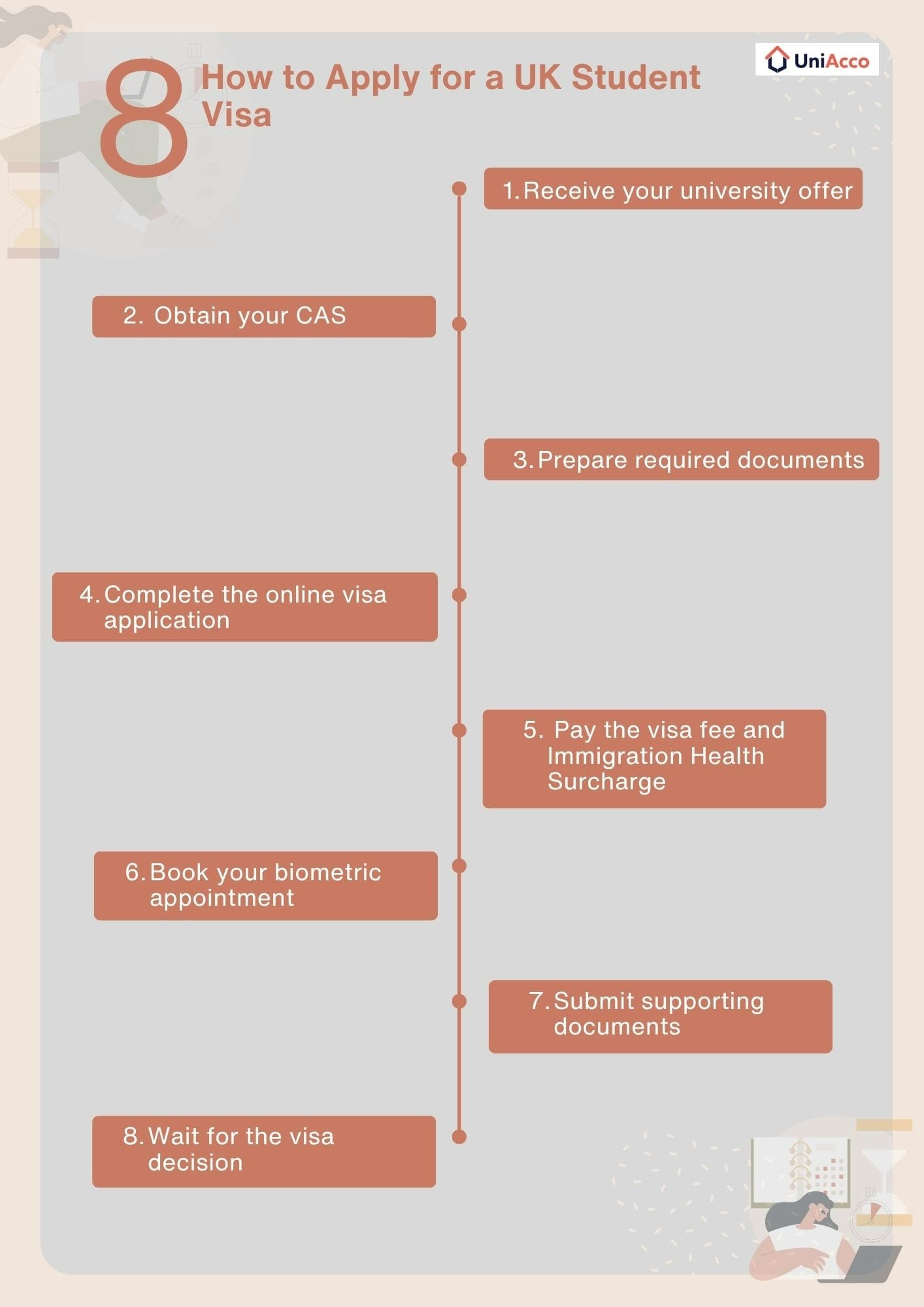
Receive your university offer.
Your offer letter, whether unconditional or conditional from the university, is your first formal step towards obtaining your CAS. All conditions will be outlined in the letter itself.
Obtain your CAS.
Once you’ve met your university’s conditions, they will issue a CAS, which is an electronic reference number. You must quote this number on your visa application. This confirmation of acceptance lists your course title, start and end date, the fees you’ve paid and the total tuition fees details.
Prepare required documents.
Gather all your UK student visa documents listed in this article and on your CAS. Typical documents include your passport, CAS, financial evidence, English test results, academic transcripts, TB test (if applicable), ATAS (if needed) and parental consent (if under 18). Make photocopies and ensure translations are certified where necessary.
Complete the online visa application.
Head on to the GOV.UK website and fill in the visa application. Answer questions honestly and ensure details match your CAS and supporting documents. Review the form before submitting, and get a printout of the form.
Pay the visa fee and Immigration Health Surcharge.
On checking the UK visa fees for Indian students, you must pay the application fee and the Immigration Health Surcharge (IHS) online as part of the application. The IHS gives you access to the NHS while you study. Keep receipts for both payments – you will need them for your appointment.
Book your biometric appointment.
Many applicants now verify their identity using the “UK Immigration: ID Check” app on their smartphone instead of attending an in-person appointment — this is available if you hold a biometric passport. Check during your application which method applies to you, as it affects how you complete this step.
Submit supporting documents.
Attend the appointment with your original documents and any requested copies. Follow the visa centre’s list exactly – missing or incomplete documents are a common cause of delay or refusal.
Wait for the visa decision.
Processing times vary, but you’ll be notified by email once a decision is made. The UK has now fully moved to a digital eVisa system — physical vignette stickers and Biometric Residence Permits (BRPs) are no longer issued. Instead, you’ll create or update your UKVI account, and your visa will appear there as a digital record linked to your passport. Before you travel, log in to confirm your eVisa is visible and correctly linked, since this is what you’ll show at the border, to your university, and to landlords or employers (via a share code) instead of a physical card or sticker.
UK Student Visa Processing Time
- Standard processing time
The decision times could vary as per countries. Typically, it should take 3 weeks after your biometrics, but local processing might take time.
- Priority processing options
Many centres have the option of priority processing, for a faster decision at an extra cost. Availability differs by country and may be limited in peak seasons.
- Best time to apply
Apply as soon as you have your CAS and all documents ready. You can usually apply up to six months before your course starts (if applying for a UK student visa from India). Applying early reduces stress and gives time for any extra checks.
- Common reasons for delays
- Missing or unclear documents.
- Additional checks (ATAS, criminal record checks, or verification of documents).
- TB test appointment backlogs in certain countries.
- High seasonal demand at visa centres.
- Credibility checks or requests for further evidence.
UK Student Visa Interview
These are a few of the most common questions the visa consulate will ask the students. They are:
- Why did you choose the UK?
It’s best to give concise and well-researched answers. Speak about the quality of education, course reputation it holds, practical learning opportunities, cultural fit, or a UK-based expertise. You can also add in the QS rankings for some of the universities in the UK.
- Why this university?
Mention programme strengths (unique modules, faculty, facilities), on-campus support services, industry links or location benefits. Name one or two concrete features you researched to show this is a genuine, informed choice.
- Why this course?
Talk about your previous education, job or interests that led to this course, what skills you expect to gain, and how the course supports short and long‑term goals. Be specific about modules or projects that interest you.
- How will you finance your education?
State your funding sources clearly (personal savings, family support, scholarship, government loan, sponsor). Refer to documentary evidence you’ve provided (bank statements, sponsorship letter, scholarship award). If sponsored, name the sponsor and describe the sponsorship letter details.
- What are your career plans?
Explain and lay out a realistic and achievable plan – jobs, further study, or professional pathways in your home country or internationally. Link the course to these goals and, where relevant, mention local opportunities at home that make returning sensible.
If you still need help preparing for your interview, you can practice solo question and answer in front of the mirror, speak to your friends who have travelled to the UK for their further studies, or read articles/quora threads that have shared experiences.
Can International Students Work in the UK?
- Part-time work during studies
Your student visa allows you up to 20 hours of part-time work per week during term time. However, work rules can also vary by course level and sponsor.
- Work during vacations
Students can work full‑time during official university vacations. It’s best to confirm exact dates and restrictions with your university.
- Internship opportunities
Work placements are a formal part of your course and are generally allowed and encouraged. You must still follow your weekly working limits if you plan on pursuing your internship outside your course.
- Restrictions under the Student Route
You cannot undertake certain roles, such as professional sportsperson or full‑time permanent employment, unless your visa expressly allows it
- Post-study work (Graduate Route)
After finishing the degree, students can apply for the Graduate Route to stay in the UK and work or look for a job. Those who apply on or before 31 December 2026 can stay for 2 years (or 3 years for PhD graduates). Applications made on or after 1 January 2027 will receive 18 months instead. Students completing their course in late 2026 or early 2027 should keep this deadline in mind when planning ahead.
Bringing Dependants to the UK
- Eligibility rules
Only some UK Student Visa holders can bring dependants. This is generally limited to students on certain postgraduate or long-term courses, or those with specific sponsorship. Most undergraduate students and those on shorter courses cannot bring family members.
- Which students can bring dependants?
Check the GOV.UK guidance and your university’s information: eligibility depends on course type, level and length.
- Required documents
You’ll need marriage/civil partnership certificates, children’s birth certificates, proof of relationship and identity documents for each dependent, and any immigration history where relevant.
- Financial requirements
You must demonstrate extra maintenance funds to support each dependent for the required period (GOV.UK sets the amounts). Include these funds in your financial evidence or show a recognised sponsor will provide for them.
Common Reasons for UK Student Visa Refusal
- Incorrect financial evidence
Your visa application may be refused if your bank statements do not show the required balance, the funds have not been held for the required period, or they do not cover your tuition fees and living expenses.
- Invalid or incorrect documents
Submitting expired, incomplete, unsigned, or incorrectly translated documents can result in a visa refusal. Make sure all required documents are valid, provide certified translations for non-English documents, and submit original or certified copies wherever requested.
- Inconsistent information
Discrepancies between your CAS, application form and supporting documents can raise red flags. Consistency and the same information in every format is necessary.
- Failure to meet English language requirements
If your university or CAS asks for a specific Secure English Language Test (SELT) and you either do not provide an accepted test result or provide one that does not meet the required score, your application can be rejected.
- Missing CAS details
A CAS with incorrect details, or failing to quote your CAS number correctly on the application, will cause problems. Ensure the CAS issued by your university matches what you enter into the visa form.
- Incomplete application
Skipping filling required sections in the online form, missing the biometric appointment, or failing to upload or present requested documents leads to delays and often denial.
- Credibility concerns
Visa personnel must be satisfied by the fact that you genuinely wish to study in the UK. Vague study plans, unexplained gaps in education or work history, unrealistic future plans, or behaviour in interviews can suggest dishonesty and can lead to refusal.
Tips to Increase Your UK Student Visa Approval Chances
- Apply early
As soon as you lay hands on your CAS form, apply for your UK student visa from India. Time is extremely crucial here. This time allows you space to collect all your documents, manage them in an orderly manner, as well as look at accommodation as well. Basically, you’re well prepared to avoid any mishaps.
- Double-check all documents
Cross-check every UK student visa document for accuracy, expiry dates, signatures and translations. Ensure copies are correct and genuine and that originals are available for appointment checks.
- Ensure financial evidence meets requirements
Follow your instructions to the brim. Make sure all your funds are in place, your bank shows the right and needed amount, acceptable account holders, and correct currency conversion. If you’re going through a sponsorship, make sure the documents for the same are in place.
- Use accurate information throughout the application
Match names, dates, course titles and fees exactly between your CAS, offer letter and visa form. Even small inconsistencies can trigger delays or refusals.
- Prepare thoroughly for any interview
Practice concise answers to common questions about your course choice, funding and career plans. The key is to be yourself, polite and kind in answering. Confidence and convincing power in your interview can get you an approved student visa. Carry originals of key documents and be ready to explain any gaps or unusual points in your history.
- Follow official UK Government guidance
Rely on GOV.UK and your university’s instructions rather than unofficial/third-party advice. Rules, fee amounts and document formats keep changing. Check the official guidance close to your submission date.
Understanding the UK Student Visa from India is the first step to scoring an approved visa. Because once you’ve thoroughly understood the requirements and format, applying and retrieving the right documents gets uncluttered. The route to an approved UK visa is a process that includes getting an offer from your university, getting your CAS, and then applying for your student visa. The road to rejection and approval is how you treat your documents and attention to the requirements. This article should give you an idea of the depth of the journey which leads to a successful student journey to the UK.
Once your visa is sorted, let UniAcco help with the next big step. Compare and book verified student accommodation in Edinburgh with fully furnished rooms, all-inclusive bills, and flexible booking options. You can also explore accommodation across other top UK student cities, all with expert support every step of the way.
🔍 Explore Student Accommodation in Edinburgh

 LinkedIn








0 Comments