

Every country has their own visa requirements known by different names. When it comes to Australia student visa requirements, it used to be called the GTE (Genuine Temporary Entrant) test; now it goes by GS (Genuine Student). The name was replaced after 23rd March, 2024, and students who logged the test before that date got the GTE. Like every visa test, this application is to know your intent on studying in Australia. This also recognises that you may later be eligible for lawful visa pathways.
For students applying for GTE in Australia, this article will help them understand the requirements, how to go about it, the documents required, the questions that will be asked and the common mistakes they should avoid for a successful visa process.
Genuine Student Requirement: 2026 Overview
| Genuine Student Requirement | Details |
| Replaced GTE | The GS requirement replaced the Genuine Temporary Entrant requirement for Student visa applications lodged on or after 23 March 2024. |
| Applies To | Applicants applying for an Australian Student visa, including the primary Subclass 500 visa applicant. |
| Main Purpose | To establish that the applicant is a genuine student and that studying in Australia is the primary reason for applying for the visa. |
| Assessment Areas | The Department of Home Affairs considers the applicant’s personal circumstances, proposed course and provider, future benefits, previous study, employment, immigration history and visa compliance. |
| GS Questions | Applicants answer questions about their current circumstances, course and provider choice, future benefits and any other relevant information. An additional question may apply to previous Student visa holders and applicants applying in Australia from a non-student visa. |
| Response Limit | Each response must be written in English and contain no more than 150 words. |
| Supporting Evidence | Applicants must upload relevant supporting documents through ImmiAccount. Statements supported by reliable evidence are given greater weight during assessment. |
GTE vs Genuine Student Requirement
GTE in Australia was a requirement that focused mainly on whether an applicant intended to stay in Australia temporarily only for study purposes. This was replaced by the Genuine Student requirement on 23 March 2024. The GS requirements in 2026 require students to prove to them that they only want to pursue their further education in Australia and that this is their sole and primary purpose of applying for this visa. If they plan on extending their stay due to career decisions or other reasons, they will have to apply for another visa, including a permanent one. Following the legal pathway is the only route suggested for students and any such individual for the future.
Note that this change applies specifically to the Student visa (Subclass 500). If you’re applying for a Student Guardian visa (Subclass 590) to accompany a student under 18, the previous GTE requirement still applies to your application.
What Is the Genuine Student Requirement?
The Genuine Student Requirement test is taken by students who want to apply for a student visa. This student visa is issued by the government of Australia to the student once they prove that studying is the only and sole reason they want to come to Australia. This can apply to those who can also become eligible for other visa pathways. During the assessment, Australian immigration authorities can look into the applicant’s personal circumstances, family and home-country ties, previous education and employment, reasons for choosing Australia and the selected course, understanding of the education provider, the course’s future value and any previous immigration or visa history.
Find your perfect student accommodation in Australia with UniAcco. Explore affordable options with fully furnished rooms and all-inclusive bills, making it easier to manage your living expenses and settle into student life.
🔍 Explore Student Accommodation in AustraliaHow to Apply for the GS Requirement
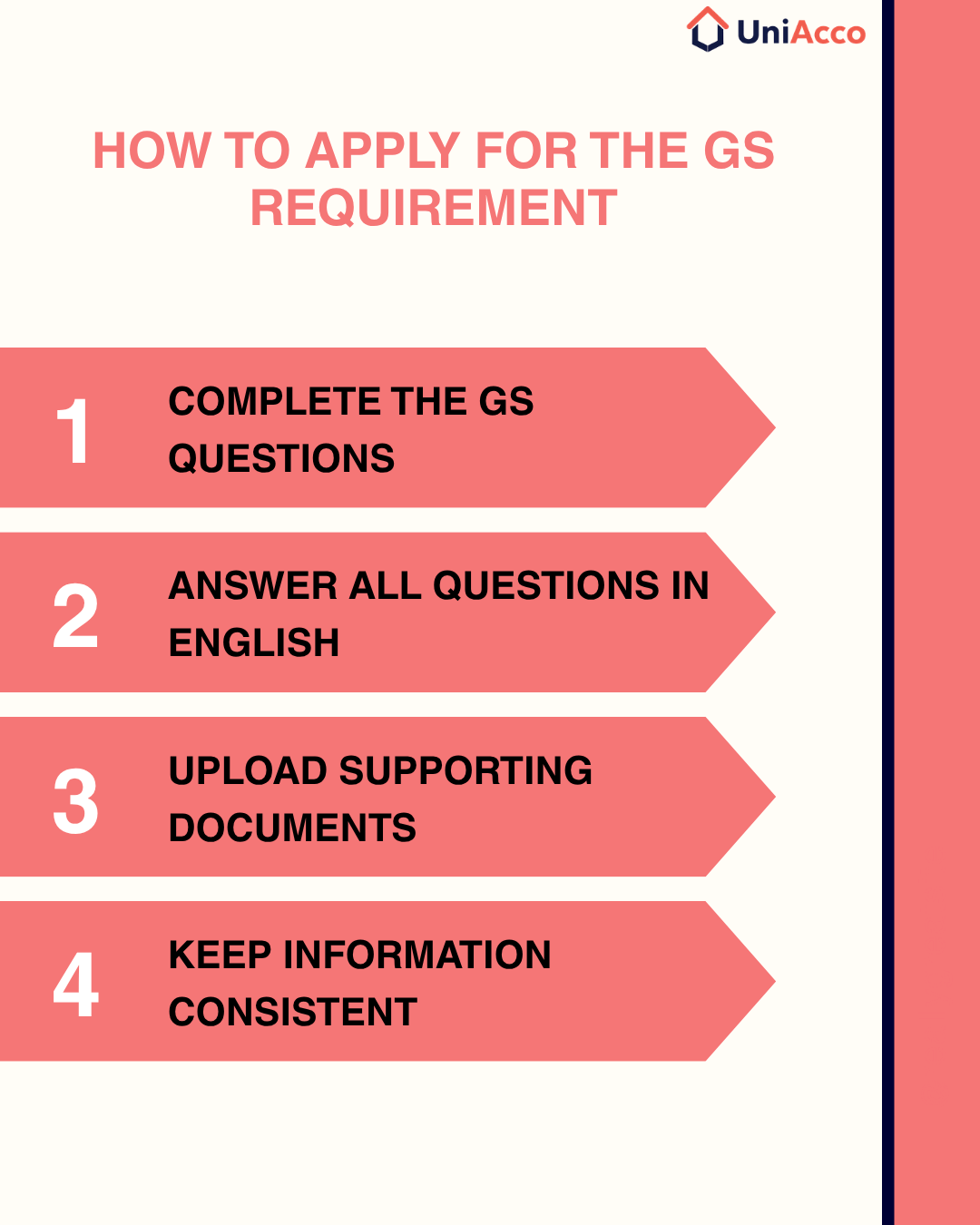
Complete the GS questions in the online Student Visa application
The GS questions appear when you sign in to apply for the student visa itself. Answer all the questions to the point, and answer them in the space provided to you. Explain your personal circumstances, reasons for choosing Australia, the university and future plans.
Answer all questions in English
All answers need to be in English only. Anything that’s not written in English can lead to confusion and maybe a denial of approval. Use simple English, and keep all answers clear and relevant and within the 150-word limit.
Attach supporting evidence through ImmiAccount
To get a successful GTE in Australia, you need to submit valid and supporting evidence through your ImmiAccount. This can include your academic records, employment history, financial statements and proof of home-country ties, etc. To understand the documents needed, you can use the Department of Home Affairs Checklist to prepare well in advance.
Ensure answers are consistent with the submitted documents
Review your answers before submitting them; make sure all your answers are consistent with your available documents. Check the dates, course names, financial information, and previous visa details. This makes it easier for the team to cross-check it and approve your visa application faster.
Want some insider advice on GTE/GS requirements? Read this Reddit thread and discover what the other students have to say.
Advice on Australian student visa GTE/GS? What are … – r/AusVisa
Genuine Student Requirements in Australia
Current circumstances and ties
Describe your situation at home as it is; this can be related to your personal responsibilities, community connections, employment, business connections or even financial circumstances. This is one of the GTE requirements in Australia where you explain the nature of your closeness to your family, rather than giving a generic and vague answer. If a similar course is available in your home country, explain how and why studying in Australia will be beneficial to you in the long run.
Reasons for choosing Australia and the course
Explain why you selected Australia instead of your home country or another study destination. You can talk about the course structure, practical learning, specialist facilities, teaching approach, industry exposure and how you plan on using these resources to work on your future.
Understanding of the course and provider
As a potential student in Australia, the GTE in Australia student visa requirements will require you to know all about the university and course you’re applying for. Whether it’s the modules, course structure, assessment methods, entry requirements, tuition fees, and other components revolving around it.
Benefits of completing the course
Talk about what skills you will gain at the end of the course, how this affects your employment prospects, and how you will move forward with your academic journey. You can mention potential employers and expected career progression and opportunities where you can later on divert to as well. Be as authentic in your answer as possible.
Previous study and employment
If you’ve studied or had work experience for a few years, you can use that information to connect to the course as well. You can mention that you’re diverting your career and hence you plan on changing the course. This explanation should be logical, or if you’re pursuing your Master’s, you can tell them how a postgraduate will help you strengthen subject knowledge and land better roles with better pay.
Immigration history
Always mention if you’ve applied for a visa to study in Australia, if approved or denied, any breach of the code of conduct on your behalf, international travel or any such things that can later come up and cause a barrier and weaken your application. Explain relevant information and give an understanding as to why those incidents took place, to help for a smoother application.
Documents Required for the GS Requirement
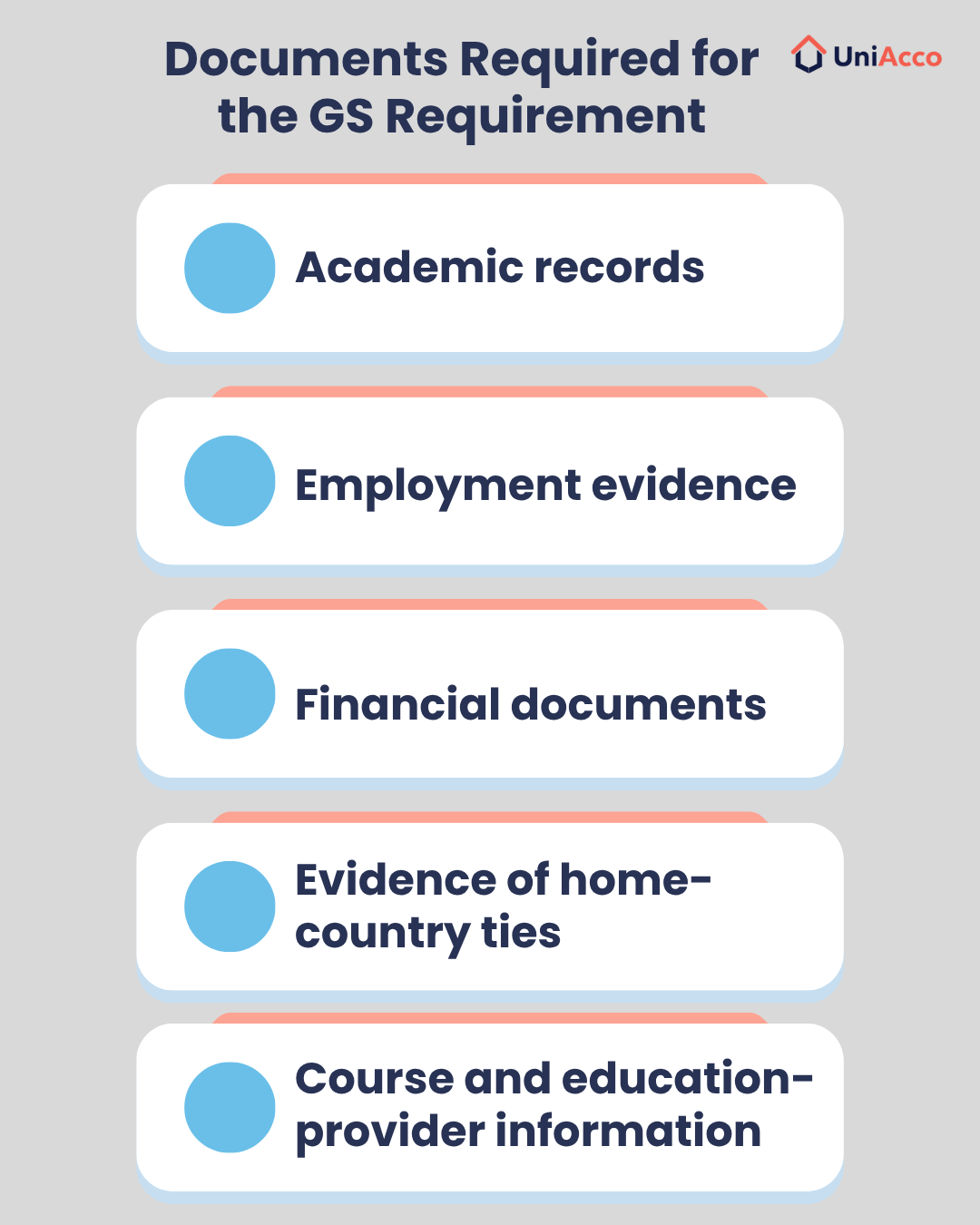
Academic records
These may include:
- Academic transcripts.
- Degree, diploma or school certificates.
- Certificates of attainment.
- Letters from previous education providers.
- Details of previous Australian study.
- Evidence explaining course changes or study gaps, where relevant.
Your documents should support the academic history described in your GS answers.
Employment evidence
If you are employed or have worked recently, you may provide:
- Employment contracts.
- Payslips.
- Employer letters.
- A résumé or CV.
- Details of your employer, position and employment period.
- Contact details for someone who can verify your employment.
A CV should present your education and employment history clearly, including relevant dates and positions held.
Financial documents
Your bank statements, sponsorships if any, scholarship letters and basically any evidence which shows you can cover your tuition fees and maintenance fees in the country will be required.
Evidence of home-country ties
Depending on your circumstances, this could include:
- Family or relationship documents.
- Proof of property ownership or a tenancy.
- Business registration documents.
- Evidence of ongoing employment.
- Professional memberships.
- Community commitments.
- Documents showing financial or personal responsibilities.
Only provide evidence that is genuine and relevant.
Course and education-provider information
These are the documents given to you by your university, which include your confirmation letter and information relating to your proposed study, including:
- Confirmation of Enrolment (CoE).
- Course offer letter.
- Course structure and subject information.
- Education-provider details.
- Tuition fee information.
- Campus location.
- Accommodation research.
- Details of practical training or work placements, if applicable.
A valid CoE for each intended course is generally required to make a valid Student visa application, unless a specific exception applies.
Prepping for your GTE in Australia can be stressful, but looking for your student accommodation shouldn’t be. Get ahead with UniAcco and explore affordable student accommodation in Sydney with fully furnished rooms and all-inclusive bills, so you can focus on preparing for your studies and your move.
🔍 Explore Student Accommodation in SydneyGS Questions and How to Answer Them
Current circumstances
This is one of the main sections of your GTE interview questions where you explain the current situation when it comes to your family, employment conditions, education, community and financial situation. Make your answer strong, like what you do for work, or what you are currently studying and how taking the next step to Australia will be the right decision.
Why this course and provider?
Show your interest in the course and explain why you chose that particular university. Tell them that you are really looking forward to studying so and so subjects and how it will create an impact on your future. Talk about the modules and how your university stands out in terms of employment opportunities and courses that only they teach.
How will the course benefit you?
Discuss the knowledge, technical abilities or professional experience you expect to gain and how these may support your employment or further study. If you have a past education experience, connect how this will act as the next step or make you better at your craft.
Other relevant information
You can use this space to add any information not already covered in the earlier questions. These can be:
- A significant study or employment gap.
- A previous visa refusal or cancellation.
- A change of course or education provider.
- Previous study in Australia.
- Unusual circumstances affecting your application.
- Any additional evidence that helps explain your plans
- 150-word limit per response
For the test for GTE in Australia, the visa test must be written in English and contain no more than 150 words. Be specific with your answers, and if they’re ending under 150 words, don’t fret; it’s better than over-trying to add in extra words that are useless.
How Australia Assesses GS Applications
Personal circumstances
The department will consider and look into your family background, community, employment and economic ties, as well as your reasons for choosing to study outside your home country.
Course relevance
Your course should make sense in the context of your previous education, work experience and future career plans. A different course may still be appropriate, but you should explain how and why you chose that course and how it will be of use to you.
Study and career history
Your academic records, employment history and any gaps or changes may be reviewed. Make sure all the answers on your GS form match the ones on your CV and academic certificates.
Knowledge of Australia and the chosen course
You need to be well informed about the country you’re choosing to study in. Such as the cost of living in Australia, background research on your university, the courses it offers, modules, the living arrangement, available student accommodations and more. A generic understanding can make your application less credible.
Immigration and visa history
Your previous visa applications, travel history, visa refusals, cancellations and compliance with visa conditions may be considered.
Common GTE Mistakes to Avoid
Generic answers
Avoid giving very vague or over-the-top answers to the GTE interview questions – that seem like they’re copied from someone else. These answers have to feel like your own, reflecting your situation and circumstances. Chances are they know when the answer feels inauthentic, which could raise questions.
Unsupported claims
If you’ve claimed to do something, then always carry proof with you. Or when it comes to speaking about the university or Australia, always carry supporting evidence such as the rate of employment or reviews from students who’ve graduated and they’ve landed a job in your chosen company.
Inconsistent information
Check that your GS answers match your passport, CV, academic records, employment documents, financial evidence and visa history. Differences in dates, course names or employment details can raise concerns.
Weak course justification
Simply listing the subjects in a course is not enough. Explain why those subjects, teaching methods or practical opportunities will help you achieve the heights and skills required in your profession.
Focusing only on migration outcomes
The GTE in Australia, which has now become GS, focuses on the idea that a student should only apply for this visa if the sole purpose is education and career plans in Australia. If your sole reason is migration, your visa has a chance of being rejected.
The final step to your student visa journey is imagining yourself settling into life in Australia. Make your accommodation search easier with UniAcco and explore student housing options designed to help you feel comfortable and ready for your new chapter.
🔍 Explore UniAccoUnderstanding the GTE in Australia is the first step to moving in the right direction. GS, which was once GTE, is made for students whose sole reason is to study in Australia. These requirements ensure that students get into Australia easily, such as knowing how to apply for one, avoiding common mistakes, and preparing for the interview and required documents. This article will give the students all that they need to know about GS requirements in Australia and how to plan for it accordingly.


 LinkedIn







0 Comments