
You’re arriving in a new city, with two suitcases and a confirmation email for your place to stay. You hop in a taxi, head to the address, and the building manager says there’s no booking under your name. In that moment, you’d feel betrayed. You have flashbacks of what went wrong. Are you aware that approximately 57% of students have encountered fraud or theft by scammers? The risk of these student accommodation scams increases during the freshers’ season when everyone is rushing to secure housing.
The UK Government’s Stop! Think Fraud campaign warns that students are prime targets and urges young people to stay alert before sharing personal or financial details. In this blog, we’ll help you recognise common housing scams, red flags, how to verify legitimate accommodation sites, what to do if you’ve been scammed, and tips to avoid these scams.
What Are Student Accommodation Scams?
To put it simply, student accommodation scams trick students planning to lease properties by asking them to pay deposits or rent for fake, unavailable properties. So, a person who poses as a “landlord” doesn’t really own the property. They use stolen photos from the internet from other legit websites and design emails that look almost real by pretending to be a legit student accommodation company.
Their websites also show you these rush-hour messages like “Only 1 room left!” or “Pay today to secure”, which make you fall for these rental scams by creating panic in your minds. They know you’re already stressed about finding your perfect home and wouldn’t want to miss out on a deal that looks so good or almost real. And as of today, with social media and WhatsApp group chats, these scammers are finding it easier ways to fool you.
Most Common Student Housing Scams in the UK
- Fake Landlord Scam
You come across a room online and message the landlord. They reply almost immediately and seem completely genuine. They might even send over a copy of their ID or a draft tenancy agreement to build trust. Then they tell you that several other students are interested and that you’ll need to pay a deposit quickly to secure the room. Not wanting to miss out on a place that fits your budget, you transfer the money. After that, communication stops. The listing disappears, or you discover the property was never actually available. This is one of the most common student accommodation scams, particularly in the weeks before term begins when students are rushing to book housing.
- Cloned Listing Scam
Do you know another common way these scammers fool you? They take real photos and details from genuine property listings and repost them on Facebook groups, WhatsApp chats, or sites like Gumtree. The rent is usually slightly cheaper to make it irresistible. You think you’ve found a bargain. In reality, you’re sending money to someone who has zero connection to the property. Cloned ads are a huge part of student accommodation scams because the listing itself looks completely real.
- Deposit Before Viewing Scam
Another common way students fall victim to scams is when a landlord says they are currently out of town or working abroad. So, they cannot show you the place in person. And you are asked to pay before seeing the property, even by live video, which is one of the biggest red flags in student accommodation scams.
- Tenancy Agreement Scam
Students get scammed easily because the paperwork looks convincing. Since the tenancy agreement comes with logos and official formatting, this convinces students to trust the scammer and send money. However, the entire contract is fake, and once the scammer receives the amount, they disappear.
Why Students Are Easy Targets for Student Accommodation Scams
- First time handling real money:
You, as a student, become an easy target for student accommodation scams since the rent and deposit transactions are done all by yourself to your “landlord”. You thought you found a good deal because the website and details seemed real, and the “landlord” sent over bank details, so you transferred £600 without fully checking the contract. A week later, they’ve vanished. That’s how a lot of student accommodation scams play out.
- You’re in a rush; scammers love that:
Let’s say you’re already on a time crunch and you panic-book because you don’t want to be stuck without housing. You rush the payment, thinking you’ve secured the room. Turns out, it was a student accommodation scam using stolen photos from another website. That’s how most student accommodation scams work. Urgency is their biggest weapon.
- International students face extra pressure:
Let’s say you want to move to Edinburgh for your studies, and if you’ve ever read Harry Potter books or seen movies or even travel vlogs of Edinburgh, you know this place is magical. So, you go online and find a student accommodation. But since you’re booking from far away, you haven’t seen it in person. The landlord asks you to transfer the deposit today to secure your spot, or the room will go to someone else. Not wanting to lose the chance, you send the money. But as your departure date gets closer, the landlord stops replying, and the listing disappears. This isn’t just bad luck. It’s one of the most common student accommodation scams targeting international students.
- The stats show this isn’t rare:
The number may be alarming, but it’s true: around 57% of students have encountered rental or student accommodation scams, and they are generally aged 18 to 24. A lot of the young crowd lose an average of £300 a year to scammers. That’s not a small amount; that’s rent money, food budget, or flight tickets all gone.
Red Flags Every Student Should Watch For
| Red Flag | What It Actually Means |
| Rent is way cheaper than everything else | If it looks unreal for the area, it probably is. Lower-than-usual prices are one of the biggest hooks used in student accommodation scams. |
| “Pay now, or you’ll lose the room” pressure. | Scammers create a sense of urgency to manipulate students. Real landlords don’t force instant transfers. |
| No in-person or live virtual viewing allowed | If your accommodation provider can’t show the property live (even on video), you are likely to get scammed. This is one of the major red flag factors in many student accommodation scams. |
| Asking for bank transfers to overseas accounts | UK rental payments should usually go to UK accounts. Overseas transfers make it harder to trace, exactly why scammers prefer them. |
| Weird grammar, mismatched details, or photos that look too polished | Scammers use stolen images and inconsistent information, which are classic signs of a fake listing. They reuse photos from legit websites. |
| No written tenancy agreement | If there’s no proper contract outlining terms and deposit protection, stop right there. Legit rentals come with paperwork, and scams don’t. |
Watch for red flags like rushed deposits or no viewings. Book verified student accommodation near London with UniAcco and avoid last-minute scams.
Explore Verified London Student HousingHow to Verify Legit Student Accommodation in the UK
- Request a live video viewing or arrange to see the property in person:
To verify if it’s legit student accommodation, students must know that a trustworthy landlord would not hesitate to show the property in real time. They just don’t send photos. If you feel your student accommodation provider is not transparent with you about these things, it’s a sign that your accommodation landlord is scamming you.
- Check if the landlords are registered:
Students need to know that in some areas of the UK, landlords must be registered. Before you go ahead and book your place with your accommodation provider, make sure you have verified this intricate detail. Simply check online to see if they are legitimate.
- Confirm the deposit protection scheme:
In England and Wales, deposits must be protected in a government-approved scheme; if they can’t explain this clearly, pause. Many student accommodation scams skip this step entirely.
- Reverse image search the property photos:
Upload the images to Google. If they show up on multiple unrelated listings, it could be a cloned ad, which is a common trick in student accommodation scams.
- Check the agency on Companies House:
If the agency is a registered UK company, it will show up on the official Companies House website. If you can’t find it, be careful.
- Cross-check the address:
Check the address on Google Maps and your university’s housing pages. Make sure the building is real and matches the listing.
- Book Via UniAcco:
The Internet has a thousand private student accommodation websites, but how can one trust them all? If the website doesn’t give real-time information, or doesn’t list verified properties and isn’t registered, then it’s a cue for you to recognise a scam. Because all properties at UniAcco are verified, we offer 24/7 support, so even if you have any hesitation, you can call us at 2 in the morning and get the resource. To avoid any kinds of student accommodation scams, book through UniAcco.
Safe Platforms to Book Student Housing
- Stick to accommodation providers that your university has approved:
If your university recommends a provider, it’s usually a safer choice. So, you can go ahead and book your accommodation. This is one of the safest and easiest ways to avoid falling for any student accommodation scams.
- Book your accommodation through well-known PBSA operators, official university halls, or trusted platforms:
Currently on the market, there are many student accommodation platforms that work directly with recognised properties. UniAcco is one of them. We help you book verified furnished student accommodation in top study destinations, the UK being one of them. This helps protect you from fake landlords and student accommodation scams.
- Make sure you communicate using official company email addresses:
A safe way for you to realise that you’re not getting scammed is by making sure the business contacting you for your student accommodation has a business email address, rather than a generic Gmail account, which makes the process more trustworthy. Many student accommodation scams appear in Facebook groups and WhatsApp chats since anyone can post in these spaces. So, avoid relying on social media listings and save yourself from housing scams. Cross-check these businesses online, look for their legit addresses, and do a quick search on that business online; it barely takes a minute or two. Read online reviews of them.
What to Do If You’ve Been Scammed
- Contact your bank immediately:
First, take a deep breath. If you’ve been caught by a student accommodation scam, it doesn’t mean you were careless. These scams are getting smarter and more convincing every year. Second, don’t wait. Call your bank as soon as you notice something is wrong. The sooner you report it, the better the chance they can freeze or recover your payment.
- Report it to Action Fraud:
Action Fraud is the UK’s national centre for reporting fraud and cybercrime. By reporting, you help build cases and spot patterns in student accommodation scams.
- Tell your university:
Let your student support team or accommodation office know. Universities understand these student accommodation scams keep happening and can guide you to emergency housing or other support.
- Save everything:
Save screenshots, bank transfer receipts, emails, and messages. All of this evidence is important if your bank or the authorities investigate.
- Don’t feel embarrassed:
It’s true, student accommodation scams are made to look real. With professional websites, fake contracts, and urgency tactics, anyone can be fooled.
Don’t let housing scams ruin your move. Browse trusted student accommodation options in Edinburgh and book with confidence before you arrive.
Explore Edinburgh Student HousingTips for International Students to Avoid Accommodation Scams
- Pause if you’re contacted unexpectedly:
Most of the time, you get an unexpected email or message about housing. Scammers use urgency and pressure to trick students. Always check the details before giving out personal or bank information.
- Use official bank contact numbers:
If you get a call and they say they are from your bank, don’t give out any details or call on numbers they’ve asked you to. Instead, the best thing to do is visit your bank’s official website and use the number listed there. This helps you avoid extra fraud linked to student accommodation scams.
- Check HMRC communication directly on GOV.UK:
If you get messages about taxes, make sure to check them using the official GOV.UK website. What scammers do is sometimes mix fake tax refunds with housing scams to create more pressure.
- Never move money for someone else:
Anytime your landlord asks you to move money, take that as a warning sign. This is part of a student accommodation scam. The best way to make sure you aren’t getting scammed is to ask your university’s international office to look at it for you. Getting this double-checked by a legitimate source will help students avoid housing scams and issues.
- Avoid paying deposits before arrival unless using recognised platforms:
If you aren’t booking through official university housing or trusted providers like UniAcco, be very careful. Many student accommodation scams occur when people pay upfront without proper checks.
See this Reddit thread to know how to avoid housing scams as an international student.
Avoiding rental scams as international student? – r/cambridge
Final Checklist Before Paying a Deposit
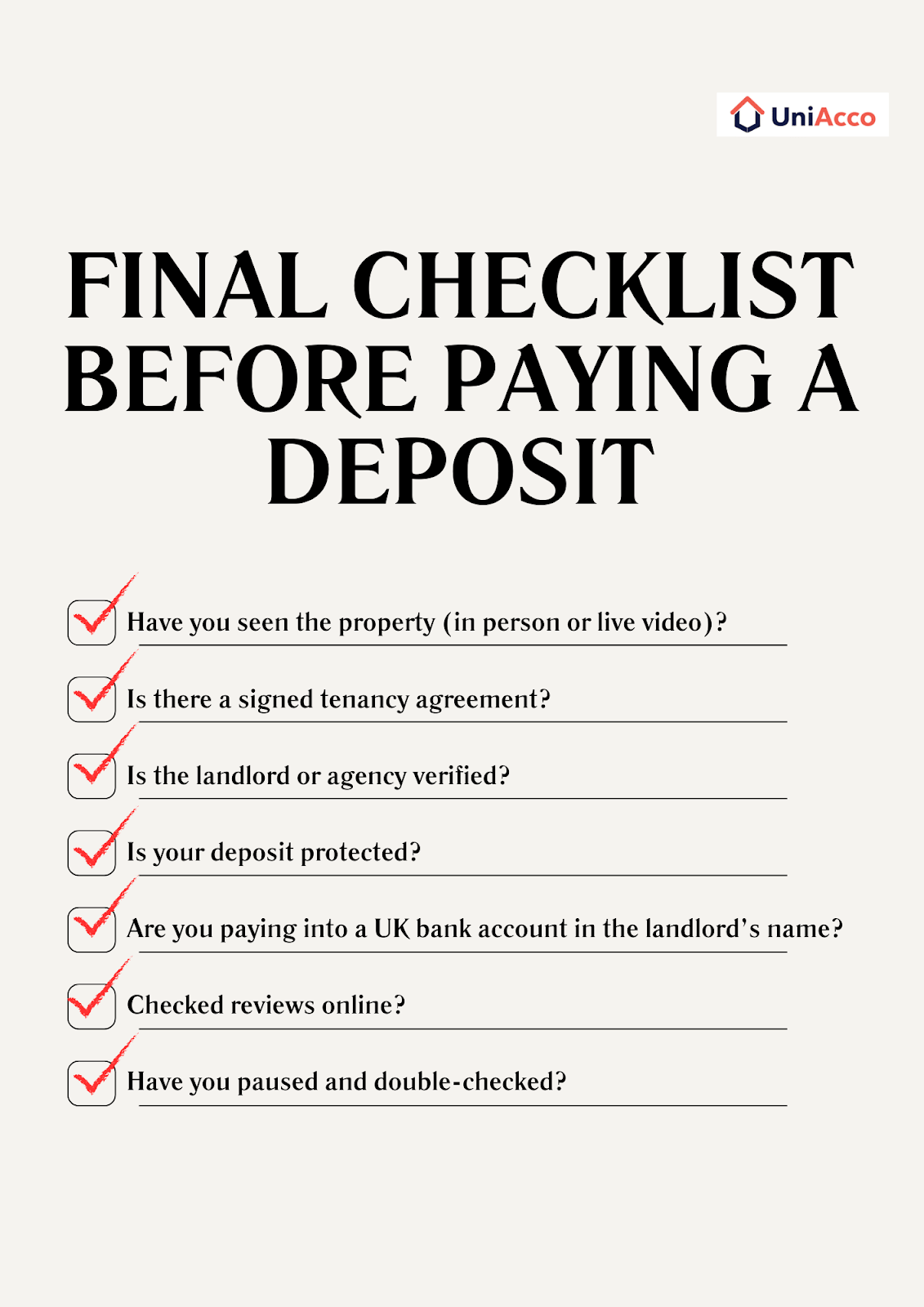
Here is a checklist to go through before you make your first deposit. Hope it helps!
- Have you seen the property (in person or live video)?
If you have only seen photos, be careful. Sometimes scammers make use of stolen pictures in student accommodation scams.
- Is there a signed tenancy agreement?
If your accommodation provider has not given you a proper and clear contract, do not pay or book your accommodation. Real landlords always share legitimate and complete paperwork before asking for money.
- Is the landlord or agency verified?
In this online generation, students need not wait to verify sources with other humans; they can simply look up their accommodation provider’s name, check whether they are registered, and make sure they are real, and not just a WhatsApp contact.
- Is your deposit protected?
In the UK, your deposit should be placed in a government-approved scheme. If the landlord cannot explain this clearly, it is most definitely a warning sign of a possible scam.
- Are you paying into a UK bank account in the landlord’s name?
Be cautious. Check if you are asked to pay into an overseas account or if the payment details seem unusual.
- Checked reviews online?
Look beyond their website. Google reviews can quickly expose student accommodation scams.
- Have you paused and double-checked?
If you feel rushed, take a step back. Scammers often use pressure to trick students. If you are unsure about any point, wait before sending any money.
Want a safer way to book your student home? Explore verified student accommodation with UniAcco and avoid the risk of dealing with unknown landlords.
Explore Verified Student HousingConclusion
This quote could sum up everything this blog wanted to tell you: “Better safe than sorry”. You should use this as your go-to motto when you’re planning your studying journey abroad. We know the stress of planning to study abroad comes up.
Getting scammed while finding accommodation isn’t something you, as a student, should experience. Especially when you’re planning to completely start over in a new country with new aspirations and dreams. So that you don’t fall for these student accommodation scams, UniAcco is here to support you throughout your stay!






0 Comments