
The group chat has at least one person in it right now who’s either just got their offer letter or is very loudly planning to “figure it out this year.” And if you’re reading this, you’re probably somewhere between inspired and mildly overwhelmed, because the idea of studying abroad is easy, but the actual process of how to go abroad for studies is where most people hit a wall.
Here’s the reality: in 2019, six million students were studying in countries other than their own, and that number is projected to grow to over nine million by 2030. The demand has never been higher. But so has the competition. New international student enrolments in the US dropped by 17% in the Fall 2025 Snapshot, not because students stopped wanting to go abroad, but because more of them are applying without a clear plan and not making the cut.
This guide fixes that. We’ll cover why studying abroad is worth it, the top 10 countries for 2026-2027, a step-by-step process for how to apply for universities abroad, and the tips that separate accepted from waitlisted.
Why Study Abroad
Why do students actually study abroad? Is it for the vibe or the career? Honestly, the data says it’s both, and that’s not a cop-out answer.
Career impact is the most important decision factor for international students deciding where to study, and it has been since 2019, according to Etio’s International Student Barometer. But the personal growth piece is real, too. Living alone in a country where you have to figure everything out from scratch builds a version of you that a domestic degree simply doesn’t.
- Learn from Top Universities & Professors:
There’s a difference between reading the papers of great professors versus actually learning from them. The main reason why students study abroad is that they get wide exposure to top universities, and these top universities give them the chance to learn from professors who are now creating research papers and laws.
- Access Specialised Courses & Research Opportunities:
Sometimes the course you want to pursue is not available in your home country, and if it is, then it might not be as extensive as it would be in another country. This is the main reason why students study abroad: they can select a course that actually suits their career path.
- Boost Career Prospects with Global Experience:
Studying abroad adds credibility to your resume, and it’s not only because you studied at the most prestigious and globally known university, but also because it shows you learned the concept from the experts, from the ones who are changing the market today. That’s how it helps you boost career prospects by gaining the best knowledge.
- Build an International Network of Peers & Mentors
One of the main reasons why students choose to study abroad is that their network will never be limited. You will build a network outside your country, you will meet new people, peers and go to different events and build a network that you can’t do from LinkedIn or from your home country. And building this international network will help you get the right opportunities.
- Improve Language & Communication Skills:
Not everyone understands that knowing a language doesn’t automatically mean you are good at conversing. And that’s exactly what you learn when you decide to study abroad. You not only master the language, but also the communication skills as well. You learn to talk to people from different cultures, which helps you put out your ideas in a better way and also gives you confidence to speak everywhere.
Step-by-Step Guide on How to Study Abroad
Read the part that actually determines whether you will get to study abroad. How to apply for foreign universities isn’t complicated, but it is sequential, and skipping steps is where most applications fall apart.
- Step 1- Define your career goal and study level.
Make sure you have a clear career goal in your mind; this will help you choose the right university with the right course. Know this before anything else, because the country, the university, and the timeline all depend on it.
- Step 2- Choose your exact specialisation.
Now that you know what you want to do, the next step is to know how you will do it. Once you choose the field, choose the exact specialisation. Because “Business” is not a specialisation. “Supply chain management with a focus on Southeast Asian markets” is. The more specific you are, the more targeted your university list becomes.
- Step 3- Shortlist countries best suited for your course.
After selecting the course and specialisation, shortlist countries that are best for the course you want to do. For example, for the engineering shortlist in Germany, not some randomly typed on Google. Shortlist UK or Singapore for finance. Match the country’s industry strengths to your field.
- Step 4- Research and rank universities that fit your profile.
Now that you have chosen the university, check its ranking, course details and university details as well. The QS rankings are just a starting point; they don’t tell the complete story. Check the school’s placement rates, research output, alumni networks, and whether your profile is strong enough to get in.
- Step 5- Check admission requirements and deadlines.
You have a country, a university and a course, but the journey begins when you start looking for admission requirements and deadlines. That’s when it starts feeling real. Each university has its own admission requirements. Basic requirements involve academic transcripts, English language proficiency, a strong portfolio, a letter of recommendation and a good essay. Keep all these handy even before the admissions start. Additionally, you need a strong knowledge of application deadlines. Don’t read a synopsis from 2023; see the official page.
- Step 6- Prepare all required documents properly.
After checking the requirements, it’s time to gather all the documents. This is when everything starts feeling real, and anxiety and excitement start building. Gather all the required documents and submit them before the deadline. Transcripts, LORs, SOP, CV, English scores, and passport. Start the document collection process months before the deadline; some take longer than you expect.
- Step 7- Apply for university admission strategically.
The next step is to repeat all the steps, because applying to one university is not enough. Most students rely on just one university, and that’s risky. Always keep the plan B ready. Apply to more than one university, so even if you don’t get your favourite university, you will have the option to go to the second-best university. So, apply for university admission strategically.
- Step 8- Apply for scholarships and funding early.
This step is very important; don’t miss it. If you don’t have enough funding, start looking for the scholarships provided by the university or the government and start applying early. Most scholarship deadlines fall before or at the same time as university deadlines. Research these simultaneously, not afterwards.
- Step 9- Plan your student visa and financial proof.
The most important step for studying abroad is having a study visa. Got the university offer? Apply for a student Visa immediately. Once you have an offer, the visa process begins. Start collecting all the required documents and also financial proof. Your bank statement, university offer, payment proof, and everything else need to be submitted for the student visa.
- Step 10- Arrange accommodation and pre-departure essentials.
Now comes the last and most important step—finding the right student accommodation. If you keep this step for the last moment, you will not get anything. Also, to save your time and money, book from UniAcco. We list only verified properties. You can compare prices and properties; all the rooms are fully furnished with modern amenities like fridge, TV, microwave, dishwasher, and they will also be near your campus. What more do students need? You will get your room aesthetic in your budget. So, search UniAcco, and book as soon as you get the university offer.
Check out this Quora thread to understand the basic first steps students should know before planning to study abroad

Top 10 Countries to Study Abroad in 2026–2027
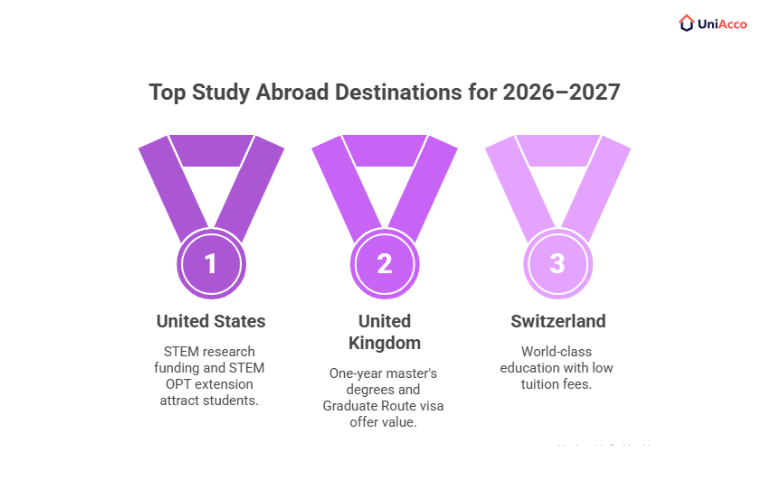
Picking a country feels like a big decision because it is. What was the obvious choice two years ago might not make sense in 2026, visa policies shift, living costs change, and post-study work rights get updated without warning. Here’s where things actually stand right now.
United States
It’s impossible to argue against it being the most popular place to go in the world, especially for students in STEM, finance, and business. There is no other place like this for research funding. Labs at MIT and Stanford are working on topics that won’t be in textbooks for another ten years.
The STEM OPT extension means eligible graduates can work in the US for up to 3 years after graduation, which is one of the main reasons Indian and Chinese students still make up the largest share of international enrolments despite the higher costs.
One real flag for 2026: new international student enrolments dropped 17% in Fall 2025, partly due to visa uncertainty under shifting immigration policies. Apply early, have your documents watertight, and don’t assume acceptance means a smooth visa process.
| University | Popular Fields | Tuition (Annual) | Living Cost | Post-Study Work |
| MIT | Engineering, Computer Science | USD 62,000+ | USD 2,000/month | OPT: 3 yrs (STEM) |
| Stanford | Technology, Business | USD 57,000+ | USD 2,000/month | OPT: 3 yrs (STEM) |
| University of Chicago | Economics, Social Sciences | USD 50,000+ | USD 1,800/month | OPT: 1–3 yrs |
United Kingdom
The one-year master’s degree is still one of the greatest values in international education. You’re in, done, and qualified in 12 months. That means one year of school and living fees, and you can get back to work faster than anywhere else. The Graduate Route visa lets you work for two years after you get your degree (three years for PhDs), which is a lot of time.
The honest 2026 caveat: 7 in 10 UK universities are reporting declining international postgraduate enrolments, partly from visa policy tightening and partly from rising costs. The UK is still absolutely worth it for the right course, but do your research on the specific programme, not just the university name.
| University | Popular Fields | Tuition (Annual) | Living Cost | Post-Study Work |
| Oxford | Law, PPE, Sciences | £30,000–50,000 | £1,200–1,400/month | 2-yr Graduate Route |
| Imperial College | Engineering, Medicine | £35,000–45,000 | £1,300–1,500/month | 2-yr Graduate Route |
| UCL | Architecture, Social Sciences | £25,000–35,000 | £1,200–1,400/month | 2-yr Graduate Route |
Shortlisted the UK for your studies? Now it’s time to find your accommodation. UniAcco helps students discover verified and affordable student housing near top universities, with 24/7 support before you even land.
🔍 Explore UK Student HousingSwitzerland
Two universities, two of the best in the world. ETH Zurich and EPFL consistently rank in the global top 25, and the tuition fees are almost offensively low for the level of education you’re getting, CHF 800–1,200 a year.
The thing that everyone forgets is that living in Zurich or Lausanne is more expensive than practically anywhere else in Europe. A monthly budget of CHF 2,000+ is not pessimistic, it’s realistic. Students in engineering, hard sciences, and IT who have good grades and can get scholarships or part-time jobs to help pay for living expenses do well in Switzerland.
| University | Popular Fields | Tuition (Annual) | Living Cost | Post-Study Work |
| ETH Zurich | Engineering, Sciences | CHF 800–1,200 | CHF 2,000+/month | 6-month job search permit |
| EPFL | Technology, Life Sciences | CHF 800–1,200 | CHF 2,000+/month | 6-month job search permit |
Germany
The value proposition is clear: there is no tuition at public universities, even for students from other countries. You pay €300 to €500 per semester, which usually includes a public transport pass for the city. This means that you get a free commute.
Living costs run €900–1,100/month depending on the city, with smaller university towns like Heidelberg and Freiburg coming in cheaper than Munich or Berlin.
The 18-month job seeker visa after graduation is genuinely one of the best post-study work arrangements in Europe; you get over a year to find employment without the clock ticking down on your legal stay. German language skills help significantly in the job market, even if your degree was taught in English.
| University | Popular Fields | Tuition (Annual) | Living Cost | Post-Study Work |
| TU Munich | Engineering, CS | €0 (public) | €900–1,100/month | 18-month job seeker visa |
| LMU Munich | Sciences, Business | €0 (public) | €900–1,100/month | 18-month job seeker visa |
| Heidelberg | Medicine, Sciences | €0 (public) | €900–1,000/month | 18-month job seeker visa |
Netherlands
The Netherlands has quietly become one of the most student-friendly countries in Europe. Over 2,000 programmes are taught entirely in English, which means you’re not locked into learning Dutch to function academically or socially.
The Dutch are also genuinely good at English, daily life is navigable from day one. Geographically, it’s hard to beat: Amsterdam, Rotterdam, and Eindhoven are all under two hours from Paris, Berlin, and London by train. The 12-month orientation visa after graduation gives you a full year to find work in one of Europe’s most internationally connected job markets.
Tuition is reasonable for Europe, and the Holland Scholarship plus Erasmus Mundus options can bring costs down further.
| University | Popular Fields | Tuition (Annual) | Living Cost | Post-Study Work |
| University of Amsterdam | Social Sciences, Business | €9,000–15,000 | €1,000–1,200/month | 12-month orientation visa |
| TU Delft | Engineering, Architecture | €10,000–17,000 | €1,000–1,200/month | 12-month orientation visa |
Singapore
If your career goals involve anything in the Asia-Pacific region, finance, tech, trade, policy, Singapore is where the network lives. NUS ranks in the global top 10 and NTU isn’t far behind. The city-state punches way above its size in terms of industry connections, multinational headquarters, and graduate employment outcomes.
It’s expensive to live in, SGD 1,500–2,000/month is the reality, not the outlier, but starting salaries for graduates here are among the highest in Asia. Admission is competitive and the academic environment is rigorous. Singapore works best for students who are academically strong, financially prepared, and serious about building an Asia-facing career.
| University | Popular Fields | Tuition (Annual) | Living Cost | Post-Study Work |
| NUS | Business, Engineering, CS | SGD 17,000–25,000 | SGD 1,500–2,000/month | Employment Pass available |
| NTU | Engineering, Sciences | SGD 17,000–25,000 | SGD 1,500–2,000/month | Employment Pass available |
Heading to Singapore but haven’t booked your accommodation yet? Explore fully furnished and affordable student housing on UniAcco with all-inclusive bills, and choose the room that best fits your budget and lifestyle.
🔍 Explore Student Housing in SingaporeAustralia
Australia’s biggest selling point for international students has always been what happens after the degree. The Temporary Graduate Visa (subclass 485) gives 2-4 years of post-study work rights depending on your qualification level and where you studied. Regional study locations get extended visa durations.
Sydney and Melbourne are pricey (AUD 1,800–2,200/month), while smaller areas like Adelaide and Perth are far cheaper and now offer the same extended visa perks. STEM, business, nursing, and health sciences are all strong industries in Australia where there is a lot of demand for workers.
| University | Popular Fields | Tuition (Annual) | Living Cost | Post-Study Work |
| University of Melbourne | Business, Sciences, Arts | AUD 40,000–50,000 | AUD 1,800–2,200/month | 2–4 yrs (subclass 485) |
| ANU | Policy, Sciences, IT | AUD 38,000–48,000 | AUD 1,600–2,000/month | 2–4 yrs (subclass 485) |
| University of Sydney | Engineering, Health | AUD 40,000–50,000 | AUD 1,800–2,200/month | 2–4 yrs (subclass 485) |
China
Most students don’t consider China, which is exactly why it’s worth considering. Tsinghua and Peking University are climbing global rankings fast, tuition is low, and the Chinese Scholarship Council (CSC) funds thousands of international students every year, covering tuition, accommodation, and a monthly stipend.
The cost of living in Beijing and Shanghai is lower than in cities in the West. Language is what really sets you apart. Even if you only know a little Mandarin, it will help your career more than most of your contemporaries. There are programs in English, but students who use the language get a lot more out of the experience.
| University | Popular Fields | Tuition (Annual) | Living Cost | Post-Study Work |
| Tsinghua University | Engineering, CS, Business | CNY 30,000–50,000 | CNY 4,000–6,000/month | Work permit available |
| Peking University | Sciences, Humanities | CNY 25,000–45,000 | CNY 4,000–6,000/month | Work permit available |
Denmark
Denmark consistently ranks as one of the happiest countries in the world to live in, and that’s not just a tourism tagline; the work-life balance, the cycling culture, and the flat social hierarchy are all real and different. For students in renewable energy, engineering, architecture, and design, Danish universities are genuinely world-class.
Integration isn’t as hard in Denmark as it is in Germany or France because everyone speaks English. International students do have to pay tuition, although the Danish Government Scholarships and grants from certain universities can help with this. Copenhagen is pricey, but smaller university cities are easier to handle.
| University | Popular Fields | Tuition (Annual) | Living Cost | Post-Study Work |
| University of Copenhagen | Sciences, Life Sciences | DKK 80,000–120,000 | DKK 8,000–10,000/month | Job search visa available |
| DTU | Engineering, Technology | DKK 80,000–120,000 | DKK 8,000–10,000/month | Job search visa available |
Choosing the right country is more important, so check out this Reddit thread that shows the top 10 countries based on current trends
Top 10 Countries to Study Abroad in 2026 (Latest Guide) – r/StudyAborddelhi
France
There are two very distinct price points in France. Public institutions charge between €170 and €380 a year, which is one of the lowest prices in Europe for a degree that is accepted around the world. Then there are the grandes écoles, such as HEC Paris, Sciences Po, and ESSEC. They cost a lot more, but they have great job networks, especially in business, consulting, and international organisations.
Paris is expensive to live in; Lyon, Bordeaux, and Toulouse are significantly more affordable. The Eiffel Scholarship and Charpak Fellowship are specifically designed for international students and cover tuition plus living costs. The APS visa after graduation gives 1–2 years to find work in France.
| University | Popular Fields | Tuition (Annual) | Living Cost | Post-Study Work |
| Sciences Po | Political Science, International Relations | €14,000–17,000 | €1,000–1,400/month | APS visa: 1–2 yrs |
| HEC Paris | Business, MBA | €45,000+ (MBA) | €1,200–1,500/month | APS visa: 1–2 yrs |
| Sorbonne University | Humanities, Sciences | €170–380 (public) | €1,000–1,200/month | APS visa: 1–2 yrs |
Tips to Maximise Your Chances to Study Abroad
- Start 12–15 months before your intake. Not 6. Not 3. Most students who miss out on their first-choice university ran out of time, not merit.
- Apply where your profile actually fits. A student with a 3.2 GPA applying exclusively to top-5 universities is not being ambitious; they’re being inefficient.
- Write SOPs that say something real. Admission readers go through hundreds. One that sounds like everyone else’s is memorable for the wrong reason.
- Track everything in one place. Deadlines, test scores, document statuses, application portals, one missed email can cost you a cycle.
- Prepare for interviews. Some programmes, particularly competitive research or MBA programmes, include interviews. Know your research proposal or professional background inside out.
- Know your funding clearly before you commit. An offer is exciting. An offer you can’t afford to accept is a problem. Apply to multiple universities. More applications within a realistic range increase your chances without spreading you too thin.
Ready to make the move? Start with where you’ll live. UniAcco offers verified and affordable student accommodation across Australia with 24/7 personal support and a guaranteed lowest price.
🔍 Explore Student Housing in AustraliaConclusion
How to study abroad is a process, not a decision you make once. It’s a sequence, country, course, university, application, funding, visa, accommodation, and each step depends on the one before it. Students who get it right aren’t necessarily the most qualified. They’re the most prepared.
Pick your country, match it to your course, give yourself enough time, and apply with specificity rather than hope. Everything in this guide exists to help you do exactly that.
Once you’ve got your offer, UniAcco helps you sort out where you’ll live, verified accommodation near universities in the UK, Australia, Ireland, and beyond, with 24×7 support from day one.


 LinkedIn





0 Comments