

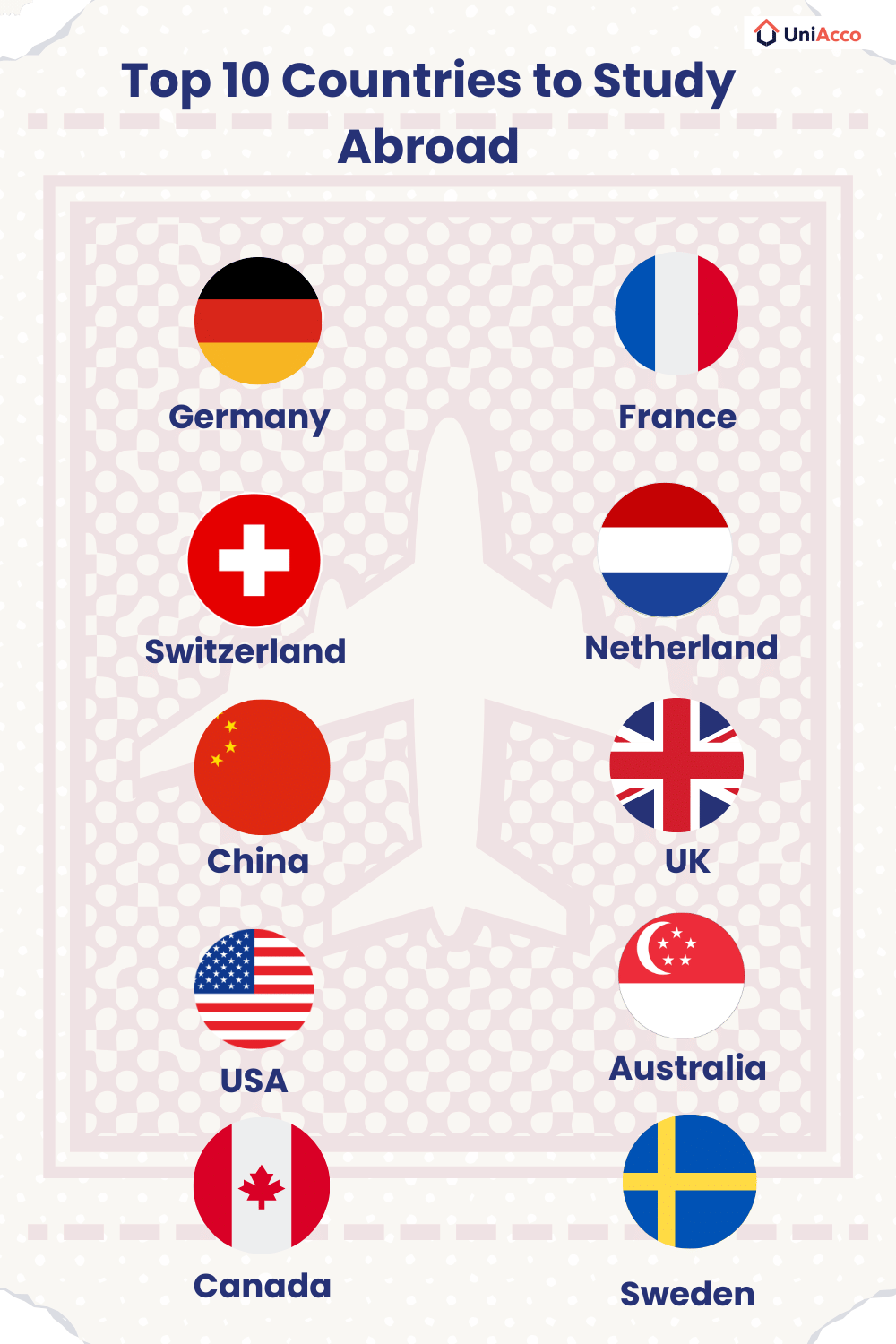
Is you’re instagram is also filled with “day in my life as an international student” reels? If yes, you’re not alone. More than 6 million students have left home to study abroad, according to UNESCO’s data. Students are going to places like Germany, France, Switzerland, the Netherlands, China, the UK, the USA, Australia, Canada, and Sweden for better degrees and bigger career opportunities. With so many great choices, picking the right country can feel overwhelming.
In this blog, we’re breaking down the top 10 best countries to study abroad, what makes each one worth considering, who they’re actually suited for, and the average tuition fees you should expect. So, let’s get into it.
10 Best Countries to Study Abroad Overview:
| Country | Why Students Love It (USPs) | Approx. Annual Tuition Fee |
| Germany | Low or no tuition at public universities | £0 – £3,000 |
| France | Business & fashion capital vibes | £2,500 – £15,000 |
| Switzerland | Top precision engineering, innovation | £500 – £5,000 |
| Netherlands | English-taught degrees in Europe | £6,000 – £18,000 |
| China | Rising rankings, scholarships | £3,000 – £10,000 |
| UK | 1-year master’s, strong global rankings | £12,000 – £30,000 |
| USA | Top-ranked universities, career flexibility | £16,000 – £40,000+ |
| Australia | Work-life balance, strong employability | £11,000 – £25,000 |
| Canada | Diverse programs | £9,000 – £25,000 |
| Sweden | Tuition-free for EU (low for others), innovation focus, work-life balance | £8,000 – £15,000 |
Find student accommodation early in the UK near top universities with UniAcco. Secure the best options with modern amenities, great locations, and student-friendly pricing.
🔍 Explore UK Student HousingTop 10 Countries to Study Abroad
1. Germany
If studying abroad has always been the dream, but the thought of massive student loans or stressing your parents out over money makes you hesitate, don’t give up on it just yet. Germany stands out as one of the top countries to study abroad, and honestly, it’s easy to see why. Over 440,000 international students are already studying there, including more than 34,000 from India. In 2024/25 alone, over 402,000 students enrolled. Plus, these numbers continue to grow. It simply shows that students from around the world trust the education system. And the best part or the biggest advantage is how affordable Germany is for students. In Germany, many big schools don’t ask for much money to study. Some even ask for almost no money. You might only pay about £0 to £3,000 each year, which is much less than in many other countries. While you’re studying, you’re also allowed to do a small job on the side. That way, you can earn some pocket money and learn new skills. When you finish your studies, Germany lets you stay for 18 more months to look for a job. That’s like giving you extra time to find something you really like. There are also 400,000+ job openings for skilled people, especially in fields like engineering, computer science, AI, and automotive. That means there are lots of real jobs waiting, not just promises. That’s why Germany is called one of the best countries to study abroad: it’s affordable, gives you time to find work, and has lots of job opportunities.
Top Universities and Courses Highlights
| Universities in Germany | Best Courses | Avg. Annual Tuition Fee |
| Technical University of Munich | Aerospace Engineering, Mechanical Engineering, Medicine(Clinical Work) | €170–€200 (~£1,500); some master’s €8K–€12K |
| LMU Munich | Medicine, Physics, Humanities | €170 (~£1,200) |
| Heidelberg University | Medicine, Life Sciences, Law | €320 (~£1,400) |
| RWTH Aachen | Engineering, Mechanical, Automotive | €600 (~£1,500) |
| University of Freiburg | Biology, Environmental Science, Forestry | €380 (~£1,300) |
2. France
If “Emily in Paris” put France on your vision board for studying abroad, you are honestly not wrong. France has 444,000 international students. What really makes France one of the best countries to study abroad is its balance of affordability and global reputation. You pay approximately about €2,770 for Bachelor’s programs and €3,770 for Master’s programs. And yes, the lifestyle is exactly what you’re imagining. Did you know that Paris ranks 7th in QS Best Student Cities? It’s because of fashion, luxury management, business, culinary arts, politics, and the humanities. Also, it lowkey feels like you’re stepping onto a runway every time you leave your apartment when in Paris. Plus, your weekend can be either cafe study sessions or art museums, depending on your mood.
Universities and Courses Highlights
| Universities in France | Best Courses | Avg. Annual Tuition Fee |
| Sorbonne University | Humanities, Arts, Literature | €2,770 |
| HEC Paris | Business, Finance, Management | €14,000+ |
| École Polytechnique | Engineering, Mathematics, Physics | €12,000–€15,000 |
| Sciences Po | Political Science, International Relations | €14,000+ |
| Université PSL | Multidisciplinary: Sciences, Humanities, Business | €10,000 |
3. Switzerland
We all know Switzerland is famous for its chocolate, cheese, watches, and stunning scenery. But there is much more to this European country than just great food and beautiful landscapes. Even though it’s small, it is super powerful in education. Their universities offer low tuition fees, with an average cost of between £500 – £5,000. Around 95%+ graduates get jobs, especially in engineering, finance, and pharma. Universities like ETH Zurich are ranked the 7th best university in the world according to QS rankings. Zurich is ranked 9th, and Lausanne is ranked 21st in the QS Best Student Cities list. That means Zurich is the 9th best city in the world for students to live and study in, and Lausanne is the 21st best. So you know that these rankings are given by real students based on things like university quality, job opportunities, student diversity, safety, and overall student life. Another reason it’s one of the best countries to study abroad is that when you study in Switzerland, you get something called a Schengen visa. This basically means you can travel to other countries in Europe like France, Italy, Germany and more, without needing a separate visa for each one. So while you’re studying in Switzerland, you can easily explore a bunch of European countries too.
Universities and Courses Highlights
| Universities in Switzerland | Best Courses | Avg. Annual Tuition Fee |
| ETH Zurich | Engineering, Computer Science, Data Science, Robotics, Architecture | CHF 1,460 (~£1,200) |
| EPFL (École Polytechnique Fédérale de Lausanne) | Artificial Intelligence, Engineering, Life Sciences, Technology | CHF 1,460 (~£1,200) |
| University of Zurich | Business, Economics, Medicine, Law, Finance | CHF 1,500 (~£1,250) |
| University of Geneva | International Relations, Political Science, Law, Development Studies | CHF 1,000 (~£850) |
| University of St. Gallen | Business, Finance, Management, Economics | CHF 3,000–6,000 (~£2,500–£5,000) |
4. Netherlands
In the Netherlands, bikes aren’t just transport, they’re a personality trait. People cycle to uni, to work, to dates, to buy groceries… basically everywhere. You can study in the Netherlands and take your entire degree in English, even though the country’s main language isn’t English. So you don’t need to learn Dutch to start university. Want to know how many international students there are in the Netherlands? Around 122,000 international students study there. This is because their average tuition fees are usually between £6,000 and £18,000 per year, which is often cheaper than in countries like the US or UK. The country also has strong job options in tech and logistics, making it one of the best countries to study abroad. Also, Amsterdam ranks 20th in QS rankings for best student cities, which definitely counts for something. The Netherlands is also home to big international companies like ASML (which makes important computer chips), Philips (healthcare technology), Booking.com, and TomTom.
Universities and Courses Highlights
| Universities in the Netherlands | Best Courses | Avg. Annual Tuition Fee |
| University of Amsterdam | Business, Social Sciences, Humanities | €9,000–€17,000 (~£6,000–£11,000) |
| Delft University of Technology | Engineering, Architecture, Design | €11,000–€20,000 (~£7,500–£13,000) |
| Utrecht University | Life Sciences, Veterinary, Psychology | €9,000–€16,000 (~£6,000–£11,000) |
| Leiden University | Law, Medicine, Archaeology | €10,000–€18,000 (~£7,000–£12,000) |
| Erasmus University Rotterdam | Economics, Business, Public Health | €10,000–€16,000 (~£7,000–£11,000) |
5. China
Technology is everywhere here. With neon-lit skylines and some of the world’s fastest trains, cities like Shanghai feel like you’re living in a sci-fi film, but it’s just normal life there. China is becoming a really popular place in Asia for students who want to study abroad. More than 500,000 international students are already studying in China, so you wouldn’t be alone. Also, Beijing is ranked 13th among the best student cities in the world and Tsinghua University ended up being ranked 20th globally by QS rankings, making it one of the top universities on the planet. China is also growing very fast in Artificial Intelligence, engineering, and business. You have large career opportunities in these fields. You can call China home to major tech companies and gaming giants, including TikTok. Basically, one of the best countries to study abroad because you use apps to pay for meals, get into the library, book classes, and enter your dorms. Around the city, things like smart transport, cashless payments, and AI-powered services are just part of everyday life.
Universities and Courses Highlights
| Universities in China | Best Courses in China |
| Tsinghua University | Engineering, Computer Science, Business |
| Peking University | Law, Economics, Medicine |
| Fudan University | Business, International Studies, Journalism |
| Shanghai Jiao Tong University | Engineering, Medicine, Management |
| Zhejiang University | Engineering, Agriculture, Computer Science |
Check out this Reddit thread where students are ranking the USA, UK, Germany and Australia — hyping Germany’s low tuition and Canada’s vibrant student life.
What’s the best country to study abroad? – r/studyAbroad from r/studyAbroad
6. United Kingdom (UK)
If you’ve ever imagined studying in a castle that looks straight out of Harry Potter while spending weekends at Premier League matches, the UK might already be your answer. But beyond the vibes, the UK is seriously stacked. It has 4 universities in the global top 10, Imperial College London ranked 2nd, Oxford 4th, Cambridge 6th, and UCL 9th. London is also ranked the 3rd best student city in the world. That combination of elite universities and a top-ranked city is a big reason why the UK consistently ranks as one of the best countries to study abroad.
Tuition fees range from £12,000 – £30,000, but here’s the smart part: most Master’s degrees take just 1 year, and Bachelor’s degrees are typically 3 years. That means you graduate faster and enter the job market sooner. You can call the UK a global leader in business, medicine, research, and law, which means your degree carries serious international weight. Employers value UK graduates for their strong English communication skills, creative thinking, problem-solving abilities, and leadership mindset. And yes, student life isn’t boring either with 800+ music festivals, historic landmarks, and a strong sports culture; there’s always something happening outside the classroom.
Universities and Courses Highlights
| Universities in the UK | Best Courses | Avg. Annual Tuition Fee |
| Imperial College London | Engineering, Medicine, Physics | £35,000–£50,000 |
| University of Oxford | Humanities, Law, Sciences | £28,000–£45,000 |
| University of Cambridge | Mathematics, Economics, Engineering | £30,000–£48,000 |
| UCL (University College London) | Medicine, Architecture, Social Sciences | £32,000–£46,000 |
| University of Edinburgh | Computer Science, Medicine, Law | £25,000–£40,000 |
7. United States of America (USA)
If you picture university life as something out of a TV show, like Serena van der Woodsen heading to Columbia or Blair at NYU, surrounded by stylish outfits, Manhattan campuses, library drama, and ambitious friends, then the US really does have that vibe. USA is considered one of the largest study destinations because it has about 1.18 million international students. Honestly, it is expensive, but for a reason. Their average tuition fees are between £16,000 and £40,000 or more. The country is one of the top places in the world for industries like technology, money and banking, medicine, artificial intelligence, and starting new businesses. That’s why it’s such a popular place to study abroad. Also, US universities often offer more financial aid to students than many other countries do.
Universities and Courses Highlights
| Universities in the UK | Best Courses | Avg. Annual Tuition Fee |
| Imperial College London | Engineering, Medicine, Physics | £35,000–£50,000 |
| University of Oxford | Humanities, Law, Sciences | £28,000–£45,000 |
| University of Cambridge | Mathematics, Economics, Engineering | £30,000–£48,000 |
| UCL (University College London) | Medicine, Architecture, Social Sciences | £32,000–£46,000 |
| University of Edinburgh | Computer Science, Medicine, Law | £25,000–£40,000 |
8. Australia
“Australia gave us Thor,” even though technically, it gave us Chris Hemsworth. But yeah, you get it. Australian campuses are super diverse, so pretty much everyone is new in some way. It’s easy to find your people. Australia had 821,555 international students in 2024. Plus, cities like Melbourne rank 5th and Sydney 6th among the best student cities in the world. So you won’t feel like “the only international student” there or feel lonely at all. One reason it is one of the best countries to study abroad is that it offers post-study work rights of up to 4 years for eligible graduates. That gives you real time to build work experience and potentially move toward PR. Your Australian degrees are recognised globally. On top of that, there are plenty of scholarships available for international students that can seriously reduce the overall cost.
Universities and Courses Highlights
| Universities in Australia | Best Courses | Avg. Annual Tuition Fee |
| University of Melbourne | Medicine, Law, Business | AUD 45,000–55,000 (~£23,000–£28,000) |
| University of Sydney | Engineering, Arts, Health Sciences | AUD 44,000–52,000 (~£22,000–£27,000) |
| UNSW Sydney | Engineering, Computer Science, Business | AUD 46,000–54,000 (~£23,000–£28,000) |
| University of Queensland | Agriculture, Biotechnology, Mining | AUD 42,000–50,000 (~£21,000–£26,000) |
| Monash University | Pharmacy, Business, Engineering | AUD 43,000–51,000 (~£22,000–£26,000) |
9. Canada
In Canada, ice hockey is more than just a sport; it’s a big part of the culture. It’s similar to how football is in the UK or cricket in India. Universities generally have their own teams to play this sport. So if you don’t play, you can still watch these games and enjoy a live match of this beautiful sport. But Canada isn’t just about sports and vibes. It hosts 1 million+ international students, making it one of the most trusted study destinations globally. Cities like Toronto and Montreal rank in the QS Top 20 student cities, which means strong universities, job opportunities, and quality of life.
Tuition fees usually range from £9,000 to £25,000 per year, which is more affordable than the US in many cases. You can also work part-time while studying, helping you earn and gain real-world experience. Yes, visa rules have recently become stricter, but Canada still offers strong post-graduation work pathways, especially for students in healthcare, STEM, and skilled trades, where demand is high. Many graduates stay back to work and even apply for permanent residency.
Universities and Courses Highlights
| Universities in Canada | Best Courses | Avg. Annual Tuition Fee |
| University of Toronto | Business, Computer Science, Medicine | CAD 45,000–60,000 (~£25,000–£33,000) |
| University of British Columbia | Engineering, Environmental Science, Business | CAD 42,000–58,000 (~£23,000–£32,000) |
| McGill University | Law, Medicine, Arts | CAD 40,000–55,000 (~£22,000–£30,000) |
| University of Waterloo | Computer Science, Engineering, Mathematics | CAD 44,000–62,000 (~£24,000–£34,000) |
| University of Alberta | Energy Engineering, Public Health, Agriculture | CAD 30,000–45,000 (~£16,000–£25,000) |
10. Sweden
Sweden is a cold country with snow, cute cafes, and very neat, simple homes. If you like calm, clean, cosy places, Sweden might feel really nice to you. But Sweden is not just pretty. It’s also very smart. The country is really good at making new ideas, especially things that help the planet, like clean energy. That’s what people mean when they say “innovation and sustainability.”
If you want to study there, school costs about £8,000–£15,000 each year, which is normal compared to many other big countries. The main city, Stockholm, is ranked #24 as one of the best cities in the world for students. That means students like living and studying there. Big schools like Karolinska are very famous for medicine and science. More than 50,000 students from other countries study in Sweden. So you’ll meet people from many places, but it won’t feel too crowded. Sweden also created big brands like IKEA, Spotify, and H&M. That shows the country is very good at business, tech, fashion, and new ideas. After you finish your studies, Sweden gives you one whole year (12 months) to stay and find a job. That’s helpful. And guess what? Sweden is often called one of the happiest countries in the world because people have a good balance between work and life. They work hard, but they also rest and enjoy life.
Universities and Courses Highlights
| Universities in Sweden | Best Courses | Avg. Annual Tuition Fee |
| Karolinska Institute | Medicine, Biomedicine, Public Health | SEK 90,000–150,000 (~£6,500–£11,000) |
| Lund University | Engineering, Economics, Environmental Science | SEK 100,000–140,000 (~£7,200–£10,000) |
| Uppsala University | Pharmacy, Law, Game Design | SEK 90,000–130,000 (~£6,500–£9,500) |
| KTH Royal Institute of Technology | Engineering, Computer Science, Architecture | SEK 120,000–160,000 (~£8,700–£11,500) |
| Stockholm University | Social Sciences, Environmental Studies, Business | SEK 90,000–120,000 (~£6,500–£8,700) |
Let UniAcco lock in safe, student-friendly housing near Sweden’s top universities so you can settle fast and stress less.
🔍 Explore Sweden Student HousingTips to Choose the Right Country for Studying Abroad
Okay, let’s pause the aesthetic reels for a second. This decision isn’t just about vibes; it’s about your future salary, lifestyle, immigration plans, and how you actually want your 20s to look.
- Choose Shorter Programs If You Want to Start Working Sooner
If you want to finish your studies quickly and start working soon, consider countries like the UK. There, bachelor’s degrees usually take 3 years and master’s degrees often just 1 year. This means you spend less on tuition and living costs and can start earning sooner.
- Check Post-Study Work & PR Pathways Before You Apply
If you want to settle in another country after your studies, check the immigration options carefully. Australia and Canada, for example, have clear post-study work programs. You usually get time after graduation to gain local work experience, but make sure to check the latest visa rules before you decide.
- Compare Tuition Fees If Budget Is a Priority
If keeping costs low is most important to you, look for countries with cheaper tuition. In Germany, many public universities charge little or no tuition. France also offers affordable public education, especially for arts and humanities courses. Remember to factor in living expenses as well.
- Pick Countries Strong in Your Target Industry
If you want to work in areas like AI, technology, sustainability, or innovation, pick countries with strong industries in these fields. The USA, Germany, and Sweden are known for research, startups, and tech opportunities.
Let UniAcco handle the housing hunt. Find verified student homes near top universities and focus on your glow-up—not rent stress.
🔍 Explore Student HousingWrapping Up!
Choosing where to study abroad isn’t just about picking a country. It’s about choosing your next version. Whether you’re chasing low tuition, big innovation hubs, globally ranked universities, PR pathways or just a better quality of life, we get it. It’s a huge decision. And yes, it can feel overwhelming. But you don’t have to figure it all out alone. Once you’ve picked your country, let UniAcco handle the next big stress of housing. Get tailored student accommodation picks in just 20 seconds with UniAcco and move one step closer to your study abroad era.












0 Comments