
It’s been a generational conditioning to dream of studying in English-speaking countries like the United States, United Kingdom, Canada, or Australia. But a dream like that often comes with a big price tag in the form of tuition fees and an overall cost of living. However, in today’s times, this dream is not limited to a select few affluent families, thanks to countries with free education for international students, where world-class education is a possibility without a lifetime of financial loans.
While evaluating countries with free education for international students, it is vital to remember that ‘tuition-free’ or ‘zero-tuition’ does not mean that your entire expense will cost zero pounds or euros. International students still need to account for their day-to-day budget, mandatory health insurance, student visa application fees, and personal upkeep. In this blog, we break down the top tuition-free countries, examine their mechanics of zero-tuition admissions, compare the cost of living, and share some practical strategies to gain a world-class degree with an affordable budget.
Study Abroad for Free: At a Glance
While some nations belong to the category of ‘tuition-free countries,’ their entry requirements, language expectations, and basic cost of living vary considerably. When evaluating this list of countries with free education, analysing the total annual budget is crucial. The table below gives you a quick glance for international students evaluating tuition-free countries for the 2026-2027 academic cycle.
| Country | Tuition Fees | Annual Living Costs | Key Highlights/ Why Study |
| Germany | €0 (Free at public universities.€1,500/semester in Baden-Württemberg) | €11,500 – €13,500 | Complete tuition-free across 15 of the 16 federal states.Nominal semester fee of €150 – €350.Multiple English-taught PG programs. |
| Austria | approx €1,453/year + €25.20 student union fee | €11,000 – €13,000 | Nominal fees for international students. Globally known music, humanities, and engineering faculty.Exceptionally good quality of life. |
| Czech Republic | €0 for degree programmes taught in Czech; €2,000 – €8,000/year for English | €7,500 – €9,500 | Full tuition-free if you study in the Czech language at state universitiesHighly affordable cost of living in Central Europe. |
| Iceland | €0 tuition;ISK 75,000 annual registration fee (approx €500) | €14,000 – €18,000 | Regardless of nationality, public universities charge zero tuition fees.High-tech speciality research hubsHigher cost of living. |
| Finland | €0 for Finnish or Swedish taught courses;€4,000 – €18,000/year for English | €9,500 – €12,000 | Tuition-free for local language instruction and all PhD programmes. Merit-based scholarships available for English tracks. |
| Luxembourg | approx €200 – €400/semester;Only administrative registration fee | €14,000 – €17,000 | Virtually tuition-free public higher education. Trilingual culture (French, English, German).European financial hub. |
| Greece | €0 for public UG degrees under constitutional protection | €7,000 – €9,000 | Public universities are constitutionally forbidden from charging tuition for UG degrees. Affordable cost of living. |
| France | approx €170 – €380/year or low differential fees | €9,500 – €12,500 | Heavily state-subsidised higher education.International students qualify for CAF – state housing grants.Academic heritage. |
Can International Students Really Study Abroad for Free?
Short answer — Yes, provided you understand the mechanics behind free education. In order to prevent yourself from financial surprises later down the road, understanding how countries with free education for international students structure their academic funding is important. Students and their families usually fall into 2 traps. One, assuming everything from housing to food is funded by the state. Two, suspecting the offer is too good to be true. However, the key lies in national economic planning. Let’s understand this in detail.
What Does “Free Education” Actually Mean?
In the global higher education landscape, ‘free education’ specifically refers to the waiver of direct tuition fees for lectures, lab access, and exams. In nations like Germany or Iceland, state governments fund university budgets through dental taxation, as maintaining top-level academic heritage requires innovation in technology, research, and industrial vitality. But state universities do collect mandatory semester administrative contributions like Semesterbeitrag in German-speaking Europe. These range from €150 to €400 per term, and they directly fund student welfare services, campus facilities, student unions, and public transit tickets for students.
Who Qualifies For Tuition-Free Education?
Qualification criteria depend on 3 factors:
- Nationality & Residency
Citizens of EU and EEA member states avail tuition-free higher education in almost all European public universities. Non EU/EEA international students qualify for 100% tuition-free education at public universities in Germany, Iceland, Luxembourg, and Greece.
- Language Proficiency
Provided that students enrol in a program taught in the host nation’s official language, most nations extend free public higher education to all international students irrespective of their citizenship. For example, the Czech Republic charges €0 tuition for programs taught in Czech, and similarly for Finland.
- Academic Entry Standards
Public universities that charge zero tuition fees maintain strict admission requirements. Applicants are expected to demonstrate strong academic records, course prerequisites, and verified language certificates like IELTS/TOEFL for English, TestDa/Goethe-Zertifikat for German, and CEFR B2/C1 for Czech.
What expenses do students still need to pay?
- Accommodation and Utilities: Housing is the highest cost that students have to incur, depending on the city. Private shared apartments or student halls of residence range between €300 and €900 monthly.
- Health and Accident Insurance: It is mandatory for international students to hold approved health insurance as per the European immigration policy. For instance, in Germany, public health insurance for students roughly costs between €120 to €130 per month.
- Visa and Residency Documentation: Student visa processing fees are mandatory and range between €75 and €250, along with minimum annual residence permit renewal charges.
- Proof of Financial Means: To secure a visa in zero-tuition countries, students must prove they possess adequate funds for their cost of living. For example, Germany requires depositing €11,904 into a secure blocked account.
- Course Materials and Supplies: Academic requirements like books, specialised software, lab equipment, etc may require an additional €200 to €500 per year.
Even if your tuition is free, accommodation doesn’t have to stretch your budget. Explore verified and affordable student accommodation in the UK with UniAcco, featuring fully furnished rooms, modern amenities, and all-inclusive bills to help you manage your student expenses with ease.
Explore Student Accommodation in the UKList of Countries with Free Education for International Students
Germany
Germany has consistently been the leading destination among the other countries with free education for international students because of its massive public university network. From 2014 onwards, all of the 16 German federal states eliminated tuition charges for UG programmes at public universities. Living expenses across Germany are also moderate as compared to Scandinavian or UK benchmarks. Cities like Leipzig, Essen, and Dresden are more affordable compared to Munich or Frankfurt.
| Cost of Living | Popular Universities | Scholarship Opportunities | Key Highlights |
| €900 to €1150 per month | TUM: Technical University of MunichLMU: Ludwig-Maximilians-Universität München Heidelberg University Humboldt University of BerlinRWTH Aachen University | Competitive grants from DAADDeutschlandstipendium (€300/month)Heinrich Böll Foundation | Germany combines tuition-free education with Europe’s largest industrial economy.An 18-month post-study work visa allows graduates to work in the fields of engineering, technology, finance, and research. |
Austria
Austria offers free tuition for EU/EEA nationals, while Indian and other non-EU students on a student residence permit pay tuition of only €726.72 per semester. Austria is a comparatively affordable German-speaking destination, with living costs 30-40% lower than Switzerland. Along with a national student union fee of €25.20, the total amount comes to about €1,503 per academic year.
| Cost of Living | Popular Universities | Scholarship Opportunities | Key Highlights |
| €950 to €1200 per month | University of ViennaVienna University of TechnologyUniversity of InnsbruckGraz University of Technology | Ernst Mach Grant Austrian Federal Ministry of Education GrantsRegional research funding packages | Exceptional public safetyClean infrastructure and top-ranked research hubsEasy travel, as it is located in Central Europe.Post-study residence visa pathway offers strong career transition opportunities. |
Czech Republic
The Czech Republic is one of the top countries with free education, where the tuition-free policy applies specifically to programs taught in the local language. You are required to demonstrate Czech language proficiency at B2 level or above for admission. If you prefer to study in English, Czech public universities do offer English-taught programs, but charge tuition fees. If you choose an English-taught degree, tuition fees range from €2,000 to €8,000 per year depending on the faculty.
| Cost of Living | Popular Universities | Scholarship Opportunities | Key Highlights |
| €650 to €850 per month | Charles University (Prague)Czech Technical University in PragueMasaryk University (Brno)Brno University of Technology | Czech Government Scholarships for Developing NationsSouth Moravian Centre for International Mobility GrantsUniversity merit awards | Historic university towns like Prague and Brno have a vibrant international student community.Expanding technology sectors are offering part-time work during studies. |
Iceland
Higher education in state-run universities is tuition-free for Icelandic and international students. However, you have to pay a registration fee of ISK 75,000 (€500) to cover administrative costs. Iceland also has many English-taught programs, making it easy for Indian students.
| Cost of Living | Popular Universities | Scholarship Opportunities | Key Highlights |
| €1,200 to €1,500 per month | University of IcelandReykjavik UniversityUniversity of Akureyri | Target scholarships are provided by the Icelandic Ministry of Higher Education for international students pursuing Icelandic language, literature, and environmental research | Iceland is known for specialist programs in renewable energy, environmental science, and marine biology. |
Finland
Finland’s tuition fee-free policy depends entirely on the language of instruction. Public universities in Finland charge no tuition fees for programs taught in Finnish or Swedish. Public universities charge €0 tuition for international students enrolled in degree programmes taught in Swedish or Finnish. English-taught UG and PG degrees charge international applicants between €4,000 and €18,000 per year. PhD (doctoral) degrees remain 100% free of tuition for all nationalities.
| Cost of Living | Popular Universities | Scholarship Opportunities | Key Highlights |
| €800 to €1,050 per month | University of Helsinki Aalto UniversityTampere UniversityUniversity of Oulu | National Finland Scholarships with 50% to 100% tuition coverage | Consistently ranked as one of the world’s happiest nations. Advanced laboratory facilities. High social trust. 2-year post-work visa for international graduates. |
Luxembourg
Luxembourg offers tuition-free education to all its students from around the world. It charges only an amount of up to €400 per semester. Students who are eligible for state grants may have access to free higher education at several other universities. Due to its strong economy, Luxembourg is an ideal country to study finance, business, and technology.
| Cost of Living | Popular Universities | Scholarship Opportunities | Key Highlights |
| €1,200 to €1,500 per month | University of LuxembourgEuropean Business UniversityUnited Business Institute | Luxembourg State Higher Education Grants (AIDEFiFi)University of Luxembourg Excellence AwardsErasmus+ Mobility Funds | Luxembourg hosts a number of EU institutions and multinational corporate headquarters It offers direct career paths in European Law, International Finance, and Data Science. |
Greece
As mandated under Article 16 of the Hellenic Constitution, all education is free in Greece at State Public Universities. Public universities charge no tuition fees, but you may have to pay around INR 1.5 lakhs per year in private universities like Hellenic Open University. Greece has one of the lowest living costs in Southern Europe, making it super affordable for international students.
| Cost of Living | Popular Universities | Scholarship Opportunities | Key Highlights |
| €600 to €800 per month | National and Kapodistrian University of AthensAristotle University of ThessalonikiNational Technical University of Athens | IKY (Greek State Scholarships Foundation) scholarships, Erasmus+ Mobility Grants, university-specific merit scholarships | One of the most affordable study destinations in Western Europe. Renowned for its rich history, culture, and excellence in humanities, archaeology, and classical studies. Increasing number of English-taught postgraduate programmes, particularly in Athens and Thessaloniki. |
France
France offers heavily subsidised state public higher education. Many of the French public universities waive the differential charges for international students, which enables them to pay a standard domestic rate of approximately €170 per year for UG degrees and €243 per year for PG degrees. Additionally, the French government’s CAF program provides housing allowances that students can reimburse for up to 30%-40% of their monthly rent.
| Cost of Living | Popular Universities | Scholarship Opportunities | Key Highlights |
| €750 to €950 per month | Sorbonne University Université Paris-SaclayÉcole Polytechnique University of Strasbourg | The Eiffel Excellence Scholarship Program and French Embassy grants offer funding packages that cover living stipends, flights, and health insurance. | Low university costs, public housing subsidies, high research output, and a post-study work visa makes it highly viable to study in France. |
Cost of Living Comparison in tuition-free countries
While public universities in tuition-free countries cover tuition costs, living costs require in-depth planning. Housing remains the single largest expense in every country. The table below offers an estimated monthly living budget breakdown across countries with free education for international students.
| Country | Accommodation | Food Cost | Transport | Estimated Monthly COL |
| Germany | €350 – €650 | €200 – €300 | Included in the mandatory semester fee | €900 – €1,150 |
| Austria | €380 – €600 | €220 – €320 | €30 – €50 | €950 – €1,200 |
| Czech Republic | €220 – €420 | €150 – €230 | €15 – €25 | €650 – €850 |
| Iceland | €650 – €950 | €350 – €480 | €50 – €75 | €1,200 – €1,500 |
| Finland | €350 – €580 | €220 – €320 | €35 – €55 | €800 – €1,050 |
| Luxembourg | €650 – €950 | €300 – €400 | €0 (free throughout the nation) | €1,200 – €1,500 |
| Greece | €250 – €450 | €180 – €260 | €20 – €35 | €600 – €800 |
| France (Excluding Paris) | €300 – €550 | €200 – €300 | €30 – €50 | €750 – €950 |
Found a country that fits your budget? Make sure your accommodation does too. Explore affordable and verified student accommodation in Germany with UniAcco, featuring fully furnished rooms, modern amenities, and all-inclusive bills to help you manage your student expenses with ease.
Explore Student Accommodation in GermanyBest Free-Education Countries for Indian Students
For Indian candidates reviewing the list of countries with free education, it is important to match personal career goals with host country policies. Some of the key factors to decide which country provides free education for international students include — work visa terms, English-taught programmes, and document verification requirements like the APS certificate.
| Goal | Best Country |
| Lowest Overall Cost | Czech Republic / Greece |
| Best Career Opportunities | Germany |
| Best Engineering Education | Germany |
| Best Research Opportunities | Finland / Austria |
| Best English-Taught Programs | Germany / Iceland |
| Best Overall Value | Germany |
Tips for Studying Abroad Without Paying High Tuition Fees
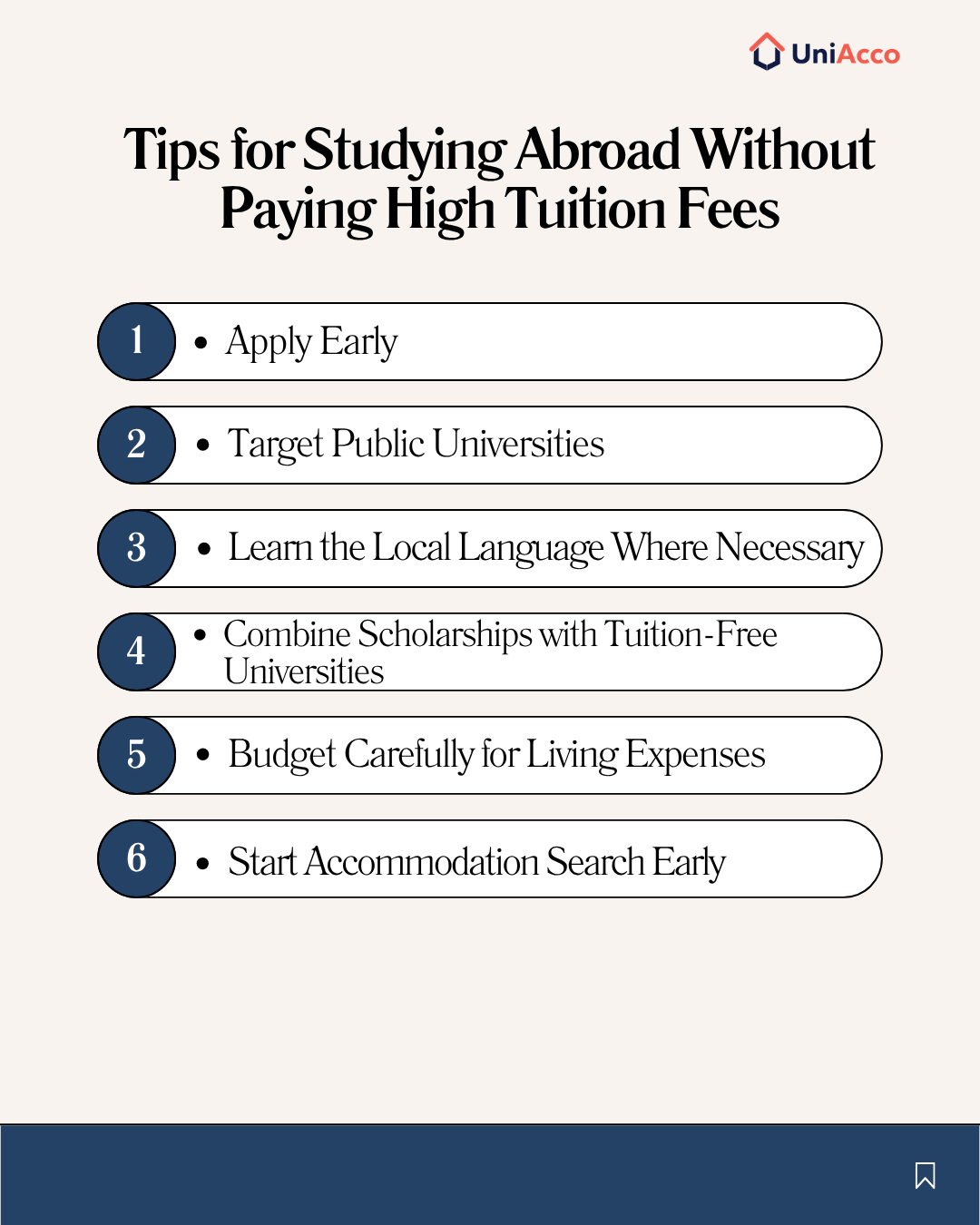
Apply Early
Public universities with zero-tuition receive high volumes of international applications. Submitting your application early provides enough time for evaluators to screen your profile.
Target Public Universities
Be sure that you are applying to state-funded public universities. Private universities located within zero-tuition countries charge substantial tuition fees. Refer to the official government education portals to verify institutional status.
Learn the Local Language Where Necessary
Even though your degree programme may be delivered in English, if you learn the native language like German or Czech, it unlocks some strategic advantages like — gives access to a wider selection of fully tuition-free UG and PG degrees, expands part-time employment opportunities, and boosts your employability post-study.
Combine Scholarships with Tuition-Free Universities
If you add a scholarship to your kitty, it’s like a cherry on the cake! Pair zero-tuition public universities with competitive living-stipend grants like Erasmus+, DAAD grants, Heinrich Böll & Konrad Adenauer Foundations.
Budget Carefully for Living Expenses
Make sure you have enough liquid capital to cover blocked bank account deposits, visa applications, flight bookings, and rental security deposits. Remember that zero-tuition does not eliminate your living costs.
Start Accommodation Search Early
Popular European universities in Munich, Heidelberg, Vienna, or Prague often face housing shortages because of the large number of international entrants. Start looking out for accommodations as soon as you receive your acceptance letter.
Now that you know how to study abroad without paying high tuition fees, let UniAcco help you with the next step. From shortlisting verified accommodation to move-in day, our team offers personalised, round-the-clock support to help you find student housing in the USA that suits your needs and budget.
Explore Student Housing in the USAConclusion
To wrap up, studying abroad doesn’t have to mean taking on overwhelming student debt. While countries like Germany, France, and other tuition-friendly destinations offer international students the opportunity to study with little or no tuition fees, careful planning is still essential. Before applying for the 2026–2027 intake, ensure your degree meets ECTS requirements, start document verification early, budget beyond the minimum living costs, and understand post-study work visa options. Pairing tuition-free education with scholarships, part-time work, and smart financial planning can help you earn a globally recognised degree while keeping your overall study abroad costs under control.


 LinkedIn









0 Comments