

Every student dreams of studying internationally at their chosen university, but sometimes a course may not fit their interests, or due to personal reasons, you have to move universities. This is a new thing for most students, because usually such circumstances arise very rarely. But if you’re looking to know how to transfer universities in the UK and need to know what documents are needed and the necessary requirements, continue reading this blog.
Can You Transfer Universities in the UK?
- Transfer eligibility
If you’re wondering how to transfer universities in the UK, it all depends on your eligibility. These are mostly requirements that will be very obviously needed by your next university. Which is your academic performance to date, similarities between your current and target course and availability at your chosen university. You will mostly need A-levels and your university grades, and you should showcase your completed modules aligned closely enough to justify credit transfer or advanced entry.
- University acceptance
First, you need to find out whether the university you want to transfer to even accepts transfer students. We recommend you directly check with the admissions committee before proceeding further. Some institutions may consider you via a Record of Prior Acceptance (RPA) without needing you to fill out a full UCAS application, while others will ask you to apply from scratch. Competitive courses like Medicine, Dentistry, or Veterinary Science rarely accept mid-degree transfers at all.
- Transfer timing
Timing is extremely crucial when it comes to the decision about moving universities. They only consider transfers at the start of the new academic year. If you’re in your first year, you will be qualified as a ‘false start’ and will compete with other new applicants. Most universities recommend transferring at the end of year one, and close to the start of year 2 of a similar course. However, even this happening is quite uncommon.
- Year of entry
Most students transferring universities in the UK enter either Year 1 or Year 2. Advanced entry into Year 2 (or occasionally Year 3) is possible if your previous curriculum closely matches the new course’s modules and you’ve earned enough credits to skip the first year. However, many students end up restarting in Year 1, especially if module content doesn’t align closely enough for credit transfer.
- Credit transfer
This completely depends on each university. Your credits from the past course – modules and transcripts play an important role. The university will assess your case and match your credits against their own curriculum, and then decide how many credits can be carried over (if any). Even with similar courses, you might still be asked to start over from Year 1, so it’s crucial to ask explicitly about the university transfer process when it comes to credits early in the process and take your financial and academic planning into consideration.
How to Transfer Universities in the UK
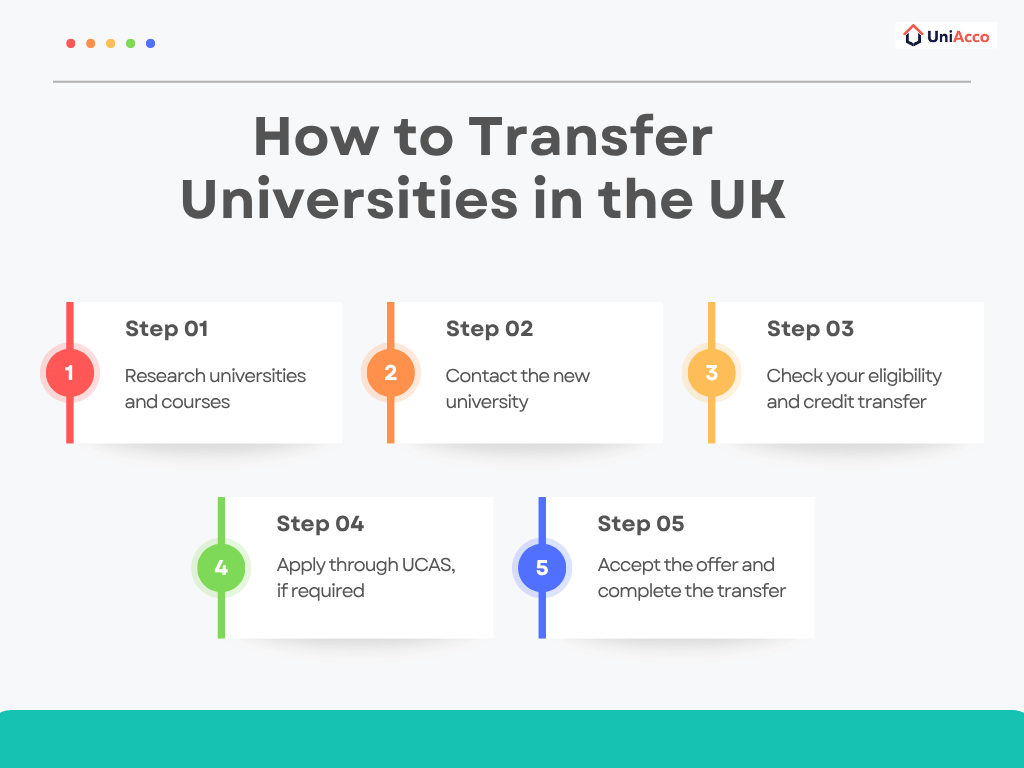
Step 1: Research universities and courses
Search for the universities and courses with the help of keywords, just the way you would do it if you were starting over. Also look for terms such as “advanced entry”, “credit transfer”, or “transfers” on course pages.
Step 2: Contact the new university
Search for the university’s official email address on their website and send them the following information:
- Your full name and current course details
- The course you’re interested in
- Your academic history (A-levels and university grades)
- Completed module information
Step 3: Check your eligibility and credit transfer
You can ask the university to send you a list of self-assessments you can take to determine if you qualify for that course or credits. Some universities use Accreditation of Prior Learning (APL) forms to evaluate this.
Step 4: Apply through UCAS, if required
Most UK university transfer processes go through UCAS. For that, you’ll need:
- A personal statement explaining why you’re transferring.
- Full education history (A-levels and university).
- References and transcripts.
Deadlines are typically in mid-January for most courses, and 15 October for Oxbridge, Medicine, Dentistry or Veterinary Science. Since the exact January date shifts each cycle slightly, always confirm the current deadline on UCAS’s website before applying.
Step 5: Accept the offer and complete the transfer
Once you’ve got an offer:
- Formally withdraw from your current course
- Inform Student Finance of your change
- Sort out accommodation and complete enrolment at the new university.
Transferring university feels overwhelming? Read this Reddit thread to learn how other students transferred universities and get some real tips.
How does transferring to other universities work? – r/UniUK
Things to Check Before Transferring
- Entry requirements
Check both the standard entry criteria (A-levels, IB, etc.) and any subject-specific prerequisites. If your grades or requirements are not up to the mark, speak to admissions – they may still consider you depending on your university performance.
- Available places
Certain popular courses will fill up faster, and even most other courses – especially after the UCAS deadline. We recommend emailing admissions to know if there’s space before you invest time in an application.
- Course/module compatibility
The easiest way to get a transfer is if your current course and your target course are very similar. This can lead to an advanced entry. You can always strengthen your case by pulling up your module and syllabus to support your transfer.
- Credit transfer
Be straightforward with them, state your case and ask how many credits will be transferred and whether you will be allowed a Year 2 entry. Be prepared for the possibility of starting again, and factor that into your financial planning.
- Year of entry
Make sure to confirm your point of entry on your UCAS form. If you’re restarting in Year 1, leave the “point of entry” section blank. For Year 2, enter “2” – but only if the university has agreed to consider you for advanced standing.
No matter which university you transfer to, UniAcco helps you find student accommodation that suits your new plans. Explore verified student housing across the UK and choose a fully furnished room with all-inclusive bills for a comfortable and hassle-free stay.
🔍 Explore UK Student HousingCan You Transfer Directly Into the 2nd or 3rd Year?
- Credit transfer
Credits are what you keep collecting throughout your university time. When you opt for a transfer, the university you want to get to will assess your transcripts and modules and check your credits. As credits lay the foundation of any advanced entry, the higher the number of them, the more likely you are to enter year 2. If not, you may have to repeat the first year altogether.
- Advanced entry
Advanced entry is when you jump ship from year 1 to year 2. And sometimes even into year 3. Not all universities can offer this, but those that do usually restrict it to specific courses with clear module mapping. For this, you will have to be academically strong with great results, and your learning needs to match the curriculum you’ve left to enter the new one in order to justify your transfer.
- Year 1 entry
Don’t be surprised if you applied for a Year 2 transfer and get a Year 1 seat. This can happen when the module content doesn’t align closely enough, or when the university doesn’t have the space for advanced entry. Restarting Year 1 can add the burden of extra expenses, so it’s worth asking upfront what point of entry you’re likely to be considered for.
- Module compatibility
This is the most obvious of the checklist. Your module has to match to be considered for an advanced entry. The admissions committee will review your application, as well as your credits and the strength you possess academically and then make a decision. The more overlap – in content, learning outcomes, and assessment style – the stronger your case for skipping Year 1. Collect your module handbooks or detailed syllabi to aid your application.
- University decision
Ultimately, the decision rests with the university. Even if your credits look transferable on paper, admissions teams have final say on whether to accept you into Year 2 or ask you to start from Year 1. That’s why it’s so important to contact them early, share your academic history, and get a clear sense of your chances before submitting a formal application.
Just like your interests, your accommodation preferences can be different too. UniAcco offers student housing across various price ranges, so you can compare properties in London and choose a verified home that fits your budget, lifestyle, and needs.
🔍 Explore Student Housing in LondonUK Student Visa Requirements When Changing Universities
- Student visa implications
You have entered the UK through a student visa, which very clearly has your university mentioned on it. Changing universities will affect your visa status. Once you withdraw, your university may report this to the Home Office, which could lead to your visa being cut short. You will have to move quickly to make sure your visa is updated with the next university to maintain your legal right to stay and study in the UK.
- New university sponsorship
Your new university must be a licensed Student visa sponsor and agree to take you on as a transfer student. Before you apply, confirm they’re willing to sponsor your visa – not all institutions will do this for mid-course transfers. Once you’ve accepted an offer, they’ll begin the process of issuing your new sponsorship documentation.
- CAS requirements
A Confirmation of Acceptance for Studies (CAS) is crucial for you to land a student visa from your new university. This is a unique reference number that confirms your offer and is essential for your stay in the UK. You can’t apply for a visa without it as you will need the number, so don’t back out of your current course until you’re confident the new university will issue a CAS.
- When a new visa application may be needed
As your visa has all of the updated information that informs the officials about you, you will need to apply for a new UK student visa. This is because your visa is linked to your original sponsor/university, and switching institutions requires a new CAS and updated sponsorship details. You can usually apply from within the UK, but you must wait for approval before starting classes at your new university.
Costs of Transferring Universities
- Tuition fees
If your credits or modules aren’t up to par, your transfer university will ask you to repeat year 1, which means paying the fees and living expenses for an additional year, adding to the total tuition fees.
- Additional year of study
Student Finance England is known to fund the length of your chosen course plus one extra year. But if you’ve already used that “plus one” year, you may have to self-fund.
- Accommodation costs
If you end a hall contract or move out of your student accommodation before the contract ends, you may still be liable to pay for the rent unless you find a replacement tenant. Consider budgeting for moving into your new accommodation and expenses that may flow with it.
- Student finance implications
- Transferring to another university during the same academic year does not necessarily end your student finance entitlement, but the Tuition Fee Loan may be divided between your previous and new university depending on when you transfer.
- Starting a new course after Year 1 may reduce your entitlement.
- Always inform your student finance body as soon as possible.
Common Reasons Students Transfer Universities
- Course dissatisfaction
The course at your current university may not be what it was advertised as; course dissatisfaction is completely normal and fair. If you find a better course at a different university, you can apply for a transfer.
- Better academic opportunities
Not every course will be the same. Connections linked with universities are also a reason most students may apply for a transfer. Some companies – the ones you were eyeing- may be linked to another university, or the course over there will lead to a higher-ranked department.
- Location or personal circumstances
Homesickness, the need to cut down on travel or any other personal reasons are also reasons to move universities.
- Course/university mismatch
After spending a considerable amount of time, you may not find the culture or environment to your liking to continue for the rest of 2 years.
Conclusion
If you’re looking for answers on how to transfer universities in the UK, then this article should make things clear for you. There are a few foundational reasons, and once you have your basics all in place—such as your module match, credits strong enough and being academically brilliant—you can move up to year 2 without putting in the extra money. It all comes down to the student’s choice and what they want to pursue in the long run, and if transferring universities is the answer for you, then so be it.
Looking for the right accommodation near your new university? UniAcco’s experts are here to assist you in finding a suitable student home and make your booking journey faster, easier, and hassle-free.
🔍 Connect with UniAcco Experts

 LinkedIn









0 Comments