

Hello tech enthusiasts. Here’s some good news. By August 2026, the EU’s AI Act will take full effect. What does this mean? The AI Act is the first-ever legal framework on AI that addresses AI risks and positions Europe to play a leading role globally. For example, it is currently not possible to determine why an AI system made a particular decision or took a specific action. So, it may be difficult to assess whether someone has been unfairly disadvantaged, for example, in a hiring decision or in a plagiarism case.
Because of this, the demand for tech-literate lawyers who understand the objective has skyrocketed. Here’s data to prove it. The global legal services market reached USD 1.17 trillion in 2026, with a projected steady 5% year-on-year growth. Simply put, there is a big bag waiting to be picked. If you want to bypass the gatekeepers and get an entry into the multinational firms, a standard degree isn’t going to help. Attending a top-tier law school is your ultimate hack.
In this blog, we’ve done an in-depth analysis of the 10 best law schools in the world for international students. We’re breaking down the latest 2026 rankings, tuition fees, unique selling propositions (USPs), and the rigorous admission requirements.
Top Law Schools Across The Globe: Quick Comparison
Spoiler alert. Harvard University is still the best amongst them all. In both 2025 and 2026, they were ranked #1 in the QS rankings, with an overall score of 99.
| School | Country | QS Ranking (2026) | Types of Programs Offered | Average Tuition Fees | USPs |
| Harvard University | USA | 1 | Juris Doctor (JD), Master of Laws (LLM), Doctor of Juridical Science (SJD) | $75,000 – $78,000 | The Ames Moot Court Competition is the largest academic law library globally. |
| University of Oxford | UK | 2 | Bachelor of Arts in Jurisprudence (BA), Bachelor of Civil Law (BCL), Doctor of Philosophy (DPhil) | $45,000 – $55,000 | The historic tutorial system offering intensive, 1-on-1 academic scrutiny. |
| University of Cambridge | UK | 3 | Bachelor of Arts in Law (BA), Master of Laws (LLM), Doctorate in Law (PhD) | $45,000 – $55,000 | Home to the Squire Law Library and Lauterpacht Centre for International Law. |
| Yale University | USA | 4 | Juris Doctor (JD), Master of Laws (LLM), Doctor of the Science of Law (JSD) | $73,000 – $76,000 | Distinctive grading system (Honours/Pass) and an exceptionally low student-to-faculty ratio. |
| Stanford University | USA | 5 | Juris Doctor (JD), Master of Laws (LLM), Doctor of the Science of Law (JSD) | $71,000 – $75,000 | Law and Policy Lab for real-world consulting and deep Silicon Valley tech integration. |
| National University of Singapore | Singapore | 6 | Bachelor of Laws (LLB), Master of Laws (LLM), Doctor of Philosophy (PhD) | $30,000 – $40,000 | The Centre for Asian Legal Studies and mandatory pro-bono service requirements. |
| New York University (NYU) | USA | 7 | Juris Doctor (JD), Master of Laws (LLM), Doctor of Juridical Science (JSD) | $76,000 – $79,000 | The Hauser Global Law School Program integrates elite international faculty. |
| Columbia University | USA | 8 | Juris Doctor (JD), Master of Laws (LLM), Doctor of the Science of Law (JSD) | $78,000 – $81,000 | The Richard Paul Richman Centre for Business, Law, and Public Policy for corporate law. |
| The London School of Economics | UK | 9 | Bachelor of Laws (LLB), Master of Laws (LLM), Doctor of Philosophy (PhD) | $35,000 – $45,000 | An interdisciplinary curriculum blending law with deep economics and sociology. |
| University of California, Berkeley | USA | 10 | Juris Doctor (JD), Master of Laws (LLM), Doctor of Juridical Science (JSD) | $65,000 – $75,000 | The renowned Berkeley Centre for Law & Technology (BCLT) has an environmental law focus. |
Before choosing the university, choose the country. Discover verified and affordable student accommodation across the UK with UniAcco and enjoy fully furnished rooms, modern amenities, and all-inclusive bills designed for international students.
🔍 Explore Student Housing in the UKKey Factors that Define a Law School in the World
Here’s some mind-blowing data. As per Business Research Insight, the legal tech market around the globe is set to explode to $96.58 billion by 2035. 58% of major law firms are leveraging AI for document review and compliance tasks. How does this matter to you as a student? Because of this AI revolution, the standard curricula are struggling to keep up. Here’s what separates the best law schools from the rest.
1. Global Accreditation & Rankings
Consider this. Why does Yale University consistently rank in the global top 5? Because of its elite accreditation, which acts like a VIP pass. Yale graduates face few bureaucratic hurdles when transitioning across different global legal jurisdictions. An internationally accredited program makes sure you meet the complex requirements to sit for global bar exams.
2. Faculty Expertise & Academic Reputation
New York University (NYU) is famous for its Hauser Global Law School Program, which actively recruits leading international legal minds from around the globe to teach in Manhattan, which gives them academic clout. Know this. The best law schools aren’t simply about reading the textbooks; they’re the ones that are writing the laws. Think of Supreme Court judges, legal theorists, and international arbitrators who will actually be your professors!
3. Curriculum & Specialisations Offered
Here’s a well-known secret. Stanford University offers one of the best law programs in the world for tech and IP. Its curriculum is embedded with Silicon Valley, which helps students get first-hand experience to navigate through the messy legalities. The most competitive law schools are now offering hyper-specialised tracks in AI regulation, space law, and cybersecurity.
4. Moot Court & Practical Training Opportunities
Harvard University hosts the legendary Ames Moot Court Competition. Students get to test their appellate advocacy skills by arguing complex cases before sitting U.S. Supreme Court Justices, isn’t that cool! All that theory is basically useless if you freeze under pressure, which is why these practical training opportunities are most important. From arguing real-world scenarios to drafting complex contracts, you’ll be a part of it all.
5. Internship & Placement Opportunities
Columbia University, a heavyweight among Ivy League law schools, is universally recognised for its direct recruitment. Its placement cell drives graduates straight into top-tier Wall Street corporate law firms. So you should aim for a school that gives you an On-Campus Interview (OCI) with a high-paying role.
6. Alumni Network & Career Outcomes
The University of Oxford has an alumni network of global Prime Ministers, Chief Justices, and Heads of State. When you attend a top-tier university, the people sitting next to you are potentially your future partners, clients or political allies. These connections are invaluable if you’re building a career in high-level global politics or international law.
7. Research Output & Publications
The University of Cambridge publishes the Cambridge Law Journal, one of the longest-running and most highly cited legal periodicals. This journal is one of the primary reasons it remains one of the best law schools in the world. If a university wants to lead global policy, then it needs to drop heavily cited research.
Top 10 Best Law Schools in the World for International Students in 2026
Based on the 2026 QS ranking data, here is a meticulously detailed breakdown of the 10 best law schools in the world.
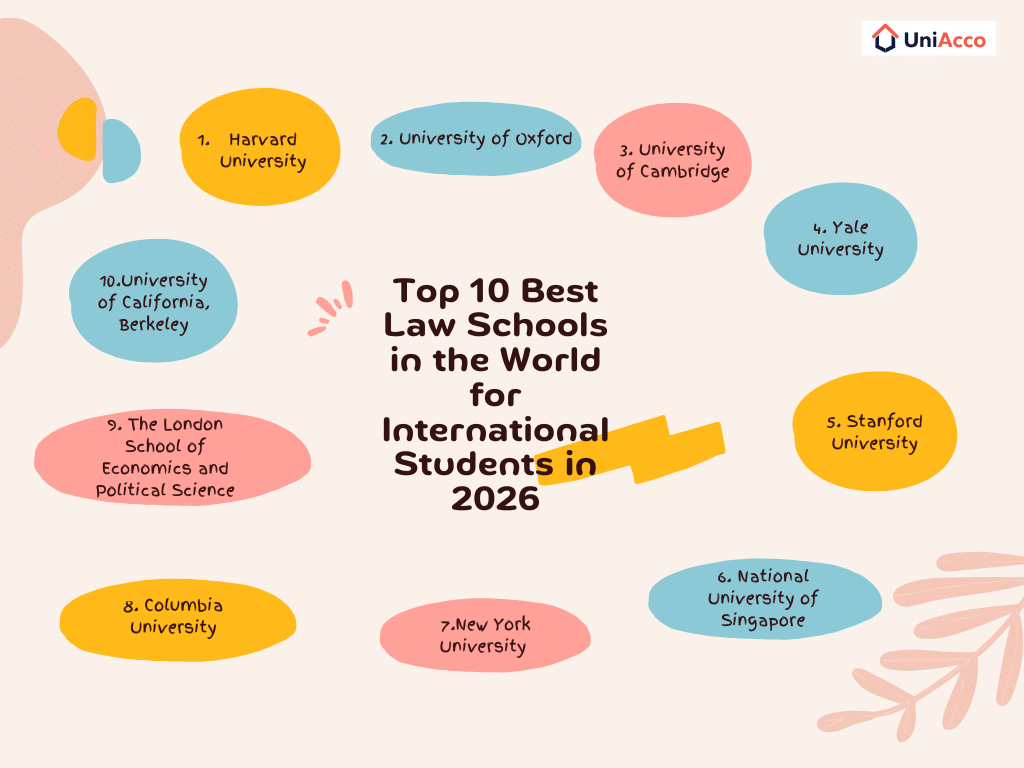
1. Harvard University
With a QS ranking of 1, Harvard Law School (HLS) is the Big Boss of all the law schools. Founded in 1817 in Cambridge, Massachusetts, it is the oldest continuously operating law school in the US. If you’re someone who spends most of their time in libraries, HLS has the largest academic law library in the world; imagine the aesthetic of this library! On top of that, Harvard’s massive student body provides an incredibly expansive network. Your classmates, including yourself, are basically future presidents, diplomats, and Supreme Court justices.
| Category | Details |
| Specialisations | Constitutional Law, Corporate Law, International Human Rights |
| Program Duration | 3 Years (JD), 1 Year (LLM) |
| Average Annual Tuition Fees | $75,000 – $78,000 |
2. University of Oxford
With a QS ranking of 2, the Faculty of Law at Oxford screams centuries of tradition. Located in the heart of Oxford, England, it operates on a unique tutorial system. Universally recognised as the best law school in Europe, Oxford produces graduates with razor-sharp analytical skills who are ready to argue just about anything. Think Banksy’s provocative new statue of the suited man blinded by a flag that just mysteriously appeared in London. That could potentially be the talk in the school where you could debate on the complex property rights and legal loopholes of his guerrilla art drop.
| Category | Details |
| Specialisations | Public International Law, Jurisprudence, Commercial Law |
| Program Duration | 3 Years (BA), 10 Months (BCL/LLM) |
| Average Annual Tuition Fees | $45,000 – $55,000 |
3. University of Cambridge
With a 3 QS ranking, Cambridge offers a deeply intellectual environment for legal studies. Founded way back in 1209, which is older than the Aztec empire, the beautiful collegiate campus houses the world-renowned Lauterpacht Centre for International Law. If you want to be a criminal lawyer or the one drafting global treaties, Cambridge offers some of the absolute best criminology and international public law programs. Note this – Their system is different from the US law schools. Cambridge focuses on independent study and supervisions, which are small group debates with experts.
| Category | Details |
| Specialisations | International Law, Criminology, Private Law |
| Program Duration | 3 Years (BA), 9 Months (LLM) |
| Average Annual Tuition Fees | $45,000 – $55,000 |
4. Yale University
Yale Law School holds a QS ranking of 4. Located in New Haven, Connecticut, Yale is famous for having the smallest class sizes among the elite Ivy League law schools. What might interest you is their new collaborative approach, which ditches strict GPA rankings for a much less stressful system. If your goal is to become a top legal scholar or to change the world through public interest law, Yale is the top choice. By the way, did you know that Bill and Hillary Clinton had their cute-meet in the Yale Law Library?
| Category | Details |
| Specialisations | Public Policy, Legal Academia, Constitutional Law |
| Program Duration | 3 Years (JD), 1 Year (LLM) |
| Average Annual Tuition Fees | $73,000 – $76,000 |
5. Stanford University
With a 5 QS ranking, Stanford Law School leverages its sunny Northern California campus and proximity to Silicon Valley to offer intellectual property and tech law programs. If you’re aiming to solve the legal entanglement of the latest AI unicorn, space-tech startups, or data privacy scandals, then this is exactly where you should be. Founded in 1893 on a massive horse ranch, which is famously called The Farm by students and alumni, Stanford is all about breaking the traditional mould.
| Category | Details |
| Specialisations | Intellectual Property, Tech Law, Corporate Governance |
| Program Duration | 3 Years (JD), 1 Year (LLM) |
| Average Annual Tuition Fees | $71,000 – $75,000 |
6. National University of Singapore (NUS)
With a 6 QS ranking, NUS is located on the gorgeous Bukit Timah campus, which is right next to the UNESCO World Heritage site, Singapore Botanic Gardens. NUS Faculty of Law serves as a critical bridge between Eastern and Western legal frameworks. Its mandatory pro-bono work is blended perfectly into the course structure, so you are bound to get real-world experience with a genuine sense of social responsibility. A fun fact – Min-Liang Tan, the billionaire co-founder and CEO of Razer, graduated from NUS Law.
| Category | Details |
| Specialisations | Asian Legal Studies, Maritime Law, International Arbitration |
| Program Duration | 4 Years (LLB), 1 Year (LLM) |
| Average Annual Tuition Fees | $30,000 – $40,000 |
7. New York University (NYU)
NYU Law stands at a 7 QS ranking in 2026, with its location being the biggest flex. Situated in the heart of Manhattan’s Greenwich Village, which is literally Washington Square Park, NYU gives you access to Wall Street, global NGOs, and the UN. Founded back in 1835, NYU is deeply historic, but what differentiates it from the rest is its legendary Hauser Global Law School Program and its dominance in US Tax Law. NYU is undoubtedly one of the best law schools in the world if your goal is to get into international law or corporate compliance.
| Category | Details |
| Specialisations | International Law, Tax Law, Environmental Law |
| Program Duration | 3 Years (JD), 1 Year (LLM) |
| Average Annual Tuition Fees | $76,000 – $79,000 |
8. Columbia University
With a QS ranking of 8, Columbia Law School is your direct entry ticket to Wall Street. Situated in Morningside Heights, a neighbourhood of New York, it is a heavyweight among the Ivy League law schools. The iconic Ruth Bader Ginsburg (R.B.G) transferred to Columbia Law for her final year. If your goal is to get into mergers and acquisitions, Columbia’s training in corporate law and finance should be your choice.
| Category | Details |
| Specialisations | Corporate Law, Mergers & Acquisitions, Financial Law |
| Program Duration | 3 Years (JD), 1 Year (LLM) |
| Average Annual Tuition Fees | $78,000 – $81,000 |
9. The London School of Economics and Political Science (LSE)
With a 9 QS ranking, LSE is located in central London, literally next door to the Royal Courts of Justice. LSE Law refuses to teach only the standard way and is known to merge deep economic and sociological theory. Fun fact? Prime Minister and global climate justice Mia Mottley got her LLB from LSE. If your goal is genuinely to change the system from the inside out, this is where you need to be.
| Category | Details |
| Specialisations | Banking Law, Human Rights, Competition Law |
| Program Duration | 3 Years (LLB), 1 Year (LLM) |
| Average Annual Tuition Fees | $35,000 – $45,000 |
10. University of California, Berkeley (UCB)
With a 10 QS ranking, UC Berkeley Law is located on a beautiful campus overlooking the San Francisco Bay. Known for its fierce history of social justice and environmental advocacy, Berkeley provides a public university environment that rivals any private institution. They were the legal pioneers of the Green Movement back in the day. If you wish to merge your passion with radical social change, this is your spot.
| Category | Details |
| Specialisations | Environmental Law, Social Justice, Intellectual Property |
| Program Duration | 3 Years (JD), 1 Year (LLM) |
| Average Annual Tuition Fees | $65,000 – $75,000 |
Which is your top choice of school? If you’re still not sure, that’s perfectly okay. Take a break and explore the best student accommodation in London with UniAcco. Discover fully furnished rooms, premium amenities, and all-inclusive bills designed for student living.
🔍 Explore Student Housing in LondonAdmission & Eligibility Requirements for International Students
Yale Law School typically maintains an acceptance rate below 5%, proving that simply meeting the basic law degree requirements is never enough—candidates must show exceptional narrative, leadership, and intellect. Here’s what you need to navigate the 2026 admissions cycle.
Academic Qualifications
The bar is extremely high. For undergraduate programs (LLB/BA) in the UK or Singapore, top-tier high school qualifications like a 40+ in the IB Diploma or A*AA in A-Levels are expected.
For US postgraduate programs (JD/LLM), you need an undergraduate degree equivalent to a US GPA of 3.8+ or a UK First-Class Honours. Plus, if you’re applying to US schools, you have to route your transcripts through LSAC’s Credential Assembly Service (CAS). They basically do the heavy lifting of translating your international grading system into an acceptable standard US format.
English Language Proficiency (IELTS/TOEFL/PTE)
Law is all about arguing with precise words, so you need fluency in the language, especially English if you’re thinking global. Elite institutions typically expect an IELTS score of 7.5 (with no individual band lower than 7.0) or a TOEFL iBT score of 105+.
Standardised Tests
The testing landscape has drastically evolved. As of 2026, the LSAT has permanently removed the “Logic Games” (Analytical Reasoning) section, focusing entirely on Logical Reasoning, Reading Comprehension, and a newly structured Argumentative Writing task.
Remote testing has gone down. You’re likely to sit for an in-person at a Prometric centre. To get into the top US schools, you need to aim for a 170+ score range. If the UK is where you want to be, then prepare to conquer the LNAT, which is a speed run of advanced comprehension and essay writing under intense time pressure.
Statement of Purpose (SOP)
Your SOP is like the cover of your book. It cannot be a generic, copy-paste cover letter. You need to build this letter in a way that your past experiences and your specific legal ambitions marry well. Whether you’re looking to draft new AI regulations or handling international trade disputes, you need to be clear in your objective.
Letters of Recommendation (LOR)
You will generally need 2 to 3 LORs. For JD programs, academic references from professors who can confirm your critical thinking, debate skills, and analytical writing are highly preferred over general professional references. These are also submitted and processed centrally through your LSAC CAS account.
Resume/CV
This is basically essential for JD and LLM applicants. Your CV must clearly outline any legal internships, research publications, paralegal experience, and relevant extracurricular leadership.
Valid Passport & Student Visa Documentation
Once you get the acceptance letter, you will use the university’s official documentation (like the I-20 form in the US or the CAS letter in the UK) to apply for an F-1 Student Visa in the US, or a Student Route Visa in the UK.
Proof of Financial Support
This is a reality check moment. For visa clearance and to clear immigration, you must provide certified bank statements proving you possess enough liquid funds to cover the first-year tuition and living expenses. For top-tier US schools, you are required to show $100,000 just to get through the main door.
How to Choose the Right Law School Abroad?
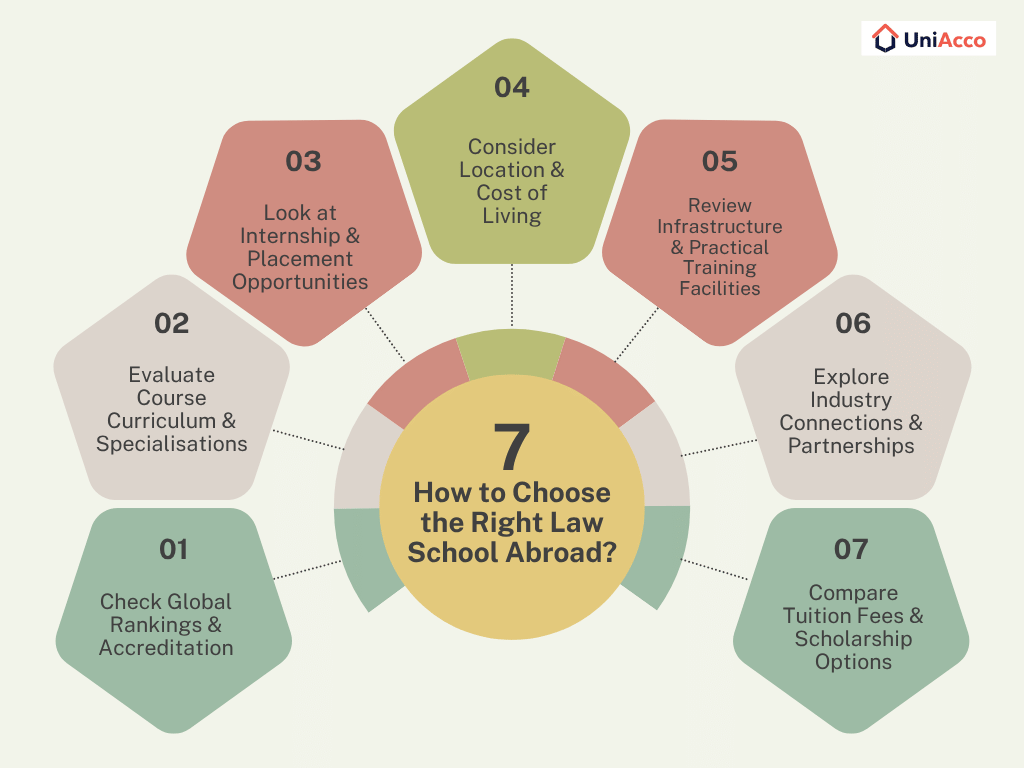
Choosing the right institution requires a thought-through strategy. If you grew up idolising the fierce corporate manoeuvres of Louis Litt from Suits, selecting a Wall Street feeder like Columbia University is a brilliant move. If your actual passion is environmental public policy, choosing Columbia based purely on general prestige over a specialised school like UC Berkeley could be a blunder. Keep these detailed considerations in mind to find the best law fit for you:
Check Global Rankings & Accreditation
Always verify a school’s global QS ranking, for those stats will potentially translate to your future bank account. Statistically, graduates from the top 10 schools often see starting salaries upwards of $225,000 at major firms, vastly outperforming graduates from regional institutions.
Evaluate Course Curriculum & Specialisations
If you want to pursue Tech Law, Stanford offers one of the best law programs in the world. If International Public Law is your goal, Cambridge is unparalleled. If you wish to jump on the 2026 tech wave and pursue AI regulations or Tech Law, Stanford offers the best programs. Basically, you need a school that matches your specific interests.
Look at Internship & Placement Opportunities
Put on your Sherlock hats and investigate where graduates from the top schools end up. Do elite firms run On-Campus Interview (OCI) programs at the school? Look at NYU’s massive OCI placement numbers in New York City.
Consider Location & Cost of Living
The city you choose to live in dictates your lifestyle and budget. Studying at LSE in London offers brilliant networking but comes with an exorbitant cost of living compared to the highly affordable lifestyle and tuition at NUS in Singapore. Spend time comparing the cost of living of your top options; this will make your filtering process easier.
Review Infrastructure & Practical Training Facilities
Harvard’s 50+ student practice organisations provide unmatched hands-on client representation before you even graduate. Make sure the school you choose gives you enough practical knowledge.
Explore Industry Connections & Partnerships
A school connected to local court-houses provides superior clerkships. Remember this – Proximity is Power. The proximity of the best university in the world to financial hubs (like Columbia to Wall Street) dictates your networking capability.
Compare Tuition Fees & Scholarship Options
Legal education in 2026 is expensive, with the total Cost of Attendance, which is your tuition plus living expenses at top US private schools, pushing up to $110,000 per year. Look for merit-based scholarships, like NYU’s Hauser Scholarships or loan-forgiveness programs for public interest work, like Yale’s COAP program, which could be a good starting point.
Still not sure how to choose the right law school? Read this Reddit thread and learn how students made this important decision.
I’m currently in 11th and I wish to study law abroad – r/Indians_StudyAbroad
Conclusion
To wrap it up, choosing the right educational foundation is literally everything you need to become a global leader in the legal sector, unless you own a family-run business. The competition is undeniably fierce. According to data from the Law School Admission Council (LSAC), recent admission cycles saw over 76,000 applicants, marking the highest volume in over a decade, with international applications projected to grow further throughout 2026.
Whether you choose the rich historical legacy of the UK, the corporate powerhouse of an American Ivy League institution, or the booming university in the futuristic tech hubs in Asia, an international legal education is going to push your limits. So figure out your career goals, and take the first step towards an intellectually thrilling and socially responsible global law.
Before you hit the close button, looking at the right home is just as crucial as choosing the right law school. UniAcco simplifies your journey with premium student housing near top global institutions. With all-inclusive rent covering utilities, high-speed Wi-Fi, and modern amenities, here are some of the top picks for you.


 LinkedIn





0 Comments