
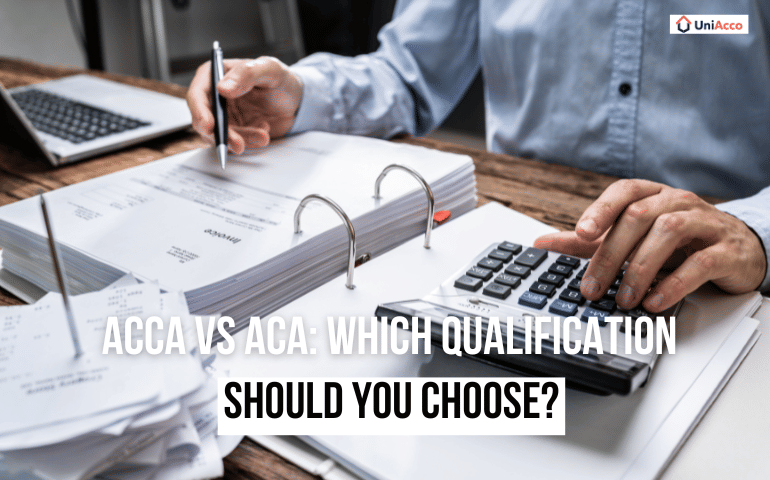
Whether you’re looking to hold a position at a CFO’s desk in the UK, exploring finance careers in the UK, or simply looking to study accounting abroad, making a choice between ACCA vs ACA is your first decision in career building.
As per the official data from ACCA’s 2026 Annual Integrated Report, ACCA supports over 266,000 fully qualified members and over 546,000 active future members across 180+ countries. At the same time, figures from the FRC (Financial Reporting Council) showcase that ICAEW’s ACA qualification is an undisputed heavyweight within the UK’s corporate system, which trains thousands of professionals under structured employer training agreements each year.
In this guide, we will unveil the key differences between ACCA and ACA, including their exam structures, pass rates, costs, global recognition, ACCA vs ACA salary expectations, and future career prospects. This will help you confidently decide which accounting qualification best matches your personal career goals.
ACCA vs ACA: What’s the Difference?
While comparing ACCA vs ACA, the primary distinction lies in the flexibility and entry pathways. For example, ACCA qualification, which is offered by the Association of Chartered Certified Accountants, is a flexible and globally focused professional path that leads students through an employer from anywhere in the world.
On the other hand, ACA qualification, which is offered by the Institute of Chartered Accountants in England and Wales (ICAEW, is a highly structured and UK-focused path that requires a formal training agreement with an ICAEW-approved employer, which makes it a preferred choice for the Big Four accounting qualifications.
| Feature | ACCA | ACA |
| Awarding Body | ACCA – Association of Chartered Certified Accountants | Institute of Chartered Accountants in England and Wales (ICAEW) |
| Eligibility | High school graduates, university students, and professionals | Requires a degree or entry through a formal ICAEW training contract |
| Duration | 3 to 4 years | 3 to 5 years |
| Training Requirement | 36 months of PER (Practical Experience Requirement), flexible completion | 450 days of practical work experience under a formal training agreement |
| Exam Structure | A total of 13 exams which are split across 3 levels | A total of 14 exams split across 3 levels – Certificate, Professional, Advanced |
| Global Recognition | Recognised by over 180+ countries | UK-focused with Europe and Commonwealth finance hubs |
| Best For | International students, flexible study structure, corporate finance, and independent learning | UK-based practice, audit, Big Four accounting qualifications, and statutory compliance |
What Is ACCA?
- What ACCA Stands For
ACCA is the acronym for the Association of Chartered Certified Accountants. It was founded in the year 1904 and is one of the oldest and largest globally recognised professional accounting bodies.
- Awarding Body
The qualification is directly awarded by ACCA Global, which is headquartered in the UK.
- Qualification Overview
The ACCA qualification focuses on international accounting standards like IFRS, financial management, tax, audit, and strategic business leadership. It comprises 13 exams, an Ethics and Professional Skills module, and 3 years of practical experience.
- Career Focus
ACCA offers a broad range of business skills. It teaches students important accounting and business skills. This helps them prepare for jobs in large companies, risk management, financial advisory boards, and shared service centres.
- Who Should Choose ACCA
ACCA is a good choice for those who want to study abroad and settle there. It is also good for working professionals who want flexible exam dates and locations. Students who prefer to study independently and pay for their education themselves can also choose ACCA.
What Is ACA?
- What ACA Stands For
ACA stands for Associate Chartered Accountant, which is a title given after completing the professional program administered by the ICAEW. This title will designate you as a premier Chartered Accountant in the UK.
- ICAEW Overview
The Institute of Chartered Accountants in England and Wales (ICAEW) was established in the year 1880 by the Royal Charter. It is a premier accounting body for public practice in the UK.
- Training Agreement Requirement
To study ACA, students usually need a training contract with an ICAEW-approved employer, such as Deloitte, EY, PwC, KPMG, or other accounting firms. The employer supports the student with exam costs, training, and practical work.
- Career Focus
ACA focuses on financial reporting, taxation, auditing, and business strategy. It is a good choice for students who want to work in accounting, auditing, or senior finance roles.
- Who Should Choose ACA
ACA is a good choice for graduates who have a job or training scheme with a Big Four firm or a leading UK accounting firm. It is also suitable for those who want to become a Chartered Accountant in the UK and prefer a structured work-and-study programme.
Living in the UK can be expensive, but finding the right accommodation can help you manage your budget. Explore affordable student accommodation in the UK with UniAcco, featuring fully furnished rooms and all-inclusive bills to make your student experience more convenient.
🔍 Explore Student Accommodation in the UKACCA vs ACA: Detailed Comparison

Entry Requirements
There are some clear structural differences for evaluating ACCA vs ACA eligibility. ACCA is highly accessible. Students can start directly after high school through the Foundations in Accountancy (FIA) or entry-level papers. Graduates in Business or Finance receive exemptions up to 9 papers.
For ACA, ICAEW allows entry through competitive graduate training contracts with an ICAEW training agreement.
Qualification Level
ACCA’s Strategic Professional level is benchmarked to Level 7 of the UK Regulated Qualifications Framework (RQF), equivalent to a Master’s degree.
ACA is also benchmarked at RQF Level 7 in the UK. It is highly prestigious in corporate governance and auditing.
Duration & Study Timeline
ACCA offers a flexible timeframe. Most candidates complete the 13 exams in 3 to 4 years. The exams are held every quarter, so students can speed up their studies or pause depending on their work.
ACA takes 3 to 5 years to complete when combined with the mandatory practical work experience and training agreement.
Exam Structure & Syllabus
The ACCA exam structure has 13 papers which are broken into 3 tiers — Applied Knowledge (3 computer-based exams), Applied Skills (6 exams), and Strategic Professional (2 Essentials + 2 Option Papers).
The ACA curriculum includes 14 exams broken down into 3 stages — Certificate Level (6 introductory computer-based exams), Professional Level (6 open-book core exams), and Advanced Level (3 comprehensive exams which culminate in a Case Study paper).
Practical Experience
ACCA requires 36 months of PER signed off by a practical experience supervisor.
ACA requires 450 days of structured practical work experience logged directly with an ICAEW-sanctioned training employer.
Flexibility
ACCA allows self-study, distance learning, and independent exam registrations without an employer.
ACA requires an employer’s mandate, scheduled exam sittings, and contractual study leave.
Global Recognition
ACCA has recognition in over 180 countries and is widely considered a top choice for ACCA for international students.
ACA is strong in the UK, Europe and Commonwealth regions like Australia, Hong Kong, and Canada.
Cost
ACCA costs £89 to register, plus a £140 annual subscription fee in 2026. Exam fees range from around £98 to £280 per paper.
For ACA, it costs literally £0 for the applicants as the employers fully sponsor tuition, exam entries, study materials, and retakes under the ACA training contract.
Difficulty
ACCA’s flexible pacing makes managing the workload a lot easier, but the Strategic Professional papers require a deep analytical mindset and carry a global pass rate of 38% to 55%.
ACA’s Professional Level pass rates are generally strong, often in the 70–85% range, though individual papers can vary significantly by session — some, like Financial Accounting and Reporting, have dipped into the 40–60% range in certain sittings. The intense pressure of sitting multiple open-book exams while working full-time makes ACA highly demanding.
Salary
Graduate and Trainees with ACCA earn £25,000 to £ 32,000, and ACA trainees on Big Four schemes earn around £30,000 to £38,000.
Newly qualified ACCA or ACA professionals earn competitive salaries between £50,000 and £65,000 in the UK.
Mid-Career or senior professionals in roles of Senior Manager, Director, or CFO earn between £85,000 and £150,000+.
Career Opportunities
- Audit: While ACCA is globally valued for audit roles, ACA holds a historical edge in UK statutory audit.
- Tax: Both ACCA and ACA provide specialised advanced taxation tracks which are highly valued by corporate tax departments.
- Consulting: Both are considered to be ideal pathways to get an entry into the Big Four advisory, practice groups, and management consulting.
- Corporate Finance: ACCA is widely accepted in global corporate structuring, while ACA is highly favoured in UK deal advisory and M&A.
- Banking & Investment: ACCA and ACA holders usually transition into credit risk, equity research, and corporate banking.
Still confused between ACCA vs ACA? Read this Reddit thread and find out more from the professionals.
ACA or ACCA? – r/ICAEW
Which Qualification Is More Difficult?
ACA is generally considered more difficult than ACCA as it offers the best route into private practice. Yet there are certain components of the ACCA course pattern students particularly struggle with. For instance, the Strategic Professional option has been shown to have one of the lowest pass rates.
Pass Rates: ACCA Applied Skills and Strategic Professional pass rates range between 38% and 55% globally. And ACA’s exam pass rates at the Professional and Advanced levels are between 70% and 85%. ACA candidates are known to be heavily screened by Big Four recruiters.
Workload: ACCA allows students to pace their exams by taking one paper every 3 months. On the contrary, ACA candidates often sit 3 complex exams in 1 week while managing client hours.
Training Contract: ACCA carries no job security pressure, which gives you enough room to retake papers. With ACA, your job and qualification are linked.
Flexibility: ACCA allows you to control your study schedule and pace, making it easier to balance other commitments. ACA follows a strict timeline which is governed by your employer.
ACCA vs ACA for International Students
If you’re an international student and are planning to study accounting abroad, ACCA for international students has some advantages.
Unlike ACA, ACCA allows international students to register for its exams from almost anywhere without having the need for a UK visa or a UK employer contract.
ACCA’s syllabus is built around International Financial Reporting Standards (IFRS), which makes your skill set transferable across international markets. Think India, Dubai, Europe, or Singapore.
While ACA requires a UK-sanctioned training employer who is willing to sponsor work visas, ACCA allows international students to complete exams independently before applying for any overseas jobs.
Looking for a shared room or a private apartment with a kitchen? Explore affordable student accommodation in London with UniAcco and choose from fully furnished rooms with all-inclusive bills to make your student life more comfortable and convenient.
🔍 Explore Student Accommodation in LondonACCA vs ACA vs CPA vs CIMA
Let us compare all the major international pathways to choose the best accounting qualification.
| Qualification | Best For | Global Reach | Typical Careers |
| ACCA | Global flexibility and international business opportunities | 180+ countries | Audit Manager, Financial Controller, Financial Analyst, IFRS Specialist |
| ACA | Statutory audit, public practice in the UK, Corporate leadership roles | Specific to UK and Commonwealth countries | Big Four Partnerships, Financial Director, Statutory Auditor, M&A Advisor |
| CPA | US corporate bodies and US accounting (US GAAP) | US and global US MNCs | Tax Consultant, Corporate Auditor, Reporting Specialist (all US-specific roles) |
| CIMA | Business leadership and strategic management accounting | Global corporate management companies | CFO, Strategic Planner, Management Accountant, Commercial Analyst |
Which Qualification Should You Choose?
- Work Internationally: If you plan to work internationally, choosing ACCA would be an ideal decision because of its worldwide network and international alignment, which makes global relocations seamless.
- Join the Big Four: If working for the Big Four in the UK is your goal, choosing ACA is the pathway. The Big Four graduate intakes sponsor the ACA qualification as part of their contract.
- Have Greater Study Flexibility: For flexibility of choice, ACCA is the most flexible as it lets you set your own study pace, book exam dates as per your convenience, and choose your tuition methods.
- Get Trained While Employed: If you wish to prepare while working, choose ACA for a fully funded sponsorship. If you secure an ICAEW training agreement, your employer will cover all your exam costs while you earn your full-time salary.
- Build a Corporate Finance Career: If you want to build your corporate career in the UK, choose ACA as it holds a dominant reputation in the UK’s financial advisory sectors.
- Have a UK-Focused Accounting Career: ACA is the gold standard for practising as a Chartered Accountant in the UK with audit sign-off authority.
Find a house that matches your UK-focused accounting career plan. Explore affordable student accommodation in Manchester with UniAcco and choose from fully furnished rooms with all-inclusive bills for a more convenient student experience.
🔍 Explore Student Accommodation in ManchesterConclusion
While you may pursue both ACA and ACCA, it is rarely advisable. The qualifications have significant syllabus overlap, and holding both does not meaningfully enhance career prospects compared to holding one plus gaining strong work experience. Your time and investment are better directed toward completing one qualification and building domain expertise. A more strategic combination for Indian professionals is ACCA + CFA for those interested in investment analysis or ACCA + Indian CA for those wanting both domestic signing authority and international mobility. Assess your long-term goals, evaluate current options, and choose the qualification that aligns with your journey.


 LinkedIn









0 Comments