
Have you watched Breaking Bad? Then you know Walter White, a genius chemistry professor who decides to build a pharmaceutical empire. Isn’t that every pharmacist’s dream to fly to the UK to build their own empire! Now, this blog is not about how to become Walter White. We’re here to understand the ‘legal’ way to enter the incredibly rewarding world of British Pharmacy.
As of 2026, the UK’s pharmacy sector is facing a critical workforce gap; projections from the Company Chemists Association (CCA) indicate that England alone faces a potential shortfall of 16,000 community pharmacists by 2036 if current recruitment trends don’t accelerate. For international students, this means the OSPAP route isn’t just a career path; it is a vital bridge to filling one of the UK’s most essential healthcare roles. An OSPAP course is the direct gateway to becoming a licensed UK pharmacist.
What is an OSPAP Course in the UK?
The Overseas Pharmacists Assessment Programme (OSPAP) is a rigorous, postgraduate conversion course designed to bridge the gap between global pharmacy practice and the specific clinical and legal standards of the UK’s National Health Service (NHS). Spanning 9 – 12 months, the curriculum focuses heavily on UK Medicines Law and Ethics, clinical therapeutics based on NICE (National Institute for Health and Care Excellence) guidelines, and patient-centred consultation skills. It is an intensive programme, requiring students to “unlearn” home-country prescribing habits to master OSCEs (Objective Structured Clinical Examinations) live simulations where clinical decision-making is tested under pressure. Passing this course is the mandatory first step for non-EEA pharmacists to secure their 52-week Foundation Training and ultimately gain GPhC registration.
Why study OSPAP in the UK?
A UK work experience is the gold standard for the pharmaceutical industry. The National Health Service (NHS) and the private pharmaceutical sectors demand the topmost level of clinical expertise. Considering an OSPAP course in the UK is the smartest career move you’ll make in 2026.
Now, let’s get back to why study OSPAP in the UK –
Eligibility to register as a pharmacist in the UK
Legally speaking, you cannot register as a pharmacist in the UK without a General Pharmaceutical Council (GPhC) accredited OSPAP if your degree is from outside the European Economic Area (EEA). So this is a non-negotiable first step. This is like your chemist’s license to enter the UK. The OSPAP qualification allows you to enter the 52-week foundation training year.
Access to UK pharmacy practice and clinical experience
On signing up for an OSPAP course in the UK, you don’t just get a ticket to sit in a lecture hall; you get direct access to placements and mock dispensaries that mirror the real-world NHS environment. You’ll learn to conduct clinical medication reviews, manage chronic diseases, and work alongside doctors. This practical experience will transform you from a student to a practitioner.
Exposure to advanced healthcare systems and regulations
With the advent of AI-driven diagnostics, electronic prescribing will be the most sophisticated standard practice. With the UK’s healthcare being one of the most advanced, you’ll get access to the best of the best technology. You’ll be exposed to advanced systems and stringent regulatory frameworks like the Medicines Act and the Misuse of Drugs Act.
Opportunity to work part-time while studying (with visa rules)
How will you fund your empire? Under the 2026 Student Visa regulations, international students are allowed to work for up to 20 hours per week during term-time, and full-time during vacations. This is a big advantage, knowing the high standard of living in the UK. You can find a part-time gig as a pharmacy dispenser or assistant. This won’t just help you manage your OSPAP course fees in the UK; it will also give you ‘on-the-job’ training to add a star on your CV.
Networking and career opportunities in the UK healthcare sector
While ‘what you know’ will get you into an OSPAP course in the UK, ‘who you know’ will lay the foundation of your empire. Being in the UK, you’ll get to attend events like the Clinical Pharmacy Congress (CPC) 2026 or local General Pharmaceutical Council (GPhC) networking events. You’ll get to share the same air as the recruiters of pharmacy chains like Boots and Superdrug. This is how the ‘smart kids’ secure themselves a high-paying placement even before the completion of the course.
High-quality teaching and practical training
Writing essays sounds boring? With the OSPAP course in the UK, you’ll be participating in OSCEs (Objective Structured Clinical Examinations). These are live simulations where you’ll be tested on your ability to think on your feet, communicate clearly, and make accurate clinical decisions. It’s the closest you’ll get to the real-world labs before you actually get there.
Pathway to further specialisation or postgraduate studies
OSPAP is like the foundation layer of your empire. Once you are transformed into a registered pharmacist, the UK will open up immense pathways for the upper levels of your empire. You can opt for a PhD in clinical research, specialise in Oncology or Pediatrics within the NHS (moving up to Band 8 and 9 roles), or you can enter into the high-stakes world of Industrial Pharmacy.
Book smart with UniAcco student housing in the UK and enjoy all-inclusive rent covering utilities, high-speed Wi-Fi, and modern amenities.
From university halls to private studios, find a space that suits your lifestyle and budget — UniAcco has got your back.
🏡 Browse UK Student AccommodationsTop Universities for Studying the OSPAP Course in the UK 2026
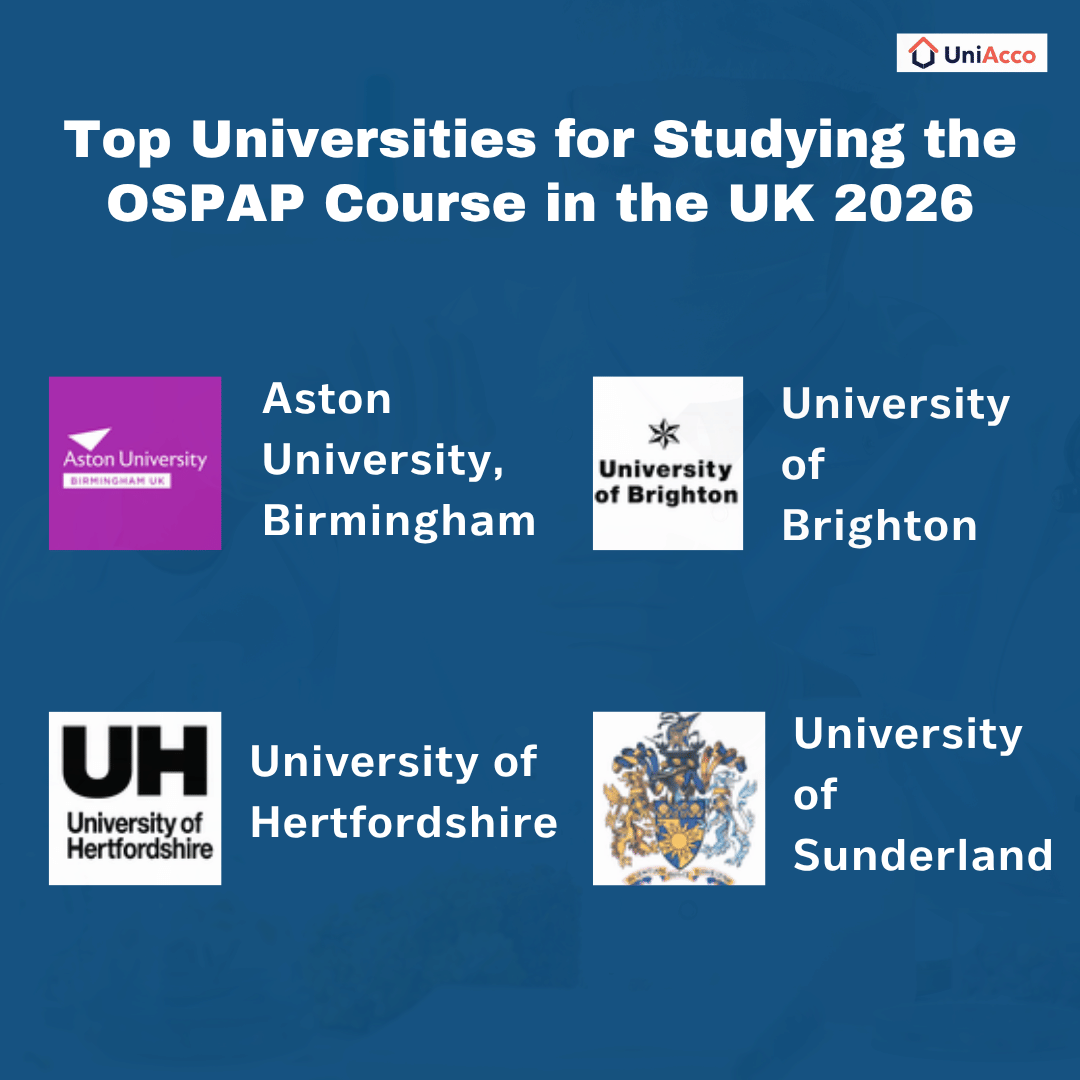
Choosing an OSPAP university in the UK is like choosing the right kind of partner in your lab to conduct an experiment to build your empire of dreams. An environment that supports cutting-edge technology and industry connections is your keyword. Here’s a deep dive into the 4 major titans of 2026.
Aston University, Birmingham
Situated in the industrial heart of Birmingham, Aston University is considered the ‘big daddy’ of pharmacy education in the UK. In order to adapt to the new technological revolution, Aston University’s curriculum focuses heavily on the Pharmacist Prescriber role to make sure that the postgraduates are ready to enter the modern world of the NHS. The red jewel at the centre of the crown of this university is its Clinical Skills Suite. It’s not your average laboratory; it’s a highly simulated lab featuring automated dispensing robots and high-tech mannequins that react to. medications. From emergency triage to chronic disease management, you’ll be chiselled to be the best in the industry.
Course Details:
| Category | Details |
| Specialisations | Advanced Clinical Pharmacy, Medicines Management, and Independent Prescribing Readiness. |
| Program Duration | 1 Year ( Full-time) |
| Average Annual Tuition Fees | For 2026, the OSPAP course fees in the UK are from £17,500 to £19,800 for international students. |
Applied to Aston University, but haven’t gotten any response? Read this Reddit thread, and learn how much time Aston University takes to respond.
OSPAP timeline – r/Pharmacy_UK from r/Pharmacy_UK
University of Brighton
Closer to the ocean, the University of Brighton is well-known for its inclusive, progressive atmosphere and is loved by international students. Maybe it’s the ocean!? Wait. Don’t flow just yet. Brighton’s OSPAP is renowned for its Pharmacy Law and Professional Ethics module. What does this mean? They don’t just teach you the rules; they teach you how to make complex ethical decisions in high-pressure clinical settings. In 2026, the university introduced a Community Leadership track, focusing on how pharmacists can lead public health initiatives in the UK’s diverse southern coastal towns.
Course Details:
| Category | Details |
| Specialisations | Public Health Pharmacy, Community Pharmacy Leadership, and Pharmaceutical Ethics. |
| Program Duration | 1 Year ( Full-time) |
| Average Annual Tuition Fees | Approximately £16,200 – £18,500. |
University of Hertfordshire
Located in the north of London, Hertfordshire is the tech-savvy choice for international students. Their main focus is on Interprofessional Learning (IPL). It’s not your regular classroom studying experience; you’ll have joint clinical sessions with student doctors, nurses, and paramedics. This is to give you a glimpse of how the Multi-Disciplinary Team (MDT) at the NHS functions. The curriculum deep dives into Digital Health, which means you’ll be taught how to use AI-driven prescribing tools and tele-pharmacy platforms.
Course Details:
| Category | Details |
| Specialisations | Digital Health in Pharmacy, Integrated Care, and Advanced Therapeutics. |
| Program Duration | 1 Year ( Full-time) |
| Average Annual Tuition Fees | Approximately £15,800 – £17,900. |
University of Sunderland
The University of Sunderland is situated in one of the most beautiful locations, with sandy beaches and riverside views alongside easy access to Newcastle and Durham. The London campus is located in Canary Wharf, which is the heart of Europe’s financial hub. Sunderland is all about Hospital Pharmacy Practice. They have long-standing ties with NHS trusts in the North East, which gives their students first-look access to high-quality hospital placements. Their mock dispensaries look very much like the NHS pharmacies. In 2026, they updated a new module on Primary Care Pharmacy, which prepares students for roles within General Practitioner (GP) surgeries.
Course Details:
| Category | Details |
| Specialisations | Hospital Pharmacy Practice, Primary Care Clinical Roles, and Acute Care. |
| Program Duration | 1 Year ( Full-time) |
| Average Annual Tuition Fees | The most affordable among OSPAP universities in the UK, at £15,000 – £16,800. |
Now that you’ve picked your university, discover student accommodation in London that’s close, convenient, and tailored to your needs.
Simply enter your university on UniAcco to explore nearby options, with 24/7 support throughout your stay.
🏡 Explore London Student AccommodationsCurriculum and Duration of OSPAP Courses in the UK 2026
Course Duration
The OSPAP course in the UK is intense as it condenses a 4-year UK MPharm degree into a 1-year program (9-12 months). It follows the standard UK academic calendar, starting in September/October and running up to the following summer.
Core Modules
The key subjects covered in the curriculum are built around the fundamentals of clinical practice –
- Clinical Therapeutics: Under this topic, you’ll master the UK-specific guidelines for managing cardiovascular, respiratory, endocrine, and central nervous system disorders.
- Pharmaceutical Science: This includes drug delivery, pharmacokinetics, and pharmacodynamics with respect to the pharmaceutical standards of the UK.
- Medicines Optimisation: This subject focuses on how to ensure patients get the right medicine at the right time while minimising waste and side effects.
Clinical and Practical Skills Training
This is where the hands get in touch with the drugs. This is where you’ll spend a lot of time in Patient Simulation Suites. From using a stethoscope for chest sounds, monitoring blood pressure, to performing diabetic foot checks, here is where you apply what you learned. In 2026, there’s a new addition called Point-Of-Care-Testing (POCT), which prepares you to handle rapid diagnostic tests in the pharmacy.
Pharmacy Law and Ethics
This teaches you how not to ‘break it bad’. From the Medicines Act 1968, Human Medicines Regulations 2012, to the Misuse of Drugs Act, you’ll learn it all. You’ll also see what a legal prescription looks like, how to handle controlled substances and the ethical frameworks required to maintain patient confidentiality and consent.
Dispensing and Pharmaceutical Calculations
If you’re someone who looks forward to spending time in the Dispensing Lab, you’ll love this part of the curriculum. For here is where you manage traditional compounding to the latest digital pharmacy software and automated dispensing robots. You will be drilled on pediatric dosing, IV concentrations, and millimole conversions until your accuracy is 100%.
Assessment Methods
Assessments are quite interesting as it’s not just about writing essays.
- OSCEs (Objective Structured Clinical Examinations): A simulator practice where you interact with standardised patients (actors) while being observed by examiners.
- Closed-Book Exams: These tests your memory recall of clinical guidelines and laws.
- Clinical Portfolios: This is where you document your practical experiences and reflections.
Placements and Work Experience
Most OSPAP courses in 2026 include mandatory or optional clinical placements to give you a taste of the NHS. You’ll spend a week in a high-pressure hospital pharmacy or a community setting. Look at this as an opportunity to connect and network for future career prospects.
Entry Requirements and Eligibility for the OSPAP Course in the UK for 2026
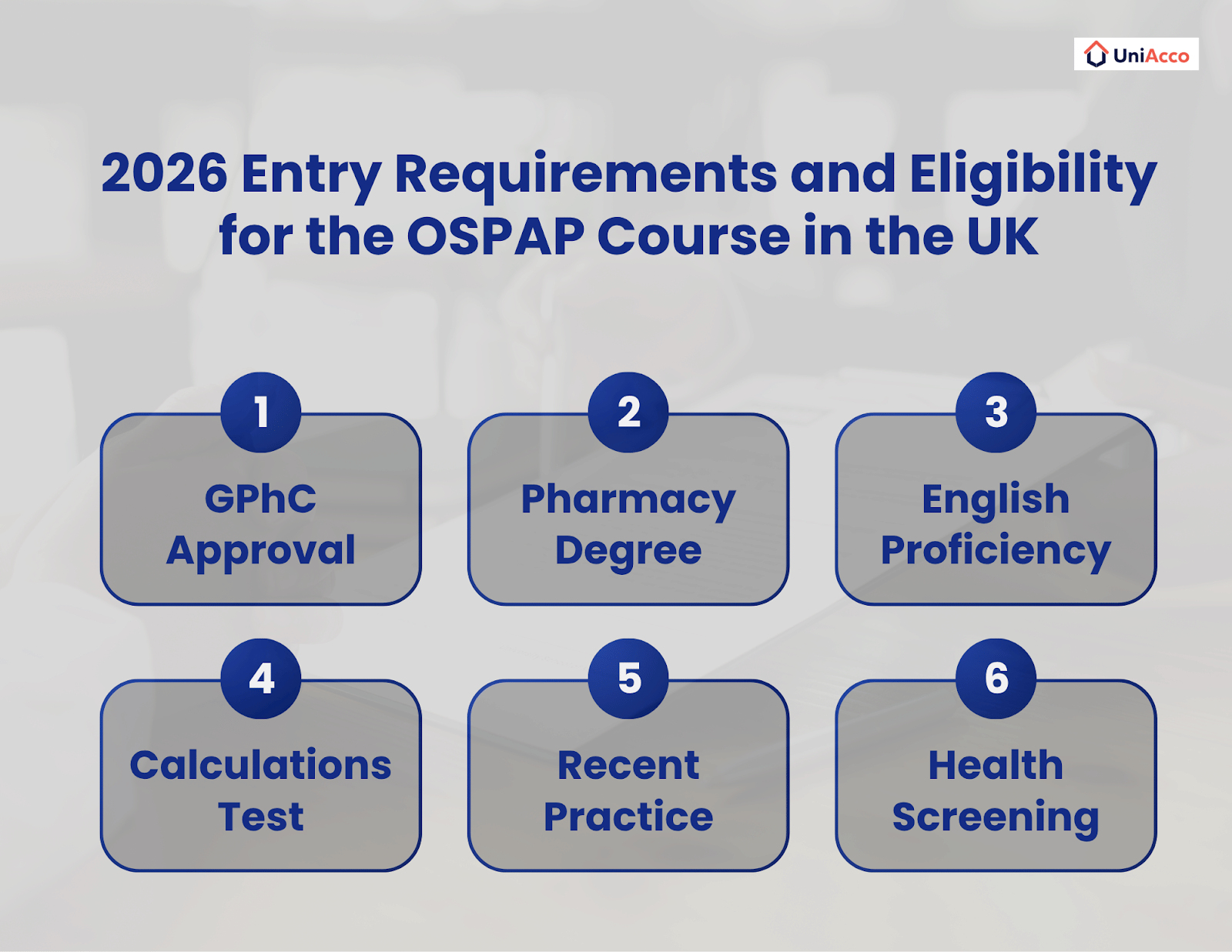
In order to ensure that there’s no Breaking Bad sequel, applying for an OSPAP course in the UK is a multi-layered process. In 2026, the requirements are more stringent than before to ensure only the best get in. Here’s a detailed breakdown.
1. GPhC Approval
As we discussed at the start, this is the first and foremost step. The GPhC is the ultimate regulator of pharmaceutical standards in the UK. They are the ones who review your pharmacy degree, including the university’s syllabus and your professional standing. On their approval, you receive an Adjudication Letter. This letter is your license to apply to OSPAP universities in the UK.
2. Pharmacy Degree
Since the competition is quite high in 2026, most universities require the equivalent of a 2:1 (Upper Second Class Honours). You’re required to hold a Pharmacy degree that is equivalent to a MPharm degree in the UK.
3. English Proficiency
Imagine the horror of prescribing the wrong dosage just because of a lack of communication skills. Blunder. It’s a life and death situation, literally. Which is why you need –
- IELTS Academic: A minimum score of 7.0 with no less than 7.0 in any single component (reading, writing, listening, speaking)
- OET (Occupational English Test): You normally require a Grade B in all sub-sets.
- Qualification in English: Most universities stick to the 7.0/Grade B standard.
4. Calculations Test
Just like wrong communication could lead to a life or death situation in the pharmaceutical industry, a calculation gone wrong would mean the same. Most of the OSPAP universities in the UK require you to pass an internal Pharmacy Calculations Test as part of the interview process. This test monitors your ability to calculate dosages, concentrations, and infusion rates with 100% accuracy.
5. Recent Practice
The GPhC, as a regulator, keeps a close eye on your knowledge. There’s something called a ‘6-year rule’ which means you should have graduated within the last 6 years. If you’ve graduated before the 6-year rule, you need to provide proof through a detailed portfolio and professional references which state that you’ve been in active pharmacy practice. In case you don’t fit the bill, you’re required to opt for further clinical training.
6. Additional Checks
A friendly advice. Don’t take our Breaking Bad reference too seriously, or else the UK healthcare sector won’t take you seriously. Your record must be ‘pure’. You are required to undergo a health screening to prove your fitness. Along with that, you’ll also need an enhanced DBS (Disclosure and Barring Service) check in the UK, with a ‘Good Character Certificate’ or police clearance from every country that you’ve lived in for more than 6 months over the last decade.
Scholarships and Financial Support for OSPAP Course in the UK 2026
| Scholarship Name | University / Provider | Eligibility | Coverage / Benefits |
| Sir Adrian Cadbury Chancellor’s Scholarship | Aston University | International students with a strong SOP (500 words) on community impact. Note: OSPAP is often excluded from certain general awards; keep a check on the specific PGDip exclusion list for the 2026 cycle. | £10,000 tuition fee reduction. |
| Vice-Chancellor’s Enterprise Scholarship | Aston University | Students demonstrating leadership, entrepreneurial mindset, or social responsibility. | £10,000 toward tuition fees. |
| Automatic Merit Scholarship | Aston University | International applicants classified as “Overseas” for fee purposes who meet academic high-achiever thresholds. | £2,000 – £5,000 (depending on academic performance). |
| Vice-Chancellor International Scholarships | University of Brighton | Self-funded international students starting in September 2026. Note: The MPharm is excluded, but PGDip OSPAP applicants can apply for the International Office variant. | £2,000 reduction (Postgraduate) or £4,000 (Undergraduate). |
| International Office Scholarships | University of Brighton | New international fee-status students with a minimum course duration of one year. | £2,500 reduction in the first year of study. |
| International Scholarship | University of Sunderland | Automatically applied to all international students who meet the university’s entry criteria for OSPAP. | £1,000 – £1,500 tuition fee waiver. |
| Student Bursary Scheme | Pharmacist Support (Charity) | Pharmacy students entering their final year in Sept 2026 who have faced unexpected financial or personal hardship. | £3,000 or £5,000 grants to help stay the course. |
Saving money? Now, save on accommodation too. Explore affordable student housing in Birmingham with UniAcco.
Get fully furnished rooms designed for comfort, convenience, and student living.
🏡 Explore Birmingham Student AccommodationsJobs After Studying the OSPAP Course in the UK in 2026
GPhC Registration and Licensing
Once you complete this 52-weekish OSPAP course and pass the GPhC registration exam, you become a fully licensed Pharmacist in the UK. This license is your ticket to practice anywhere in England, Scotland, or Wales. If this goes up on your resume, you’ll be respected globally. The foundational salary would be in the range of £32,000 – £35,000.
Community Pharmacy Roles
With the OSPAP course in your hand, you’ll get entry into the retail pharmacies like Boots, Superdrug, and local independent pharmacies. Your role involves dispensing and providing clinical services like smoking cessation, weight management, and minor ailment clinics. The salary range is between £42,000 – £48,000 for newly qualified; over £55,000 for managers.
Hospital Pharmacy Positions
You’ll be working with NHS or private hospital groups like Nuffield Health, where you’ll be a part of the clinical team on the wards, reviewing patient charts, and ensuring safety in critical settings. You can expect a salary from Band 6, starting at £39,959, rising to Band 7 at £49,387 with experience.
Clinical Pharmacy and Specialist Roles
With experience, you can specialise in therapeutic areas like Oncology, Cardiology, or Mental Health. There are high chances of becoming a Consultant Pharmacist, where you’ll be leading medication strategy. Specialist roles often fall into Band 8a or 8b, with pay ranging from £57,528 to £77,368.
Pharmaceutical Industry Careers
Prefer labs or pharmacies? The UK is home to giant stalwarts like GSK and AstraZeneca. You’ll get opportunities in Research & Development (R&D), Regulatory Affairs, or Quality Control. This is for those Breaking Baddies who are in an Empire State of Mind. Entry-level salary starts around £35,000 – £45,000, while Director roles can exceed £120,000.
Academic and Research Opportunities
All the geeks please stand up, for this calling is for you all who wish to go back to school. You can join the OSPAP universities in the UK as a lecturer or clinical researcher. You could also get into the training departments of various organisations. Lecturers in Pharmacy typically earn salaries between £48,822 and £56,535.
Salary Expectations and Growth
There is immense potential for OSPAP graduates in 2026. After the OSPAP course completion, your starting salary as a registered pharmacist in 2026 will typically be between £42,000 and £46,000. Within a period of 5 years, most pharmacists will see their salary jump by 30% – 50% for leadership roles or as Independent Prescribers. On the other hand, as a consultant, you can expect a daily rate often reaching £400 – £600.
Wonder how many years you can stay back after finishing OSPAP? In this Quora discussion, students are shedding light on how many years you will get to stay after finishing your studies.

Conclusion
As we discussed at the beginning of this blog, as of 2026, the UK’s pharmacy sector is facing a critical workforce gap. Projections from the Company Chemists Association (CCA) indicate that England alone faces a potential shortfall of 16,000 community pharmacists by 2036. This means there’s a huge opportunity to make an entry via OSPAP courses in the UK in 2026. Does that mean the chances of making an exponentially high income are possible? Yes. The OSPAP route isn’t just a career path; it is a vital bridge to filling one of the UK’s most essential healthcare roles.
Consider looking for a comfortable accommodation right away? Get tailored student housing picks in just 20 seconds at UniAcco.












0 Comments