For years, IELTS has felt like the final hurdle between students and their study abroad dreams. But that’s quickly changing. In 2024 alone, over 30% of European universities revised their language policies, allowing students to study abroad without IELTS. Today, countries like the UK, Canada, Australia, Germany, and Singapore welcome international students through alternate pathways, from a Medium of Instruction (MOI) certificate and Duolingo English Test to internal assessments and solid Class 12 English scores.
This blog highlights how you can study abroad without IELTS, exploring countries, universities, and smarter routes to begin your global education journey with confidence, not test anxiety.
Top 10 Countries Without IELTS For Study Abroad: An Overview
| Country | Popular Courses | Accepted Alternatives to IELTS |
| UK | Business, Engineering, Law, Medicine | MOI CertificateDuolingoUniversity English Assessment |
| Canada | Computer Science, Business, Hospitality, Health Sciences | MOI CertificateDuolingoTOEFLCAEL |
| USA | Data Science, MBA, Psychology, Arts | DuolingoPTEMOI CertificateInternal Language Test |
| Singapore | Business and Management, Information Technology and Computer Science, and Engineering and Technology | TOEFLPTE AcademicMOIDuolingo English Test |
| Australia | Nursing, IT, Education, Environmental Science | MOI CertificatePTECambridge English TestDuolingo |
| Germany | Engineering, Business, Natural Sciences, Humanities | MOI CertificateTestDaFDSHUniversity Language Assessment |
| France | Fashion, Business, Culinary Arts, International Relations | MOI CertificateUniversity Language TestFrench Proficiency (DELF/DALF) |
| Italy | Architecture, Design, Business, Fine Arts | MOI CertificateDuolingoUniversity Interview |
| New Zealand | Computer Science and IT, Business and Management, Healthcare (including nursing and medicine), and Engineering | TOEFLPTECambridge English Qualifications (CAE/CPE)Duolingo English Test |
| Ireland | Business, Law, Computer Science, Media Studies | MOI CertificateDuolingoTOEFLPTE |
Best Countries To Study Abroad Without IELTS: In-Depth Guide
United Kingdom
The UK is no longer a primary destination for international students that requires test scores first. In recent years, more than 30% of UK universities have relaxed strict IELTS requirements, placing greater emphasis on academic performance and internal English assessments.
Many institutions now accept alternatives such as a Medium of Instruction (MOI) certificate, the Duolingo English Test, Pearson PTE, or their own university-conducted English assessments. Strong English scores in Class 12, typically ranging from 70% to 75% for CBSE and ICSE students, can also secure admission without the need for IELTS.
This shift simplifies the process for students pursuing courses in business, engineering, law, medicine, and creative arts, prioritising academic merit over standardised test scores.
UK Universities That Don’t Require IELTS
| University Name | Location | QS Ranking 2026 | Average Tuition Fees (per year) |
| University of Bristol | Bristol | 51 | £20,000 – £40,000 |
| University of Warwick | Coventry | 74 | £22,000 – £30,000 |
| Aston University | Birmingham | 395 | £17,000 – £24,000 |
| University of Greenwich | London | 801–850 | £14,000 – £18,000 |
| University of Northampton | Northampton | 1201–1400 | £13,000 – £15,000 |
| University of Portsmouth | Portsmouth | 635 | £15,000 – £20,000 |
| University of Plymouth | Plymouth | 613 | £14,000 – £18,000 |
| Northumbria University | Newcastle | 550 | £16,000 – £20,000 |
| Robert Gordon University | Aberdeen | 951–1000 | £13,000 – £17,000 |
| Sheffield Hallam University | Sheffield | 1001–1200 | £14,000 – £18,000 |
Accepted Alternatives
Medium of Instruction (MOI) Certificate
The MOI Certificate confirms that your education was conducted in English and is issued by your previous school or college. Most UK universities accept MOI certificates as proof that you can study in English, especially if your prior education was at a recognised institution. This is becoming increasingly popular among students from countries where English is the primary language of instruction.
Duolingo English Test
The Duolingo English Test is a fully online, adaptive exam that assesses reading, writing, listening, and speaking skills in a single session. It has become widely accepted by UK universities, especially for undergraduate and postgraduate programs where flexibility is important.
Minimum accepted scores typically range from 105–120, though highly competitive courses, such as business, law, or computer science, may require 125+. DET is convenient, cost-effective, and delivers results within 48 hours, allowing faster admission decisions than traditional exams.
Pearson PTE Academic
PTE Academic is a computer-based test that assesses all four language skills in an academic context: reading, writing, listening, and speaking. UK universities, including both public and private institutions, accept PTE scores as an alternative to IELTS.
Most programs require scores in the range of 51–67, with higher thresholds for postgraduate or competitive courses like management, engineering, or healthcare. PTE is valued for its AI-driven scoring, consistent evaluation, and globally recognised certificate.
Occupational English Test (OET)
OET is specifically designed for healthcare professionals, testing English in a medical or clinical context. Many UK medical, nursing, dentistry, and allied health programs accept OET in place of IELTS. The test evaluates reading, writing, listening, and speaking skills as used in professional healthcare environments, ensuring that applicants can communicate effectively in patient care and clinical settings.
Score requirements vary by university and program, but most require at least a grade B in each subtest. OET provides a specialised alternative for students aiming for healthcare careers.
University-Conducted Internal English Assessment
Some UK universities conduct their own English assessments or interviews to gauge applicants’ proficiency. For example, institutions might use video interviews, written tasks, or internal tests to determine if you can successfully study in an English-taught course. Passing these internal tests can eliminate the need for IELTS and allow universities to evaluate your ability to handle coursework in English directly.
Strong Class 12 English Score
For students from CBSE, ICSE, or other recognised boards, achieving 70–75% in English can be considered sufficient by many UK universities. This alternative relies on academic performance rather than standardised testing, reflecting the recent shift toward merit-based admissions.
Also read: How To Study In UK Without IELTS
From halls to private studios, discover verified accommodations across the UK that fit your lifestyle and budget.
🏠 Browse UK AccommodationsCanada
Canadian universities are increasingly relaxing traditional IELTS requirements. 20+ reputed institutions now accept alternatives like Duolingo, PTE, CAEL, and more. Duolingo is particularly popular; several top schools, such as McGill University, the University of Saskatchewan, and the University of Guelph, accept it. The CAEL test is also accepted by more than 180 Canadian institutions, making it a powerful alternative.
This shift from IELTS-only policies means students can apply based on their academic merit and real-world English usage, rather than just test performance, reducing stress and broadening access for global learners.
Canadian Universities to Study In Without IELTS
| University / College | Location | QS Ranking 2026 | Average Tuition Fees (per year) |
| University of Winnipeg | Winnipeg, Manitoba | – | CAD 18,000 – 22,000 |
| Brock University | St. Catharines, Ontario | 1201–1400 | CAD 16,000 – 27,000 |
| University of Saskatchewan | Saskatoon, Saskatchewan | 378 | CAD 19,000 – 23,000 |
| Memorial University of Newfoundland | St. John’s, Newfoundland & Labrador | 660 | CAD 11,000 – 18,000 |
| Concordia University | Montreal, Quebec | 465 | CAD 20,000 – 25,000 |
| University of Regina | Regina, Saskatchewan | 1001–1200 | CAD 17,000 – 21,000 |
| Carleton University | Ottawa, Ontario | 781–790 | CAD 22,000 – 26,000 |
| Seneca College | Toronto, Ontario | – | CAD 13,000 – 18,000 |
| Okanagan College | Kelowna, British Columbia | – | CAD 12,000 – 16,000 |
| Cambrian College | Sudbury, Ontario | – | CAD 12,000 – 15,000 |
Accepted Alternatives
Medium of Instruction (MOI) Certificate
Many Canadian universities, especially colleges and coursework-based programs, accept an MOI if your previous education was fully in English. This is commonly accepted for applicants from countries where English-medium schooling is standard. The MOI works as proof that you’ve already studied, communicated, and written academically in English, reducing the need for a separate language exam.
Duolingo English Test (DET)
Duolingo has become widely popular in Canada because it’s affordable, available online, and delivers results quickly. Institutions like the University of Alberta, University of Calgary, York University, and many public colleges now accept DET since it reliably tests reading, writing, listening, and speaking in one session.
Typical minimum scores range from 105–120, with competitive programs sometimes requiring 125+.
TOEFL iBT
Accepted across almost all Canadian universities, including UBC, University of Toronto, McGill, and McMaster, the TOEFL is one of the strongest IELTS alternatives. It’s recognised for accurately measuring academic English skills and is often preferred for competitive programs like engineering, sciences, and business.
Minimum total scores usually range from 80–100, with some programs expecting 100+.
Also read: TOEFL iBT Test – Tips For Every Section
CAEL (Canadian Academic English Language Test)
Designed in Canada for Canadian universities, CAEL mirrors real academic tasks like writing essays and understanding lectures. Schools such as Carleton University, the University of Waterloo, and Western University.
These institutions typically accept scores in the range of 60–70, depending on the program. Its format closely reflects actual university coursework, providing a clear measure of readiness.
PTE Academic (Pearson Test of English)
Canadian institutions are increasingly accepting PTE due to its AI-driven scoring and consistent evaluation. It assesses all four language skills, serving as a reliable alternative to IELTS.
Universities, including Concordia, SFU, Dalhousie, and several Ontario universities/colleges, consider scores between 58–65 acceptable, with higher thresholds for competitive programs.
Proof of English-Medium Education (3–4 Years)
Applicants who studied for 3–4 years in an English-medium school, high school, or undergraduate program may be exempt from English tests at many colleges and select universities. This pathway is beneficial for students from India, Africa, and the Middle East, whose transcripts clearly indicate that English is the language of instruction.
If you’ve been wondering how to study abroad without IELTS, Canada is your answer. With inclusive universities, affordable education, and endless opportunities, you can confidently study abroad without IELTS and take your first step toward a global future.
United States of America
The United States of America continues to be a leading destination for international students, and its admission landscape has undergone significant evolution. According to the Institute of International Education, over 1,200 universities in the US now offer flexible English language requirements, reflecting a shift from IELTS-focused admissions to holistic evaluation of academic merit.
This change enables students to meet English proficiency standards through alternative assessments, such as the Duolingo English Test, TOEFL iBT, Pearson PTE Academic, or a Medium of Instruction (MOI) certificate confirming prior education in English. Some universities also conduct internal language assessments or interviews to evaluate practical communication skills.
USA Universities to Study In Without IELTS
| University Name | Location | QS Ranking 2026 | Average Tuition Fees (per year) |
| Rice University | Houston, Texas | 119 | ~USD 50,000 |
| California State University | California (various campuses) | 1201-1400 | ~USD 20,000-28,000 |
| University of New Orleans | New Orleans, Louisiana | – | ~USD 15,000-20,000 |
| University of Delaware | Newark, Delaware | 553 | ~USD 30,000 |
| University of Iowa | Iowa City, Iowa | 530 | ~USD 30,000 |
| University of Colorado (Boulder) | Boulder, Colorado | 299 | ~USD 35,000 |
| University of Arkansas | Fayetteville, Arkansas | 1001-1200 | ~USD 26,000-30,000 |
| Drexel University | Philadelphia, Pennsylvania | 711-720 | ~USD 44,000 |
| University of North Alabama | Florence, Alabama | – | ~USD 25,000-32,000 |
| University of Dayton | Dayton, Ohio | – | ~USD 30,000-35,000 |
Accepted Alternatives
Medium of Instruction (MOI) Certificate
Several US universities, especially state universities and liberal arts colleges, accept an MOI if you’ve completed your previous schooling or degree entirely in English. Institutions use the MOI to confirm that you’ve already studied, written, and communicated in English in an academic setting. This is often paired with strong academic transcripts or an interview to verify proficiency.
TOEFL iBT
TOEFL remains one of the most widely accepted English tests in the US. Universities like NYU, UC campuses, Michigan, and Purdue recognise it for undergraduate and graduate admissions. The typical accepted score range is 80–100, with competitive programs often requiring 100+.
Duolingo English Test (DET)
Duolingo is increasingly accepted by more than 4,000 US institutions, including Columbia, Yale (graduate programs), and Northeastern. The online, at-home test is valued for its convenience and speed. Most universities accept scores from 110–120, with highly competitive programs sometimes requiring 125+.
PTE Academic (Pearson Test of English)
PTE Academic is recognised by a growing number of universities, including Harvard Extension, University of Illinois, and Johns Hopkins (select programs). Scores are generally accepted in the range of 58-65, depending on the university and program.
University-Specific English Assessments
Many US universities conduct their own English placement or internal proficiency tests, especially the CSU system, the University of Arkansas, the University of Dayton, and certain community colleges. Passing these internal tests (often 70–75% minimum) can eliminate the need for external exams.
Conditional Admission / Bridging English Programs
If your English proficiency doesn’t meet the standard requirement, universities often offer conditional admission. Students can start their academic program after completing an approved English Language Program (ELP). Schools like Oregon State, Arizona State (Global Launch), and INTO/Pathway partner universities follow this model. Completing these programs typically requires achieving a B2–C1 CEFR level or equivalent score in the ELP.
Since 2020, U.S. universities have steadily increased their acceptance of alternatives like MOI, Duolingo, and TOEFL, meaning you can now enter a top-ranked American program without IELTS while still meeting all visa and admission standards.
Singapore
Singapore has become one of Asia’s fastest-growing destinations for international students, with over 20,000 new enrollments recorded in 2024 alone. Institutions such as the National University of Singapore (NUS), Nanyang Technological University (NTU), and Singapore Management University (SMU) now accept alternatives, including the Duolingo English Test, Pearson PTE Academic, TOEFL iBT, or a Medium of Instruction (MOI) certificate that confirms prior education in English.
Some programs also offer internal language assessments or interviews to evaluate communication skills directly. For students, this change reduces the barrier of a high-stakes test, accelerates the admission process, and allows them to focus on academic preparation, making Singapore a more accessible and student-friendly destination for quality education.
Singapore Universities to Study In Without IELTS
| University Name | Location | QS Ranking 2026 | Average Tuition Fees (per year) |
| National University of Singapore (NUS) | Singapore | 8 | SGD 30,000 – SGD 40,000 |
| Nanyang Technological University (NTU) | Singapore | 12 | SGD 32,000 – SGD 38,000 |
| Singapore Management University (SMU) | Singapore | 511 | SGD 30,000 – SGD 37,000 |
| Singapore University of Technology and Design (SUTD) | Singapore | 519 | SGD 26,000 – SGD 35,000 |
| SIM Global Education | Singapore | – | SGD 20,000 – SGD 30,000 |
| James Cook University (Singapore Campus) | Singapore | – | SGD 25,000 – SGD 30,000 |
| PSB Academy | Singapore | – | SGD 20,000 – SGD 25,000 |
| Kaplan Singapore | Singapore | – | SGD 22,000 – SGD 28,000 |
| East Asia Institute of Management | Singapore | – | SGD 18,000 – SGD 25,000 |
| Management Development Institute of Singapore (MDIS) | Singapore | – | SGD 15,000 – SGD 25,000 |
| Amity Global Institute Singapore | Singapore | – | SGD 20,000 – SGD 25,000 |
Accepted Alternatives
Medium of Instruction (MOI) Certificate
Many Singapore universities, including NUS, NTU, SMU (select programs), and private institutions like SIM, PSB Academy, and Kaplan, accept an MOI if your previous education was entirely in English. The certificate demonstrates your ability to handle English-taught coursework without requiring an IELTS score.
Typically, universities expect an MOI along with a minimum GPA of 2.5–3.0/4.0 or equivalent academic performance.
Strong Academic Performance in English
Universities in Singapore often look at your high school English grades. For example, private universities typically accept Class 12 English scores (usually 70% or higher for CBSE/ICSE students) as proof of proficiency.
This matters because Singapore’s education model heavily emphasises English communication, so strong school grades are considered reliable indicators.
TOEFL iBT
TOEFL is widely recognised by Singapore institutions, including NUS, NTU, SMU, and private universities offering international pathways. Accepted scores typically range from 80 to 100, with competitive programs sometimes requiring a score of 100 or higher.
PTE Academic (Pearson Test of English)
Many private institutions accept PTE and select postgraduate programs at public universities. Accepted scores typically fall within the range of 58–65, depending on the university and program.
Duolingo English Test (DET)
Duolingo is increasingly accepted by universities like James Cook University Singapore, Kaplan, and PSB Academy. Most institutions require scores between 110 and 120, with some competitive programs asking for scores of 125 or higher.
University Interviews or Internal Assessments
Many private universities in Singapore conduct their own English placement tests or interviews instead of requiring IELTS. Institutions like Kaplan, SIM, MDIS, and PSB Academy commonly use internal assessments (often requiring a minimum proficiency of 70–75%) to evaluate your speaking, comprehension, and academic readiness. This benefits students by allowing direct, institution-specific evaluation rather than depending on external exams.
Singapore offers the best of both worlds: academic excellence and global exposure. Its welcoming admission policies allow you to study abroad without IELTS and still access top-quality education at some of the world’s leading universities.
Australia
Australia has seen a significant shift in its international admissions landscape over the past few years, with over 40% of universities now accepting alternatives to IELTS, according to sectoral admission reports. This change reflects a broader effort to make Australian higher education more accessible by recognising real academic preparedness instead of relying solely on one standardised test.
Institutions such as the University of Queensland, RMIT, Deakin University, and the University of Adelaide now accept Duolingo English Test, Pearson PTE Academic, TOEFL iBT, or a Medium of Instruction (MOI) certificate for students who completed their schooling in English.
Australian Universities That Don’t Require IELTS
| University Name | Location | QS Ranking (2026) | Average Tuition Fees (per year) |
| UNSW Sydney (University of New South Wales) | Sydney, NSW | 20 | AUD 40,000 – 50,000 |
| University of Adelaide | Adelaide, SA | – | AUD 30,000 – 45,000 |
| University of Queensland (UQ) | Brisbane, QLD | 42 | AUD 35,000 – 48,000 |
| University of Southern Queensland (USQ) | Toowoomba / Springfield, QLD | 410 | AUD 22,000 – 30,000 |
| Macquarie University | Sydney, NSW | 138 | AUD 33,000 – 42,000 |
| University of South Australia (UniSA) | Adelaide, SA | – | AUD 28,000 – 36,000 |
| Swinburne University of Technology | Melbourne, VIC | 294 | AUD 28,000 – 36,000 |
| Bond University | Gold Coast, QLD | 591 | AUD 30,000 – 45,000 |
Accepted Alternatives
Medium of Instruction (MOI) Certificate
Several Australian universities, TAFE institutes, and private colleges accept an MOI if your previous education was fully in English. Institutions like CQUniversity, University of Southern Queensland, and Federation University use the MOI as proof of English proficiency.
Typically, universities expect a minimum of 2.5–3.0 GPA on a 4.0 scale or equivalent academic performance.
Pathway or Foundation Programs with English Training
Australia offers robust foundation and diploma pathways that include Academic English modules. Completing programs at Monash College, UTS College, UNSW Global, La Trobe College, or Deakin College allows entry into undergraduate degrees without IELTS, as the university’s internal English curriculum is accepted. Students are generally expected to pass the English modules with a minimum score of 65–70%.
PTE Academic (Pearson Test of English)
All Australian universities widely accept PTE and is often preferred for fast results. Required scores typically range from 58 to 65, with competitive programs sometimes requiring a score of 65 or higher.
Cambridge English (CAE/C1 Advanced)
Recognised by top institutions such as the University of Melbourne, ANU, and University of Queensland, CAE scores are generally accepted in the range of 180–210, depending on the university and program.
Duolingo English Test (DET)
Many private universities and some postgraduate programs accept the Duolingo test. Most universities require scores between 110 and 120, with selective courses sometimes asking for scores of 125 or higher.
If you’re exploring universities that don’t require IELTS, Australia offers a wide range of opportunities through MOI certificates, pathway programs, and alternative language tests.
From city apartments to campus halls, explore verified student accommodations across Australia that suit your lifestyle and budget.
🏠 Browse Australian AccommodationsGermany
Germany’s higher education system has evolved rapidly, with recent DAAD reports indicating that over 60% of international programs are now offered in English, thereby reducing the reliance on IELTS as the sole indicator of language proficiency.
As a result, institutions such as TU Munich, RWTH Aachen, and the University of Freiburg now accept alternatives, including the TOEFL iBT, Duolingo English Test, Pearson PTE Academic, or a Medium of Instruction (MOI) certificate, for students who have previously studied in English. Additionally, students applying to German-taught programs can qualify through TestDaF, DSH, or preparatory Studienkolleg pathways instead of English-language tests altogether.
German Universities to Study In Without IELTS
| University Name | Location | QS Ranking (2026) | Average Tuition Fees (per year) |
| Technical University of Munich (TUM) | Munich | 22 | Public university – minimal semester fees (~€150–€300) |
| Ludwig-Maximilians University Munich (LMU) | Munich | – | Public university – semester fees (~€200–€350) |
| Heidelberg University | Heidelberg | – | Public university – semester fees (~€150–€350) |
| Free University of Berlin | Berlin | – | Public university – semester contribution only |
| RWTH Aachen University | Aachen | 105 | Public university – minimal semester fees |
| Karlsruhe Institute of Technology (KIT) | Karlsruhe | 98 | Public university – semester fees (~€170–€300) |
| Humboldt University of Berlin | Berlin | – | Public university – semester contribution (~€250–€350) |
| Technical University of Berlin (TU Berlin) | Berlin | 147 | Public university – semester fees (~€250–€400) |
| University of Hamburg | Hamburg | – | Public university – semester contribution (~€250–€350) |
Accepted Alternatives
Medium of Instruction (MOI) or an official letter confirming prior education was in English
Many German public universities, especially for English-taught master’s programs, accept an MOI as proof of English proficiency. Institutions like TU Munich (select programs), RWTH Aachen, University of Stuttgart, and Saarland University consider MOI sufficient when accompanied by strong academic records. Typically, applicants should have completed at least 3–4 years of English-medium education with a good GPA or equivalent performance.
TOEFL iBT
TOEFL remains widely recognised across public universities. Most programs require 80–100, while competitive master’s programs in engineering, economics, or management may ask for 95–105.
PTE Academic (Pearson Test of English)
PTE is increasingly accepted by universities such as the University of Freiburg, the University of Mannheim, and the Frankfurt School of Finance & Management. Required scores generally range between 58 to 65, depending on the program.
Duolingo English Test (DET)
Duolingo is accepted by some applied sciences universities (Fachhochschulen) and private institutions, offering a faster and more affordable alternative. Most programs require 110–120, although selective courses may require higher scores.
Proof of an English-taught degree, conditional admission, or German-language routes
Students who have completed a full bachelor’s in English may bypass IELTS, particularly for STEM or international master’s programs. Conditional admission may also be granted, requiring completion of a university-run English assessment before starting the degree.
For programs taught in German, applicants can avoid taking the IELTS entirely by meeting the German proficiency requirements (e.g., TestDaF 4–5, DSH-2).
With Germany hosting over 370,000 international students, this flexibility plays a significant role in helping applicants qualify through multiple recognised pathways.
France
Over the last five years, France has seen a 40% surge in international students, prompting universities to adopt more flexible English proficiency pathways, rather than relying solely on the IELTS. This shift is mainly driven by the rise of English-taught programs, now 1,600+ across France.
What makes this especially significant is that top private business and engineering schools such as NEOMA, SKEMA, ESSEC Global BBA, EPITA, and ECE Paris, now use internal evaluations or video interviews to judge real communication skills, which means students aren’t blocked by a single high-stakes test. As a result, international students get more chances to qualify, faster admissions decisions, and a pathway that focuses on actual ability rather than test-specific performance.
French Universities to Study In Without IELTS
| University Name | Location | QS Ranking 2026 | Average Tuition Fees (per year) |
| Paris School of Business | Paris | – | €12,000 – €20,000 |
| ESAIP School of Engineers | Angers / Aix-en-Provence | – | €10,000 – €12,500 |
| ISC Paris Business School | Paris | – | €13,000 – €22,000 |
| American Business School, Paris | Paris | – | €10,000 – €15,000 |
| EBS Paris (European Business School) | Paris | – | €10,000 – €12,000 |
| ESGCI, Paris | Paris | – | €9,000 – €11,000 |
| Toulouse Business School | Toulouse / Paris | – | €12,000 – €18,000 |
| EPITA Graduate School of Computer Science | Paris / Lyon / Toulouse | – | €11,000 – €13,000 |
| ESC Rennes School of Business | Rennes | 501–550 | €11,000 – €15,000 |
| ESLSCA Business School | Paris | – | €9,000 – €12,000 |
| IESA International | Paris | – | €10,000 – €13,000 |
| INSEEC Business School | Paris / Lyon / Bordeaux | – | €10,000 – €14,000 |
| NEOMA Business School | Paris / Reims / Rouen | 451–500 | €13,000 – €19,000 |
| SKEMA Business School | Paris / Lille / Sophia Antipolis | 501–550 | €12,000 – €18,000 |
Accepted Alternatives
TOEFL iBT
A widely recognised online English proficiency test assessing reading, writing, listening, and speaking, accepted by top schools like HEC Paris, ESSEC, INSEAD, ESCP, SKEMA, and EDHEC; typical required scores are 90–100 for undergraduate and 95–110 for postgraduate programs.
PTE Academic (Pearson Test of English)
A computer-based English test measuring academic language skills, increasingly accepted by private universities and Grandes Écoles; required scores usually range from 58–65.
Duolingo English Test (DET)
A modern, online, and cost-effective test taken from home, accepted by schools like SKEMA, EDHEC, and other international programs, with most programs requiring a score of 110–120.
Cambridge English Advanced (CAE)
A high-level English test evaluating academic English ability, accepted by many top French institutions; typical requirement is Grade B or C (CEFR C1).
Medium of Instruction (MOI) Certificate or English-taught Degree
Several French institutions permit students to waive the IELTS requirement if they can provide an MOI or demonstrate that they have completed a bachelor’s or high school education in English. Schools such as Sciences Po, Grenoble INP, Audencia, KEDGE, and NEOMA consider this sufficient for English-taught programmes, especially when supported by strong academic performance.
University Interviews or Internal English Assessments
Some institutions conduct their own assessments instead of IELTS. For example, EDHEC Business School and SKEMA Business School interview applicants to evaluate spoken English and academic readiness, while EPITA tests technical students’ ability to follow English-taught coursework. These assessments enable universities to directly evaluate communication skills and ensure that students can meet program demands.
Pre-sessional / English Language Preparation (ELP) Courses
Many business and engineering schools offer pre-sessional English courses for students who meet academic requirements but need language support. Like the EDHEC Pre-sessional English Program and SKEMA English Bridging Course, which prepare students to meet the university’s proficiency standards before starting the main program. Completing these courses enables students to gain admission without taking the IELTS, while also strengthening their English skills for academic success.
France is home to many universities without IELTS mandates, especially among private and specialised schools, so you can pursue high-quality programs and study abroad without IELTS by using accepted alternatives or internal assessments. Always check the specific university page and application guidance to confirm current requirements.
Italy
Over the past decade, Italy has quietly doubled the number of English-taught degree programs, from around 250 to more than 500 today. This expansion has prompted universities to adopt more flexible English proficiency rules, rather than relying strictly on the IELTS. The most significant change is that publicly funded institutions now allow students to qualify through the MOI, the Duolingo English Test, the TOEFL iBT, the PTE Academic, or university-conducted interviews.
This shift matters because Italy receives a growing number of non-EU applicants each year, with an over 20% increase since 2018, and rigid testing requirements were filtering out qualified students.
Italian Universities to Study In Without IELTS
| University Name | Location | QS Ranking (2026) | Average Tuition Fees (per year) |
| University of Bologna | Bologna | – | €2,000 – €4,000 |
| Sapienza University of Rome | Rome | 128 | €1,500 – €3,000 |
| University of Padua | Padua | – | €2,500 – €3,500 |
| University of Milan | Milan | 276 | €1,500 – €3,000 |
| Politecnico di Milano | Milan | 98 | €3,000 – €4,500 |
| University of Pisa | Pisa | 343 | €2,000 – €3,000 |
| University of Florence | Florence | 404 | €1,500 – €3,500 |
Accepted Alternatives
Medium of Instruction (MOI) Certificate Confirming English as the Teaching Language
Many Italian universities, especially those offering English-taught bachelor’s and master’s programmes, accept an MOI as valid proof of proficiency. Institutions such as the University of Bologna, University of Padua, Sapienza University of Rome, and Politecnico di Torino often allow students to submit a MOI instead of an IELTS score for international programmes.
Proof of Completing Prior Education Entirely in English
Completion of high school or a bachelor’s degree fully in English is considered sufficient by several institutions, especially for STEM, business, and design programs. Schools such as Politecnico di Milano, Bocconi University, and University of Milan frequently allow this pathway.
Participation in University-Conducted Interviews
Several Italian universities assess English proficiency through video interviews or oral evaluations, allowing students to demonstrate their language skills directly. Institutions such as Ca’ Foscari University of Venice, University of Siena, and University of Pavia often prefer this personalised approach, making IELTS unnecessary for admission.
TOEFL iBT
A globally recognised online test evaluating reading, writing, listening, and speaking skills. Italian universities like Politecnico di Milano and Bocconi University accept TOEFL scores, typically requiring 80–100 for undergraduate and 90–110 for postgraduate programs.
Duolingo English Test (DET)
English-taught programs in Italy increasingly accept an affordable, online, and fast English proficiency test like the DET. Universities such as LUISS Rome and John Cabot University may accept scores of 110–120, providing a flexible alternative to IELTS.
Cambridge English (B2/C1 Advanced – CAE)
A high-level exam measuring academic English, recognised by several Italian universities for English-taught programs. Typical requirement is B2–C1 level, accepted by schools like the University of Bologna and Politecnico di Milano.
With over 500 English-taught programs and universities increasingly accepting MOI or prior English-medium education, Italy offers one of the smoothest pathways to study abroad without IELTS, without compromising on academic quality or global recognition.
New Zealand
New Zealand has seen a 40% rise in international enrollments over the past five years, and this surge has prompted universities to reconsider their rigid English-testing rules. As part of this shift, major institutions now allow students to demonstrate proficiency through alternative assessments instead of relying solely on the IELTS.
For international applicants, this means faster admissions, fewer exam-related delays, and smoother access to post-study work routes, especially since New Zealand strongly links education to long-term career and residency pathways.
New Zealand Universities That Don’t Require IELTS
| University Name | Location | QS Ranking (2026) | Average Tuition Fees (per year) |
| University of Auckland | Auckland | 65 | NZD 35,000 – 45,000 |
| University of Otago | Dunedin | 197 | NZD 28,000 – 40,000 |
| Victoria University of Wellington | Wellington | 240 | NZD 24,000 – 36,000 |
| University of Canterbury | Christchurch | 261 | NZD 26,000 – 38,000 |
| Lincoln University | Canterbury | 407 | NZD 25,000 – 35,000 |
| Auckland University of Technology (AUT) | Auckland | 410 | NZD 25,000 – 35,000 |
| Unitec Institute of Technology | Auckland | – | NZD 20,000 – 30,000 |
Accepted Alternatives
1. Medium of Instruction (MOI) Certificate
Many Singaporean universities, especially private institutions and select programmes in public universities, accept an MOI if your previous education was fully conducted in English. Since Singapore is an English-speaking academic hub, the MOI helps universities confirm that you have already studied and communicated in English at an academic level, reducing the need for IELTS.
2. Strong English Scores in Previous Academics
Several universities, including NUS, NTU, and SMU, may exempt students from language tests if they scored well in high school English or completed a prior degree in English.
Typically, a score of 70–75% or above in English subjects is sufficient for undergraduate admission, while postgraduate programs may require a higher standard. This pathway is common for Indian CBSE/ICSE students and applicants from countries where English is widely used in education.
University-Conducted Interviews or English Assessments
Many institutions, such as SIM Global Education, Kaplan Singapore, PSB Academy, and James Cook University Singapore, conduct their own online interviews or internal English assessments. These evaluations allow universities to directly test your communication skills rather than rely on standardised exams.
TOEFL iBT
The TOEFL iBT is a widely recognised English proficiency test measuring reading, writing, listening, and speaking skills in an academic context. Most universities in New Zealand, including the University of Auckland, University of Otago, and Victoria University of Wellington, accept TOEFL scores.
Minimum required scores usually range from 79–90 for undergraduate programs and 90–100 for postgraduate programs, depending on the university and course level. It’s often preferred for programs in STEM, business, and social sciences.
Pearson PTE Academic
PTE Academic is a computer-based English test designed to assess academic English proficiency across reading, writing, listening, and speaking. New Zealand universities such as Massey University, AUT, and the University of Canterbury accept PTE scores in place of IELTS.
Minimum accepted scores typically range from 50–58 for undergraduate programs and 58–65 for postgraduate courses. PTE is valued for its AI-driven scoring and rapid result turnaround, making it convenient for international applicants.
Duolingo English Test (DET)
The Duolingo English Test is an online, affordable, and flexible alternative to IELTS that evaluates reading, writing, listening, and speaking skills in one session. Many New Zealand universities now accept DET scores, generally requiring a minimum of 105–120, depending on the program. Its online format allows students to take the test from home and receive results quickly, helping streamline the admission process.
Completion of English-Medium Schooling (3–4 Years)
Students who have completed several years of schooling in English, typically 3–4 years of high school or undergraduate study, may be exempt from IELTS at many New Zealand institutions. This pathway is particularly common for applicants from schools following the CBSE, ICSE, or British curriculum.
Universities verify transcripts and academic records to ensure that English was the primary language of instruction, confirming the student’s readiness for English-taught programs.
If you’re exploring options among countries without IELTS for study, add New Zealand to your shortlist, then verify the exact alternative-language requirements on the university’s official admissions page before you apply.
Ireland
Top Irish institutions now accept Duolingo, PTE, TOEFL, and MOI certificates, as well as interviews, for students who have studied in English, rather than relying solely on IELTS.
Ireland’s need for skilled graduates drives this shift as global companies expand their presence in Dublin. For students, it means lower costs, quicker admissions, and a smoother pathway to the two-year post-study work visa, all without the pressure of clearing a single English test.
Irish Universities to Study In Without IELTS
| University Name | Location | QS Ranking (2026) | Average Tuition Fees (per year) |
| University College Dublin (UCD) | Dublin | 118 | €20,000 – €27,000 |
| Trinity College Dublin (TCD) | Dublin | 75 | €18,000 – €25,000 |
| National University of Ireland Galway (NUI Galway) | Galway | – | €15,000 – €22,000 |
| Dublin City University (DCU) | Dublin | 410 | €14,000 – €20,000 |
| Maynooth University | Maynooth | 771–780 | €12,000 – €18,000 |
| University of Limerick (UL) | Limerick | 401 | €14,000 – €20,000 |
| Royal College of Surgeons in Ireland (RCSI) | Dublin | – | €22,000 – €30,000 |
| Technological University Dublin (TU Dublin) | Dublin | 781–790 | €12,000 – €18,000 |
| Cork Institute of Technology (CIT) | Cork | – | €10,000 – €15,000 |
Accepted Alternatives
Medium of Instruction (MOI) Certificate
Many Irish universities and institutes of technology accept an MOI from students who completed their previous education entirely in English. This is mainly considered for applicants from countries where English is widely used in schools. Universities like TU Dublin and Munster Technological University (MTU), as well as several colleges, may allow MOI for certain programs or issue a conditional offer based on it.
Strong English Scores in Class 12 (Above 70–75%)
Some Irish institutions allow waivers if you scored well in English in high school (CBSE/ICSE/State Boards). Typically, a score of 70–75% or higher in Class 12 English (CBSE, ICSE, or equivalent) is considered sufficient for undergraduate admission, while higher marks may be expected for competitive postgraduate programs. This pathway is prevalent in technological universities and colleges, where consistent academic performance is valued.
TOEFL iBT
TOEFL iBT is widely accepted across Irish universities as an alternative to IELTS. It assesses reading, writing, listening, and speaking skills in an academic context. The minimum accepted scores generally range from 79 to 90 for undergraduate programs and 90 to 100 for postgraduate courses, depending on the institution and program.
Pearson PTE Academic
Irish universities accept PTE scores as proof of English proficiency, often requiring 50–58 for undergraduate courses and 58–65 for postgraduate programs. Its quick results and AI-driven scoring make it a convenient choice for international applicants.
Duolingo English Test (DET)
DET is accepted by many Irish universities and institutes, providing a fast, accessible option for students who prefer remote testing and rapid results. Minimum scores typically range from 105 to 120, depending on the program.
Cambridge English Exams (CAE/C1 Advanced)
The Cambridge C1 Advanced (CAE) exam evaluates academic English at a high level, covering reading, writing, listening, and speaking. Irish universities may accept CAE scores in place of IELTS, typically requiring a minimum of 180–190, ensuring students are well-prepared for English-taught coursework.
University Interviews or Internal English Assessments
Some Irish institutions conduct online interviews or internal English tests to assess communication and comprehension skills directly. This method is especially used for postgraduate or business programs where applicants have strong academic records but do not present a standardised English test score. These assessments provide universities with a holistic view of the candidate’s readiness for English-taught programs.
Ireland has become a strong global study destination, attracting over 35,000 international students yearly and maintaining a 96% graduate employability rate. Its flexible English proficiency options, accepted by leading universities, make admissions more accessible without relying solely on the IELTS.
From vibrant city apartments to comfortable campus halls, find verified student accommodations across Ireland that match your lifestyle and budget.
🏠 Browse Ireland AccommodationsBenefits of Studying Abroad Without IELTS
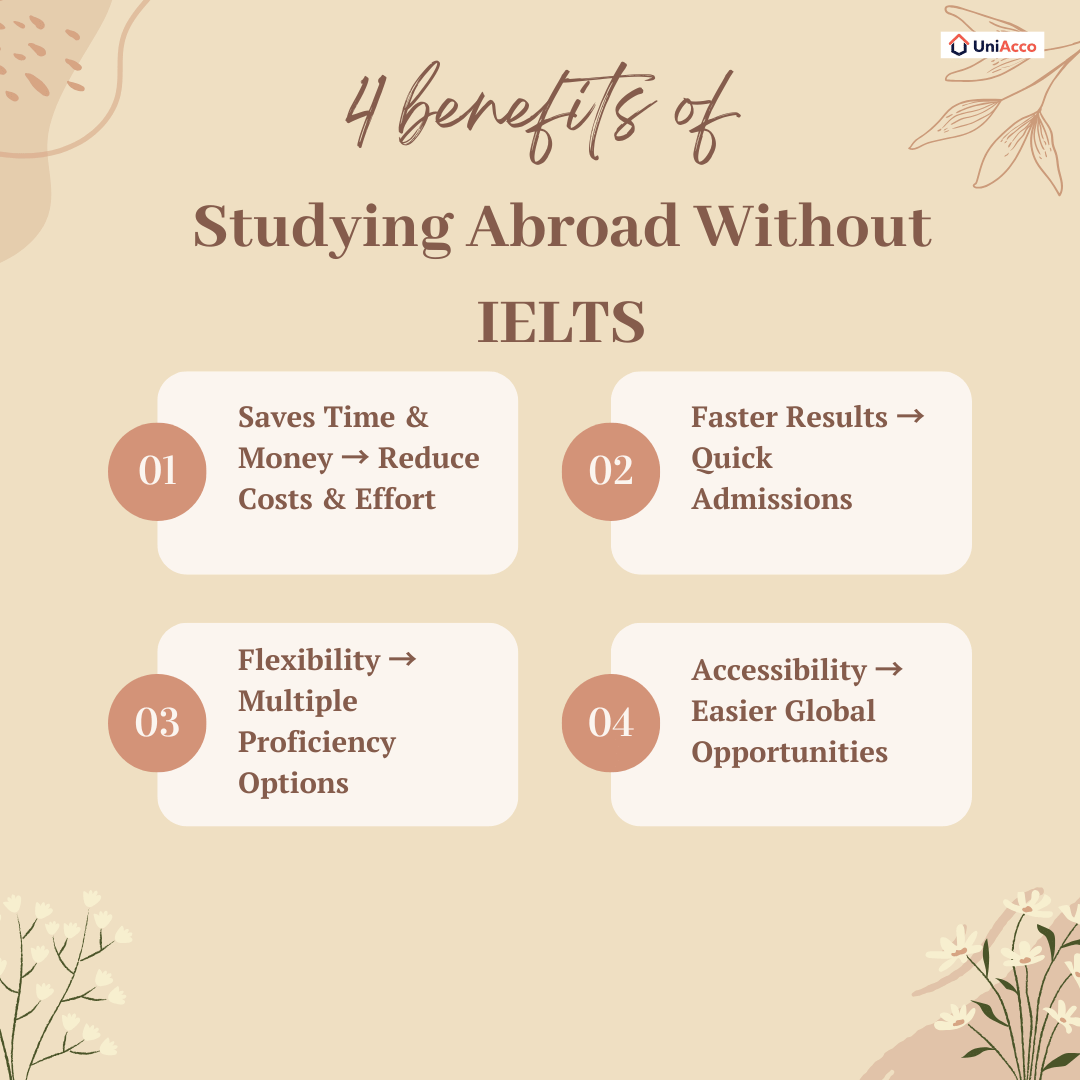
1. Saves Time & Money
Preparing for IELTS often takes months of study and multiple attempts, each costing both time and money. By applying to universities that accept alternative qualifications, you can redirect those resources toward application fees, travel, or settling into your new country, making your journey to global education more efficient and affordable.
2. Faster Results
Universities that don’t require IELTS typically have simpler admission procedures, meaning faster evaluation and quicker offer letters. You can plan your move, arrange student accommodation, and start your studies without waiting for lengthy exam results or retests.
3. Flexibility
Many institutions allow you to prove your English proficiency through previous academic records, interviews, or internal tests instead of standardised exams. This flexibility ensures that your potential isn’t limited by one test score and that your overall academic performance and communication skills are recognised.
4. Accessibility
For students from non-English-speaking countries, finding countries without IELTS for study abroad makes global education more accessible. It removes unnecessary barriers, empowering talented students, regardless of background, to pursue degrees from top international universities.
In short, skipping IELTS doesn’t mean lowering standards; it means expanding opportunities. It’s about making quality education reachable, fair, and truly global.
Read this Reddit thread to understand what students say about pursuing their degrees without IELTS.
How to pursue Masters abroad without IELTS/TOEFL? – r/Indians_StudyAbroad from r/Indians_StudyAbroad
Alternatives to the IELTS Exam
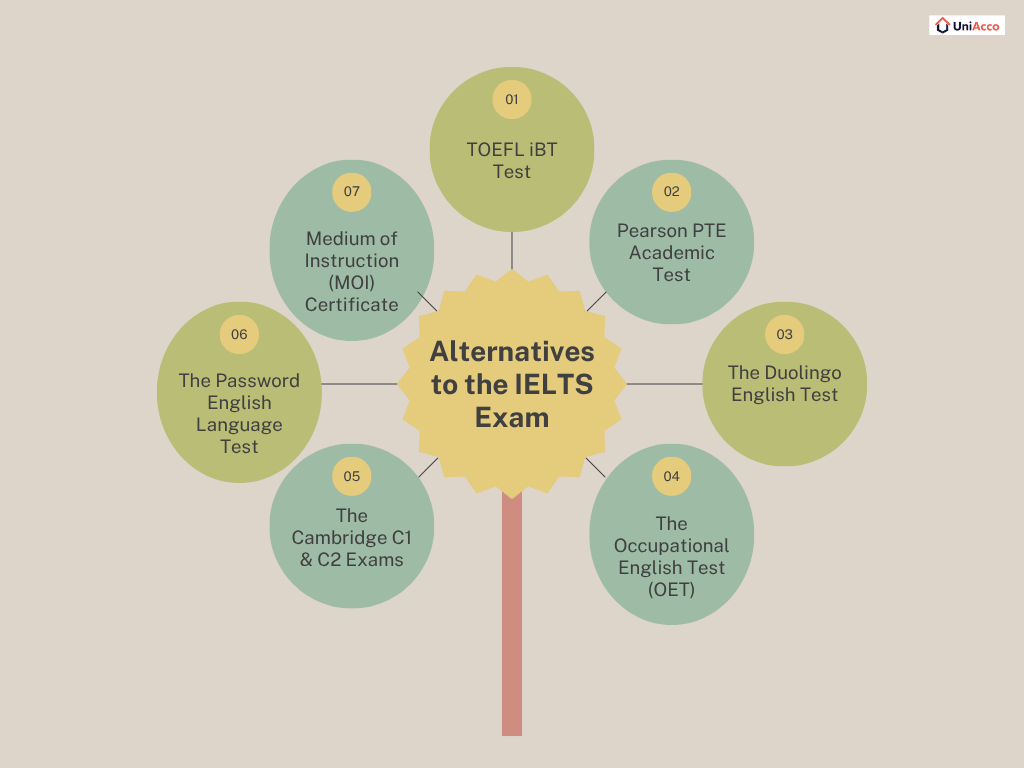
If you’re planning to study abroad without IELTS, several credible alternatives are accepted by universities across the globe. These tests and qualifications assess your English proficiency just as effectively, offering flexibility and accessibility to students from different academic backgrounds. Here are some of the most recognised options:
| Alternative Test | Key Highlights | Accepted In |
| TOEFL iBT (Test of English as a Foreign Language) | Assesses reading, writing, listening, and speaking skills. Accepted by over 11,000 institutions globally. | USA, Canada, parts of Europe |
| Pearson PTE Academic | Fully computer-based with AI scoring; results available within 48 hours. Known for speed and reliability. | Australia, New Zealand, UK |
| Duolingo English Test | Online, affordable, and can be taken from home; results ready within 48 hours. | USA, Canada, UK, select European universities |
| Occupational English Test (OET) | Focused on healthcare professions; measures English in a clinical or medical setting. | Nursing, Medicine, and Allied Health programs in the UK, Australia, and New Zealand |
| Cambridge English Exams (C1 Advanced & C2 Proficiency) | Globally recognised; certificates have lifetime validity and show high English mastery. | Accepted across Europe, UK, Australia, and Canada |
| Password English Language Test | Conducted online with remote supervisionRecognised by several UK and EU universities. | UK and select European countries |
| Medium of Instruction (MOI) Certificate | Issued by your previous institution confirming English was the primary medium of study | Widely accepted across the UK, Canada, Australia, and Germany. |
Discover the alternative exams students take instead of IELTS on this Quora thread.

How to Study Abroad Without IELTS?
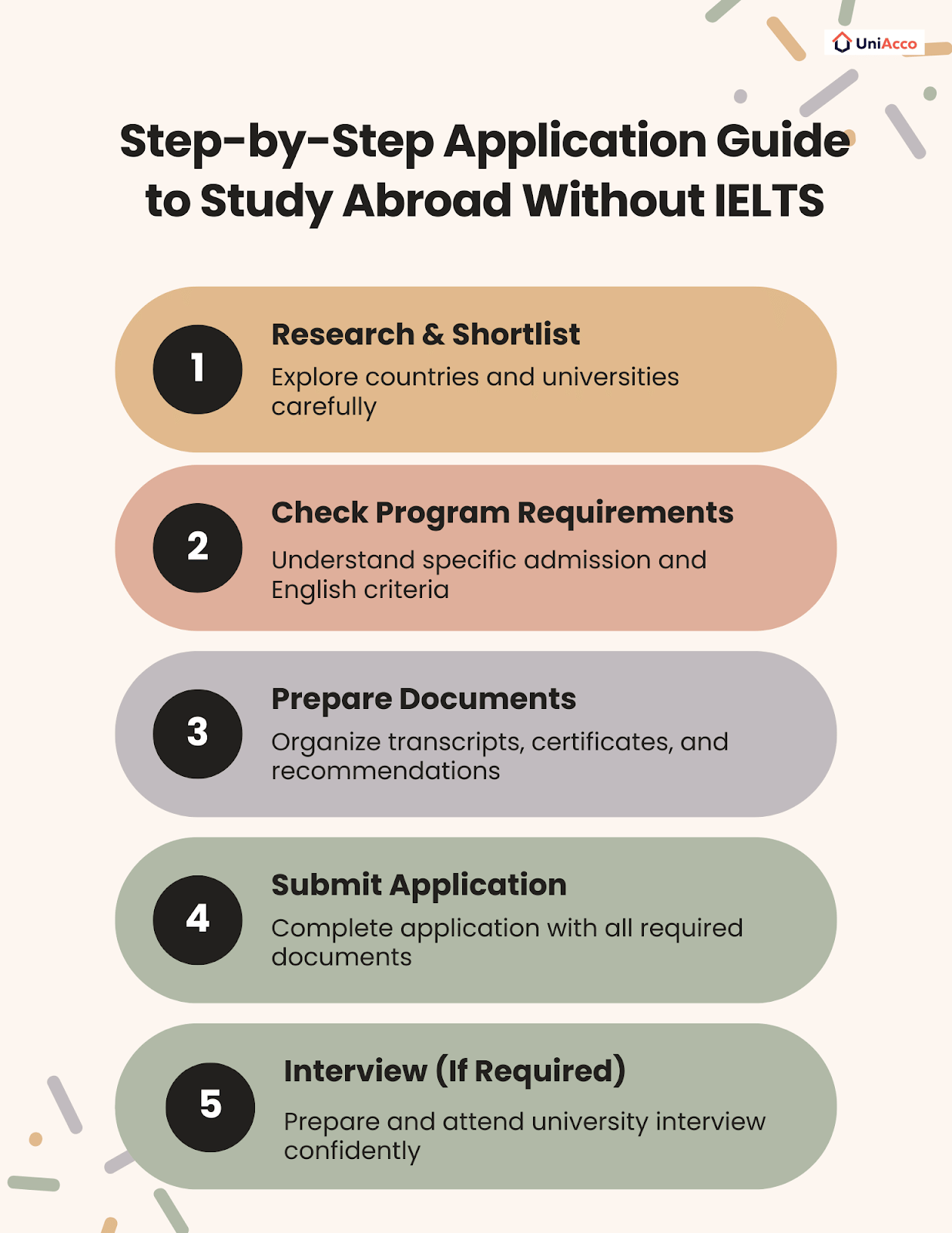
- Shortlist countries and universities
Begin by identifying study destinations that officially recognise IELTS alternatives. Build a list of universities in those countries that offer your preferred programs and clearly state MOI, Duolingo, TOEFL, or internal assessments as valid English-proficiency routes.
- Check program-specific requirements
After shortlisting universities, visit each program’s official page and review its exact English-language criteria. Check whether they accept an MOI, require specific English marks from previous studies, or use their own internal assessment. Mark these details so you know precisely what each program expects instead of IELTS.
- Prepare all required documents for submission
After reviewing the program’s criteria, collect your transcripts, MOI certificate or English-medium proof, passport, SOP, LORs, and any additional documents required by the university. Ensure each file is correctly formatted and ready to upload to the university portal.
- Submit your application
Once your documents are ready, log in to the university’s official application portal and begin your submission. Upload every required file in the specified format, fill out the application fields carefully, pay the application fee, and submit the form. This completes your formal application to study without IELTS.
- Complete the interview or internal English test
If the university invites you for an interview or conducts its own English assessment, participate as scheduled through their official platform. This step serves as your final demonstration of language ability, and your performance here often confirms your eligibility for admission without IELTS.
Discover verified student accommodations across multiple countries. Focus on studying and living fully — UniAcco makes it easy to find your ideal space.
🏠 Browse All Student AccommodationsConclusion
Today, global universities think differently, and so should you. Studying abroad without IELTS is now entirely possible, thanks to alternative pathways like the Medium of Instruction (MOI) certificate or the Duolingo English Test. As admission policies grow more flexible, your focus can stay on building a future that speaks of ambition. Just remember: every university has its own criteria, so review the details carefully before you apply.
Your journey doesn’t end with an acceptance letter. It begins there. UniAcco makes it easier to find verified student housing near your university, so you can effortlessly transition to life abroad from day one.


 LinkedIn






0 Comments