
Somewhere between your board exams and your tenth, “so what are you doing ahead?” video call with a relative, you Googled “highest paying engineering degrees”. But all you got was a list of outdated and recycled stats, right? Don’t panic, we have all had such moments! Here’s the truth. Choosing your engineering branch makes you feel as if the whole world is watching you, expecting perfection from day 1. But let’s face it; you need figures before taking any further steps.
That’s why we went down the research rabbit hole and did our homework for you. In this article, we are giving the exact breakdown of the best 10 engineering majors that offer the highest salaries in 2026 based on factual data collected from sources such as the BLS, QS Rankings, Payscale, and Grad Reports. Median salaries and job-growth percentages throughout this guide are official BLS figures; entry-level and mid-career ranges are estimates drawn from Payscale, Glassdoor, and industry salary reports layered on top of those medians, since BLS doesn’t publish an official ‘entry-level’ wage band.
Choosing the highest-paying engineering degrees in 2026 is all about mixing the right skills, picking the right industry, and sometimes just being in the right place. Let’s figure out which one fits you.
Highest-Paying Engineering Degrees at a Glance
Not in the mood to scroll through a giant info dump? Here’s a quick cheat sheet of the best engineering majors right now.
| Engineering Degree | Average Starting Salary | Mid-Career Salary | Top Hiring Industries | Best Countries |
| Computer Hardware Engineering | $95,000 | $165,000+ | Semiconductors, consumer tech, AI/data centres | US, Taiwan, South Korea, Germany |
| Petroleum Engineering | $100,000 | $175,000+ | Oil & gas, energy, carbon capture | US, Saudi Arabia, Norway, UAE |
| Aerospace Engineering | $88,000 | $145,000+ | Aviation, defence, space | US, France, UK, Germany |
| Nuclear Engineering | $90,000 | $140,000+ | Power generation, national labs, medical | US, France, UK, Canada |
| Chemical Engineering | $82,000 | $140,000+ | Energy, pharma, food, materials | US, Germany, Switzerland, Netherlands |
| Electrical & Electronics Engineering | $80,000 | $135,000+ | Power, renewables, telecom, robotics | US, Germany, Japan, Switzerland |
| Materials Engineering | $78,000 | $125,000+ | Semiconductors, aerospace, batteries | US, Japan, Germany, South Korea |
| Biomedical Engineering | $72,000 | $120,000+ | Medical devices, pharma, healthcare | US, Germany, Switzerland, UK |
| Marine Engineering & Naval Architecture | $80,000 | $120,000+ | Shipbuilding, offshore wind, defence | South Korea, Japan, Norway, Netherlands |
| Environmental Engineering | $70,000 | $115,000+ | Water, waste, climate adaptation | Netherlands, Germany, Canada, Australia |
Starting figures reflect typical entry-level US offers; mid-career figures reflect ten or more years of experience. Median salary data is from the BLS, May 2024.
Heading to the UK to study a high-paying engineering course? Make your accommodation search just as important as choosing your university. Compare verified and affordable student accommodation with UniAcco, including fully furnished studios, en-suite rooms, and shared apartments with all-inclusive utility bills, modern amenities, and flexible booking options before your academic session begins.
🔍 Explore Student Accommodation in the UKTop 10 Highest-Paying Engineering Degrees
Computer Hardware Engineering
Hardware engineers design the physical parts inside computers, phones and other electronic devices, including processors, circuit boards and memory chips. They create and test new hardware, check how well it works, and work with software engineers to make sure the hardware and software work well together.
Average salary
The US median salary is $155,020 (BLS, May 2024). Entry-level jobs usually pay around $90,000–$115,000, while experienced hardware architects in major tech cities can earn more than $200,000.
Top recruiters
Apple, NVIDIA, Intel, AMD, Qualcomm, TSMC, Samsung.
Best countries
United States, Taiwan, South Korea, Japan, Germany.
Best universities
MIT, Stanford, UC Berkeley, Carnegie Mellon, ETH Zurich.
Career outlook
About 7% projected US growth to 2034, driven by AI hardware, semiconductor reshoring, and data centre buildout.
Still wondering why computer engineers get high-paying jobs? Read this Quora discussion and hear the reason from professionals.

Petroleum Engineering
This one is about getting oil and gas out of the ground safely and profitably. You figure out where to drill, how deep to go, and the best way to extract what’s down there. Day to day, you’re split between computer models and site visits, solving whatever the reservoir throws at you. The pay is great, but keep in mind the industry is slowly shifting toward cleaner energy.
Average salary
US median $141,280 (BLS, May 2024). Entry-level offers often start at $100,000, and experienced engineers in senior or offshore roles can push past $200,000.
Top recruiters
Saudi Aramco, ExxonMobil, Shell, BP, Chevron, Halliburton, SLB.
Best countries
United States, Saudi Arabia, Norway, United Arab Emirates, Canada.
Best universities
Colorado School of Mines, University of Texas at Austin, Texas A&M, Heriot-Watt.
Career outlook
About 1% projected US growth by 2034. The field is cyclical, but demand is shifting toward carbon capture, geothermal, and offshore wind, so the skills are migrating rather than disappearing.
Aerospace Engineering
Did you ever dream of designing something that flies, whether planes, satellites, rockets, or drones? This field deals with rocket science, literally! Every day, your life revolves around simulation testing, modifying designs based on safety and energy conservation standards and regulations.
Average salary
US median $134,830 (BLS, May 2024). Entry-level roles typically pay $85,000 to $100,000, with experienced engineers at major manufacturers earning well above the median.
Top recruiters
Boeing, Airbus, Lockheed Martin, SpaceX, NASA, Northrop Grumman, RTX, Rolls-Royce.
Best countries
United States, France, United Kingdom, Germany, Canada.
Best universities
MIT, Caltech, Georgia Tech, TU Delft, Cranfield.
Career outlook
About 6% projected US growth by 2034, supported by fuel-efficient aircraft redesigns, cheaper satellite launches, defence spending, and commercial drones.
Nuclear Engineering
Nuclear engineers work with nuclear energy and radiation. They help design and maintain systems used to produce electricity and can also work on medical applications. Their daily work may include designing reactor systems, carrying out safety checks, and using physics to solve technical problems. It is a small field, so there are fewer jobs, but the jobs available are usually well-paid and stable.
Average salary
US median $127,520 (BLS, May 2024). Entry-level roles typically start around $85,000 to $100,000, with senior reactor engineers and safety specialists earning considerably more.
Top recruiters
Westinghouse, GE Hitachi, Framatome, EDF, NuScale, Kairos Power, US national laboratories.
Best countries
United States, France, United Kingdom, Canada, Japan.
Best universities
MIT, University of Michigan, Texas A&M, North Carolina State, Cambridge.
Career outlook
US employment is projected to decline about 1% by 2034, but a wave of retirements and new small modular reactor projects mean the openings that do appear are well paid and hard to fill.
Chemical Engineering
You take raw materials and figure out how to turn them into useful stuff at scale: fuel, medicine, plastics, food. It’s less about lab experiments and more about designing the giant processes that make products by the ton. Day to day, you’re optimising production, fixing quality issues, and keeping everything safe and efficient.
Average salary
US median $121,860 (BLS, May 2024). Entry-level roles typically pay $80,000 to $95,000, with process engineers in pharma and energy climbing fast.
Top recruiters
Dow, BASF, ExxonMobil, Shell, DuPont, Pfizer, Procter & Gamble, Linde.
Best countries
United States, Germany, Switzerland, Netherlands, Japan.
Best universities
MIT, Stanford, UC Berkeley, ETH Zurich, Cambridge.
Career outlook
About 3% projected US growth by 2034. Traditional refining is mature, but biomanufacturing, battery materials, and carbon capture are opening new lines of work.
Electrical & Electronics Engineering
You work with anything that runs on electricity, from power grids to the tiny circuits inside your phone. Electrical is the big-scale stuff like power systems, while electronics is the small stuff like chips and sensors. Day to day, you could be designing circuits, upgrading power networks, or building renewable energy tech.
Average salary
US median $118,780 (BLS, May 2024), with electronics engineers at $127,590 and electrical engineers at $111,910. Entry-level roles typically start between $80,000 and $95,000.
Top recruiters
Siemens, ABB, GE Vernova, Tesla, Texas Instruments, Schneider Electric, Bosch, Infineon.
Best countries
United States, Germany, Japan, Switzerland, South Korea.
Best universities
MIT, Stanford, ETH Zurich, NTU Singapore, UC Berkeley.
Career outlook
About 7% projected US growth to 2034, one of the fastest rates in engineering, driven by electrification, renewables, semiconductors, and communications infrastructure.
Materials Engineering
Materials engineers study the stuff things are made of, then invent better versions. They develop the lightweight alloys in aircraft, the semiconductors in phones, the ceramics in jet engines, the composites in wind turbine blades, and the next generation of batteries and superconductors. If something breaks or could just be better, you figure out what it should be made of. Day to day, you’re testing samples, analysing structures, and helping manufacturers bring new materials to market.
Average salary
US median $108,310 (BLS, May 2024). Entry-level roles typically pay $75,000 to $90,000, with semiconductor and aerospace materials specialists earning well above the median.
Top recruiters
Corning, Intel, Apple, Tesla, Boeing, 3M, Saint-Gobain, Umicore.
Best countries
United States, Japan, Germany, South Korea, Switzerland.
Best universities
MIT, Stanford, Cambridge, ETH Zurich, Northwestern.
Career outlook
About 6% projected US growth to 2034, lifted by batteries, semiconductors, 3D printing, and aerospace composites.
Biomedical Engineering
What it is: You mix engineering with medicine to build things that help people: pacemakers, artificial limbs, MRI machines. It’s hands-on problem solving for real health issues. You might be designing medical devices, running tests, or working with doctors to improve the equipment they use.
Average salary
US median $106,950 (BLS, May 2024). Entry-level roles typically start between $70,000 and $85,000, with R&D and engineering-services roles paying the most.
Top recruiters
Medtronic, Johnson & Johnson, Abbott, Boston Scientific, Siemens Healthineers, Stryker, GE HealthCare.
Best countries
United States, Germany, Switzerland, United Kingdom, Israel.
Best universities
Johns Hopkins, MIT, Stanford, Harvard, Duke.
Career outlook
About 5% projected US growth to 2034, supported by ageing populations and rising demand for medical devices and procedures.
Marine Engineering & Naval Architecture
You design, build, and maintain ships, submarines, and offshore structures. Don’t confuse it with a cruise ship captain. It’s more of “the engineer who makes sure huge vessels don’t sink.” Day to day, you’re working on propulsion systems, hull designs, and safety gear, often between an office and a shipyard.
Average salary
US median $105,670 (BLS, May 2024). Entry-level roles typically start between $80,000 and $90,000, with offshore and defence work paying premiums.
Top recruiters
Huntington Ingalls, BAE Systems, Damen, Fincantieri, Hyundai Heavy Industries, Rolls-Royce Marine.
Best countries
South Korea, Japan, Norway, Netherlands, and the United Kingdom.
Best universities
University of Michigan, University of Southampton, Newcastle University, TU Delft.
Career outlook
About 6% projected US growth to 2034, driven by defence shipbuilding and offshore wind installation vessels.
Environmental Engineering
You use engineering to protect the planet: cleaning up polluted water, managing waste, cutting air pollution. On a normal workday, you’ll be testing samples, designing treatment systems, and checking that projects follow environmental rules. It’s a field that’s only going to matter more as climate pressure grows.
Average salary
US median $104,170 (BLS, May 2024). Entry-level roles typically start between $70,000 and $85,000, with consulting and regulatory work dominating the field.
Top recruiters
AECOM, Jacobs, Tetra Tech, Veolia, SUEZ, WSP, ERM, Ramboll.
Best countries
Netherlands, Germany, Canada, Australia, United States.
Best universities
ETH Zurich, Stanford, UC Berkeley, Imperial College, TU Delft.
Career outlook
About 4% projected US growth to 2034, with climate adaptation and water infrastructure projects providing steady demand.
Shortlisted your engineering degree in Germany? Your next step is finding the right student accommodation. With UniAcco, you can explore verified and affordable student accommodation in Germany, including fully furnished studios, en-suite rooms, and shared apartments with modern amenities, flexible contracts, and convenient booking support to help you settle in with ease.
🔍 Explore Student Accommodation in GermanyEngineering Degrees Ranked by Salary
Are you trying to figure out exactly what type of engineer makes the most money over the span of a whole career? We’ve got you covered. Here is how they stack up when you look at engineering degrees ranked by salary.
| Rank | Degree | Starting Salary | Mid-Career Salary | Job Outlook |
| 1 | Computer Hardware Engineering | $95,000 | $165,000+ | +7% |
| 2 | Petroleum Engineering | $100,000 | $175,000+ | +1% |
| 3 | Aerospace Engineering | $88,000 | $145,000+ | +6% |
| 4 | Nuclear Engineering | $90,000 | $140,000+ | -1% |
| 5 | Chemical Engineering | $82,000 | $140,000+ | +3% |
| 6 | Electrical & Electronics Engineering | $80,000 | $135,000+ | +7% |
| 7 | Materials Engineering | $78,000 | $125,000+ | +6% |
| 8 | Biomedical Engineering | $72,000 | $120,000+ | +5% |
| 9 | Marine Engineering & Naval Architecture | $80,000 | $120,000+ | +6% |
| 10 | Environmental Engineering | $70,000 | $115,000+ | +4% |
Outlook refers to projected US employment growth from 2024 to 2034 (BLS).
You’ll see that the highest salaries and the fastest-growing jobs don’t always line up. Petroleum and nuclear pay really well, but those fields aren’t growing much. Electrical, mechanical, and industrial are growing way faster. That gap between what pays now and what will still be hiring in a few years? That’s the big thing you need to think about before you pick.
Wanna know which highest-paying engineering degrees students are pursuing? Read this Reddit thread and find out which course these students are doing.
Highest paying engineering degree? – r/EngineeringStudents
Highest-Paying Countries for Engineers
Where you end up living matters just as much as what you study. You could have the fanciest engineering degree, but if you’re stuck somewhere with zero tech investment, your paycheck is going to feel it.
| Country | Average Engineer Salary | Popular Engineering Fields | Work Opportunities |
| United States | $99,590-$155,020 median by branch | Tech, aerospace, oil & gas, defence | World’s largest engineering job market; visa sponsorship varies |
| Switzerland | CHF 95,000+ (around $110,000+) | Pharma, medical devices, precision manufacturing | Europe’s highest pay, but among the world’s highest living costs |
| Germany | €60,000-€75,000 | Automotive, mechanical, chemical, energy | Strong industrial base and structured graduate routes |
| Australia | A$110,000-A$135,000 | Mining, oil & gas, infrastructure | Mining regions pay top rates; strong graduate demand |
| Netherlands | €55,000-€70,000 | Semiconductors, water management, logistics | English-friendly hiring, especially around ASML’s ecosystem |
| United Kingdom | £38,000-£55,000 experienced | Aerospace, automotive, energy, defence | Structured graduate schemes, lower nominal pay than the US |
| Canada | CAD 85,000-CAD 110,000 | Oil sands, aerospace, infrastructure | Skilled-worker immigration pathways are relatively open |
| UAE & Saudi Arabia | Tax-free packages often $100,000+ | Oil & gas, construction, power | No income tax, expat-heavy, rotation-based roles |
Figures are indicative ranges from national salary guides and professional bodies; currency conversions fluctuate.
Best Universities for Each Engineering Specialisation
Does the uni name on your degree matter? Yes, it can totally help you get past those annoying HR software filters. According to the latest QS World University Rankings for Engineering and Tech, here are the big names:
| Specialization | Leading Universities |
| Computer Hardware | MIT, Stanford, UC Berkeley, Carnegie Mellon, ETH Zurich |
| Petroleum | Colorado School of Mines, University of Texas at Austin, Texas A&M, Heriot-Watt |
| Aerospace | MIT, Caltech, Georgia Tech, TU Delft, Cranfield |
| Nuclear | MIT, University of Michigan, Texas A&M, North Carolina State, Cambridge |
| Chemical | MIT, Stanford, UC Berkeley, ETH Zurich, Cambridge |
| Electrical & Electronics | MIT, Stanford, ETH Zurich, NTU Singapore, UC Berkeley |
| Materials | MIT, Stanford, Cambridge, ETH Zurich, Northwestern |
| Biomedical | Johns Hopkins, MIT, Stanford, Harvard, Duke |
| Marine | University of Michigan, University of Southampton, Newcastle, TU Delft |
| Environmental | ETH Zurich, Stanford, UC Berkeley, Imperial College, TU Delft |
Engineering degrees in Ireland can be demanding, and finding the right place to live shouldn’t add to the stress. Explore verified and affordable student accommodation in Ireland with UniAcco, featuring fully furnished studios, en-suite rooms, and shared apartments with modern amenities and all-inclusive utility bills, helping you settle into student life with ease.
🔍 Explore Student Accommodation in IrelandFuture Demand: Engineering Fields with the Strongest Job Growth
You can’t just see one side of the coin, can you? We get it, paycheck matters, but at the same time you also need to make sure there is enough demand for your degree in the future. Here’s how things stand at the moment. Industrial engineering takes the first place at the podium at 11%, followed closely by mechanical at 9%. Electrical, hardware, aerospace, marine, and materials are all in the 6-7% range. But what’s pushing all this growth? Four big things:
Electrification
Power grids, electric vehicles, and renewables need electrical engineers in volumes the industry has never hired before. Every new wind farm, substation, and EV platform needs a team of them.
AI and Semiconductors
The chips powering AI models have to be designed, tested, and manufactured, which is why hardware engineering is both one of the highest-paying and one of the fastest-growing branches.
Reshoring
After decades of offshoring, manufacturing is returning to the US and Europe, and industrial and mechanical engineers are the people who design and run those new plants.
Infrastructure and climate
Ageing roads, bridges, and water systems, plus flood defences and clean-energy retrofits, keep civil and environmental engineers in steady demand.
But here’s the other side: petroleum is only growing 1%, and nuclear is actually shrinking, even though both pay really well and still have jobs open up when people retire. If you want both good pay and solid job growth, electrical, mechanical, industrial, and computer hardware are your safest bets for the next decade.
Skills Recruiters Look for in High Paying Engineering Jobs
Trust us, nobody is reading your cover letter to see if you are a “highly motivated, synergy-driven team player.” If you want the most paying engineering jobs, you need to show you can actually do the work.
- Technical Skills: Do you know Python, PyTorch, C++, or SQL? Can you optimise a real-time data stream using Kafka?
- Software & Tools: If you are an AI engineer, you need to understand RAG pipelines and LLMs. If you are mechanical, your CAD and MATLAB skills need to be flawless.
- Soft Skills: Systems engineers especially need to be able to explain crazy complex tech to business executives who have zero technical background.
- Real-World Proof: Please, don’t just lean on your GPA. A good Kaggle ranking, a GitHub full of real projects, or something you’ve actually built and shipped will impress interviewers way more.
How to Choose the Right Engineering Degree
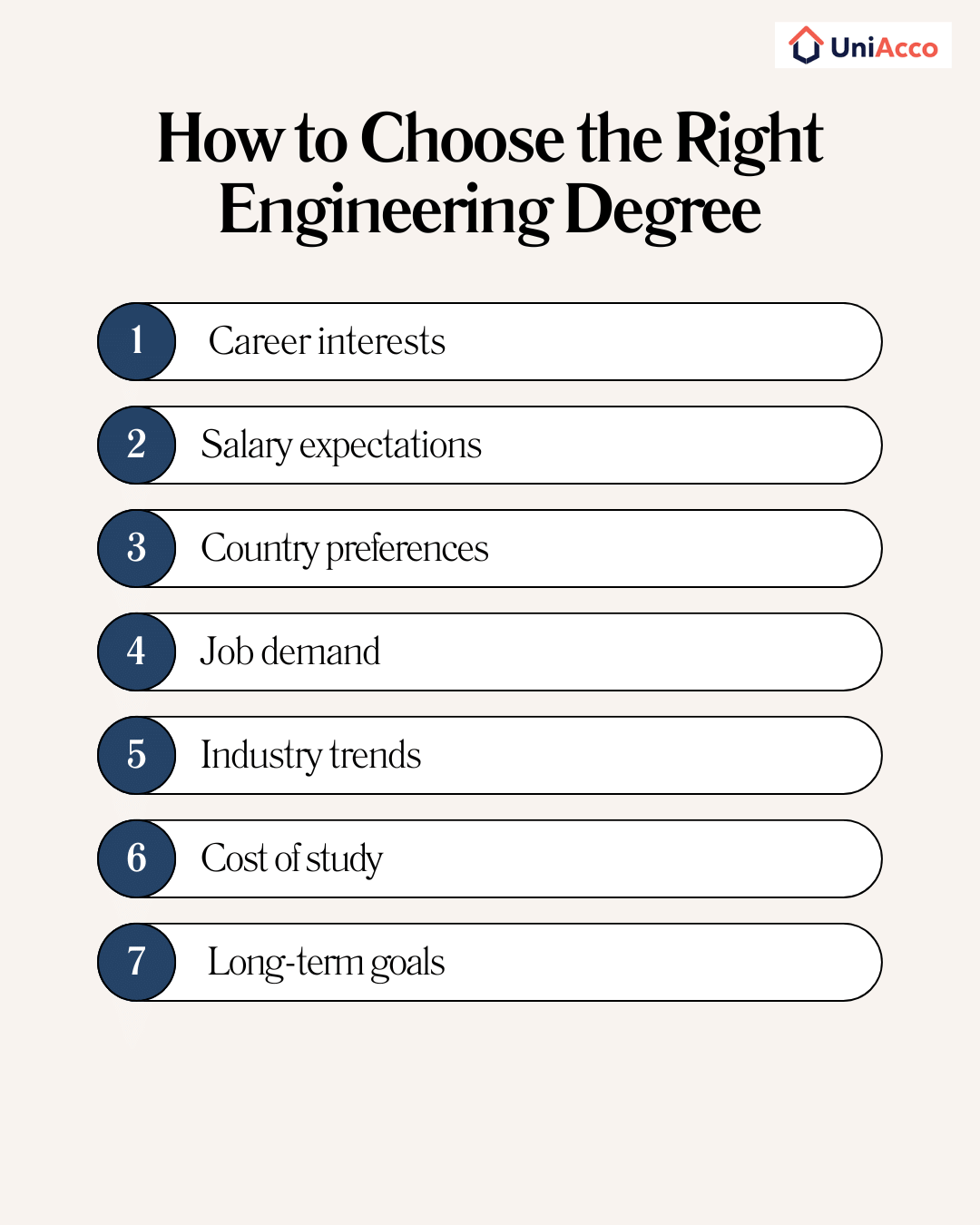
With all these choices, how are you supposed to pick the right one? Here are the questions you actually need to answer (and be honest with yourself about):
- Career interests: Can you picture yourself on an oil rig? In a lab? On a construction site? Your day-to-day matters more than the first digit in your salary.
- Salary expectations: Look beyond the starting offer. What does your 10-year earning potential look like? Petroleum and hardware engineers win long-term.
- Country preferences: Did you know that some courses hold higher value according to specific countries? Such as mining engineering in Australia, petroleum engineering in Canada, computer hardware engineering in the USA, and mechanical engineering in Germany.
- Job demand: Do you hate applying for internships where thousands of resumes are submitted every day? It sounds terrifying. Fortunately, job demand projections will give you peace of mind. According to growth projections, industrial engineering (+11%) and mechanical engineering (+9.1%) offer job security, which means less competition and more opportunities for placements.
- Industry trends: Renewable energy sources, AI hardware, and robotics technologies will revolutionise the future economy. So, wouldn’t it be wise to select branches based on the scope? You bet!
- Cost of study: This is the one everyone forgets. If you pick an expensive degree in a country where it’s hard to stay and work after, your salary advantage can disappear fast. Check tuition, living costs, and accommodation before you commit.
- Long-term goals: Wanna lead teams, start your own company, or move abroad for work? What you want in your future will clearly shape your degree choice.
Conclusion
That’s it! The 10 highest-paying engineering degrees in 2026, with real numbers, the best unis, the top countries, and the skills you actually need to make it work.
Here’s the big picture: engineering is still one of the best degrees out there. Computer hardware and petroleum are at the top for pay right now, but electrical, mechanical, and industrial give you the best mix of salary, job growth, and future demand. No matter which branch you pick, you’re stepping into a field with nearly 187,000 job openings every year, according to BLS projections, a mix of newly created roles and positions vacated by retirements and career changes.
University life is stressful enough. Don’t let accommodation become another thing on your plate — compare vetted student homes with transparent, all-inclusive pricing on UniAcco.
Frequent Asked Questions


 LinkedIn










0 Comments