Remember the 2020 hit Normal People? Sally Rooney, the author of the book by the same name, is an alumnus of Trinity College Dublin. If you are normal enough, then you have already had a stunning glimpse of Dublin’s historic, intellectual halls of Trinity College. If you haven’t watched the film or read the book yet, do yourself a favour. You’re welcome.
Dublin, Ireland’s capital, is more than just a beautiful backdrop. It has made its mark as a leading global education hub. In fact, in the 2024-25 academic year, 44,500 students enrolled in Ireland. This means there is a growing appeal for Ireland as an educational hub.
Known as the Silicon Valley of Europe, Dublin offers a blend of cultural diversity and a booming job market. In this guide, we’ll give you an in-depth look at the top universities in Dublin, their acceptance rates, tuition fees, and the best universities in Dublin.
Dublin’s Best Universities at a Glance
Before we deep dive into the best colleges in Dublin, here’s a quick overview of the leading institutions in 2026.
| University Name | Latest QS Ranking | Key Highlights | Approx Annual Tuition Fees |
| Trinity College Dublin | 75 | Ireland’s oldest universityNo. 1 in Ireland’sGlobal research leader | €18,000 – €28,000 |
| University College Dublin | 118 | The largest university in IrelandHighly reputed for graduate employability | €20,000 – €29,000 |
| Dublin City University | 410 | Renowned for industry-focused programs, enterprise, and innovation | €15,000 – €18,000 |
| Technological University Dublin | 781 – 790 | Ireland’s first technological universityHeavy focus on applied sciences | €11,000 – €15,000 |
| National College of Ireland | 701 | Premier specialist in Business, Computing, HR, and Data analytics | €10,000 – €15,000 |
| National College of Art and Design | — | Ireland’s premier institution for fine arts, design and visual culture | €14,000 – €17,000 |
| Royal Irish Academy of Music | — | World-class conservatoire for elite classical music and vocal training | €12,000 – €16,000 |
| Dublin Institute for Advanced Studies | — | Elite statutory institute for advanced fundamental physics and Celtic research | Offers fully-funded PhD studentships and scholarships. |
| Royal College of Surgeons in Ireland | 101-150 | Leading medical institutionGlobally recognised for healthcare and surgery | €25,000 – €57,000 |
Why Choose to Study in Dublin?
Dublin is the home ground for the best universities like Trinity College, University College Dublin, Dublin City University and so on. Across these institutions, students and teachers have made immense progress in medicine, atomic physics and literature. More recently, they have led the way in areas like business, technology and digital innovation.
Here’s why choosing to study in Dublin is a Normal People sign…
- Home to Globally Recognised Universities: Dublin features top ranked institutions like Trinity College Dublin (ranking 81st in the world) and University College Dublin (top 1% globally). These universities offer state-of-the-art education in research-intensive environments, with strong industry links in technology, business, and medicine, attracting students worldwide to the city. The best universities in Dublin consistently feature at the top of the global charts.
- Major hub for Tech and Multinational Companies: Famously known as the Silicon Docks, Dublin is a premier European tech hub. It hosts European headquarters for major multinational companies like Google, Meta, Amazon, Microsoft, and Apple. That’s not it. 9 of the top 10 US tech companies (Google, Meta, Apple, Amazon, Microsoft, Intel, Oracle, Salesforce, and IBM) operate in Dublin, drawn by a 15% corporate tax rate, skilled talent, and an ecosystem fostering AI, cloud, and software innovation.
- Strong Internship and Job Opportunities: Dublin offers a range of internship and job opportunities, especially in tech, finance, and professional services. Major firms like Deloitte offer roles in tax, consulting, and technology. Key employment sectors include engineering, cybersecurity, accounting, and project management.
- Vibrant International Student Community: The scenic lakes, woodland walks and abundant wildlife in Dublin draw a diverse international student community from around the globe. Ranked 32nd in the world, top institutions like University College Dublin and Dublin City University draw students from over 150 countries. The city provides a welcoming, walkable environment with extensive support services, career opportunities, and an active social scene tailored for a student lifestyle.
- Post-Study Work Opportunities in Ireland: A strategic report from the Higher Education Authority (HEA) of Ireland highlights that approximately 70% of all graduates from the 7 public universities in Ireland are employed shortly after graduation. Among these employed graduates, around 60% found work within Ireland, while about 10% secured positions outside of Ireland. This indicates a robust domestic job market and international mobility for Irish graduates. Ireland’s job market is particularly attractive for graduates due to steady growth in the service sector, making it the preferred destination for Irish university alumni.
Found your reason to study in Dublin? Now let’s sort your accommodation too. Explore affordable, fully furnished student rooms with flexible lease terms on UniAcco.
🔍 Explore Dublin Student HousingBest Universities in Dublin for International Students
Let’s take a comprehensive look at the top universities in Dublin for the 2026-27 academic year.
Trinity College Dublin, The University of Dublin (TCD)
Founded in 1592, with a QS ranking of 75 as of 2026, Trinity College is Ireland’s oldest and highest-ranked university. This historic research-intensive institution is known for its 47-acre campus, the Book of Kells, and academic excellence in arts, humanities, science, and health sciences. Located in a beautiful campus in the heart of Dublin’s city centre, Trinity College is home to 22,000 undergraduate and postgraduate students across all the major disciplines in the arts and humanities, and in business, law, engineering, science, and health sciences.
- Location and Accessibility
College Green, Dublin 2, Ireland.
- Popular Nearby Places
| Where To Visit | Distance in Miles | Travel Time | How to reach? |
| Temple Bar | 0.3 miles | 5 min | Walk |
| Book of Kells | on the campus | 2-5 min | Walk |
| Grafton Street | 0.2 miles | 3 min | Walk |
| St. Stephen’s Green | 0.5 miles | 10 min | Walk |
- Acceptance Rate: 34%
- UG & PG Courses to Study
| Course Name | Key Course Highlights | Eligibility Criteria | Avg Fees (for international students) |
| Engineering & Science (UG) | Chemical Sciences, Environmental Science and Engineering, Electronic and Computer Engineering, Mechanical and Manufacturing Engineering. | Strong academic results, typically including higher-level mathematics. Applicants need a minimum of six subjects, including English, Mathematics, and another language, with specific grades in A-Level (Grade C in Math), IB (HL Grade 5 Math), or equivalent leaving certificates, and English proficiency (IELTS 6.5+). | €21,000 to €57,000 per year |
| Social Sciences and Humanities (UG) | Law, Psychology, Philosophy, Political Science, Economics, and European Studies. | A full set of 6 valid subjects from high school/secondary education.Typically requires specific grades in at least 6 subjects, including pass grades in English, Mathematics, and a language other than English.Applicants whose first language is not English must provide evidence of proficiency (e.g., IELTS, TOEFL, Cambridge, or Pearson test of English). | €21,000 to €29,500+ per year |
| Business School (PG) | MSc in Business Analytics & AI, Digital Marketing Strategy, Finance, Human Resource Management, and International Management. | A 2.1 Honours degree (or GPA 3.2+/4.0) is the standard minimum for most programs, though sometimes a 2.2 may be considered depending on the course and experience.IELTS: Minimum 6.5 (no band below 6.0).TOEFL: 90 (internet-based).Cambridge Proficiency/Advanced: 180 (no score below 170).The Trinity MBA requires 3–5 years of professional managerial experience, a preferred GMAT score of 600, or equivalent GRE. | €24,000 for standard Master’s programmes to over €37,000 for specialised courses like the MBA. Most MSc programs fall in the €20k-€30k range, while the Full-Time MBA is notably higher. |
| Engineering & Science (PG) | Intelligent Systems (Computer Science), Environmental Engineering, Sustainable Energy. | A minimum of an upper second-class honours bachelor’s degree (2.1) is required for most taught master’s programs.Candidates must hold a degree in engineering, science, computing, statistics, or mathematics.Applicants must satisfy university-level English proficiency requirements, typically through tests like IELTS or TOEFL.Well-qualified candidates from other numerate disciplines or with significant professional experience may also be considered. | €20,000 to €35,800 per year |
- Notable Alumni
Legendary is the word when it comes to the alumni of Trinity College Dublin. Literary giants like Oscar Wilde, Bram Stoker, and Samuel Beckett and more recently, notable alumni include Mary Robinson – former President of Ireland, and Sally Rooney – acclaimed modern author of Normal People.
University College Dublin
Ranked 118th in the QS World University Rankings 2026, UCD was established in 1854 by John Henry Newman. It is a historic institution with a strong international focus and elite world-ranked subjects. Top 1% ranked research university and Ireland’s largest institution, the University College Dublin (UCD), hosts over 38,000 students from 152 countries. Located in Dublin, UCD is a member of the National University of Ireland. It is consistently ranked among the best universities in Dublin for its massive international student intake.
- Location and Accessibility
Belfield, Dublin 4, Ireland.
- Popular Nearby Places
| Where To Visit | Distance in Miles | Travel Time | How to reach? |
| Dundrum Town Centre | 2.5 miles | 15 min | Bus / Luas |
| Sandymount Strand | 2 miles | 15 min | Bike / Bus |
| Aviva Stadium | 2.2 miles | 20 min | Bus |
- Acceptance Rate: 20%
- UG & PG Courses to Study
| Course Name | Key Course Highlights | Eligibility Criteria | Avg Fees (for international students) |
| Veterinary Science & Medicine (UG) | Offers the only Bachelor of Veterinary Medicine (MVB) degree in Ireland. The 5-year undergraduate programme (DN300) is globally recognised and highly ranked, educating students to international standards. | Minimum 6 subjects, including at least two H5 grades, with H5 in Chemistry and O6/H7 in English, Irish, Mathematics, a third language, and one other subject.Applicants must complete at least 60 hours of practical experience in animal handling. | €35,225 per year |
| Computer Science & Data Science/AI (UG) | A balance of theoretical foundations (machine learning, algorithms) and practical applications (Python, Java) | Applicants must have passed high school (e.g., CBSE/CISCE) with an average of 80% or higher, based on the top 5 subjects.A high proficiency in Mathematics is crucial. A minimum Grade H4 in Leaving Certificate Mathematics (or equivalent) is strongly recommended, or a minimum of O2/H6 in Math, H7 in English, and H7 in Irish or another language.If English is not the first language, certification (e.g., IELTS, TOEFL) is required. Common requirements are an overall IELTS score of 6.5 (no band less than 6.0). | €27,720 per year |
| Business & Analytics (PG) | It combines data science, management science, and operational research to train students in modelling, machine learning, and using data for strategic decision-making, with a high return on investment. | A degree in a quantitative field or a business degree with a strong emphasis on MIS, Maths, or Statistics.A minimum second-class honours (2:2) or international equivalent, though higher performance is preferred.Applicants whose first language is not English must provide evidence of proficiency, typically with an IELTS score of 6.5 or higher (with no component lower than 6.0) or equivalent. | €26,180 |
| Computer Science & Artificial Intelligence (PG) | Focus on machine learning, deep learning, and AI applications to real-world challenges, emphasising ethics, technical skills, and tailored learning paths for tech careers | A 2:1 honours degree (or equivalent, typically 60% or higher) in Computer Science, Computer/Electronic Engineering, Informatics, AI, Mathematics, or Physics.Evidence of completing a module with a significant programming component in C, C++, C#, Java, Python, or R.A strong background in Mathematics is required, along with at least one module in Machine Learning, AI, Data Science, or Data Mining.Applicants must demonstrate English language proficiency, typically requiring an IELTS score of 6.5 (no band below 6.0) or equivalent | €24,140 to €31,780+ per year |
- Notable Alumni
UCD has produced iconic historical figures such as author James Joyce, renowned actor Gabriel Byrne, and comedian Chris O’Dowd, alongside numerous Irish political leaders and international business innovators.
Submitted your application to University College Dublin? Now let’s close the deal on your accommodation. Explore top student housing near UCD with UniAcco, featuring fully furnished rooms and premium in-room and community amenities.
🔍 Explore Student Housing Near UCDDublin City University (DCU)
With a QS ranking of 410 as of 2026, Dublin City University (DCU) is a young, research-intensive public university in Dublin. It is recognised for its strong focus on employability, innovation, and industry partnerships. With over 20,000 students from more than 120 countries, DCU was established in 1989. The university operates three academic campuses — Glasnevin, Drumcondra, and St. Patrick’s, located on the north side of Dublin, about 15 minutes from the city centre.
- Location and Accessibility
Glasnevin, Dublin 9, Ireland.
- Popular Nearby Places
| Where To Visit | Distance in Miles | Travel Time | How to reach? |
| National Botanic Gardens | 1.5 miles | 10 min | Bus / Walk |
| Croke Park | 2.0 miles | 15 min | Bus |
| Phoenix Park | 3.5 miles | 25 min | Bus |
| Glasnevin Cemetery & Museum | 1.5 – 2 miles | 20 min | Bus |
- Acceptance Rate: 40–52%
- UG & PG Courses to Study
| Course Name | Key Course Highlights | Eligibility Criteria | Avg Fees (for international students) |
| BSc Digital Business and Innovation (UG) | Focuses on leveraging digital technologies to transform businesses | Minimum of 6 subjects, including at least 2 Higher Level H5 grades and 4 Ordinary Level O6/H7 grades. English/Irish (O6/H7) and Mathematics (O4/H6) are mandatory.At least 3 A-Level grades C, or a mix of A/AS levels, requiring Mathematics and English at GCSE level.Minimum 24-26 points required, with specific grade requirements for Maths.Applicants must satisfy DCU’s English language requirements, typically an IELTS score of 6.5 (or equivalent) for non-native speakers. | €15,000 to €16,500 per year |
| BA Global Business (UG) | Double degree program; study in Ireland/Canada, including work placements | Completion of Standard XII with an overall average of 80% or higher.Mathematics and English must be passed at the 12th-grade level.For language-specific tracks (France, Germany, Spain), you must demonstrate competency in that language.IELTS: A minimum overall score of 6.5 is required, with no component below 6.0.TOEFL iBT: A minimum total score of 92. | €15,000 to €16,500 per academic year. |
| MSc in Finance (PG) | Full-time/Part-time options, industry-aligned curriculum | A 2.1 Honours degree (Level 8) in a Business discipline, OR a 2.1 Honours degree in a relevant non-business discipline (Engineering, Physics, Maths, Computer Science).A 2.2 Honours degree may be considered depending on availability and high grades in relevant modules.IELTS: Minimum 6.5 overall (with 6.0 in all components).TOEFL iBT: Overall 92 or above.PTE: Minimum 63.Duolingo: 120+ | €23,000 |
| MSc in Business Management (PG) | Focus on business strategy; 3 Master’s available in January | A 2.1 Honours degree (Level 8) in a non-Business discipline.Candidates with a 2.2 Honours degree in a non-business discipline may be considered based on grade performance and place availability.IELTS: Minimum 6.5 overall, with 6.0 or higher in all components.TOEFL iBT: 92 overall, with all section scores 21 or above.PTE: 63 or higher, with a minimum of 63 in speaking/writing and 59 in listening/reading.Duolingo: Minimum 120, with 110 in each subscore. | €23,000 per year |
- Notable Alumni
Dublin City University has a network of over 110,000 alumni worldwide, with graduates frequently recognised for leadership in business, technology, media, and politics. To name a few — Lorraine Twohill (Chief Marketing Officer at Google), Ardal O’Hanlon (Comedian, actor), John Connolly (Author).
Technological University Dublin
Technological University Dublin (TU Dublin) is Ireland’s second largest university, officially established on 1st January 2019. It was born as a fruit of the collaboration of the three existing universities — Dublin Institute of Technology (DIT), Institute of Technology Blanchardstown (ITB), and Institute of Technology Tallaght (ITT). TU Dublin is a leader in STEM (Science, Technology, Engineering, Mathematics), arts, business, and humanities education, operating a practice-based, employer-engaged learning model.
- Location and Accessibility
Grangegorman Lower, Dublin 7, Ireland (Main Campus).
- Popular Nearby Places
| Where To Visit | Distance in Miles | Travel Time | How to reach? |
| Phoenix Park & Dublin Zoo | 2.5 – 3 miles | 15-20 min | Bus / LUAS |
| Temple Bar & Ha’penny Bridge | approx 1 mile | 15 min | Walk / Short LUAS ride to Jervis/Abbey St. |
| National Botanic Gardens | approx 2 miles from Grangegorman | 15-20 min | Bua (4,9, 83) |
- Acceptance Rate: 46-60%
- UG & PG Courses to Study
| Course Name | Key Course Highlights | Eligibility Criteria | Avg Fees (for international students) |
| BSc (Hons) in Computer Science | A comprehensive 4-year program (often with AI or Data Science options) focusing on software development, data analytics, and artificial intelligence. It emphasises practical skills through project-based learning and offers strong career prospects in Ireland’s tech sector. | Minimum of 6 subjects, including at least two H5 (Higher Level) grades. Subjects must include Mathematics and either English or Irish.A grade of O6/H7 or better is required in Maths.Minimum 5 distinctions, including a distinction in specific Maths-related modules.Equivalent of 60% or higher in 12th Standard/High School, with a focus on Mathematics and English.If English is not your first language, proof of proficiency is required (e.g., IELTS 6.0 overall or equivalent). | €13,500 to €15,000 per year |
| BSc (Hons) in Business and Finance | A four-year degree based at the Aungier Street campus, focusing on accounting, economics, and finance. It provides a solid foundation for careers in banking, corporate finance, and management, with a high degree of industry relevance. | A completed high school education with strong grades (typically a minimum of 60-70% overall average in 12th standard, depending on the educational board).Applicants must pass high school with satisfactory marks in Mathematics and English.IELTS: Minimum score of 6.0 overall, with no less than 6.0 in each component.TOEFL iBT: Minimum score of 80.Duolingo English Test: Minimum score of 120 with at least 110 in each sub-section. | €12,000 to €15,000 per year |
| MSc in Computer Science (Advanced Software Development) | A one-year full-time programme (or two years part-time) focusing on advanced software engineering, AI, and cloud computing. It is designed to upskill professionals in cutting-edge technology, with courses held on campus | A BSc (Honours) in Computer Science or a closely related discipline with an Upper Second-class Honours (2.1) or higher.Applicants with a 2.2 honours degree and at least 2 years of relevant professional work experience may be considered.Strong programming competence is required, with potential testing in C, C++, or Java. Applicants must provide evidence of English proficiency (minimum IELTS 6.5 overall, with no less than 6.0 in each component). | €21,750 |
| MSc in Energy Management | A one-year, intensive program designed to equip students with advanced knowledge in sustainable energy systems and energy policy. It is highly relevant to the growing global renewable energy sector. | A minimum 2.2 award in an Honours Bachelor of Engineering Degree (Level 8) is typically required.If English is not the first language, a minimum IELTS (Academic Version) score of 6.5 overall, with nothing less than 6.0 in each component, is required. | €14,500 (full-time one year) |
- Notable Alumni
TU Dublin has a distinguished alumni network of over 175,000 people, particularly known for graduates in arts, hospitality, business and engineering. Some of the popular known faces are — Domhnall Gleeson (Actor/Writer), Liam Cunningham (Actor, Game of Thrones), Caitriona Balfe (Actor), and John Moore (Film Director). Sinéad O’Connor (Singer-Songwriter), Imelda May (Musician), Damien Dempsey (Folk Singer), and Duke Special.
National College of Ireland
Established in 1951, the National College of Ireland (NCI) is situated in the heart of Dublin’s International Financial Services Centre (IFSC) at Mayor Square and Spencer Dock. They’re celebrating their 75th anniversary this year. NCI is known for its industry-focused curriculum, particularly in business, computing, psychology, and education, with a strong emphasis on employability and student support.
- Location and Accessibility
Mayor Street Lower, International Financial Services Centre (IFSC), Dublin 1.
- Popular Nearby Places
| Where To Visit | Distance in Miles | Travel Time | How to reach? |
| EPIC The Irish Emigration Museum | 0.1 miles | 2 min | Walk |
| The Convention Centre | 0.2 miles | 4 min | Walk |
| 3 Arena | 0.8 miles | 15 min | Walk / Luas |
- Acceptance Rate: 50-53%
- UG & PG Courses to Study
| Course Name | Key Course Highlights | Eligibility Criteria | Avg Fees (for international students) |
| BSc (Hons) in Computing (UG) | Covers software development, databases, and network technologies. | Overall average of 70% or above in Class XII (All State boards/CBSE/ICSE).High school diploma with strong academic results. A-Levels (2-3 subjects) or IB Diploma are accepted. A minimum of grade O6/H7 is required in Mathematics.IELTS score of 6.0–6.5 (with no band lower than 6.0) or equivalent TOEFL/Duolingo scores | €10,000 to €14,000 per year |
| BSc (Hons) in Data Science (UG) | Focuses on analytics, data mining, and machine learning techniques. | A 70% average or higher in 12th Standard Higher Secondary Certificate (or equivalent state board exams).A minimum of grade H5 or higher in Mathematics (or a very strong score in 12th math) is typically required.Proficiency in English must be demonstrated through a recognised test, generally an IELTS score of 6.0 overall (or equivalent, such as 60+ TOEFL or 105+ Duolingo). | €14,000 per year |
| MSc in Artificial Intelligence (PG) | Focuses on AI techniques, machine learning, and automation. | Minimum Level 8 honours degree (2.2 or higher) in Computing or a cognate area.STEM (Science, Technology, Engineering, Mathematics) degrees that included programming or application development modules.Applicants should ideally have no more than 5-7 backlogs. | €17,000 |
| MSc in Cyber Security (PG) | Covers threat intelligence, ethical hacking, and digital forensics. | An Honours (Level 8) primary degree in Computing, or a cognate area (STEM – Science, Technology, Engineering, Mathematics) with a 2.2 grade or higher.Applicants must demonstrate programming ability, typically shown through transcripts, certifications, or relevant work experience.Non-native English speakers require an academic IELTS score of 6.0 or higher (with no band less than 5.5), or equivalent proficiency (e.g., PTE, TOEFL). | €17,000 |
- Notable Alumni
NCI has a network of 50,000 alumni worldwide, with graduates working in top international companies. Some popular names include: Paul Reid – Director-General of the Health Service Executive (HSE), Mark Pollock – entrepreneur and author, Christine Elizabeth Murray – co-founder of Chillventa.
National College of Art and Design
The National College of Art and Design (NCAD) was established in 1746, making it Ireland’s oldest (275 years) and most prestigious art and design institution. Situated in the heart of Dublin, its key focus is on art, design, education, and visual culture. The college hosts approximately 1900 full-time and part-time students. It is an independent institution operating under the aegis of the Irish Department of Education and Skills. The campus includes specialised studios, workshops, and galleries for different disciplines.
- Location and Accessibility
100 Thomas St, The Liberties, Dublin 8.
- Popular Nearby Places
| Where To Visit | Distance in Miles | Travel Time | How to reach? |
| Christ Church Cathedral | 0.3 miles | 5-7 min | Walk east along Thomas Street/Cornmarket |
| Dublin Castle | 0.5 miles | 5-8 min | Walk straight east from Thomas Street into Dame Street |
| The Guinness Storehouse | 0.6 miles | 7-10 min | Walk west along Thomas Street/James’s St, or take the Dublin Bus |
- Acceptance Rate: 49%
- UG & PG Courses to Study
| Course Name | Key Course Highlights | Eligibility Criteria | Avg Fees (for international students) |
| BA (Hons) – Graphic Design, Illustration, Fashion Design, Jewellery Design, Textile Design | Emphasis on studio practice, collaborative projects, and preparation for creative industries. | Applicants must hold a 12th-grade certificate (Leaving Certificate or equivalent).Applicants typically need passes in at least six subjects, including English and a third language (or Art/Design-related subjects).A mandatory portfolio is required, showcasing recent creative work. Places are offered based on a combination of academic minimums and the portfolio score.Applicants must demonstrate proficiency in English. | €12,000 – €16,500 per year |
| MA in Interaction Design | The programme is designed for professionals looking to advance in fields like UX/UI design, product design, or design research. | A bachelor’s degree (Honours 2.2 or higher) in Art, Design, Humanities, Social Science, Computer Science, Engineering, or Business.Equivalent professional qualifications and relevant prior learning/work experience will be considered.A portfolio is required to demonstrate relevant creative or analytical skills, often focusing on projects, process, and interaction design thinking.For non-native speakers, an IELTS score of 6.5 (with at least 6.0 in each component) or equivalent (e.g., TOEFL, Duolingo) is usually required. | €16,500 |
| Master’s in Fine Arts | Two-year, practice-led, taught program focused on advancing contemporary artistic practice. | A bachelor’s degree in Fine Art or a related discipline, typically with an honours degree (2.2 or higher).Applicants with equivalent professional experience or academic qualifications may also be considered (Recognised Prior Learning).A comprehensive portfolio showcasing creative practice is required, which is a major component of the selection process.International students must provide proof of proficiency (e.g., IELTS 6.5 or equivalent) if they are not from a majority English-speaking country. | €14,500 to €16,500 |
- Notable Alumni
Philip Treacy – World-renowned milliner/hat designer who created his first hat at NCAD.
Royal Irish Academy of Music
Founded in 1848, the Royal Irish Academy of Music (RIAM) is Ireland’s premier institution for classical music education and performance. Located on Westland Row in Dublin, it is an associate college of Trinity College Dublin. Recently, it got a QS ranking of 12 in the world of Music. The institution focuses on classical music performance, composition, and pedagogy. It’s based in a newly redeveloped 65,000 square feet campus on Westland Row, Dublin.
- Location and Accessibility
36-38 Westland Row, Dublin 2.
- Popular Nearby Places
| Where To Visit | Distance in Miles | Travel Time | How to reach? |
| Merrion Square & Oscar Wilde Monument | 0.2 miles | 3-5 min | Walk south on Westland Row toward Merrion Square North |
| The Little Museum of Dublin | 0.2 miles | 5-7 min | Walk south on Westland Row toward Merrion Square North |
| National Museum of Ireland – Archaeology | 0.1 miles | 5 min | Located near Merrion Square/Kildare Street |
- Acceptance Rate
The academy is known to have an extremely limited intake, with a maximum of only 7-16 students.
- UG & PG Courses to Study
| Course Name | Key Course Highlights | Eligibility Criteria | Avg Fees (for international students) |
| Bachelor’s in Music | 2 hours of one-to-one tuition weekly, specialised strands (Keyboard, Strings, Wind/Brass/Percussion, Vocal), and extensive chamber/orchestral opportunities. | High level of performance proficiency, typically expected to be at least ABRSM/RIAM Grade 8 standard.Candidates must pass an audition (usually held in January), performing two contrasting pieces, followed by a short interview.Applicants must pass a written music theory and aural test (recommended minimum standard is Grade 6 RIAM Local Centre/ABRSM).Leaving Certificate (minimum 2 H5s and 4 O6/H7s) or equivalent international qualification (e.g., A-Levels or High School Diploma).If the first language is not English, proof of proficiency is required (IELTS) | €25,740 per annum |
| Bachelor’s in Music Education | A joint course with Trinity College Dublin and DCU, preparing students for secondary school music teaching. | Meet CAO points requirement and minimum matriculation (Leaving Certificate with at least two H5s/C2s, plus passes in English, Mathematics, and another language).Perform two contrasting pieces on your principal instrument or voice (approx. ABRSM Grade 6-7 standard or higher).Pass a written music theory and aural test.Short interview to assess aptitude for teaching.Proficiency in English (e.g., IELTS 5.5+ for non-native speakers). | €22,070 per year |
| Master’s in Music Performance | Designed for emerging artists specialising in performance or composition. | A 2:1 Honours Bachelor’s degree (or equivalent) is typically required.A high technical and musical standard equivalent to a recognised music performance diploma in the Principal Study.Applicants without a degree, or with a degree in another discipline, may apply via the Recognition of Prior Learning (RPL) process if they demonstrate a high level of ability.A successful audition is mandatory.Proficiency in English (e.g., IELTS 5.5+ for non-native speakers). | €25,740 per year |
| Doctor in Music Performance | A professional doctorate focusing on practical performance research. | A Master’s degree in Music (or equivalent) is normally required.Candidates must have a strong track record of professional performance. Exceptional performers without a master’s degree may be considered via recognition of prior learning (APEL).Must demonstrate advanced performance expertise and artistic maturity. | €25,740 per year |
- Notable Alumni
Celine Byrne (renowned Soprano), Tara Erraught (international mezzo soprano), Claudia Boyle (opera singer), and Naomi Louisa O’Connell (mezzo soprano and 2026 Grammy nominee).
Dublin Institute for Advanced Studies
The Dublin Institute of Advanced Studies (DIAS) was founded in 1940 with an aim to conduct fundamental, high-level research, initially designed to mirror the academic freedoms of the Institute for Advanced Study in Princeton. It is spread across 4 locations — 10 Burlington Road, 31 Fitzwilliam Place, 5 Merrion Square, and the historic Dunsink Observatory. It provides training for post-graduate students and early-stage researchers, with around 100 researchers from 29 countries.
- Location and Accessibility
10 Burlington Road, Dublin 4.
- Popular Nearby Places
| Where To Visit | Distance in Miles | Travel Time | How to reach? |
| St Stephen’s Green | 0.4 – 0.7 miles | 10-15 min walk, 5 min by taxi | Walk north-west from Burlington Road, or take a short taxi/bus ride along Leeson Street. |
| Merrion Square | 0.5 – 0.8 miles | 15 min walk, 5 min by taxi | Walk north-east from Burlington Road towards Fitzwilliam Square/Merrion Square. |
| Grand Canal | 0.1 – 0.3 miles | 2-5 min walk | The Burlington Road/Mespil Road area is immediately adjacent to the canal, offering scenic walking paths towards Baggot Street. |
- Acceptance Rate: 46%
- UG & PG Courses to Study
| Course Name | Key Course Highlights | Eligibility Criteria | Avg Fees (for international students) |
| School of Theoretical Physics | Focuses on fundamental questions in physics, including quantum physics, string theory, and general relativity. | Master’s degree (MPhys/MSci/MPhil) or equivalent in physics or mathematics, or expected to finish before start. 1st Class Honours or high 2:1 undergraduate degree.Strong background in theoretical physics (quantum field theory, string theory, condensed matter, etc.), and familiarity with programming (Python, C++) is advantageous. | Historically, DIAS offers fully funded PhD studentships in theoretical physics, which cover university fees and include an annual stipend (€18,500 tax-free) for 4 years. |
| School of Cosmic Physics | Explores the universe (Astrophysics) and the Earth (Geophysics). | Candidates typically need a first-class or upper second-class honours (2:1) bachelor’s degree or a Master’s degree (MPhys/MSci/MSc) in Physics, Astronomy, Geophysics, or a closely related field.Applicants must hold a PhD in a relevant field (Physics, Astronomy, Solar Physics) and show experience in research.Strong computational skills (Python, MATLAB, C++) are generally required, along with proficiency in English.Experience in star formation, high-energy astrophysics, radio astronomy, seismology, or geophysical fluid dynamics is highly advantageous. | €15,000 and €20,000 per year. |
| School of Celtic Studies | Researches the history, language, and literature of Celtic society. | Selection is based on the quality of the research proposal, publications, and fit with the school’s research goals.Candidates should hold a PhD (or equivalent) and have relevant, demonstrated research experience in fields such as Early/Modern Irish linguistics, Welsh, palaeography, or medieval Celtic studies.Open to early-career researchers looking to pursue a research project, often starting in September. | €10,000 and €35,000 per academic year |
- Notable Alumni
Erwin Schrödinger: Nobel Laureate and the first Director of Theoretical Physics at DIAS (1940–1955)
Lochlainn O’Raifeartaigh: A world-renowned theoretical physicist known for the “O’Raifeartaigh theorem”.
Royal College of Surgeons in Ireland
Established in 1784, the Royal College of Surgeons in Ireland (RCSI) is a premier, specialised, not-for-profit health sciences institution based in Dublin. It offers education in medicine, pharmacy, physiotherapy, nursing, and midwifery. It hosts 3000 students from 60 countries. The main campus is situated on St. Stephen’s Green and York Street in Dublin.
- Location and Accessibility
123 St Stephen’s Green, Dublin 2.
- Popular Nearby Places
| Where To Visit | Distance in Miles | Travel Time | How to reach? |
| Irish Whiskey Museum | 0.4 miles | 8-10 min walk | Walk north up Grafton Street to Trinity College |
| Chester Beatty Library & Dublin Castle | 0.3 miles | 7-10 min walk | Walk west along York Street or take pedestrian shortcuts to the Dame Street area. |
| Grafton Street (shopping area) | 0.2 miles | 3-5 min walk | Head north towards the top of St. Stephen’s Green. |
- Acceptance Rate
RCSI has an overall acceptance rate of 45%. However, admission is highly competitive, especially for medical programs, which may have lower, more selective rates (approx 30%).
- UG & PG Courses to Study
| Course Name | Key Course Highlights | Eligibility Criteria | Avg Fees (for international students) |
| Medicine (MB, BCh, BAO) | A 5–6 year programme offering clinical training in leading hospitals. | A minimum average of 90% or higher across five subjects in Grade 12.A minimum average of 80% or higher across five subjects.Applicants must have achieved strong scores (typically 75% or higher) in Chemistry, Biology, Physics or Mathematics.Proof of English proficiency (e.g., IELTS) is mandatory for international students.Candidates must sit the HPAT-Ireland test in the same year as their application. (EU students) | €58,000 to €61,135 per year |
| Physiotherapy (BSc) | Covers musculoskeletal, neurological, and cardiorespiratory therapy. | Completion of secondary education (e.g., A-Levels, IB, or equivalent) with strong grades in science subjects.Minimum of 3 A-Levels with grades BBB or higher, including a laboratory science subject (Biology, Physics, or Chemistry).Minimum of 6 subjects, including Grade 4/C or above in English and Mathematics.An overall IELTS score of 6.5 with no band lower than 6.0 is required (must be less than two years old). | €18,515 |
| MSc in Advanced Clinical Practice | Designed for healthcare professionals seeking to enhance clinical expertise. | A primary undergraduate degree (minimum honours 2:2) in nursing, medicine, pharmacy, or a related healthcare discipline.Active professional registration with the relevant body (e.g., Nursing and Midwifery Board of Ireland (NMBI) or equivalent).A minimum of 2–3 years of recent post-qualification clinical experience.Must be currently employed in a clinical role that allows for the development of advanced practice skills. | €25,000 per year |
| MSc in Human Factors in Patient Safety | Focuses on reducing human error and improving patient care systems. | A Bachelor of Medicine (MB) or a primary degree in a health/social sciences field, with a minimum of 2.2 honours.At least two years of professional experience in healthcare.Submission of a CV, educational transcripts, and a 500-800-word response to: “Why is healthcare still not safe?” | €11,796 |
- Notable Alumni
Ms Dilly Little (Class of 1987): Recipient of the 2025 Vice Chancellor’s Outstanding Achievement Award.
Dr Daniel Briscoe (Class of 1987): A leading ophthalmologist in Israel and the first Irish/RCSI graduate elected to the International Orbital Society.
Dr Muhammad Radzi bin Abu Hassan (Class of 1990): Recipient of the 2025 RCSI Lifetime Achievement Award.
Cost of Studying in Top Dublin Universities
The total cost of studying in the top universities in Dublin for international students ranges from €20,000 to over €60,000 per year, which covers both tuition fees and living accommodation. The cost of studying depends on the reputation of the university, the type of degree, the duration, and the specific field of study.
| Degree Level | Average Annual Tuition Fees (£) | Why Fees Vary | What This Means for You |
| Undergraduate (BA/BSc) | £10,000 – £22,000 | Legacy-led public traditional universities generally cost more than specialist private colleges or newer institutes of technology. | Research the exact course fees. A business degree at NCI will cost considerably less than at TCD. |
| Postgraduate (MA/MSc) | £11,000 – £25,000 | MBA programs and highly specialised tech or clinical courses command premium, higher-tier fees. | Budgeting for a 1-year Master’s requires showing upfront proof of funds for immigration and visa purposes. |
| Medicinal/Clinical Degrees | £33,000 – £48,000 | Extensive lab use, mandatory clinical placements, and high-tech medical training equipment drive up costs. | Research about international scholarships and educational loans. |
Want to save a few extra euros? Discover affordable, fully furnished student accommodation across Ireland with UniAcco and keep your housing costs under control.
🔍 Explore Student Housing in IrelandAdmission Requirements for Top Universities in Dublin
The application processes differ from the UK or US systems, so applying to the best colleges in Dublin, Ireland, requires careful preparation. When you’re looking at universities in Dublin for international students, below are the core admission requirements for 2026.
- CAO Application System for Irish Universities:
Primarily, this is for EU/Irish students; some international students completing EU-equivalent high school exams may apply via the Central Applications Office (CAO). It is an alternative way of application.
- Direct Applications for International Students:
The majority of non-EU international students apply directly to the university via their respective online application portals.
- Academic Qualification Recognition (Irish NFQ Equivalency):
Your high school diploma or undergraduate degree must be accurately mapped to the Irish National Framework of Qualifications (NFQ) to ensure it meets the standard.
- English Language Requirements for Irish Universities:
Non-native English speakers must prove their English proficiency. Generally, an IELTS score of 6.0 – 6.5, a TOEFL iBT of 90, or a PTE of 63 is the baseline requirement.
- Portfolio Requirements for Creative Programs:
For specialised institutions like NCAD or TU Dublin’s architecture programs, a comprehensive digital portfolio showcasing original artwork and design processes is strictly mandatory.
- Graduate Entry Requirements for Postgraduate Programs:
Most Master’s programs in Dublin universities require a minimum of a 2.1 Honours bachelor’s degree (or international equivalent) in a closely related field.
- Irish Student Visa Requirements (Stamp 2):
Non-EEA students must secure a Stamp 2 visa. This requires a formal letter of acceptance, proof of tuition fee payment, and clear evidence of sufficient living funds (typically €10,000 per year in a bank account).
- Recognition of International Qualifications:
You can easily use the official NARIC (National Academic Recognition Information Centre) Ireland online database to check how your home country’s specific academic qualifications align with Irish university standards.
Still not sure of the admission requirements for postgraduate? Read this Quora discussion and gain important information on admission requirements.

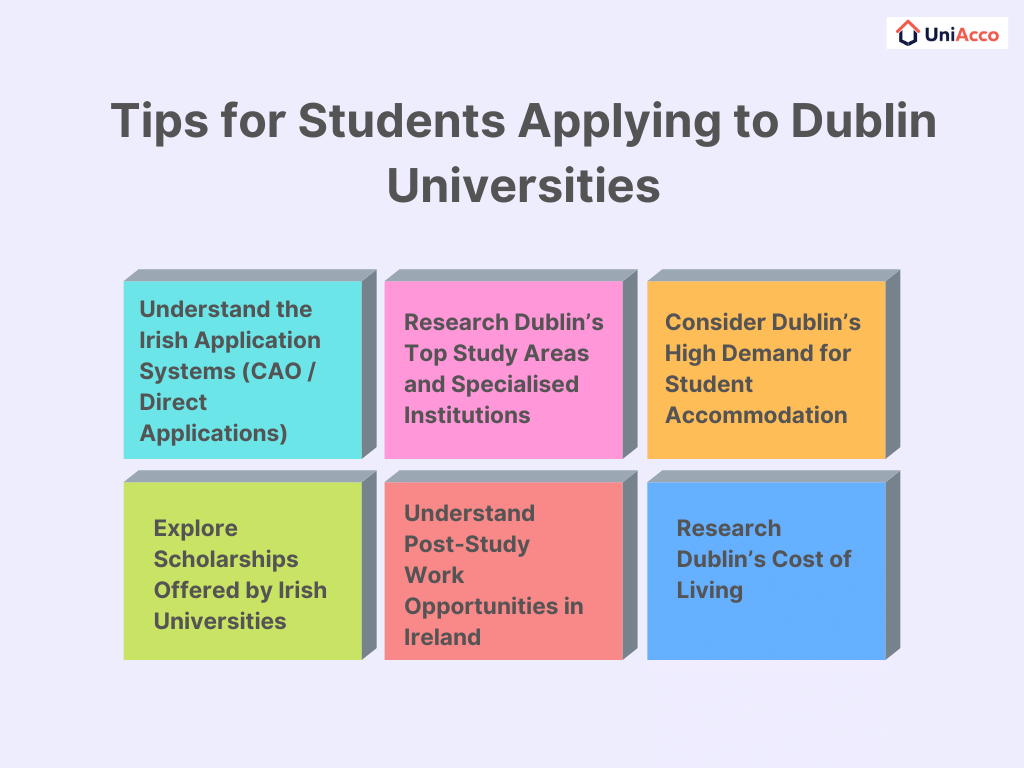
Tips for Students Applying to Dublin Universities
Maximise your chances of getting into the best universities in Dublin by keeping these strategic, actionable tips in mind during your preparation:
- Understand the Irish Application Systems (CAO / Direct Applications):
Ensure you are using the correct pathway. Non-EU applicants almost exclusively use the direct application portals of the respective Dublin colleges and universities. Some international students completing EU-equivalent high school exams may apply via the Central Applications Office (CAO)
- Research Dublin’s Top Study Areas and Specialised Institutions:
Don’t simply make a choice based on the QS rankings. If you want to study fine art, NCAD is superior; for aviation or pure data analytics, NCI is exceptionally strong. Pick a university or college based on your specialisation.
- Consider Dublin’s High Demand for Student Accommodation:
Dublin is currently facing a massive housing squeeze. Begin looking for accommodation the moment you receive a conditional offer.
- Explore Scholarships Offered by Irish Universities:
Irish universities offer a wide array of scholarships to international students, ranging from merit-based tuition waivers to fully funded government grants. Some scholarships to consider include — Government of Ireland International Education Scholarship (GOI-IES), Irish Research Council (IRC) Postgraduate Scholarships.
- Understand Post-Study Work Opportunities in Ireland:
Plan your education in Dublin around your long-term career goals. A Master’s degree grants you a highly valuable 2-year stay-back visa, giving you ample time to secure a permanent job in the Silicon Docks. Approximately 70% of graduates from Irish public universities are employed in Ireland shortly after graduation.
- Research Dublin’s Cost of Living:
Beyond your tuition fees, you must budget approximately €1,100 to €1,500 per month for rent, groceries, transport, and utilities, depending on your lifestyle.
Wanna know some less-known facts about Ireland? Read this Reddit thread and learn some lesser-known facts that will help you make the right decision.
Education in Ireland and why people should research thoroughly before making any decisions – r/Indians_StudyAbroad
Conclusion
Whether you are actively seeking the historic and best universities in Dublin, like the centuries-old prestige of Trinity College, the modern employability focus of UCD, or the niche, highly specialised expertise of NCAD, Dublin provides an academic environment that is globally respected, innovative, and culturally rich. In the 2024-25 academic year, 44,500 students enrolled in Ireland, which means there’s a growing appeal for Ireland as an educational hub.
However, successfully navigating the admissions process to one of these top universities in Dublin is only the first step. Moving to a new country requires meticulous planning. Once you have thoroughly researched and compared your options from this extensive Dublin colleges and universities guide, make sure you have a safe and comfortable place to live. We encourage students to research, compare, and explore suitable, verified accommodation with UniAcco for a smooth, entirely stress-free transition to their new, exciting academic life in one of the best universities in Dublin.







0 Comments