

If you’ve watched Suits, forget Harvey’s charm or Mike’s memory; it was Louis Litt’s financial mastery that truly kept Pearson Hardman alive. Because at the end of the day, numbers don’t lie, and they dictate who holds real power in the corporate world. And to master that game, all you need is ACCA. ACCA is the Association of Chartered Certified Accountants (ACCA), a globally recognised qualification that enables a person to build expertise in accounting, auditing, and financial management.
Did you know that as of May 2024, ACCA has crossed 100K members in the UK? That means a whole lot of students are building serious careers in finance. In this blog, you’ll explore what ACCA is in the UK, why you should study it, the top universities for 2026, entry requirements, course structure and duration, and career opportunities after qualification.
Top 10 ACCA Universities in the UK: Quick Comparison
Before we deep dive into the intricacies of each university, here’s a quick comparative guide of the top institutions leading the charge in 2026.
| University | QS Ranking 2026 | Courses Offered | Avg Tuition Fee | USPs |
| University of Edinburgh | 34 | MSc Accounting & Finance | £37,200 | Triple-accredited; historic prestige and intensive research |
| University of Manchester | 35 | MSc in Accounting | £33,500 | Elite “Big Four” recruitment ties; practical Manchester Method |
| University of Warwick | 74 | MSc Accounting & Finance | £38,000 | Number one for graduate employability; heavily corporate-linked |
| University of Glasgow | 79 | MA Accountancy / MSc Finance | £26,000 – £32,000 | Focus on international reporting; centuries-old legacy |
| University of Birmingham | 76 | MSc Accounting and Finance | £28,890 | Industry-led professional placements; vast alumni network |
| University of Southampton | 87 | BSc/MSc Accounting & Finance | £25,000 – £29,000 | High research intensity with a modern Fintech integration |
| University of Leeds | 86 | MSc Accounting & Finance | £34,000 | Innovative data analytics focus; high student satisfaction |
| Durham University | 94 | MSc Accounting | £36,500 | Unique collegiate system; exceptionally high academic rigor |
| Newcastle University | 227 | BSc/MSc Accounting | £25,750 – £30,000 | Triple-crown accreditation (AACSB, EQUIS, AMBA) |
| Lancaster University | 157 | MSc Accounting & Financial Management | £26,500 | Quadruple-accredited management school; robust career services |
What is ACCA?
The Association of Chartered Certified Accountants (ACCA) is a London-based, globally recognised professional accounting body offering a Chartered Accountant qualification. Originally called the London Association of Accountants, it was established to make the accounting profession accessible and to uphold high professional standards. It covers finance, auditing, and business management, with qualifications in over 180 countries. The program includes 13 exams, 3 years of practical experience, and is often completed in 2–3 years. Alongside the exams, candidates must complete an Ethics and Professional Skills Module (EPSM) and accumulate 36 months of supervised Practical Experience Requirement (PER).
As per ACCA Global 2026 Report, there are currently over 2,57,900 fully qualified members and a staggering 5,30,100 future members across 180 countries actively working toward this prestigious designation. This means the demand for financial strategists is at an all-time high.
If you’re looking to hold a fort in this industry, ACCA universities in the UK are the most strategic move you can make. Pursuing ACCA in the UK for international students offers multiple benefits, blending academic theory with direct access to the world’s most lucrative financial hubs in London. However, choosing the right university in the UK is the first step in your Louis Litt-style origin story.
Why Study ACCA in the UK?
ACCA opens doors to a respected, rewarding career with the world’s top employers – across nearly every sector. From Formula 1 to fashion, football to fintech, and renewable energy to retail, ACCA-qualified professionals are shaping the future of business.
Studying in the UK is an expensive affair. That’s why there are scholarships. Similarly, the cost of living in the UK is high too. But with UniAcco, you can get all-inclusive rent covering utilities, high-speed Wi-Fi, and modern amenities. Explore a comfortable home within minutes.
Now, let’s get back to the top reasons to study ACCA in the UK.
1. Globally Recognised Qualification
If you want to be globally recognised, think ACCA. Whether you want to work on Wall Street, Dubai, Dublin or Singapore, employers recognise the unmatched quality of ACCA-accredited educational standards.
2. High-Quality Education and Training
The UK’s Quality Assurance Agency (QAA) rigorously monitors universities. It’s not just about memorising formulas; you will be analysing real-world case studies, learning forensic accounting techniques, and mastering financial modelling.
3. Access to ACCA Exemptions
This is the biggest tactical advantage. ACCA exemptions allow qualified students to skip up to 9 of the 13 exams (primarily Applied Knowledge and Skills levels) based on prior relevant academic or professional qualifications (degrees, CA, MBA). Candidates must apply during registration via the ACCA exemptions calculator, paying fees for awarded exemptions.
4. Strong Finance and Accounting Job Market
Studying in the UK geographically places you closer to the headquarters of multinational banks, hedge funds, and the Big Four accounting firms – Deloitte, PwC, EY, and KPMG. ACCA works with leading recruitment consultants around the world to assist students and affiliates in accessing the best jobs in accounting and finance. Their online database covers 71 consultants in 14 countries, enabling you to locate specialist finance recruitment consultants, regionally and internationally.
5. Practical Experience
The UK’s Graduate Route visa allows international students to stay in the country for two years post their graduation. This is the perfect window to secure a high-paying job to complete the 36-month Practical Experience Requirement (PER) required to become a fully chartered member.
6. Flexible Learning
Whether you want to study full-time, part-time, online, or with a mix of learning styles, ACCA moves at your pace. With multiple exams every year, you are the controller – balancing work, family, and life’s demands.
Studying ACCA in the UK gives you access to top universities, exam exemptions, and a global finance hub. Secure all-inclusive UniAcco student housing and focus fully on your success.
🏡 Explore Student Housing Across the UKTop 10 ACCA Universities in the UK for Students in 2026
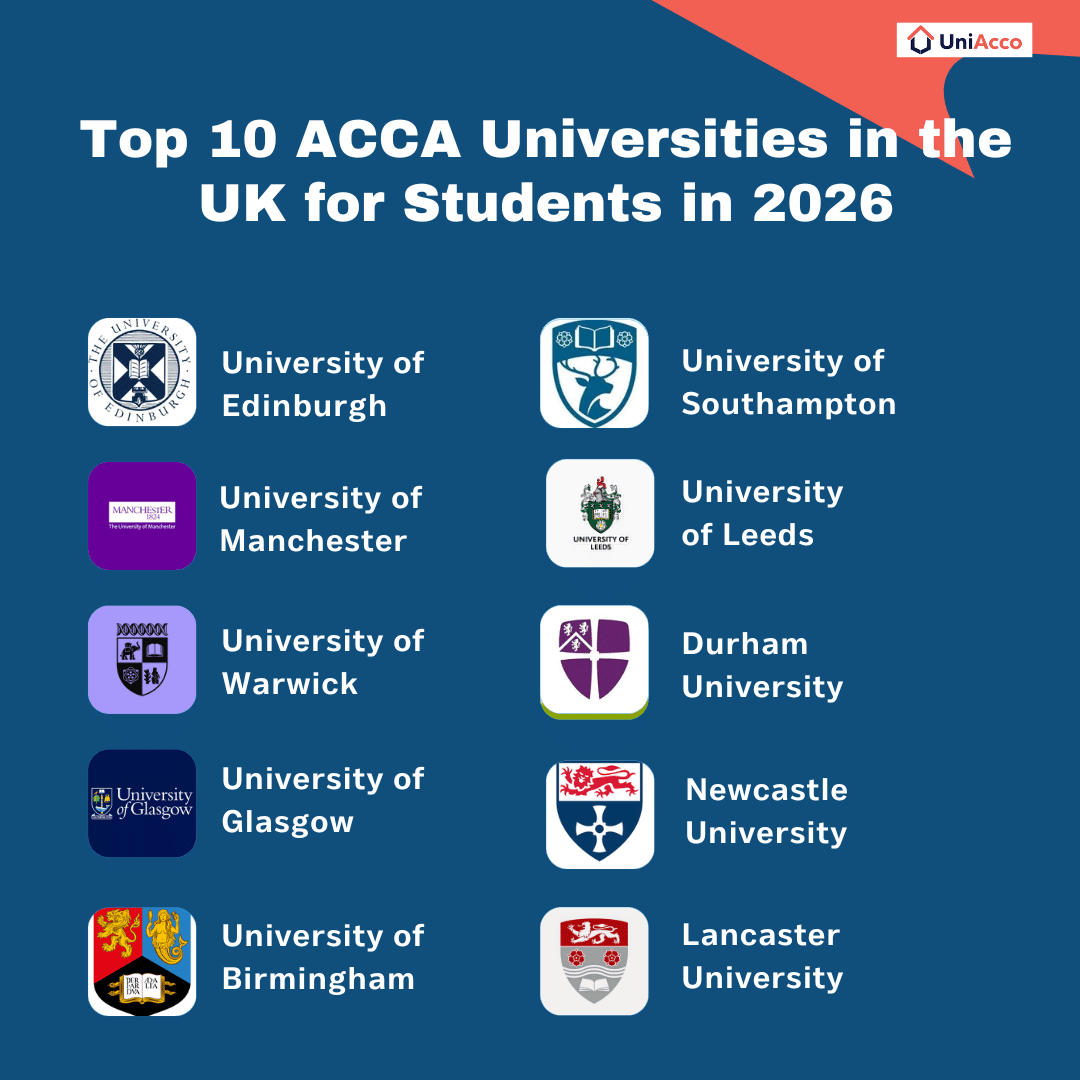
Top ACCA-accredited universities in the UK for 2026 include top-tier institutions like the University of Manchester, University of Glasgow, University of Leeds, and University of Edinburgh. These universities offer specialised BSc or MSc accounting degrees that fast-track students toward Chartered Certified Accountant status. Below is a detailed breakdown of the premier ACCA universities in the UK.
1. University of Edinburgh
With a QS ranking of 34, the University of Edinburgh offers ACCA-accredited programs, including the MSc in Accounting and Financial Management, which provides exemptions from several ACCA papers. Undergraduate options, such as MA (Hons) Accounting and Business, also align with professional accreditation, offering pathways to exemptions. What sets Edinburgh apart is its deep integration of modern Environmental, Social, and Governance (ESG) reporting into traditional accounting frameworks. The teaching style is heavily research-driven. Competition is fierce, but graduating from Edinburgh sends strong signals to recruiters that you possess an elite, analytical mind capable of handling the most complex financial portfolios.
Program Highlights
| Category | Details |
| Specialisations | Corporate Finance, Investment Management, Advanced Audit |
| Program Duration | 1 Year (MSc) / 4 Years (MA Undergraduate) |
| Average Annual Tuition Fees | £24,800 to over £43,300 per year |
2. University of Manchester
With a QS ranking of 35, the Alliance Manchester Business School (AMBS) at The University of Manchester offers top-tier accounting courses, often integrated with professional exemptions (like ACCA) through its BSc Accounting and Postgraduate programs. It provides strong industry connections, high employability (95%), and a globally recognised reputation for developing technical and strategic accounting skills. A highly practical and project-based teaching style forces students to solve real-time problems for corporations. The University has a long-standing bond with the Big Four, which means recruitment is fast-tracked.
Program Highlights
| Category | Details |
| Specialisations | Financial Economics, Quantitative Accounting, Assurance |
| Program Duration | 1 Year (MSc) / 3 Years (BSc) |
| Average Annual Tuition Fees | £33,100 per annum |
3. University of Warwick
With a QS ranking of 74, the University of Warwick (Warwick Business School) offers a prestigious BSc in Accounting & Finance and MSc in Accounting & Financial Management, which are professionally accredited, providing maximum exemptions from ACCA exams (9 papers). The courses blend rigorous academic theory with practical, real-world skills suitable for a global career in finance, audit, and consulting. Warwick offers a specialised curriculum that seamlessly bridges the gap between academic theory and the ACCA Strategic Professional papers. Their teaching style relies on the Harvard Case Study method. Warwick students command some of the highest starting salaries in the UK.
Program Highlights
| Category | Details |
| Specialisations | Strategic Management Accounting, Digital Finance, Mergers |
| Program Duration | 1 Year (MSc) / 3-4 Years (BSc with Placement) |
| Average Annual Tuition Fees | £27,000 to £36,000 for undergraduate courses and £25,000 to £43,000 for postgraduate programs |
4. University of Glasgow
With a QS ranking of 79, the University of Glasgow Adam Smith Business School provides rigorous accounting education, offering undergraduate (BA Accountancy) and postgraduate (International Accounting & Financial Management) degrees. While not solely an ACCA training provider, these degrees provide exemptions from several ACCA papers due to their in-depth coverage of finance, tax, and auditing. The programs cover financial reporting, management accounting, audit, and tax, aligning with professional standards. Glasgow stands out among ACCA universities in the UK for its comprehensive approach to International Reporting Standards (IFRS). The teaching style is supportive yet intellectually demanding, characterised by small tutorial groups that encourage fierce debate.
Program Highlights
| Category | Details |
| Specialisations | Professional Accounting, Financial Analysis, Global Audit |
| Program Duration | 1 Year (MSc) / 18 Months (with Industry Placement) |
| Average Annual Tuition Fees | £26,580 to over £55,000 |
5. University of Birmingham
With a QS ranking of 76, Birmingham City University (BCU) offers a premier, Platinum Approved Learning Partner program (MSc International Professional Accounting) designed to prepare students for ACCA Strategic Professional exams. The course focuses on financial reporting, strategic business leadership, auditing, and ethics. The Birmingham Business School offers a highly specialised MSc Accounting and Finance course. Students get a chance to undertake a 6-month professional placement as part of their degree, making it a highly attractive choice. The university has a strong regional dominance, which means local firms prioritise Birmingham graduates.
Program Highlights
| Category | Details |
| Specialisations | Professional Accounting, Financial Analysis, Global Audit |
| Program Duration | 1 Year (MSc) / 18 Months (with Industry Placement) |
| Average Annual Tuition Fees | £19,980 to over £44,100 |
6. University of Southampton
With a QS ranking of 87, the University of Southampton’s BSc Accounting and Finance is accredited by the ACCA, offering significant professional exam exemptions. It focuses on financial/managerial accounting, audit, and tax, featuring strong PwC links, a 3-year format, and optional industry placements. It is one of the few ACCA universities in the UK where accounting students are encouraged to understand data analytics, Python, and Fintech. The campus houses Bloomberg trading terminals, allowing students to simulate real-time financial modelling. Southampton’s teaching style blends traditional lectures with high-tech lab sessions, perfectly preparing students for the increasingly digitised future of the ACCA profession.
Program Highlights
| Category | Details |
| Specialisations | Risk Management, Fintech & Accounting, Corporate Governance |
| Program Duration | 1 Year (MSc) / 3 Years (BSc) |
| Average Annual Tuition Fees | £25,000 – £29,000 |
7. University of Leeds
With a QS ranking of 86, the University of Leeds Business School is consistently ranked within the UK’s top 10 for accounting. The university offers advanced accounting education through its MSc Accounting and Finance program, designed to prepare students for leadership roles and potential ACCA exemptions. The curriculum integrates technical skill development with strategic thinking, tailored for students aiming for professional certification. Their accounting programs are highly practical, frequently bringing in guest lecturers from the Big Four to teach specialised modules. Furthermore, Leeds offers unique “commercial awareness” training workshops, ensuring that graduates not only know how to balance a spreadsheet but also understand the broader economic implications of a business’s financial strategy.
Program Highlights
| Category | Details |
| Specialisations | Corporate Finance, Forensic Accounting, Data Analytics |
| Program Duration | 12 Months (Full Time MSc) |
| Average Annual Tuition Fees | £30,000 |
8. Durham University
With a QS ranking of 94, Durham University Business School offers an MSc Accounting program with maximum professional exemptions from ACCA, aimed at careers in accountancy, finance, and business. The MSc in Accounting program is specifically designed to maximise exemptions from ACCA exams, allowing students to skip several fundamental papers. The program features a strong focus on accounting theory, critical thinking, and international context. The Durham University Business School is triple-accredited and maintains rigorous ACCA entry requirements in the UK. The teaching style is deeply analytical and traditional, focusing heavily on academic literature and critical thinking.
Program Highlights
| Category | Details |
| Specialisations | Auditing, Accountability, Advanced Financial Theory |
| Program Duration | 1 Year (MSc) |
| Average Annual Tuition Fees | £21,750 to £29,250 |
9. Newcastle University
With a QS ranking of 227, Newcastle University Business School offers accredited accounting programs, including BSc Accounting and Finance. The courses cover financial management, audit, and tax, preparing students for roles in top firms like Deloitte, KPMG, and EY. The courses hold the coveted “Triple Crown” of accreditation (AACSB, EQUIS, AMBA) — an honour bestowed upon only 1% of business schools globally. Programs such as BSc Accounting and Finance or related postgraduate courses focus on an in-depth understanding of Management/Financial Accounting, Quantitative Methods, and Data Analysis.
Program Highlights
| Category | Details |
| Specialisations | Management Accounting, Business Law, Financial Regulation |
| Program Duration | 1 Year (MSc) / 3 Years (BSc) |
| Average Annual Tuition Fees | £9,535 per year |
10. Lancaster University
With a QS ranking of 157, the Lancaster University Management School (LUMS) is quadruple-accredited and a perennial top-10 contender in domestic UK rankings. Their MSc Accounting and Finance course provides a rigorous foundation in finance, offering significant ACCA exam exemptions upon completion. Students can gain exemptions from most of the Fundamental level papers (up to 9 papers) based on module choices, speeding up the pathway to becoming a Chartered Certified Accountant. Lancaster is renowned for its “Career Skills in Accounting” module. The faculty includes prominent authors of standard accounting textbooks, which means you are literally learning from the masters.
Program Highlights
| Category | Details |
| Specialisations | Sustainability in Accounting, Financial Risk Management |
| Program Duration | 1 Year (MSc) / 3 Years (BSc) |
| Average Annual Tuition Fees | £24,830–£40,560 |
Do any of these universities feel like a calling? In the meantime, take a look at some of the UniAcco residences near these universities. Reach out to us anytime. We have 24/7 expert support to assist you throughout your stay.
Sorted your studies, but still figuring out where to stay? Get 24/7 support and find verified student housing near Lancaster University with UniAcco — so you can focus on what really matters.
🏡 Browse Student Housing Near Lancaster UniversityEntry Requirements for ACCA Universities in the UK
Getting into one of the top B-schools in the UK is a highly competitive process. The ACCA entry requirements in the UK are designed to ensure that candidates possess a quantitative and analytical mind. Entry requirements for ACCA-affiliated universities in the UK generally require two A-Levels and three GCSEs (in five separate subjects, including English and Mathematics) or recognised equivalents. For postgraduate (MSc) pathways, a 2:2 honours degree in a related field or passing ACCA Applied Knowledge/Skills papers is required. Below are detailed entry requirements for ACCA universities in the UK.
1. Academic Qualifications
For the undergraduate programs, universities look for exceptional A-levels, the International Baccalaureate (IB), or equivalent international high school diplomas. Minimum entry includes two A-Levels and three GCSEs (or equivalent) in five separate subjects, including English and Mathematics. For Master’s programs, a strong Bachelor’s degree in a related field (Finance, Economics, Business) is required.
2. Minimum Academic Grades
Entry requirements for ACCA-aligned universities in the UK generally require a minimum of two A-Levels and three GCSEs (including English and Mathematics) in 5 separate subjects, or equivalent qualifications. Indian students often need at least 65% in English and Maths/Accounts and 50% in the other 12th-grade subjects.
3. English Language Proficiency
To study ACCA at a UK university, you typically need two A Levels and three GCSEs (or equivalent) in 5 separate subjects, including English and Mathematics. International students must demonstrate English proficiency, generally equivalent to a B2 level, with many universities requiring an IELTS score of 6.5 overall (no component below 6.0) or a TOEFL iBT score of 90.
4. Mathematics Background
If Accounting is the language of the business, then Mathematics is the alphabet. A strong grade in High School/GCSE Mathematics is absolutely non-negotiable. Top universities may even require advanced calculus or statistics backgrounds. For international applicants, this often means high school graduation (12th grade) with strong grades in Maths or Accounts, specifically a 65% or higher, alongside English.
5. Personal Statement
Simply, grades are not enough. Your Personal Statement must compellingly articulate your reason to believe in finance, your understanding of the global market, and your long-term career trajectory as a Chartered Accountant.
6. Academic References
You’ll require 1-2 strong official letters of recommendation from former professors or professionals who can vouch for your analytical capabilities.
7. Valid Passport and VISA
Necessary for all international applicants to secure the UK Student Visa (formerly Tier 4).
ACCA Course Structure and Duration in the UK
The structure of an ACCA course in the UK is designed meticulously to build a candidate from a novice to a strategic mastermind. Below are the details you need to know.
- Foundation Level (Applied Knowledge)
The ACCA Applied Knowledge level is the foundation of the ACCA qualification in the UK, comprising three computer-based exams: Business and Technology (BT), Management Accounting (MA), and Financial Accounting (FA). It introduces core accounting, usually completed within 3–6 months, with on-demand exams available year-round.
- Applied Skills Level
The ACCA Applied Skills level in the UK consists of 6 core exams (LW, TX, FR, PM, FM, AA) designed to build practical finance expertise. It usually takes 12–18 months to complete. As the second stage of the qualification, it follows Applied Knowledge and typically precedes Strategic Professional, with exams held four times annually via computer-based sessions.
- Strategic Professional Level
The ACCA Strategic Professional level in the UK is the final, Master ’s-level stage, designed to build advanced strategic thinking and technical expertise over 1-2 years. It consists of four 3-4 hour papers—two compulsory (SBL, SBR) and two options—requiring a 50% pass rate. Students have 7 years to complete this level, often alongside 36 months of practical experience. These are highly advanced papers focusing on Strategic Business Leader (SBL) and Strategic Business Reporting (SBR), alongside two elective papers, such as Advanced Financial Management or Advanced Taxation.
- Practical Experience Requirement (PER)
It is mandatory to complete 36 months of relevant, supervised accounting experience to learn how to apply theory to reality.
- Ethics and Professional Skills Module (EPSM)
The Ethics and Professional Skills Module (EPSM) is a mandatory 20-hour online module costing £82 in the UK, focusing on ethical behaviour and business simulation, best taken before Strategic Professional exams.
- Duration of ACCA Qualification
If you are starting from an absolute scratch, it typically takes 3 to 4 years. If you enter with a relevant Master’s degree from a UK university and claim your 9 exemptions, you can complete the remaining professional papers and qualify in as little as 1 to 2 years, while working to gain your PER.
Still confused about how many subjects there are in the ACCA course? Read this
Scholarships for ACCA Students in the UK
The cost of living in the UK is as high as the skyscrapers there. As we’ve seen earlier in this blog, ACCA course fees in the UK are a mouthful too. However, UK universities are incredibly generous when it comes to funding top-tier global talent. Earning a scholarship not only reduces your financial burden but also serves as a prestigious addition to your CV.
| Scholarship Name | University / Provider | Eligibility | Coverage / Benefits |
| Simpson Scholarship | ACCA Global | Active ACCA students worldwide who demonstrate high academic merit; An average of 80%+ in Applied Knowledge/LW exams or 66%+ in Applied Skills exams (at first attempt). Applicants must have all fees paid Submit a 1,000-word essay and provide two references. | Covers all exam fees, exemption fees, and annual subscription fees for up to five years. |
| Global Accounting Scholarship | University of Leeds | Active ACCA students worldwide who demonstrate high academic merit; An average of 80%+ in Applied Knowledge/LW exams or 66%+ in Applied Skills exams (at first attempt). Applicants must have all fees paid Submit a 1,000-word essay and provide two references. | Tuition fees, exam costs, study materials, and annual subscription fees for students demonstrating academic merit, leadership potential, or financial need |
| International Merit Scholarship | University of Glasgow | Applicants must be international fee-paying students with an offer of study for an eligible undergraduate or postgraduate program. | Partial tuition fee discounts ranging up to £10,000. |
| Business School Excellence Award | University of Manchester | Must be holding an offer for a full-time, on-campus master’s courseBe self-fundedDemonstrate high academic performance (specific Indian Standard XII grades or equivalent A-levels) | £2,000 to over £10,000 as tuition fee discountsThe Chancellor’s Excellence Award offers 100% tuition waivers for top candidates. |
| Global Diversity Scholarship | Various Top UK Universities | Partial-to-full tuition fees, and in some cases, include living stipends, accommodation, and travel allowance | Ranges from partial fee waivers to full tuition coverage, depending on the institution. |
| Makesworth ACCA Scholarship | Makesworth Accountants / Foundation | Registered ACCA students Must demonstrate financial hardshipA minimum Higher Secondary Education Board (HSEB) qualification or equivalent. | Designed for deserving ACCA students in NepalAimed at supporting their journey to becoming chartered certified accountants by covering key fees. |
Make the most of it by choosing stress-free living. Book all-inclusive student housing in London with utilities and high-speed Wi-Fi — everything you need, all in one place with UniAcco.
🏡 Explore Student Housing in LondonCareer Opportunities After ACCA
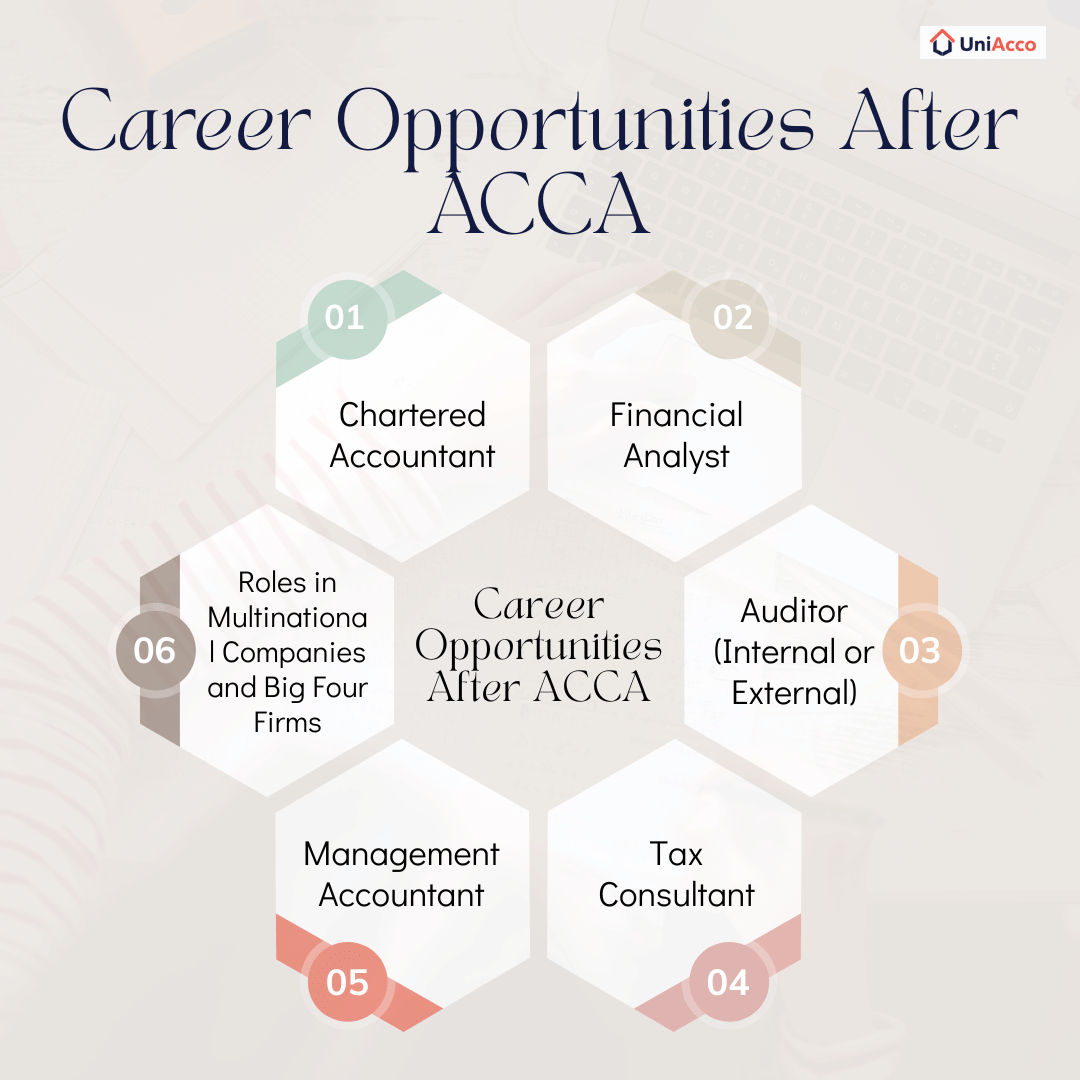
ACCA qualified professionals in the UK are in high demand, with career opportunities in public practice, corporate finance, and financial services. ACCA offers diverse global career opportunities in auditing, financial management, tax, and consulting, with high demand in Big Four firms and MNCs. Key roles include CFO, Financial Analyst, Audit Manager, and Risk Analyst.
- Chartered Accountant
This is the classic route. You will work in public practice, managing the financials of corporate clients, advising on mergers, and ensuring legal compliance. ACCA-qualified Chartered Accountants in the UK, particularly in London, typically earn between £40,000 and £60,000 annually, with senior roles often exceeding £70,000 to £100,000+.
- Financial Analyst
Financial Analysts work within investment banks or hedge funds, analysing massive data sets to recommend multi-million dollar stock and equity investments. ACCA-qualified professionals in the UK can secure high-paying roles as financial analysts, with qualified members typically earning between £48,000 – £65,000 annually. Entry-level positions (0-2 years) start around £25,000–£35,000, while experienced financial analysts and senior roles can exceed £80,000–£110,000, particularly in London.
- Auditor (Internal or External)
An auditor is like a financial police officer, who ensures that a company’s financial statements represent a ‘fair’ view of its operations. It is a high-pressure but high-rewarding job role. ACCA-qualified auditors in the UK typically earn between £40,000–£65,000 as newly qualified members, rising to £65,000–£100,000+ with 3–5 years of experience, especially within Big Four firms.
- Tax Consultant
With an ACCA qualification, you can become a tax consultant, which includes roles like Corporate Tax Manager, VAT Advisor, and International Tax Specialist within Big Four firms, mid-tier practices, and industry. Qualified tax professionals can advance to Senior Tax Manager, Tax Director, or Partner, with salaries for experienced staff frequently exceeding £70k – £100k+ per annum.
- Management Accountant
The ACCA qualification offers excellent career prospects in the UK as a Management Accountant, with roles ranging from
analysts to senior strategic positions in sectors like financial services, retail, and technology. Typical roles include Management Accountant, Finance Manager, Financial Controller, and Financial Analyst, offering competitive salaries often above £45,000 per annum.
- Roles in Multinational Companies and Big Four Firms
This is the ultimate dream job for many. Starting your career at PwC, EY, Deloitte, or KPMG opens doors to eventually becoming a Chief Financial Officer (CFO) or Chief Executive Officer (CEO) of Fortune 500 companies. You can expect a newly qualified salary of around £45,000 – £60,000 in London, with salaries for senior roles often exceeding £70,000 – £100,000+ as they advance. Entry-level trainees (part-qualified) start lower, often between £25,000 and £35,000, rising significantly upon full qualification.
Do you wanna know how much ACCA professionals earn in the UK? Read this Reddit thread and learn how much they are earning.
What salary are you on if you are an ACCA student in the UK? – r/ACCA from r/ACCA
Conclusion
To summarise, studying ACCA in the UK offers an array of benefits. From claiming up to 9 strategic exam exemptions to leveraging the UK’s Graduate Visa route to fulfilling your crucial Practical Experience Requirement (PER), the UK pathway is carved to fast-track your growth in the corporate world.
Whether you leverage the Big Four recruitment pipeline at Manchester, the “Triple Crown” prestige of Newcastle, or the cutting-edge Fintech integration at Southampton, your university is the foundational ledger of your future career.Before you find your ground in the corporate room, secure a home ground. Your accommodation is your base. Take a look at some of the UniAcco residences near these universities. We have 24/7 expert support to assist your stay.












0 Comments