
Ever wondered, when you’re sitting in a doctor’s clinic or speaking to an accountant, how they got there, and what kind of studying they go through to get here? Turns out, those are just some of the toughest courses in the world, because the careers are extremely demanding and require intense subject knowledge and skills that prepare them for the world. Yes, salaries are insanely high, but so is the road that leads to it.
This article speaks about the toughest courses in the world for students and those who are just curious, covering facts about the top 10, what makes a course tough, skills required and how to know what course is the right one for you.
What Makes a Course Difficult?
Extensive syllabus
Unlike other degrees, these hardest degrees in the world cover vast amounts of information, usually very complex, covering various topics that require deep and interconnected knowledge.
Practical training and lab work
These are degrees that need practical knowledge and hands-on training just as much as they need to study theory. These can take place in clinics, laboratories, courts and more – and they’re done under intense scrutiny to ensure perfection upon graduation.
Competitive admissions
The number of students applying for these courses is in the thousands, so a select few make it, who have shown exceptional scores and excellent minds.
Long study duration
If you want to get into this and build a secure future, you have to be ready to devote over 5 years to studying. These can include internships or residencies.
High workload and assessments
The toughest courses in the world come with their fair share of high workload. Expect relentless deadlines, gruelling exams and continuous evaluations.
Licensing or professional examinations
To be able to call yourself a doctor or a lawyer, you have to sit through a bunch of exams and pass them all. Failure in any one can mean starting over.
Strong analytical and problem-solving requirements
Success demands not just memorisation, but the ability to think critically under pressure. These degrees will need you to think constantly, come up with creative and yet effective measures to treat and protect.
| Rank | Course | Why It’s Challenging | Typical Duration | Popular Career Paths |
| 1 | Medicine | Vast syllabus covering anatomy, physiology, pharmacology and more; years of clinical rotations; high-stakes licensing exams (e.g. USMLE, PLAB); emotional resilience needed for patient care. | 5–6 years (plus residency) | Doctor, Surgeon, Specialist Physician, Medical Researcher |
| 2 | Engineering (Mechanical, Electrical & Chemical) | Heavy maths and physics load; complex design projects; lab and workshop hours; accreditation exams; constant problem-solving under tight deadlines. | 3–4 years (BEng), 4–5 (MEng) | Mechanical, Electrical or Chemical Engineer, Project Manager, R&D Specialist |
| 3 | Architecture | Blend of creative design and technical precision; studio-based learning with long hours; strict building codes and sustainability standards; portfolio-intensive assessments. | 5 years (BA + MArch) | Architect, Urban Designer, Interior Designer, Project Architect |
| 4 | Law | Dense legal texts and case law; critical reasoning and argumentation skills; moot courts and internships; bar exams required to practise. | 3–5 years (LLB + LLM/Bar) | Solicitor, Barrister, Legal Consultant, Judge, Corporate Lawyer |
| 5 | Chartered Accountancy (CA) | Extremely low pass rates; multiple levels of rigorous exams; articleship/training period; numerical accuracy and discipline essential. | 4–5 years (including articleship) | Chartered Accountant, Auditor, Tax Consultant, Financial Analyst |
| 6 | Quantum Mechanics | Abstract, counter-intuitive concepts; advanced mathematics (linear algebra, differential equations); research-heavy; often part of Physics degrees at postgraduate level. | 3–4 years (BSc), 5–6+ (PhD track) | Physicist, Research Scientist, Quantum Computing Specialist, Academic |
| 7 | Neuroscience | Interdisciplinary (biology, psychology, chemistry); lab-intensive; complex brain imaging and data analysis; growing field with high research expectations. | 3–4 years (BSc), 5–6+ (PhD track) | Neuroscientist, Clinical Researcher, Neuropsychologist, Biotech Specialist |
| 8 | Aerospace Engineering | Advanced fluid dynamics, thermodynamics and materials science; design-build-test cycles; safety-critical projects; often requires postgraduate specialisation. | 3–4 years (BEng), 4–5 (MEng) | Aerospace Engineer, Flight Systems Designer, Defence Contractor, NASA/ESA Researcher |
| 9 | Clinical Psychology | Competitive entry; extensive supervised clinical hours; research thesis; licensing exams; emotionally demanding patient work. | 5–6 years (BSc + Doctorate) | Clinical Psychologist, Counsellor, Mental Health Specialist, Academic Researcher |
| 10 | Pharmacy | Detailed pharmacology and chemistry knowledge; lab and dispensing practice; regulatory exams; high responsibility for patient safety. | 4–5 years (BPharm/MPharm) | Pharmacist, Clinical Research Associate, Drug Safety Officer, Pharmaceutical Sales |
No matter how tough the course may be, the right student accommodation can make university life more comfortable. Book your student accommodation in the UK with UniAcco and get a fully furnished room with all utility bills included, so you can focus on your studies without worrying about everyday housing expenses.
🔍 Explore Student Accommodation in the UKTop 10 Toughest Courses In The World
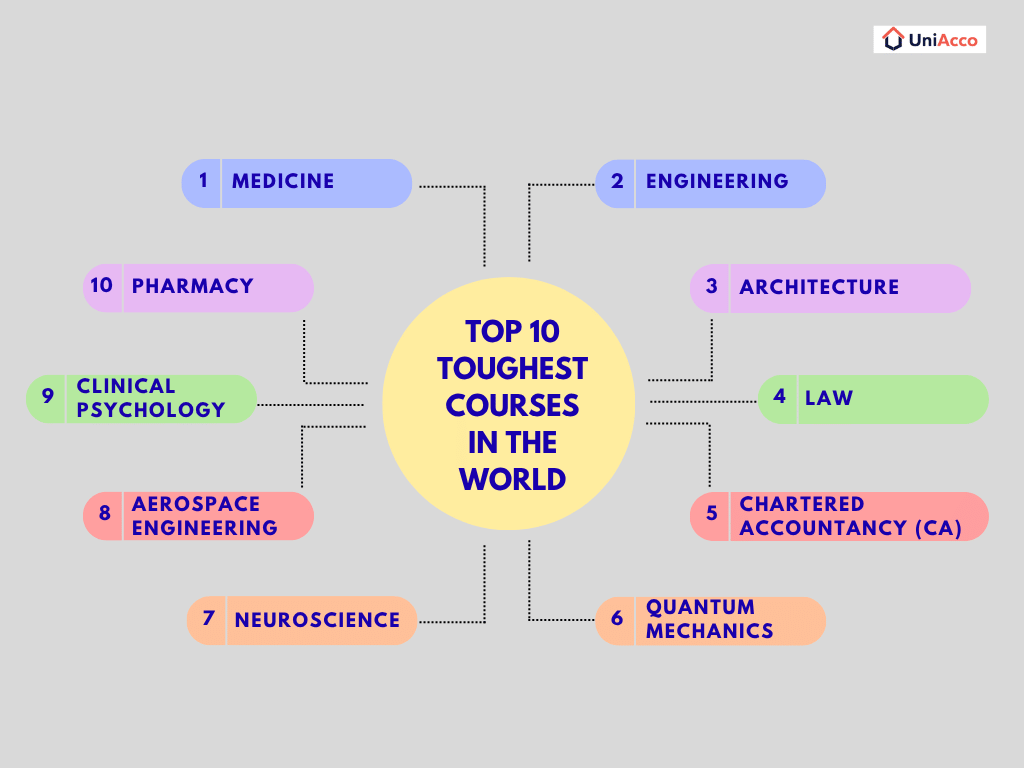
Some courses ask for more than just good grades. You may have to study for long hours, deal with difficult subjects, complete practical training, and sit through challenging exams. If you are planning your studies and wondering which courses can really test you, here are 10 of the toughest courses in the world.
Medicine
Medicine takes a lot of time, effort, and commitment. You have to learn how the human body works, understand different diseases, remember medicines and treatments, and then use that knowledge during clinical training. The amount of information you need to cover can be overwhelming at times.
Your studies do not stop at textbooks either. You will spend time in hospitals and prepare for important exams before you can practise. A good memory, patience, problem-solving skills, and the ability to communicate well can help you through the course. Once qualified, you can work as a doctor, surgeon, researcher, or public health professional. The UK, US, Canada, Australia, Germany, and Singapore are popular places to study medicine.
Engineering
If maths and physics are not your favourite subjects, engineering can be a real challenge. You have to understand difficult concepts and then use them to solve practical problems. Along the way, there are lab sessions, projects, calculations, designs, and plenty of deadlines to keep up with.
The workload also changes depending on your specialisation. Mechanical engineering looks at machines and thermodynamics, while electrical engineering covers circuits and power systems. Chemical engineering focuses on chemical processes and plant design. An engineering degree can lead to careers in engineering, project management, consulting, or research and development. The US, UK, Germany, Canada, Australia, and Singapore are popular study destinations.
Architecture
Architecture is not just about drawing attractive buildings; it involves maths, and that’s what makes it one of the toughest degrees in the world. You have to make sure your ideas can actually be built and used. That means learning about design, construction, structures, materials, and technology while still finding room for creativity.
A single project can take a lot of your time. You may spend hours working on drawings, models, presentations, and digital designs. Deadlines can also come one after another, making time management very important. You can later work as an architect, urban designer, interior designer, or landscape architect. Popular choices for studying architecture include the UK, US, Italy, Netherlands, Australia, and Singapore.
Law
Law involves a lot of reading. You need to understand legal rules, go through case studies, remember important details, and work out how those rules apply to different situations. It is not enough to simply memorise information. You also need to explain your reasoning clearly.
Moot courts, research, presentations, and internships can add to the workload. If you enjoy reading, analysing information, and building an argument, you may find the course easier to manage. Depending on your qualifications and the country where you practise, you can become a solicitor, barrister, legal consultant, corporate lawyer, judge, or compliance professional.
Chartered Accountancy (CA)
Chartered Accountancy is a long road, especially because there are several exams to clear before you qualify. You need to understand accounting, auditing, taxation, financial reporting, and other areas of finance. Getting one topic right is not enough when you have a large syllabus to cover.
You also have practical training to complete, such as articleship in India. Keeping up with work and exam preparation can be difficult, so good time management matters. You also need to be comfortable working with numbers and checking details carefully. Once qualified, you can work in auditing, taxation, financial analysis, corporate finance, or forensic accounting. CA is popular in India, the UK, Canada, Australia, South Africa, and Pakistan.
Quantum Mechanics
Quantum mechanics can be difficult to understand because it deals with a world that does not behave in the way you expect. Things work very differently at the level of tiny particles, and the maths behind these ideas can be demanding.
You may come across concepts such as superposition, quantum entanglement, wave-particle duality, and quantum tunnelling. Understanding them takes a strong base in maths and physics, along with plenty of practice. Quantum mechanics is generally studied as part of physics at university or postgraduate level. It can lead to work in research, quantum computing, physics, data science, and other technology-focused areas.
Neuroscience
The brain is one of the most complicated parts of the human body, and that is what makes neuroscience such a challenging field. You are not studying just one subject. Depending on your course, you may need knowledge of biology, chemistry, psychology, computer science, and data analysis.
You can study everything from brain structure and nerve cells to memory, behaviour, and brain imaging. Research and laboratory work are also important parts of many programmes. The subject can take you into careers such as neuroscience research, clinical research, biotechnology, or pharmaceutical research. The US, UK, Germany, Canada, Australia, and Switzerland are popular destinations for students in this field.
Aerospace Engineering
Aerospace engineering leaves very little room for mistakes. You are working with aircraft, spacecraft, and systems where safety is extremely important. That means you need to understand complicated engineering concepts and pay close attention to even the smallest details.
Your course can include aerodynamics, propulsion, flight mechanics, aircraft structures, and avionics. You will also have design and testing projects to complete. It can be a demanding mix of theory and practical work, but it can lead to exciting careers in aerospace, aviation, flight systems, and drone technology. The US, UK, France, Germany, Canada, and Australia are popular choices for studying this subject.
Clinical Psychology
Clinical psychology goes beyond learning theories from a textbook; it isn’t just about learning about emotions. You also need to learn how those ideas apply to real people, how they react and how they affect them. This means balancing academic study with practical training and learning how to work professionally with patients.
The path can be long. You will usually need a psychology degree followed by further training, which may include a doctorate, supervised clinical work, and professional registration. Getting into some programmes can also be competitive because places are limited. Once qualified, you can work in clinical psychology, counselling, research, forensic psychology, or education.
Do you know what actually makes clinical psychology one of the toughest courses in the World? Read this Reddit Thread and learn from professionals about the aspects that make this degree tough.
The most difficult aspect of clinical psychology – r/ClinicalPsychology
Pharmacy
Pharmacy involves much more than knowing which medicine is used for which illness. You need to understand how drugs are made, how they work in the body, how they interact with other medicines, and how they should be used safely.
You will study areas such as pharmacology, pharmaceutical chemistry, clinical pharmacy, and drug safety. Lab sessions and practical training add another side to the course, where accuracy really matters. Depending on where you study, you may also need to pass a licensing exam before you can work as a pharmacist. Career options include hospitals, community pharmacies, research, drug safety, sales, and regulatory affairs. Popular destinations include the UK, US, Canada, Australia, Germany, and Singapore.
Finding the right student accommodation in Germany can be tricky, but UniAcco makes the search easier by bringing multiple options and competitive prices together in one place. Explore student accommodation in Germany and find a fully furnished room with all utility bills included.
🔍 Explore Student Accommodation in GermanyWhich Skills Do You Need to Succeed in These Courses?
- Time management
To manage the amount of information you need to take in, and juggle lectures, labs, assignments and more, you will need strict time management skills. Avoid last-minute planning and cramming, and follow a calendar to plan accordingly.
- Critical thinking
A lot of these degrees are built on critical thinking, evaluation, questioning assumptions, and the need for well-reasoned arguments. This is especially needed in law, medicine and research-heavy fields.
- Analytical reasoning
This is when you break down complex problems into logical steps. A skill needed in degrees such as engineering, quantum mechanics, and data-driven disciplines.
- Problem-solving
These degrees are designed to solve a problem. The medical and law fields will need you to diagnose a patient, along with the treatment, or a court will need you to reason and draft a legal brief. These are open-ended challenges with no single “right” answer.
- Research skills
You will need to get your hands on credible sources and rely on heavily researched material before proceeding with your degree.
- Communication
Without clear communication skills, it won’t be possible for you to speak to your subordinates, or even place your case in court, or treat your patient correctly.
- Resilience and perseverance
Setbacks are inevitable. The ability to bounce back from poor grades, long hours, or stressful exams is what keeps you moving forward.
How to Choose the Right Course for You
- Choose based on interests, not just difficulty.
Passion and devotion to a course are everything when compared to just doing it for the long run. If you’re genuinely curious about the subject, you’ll be more motivated to push through the tough bits.
- Understand the time and financial commitment.
Some courses take five or six years (medicine, architecture) and come with significant tuition and living costs. With the help of scholarships, part-time work, and student loans, you can reduce the financial strain it may cause.
- Research career prospects.
The degrees prepare you for the best opportunities. But students will have to research the job prospects, salaries offered and graduate employment rates. With the skills built, these can lead to various careers and not just one.
- Explore university rankings and course structure.
Your course structure is one of the most crucial things you need to see before applying to any one of the toughest courses in the world. Check module lists, teaching methods (lectures vs. labs vs. studios), assessment types, and placement opportunities.
- Speak to current students or alumni before applying.
They’ll give you the unfiltered truth about workload, support, and life after graduation. Attend any open days available, join student forums, or reach out to various people on LinkedIn.
Be sure of where you stay with UniAcco. Explore verified student accommodation in Australia and book a fully furnished room with all utility bills included, making it easier to plan your student budget and settle into university life.
🔍 Explore Student Accommodation in AustraliaConclusion
The toughest courses in the world are ranked based on the type of rigour and learning students have to go through. Fields such as medicine, law, engineering and such involve people and problem-solving events post-graduation. So these courses teach and prepare the students to be job-ready by the time they graduate. This guide lists all the toughest courses so students can make the right decision and excel in the selected path for a successful future.


 LinkedIn










0 Comments