

Application fees may look small on paper, yet they increase quickly when you’re aiming for multiple universities. For the 2026 intake, that £50–£100 per application often turns into £250–£500 before you even begin shortlisting courses. And with nearly 730,000 international students already studying in the UK, the competition and the cost can feel intense long before the visa stage.
If you’re looking to cut avoidable expenses without limiting your options, this list of universities in the UK without an application fee gives you precisely that edge. Explore 11 institutions, their eligibility criteria, rankings, and how you can apply.
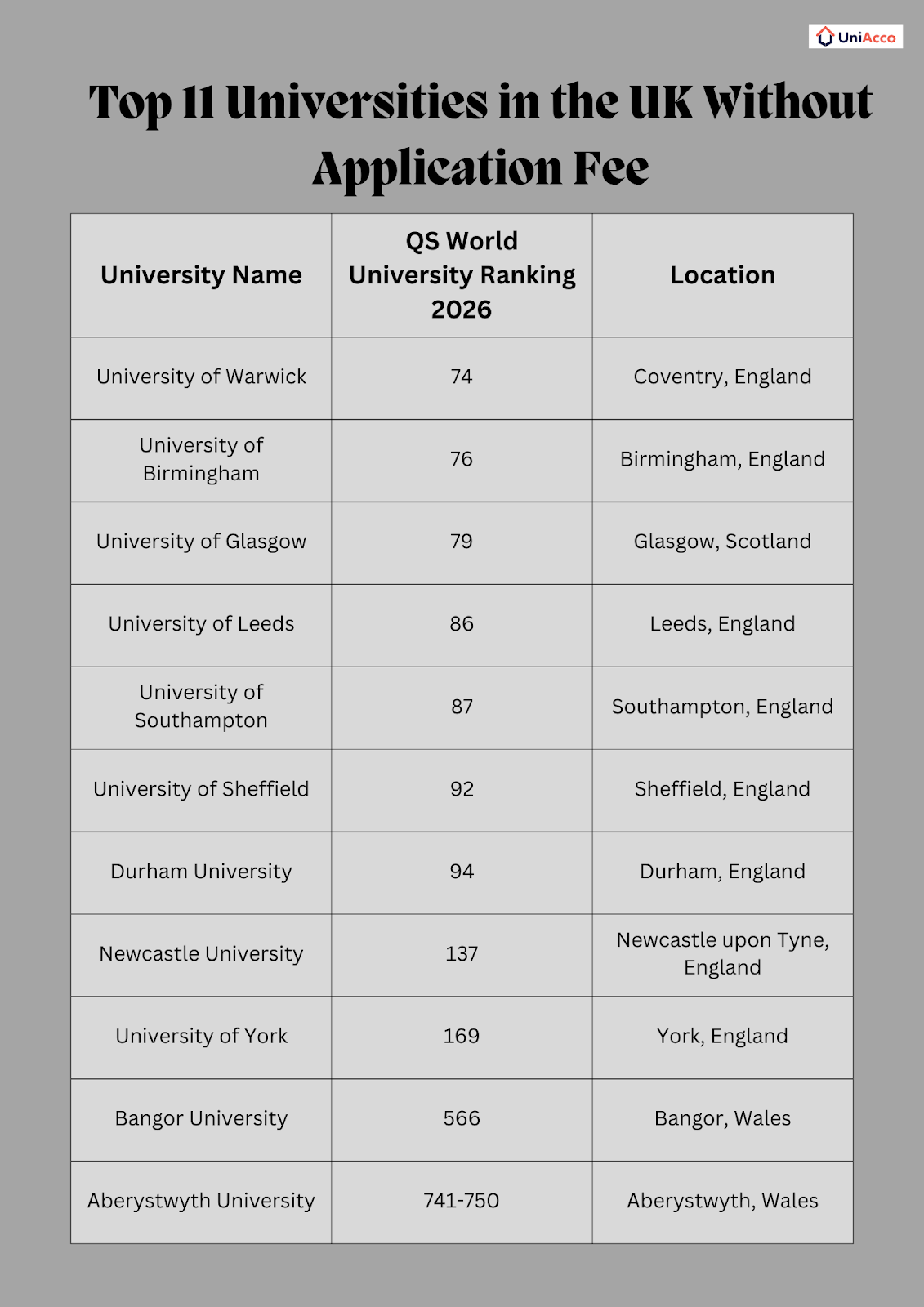
Top UK Universities With No Application Fee: An Overview
| University Name | QS World University Ranking 2026 | Application Fee (for International / PG / as publicly listed) | Location |
| University of Warwick | 74 | No application Fees | Coventry, England |
| University of Birmingham | 76 | No application Fees | Birmingham, England |
| University of Glasgow | 79 | No application Fees | Glasgow, Scotland |
| University of Leeds | 86 | No application Fees | Leeds, England |
| University of Southampton | 87 | No application Fees | Southampton, England |
| University of Sheffield | 92 | No application Fees | Sheffield, England |
| Durham University | 94 | No application Fees | Durham, England |
| Newcastle University | 137 | No application Fees | Newcastle upon Tyne, England |
| University of York | 169 | No application Fees | York, England |
| Bangor University | 566 | No application Fees | Bangor, Wales |
| Aberystwyth University | 741-750 | No application Fees | Aberystwyth, Wales |
Skip the university application fees and secure hassle-free student accommodation in the UK with UniAcco, so you can keep your focus on landing that research spot and kicking off your academic journey stress-free.
🏡 Find Your UK Student StayWhy Do Some UK Universities Not Charge an Application Fee?
- Direct Applications Over UCAS: Many universities waive fees for direct applications because it allows them to manage admissions more efficiently and tailor the process for postgraduate or research programmes. Removing the UCAS application step reduces barriers and attracts serious applicants who are specifically interested in that university.
- Encouraging Diverse Global Applications: Fee waivers help institutions reach a wider pool of international talent. By lowering financial barriers, universities can attract students from diverse backgrounds, enriching the academic and research environment.
- Reduced Administrative Costs Through Digital Systems: Modern digital application platforms reduce the cost of processing applications. Universities can afford to waive fees without affecting revenue because administrative processes are now automated and less resource-intensive.
- Targeted Programmes: Waivers are often applied to postgraduate or research degrees, where attracting high-calibre candidates is crucial. Removing the fee ensures that top talent isn’t discouraged from applying due to upfront costs.
- Seasonal or Conditional Waivers: Some universities offer fee waivers for early applicants, scholarship seekers, or specific cycles to incentivise timely applications. This helps universities manage admissions more strategically while rewarding motivated candidates.
Best No Application Fee Universities in the UK: Detailed Breakdown
In the UK, most no application fee offers apply to PhD and research programmes, while very few cover undergraduate courses. This allows international students to explore multiple research opportunities without upfront costs.
Below is a detailed breakdown of the top universities where you can apply for 2026 without paying application fees.
1. University of Warwick
The University of Warwick is a major research-led institution that attracts applicants seeking strong academic supervision and global recognition. Warwick offers no application fee for postgraduate research programmes, giving international applicants a cost-free entry point into competitive areas like engineering, social sciences, and life sciences.
With more than 9,500 international students, the university maintains a selective yet accessible research admissions system focused on proposal strength and supervisor alignment. This makes Warwick a strategic option for students targeting advanced study in the UK without upfront application costs.
| University Name | Location | Acceptance Rate | Application Mode |
| University of Warwick | Coventry, UK | 24% | Direct |
Key Highlights
1. Student Support Tailored for Ambitious Postgraduates
With postgraduates making up nearly 40% of its community, Warwick is intentionally built around their needs. International students receive one-to-one guidance through the International Student Office, from visa assistance to funding insights. Welcome Week blends academic induction with mentorship from seasoned postgraduate scholars, helping newcomers settle in quickly. Wellbeing hubs across faculties offer swift access to mental-health services, disability support, and academic coaching. Together, these systems form a reliable support network, especially reassuring for students arriving from overseas.
2. Research Ecosystem Engineered for Global Competitiveness
Warwick consistently ranks among the UK’s top 10 for research strength, securing over £180 million in annual grants. Students plug into dynamic interdisciplinary centres such as Warwick Manufacturing Group and the Institute for Global Sustainable Development. Facilities range from autonomous systems labs to advanced materials centres and cybersecurity suites, mirroring industry standards. Supervisors often partner with major organisations like Jaguar Land Rover and Siemens, opening doors to funded projects and real-world applications. For research-focused applicants, it’s an ecosystem built for scale, innovation, and industry-aligned impact.
3. Career Services Connected Directly to Industry Leaders
Warwick’s employer network links students with 300+ global companies each year through sector showcases and focused recruitment events. Its coaching model builds practical, in-demand skills, like data workshops, consulting case prep, and entrepreneurship pathways. International students can tap into “Work in the UK” mentoring tracks, gaining insider guidance from alumni across finance, tech, and engineering. The career portal lists over 4,000 internships annually, including roles offered through exclusive partnerships. Altogether, this system gives students early, realistic visibility into career routes and the support to pursue them confidently.
4. Location Advantage in the Midlands Innovation Corridor
Warwick sits between Coventry and Leamington Spa, two hotspots for growth in automotive engineering, gaming, and advanced materials. Students tap into nearby industry clusters through regional innovation institutes and tech parks woven into the campus ecosystem. Fast transport connections make it easy to reach Birmingham or London for interviews and networking, without the grind of big-city living costs. With affordability and industry access in the same radius, the location offers a rare blend of practicality and professional momentum.
2. University of Birmingham
Birmingham’s size and research footprint place it among the UK’s most influential institutions, with more than 38 per cent of students coming from overseas. The university offers fee-free applications only for postgraduate research pathways, particularly where supervisor availability determines admission.
Its sector-leading research income, which exceeds £220 million annually, ensures applicants have access to well-funded projects. The combination of scale and resources positions Birmingham strongly among affordable universities in uk for international students.
| University Name | Location | Acceptance Rate | Application Mode |
| University of Birmingham | Birmingham, UK | 13% | Direct |
Key Highlights
1. Comprehensive Support Covering Welfare, Skills, and Academic Transition
Birmingham offers international students a structured start, with visa guidance, academic transition workshops, and cultural induction programmes. The Academic Skills Centre provides targeted support in quantitative skills, literature reviews, and dissertation planning. Mental-health advisors, specialist counsellors, and college-based wellbeing teams ensure accessible care. Peer mentoring links newcomers with trained mentors in related fields, creating a supportive network from day one.
2. Research Excellence Driven by Global Institutes and Major Grants
Birmingham ranks among the UK’s top 20 for research power, backed by institutes such as the Birmingham Energy Institute and the Institute for Mental Health. With over £200 million in annual funding, students engage in projects with real international impact. Cross-disciplinary labs in engineering, medical sciences, and climate research offer advanced instrumentation, while partnerships with NHS Trusts provide rare access to clinical and translational environments. It’s an infrastructure built for rigorous, evidence-driven postgraduate research.
3. Career Support Connected to National and Global Employers
Birmingham’s Careers Network hosts industry fairs drawing over 450 employers each year. Students can join specialised sector pathways spanning finance, public policy, engineering, life sciences, and the creative industries. International graduates receive guidance on the Graduate Route visa and on turning internships into full-time roles. Enterprise programmes also support those pursuing startups or freelance work. Together, these pathways position students strongly in competitive job markets.
4. A Prime Location Blending Cultural Diversity and Economic Opportunity
Set in the UK’s second-largest city, Birmingham offers a diverse, fast-growing economic landscape—especially in tech and finance. Strong transport links make travel to London, Manchester, and Leeds simple, while living costs remain far lower than the capital. For students, the city delivers metropolitan opportunities without the metropolitan price tag.
Also read: University of Birmingham Scholarships: The Ultimate Guide
Planning your fee-free UK application journey? Lock in your ideal student accommodation near the University of Birmingham with UniAcco and focus fully on securing your scholarship without stressing about housing.
🏠 Explore Birmingham Student Housing3. University of Glasgow
Glasgow supports a thriving global community with over 140 nationalities represented on campus. Its breakthrough research in the health sciences attracts students interested in evidence-based learning. The admissions office responds quickly to applicant queries to reduce confusion during peak periods.
The University of Glasgow is an ideal choice for students who want a research-intensive environment supported by modern learning facilities.
| University Name | Location | Acceptance Rate | Application Mode |
| University of Glasgow | Glasgow, UK | 60 to 70% | Direct |
Key Highlights
1. Student Support for Diverse Academic Pathways
Glasgow provides dedicated advisers, international orientation, and faculty-led skills workshops. Students access English language support, academic coaching, and subject-specific labs, while the international hub guides visas, finances, and housing. Peer mentoring helps newcomers navigate academic expectations, ensuring a confident transition into advanced study.
2. Research Facilities Focused on Global Impact and Innovation
Glasgow hosts leading institutes like the Centre for Virus Research, James Watt Nanofabrication Centre, and the Institute of Health and Wellbeing. Students access advanced labs in biomedical engineering, robotics, and quantum imaging, while international collaborations offer early involvement in major scientific projects. Hands-on research training from the start makes Glasgow ideal for research-focused postgraduates.
3. Career Prep Linked to Scotland’s Key Industries
Glasgow’s employability services connect students with opportunities in fintech, healthcare, AI, and renewable energy. Scotland-wide career fairs and networking events complement workshops for international students on visas, eligibility, and workplace expectations. Partnerships with national innovation hubs provide access to industry placements, supporting strong graduate employability.
4. Vibrant, Affordable City with Strong Connectivity
The city of Glasgow offers a lively student experience, with a large international community and a rich cultural scene. Lower living costs than London make budgeting easier, while public transport links connect students to research hubs across Scotland. The historic campus is close to museums, parks, and innovation centres, supporting both academic and personal growth.
4. University of Leeds
The University of Leeds has a student population of over 38,000, including more than 14,000 international students from around 170 countries, which makes it one of the largest and most diverse universities in the UK. It is recognised for research strengths in fields like engineering, climate science, business, and healthcare, supported by extensive industry partnerships and major funding bodies.
| University Name | Location | Acceptance Rate | Application Mode |
| University of Leeds | Leeds, UK | 46% | Direct |
Key Highlights
1. Student Support for Large Academic Cohorts
Leeds offers comprehensive support through academic advisers, skills workshops, and writing centres. International students benefit from transition programmes covering UK assessments, research methods, and academic integrity. Peer-assisted learning reinforces course content, helping maintain strong academic performance across large and diverse cohorts.
2. Research Strength in Technology and Science
Leeds supports research through institutes like the Leeds Institute of Data Analytics, Bragg Centre for Materials Research, and Institute for Transport Studies. Students engage in interdisciplinary projects across climate modelling, robotics, materials engineering, and business analytics. Industry collaborations provide postgraduate funding, while advanced labs and simulation facilities boost research-focused career opportunities.
3. Career Services Linked to Northern Powerhouse Industries
Leeds connects students with internship and graduate opportunities in finance, digital tech, and healthcare. Careers fairs feature top employers in banking, consulting, analytics, and creative sectors. International students receive guidance on work regulations and job search strategies, while entrepreneurial programmes support start-up ventures. This network strengthens prospects for both corporate and innovation-focused careers.
4. Central Location in a Dynamic, Student-Friendly City
Leeds hosts over 60,000 students, offering a lively academic and social environment. The campus is within walking distance of commercial, cultural, and business districts, with fast transport links to Manchester, Sheffield, and London. Moderate living costs make it an attractive choice for students seeking both affordability and opportunity.
5. University of Southampton
Southampton is known for engineering and data-science excellence, with 97% of its research rated as internationally significant. Its global outlook is reflected in collaborations with institutions across Asia, Europe, and North America.
Applicants gain a transparent evaluation system that values academic potential over paperwork. This makes Southampton appealing for those exploring affordable universities in the UK for international students.
| University Name | Location | Acceptance Rate | Application Mode |
| University of Southampton | Southampton, UK | 84% | Direct |
Key Highlights
1. Student Support for STEM and Research-Intensive Programmes
Southampton offers structured support for students in engineering, maritime sciences, computer science, and environmental fields. Academic advisors, peer mentors, and faculty skills centres guide students, while international students receive targeted help with assessments, lab work, and coursework. Specialist clinics in programming, data analytics, and scientific writing ensure students start demanding programmes with a solid foundation.
2. World-Class Research Facilities with Industry Links
Southampton hosts leading institutes like the Optoelectronics Research Centre and the National Oceanography Centre. Students engage in projects on fibre optics, renewable energy, and marine climate modelling, supported by UKRI, industry, and government funding. Labs feature advanced tools for microfabrication, marine testing, and autonomous systems, creating an ideal environment for research-focused postgraduate study.
3. Career Services Supporting STEM Specialisation
Southampton’s employability teams connect students with engineering, electronics, and computer science employers through placements, hackathons, bootcamps, and networking events. International students receive guidance on UK CVs and summer internships. Partnerships with Solent maritime companies provide unique opportunities for marine and coastal science students, enhancing graduate outcomes in specialised fields.
4. Coastal Location with Industry and Transport Connectivity
Southampton’s port city setting offers access to maritime industries, logistics, and ocean research centres. Students benefit from coastal living, urban convenience, and strong transport links to London and regional hubs. Lower living costs and a culturally diverse environment make it especially welcoming for international students, combining professional access with a balanced lifestyle.
6. University of Sheffield
The University of Sheffield attracts applicants through its strong research output and globally ranked faculties. Sheffield removes application fees for several postgraduate research programmes, allowing students to target supervised academic routes without upfront costs.
The university’s structured PGR admissions system helps applicants match with supervisors efficiently. This makes Sheffield a practical choice for students comparing universities in the UK that offer application fee waivers.
| University Name | Location | Acceptance Rate | Application Mode |
| University of Sheffield | Sheffield, UK | 14% | Direct |
Key Highlights
1. Strong Academic Support Reflected in High Student Satisfaction
Sheffield regularly earns international student satisfaction ratings above 80%, backed by a support system built for real-world academic demands. The 301 Academic Skills Centre provides tailored tutoring in quantitative skills, research writing, and subject-specific methods. Faculty advisers host weekly drop-ins, giving students quick access to expert feedback without the wait. Transition teams also guide newcomers through the shift to UK-style assessments, helping them settle into academic expectations with clarity and confidence.
2. Research Strength Powered by Sheffield’s Innovation Clusters
Sheffield’s research momentum is anchored by hubs like the Advanced Manufacturing Research Centre, home to partnerships with Boeing, Rolls-Royce, and McLaren. Students in engineering, robotics, and materials science gain hands-on access to cutting-edge fabrication and testing facilities. Funding pathways are supported through regional industry councils and Innovate UK, while interdisciplinary labs connect engineering with medicine and data science. Together, these networks offer research opportunities on par with major metropolitan universities, without the metropolitan overwhelm.
3. Career Development Linked to Northern Powerhouse Employers
Sheffield’s employability hub works with more than 1,000 companies across Yorkshire and the wider North. Students benefit from a well-established internship scheme offering paid roles during term time and summer. International students receive targeted guidance on UK hiring norms and visa-related career planning. The university also hosts sector-focused fairs in health tech, advanced manufacturing, and public policy. These industry ties reinforce Sheffield’s strong employability reputation across multiple fields.
4. Urban Campus with Direct Access to One of the UK’s Greenest Cities
Sheffield blends urban convenience with natural escape, offering over 250 parks and quick routes to the Peak District. Living costs in Sheffield remain lower than in London or the South, easing financial pressure for students. The campus is steps away from cultural venues, libraries, and city-centre tech hubs, while reliable public transit makes placements and research commutes simple. It’s a setting that balances academic focus with a genuinely high quality of life.
7. Durham University
Durham maintains a top 10 UK ranking for academic excellence, making it a strong choice for competitive applicants. Its collegiate structure provides personalised academic environments that encourage independent study.
The university evaluates applications holistically, which benefits students with strong academic consistency. Durham appeals to applicants seeking a focused academic environment grounded in traditional university values.
| University Name | Location | Acceptance Rate | Application Mode |
| Durham University | Durham, UK | 39% | Direct |
Key Highlights
1. Student Support Within Durham’s Collegiate Communities
Durham’s colleges provide personalised academic support through tutors, mentors, and faculty-led workshops. International students receive guidance on adapting to Durham’s tutorial system and assessments. Support hubs offer sessions in academic writing, referencing, and quantitative methods, while college orientations ease social and academic integration. This close-knit framework keeps students connected in a rigorous academic environment.
2. Research Environment Enhanced by Global Partnerships
Durham excels in physics, archaeology, business, and social sciences, with institutes like the Institute for Computational Cosmology and Durham Energy Institute. Students access high-performance computing, advanced labs, and interdisciplinary teams. Partnerships with NASA, CERN, and UKRI networks provide exposure to large-scale collaborations. Integrated research training from term one supports both academic and industry-focused postgraduate careers.
3. Career Development for High-Achieving Graduates
Durham’s careers service targets competitive sectors like consulting, finance, research policy, and data science. Recruitment fairs feature top employers including PwC, KPMG, Deloitte, and major government departments. International students benefit from mock interviews, visa guidance, and sector-specific workshops. Strong employer partnerships also open early internship opportunities, helping students build robust career foundations before graduation.
4. Historic Cathedral City Supporting Focused Study
Durham’s compact layout provides easy access to departments, libraries, and housing, fostering a quiet, academically focused environment. Transport links to Newcastle and Edinburgh expand employment and networking opportunities, while a growing international community supports cultural integration. This setting complements Durham’s intensive academic programmes.
8. Newcastle University
Newcastle records a 94% employment or further-study rate, giving applicants confidence in long-term outcomes. Its strengths in medicine, computing, and engineering attract students aiming for professional programmes with high industry value.
The university simplifies document evaluations to help international candidates avoid repeated submissions. Newcastle suits students who prefer structured academic pathways and strong career support.
| University Name | Location | Acceptance Rate | Application Mode |
| Newcastle University | Newcastle, UK | 87% | Direct |
Key Highlights
1. Robust Student Support for International Transitions
Newcastle offers structured inductions to help international students adapt to UK academic and professional expectations. Academic advisers provide ongoing guidance in coursework, research, and skills development. Support hubs assist with English, quantitative methods, and research strategies, while wellbeing services cover mental health, finance, and disability. This integrated network helps students settle confidently from day one.
2. Research Strength in Medicine, Computing, and Sustainability
Newcastle’s research is driven by institutes like the UK National Innovation Centre for Data and the Newcastle Biomedical Research Centre. Students access advanced labs in ageing research, AI, and clinical trials, with funding from the NHS, government, and industry. Interdisciplinary projects across computing, medicine, and environmental sciences provide rich opportunities for research-focused postgraduate study.
3. Strong Employability Network in the North East and Beyond
Newcastle’s careers service partners with employers in digital tech, healthcare, engineering, and creative industries. Students gain experience through challenges, internships, and job-shadowing programmes. International applicants receive guidance on UK workplace culture, networking, and interviews. Tech-focused recruitment events also connect students with major employers, supporting strong graduate employability outcomes.
4. Vibrant City with Affordable Living and Student-Focused Culture
Newcastle ranks among the UK’s most affordable student cities, easing financial pressures for international students. Its compact layout offers easy access to libraries, research centres, and housing, while transport links connect to the wider North East and Scotland. A lively cultural scene blends academic life with social opportunities, creating a dynamic and comfortable study environment.
9. University of York
York stands out for its collegiate system, which supports more than 22,000 students through tight-knit communities and personalised academic guidance. Its humanities and social-science programmes consistently appear in global top-50 subject rankings.
The admissions workflow prioritises clarity, helping international students understand requirements without unnecessary steps. The university fits naturally into the list of universities in the UK without an application fee due to its accessible process.
| University Name | Location | Acceptance Rate | Application Mode |
| University of York | York, UK | 78.9% | Direct |
Key Highlights
1. Student Support Integrated Into York’s Collegiate System
York’s collegiate structure offers personalised academic and wellbeing support through dedicated advisers and trained mentors. International students receive targeted help with visas, housing, and academic transition. Skills workshops strengthen research writing, data analysis, and critical thinking for postgraduate study. College-based peer networks also ease social and academic adjustment, creating a stable foundation from the start.
2. Research Ecosystem Led by Interdisciplinary Institutes
York’s research strength is shaped by institutes such as the Stockholm Environment Institute, the York Plasma Institute, and the Centre for Neuroscience. Students access facilities spanning quantum technologies, health sciences, and environmental analytics, with projects supported by UKRI and Horizon Europe. Cross-disciplinary labs encourage collaboration across departments, helping students build focused yet versatile research portfolios—ideal for those pursuing research-intensive postgraduate paths.
3. Career Development Focused on Research and Analytical Skills
York’s Careers and Placements team supports students aiming for roles in research, public policy, data science, and heritage sectors. International students receive guidance on UK hiring practices and interviews. Employer events feature companies like IBM, Deloitte, and major public sector organisations, while sector-specific programmes help students build competitive graduate portfolios. This integrated approach strengthens both professional readiness and long-term career planning.
4. A Historic, Student-Friendly City with Academic Connectivity
York blends historic charm with modern student infrastructure, hosting over 20,000 students annually. Its compact layout makes commuting between campus, libraries, and housing easy, while transport links offer quick access to Leeds, Manchester, and London. Moderate living costs compared to major UK cities make it especially appealing to international students, supporting both academic focus and a balanced lifestyle.
10. Bangor University
Bangor maintains a top-25 UK ranking for teaching quality, making it attractive to students who prefer close academic support. Its programmes in psychology, ocean sciences, and environmental studies attract applicants seeking niche subject strengths.
The admissions process focuses on clarity to help students avoid unnecessary steps. Bangor offers a strong combination of affordability, specialised courses, and supportive teaching.
| University Name | Location | Acceptance Rate | Application Mode |
| Bangor University | Bangor, UK | 69% | Direct |
Key Highlights
1. Student Support in a Compact Academic Community
Bangor offers personalised support through academic advising, mentoring, and international induction programmes. Students receive guidance on UK academic styles and assessments, while writing and study skills centres provide postgraduate-focused workshops. International students also gain support with housing, budgeting, and visas, ensuring a smooth transition.
2. Research Strength in Ocean Sciences, Psychology, and Renewable Energy
The university excels in ocean sciences, psychology, and renewable energy through centres like the School of Ocean Sciences and the Psychology Research Centre. Students engage in fieldwork, labs, and industry-funded projects, collaborating with marine and energy organisations. Facilities support environmental modelling, neurocognitive testing, and marine habitat analysis, ideal for students pursuing specialised scientific research.
3. Career Support Linked to Environmental and Scientific Sectors
Bangor partners with environmental agencies, marine research bodies, and health organisations to provide placement opportunities. Students gain skills in scientific communication, research analysis, and networking, while international students receive guidance on visas and job applications. Career fairs connect students with employers in environmental science, policy, conservation, and public health, enhancing professional readiness.
4. Scenic Location Supporting a Balanced Study Experience
Bangor’s setting between mountains and coastline provides a peaceful, focused environment. The compact city ensures easy access to campus and accommodation, while lower living costs help students manage budgets. Natural surroundings offer field-based learning opportunities, particularly in environmental and marine disciplines, supporting a balanced academic and outdoor lifestyle.
11. Aberystwyth University
Aberystwyth reports a 96% overall student satisfaction score, placing it among the UK’s highest-rated institutions. Its coastal location offers an affordable lifestyle that appeals to applicants prioritising cost and environment.
The university’s simplified admissions system helps first-time international applicants submit documents confidently. Aberystwyth suits students who want a safe, community-centred academic experience.
| University Name | Location | Acceptance Rate | Application Mode |
| Aberystwyth University | Aberystwyth, UK | 90.00% | Direct |
Key Highlights
1. Personalised Student Support in a Close-Knit Environment
Aberystwyth’s small student body enables tailored academic support through regular tutor meetings and focused mentorship. International students receive guidance adapting to UK university systems, while skills centres offer workshops in writing, statistics, and research planning. This personalised support fosters smooth academic integration and confidence.
2. Research Facilities in Agriculture, Earth Sciences, and AI
Aberystwyth hosts the Institute of Biological, Environmental and Rural Sciences and the Computational Analytics Research Group. Students access agriculture labs, robotics centres, and environmental monitoring facilities, often collaborating with government and environmental organisations. Early hands-on research experience supports careers in field-based or computational research.
3. Career Development for Niche and Emerging Sectors
Aberystwyth offers career guidance in agri-tech, environmental science, and data analytics, including support for sector-specific CVs and applications. International students receive advice on job eligibility and work placements, while recruitment events connect students with employers across Wales and the UK, fostering careers in specialised fields.
4. Coastal Location Supporting Focused Study
Aberystwyth’s coastal setting provides a calm, focused environment, with easy access to campus, libraries, and housing. Proximity to natural landscapes benefits students in environmental and earth sciences. At the same time, a close-knit local community offers a welcoming atmosphere for international students, supporting both academic immersion and well-being.
How to Apply to UK Universities Without an Application Fee?
1. Identify which courses waive fees through the university’s direct application portal
Most no application fee universities in the UK waive charges only when students apply directly through their internal PG/research portal. Start by checking the course page → click “Apply Direct” → confirm that the portal shows “£0” or removes the payment step. This ensures you don’t accidentally apply through UCAS, where fees still apply.
2. Check programme-specific fee rules on the course page
Many universities waive fees only for certain postgraduate taught or research programmes. Open the course page → scroll to “Entry Requirements” or “How to Apply” → look for “No application fee for this programme”. This avoids assuming the entire university is fee-free when only selected departments are.
3. Create an applicant account to verify if the payment step is removed
Some universities don’t publicly announce a waiver. The only way to confirm is by starting the application, creating an account, and checking if the system asks for payment. If the “Payment” or “Application Fee” step never appears, the course qualifies as part of universities in the UK without application fee.
4. Contact a potential supervisor before applying for research pathways
Fee-free research applications often require an informal supervisor agreement. Email your research summary → receive interest → apply through the research portal. Once a supervisor is linked to your form, the system does not charge a fee. This is one of the most reliable routes to no application fee universities in the UK.
5. Look for cycle-based fee waivers during international recruitment windows
Some universities activate fee-free submissions only during specific months (e.g., early application rounds). Check “Application Deadlines” → “International Applicants” section for lines like “No application fee for the October–December window”. Submitting during that period ensures you don’t pay.
6. Apply through scholarship-linked routes
Some internal scholarships automatically waive the application fee when you apply through the scholarship portal instead of the general admissions portal. For example, research studentships or school-funded PG awards route you through a fee-free application pathway.
Benefits of Applying to Universities Without an Application Fee
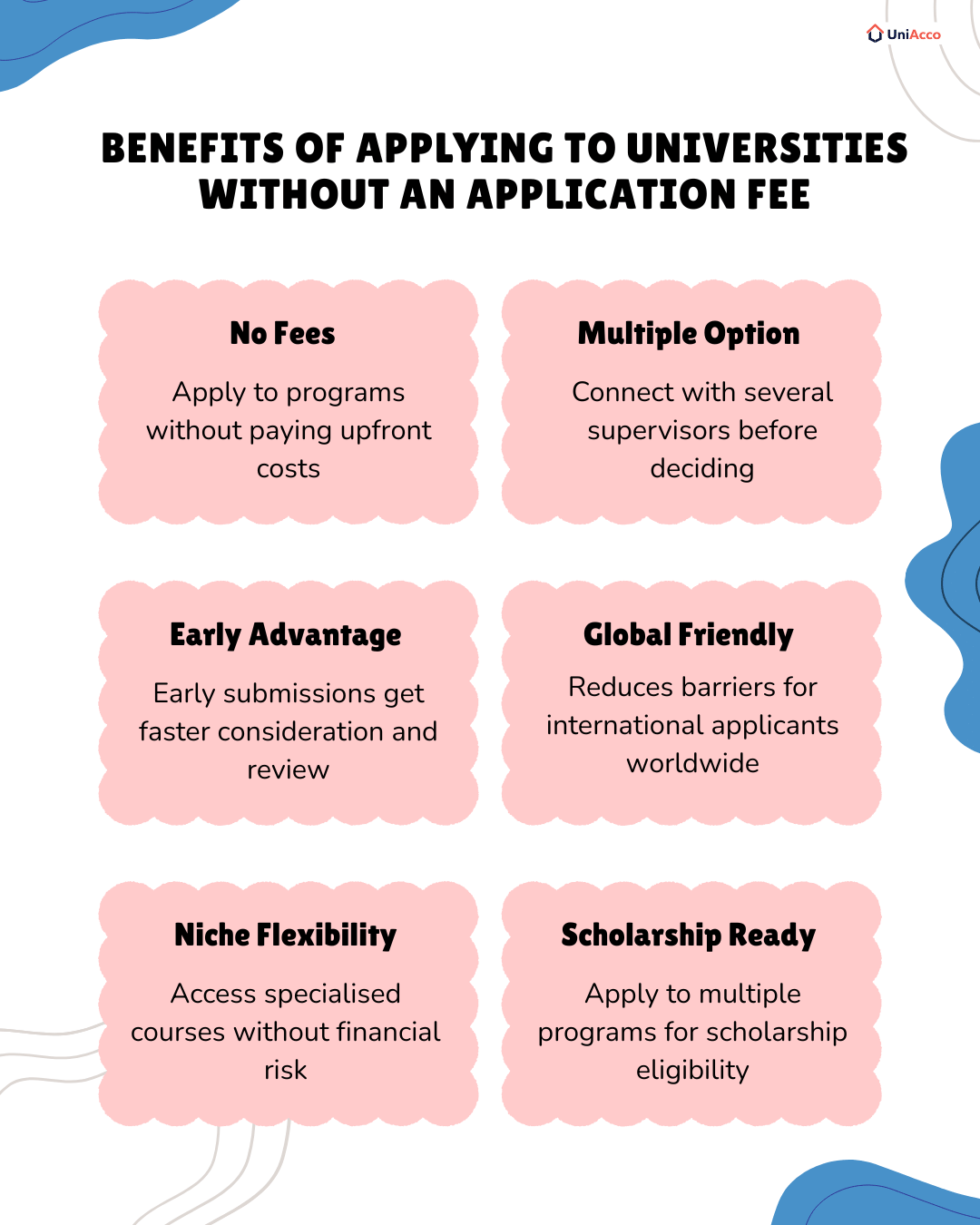
Cost-free access to competitive programmes
Many UK universities with no application fee allow students to submit applications for research and postgraduate programmes without paying the usual £50–£100 fee. This is particularly useful for high-demand courses in engineering, biosciences, and business, where applicants often apply to multiple departments to secure supervisor alignment.
Ability to explore multiple departments or supervisors
Fee-free applications allow students to contact multiple supervisors or departments before finalising their choice. For research-focused programmes, this increases the chances of securing a match without having to pay multiple application fees.
Encourages early submission and priority consideration
Universities that waive fees often operate on rolling admissions for PG and research courses. Applicants who submit early through fee-free routes are more likely to have their applications reviewed quickly and considered for limited-funded seats or departmental scholarships.
Reduces barriers for international applicants
International students often face currency conversion and banking delays. No application fee removes this administrative hurdle, allowing students from countries like India, Nigeria, or China to apply without delays or additional costs.
Greater flexibility in applying to niche programmes
Fee-free universities often waive charges for specialised courses such as marine sciences, rural studies, or AI research tracks. This allows students to pursue unconventional or highly specialised academic pathways without upfront financial risk.
Simplifies multi-programme planning for scholarship applications
Many scholarships require applications to be submitted in parallel to programmes. Fee-free applications let students apply to multiple courses simultaneously, increasing their chances of meeting scholarship eligibility criteria without incurring additional fees.
Also read: UK Government Scholarships For International Students In 2025
Tips to Maximise Your Chances of Admission at UK Universities with No Application Fee
1. Prioritise programmes where fee-free applications include academic pre-screening
Many UK universities without an application fee, such as Warwick, York, and Southampton, use internal academic screening instead of paid filters. Your first review is based entirely on academic alignment. Strengthen your CV, research interest summary, and course alignment because these are the actual acceptance triggers in fee-free pathways.
Also Read: 8 Prescribed Words To Include In Your CV
2. Use pre-application or expression of interest forms when available
Several no-fee universities run pre-application checks to reduce unqualified submissions. Completing these forms helps you get programme feedback or supervisor interest before submitting the main application. This increases your acceptance probability because your file is already familiar to the department.
3. Secure supervisor engagement before applying to research programmes
In fee-free universities, supervisors heavily influence which applications are fast-tracked. Even a short email expressing your research direction, along with 1–2 relevant papers you read from their work, can lead to a positive endorsement that admissions committees rely on.
4. Apply early in cycles where fee waivers attract higher competition
Fee waivers often increase application volumes. Departments start with more available seats and flexible evaluation standards early in the cycle. Applying in the first six weeks increases your odds because reviewers have not yet become selective due to high volume.
5. Upload extra academic evidence even when optional
Fee-free systems often see incomplete or low-effort submissions. Adding supplementary proofs, such as a writing sample, coding project, research abstract, or competition certificate, elevates your file to the high-effort category, demonstrating seriousness despite no fee barrier.
6. Request department-specific reference letters
A generic academic reference is easy to spot, especially when universities receive thousands of fee-free applications. Ask your referee to mention the exact programme, skills relevant to that department, and one quantifiable achievement. Department-tailored references perform much better in fee-free PG admissions.
7. Use the university applicant portal trackers actively
Fee-free universities often request clarifications or documents after the initial screening. Responding within 48 hours keeps your application from being sidelined or pushed into later review batches, which become significantly more competitive.

Conclusion
Fee-free applications are a strategic advantage. Universities in the UK without an application fee open the door for wider exploration to more courses, more supervisors, and more chances to find a programme that aligns with your long-term goals. These institutions remove the upfront barrier, letting you focus on building a strong, timely application rather than paying £50–£100 per attempt. For many students, that freedom means applying early, reaching out to the right departments, and keeping scholarship options firmly within reach.
If the next step on your checklist is finding a home that matches your academic plans, UniAcco offers verified, well-located student accommodation near major UK universities, designed for comfort, convenience, and peace of mind.


 LinkedIn









0 Comments