

£180 a week for a room near campus. £145 for one, a little further out. Then there’s the studio that looks aesthetically pleasing until you see the price. Suddenly, figuring out where to live in the UK feels like a whole decision of its own.
You may be weighing up questions like whether a £35 weekly saving justifies a longer journey to campus, how comfortable you’d be sharing a kitchen with others, or whether an ensuite is worth the extra cost compared to having more budget for social plans, meals out, and the occasional takeaway.
The different types of student accommodation in the UK come with different prices, privacy levels, locations, lifestyles and support. What suits your coursemate may feel completely wrong for you. This blog covers the main accommodation types, room options and practical details to help you find a place that feels right.
Types of Student Accommodation at a Glance
| Accommodation type | Description | Typical privacy | Best for |
| University halls | University-managed student housing | Medium | First-years, international students |
| PBSA/private halls | Privately managed student buildings | Medium – High | Students wanting facilities and convenience |
| Shared house/HMO | Private room in a shared property | Medium | Budget-conscious students |
| Private flat/apartment | Private rental, alone or shared | High | Independent students |
| Homestay | Room in a local family’s home | Medium | International/ younger students seeking support |
What Are the Main Types of Student Accommodation in the UK?
Student accommodation in the UK can be classified by who manages and operates the property. The main types include university-managed accommodation, private student accommodation, private rentals and homestays, with each offering a different level of independence, support and facilities.
University Halls of Residence
University halls can take one big worry off your plate: you are already close to campus and surrounded by other students for your first few weeks in the UK. That can make settling into a new city feel a little less daunting. Halls also give you a chance to meet people outside your course, which can matter when everything from your timetable to your local supermarket feels new.
Key Features:
- University-managed: University halls are managed by the university, so you have its accommodation team to contact when you need help or something needs fixing.
- Close to campus: Many halls are on campus or nearby. That can mean less time travelling each day and fewer pounds spent getting to lectures.
- Furnished rooms: University halls generally provide furnished rooms, so you can avoid buying bulky essentials when you arrive from overseas.
- Shared living: Many halls place you in a flat with other students, with shared kitchens and bathrooms. Some universities also offer rooms with private bathrooms.
- Bills often included: Many university halls include utilities within the accommodation fee, which makes your weekly budget easier to plan.
- University support: Depending on your university, you may have access to security, maintenance and student support teams.
Pros and Cons:
| Pros | Cons |
| Campus proximity: Getting to classes shouldn’t be too hard since you’ll rarely spend much time on public transport. | Room sharing: Kitchens and bathrooms will be shared by several individuals. |
| Making connections is easy: There are already some people around since other students start their studies at the same time as you do. | It can be noisy: Having flatmates who come home late or invite friends over might be distracting. |
| Bills are taken care of: Utility bills are normally included in the rent, which means you don’t have to worry about additional monthly expenses. | You may not get what you want: The room or flatmates that you wish to live with depend on availability. |
| The room is furnished: There’s nothing extra you need to bring. | Rooms may be simple: Everything is fixed, and it won’t be easy to make any changes. |
Purpose-Built Student Accommodation (PBSA)
A gym downstairs, somewhere quiet to study, and your own bathroom after a long day of lectures. That’s a big part of the appeal of Purpose-Built Student Accommodation (PBSA). These buildings are made with student life in mind, so you’ll often find useful spaces and services under the same roof. For students coming to the UK from abroad, having staff and everyday facilities nearby can make settling in a new city feel easier. PBSA can also give you more choice over where you live, with properties available near different universities and city areas.
Key Features:
- Built around student life: PBSA properties are designed specifically for students, with layouts, facilities and shared spaces that suit university living.
- More room choices: You can usually pick from shared flats, ensuite student rooms and student studios. Studios can give you a private kitchen and bathroom within your own space.
- Student-focused facilities: Many PBSA buildings offer study rooms, gyms, game areas, cinemas, outdoor spaces and communal rooms. Facilities vary by property, so check what your building actually includes.
- On-site support: Many providers have staff based at the property, with security measures such as key-fob access and CCTV. Some also provide support around the clock.
- Bills can be bundled: Many PBSA providers include utilities within the rent, which can make your monthly spending easier to plan. Always check exactly what your contract covers.
- Open to students from different universities: Unlike university halls, PBSA is usually independent of one university. You can live there even if your university does not manage the building.
Pros and Cons:
| Pros | Cons |
| More choice: You can often pick between shared flats, ensuites and studios. | Higher rent: Some PBSA options cost more than cheaper private rentals. |
| Useful facilities: Study spaces and social areas can save you trips elsewhere. | Less personalisation: Rooms usually follow a fixed design and layout. |
| Simpler bills: Many properties include utilities in the rent. | Not always on campus: You may still need public transport or a short walk to university. |
| On-site support: Staff and security can offer extra reassurance when you live abroad. | Shared living can get noisy: Communal spaces can feel busy during peak times. |
| More flexible access: Many properties accept students across different years and universities. | Facilities vary: A gym or cinema is not guaranteed at every property. |
Also Read: University Halls vs Private Student Accommodation: Which Is Better for Students?
Shared Student Houses and HMOs
Your own front door, a few mates, a bigger kitchen and no reception desk downstairs. Shared houses can feel closer to everyday life than a university residence. They also give you more say over where you live and who you live with. For many students, that freedom comes with a trade-off: you take on more of the practical stuff yourself. HMOs can suit you well if you want independence and a more traditional rental experience.
Key Features:
- Rent the house, not a student residence: You usually rent a room in a privately owned house or flat with other tenants. The property may sit in a residential neighbourhood rather than a dedicated student building.
- Shared everyday spaces: You normally share facilities such as the kitchen, bathroom and living room. The exact setup depends on the property and the number of tenants.
- More control over housemates: You can often rent with friends, which gives you more say over your living environment. Some letting agents also help match students who need housemates.
- Potentially lower rent: Shared houses often cost less than some private student residences, especially when several students split the rent. Your total cost still depends on bills and location.
- Bills usually sit outside the rent: You may need to arrange and split electricity, gas, water and internet with your housemates. Build these costs into your monthly budget.
- More responsibility: You may deal directly with the landlord or letting agent for repairs and property issues. Housemates also need to agree on cleaning, bills and shared responsibilities.
- HMO rules can apply: A property generally becomes an HMO when at least three unrelated tenants share facilities across more than one household. Some HMOs also require a licence, depending on local rules.
Pros and Cons:
| Pros | Cons |
| More independence: You get a stronger sense of living on your own terms. | More admin: Bills, repairs and household tasks can become your responsibility. |
| Live with friends: You can often choose your housemates and share the experience. | Housemate clashes: Different routines can create tension around noise, cleaning and shared spaces. |
| Can cost less: Splitting rent across several people can make larger properties more affordable. | Bills add up: Rent rarely covers every household expense. |
| More choice of areas: You can look beyond university-managed accommodation and campus locations. | Longer commute: Some cheaper properties sit further from campus. |
| Feels more independent: A shared house can give you a taste of life beyond university accommodation. | Property quality varies: Homes differ greatly in condition, maintenance and management. |
Private Student Flats and Apartments
After a long day of lectures, having a front door that is yours can feel pretty good. Private flats give you more control over your space, routine and downtime. You could go for a studio, a one-bedroom apartment or a flat in a professionally managed building. Some properties also have shared spaces, so you can grab some quiet time when you need it and still meet other students when you feel social.
Key Features:
- Your own space: A private flat gives you your own bedroom, bathroom and kitchen, so you don’t have to share the basics with a whole group of students.
- More control over your routine: Want to study late, sleep in on Sunday or cook at midnight? You can set your own routine without working around a flat full of housemates.
- Choice of apartment size: You can find studios, one-bedroom flats and larger apartments for students sharing with friends. The exact options depend on the property.
- City-centre locations: Private flats often sit in central areas, which can put shops, restaurants and transport links closer to you. Your university may still require a daily commute.
- Professional management: Some apartment buildings use dedicated management companies for maintenance and repairs. Others rely directly on a private landlord, so check the arrangement before signing.
- Fewer student-focused facilities: Some properties offer gyms or shared areas, but private apartments may not provide study rooms, student events or dedicated student support.
- Bills may sit outside rent: Unlike many PBSA properties, private flats can require you to arrange and pay for utilities separately. Check the tenancy terms carefully.
Pros and Cons:
| Pros | Cons |
| More privacy: You get greater control over your personal space and routine. | Higher costs: Private apartments often cost more than shared housing. |
| More independence: You manage your home without relying on shared facilities. | Extra bills: Utilities may come separately from your rent. |
| Central locations: Many flats sit close to shops, restaurants and transport links. | Less student support: You may not get dedicated student services or organised events. |
| Flexible room setups: Studios and larger flats can suit different living arrangements. | Fewer student facilities: A private flat may lack study areas, gyms or social spaces. |
| Quieter environment: Fewer shared spaces can make it easier to focus or switch off. | Less social interaction: Living alone can feel isolating when you are new to the UK. |
Homestay Accommodation
A Sunday roast with your host family, a quick chat over breakfast, and someone who knows the local bus route when you do not. A homestay for students gives you a very different experience from halls or private student accommodation. You live in a UK family home and become part of its everyday routine. That familiar setting can make the first few weeks feel far less unfamiliar for an international student arriving alone.
Key Features:
- Live with a UK host family: You stay in a family home rather than a dedicated student building. Your bedroom and shared household spaces form part of the host’s home.
- A more local experience: Daily life can give you a closer look at local customs, routines and food. It can feel very different from living with other international students.
- Meals may be included: Some homestays include meals as part of the arrangement. Always confirm the number of meals, timings and dietary requirements before booking.
- English in everyday life: Regular conversations at home can give you more opportunities to practise English outside your lectures.
- A ready-made home setting: You arrive at an established household rather than setting up a completely new home from scratch. Some providers also arrange for hosts to receive students when they first arrive.
- Host arrangements vary: Your experience depends heavily on the host, location and agreed terms. Check house rules, meals, travel time, guests and what you can access before committing
Pros and Cons:
| Pros | Cons |
| Local experience: You can experience everyday UK life beyond the university campus. | Less independence: You live within another household’s routines and expectations. |
| English practice: Regular conversations can help you use English in everyday situations. | House rules: Hosts may set expectations around meals, guests, noise and shared spaces. |
| Potential meal support: Some arrangements include meals, which can reduce daily cooking and grocery planning. | Less choice: You may have fewer options for room layouts and household facilities. |
| Helpful for first arrivals: A host can give you practical insight into local routines and the area. | Host compatibility matters: Your experience depends greatly on the household you join. |
| Can feel more personal: You have a home environment around you while settling into the UK. | Travel time varies: Your host home may sit further from the university than student residences. |
University Halls vs PBSA vs Private Rentals
| Factor | University Halls | PBSA | Private Rental |
| Managed by | Your university | A private student accommodation provider | A private landlord or letting agent |
| Location | Usually on or close to campus | Often close to universities, city centres or transport links | Depends on the property and area |
| Bills | Often included in the rent | Often included in the rent | Usually paid separately |
| Facilities | Usually basic and practical | Often includes gyms, study areas and social spaces | Depends on the property |
| Privacy | Usually low to moderate | Moderate to high | Moderate to high |
| Social life | Easy to meet other university students | Plenty of shared spaces and student activities | Depends on who you live with |
| Contract | Set by the university | Set by the accommodation provider | Based on your tenancy agreement |
| Best for | First-year and new international students | Students who want convenience and modern facilities | Students who value independence and flexibility |
On-Campus vs Off-Campus Student Accommodation
| Factor | On-campus | Off-campus |
| Distance from university | Usually within or close to campus | Depends on the property and area |
| Daily commute | Often short and simple | Can range from a short walk to a longer journey |
| Student community | Usually easy to meet other students | Depends on the building, house or neighbourhood |
| Privacy | Depends on the room and residence | Often offers more room and property choices |
| Cost | Depends on the university and room type | Varies by city, neighbourhood and property |
| Accommodation choice | Usually fewer options | Often a wider range of student housing options |
Student Accommodation Cost in the UK by Accommodation Type
| Accommodation | Indicative weekly cost | Main cost drivers |
| University halls | £120 – £320 | City, room, catering |
| PBSA | £150 – £350 | City, room, facilities |
| Shared house/HMO | £90 – £180 | City, number of housemates |
| Studio | £220 – £450 | Location, size, facilities |
| Homestay | £140 – £250 | Meals, location, duration |
Student Accommodation Costs in Popular UK Cities
Your university city can change your accommodation budget by hundreds of pounds each month. London sits at the expensive end, while cities such as Sheffield, Liverpool and Nottingham can offer more budget-friendly options.
London
London gives you a huge range of student housing options, but prices can vary sharply between room types. UCL lists 2026/27 rooms from £153.86 per week for a single room at Max Rayne House. Large studios at Astor College cost £450.73 per week. UCL also offers selected affordable rooms at around £200 per week.
Manchester
Manchester gives you options across areas such as the city centre, Fallowfield and Victoria Park. The University of Manchester offers contracts ranging from 41 to 51 weeks. At Square Gardens, 2026/27 rates run from £9,481 to £13,187 for 42 weeks, depending on the room. That works out at roughly £226 to £314 per week.
Birmingham
Birmingham gives you access to both university halls and private student housing close to the city centre. At University College Birmingham, 2026/27 accommodation costs £134 per week for a standard room and £158 for an ensuite. The 42-week contract runs from September to June.
Liverpool
Liverpool gives you plenty of student accommodation options, from straightforward rooms to private studios. For 2026/27, University of Liverpool accommodation starts at £110 per week for a non-en-suite room. At the other end, a Premier Studio Apartment costs £280.56 per week.
Leeds
Leeds gives you plenty of choice when it comes to university accommodation, and the price can change quite a bit by room type. For 2026/27, University of Leeds rates start at around £122 per week for some shared-bathroom rooms and reach £283 per week for higher-priced catered en-suites. So, compare the room as carefully as the rent.
Sheffield
Sheffield can give you more room to compare before committing to a higher-priced room. The University of Sheffield’s 2026/27 rates start at £151.41 per week for some shared-bathroom rooms. Studios reach £240.38 per week in Laddow Studios. Utilities, contents insurance and internet are included in the university rent.
Nottingham
Nottingham has student accommodation close to NTU’s City Campus, with room prices varying by property and room type. For 2026/27, Talbot Street ranges from £165 to £316 per week. Redgate starts at £168 and goes up to £295 per week. That gives you a useful price range to work with when planning your budget.
Bristol
Bristol gives you quite a few accommodation options, so your budget can take you from a basic room to a private studio. For 2026/27, University of Bristol rooms start at £136.50 a week for some twin rooms. At the higher end, a postgraduate studio costs £339.50 a week. If you go for catered accommodation, budget another £72 a week for two meals a day during term time.
Edinburgh
Edinburgh does not have one simple accommodation price. Your residence, room setup and contract can change the total quite a bit. For 2026/27, the University of Edinburgh lists Morgan Court from £8,658.40, Salisbury Court at £12,129, and catered John Burnett House at £14,513.03 for the stated contracts. These are official IFP rates, not city-wide averages.
Glasgow
Glasgow offers some of the clearest price differences between shared and private rooms. University of Glasgow accommodation for 2026/27 starts at £129.92 per week for a shared room at Cairncross House. Premium studios at Havannah House reach £239.40 per week. Heating, utilities, Wi-Fi and group insurance are included in the listed residence fees.
Also Read: How Student Accommodation Design in the UK is Evolving for Gen Z
Which Type of Student Accommodation Is Best for You?
| If you care most about… | You could consider… |
| Keeping rent as low as possible | Shared house or HMO |
| Meeting new people | University halls or PBSA |
| Having your own space | Studio or private apartment |
| Having a private bathroom | En-suite room |
| Living close to campus | University halls |
| Having modern facilities | PBSA |
| Living independently | Private rental or studio |
| Having more support around you | University halls or homestay |
| Keeping your monthly costs easier to plan | All-inclusive PBSA |
| Experiencing everyday UK life | Homestay |
How to Choose the Right Student Accommodation in the UK?
The cheapest room can look like a great deal until you add a 45-minute commute and separate utility bills. A nicer studio can sound perfect until it eats up most of your monthly budget. Before you book, run through these checks. They can save you money, time and a fair bit of stress after you arrive in the UK.
Set Your Accommodation Budget
Start with the full cost, not the advertised rent. Add up:
- Weekly or monthly rent
- Electricity, gas, water and Wi-Fi
- Transport to university
- Deposit
- Admin or booking fees, if applicable
- Bedding, kitchen items and other move-in costs
Keep some money aside for your first few weeks. Your first supermarket trip can cost more than expected when you are starting from scratch.
Decide How Much Privacy You Need
A cheaper room can look tempting until you realise what you’ll be sharing every day. With a shared room, you share your sleeping space too. A non-en-suite means sharing the bathroom. An en-suite gives you more privacy, while a studio gives you your own kitchen. Think about your daily routine before paying extra.
Check the Distance From Your University
“Close to campus” can mean very different things in the UK. Check the actual:
- Walking time: Is it a realistic walk in winter?
- Bus or train route: How often do services run?
- Evening travel: Can you get home easily after a late lecture or library session?
- Travel cost: Add the weekly fare to your accommodation budget.
A room that costs £20 less each week may not feel cheaper after daily transport costs.
Compare What Is Included in Rent
Two rooms can cost the same on paper and still leave you with very different monthly bills. Check what comes with the rent before you book. Does it cover Wi-Fi, heating, electricity, water or contents insurance? If you’ll pay bills separately, ask the provider what you’re likely to spend each month. That way, a cheaper-looking room doesn’t catch you out later.
Check Contract Length and Cancellation Terms
Do not skim the contract and click “accept”. Check the start and end dates, payment schedule, deposit rules, notice period and cancellation terms. Some student contracts can run for most of the academic year. Make sure the dates match your course and travel plans.
Check Security and Maintenance
A nice room means little if getting help becomes a mission. Check how you access the building, who handles repairs and who you contact when something goes wrong. Look for secure entry, CCTV, on-site staff and a proper maintenance process. Then ask about repair response times. You really do not want to discover how cold your room gets when the heating stops working in January.
Research the Area
Do not judge a neighbourhood from the property photos. Check the area on a map. Look for supermarkets, pharmacies, GP surgeries, bus stops, train stations, cafés and places to study. If you have dietary or cultural preferences, check nearby shops and restaurants too. A five-minute walk to the right supermarket can make weekly life much easier.
Check Reviews and Photos
The photos might show you a spotless room, but the reviews tell you what it’s like after a few months of living there. Look for comments about noise, cleanliness, heating, Wi-Fi and repairs. One bad review does not say much. If several students mention the same problem, pay attention. Check the newest reviews first, too. A building can have new management, updated facilities or different maintenance standards from one year to the next.
Confirm Who You Will Be Sharing With
The number of people you live with can change your whole experience. Check how many students share the kitchen and bathroom. If you’re moving with friends, make sure the provider can place you in the same flat. Otherwise, your group chat may get a little awkward.
Check Accessibility Requirements
Ask the accommodation provider about step-free entrances, lifts, accessible bathrooms and adapted rooms. If you have a specific requirement, mention it before paying. Ask the provider to confirm the arrangement in writing too. That way, you know exactly what will be available when you arrive in the UK, instead of sorting it out after move-in.
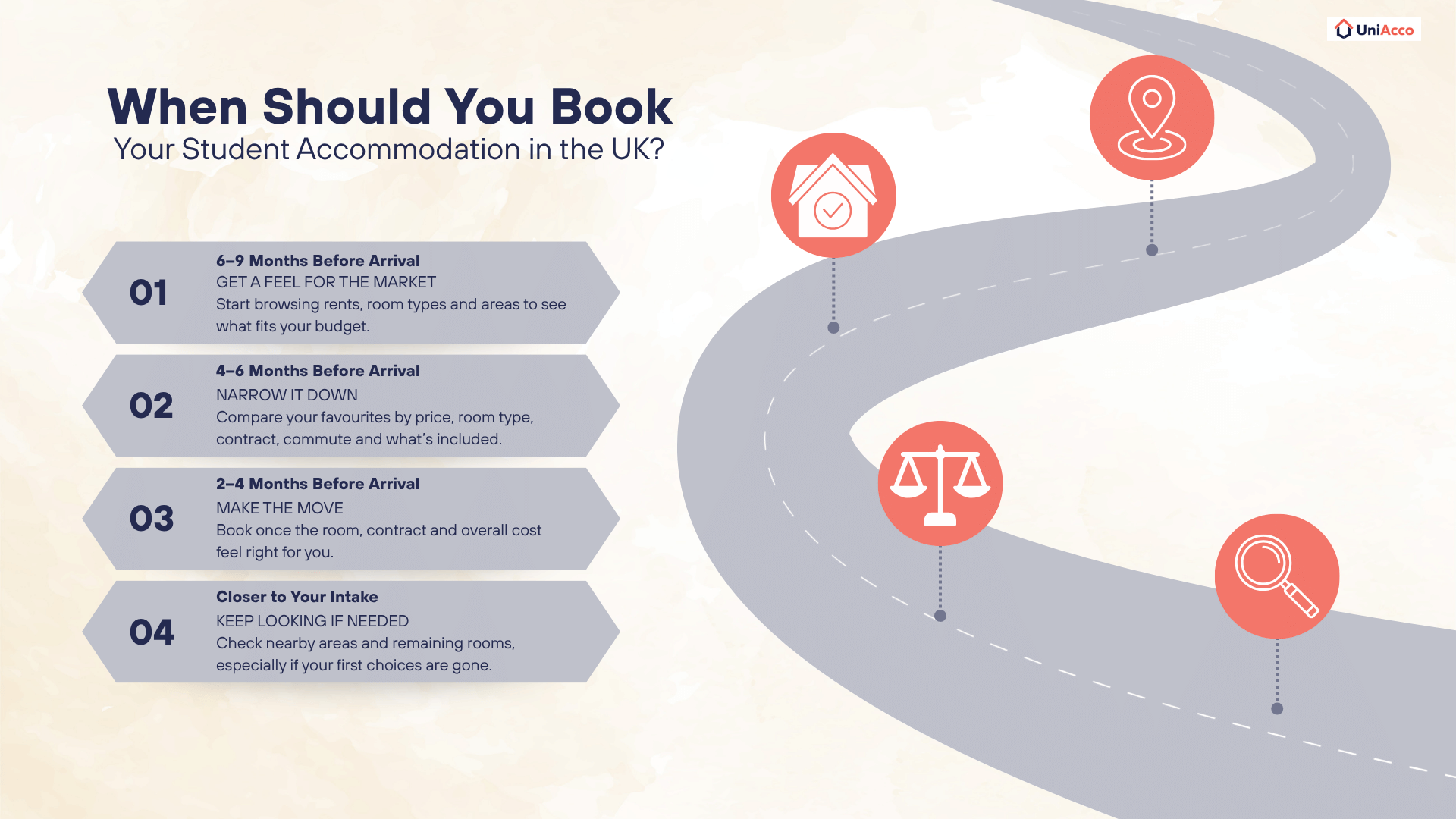
When Should You Book Student Accommodation in the UK?
6–9 Months Before Arrival: Start Looking Around
You don’t need to book yet. Use this stage to see what student accommodation actually costs in your city. Check university halls, PBSA, shared houses and private rentals. Look at different areas too. You might find that living a little further from campus gives you a much better room for your budget. Save the places that catch your eye and note their prices, room types and locations.
4–6 Months Before Arrival: Start Comparing
Now you can narrow your shortlisted properties side by side. Check the rent, bills, room type, contract length, distance from the university and facilities. If you want an en-suite, studio or accessible room, check availability sooner rather than later. You’ll have a much clearer idea of what works for you at this point.
2–4 Months Before Arrival: Time to Book
This is the best time to book a place that matches your wishlist. Before paying, read the contract properly. Check when payments are due, how much the deposit is, what your rent covers and what happens if your plans change. Leaving it too late can mean fewer rooms, fewer locations and fewer options within your budget.
Closer to Your Intake: Keep Your Options Open
Still looking for a room? That’s okay. Check what your university has left, then look at private student accommodation nearby. You can also widen your search by a few stops. A place further from campus could work well if the bus or train is frequent, reliable and affordable.
Just avoid rushing into a room you don’t actually want simply because your intake is getting closer.
Also Read: Why Consider Booking Student Accommodation in Advance in the UK?
Common Student Accommodation Mistakes to Avoid
A room can look perfect online and still turn into a headache after you arrive. These are the mistakes worth catching before you pay a deposit or sign a contract.
Booking based only on rent
That £140-a-week room may look like a bargain. Then you add bills, transport and other costs. Compare the total weekly cost, not the headline rent.
Ignoring bills
Check exactly what your rent covers. Electricity, heating, water and Wi-Fi can sit outside the advertised price. Ask for a clear breakdown before you commit.
Choosing a property without checking the commute
A room can look “near campus” on a listing and still take 40 minutes to reach. Check the actual walking route, bus or train journey and evening services. Add your travel costs to your accommodation budget.
Not reading the contract
Do not treat the tenancy agreement like terms and conditions you can skip. Check the contract length, payment dates, deposit, notice period, cancellation rules and responsibilities for bills and repairs.
Assuming every PBSA includes the same facilities
A gym, cinema or study room might appear in one PBSA listing. Another building may offer none of them. Check the facilities included at your specific property. Also confirm if you pay extra for anything you plan to use.
Booking a room without checking its actual size
“Spacious room” means very little without measurements. Check the floor plan or room dimensions. Think about where your suitcase, clothes, laptop and other belongings will actually go.
Ignoring cancellation terms
Plans can change after you book. Your visa, university offer or travel arrangements may not go as expected. Find out what happens if you need to cancel before paying a deposit or signing the contract.
Sending money without verifying the property/provider
Pause before reaching for your card when you get a message asking for a deposit. Check the accommodation provider, property details and payment instructions against their official website. Never let a countdown or pressure to “book now” rush you into sending money.
Choosing a room type without considering lifestyle
An en-suite sounds great until you realise you would rather save the extra money. A shared room can cut costs but gives you far less personal space. Think about how you actually live. Your room type should fit your routine, budget and comfort level.
Leaving the search until the last minute
Popular student rooms can disappear quickly around major university intakes. Starting early gives you more time to compare locations, prices and room types. If your first choice goes, you still have time to find another suitable option.
Also Read: How to Spot & Avoid Student Accommodation Scams in the UK
Conclusion
A student room has a funny way of becoming your whole little world. You’ll study there, sleep there, dump your shopping bags there and probably eat dinner there more often than planned. That makes the practical stuff worth checking. Rent is one thing. Bills, travel, contract dates and the room itself can change the picture quite a lot. You also need to decide how much sharing you’re comfortable with. Once you know your limits, the choice gets easier. You might end up in university halls, PBSA, a shared house or a studio. What matters is how well it fits your actual life.
Not sure where to begin your search? Browse student accommodation in the UK with UniAcco and compare options by city, room type and budget. It’s an easy way to see what’s available and narrow down your choices before making a shortlist.
🔍 Explore Student Accommodation in the UKAlso Read: UK Student Accommodation Trends to Watch in 2026


 LinkedIn








0 Comments