
Introduction
When everyone around you is talking about “Top 50” and “Top 100” universities, it’s easy to believe rankings are all that matter. But what are these rankings measuring, what parameters do they consider, and why do universities rank differently on different rank lists? Amongst thousands of universities, global university rankings often seem like a shortcut for comparing institutions and narrowing their choices. In this guide, we’ll explore the top 100 universities in the world, unpack what these rankings really mean, and show you how to use rankings to find the university that fits the bill.
Top 100 Universities in the World 2026-2027
| QS World University Rankings 2027 | University | Country | Key Highlights |
| 1 | Massachusetts Institute of Technology (MIT) | United States | Produces more venture-backed startups per graduate than any other university, with alumni-founded companies generating trillions in annual revenue collectively. The Undergraduate Research Opportunities Program (UROP) embeds students into faculty research from the first year, a model later adopted worldwide. Home to globally influential AI, robotics and semiconductor research ecosystems through CSAIL, Lincoln Laboratory and affiliated research centres. |
| =2 | Imperial College London | United Kingdom | The UK’s only university focused exclusively on science, engineering, medicine and business, creating unusually high interdisciplinary depth in STEM. Operates one of Europe’s strongest commercialisation ecosystems, with White City Innovation District connecting researchers directly with startups and industry. Houses one of the world’s leading infectious disease and public health research communities, shaping global pandemic preparedness and policy. |
| =2 | Stanford University | United States | No university has contributed more directly to the creation of Silicon Valley, with founders of Google, NVIDIA, Cisco, Netflix, Yahoo and thousands more emerging from its ecosystem. Entrepreneurial education is deeply integrated into academics, enabling students to launch ventures while studying through Stanford-affiliated accelerators and investor networks. Leads frontier research where AI, medicine, sustainability and engineering converge through large interdisciplinary institutes rather than isolated departments. |
| 4 | University of Oxford | United Kingdom | Operates the world’s largest tutorial-based teaching system, delivering intensive small-group instruction rarely replicated at scale. Its collegiate structure combines independent colleges with a central university, creating academic and social communities unlike conventional campuses. Oxford researchers developed the Oxford–AstraZeneca COVID-19 vaccine, demonstrating the university’s ability to translate research into global public health impact. |
| 5 | Harvard University | United States | Maintains the world’s largest academic library system, spanning millions of physical and digital resources across specialised collections. Alumni include an unmatched concentration of heads of state, Nobel laureates, Supreme Court justices and Fortune 500 leaders across multiple disciplines. The university’s affiliated hospitals form one of the world’s largest academic medical ecosystems, accelerating bench-to-bedside clinical innovation. |
| 6 | University of Cambridge | United Kingdom | The supervision system provides personalised academic mentoring in very small groups, fostering deep subject mastery throughout UG education. Cambridge researchers have been central to breakthroughs including the structure of DNA, modern computing, gravitational science and molecular biology. The Cambridge Cluster surrounding the university has grown into Europe’s leading deep-tech and life sciences innovation hub. |
| 7 | California Institute of Technology (Caltech) | United States | Maintains one of the world’s lowest student-to-faculty ratios among elite research universities, enabling exceptional access to leading scientists. Manages NASA’s Jet Propulsion Laboratory (JPL), placing students and researchers at the forefront of planetary exploration and space missions. Despite its small size, Caltech consistently produces Nobel-calibre research output at one of the highest per-capita rates globally. |
| =8 | ETH Zurich | Switzerland | Educated Albert Einstein and remains Europe’s benchmark institution for engineering, computational science and applied physics. Combines fundamental science with precision engineering, making it a global leader in robotics, climate science and advanced manufacturing research. Strong partnerships with Swiss industry enable rapid translation of laboratory discoveries into globally competitive technologies. |
| =8 | UCL | United Kingdom | Founded as England’s first university to admit students regardless of religion, establishing a long tradition of educational inclusivity. Offers one of the widest disciplinary portfolios in Europe, enabling collaboration across medicine, architecture, engineering, arts, law and social sciences within a single institution. Home to globally influential research in neuroscience, archaeology and education through specialised institutes with international reach. |
| 10 | National University of Singapore (NUS) | Singapore | Serves as Singapore’s primary innovation engine, with deep integration into the country’s government, technology and biomedical sectors. The NUS Overseas Colleges programme immerses students in global startup ecosystems while earning academic credit, a model unique in scale among Asian universities. Excels in tropical urban sustainability, smart cities and Asian policy research, leveraging Singapore as a living laboratory for real-world innovation. |
| 11 | The University of Hong Kong (HKU) | Hong Kong SAR | Hong Kong’s oldest university, uniquely positioned as a gateway connecting Chinese markets with global academia and industry. Its Faculty of Dentistry has consistently ranked among the world’s best, driving advances in oral health research and specialist training. Serves as a major hub for infectious disease, virology and translational medicine, contributing significantly to research on emerging epidemics in Asia. |
| 12 | Nanyang Technological University, Singapore (NTU) | Singapore | Built one of the world’s most sustainable university campuses, with multiple net-zero energy buildings and large-scale smart campus initiatives. Home to one of Asia’s strongest engineering schools, particularly in materials science, autonomous systems and advanced manufacturing. Integrates artificial intelligence across disciplines through dedicated AI institutes and industry partnerships spanning healthcare, finance and mobility. |
| 13 | Peking University | China (Mainland) | China’s foremost institution for humanities, philosophy and public policy, shaping generations of national leaders and intellectual movements. Combines elite strengths in fundamental sciences with one of the country’s most influential schools of economics and international affairs. Its campus surrounds the historic Yan Yuan gardens, blending centuries-old cultural heritage with modern research infrastructure. |
| 14 | Tsinghua University | China (Mainland) | Widely regarded as China’s premier engineering and technology university, producing a large share of the country’s top innovators and entrepreneurs. Plays a pivotal role in national research initiatives spanning semiconductors, clean energy, artificial intelligence and quantum technologies. Maintains exceptionally strong collaboration with China’s high-tech industries, accelerating the commercialisation of advanced engineering research. |
| 15 | University of Pennsylvania | United States | Home to the Wharton School, the world’s first collegiate business school and a global benchmark for finance, management and entrepreneurship education. Integrates business, medicine, engineering and law through a highly flexible interdisciplinary curriculum that encourages cross-school study. Pioneered numerous breakthroughs in gene therapy and mRNA-related biomedical research through Penn Medicine. |
| =16 | Cornell University | United States | Combines Ivy League academics with New York’s land-grant mission, offering exceptional breadth across agriculture, engineering, business, architecture and hospitality. Operates one of the world’s leading hospitality management schools, shaping the global hotel and tourism industry for nearly a century. Cornell Tech in New York City connects graduate education directly with startups, venture capital and the digital economy. |
| =16 | Yale University | United States | Renowned for its residential college system, fostering close-knit academic and social communities throughout undergraduate life. Houses the Yale School of Drama and Yale School of Music, institutions that have produced an extraordinary number of acclaimed artists, actors and performers. The Yale University Art Gallery, the oldest university art museum in the United States, provides students direct access to world-class collections for teaching and research. |
| 18 | The Chinese University of Hong Kong (CUHK) | Hong Kong SAR | Operates a collegiate system inspired by Oxford and Cambridge, combining residential life with personalised academic mentoring. Internationally recognised for biomedical engineering, gastroenterology and minimally invasive surgical innovations developed through its medical faculty. A global leader in Chinese language, literature and cultural studies while maintaining strong bilingual education in English and Chinese. |
| 19 | The University of New South Wales (UNSW Sydney) | Australia | Produces more Australian startup founders than any other university, supported by one of the country’s most active entrepreneurship ecosystems. Hosts world-leading photovoltaic research that has significantly improved the efficiency of modern silicon solar cells used worldwide. Maintains deep defence, cybersecurity and quantum engineering collaborations with government agencies and global technology companies. |
| =20 | Johns Hopkins University | United States | America’s first research university, establishing the modern research-intensive university model later adopted worldwide. Consistently attracts more external research funding than any other U.S. university, spanning medicine, engineering, public health and space science. Home to the Bloomberg School of Public Health, the world’s largest public health school and a major contributor to global health policy and epidemiological research. |
| =20 | University of California, Berkeley (UCB) | United States | The birthplace of numerous scientific breakthroughs, including the discovery of multiple chemical elements and pioneering work in CRISPR gene-editing. Lawrence Berkeley National Laboratory extends the university’s research reach into energy, computing and particle physics at a global scale. Its culture of academic activism and public policy engagement has influenced social, environmental and political movements for decades. |
| =22 | EPFL – École polytechnique fédérale de Lausanne | Switzerland | Europe’s fastest-rising technology university, renowned for robotics, microengineering and digital technologies. Houses cutting-edge facilities in brain science, including the Blue Brain Project, advancing large-scale digital models of the human brain. Its Innovation Park hosts hundreds of startups and R&D centres, creating one of Europe’s strongest university-industry ecosystems. |
| =22 | The University of Melbourne | Australia | The Melbourne Model emphasises broad undergraduate education before professional specialisation, mirroring leading North American academic structures. Australia’s leading institution for clinical medicine and biomedical research through extensive partnerships with major teaching hospitals. Plays a central role in policy, economics and sustainability research, shaping Australia’s public institutions and regional development. |
| 24 | University of Chicago | United States | Home of the Chicago School of Economics, whose ideas fundamentally shaped modern economic theory and global public policy. Operates one of the world’s most intellectually rigorous core curricula, requiring students to engage deeply across the humanities, sciences and social sciences. The first self-sustaining nuclear chain reaction was achieved under its historic Manhattan Project research site, marking the beginning of the atomic age. |
| 25 | Technical University of Munich (TUM) | Germany | Germany’s leading entrepreneurial university, generating one of Europe’s highest numbers of deep-tech startups and spin-offs. Integrates engineering, life sciences and digital technologies through industry-focused research campuses and innovation hubs. Maintains close strategic partnerships with global companies, including BMW, Siemens, Airbus and SAP, enabling large-scale collaborative research. |
| 26 | Fudan University | China (Mainland) | One of China’s foremost universities in medicine, journalism and international relations, combining strong liberal arts with advanced scientific research. Its Shanghai location provides unmatched access to China’s financial, commercial and multinational business ecosystem. Recognised for influential research in integrated circuits, biomedical sciences and public governance aligned with China’s national innovation priorities. |
| 27 | Princeton University | United States | Offers one of the world’s strongest undergraduate-focused Ivy League experiences, with every student completing original independent research or a senior thesis. Home to the Institute for Advanced Study’s close academic ecosystem, fostering collaboration with some of the world’s greatest theoretical scientists and mathematicians. Maintains one of the largest university endowments per student, enabling exceptional funding for research, scholarships and academic opportunities. |
| 28 | The University of Sydney | Australia | Australia’s first university, combining historic academic traditions with leadership in modern health, veterinary and environmental sciences. Hosts one of the Southern Hemisphere’s largest interdisciplinary health precincts, integrating research, hospitals and clinical education. Strong emphasis on multidisciplinary problem-solving through initiatives spanning climate resilience, precision medicine and digital transformation. |
| 29 | Australian National University (ANU) | Australia | Established by the Australian Parliament specifically as the nation’s premier research university, giving it a uniquely national mission. Houses world-leading expertise in astronomy, quantum science and Earth observation through internationally significant research facilities. Its close proximity to Australia’s federal government creates exceptional strengths in diplomacy, security, public policy and Asia-Pacific studies. |
| 30 | McGill University | Canada | Canada’s most internationally diverse research-intensive university, attracting students from over 150 countries. Montreal’s bilingual environment allows students to study and work within both English- and French-speaking cultural and professional ecosystems. Has a distinguished legacy in neuroscience and medicine, including pioneering contributions to modern brain research and medical education. |
| 31 | Monash University | Australia | Operates one of the world’s largest international campus networks, with degree-granting campuses in Australia, Malaysia, Indonesia and partnerships across multiple continents. Home to the Monash Institute of Pharmaceutical Sciences, a global leader in drug discovery, formulation and translational medicine. Collaborates extensively with industry through Monash Technology Precinct, accelerating innovation in advanced manufacturing, clean energy and digital technologies. |
| 32 | University of Toronto | Canada | The birthplace of insulin, one of the most transformative medical discoveries in history, revolutionised diabetes treatment worldwide. Canada’s largest research university, spanning three campuses with exceptional strengths in AI, regenerative medicine and urban innovation. The Vector Institute partnership places students at the centre of one of the world’s leading artificial intelligence ecosystems. |
| 33 | The Hong Kong University of Science and Technology (HKUST) | Hong Kong SAR | Despite being founded only in 1991, HKUST rapidly became one of Asia’s premier universities for engineering, business and technology. Maintains one of the strongest entrepreneurship ecosystems in Greater China, producing high-growth startups in fintech, robotics and biotechnology. Its coastal campus serves as a living laboratory for marine sustainability, environmental monitoring and climate resilience research. |
| 34 | Université PSL | France | Formed by bringing together France’s elite grandes écoles and research institutions, creating an unusually concentrated ecosystem of academic excellence. Hosts globally renowned institutions in physics, mathematics, economics, arts and humanities under a unified university structure. Produces one of the highest densities of Nobel laureates, Fields Medalists and CNRS researchers within a single academic network. |
| 35 | The University of Edinburgh | United Kingdom | Played a foundational role in the Scottish Enlightenment, shaping modern philosophy, economics and scientific thought. Home to internationally recognised informatics and AI research, including pioneering contributions to machine learning, robotics and language technologies. Combines world-leading veterinary medicine with extensive wildlife, conservation and One Health research through dedicated research centres. |
| 36 | Shanghai Jiao Tong University | China (Mainland) | Internationally recognised for engineering, naval architecture and advanced manufacturing, supporting China’s industrial and technological development. Publisher of the influential Academic Ranking of World Universities (ARWU), one of the world’s most cited global university ranking systems. Leads major research initiatives in biomedical engineering, integrated circuits and smart transportation through national innovation platforms. |
| 37 | King’s College London | United Kingdom | Home to one of the world’s most influential faculties of psychiatry, psychology and neuroscience, advancing mental health research and clinical practice. Its researchers made critical contributions to the discovery of DNA’s double-helix structure through pioneering X-ray crystallography work. Located across central London, offering unparalleled access to Parliament, the NHS, international organisations, and leading cultural institutions. |
| 38 | Seoul National University | South Korea | South Korea’s flagship national university, educating a significant share of the country’s leaders in government, academia and industry. Renowned for semiconductor engineering, materials science and next-generation electronics research supporting Korea’s technology sector. Plays a central role in national policy development through leading schools of public administration, law and international studies. |
| 39 | The University of Tokyo | Japan | Japan’s oldest modern university and the country’s foremost centre for scientific research, public policy and technological innovation. Maintains world-leading capabilities in earthquake engineering, disaster resilience and geosciences, reflecting Japan’s unique environmental challenges. Has educated the majority of Japan’s Nobel Prize-winning scientists and many of its political, judicial and corporate leaders. |
| =40 | The University of Manchester | United Kingdom | The world’s first stored-program computer was developed here, laying the foundation for modern computing. Researchers isolated graphene at the university, a breakthrough that earned the 2010 Nobel Prize in Physics and transformed materials science. Maintains one of the UK’s strongest industrial research partnerships, particularly in advanced materials, nuclear science and biotechnology. |
| =40 | The University of Queensland | Australia | Pioneered the molecular clamp vaccine platform and has been instrumental in translating biotechnology research into commercial healthcare solutions. Home to the Queensland Brain Institute, one of the world’s leading centres for neuroscience, neurodegenerative diseases and brain mapping. Strongly integrated with Australia’s mining, agriculture and environmental sectors, driving innovations in sustainable resource management and food security. |
| 42 | Yonsei University | South Korea | One of Korea’s prestigious “SKY” universities, with a powerful alumni network spanning government, business and media. Operates Songdo International Campus, one of Asia’s most advanced smart campuses designed for global education and international collaboration. Recognised for leadership in biomedical engineering, precision medicine and translational healthcare through Severance Hospital, Korea’s oldest Western-style hospital. |
| =43 | Columbia University | United States | Administers the Pulitzer Prizes, making it one of the world’s most influential institutions in journalism, literature and public discourse. Located in New York City, offering unparalleled access to global finance, diplomacy, media and cultural industries as part of the learning ecosystem. Home to the Lamont-Doherty Earth Observatory, a global leader in climate science, oceanography and Earth systems research. |
| =43 | Institut Polytechnique de Paris (incl. École Polytechnique) | France | Brings together France’s leading engineering grandes écoles under one institution, creating exceptional strength in mathematics, engineering and defence sciences. Produces many of France’s top engineers, military officers and technology leaders through its highly selective educational model. Plays a pivotal role in European research on cybersecurity, quantum technologies and advanced telecommunications through close collaboration with national research agencies and industry. |
| =45 | Northwestern University | United States | Houses the renowned Medill School of Journalism, consistently producing leaders in investigative reporting, media innovation and strategic communications. Seamlessly integrates engineering with medicine through its Chicago campus, accelerating breakthroughs in biomedical devices and translational healthcare. One of the few elite U.S. universities balancing top-tier research with nationally competitive programs in music, theatre and performance arts. |
| =45 | University of British Columbia (UBC) | Canada | Hosts one of North America’s largest university sustainability initiatives, using its campuses as living laboratories for climate action and green infrastructure. Canada’s Pacific Rim gateway, fostering extensive academic and research partnerships across Asia through its strategic geographic location. Home to globally respected forestry, biodiversity and ocean sciences programs, supported by direct access to diverse natural ecosystems. |
| 47 | Zhejiang University | China (Mainland) | One of China’s strongest universities for artificial intelligence, agricultural technology and advanced manufacturing, with research spanning multiple strategic sectors. Produces a remarkable number of technology entrepreneurs, earning Hangzhou a reputation as one of China’s leading innovation hubs. Maintains deep collaborations with Alibaba and other technology giants, enabling rapid translation of digital research into commercial applications. |
| 48 | Delft University of Technology (TU Delft) | Netherlands | Europe’s leading university for civil engineering and water management, developing solutions used globally for flood protection and resilient infrastructure. Houses world-class aerospace engineering facilities, contributing to aircraft design, sustainable aviation and space technologies. Recognised internationally for pioneering research in quantum computing and quantum internet technologies through QuTech. |
| 49 | University of California, Los Angeles (UCLA) | United States | Combines elite research with one of the largest and most comprehensive academic medical systems in the western United States. Leverages its Los Angeles location to lead in film, digital media, entertainment business and creative technologies through close industry engagement. Home to influential research in neuroscience, genomics and precision medicine, supported by interdisciplinary collaboration across science, engineering and healthcare. |
| 50 | The Hong Kong Polytechnic University (PolyU) | Hong Kong SAR | Internationally recognised for design, fashion and product innovation, producing award-winning industrial and user-centred design research. Leads applied research in aviation services, logistics and intelligent transportation, reflecting Hong Kong’s role as a global logistics hub. Develops advanced space instrumentation in partnership with China’s lunar and deep-space exploration missions, contributing scientific payloads for national space programs. |
| 51 | University of Michigan-Ann Arbor | United States | Home to one of the world’s largest university-owned academic health systems, integrating medicine, engineering and translational research at scale. A pioneer in autonomous mobility and connected vehicle research through the Mcity testbed, where real-world smart transportation technologies are developed and validated. Consistently ranks among the highest U.S. public universities for research expenditure, with exceptional breadth across engineering, business and social sciences. |
| =52 | City University of Hong Kong (CityUHK) | Hong Kong SAR | Internationally recognised for veterinary medicine, operating Hong Kong’s first and only veterinary school. Leads Asia in advanced materials and nanotechnology research, particularly in functional materials and energy storage innovations. Built one of Hong Kong’s strongest university commercialisation ecosystems, translating laboratory research into high-growth technology startups. |
| =52 | Korea University | South Korea | Renowned for law, business and public administration, producing many of South Korea’s senior government officials, judges and corporate leaders. Hosts one of Korea’s most influential cybersecurity and information security research ecosystems, supporting national digital resilience initiatives. Its extensive global exchange network gives students access to one of Asia’s broadest portfolios of international academic partnerships. |
| 54 | National Taiwan University (NTU) | Taiwan | Taiwan’s flagship university, playing a central role in developing the country’s semiconductor, electronics and biotechnology talent pipeline. Maintains world-class strengths in tropical agriculture, biodiversity and environmental sciences, leveraging Taiwan’s unique ecosystems for field research. Closely connected with Hsinchu Science Park and Taiwan’s technology sector, fostering innovation in AI, chip design and advanced manufacturing. |
| 55 | Carnegie Mellon University | United States | Widely regarded as the birthplace of modern artificial intelligence, with pioneering contributions spanning machine learning, robotics and autonomous systems. Home to one of the world’s premier schools of computer science, consistently shaping advances in cybersecurity, human-computer interaction and software engineering. Uniquely integrates technology with the arts through interdisciplinary programs that combine engineering, design, music and digital media. |
| 56 | Universiti Malaya (UM) | Malaysia | Malaysia’s oldest university and the country’s foremost institution for tropical medicine, public health and biomedical research. Serves as a leading research hub for palm oil, biodiversity and tropical rainforest conservation, areas of strategic importance to Southeast Asia. Its multicultural campus provides a distinctive academic environment reflecting Malaysia’s linguistic and cultural diversity, with strong regional engagement across ASEAN. |
| 57 | University of Bristol | United Kingdom | Home to the National Composites Centre, a globally significant facility advancing lightweight materials for aerospace, automotive and clean energy industries. Recognised for pioneering quantum technologies, with research spanning quantum computing, sensing and secure communications. Its engineering programmes emphasise close collaboration with industry through large-scale research partnerships and innovation clusters across southwest England. |
| 58 | New York University (NYU) | United States | Operates one of the world’s most globally distributed university systems, with full degree campuses in New York, Abu Dhabi and Shanghai plus academic centres across multiple continents. Tisch School of the Arts has shaped generations of filmmakers, actors, writers and creative professionals working across global entertainment industries. Its location in Lower Manhattan enables unmatched integration with finance, technology, media and startup ecosystems for experiential learning. |
| 59 | KU Leuven | Belgium | Europe’s oldest Catholic university, combining nearly six centuries of academic heritage with cutting-edge scientific research. A global leader in microelectronics and nanotechnology through its long-standing partnership with imec, one of the world’s foremost semiconductor research centres. Maintains one of Europe’s strongest records in research commercialisation, generating high-impact patents and university spin-offs across health and engineering. |
| 60 | University of Amsterdam (UvA) | Netherlands | Internationally recognised for communication science, media studies and social sciences, fields in which it consistently ranks among the global leaders. Home to the Amsterdam Business School and a major centre for behavioural economics, data science and digital society research. Its location in one of Europe’s most connected innovation hubs enables close collaboration with international organisations, creative industries and technology companies. |
| 61 | Ludwig-Maximilians-Universität München (LMU) | Germany | One of Europe’s strongest institutions for fundamental science, with exceptional depth in physics, chemistry and life sciences supported by multiple Nobel-winning research traditions. Forms the core of Munich’s research ecosystem alongside Max Planck Institutes, Helmholtz centres and TUM, enabling unmatched interdisciplinary collaboration. Germany’s leading university for biomedical and clinical research through the LMU University Hospital, one of Europe’s largest academic medical centres. |
| 62 | The London School of Economics and Political Science (LSE) | United Kingdom | The only university in the UK dedicated exclusively to the social sciences, creating exceptional depth across economics, politics, law and sociology. Home to globally influential research centres that directly shape public policy, financial regulation and international governance. Its central London location places students within walking distance of Parliament, the Bank of England, global NGOs and multinational headquarters. |
| 63 | KFUPM (King Fahd University of Petroleum & Minerals) | Saudi Arabia | The Middle East’s premier university for petroleum engineering, geosciences and energy technologies, supplying talent to the global energy sector. Plays a strategic role in Saudi Arabia’s economic diversification through research in AI, advanced materials, hydrogen and renewable energy. Maintains exceptionally close partnerships with Saudi Aramco and major industrial organisations, enabling large-scale applied research and technology transfer. |
| 64 | Kyoto University | Japan | Renowned for fostering independent, curiosity-driven research, encouraging academic freedom over rigid institutional structures. Home to a remarkable concentration of Nobel Prize-winning discoveries in chemistry, physics and medicine, particularly in stem cells and materials science. Internationally recognised for ecology, disaster science and environmental sustainability, supported by extensive field research across Asia. |
| 65 | KAIST (Korea Advanced Institute of Science and Technology) | South Korea | Established as South Korea’s first research-focused science and engineering university to accelerate national technological development. A global leader in robotics, autonomous systems and next-generation semiconductors through dedicated interdisciplinary research institutes. Operates one of Asia’s strongest deep-tech startup ecosystems, with extensive support for commercialisation and technology entrepreneurship. |
| 66 | Brown University | United States | The Open Curriculum allows students to design highly personalised degrees with minimal core requirements, a model rarely matched among elite universities. Undergraduate education emphasises independent scholarship, with research opportunities integrated across disciplines from the first year. Home to pioneering work in cognitive science, public health and biomedical engineering through close collaboration with leading medical institutions. |
| 67 | The University of Auckland | New Zealand | New Zealand’s largest research university, leading national innovation in engineering, health sciences and environmental research. Recognised globally for volcanic, seismic and marine science, using New Zealand’s unique geography as a natural research laboratory. Maintains strong integration of Māori knowledge and Indigenous perspectives into teaching, research and community engagement. |
| =68 | University of Warwick | United Kingdom | Founded in the 20th century, it rapidly established itself as one of Europe’s leading universities through an innovation-first academic model. Warwick Manufacturing Group (WMG) has transformed industry collaboration in advanced manufacturing, electric mobility and supply chain innovation. The university’s mathematics and behavioural science research strongly influence quantitative finance, operational research and decision sciences. |
| =68 | University of Birmingham | United Kingdom | The first UK university to establish a dedicated faculty of commerce, helping shape modern business education in Britain. Hosts one of Europe’s largest railway research centres, advancing high-speed rail, intelligent transport and infrastructure engineering. Played a historic role in the discovery of nuclear fission and continues to lead research in particle physics and energy technologies. |
| 70 | Duke University | United States | Duke University Hospital and School of Medicine form one of the world’s leading academic healthcare ecosystems, particularly in cancer, cardiovascular science and transplantation. Home to the Nicholas School of the Environment, a global leader in climate science, conservation and marine policy research. Combines elite athletics with academic excellence, creating one of the strongest student engagement and leadership cultures among top U.S. universities. |
| 71 | Lund University | Sweden | Anchors Medicon Valley, one of Europe’s largest life sciences clusters spanning southern Sweden and Denmark, linking academia with pharmaceutical and biotech innovation. Hosts the MAX IV Laboratory, the world’s first fourth-generation synchrotron light source, enabling breakthroughs in materials science, chemistry and structural biology. Plays a leading role in the European Spallation Source (ESS), giving researchers access to next-generation neutron scattering facilities for atomic-scale research. |
| 72 | University of Texas at Austin | United States | Home to the Cockrell School of Engineering, a powerhouse in semiconductors, energy systems and aerospace engineering with extensive industry collaboration. Operates one of the world’s most influential computer science ecosystems, producing major advances in AI, programming languages and computer architecture. Located in one of America’s fastest-growing technology hubs, offering exceptional access to startups, venture capital and global tech companies. |
| 73 | Sorbonne University | France | Traces its academic heritage to the 13th-century University of Paris, making it one of Europe’s oldest centres of scholarship. Internationally renowned for mathematics, where its researchers have earned multiple Fields Medals, often regarded as the Nobel Prize of mathematics. Maintains exceptional strength in marine science and oceanography through direct access to Mediterranean and Atlantic research stations. |
| 74 | University of Illinois Urbana-Champaign (UIUC) | United States | A global powerhouse in computer engineering, credited with pioneering technologies that underpin the modern internet, supercomputing and web browsers. Home to the National Center for Supercomputing Applications (NCSA), which has driven landmark advances in high-performance computing and data-intensive research. Produces one of the world’s largest pipelines of engineering graduates, with deep collaborations across semiconductor, manufacturing and computing industries. |
| 75 | Trinity College Dublin | Ireland | Home to the Book of Kells, one of the world’s most celebrated illuminated medieval manuscripts and a symbol of Ireland’s cultural heritage. Ireland’s oldest university, with centuries of influence on the country’s literature, politics and scientific development. Internationally respected for immunology, nanoscience and digital humanities through interdisciplinary research institutes and national innovation centres. |
| 76 | Université Paris-Saclay | France | Built around France’s largest scientific and technology cluster, bringing together universities, grandes écoles, national laboratories and global R&D centres. A global leader in mathematics, physics and engineering, consistently producing world-class research recognised by Fields Medals and major international awards. Its proximity to organisations such as CEA, CNRS and major technology companies enables large-scale collaborative research rarely matched elsewhere in Europe. |
| =77 | The University of Western Australia | Australia | Internationally recognised for marine science and coral reef research, supported by direct access to the Indian Ocean and Ningaloo Reef ecosystems. Plays a leading role in mining engineering, geology and resource economics, reflecting Western Australia’s position as a global mining powerhouse. Home to the UWA Oceans Institute, advancing interdisciplinary research on ocean sustainability, fisheries and coastal resilience. |
| =77 | University of Leeds | United Kingdom | A global leader in colour science, textile innovation and advanced materials, with research influencing industries from healthcare to manufacturing. Houses one of Europe’s most comprehensive institutes for transport studies, shaping policy on mobility, infrastructure and sustainable urban transport. Operates world-class facilities for atmospheric and climate research, including extensive work on air quality and weather modelling. |
| 79 | Adelaide University | Australia | Created as Australia’s first major merger of two research-intensive universities, combining complementary strengths in health, engineering and innovation. Inherits internationally recognised expertise in defence, space technologies and cyber security through South Australia’s growing defence ecosystem. Brings together decades of excellence in agriculture, viticulture and food science, serving one of the world’s premier wine-producing regions. |
| 80 | University of Glasgow | United Kingdom | Home to pioneering engineering achievements by Lord Kelvin, whose work established modern thermodynamics and precision measurement. Houses one of the UK’s leading centres for precision medicine, genomics and infectious disease research through strong NHS partnerships. The university’s archives and collections rank among Europe’s richest, supporting internationally significant research in history, archaeology and cultural heritage. |
| 81 | University of California, San Diego (UCSD) | United States | Scripps Institution of Oceanography, one of the world’s oldest and most influential oceanographic research centres, anchors UCSD’s leadership in climate and marine science. Home to one of the world’s largest ecosystems for genomics, bioengineering and precision medicine through close integration with major biomedical institutes. Located in La Jolla’s innovation corridor, enabling deep collaboration with leading biotech, telecommunications and life sciences companies. |
| =82 | KTH Royal Institute of Technology | Sweden | Sweden’s premier technical university, producing a significant share of the country’s engineers, architects and technology entrepreneurs. Internationally recognised for sustainable urban development, smart infrastructure and clean energy engineering, closely aligned with Sweden’s sustainability agenda. Maintains strong research partnerships with companies such as Ericsson, Volvo, Scania and ABB, driving industrial innovation across Scandinavia. |
| =82 | The University of Sheffield | United Kingdom | Home to the Advanced Manufacturing Research Centre (AMRC), where Boeing and other global manufacturers co-develop next-generation production technologies. One of the UK’s leading universities for metallurgy and materials engineering, with historic strengths in steel innovation and advanced alloys. Houses internationally respected research centres for nuclear engineering and translational neuroscience, supporting both industry and healthcare advancements. |
| 84 | Universidad de Buenos Aires (UBA) | Argentina | Argentina’s largest public university and the alma mater of multiple Nobel Prize winners, presidents and leading Latin American intellectuals. Offers tuition-free education, making world-class higher education accessible while attracting exceptional talent from across the region. Recognised as Latin America’s leading institution for medicine, law and social sciences, with deep influence on regional public policy and legal systems. |
| 85 | Durham University | United Kingdom | One of the few UK universities to operate a collegiate system, creating close-knit academic communities comparable to Oxford and Cambridge. Home to one of Europe’s strongest archaeology departments, benefiting from UNESCO World Heritage sites on its doorstep. Internationally respected for cosmology and particle physics through the Institute for Computational Cosmology, contributing to major discoveries about the universe. |
| 86 | Universität Heidelberg | Germany | Germany’s oldest university, with more than six centuries of continuous academic excellence and scholarly tradition. A global leader in cancer research and molecular medicine through its partnership with the German Cancer Research Center (DKFZ). Renowned for fundamental discoveries in astronomy, life sciences and theoretical physics, supported by close collaboration with Max Planck Institutes |
| =87 | Politecnico di Milano | Italy | Italy’s leading university for architecture and industrial design, producing internationally acclaimed architects, designers and innovators. Maintains one of Europe’s strongest engineering ecosystems through close collaboration with Italy’s automotive, aerospace and manufacturing industries. Plays a key role in advanced research on sustainable mobility, smart cities and digital manufacturing across the European Union. |
| =87 | University of Technology Sydney (UTS) | Australia | Australia’s benchmark university for practice-oriented education, embedding industry projects, internships and real-world problem solving into degree programs. Globally recognised for design, data science and creative technology through interdisciplinary innovation precincts in central Sydney. The UTS Tech Lab serves as a large-scale collaborative facility where researchers and industry jointly develop advanced manufacturing and infrastructure solutions. |
| =87 | Uppsala University | Sweden | Sweden’s oldest university and the institution where Carl Linnaeus established the modern system of biological classification used worldwide. Home to internationally significant research in evolutionary biology, immunology and pharmaceutical sciences through centuries of scientific excellence. Operates world-class facilities in nuclear physics and renewable energy, including major contributions to battery materials and fusion-related research. |
| =90 | Nanjing University | China (Mainland) | One of China’s foremost centres for astronomy, atmospheric science and Earth sciences, producing influential research on climate and planetary systems. Maintains exceptional strengths in theoretical physics, chemistry and mathematics, with a long tradition of fundamental scientific discovery. Combines strong liberal arts and natural sciences, making it one of the few Chinese universities equally respected for humanities and basic research. |
| =90 | University of Copenhagen | Denmark | Home to the Niels Bohr Institute, where foundational discoveries in quantum mechanics reshaped modern physics. A global leader in life sciences, with internationally recognised research in immunology, microbiology and pharmaceutical sciences. Plays a central role in the Medicon Valley ecosystem, connecting Scandinavian universities with world-leading biotech and pharmaceutical companies. |
| =92 | Pennsylvania State University | United States | Operates one of the world’s most advanced facilities for additive manufacturing through the Center for Innovative Materials Processing, driving industrial-scale 3D printing research. Home to one of the United States’ strongest meteorology and atmospheric science programmes, contributing extensively to climate modelling and weather prediction. The Applied Research Laboratory conducts high-impact defence, naval engineering and aerospace research for government and industry. |
| =92 | University of Washington | United States | Consistently ranks among the world’s largest recipients of federal research funding, supporting breakthroughs across medicine, engineering and public health. Anchors Seattle’s technology ecosystem, with deep research collaborations involving Microsoft, Amazon, Boeing and leading biotechnology companies. The School of Oceanography and the Allen School of Computer Science are internationally recognised for advancing marine science and artificial intelligence. |
| 94 | Boston University | United States | Home to the National Emerging Infectious Diseases Laboratories (NEIDL), one of the few U.S. university facilities equipped for maximum-containment pathogen research. Internationally respected for biomedical engineering, integrating engineering with clinical research through Boston’s renowned healthcare ecosystem. Its urban campus places students within one of the world’s highest concentrations of hospitals, research institutes and life sciences companies. |
| 95 | The University of Osaka | Japan | A pioneer in immunology and regenerative medicine, with landmark discoveries including the Nobel Prize-winning work on induced pluripotent stem (iPS) cells emerging from its academic ecosystem. Internationally recognised for robotics, advanced materials and laser science, supporting Japan’s high-tech manufacturing sector. Maintains one of Japan’s largest university hospitals, advancing translational medicine through close integration of research and clinical care. |
| 96 | University of Alberta | Canada | One of the world’s leading centres for artificial intelligence through the Alberta Machine Intelligence Institute, built on decades of pioneering machine learning research. A global powerhouse in energy engineering and carbon capture research, reflecting Alberta’s strategic role in the energy sector. Houses internationally significant research in virology, vaccines and infectious diseases, with strong contributions to global public health. |
| 97 | Institute of Science Tokyo | Japan | Formed through the merger of Tokyo Institute of Technology and Tokyo Medical and Dental University, uniquely combining engineering, science, medicine and dentistry under one institution. Integrates advanced engineering with clinical research, accelerating innovation in medical devices, digital healthcare and precision medicine. Continues Japan’s legacy of excellence in robotics, quantum science, semiconductor technologies and biomedical engineering through its unified research ecosystem. |
| 97 | University of Nottingham | United Kingdom | One of the UK’s most international universities, operating full-scale campuses in the United Kingdom, China and Malaysia with integrated academic programmes. Home to internationally recognised research in magnetic resonance imaging (MRI), advanced materials and sustainable manufacturing. Plays a leading role in food security and agricultural innovation through globally connected crop science and nutrition research centres. |
| =98 | Freie Universität Berlin | Germany | Founded in post-war Berlin as a symbol of academic freedom, shaping its enduring emphasis on independent scholarship and international collaboration. Internationally recognised for political science, area studies and Cold War history, supported by Berlin’s unique geopolitical heritage. Coordinates extensive interdisciplinary research on global governance, infectious diseases and environmental change through Germany’s Excellence Strategy. |
| =98 | University of Zurich | Switzerland | Switzerland’s largest university, distinguished by exceptional strengths in finance, neuroscience and evolutionary biology. Home to one of Europe’s leading veterinary schools, advancing animal health, comparative medicine and zoonotic disease research. Maintains close partnerships with ETH Zurich and Switzerland’s financial sector, fostering interdisciplinary innovation across AI, healthcare and quantitative finance. |
| =100 | Purdue University | United States | Nicknamed the “Cradle of Astronauts,” with more than two dozen alumni having flown in space, including Neil Armstrong. Operates one of the world’s most respected aerospace engineering programmes, contributing extensively to aviation, propulsion and space exploration. A global leader in semiconductor education and manufacturing research, supporting the U.S. CHIPS initiative through dedicated workforce and R&D programmes. |
| =100 | University College Dublin (UCD) | Ireland | Ireland’s largest university by enrolment, with one of Europe’s most expansive and modern unified campuses. Home to the Michael Smurfit Graduate Business School, internationally recognised for finance, management and executive education. Leads Irish research in agriculture, veterinary medicine and food systems, supporting one of Europe’s most important agri-food economies. |
How Are World University Rankings Determined?
Why is a university #5 at one ranking and #18 on another? Different ranking bodies place varying weights on factors such as academic reputation, research impact, employer reputation, faculty-to-student ratio, and other parameters. However, the general ranking criteria are the same for any of the global university ranking bodies. Let’s have a quick look below at what that involves.
- Academic Reputation
Academic reputation is like a university’s review score from the people who know higher education best. Instead of movie critics reviewing films, professors, researchers, and academic experts worldwide evaluate universities based on their teaching quality, research, innovation, and overall academic impact. Universities that consistently produce influential research and renowned scholars tend to earn stronger academic reputations.
- Employer Reputation
If your dream is to work at companies like Google, Microsoft, Deloitte, or Goldman Sachs, this is one of the ranking metrics worth paying attention to. Employer reputation measures how employers and recruiters view graduates from a university. In simple terms, it reflects whether companies trust that graduates from a particular institution have the knowledge, skills, and work ethic needed to succeed.
- Faculty-to-Student Ratio
Consider the faculty-to-student ratio similar to the size of your class. A lower faculty-to-student ratio can mean you’ll have fewer people per class, which can result in more chances for you to get your questions answered, engage with your professors directly, and participate in research. Universities that take pride in their faculty-to-student ratio tend to offer more active and helpful classroom experiences.
- Research Output
Research output is the amount of impactful research that a university generates. It measures the amount of high-quality research produced by the university, including publications, patents, innovations, and breakthrough discoveries across all areas of study. High research output can result in cutting-edge discoveries. Students benefit by being involved with top research.
- Citations Per Faculty
Publishing academic research is one thing; having researchers across the world make use of it is another. Citations per faculty count how often the university’s publications are cited by research and development scientists, professors and researchers globally. A strong citation count demonstrates that the institution is producing influential work that is highly valued and relevant to its field of study.
- International Students & Faculty
This criterion reflects how globally connected a university is. Institutions that attract students and faculty from different countries offer diverse perspectives, multicultural classrooms, and stronger international collaborations. It also indicates that the university has a strong global reputation and appeal.
- Sustainability and Innovation
The latest ranking system also factors in how institutions address real-world problems by considering aspects such as on-campus sustainability, environmental activity, industry ties, entrepreneurship, and innovative research. Universities ranking well on this criterion are likely to equip students to be the problem solvers of tomorrow while advancing technology and society.
Also Read: 25 Best University Campuses in the UK: Top Picks for International Students
Which Ranking Systems Are Most Trusted?
Although many institutions publish rankings of the world’s universities each year, the four listed below are generally regarded as the best. As they employ slightly different ranking criteria, a university’s place will differ from one list to another.
- QS World University Rankings
QS is the world’s most widely viewed league table for international students. QS ranks on the basis of Academic Reputation, Employer Reputation, Faculty-to-Student Ratio, Citations per Faculty, and International Students & Faculty. If you want to find a university with high-quality teaching, international standing, and a global reputation for employment success, QS is a great place to start.
- Times Higher Education (THE)
Focuses more on teaching quality, research, citations, international outlook, and industry income. Essentially, it’s a ranking for students who want to look beyond the basics of the classroom and grades on a certificate and consider a university’s contribution to innovation and research. It’s probably most useful for those of you who aspire to a research-intensive university or postgraduate study.
- The Academic Ranking of World Universities (ARWU)
Commonly known as the Shanghai Ranking, it prioritises research performance, taking into account Nobel and Fields Prize awards, as well as the most-cited researchers and papers published in highly reputable journals. If you intend to build a career in research, ARWU can be considered most useful when choosing a university, and especially for pursuing a PhD.
- U.S. News rankings
U.S. News rankings focus on global, regional, and national research reputation, number of papers, citations, and international research activities. The ranking relies more on research impact and prestige and much less on employer surveys and students’ satisfaction (unlike QS). The ranking is the best way to measure your university’s global research reputation and strength.
Why Do International Students Prefer Top-Ranked Universities?
- Better Research Opportunities
Picture yourself working on projects that might change the future of AI, renewable energy, cancer treatment, or space exploration. Top universities invest a lot in research, so students can use excellent labs, learn from experienced professors, and work with the latest technology.
- Global Recognition
A degree from a respected, globally renowned university is like a passport that is recognised nearly everywhere in the world. Applying for a job in London, Singapore, New York, or Dubai, the school is likely to be recognised and respected by prospective employers.
- Strong Alumni Networks
Once you graduate from university, you are granted a lifetime membership to its alumni network. Often, a graduate from a top university can find their way to work at global corporations such as Google, Microsoft, Goldman Sachs, or Amazon, or work for respected research bodies, facilitating internships, employment, and mentoring opportunities.
- Graduate Employability
Top universities often have career centres, internship programs, and strong ties with employers. This means students usually have more chances for internships, campus placements, and global job opportunities both before and after graduation.
- Scholarships
Studying overseas can be expensive; however, many world-class universities offer full scholarships based on merit or need. These often include payment of all tuition fees, accommodation, and daily living costs, and allow you to get a world-class education without crippling student debt.
Also Read: Scholarship Interview Questions: Cracking the Code for Study Abroad Success
- Collaborations with Industry
Many world-leading universities offer ties to international corporations through research, internship, and recruitment opportunities. Some courses will involve lessons from industry professionals or will enable students to work on a real business challenge prior to graduation.
- International Exposure
A classroom at an elite university may include students from around the world. Learning alongside people with different cultures, ideas, and experiences helps you build a global perspective and develop skills that employers value in today’s interconnected world.
Let UniAcco help you find affordable student accommodation before you arrive. Compare thousands of verified student homes across the UK, Ireland, Australia, Canada, the USA, and more. Choose from fully furnished studios, en-suite rooms, and shared apartments with all-inclusive bills, flexible booking options, and expert support every step of the way.
🔍 Find Your Student HomeAdmission Requirements for Top Universities
Being accepted to your dream university isn’t solely based on your marks alone. Universities want well-rounded applicants who are academically driven, passionate about their chosen subjects, involved in extracurricular activities, and have something special to add to the campus experience. However, requirements differ by nation, college, and subject. Below are general requirements for applicants to pursue undergraduate and postgraduate programs.
Undergraduate
| Academic Transcripts | Demonstrate your academic performance, consistency and subject proficiency. Strong grades help build a competitive application profile. |
| English Proficiency Test (IELTS/TOEFL) | Confirms your English language skills across reading, writing, listening and speaking, ensuring you can succeed in an English-speaking academic environment. |
| Personal Statement | Showcases your aspirations, motivations, experiences and suitability for the course, helping universities understand who you are beyond your grades. |
| Letters of Recommendation | Provide an independent assessment of your academic abilities, character and potential, reinforcing the strengths highlighted in your application. |
Find safe, verified, and affordable student accommodation near top universities with UniAcco. Explore fully furnished studios, en-suite rooms, and shared apartments with all-inclusive bills, modern amenities, and flexible booking options to make your move to the UK hassle-free.
🔍 Explore Student Accommodation in the UKPostgraduate
| Requirement | Why It Matters |
| Bachelor’s Degree | Demonstrates your academic foundation and eligibility for postgraduate study. Universities assess your degree and overall performance to determine your suitability for the programme. |
| Statement of Purpose (SOP) | Explains your academic interests, career goals, relevant experience and reasons for choosing the programme, helping universities assess your motivation and fit. |
| Resume/CV | Highlights your academic background, work experience, internships, projects, skills and achievements, providing a concise overview of your profile. |
| Research Proposal (If Required) | Outlines your intended research topic, objectives and methodology, demonstrating your research interests and preparedness for research-based programmes. |
| GRE/GMAT (If Required) | Assesses your analytical, quantitative and verbal reasoning skills. Strong scores can strengthen your application, particularly for competitive programmes. |
Career Opportunities After Graduating from Top Universities
Once the graduation cap comes off, the classic “What’s next?” hits hard. The answer looks different for every student. Whether that’s landing your first job, pursuing research, starting a business, or building a career abroad, studying at a top university gives you access to the right opportunities, networking events, and experiences. It’s often the exposure you gain during university that sets the stage for what’s next.
- Higher Employability
Whether you’ll get the job has less to do with your certificate and more to do with your ability to adapt, cooperate, and think outside the box. Top colleges ensure that you develop these qualities with projects, internships, competitions, and extensive practical training. As a result, employers view students from these colleges as job-ready.
- Global Companies
Companies such as Google, Microsoft, McKinsey, and Amazon regularly hire from certain universities. These schools focus on building students’ technical skills, communication skills, and leadership, which help students get jobs at these companies through campus placements, networking events, and special internships.
- Research Careers
If you are always asking “Why?” and “What if?”, a career in research can be both exciting and fulfilling. Top universities provide advanced labs, access to leading researchers, research funding, and opportunities to work on real-world problems, whether you want to build better AI or create new medical solutions. Instead of just learning about scientific progress, you help make it happen.
- Entrepreneurship
Many successful companies begin in classroom debates and dorm-room brainstorming sessions rather than in a typical boardroom. Leading universities encourage this spirit of innovation by offering resources such as incubators, seed funding, mentorship, and a strong network of entrepreneurs and investors. These supports help students start their own ventures.
- Higher Salary Potential
When top graduates enter the job market, they often secure higher starting packages. Businesses bet on their ability to use critical thinking skills to solve complex problems, their analytical mind, and their network. All of this can translate to increased earning power.
- International Work Opportunities
Careers today are not limited by geography. Degrees from well-known universities are recognised around the world by employers. With student exchange programs, a global alumni network, and international companies recruiting on campus, your degree can act as your second passport.
How to Choose the Right University?
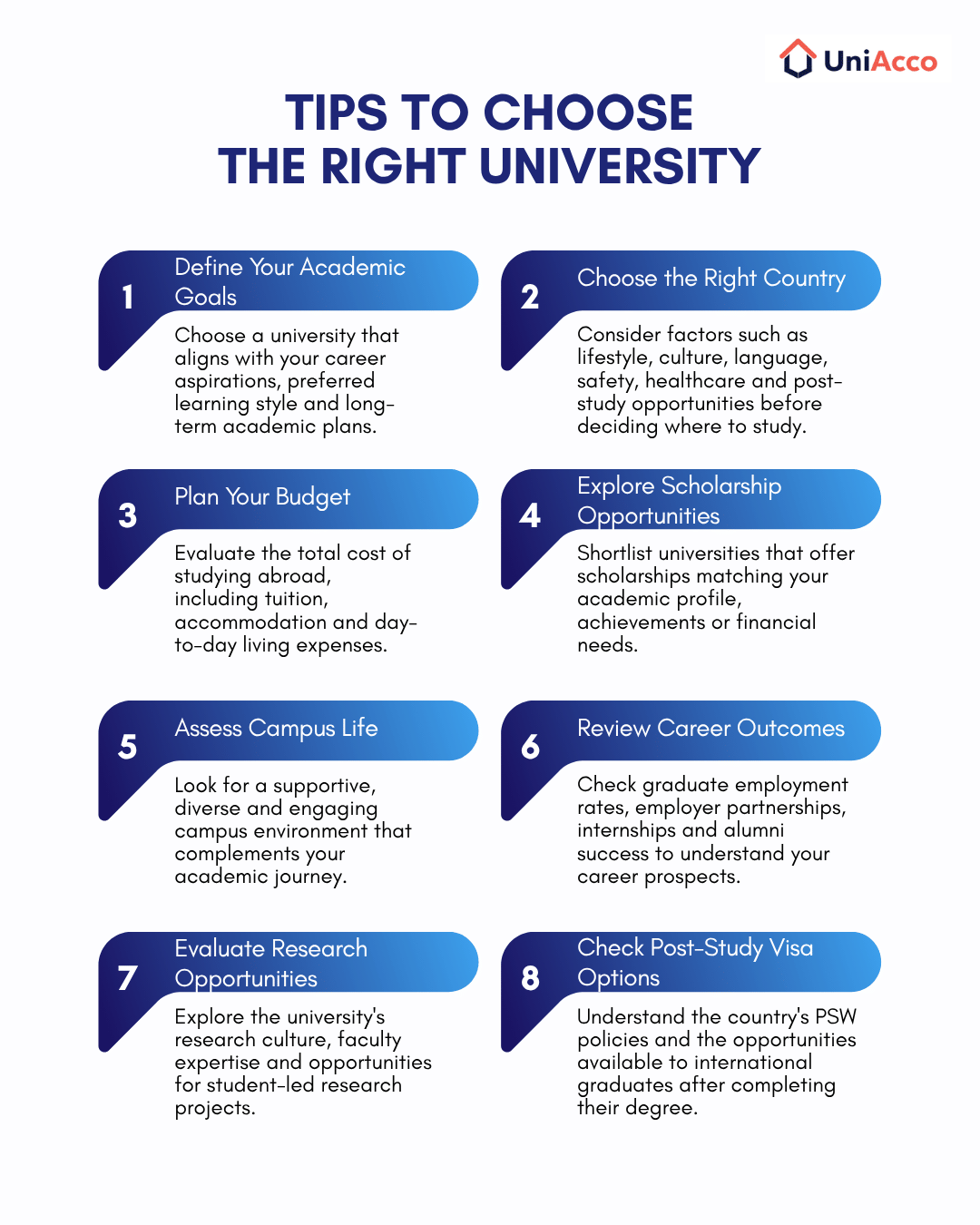
It may seem, with so many schools in the country, that the university ranking lists tell you everything you need to know about where to go to college, but that’s often not true. The best university for you might not be one of the ones that make it to the top of the rankings. Consider these criteria when deciding where to go.
- Academic Goals
Before you start searching for the latest top universities in the world, take a moment to think about your goals. Decide if you want a short one-year course to boost your job prospects or if you’re aiming for research and further studies like a PhD. If you want more focus on employability or want to pursue a career in academia. Even the faculty and recent expos of an institution could help you get a picture of how aligned the programme is with your goal. Once you know what you want, choosing a university will be about more than just rankings.
- Country of preference
Don’t simply apply to the most talked-about university or where all the other applicants are applying to. Think about the lifestyle you want, the country, the language, the climate, the security, the healthcare system, and whether you want to continue your career there post-graduation. The country of your study choice can influence you as much as the university.
- Tuition budget
Start short-listing universities only once you have set a feasible budget, including not just tuition fees but also the costs of your stay, food, transportation, insurance, and living expenses. A university that initially sounds budget-friendly could turn out to be much more expensive in reality, based on its location.
- Scholarships
If you rely on scholarships to study in a country, make this part of your selection criteria from the beginning. Countries and universities offer scholarships based on academic performance, leadership skills, research, financial need, or work experience. Research the places where you are more likely to get a scholarship and form your list.
Also Read: Indian Government Scholarships For Studying Abroad In 2026
- Campus life
Since you will be living on campus for years, make sure that you will enjoy living and studying there. Know the clubs and organisations offered at the university, the student support system, class sizes, student diversity, and even the city where the university is located.
- Career outcomes
Understand what’s after graduation. Besides the employability statistics, research on where alumni work, which companies conduct on-campus interviews, and whether the university offers paid internships and has strong relationships with industry.
- Research opportunities
If research is a major attraction for you, don’t just see whether the university has laboratories. Instead, find out whether the student is allowed to participate in research, read the faculty members’ publications, review the university’s already funded projects, and assess how easy it is for a student to participate in research projects at the university.
- Post-study visa options
Before confirming any offer or applying to any University, check the opportunities for students to obtain a post-study Visa and whether it is easy for an international graduate to continue their job in the country for some period after their studies.
Common Mistakes Students Make When Choosing Universities
When applying to university, it is hard not to let university rankings, the posts your friends are uploading, or where they are all going influence your choice. In your enthusiasm to submit those university applications, it is easy to forget certain things that may ultimately affect your experience there and beyond university.
Admitting solely based on rankings
The top-ranked universities in the world may not fit your needs. Look beyond the ranking and do your research to make sure the course, teaching methods, opportunities, and on-campus environment fit you.
Disregarding the tuition fees and cost of living
Although tuition fees will be your biggest expense, the cost of living, accommodation, food, transport, and health insurance will also be high. Varies widely across cities and countries. Set up your budget before compiling your shortlist.
Overlooking the curriculum
The same degree in two universities might consist of entirely different subjects, electives, and practical elements. Compare both syllabi to ensure you find a course that covers aspects you are actually interested in learning.
Not applying for scholarship opportunities
Most students believe that scholarship applications will not work for them and will begin looking for them only after receiving the offer. Research scholarships whilst shortlisting institutions, and be specific about where you have a genuine chance of receiving funding.
Disregarding employability results
Your university degree is an investment in your career; discover the areas that previous graduates are now employed in, companies that regularly recruit from this university, and what resources they provide on campus in order to support their students toward success.
Starting your applications too late
Leaving it late could drastically limit the number of available places, scholarships, or highly popular courses, or the visa process itself; starting early ensures you give yourself ample time to compile and submit an outstanding application to each university.
Conclusion
Picking a university is probably one of the biggest decisions you will make, and the good news is that it should not necessarily be based on the rank. While lists of the top 100 universities in the world provide a valuable starting point, they represent only one part of the bigger picture. A university is a place that meets your needs from academic ambitions and career ambitions to your financial requirements and learning style. As a result, it really pays to be diligent, assess what each university has to offer beyond its position in the global rankings, and consider applying as early as possible. At the end of the day, the best university is not merely that at the pinnacle of a chart, but a place that will act as a launchpad for your calling.









0 Comments