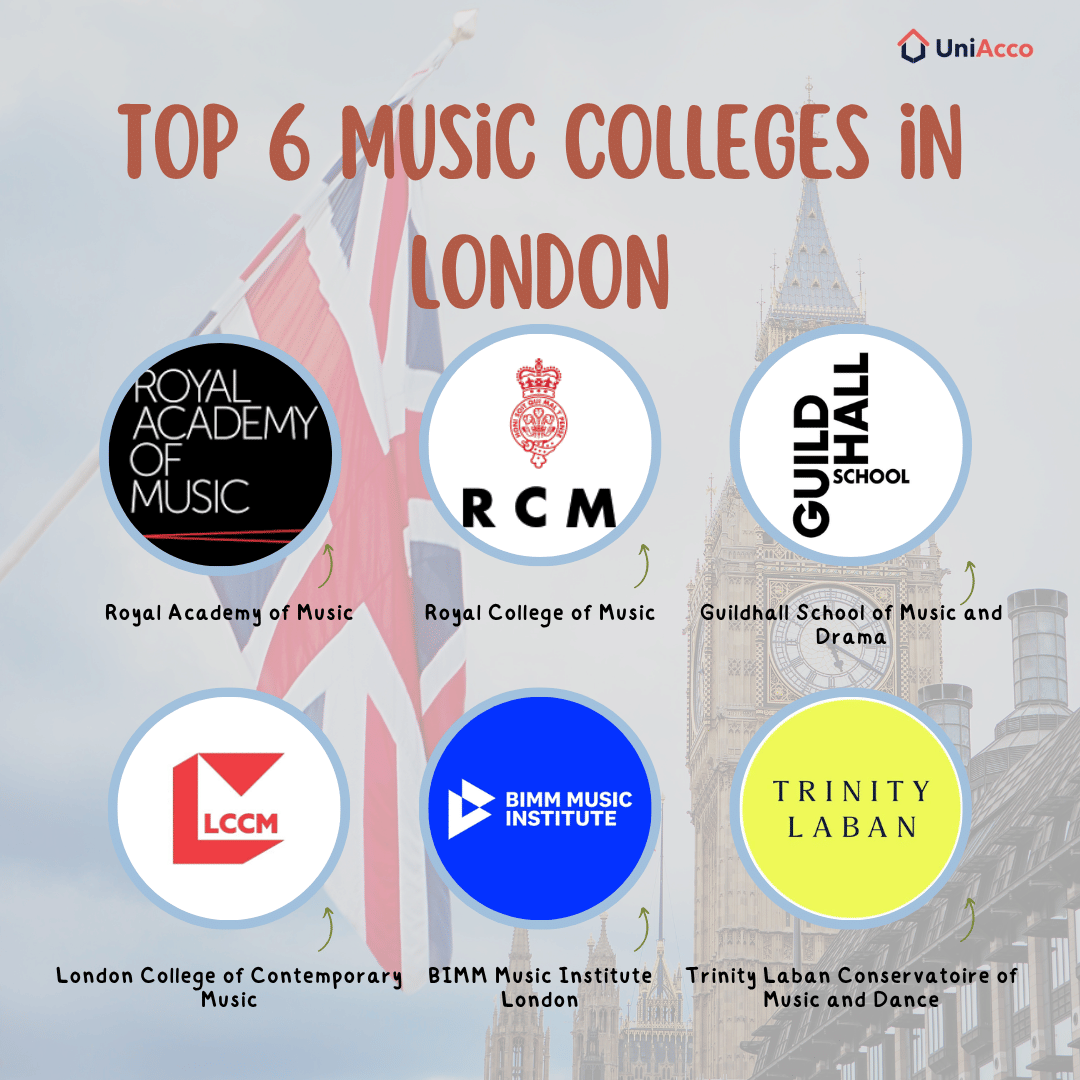

Studying music in London means being at the centre of a city alive with performances, studios, and creative energy. The city is home to the music colleges in London where you can learn, collaborate, and perform across classical, jazz, contemporary, and experimental music. With thousands of concerts every year and a music industry that contributes £8 billion annually and supports over 220,000 jobs, London gives students real opportunities to grow as musicians while building a career. This guide covers the top music colleges in London, including courses, admissions, fees, notable alumni, and tips for finding the right fit.
Top Music Colleges in London: At a Glance
| College Name | Year Established | Location | Top Courses | Avg Annual Fees (International Students) |
| Royal College of Music (RCM) | 1882 | South Kensington, London | • BMus (Bachelor of Music)• MMus (Master of Music)• MPerf (Master of Performance)• MComp (Master of Composition)• PhD / DMus | £30,100 – £31,500 |
| Royal Academy of Music (RAM) | 1822 | Marylebone, London | • BMus (Bachelor of Music)• MMus (Master of Music)• MA / PGCert (Non-Musical Theatre) | £29,050 – £37,800 |
| Guildhall School of Music & Drama | 1880 | City of London (Barbican) | • BMus (Bachelor of Music)• BA Acting• BA Performance Design & Production Arts• MMus / MPerf / MComp | £21,610 – £31,790 |
| Trinity Laban Conservatoire of Music and Dance | 2005 (origins 1872/1948) | Greenwich, London | • BMus (Bachelor of Music)• MMus / MA Music• MA Music Education | £18,500 – £26,060 |
| BIMM Music Institute London | 2001 | Fulham, London | • BA Popular Music Performance & Music Production• BA Songwriting & Music Production• BA Music Business, Events & Media• MA Popular Music Practice | £15,950 |
| London College of Music (LCM) | 1887 | Ealing, London | • BMus Popular Music Performance• BMus Performance & Music Management• BA Electronic Music Production• MMus Performance• MMus Composition / Film & TV | £16,250 – £17,250 |
| Institute of Contemporary Music Performance (ICMP) | 1986 | Kilburn, London | • BA Popular Music Performance | £16,250 |
| London College of Contemporary Music (LCCM) | 2002 | Southwark, London | • BA Music Performance & Production• BA Commercial Music• CertHE Music Business / Music Tech• MMus Music Production | £10,500 |
Also Read: List Of 12 Best Music Schools In The World 2025
Why Study at Music Schools in London?
Access to Historic Performance Venues
London is home to some of the world’s most iconic performance spaces from the Royal Albert Hall and Southbank Centre to intimate jazz clubs like The 100 Club in Soho, many of which are closely linked to leading music colleges in London. These venues host thousands of live performances each year, providing students with unparalleled opportunities to witness, study and participate in professional music events up close, enhancing both artistic insight and stage confidence.
Immersive Industry Exposure
London is widely recognised as a significant global hub for the music industry, with producers, labels, promoters, agents and media all clustered in the city and closely connected to leading music colleges in London. This concentration means students can access internships, industry events, workshops and networking opportunities that simply aren’t available in smaller cities. Being in the city increases the likelihood of real-world experience while you study a critical advantage for launching a music career.
Collaboration with Artists & Professionals
In London’s highly active music ecosystem, collaboration is a way of life. Students at music schools regularly work with practising musicians, producers, composers and industry professionals, building creative partnerships across genres. This interaction accelerates artistic growth and builds lasting professional connections, an essential asset in the competitive music world.
Cultural Diversity That Shapes Musical Creativity
London’s population represents dozens of cultures and musical traditions, making the city a living classroom for diverse musical styles. From Afro-Caribbean beats to South Asian classical traditions and avant-garde electronic scenes, students are exposed to influences that broaden creative horizons and deepen cultural understanding a key asset for contemporary musicians.
Professional Recording Opportunities & Music Tech Hubs
London hosts world-class recording studios, music technology clusters such as Tileyard London with over 100 studios and music businesses, and cutting-edge production environments closely linked to leading music colleges in London. This ecosystem allows students to develop state-of-the-art technical skills and collaborate with industry professionals on real projects, preparing graduates for careers in performance, production, songwriting, and the music business.
Also Read: Student Life In London: A Ultimate Living Guide 2025
Studying music in London means being close to venues, studios, and late-night rehearsals—and your accommodation should support that lifestyle. With UniAcco’s student housing options across key London neighbourhoods, you can choose safe, convenient stays designed for students.
🎼 Explore London Student Housing8 Best Music Colleges in London

1. Royal College of Music (RCM)
The Royal College of Music (RCM), established in 1882, is a world-leading music conservatoire in the UK and one of the most prestigious music colleges in London. It is ranked #1 globally in Music and Performing Arts in the 2025 QS World University Rankings by Subject, a title it has held for multiple consecutive years.
Location and Accessibility:
Address: Royal College of Music, Prince Consort Road, London SW7 2BS, United Kingdom
Popular Places Nearby
| Where To Visit | Distance in Miles | Travel Time | How to reach? |
| Royal Albert Hall | 0.1 mi | 2–3 mins walk | Walk via Prince Consort Road |
| Victoria & Albert Museum (V&A) | 0.4 mi | 8 mins walk | Walk through Exhibition Rd |
| Natural History Museum | 0.4 mi | 8–10 mins walk | Walk through Exhibition Rd |
| Hyde Park | 0.8 mi | 15 mins walk | Via Exhibition Rd and Kensington Road |
Popular Courses To Study
Degree options and eligibility vary by level (undergraduate/postgraduate/professional). Entry is audition- and portfolio-based for most performance and composition courses.
- Bachelor of Music (BMus)
Level: Undergraduate
Eligibility: Strong musical proficiency; audition required; academic qualifications (e.g., A-levels or equivalent) and musical portfolio.
Cost (2025–26): UK students: £9,535/year; Overseas: £30,100/year (approx).
- Master of Performance (MPerf)
Level: Postgraduate
Eligibility: Undergraduate degree (usually in music) or equivalent; audition performance forms a key part of selection.
Cost: UK students: £14, 485/Year, Overseas: £31,500/Year
- Master of Music (MMus) / Master of Composition (MComp)
Level: Postgraduate
Eligibility: Relevant bachelor’s or equivalent; audition/portfolio plus musical history/theory background.
Cost: UK students: £14, 485/Year, Overseas: £31,500/Year
- Doctoral Programmes (PhD/DMus)
Level: Research/Professional
Eligibility: A strong relevant master’s degree or equivalent; research proposal and audition for performance streams.
Cost: UK students: £8,475/Year, Overseas: £220,850/ Year
Note: RCM also offers diplomas, artist programmes and flexible study options. Entry decisions are highly selective and performance-driven.
Why study at Royal College of Music (RCM)?
- Elite, performance-first training: Teaching is centred on live performance, one-to-one tuition, and constant practical exposure, preparing students for real professional demands rather than purely academic study.
- Unmatched global reputation in music: RCM’s consistent top QS ranking gives graduates strong credibility worldwide, often making auditions, collaborations, and career entry smoother.
- Direct access to London’s music ecosystem: Students benefit from close proximity to major concert halls, orchestras, festivals, and cultural institutions, turning the city into an active learning and networking space.
- Proven pathways into music careers: Alumni success across orchestras, opera, composition, teaching, and media music reflects RCM’s strong industry alignment and long-term career impact.
Notable Alumni:
The RCM has trained many distinguished musicians across genres:
- Sir James Galway – Flutist
- Sir Thomas Allen – Baritone opera singer
- Dame Sarah Connolly – Mezzo-soprano
- Lord Andrew Lloyd Webber – Composer
- Benjamin Britten – Composer
2. Royal Academy of Music (RAM)
Founded in 1822, The Royal Academy of Music (RAM) is the oldest music conservatoire in the UK and is widely regarded as one of the most prestigious music colleges in London. It offers specialist training in performance, composition, conducting and related disciplines, and is consistently ranked among the top institutions internationally for music education.
Location & Accessibility
Address: Marylebone Road, London NW1 5HT, United Kingdom
Popular Places Nearby
| Where To Visit | Distance in Miles | Travel Time | How to reach? |
| Regents Park | 0.5 mi | 10 min walk | Walk via Marylebone Road |
| Madame Tussauds | 0.6 mi | 12 min walk | Walk via Marylebone Rd |
| London Zoo | 1.2 mi | 20 min walk/bus | Walk / Bus |
| British Museum | 2.5 mi | 15–20 min Tube | Tube (Bakerloo + Central Line) |
Popular Courses to Study
- Bachelor of Music (BMus)
Level: Undergraduate
Eligibility: Successful audition performance; relevant academic qualifications (e.g., A-levels or equivalent); English language proficiency (for international applicants, standard UK requirements).
Cost: UK/Home students: £9,535 / year; International students: £29,050 / year
- Master of Music (MMus)
Level: Postgraduate
Eligibility: Relevant bachelor’s degree (often in music/performance/composition); audition or portfolio submission; English language proficiency required for international students.
Cost: UK/ Home students: £20,600; International students: £37,800 / year (approx).
- MA / PGCert (Non-Musical Theatre)
Level: Postgraduate
Eligibility: Bachelor’s degree or equivalent; portfolio or audition where applicable; English proficiency for international students.
Cost: One-year intensive: UK Students: £17,300; International £31,750/ year
Why Study at Royal Academy of Music?
- Historic and prestigious conservatoire: RAM is the oldest music school in the UK with two centuries of continuous excellence.
- Wide range of specialist programmes: Offers undergraduate, postgraduate, doctoral and diploma pathways across performance, composition, research and advanced coaching.
- Central London location with cultural access: Situated in Marylebone, RAM students are close to London’s major music venues, concert halls, festivals and industry events.
- International community and performance opportunities: Students benefit from masterclasses, ensembles, orchestras, public performances and collaborations.
Notable Alumni
The Royal Academy of Music has trained numerous distinguished musicians across genres and eras, including:
- Sir Elton John – Singer, songwriter and performer
- Sir Simon Rattle – Conductor
- Dame Evelyn Glennie – Percussionist
- Sheku Kanneh-Mason – Cellist
- Arthur Sullivan – Composer (of Gilbert & Sullivan)
- Felicity Lott – Soprano
3. Guildhall School of Music & Drama
Established in 1880, Guildhall School of Music & Drama is one of the leading conservatoires in the world for music, drama and production arts. Consistently recognised among the top music colleges in London, it is ranked #3 globally in Music (QS World University Rankings by Subject 2025) and among the top institutions for performing arts.
Location and Accessibility:
Address: Guildhall School of Music & Drama, Silk Street, City of London, London EC2Y 8DT, United Kingdom
Popular Places Nearby:
| Where To Visit | Distance in Miles | Travel Time | How to reach? |
| Barbican Centre | 0.1 mi | 2–3 mins walk | Via Silk St |
| Museum of London | 0.2 mi | 4 mins walk | Walk along Aldersgate |
| St Paul’s Cathedral | 0.7 mi | 12–15 mins walk | Via Aldersgate St |
| Bank & Monument Area | 0.8 mi | 15 mins walk | Walk via London Wall |
Popular Courses To Study
- Bachelor of Music (BMus)
Level: Undergraduate
Eligibility: Competitive audition; academic qualifications and performance proficiency. Live/recorded auditions required.
Fees : UK students: £9,535/Year, Overseas: £31,790/Year
- BA Acting
Level: Undergraduate
Eligibility: Successful audition (performance auditions compulsory); standard academic checks.
Fees : UK students: £9,535/Year, Overseas: £31,790/Year
- BA Performance Design & Production Arts
Level: Undergraduate
Eligibility: Audition/interview and portfolio review.
Fees: UK students: £9,535/Year, Overseas: £31,790/Year
- Master’s Programmes (MMus/MPerf/MComp & Advanced Diplomas)
Level: Postgraduate
Eligibility: Undergraduate degree or equivalent; auditions or portfolio submissions.
Fees: UK students: £9,530/Year, Overseas: £21,610/Year
Why study at Guildhall School of Music & Drama?
- Strong global standing in music and performing arts: Guildhall is consistently ranked among the top music schools worldwide in the QS World University Rankings by Subject, reflecting its academic quality, employer reputation, and graduate outcomes.
- Curriculum aligned with professional practice: As one of the leading music colleges in London, the institution structures its courses around public performances, assessed productions, ensemble work, and auditions, ensuring students graduate with hands-on experience that closely reflects real industry expectations.
- Interdisciplinary conservatoire model: Music, drama, and production arts are taught within a single institution, enabling structured collaboration across disciplines, a format that reflects how professional theatre, opera, and live performance industries operate.
- Location within the Barbican arts complex: The school operates alongside the Barbican Centre, one of Europe’s largest performing arts venues, giving students regular access to concerts, productions, and professional creative activity in central London.
Notable Alumni:
Music & Performance
- Sir Bryn Terfel – Bass-baritone
- Sir James Galway – Flautist
Drama & Screen - Orlando Bloom – Actor
- Michaela Coel – Writer & actor
- Hayley Atwell – Actor
- Naveen Andrews – Actor
3. Trinity Laban Conservatoire of Music and Dance
Founded in 2005 through the merger of Trinity College of Music (1872) and Laban Dance Centre (1948), Trinity Laban is a specialist conservatoire for music and contemporary dance. It is consistently ranked among the top global institutions for Performing Arts in the QS World University Rankings by Subject and is part of the city’s leading network of music colleges in London.
Location and Accessibility:
Address: Trinity Laban Conservatoire of Music and Dance, King Charles Court, Old Royal Naval College, Greenwich, London SE10 9JF, United Kingdom
Popular Places Nearby
| Where To Visit | Distance in Miles | Travel Time | How to reach? |
| Greenwich Park | 0.4 mi | 8–10 mins walk | Via College Way |
| Cutty Sark | 0.3 mi | 6–8 mins walk | Walk via King William Walk |
| National Maritime Museum | 0.5 mi | 10–12 mins walk | Through Greenwich Park |
| Canary Wharf | 2.5 mi | 15–20 mins | DLR from Cutty Sark |
Popular Courses To Study in Trinity College of Music
- Bachelor of Music (BMus)
Level: Undergraduate
Eligibility: Relevant academic qualifications (A-levels or equivalent); successful audition demonstrating musical ability and potential.
Cost: UK students: £9,535 / year, Overseas students: £26,060 / year
- Master of Music (MMus) / MA Music
Level: Postgraduate
Eligibility: Relevant bachelor’s degree or equivalent; audition or portfolio submission depending on pathway (performance, composition, collaborative practice).
Cost: UK students: £12,420 / year, Overseas students: £24,540 / year
- MA Music Education
Level: Postgraduate
Eligibility:Relevant bachelor’s degree or equivalent; experience in music education or related practice; audition or interview may be required depending on background.
Cost: UK students: £9,700 / year, Overseas students: £18,500 / year
Why study at Trinity College of Music?
- Dual specialism in music and contemporary dance: Trinity Laban operates as a specialist conservatoire delivering degree-level training in both music and contemporary dance within a single institution.
- Structured interdisciplinary learning: Academic programmes are designed to support collaboration between music and dance students through shared modules, projects, and performance work.
- Practice-based assessment approach: Assessment is primarily based on live performance, practical projects, portfolios, and public presentations, with limited reliance on written examinations.
- Greenwich campus location: The conservatoire is based within the Old Royal Naval College, a UNESCO World Heritage Site in Greenwich, offering dedicated performance and studio facilities outside central London.
Notable Alumni:
- Ralph McTell – Singer-songwriter
- Sam Lee – Folk singer and Mercury Prize nominee
- Bobbie Arlo – Musician
- Siobhan Davies – Contemporary choreographer
5. BIMM Music Institute London
BIMM Music Institute London is part of BIMM University, a specialist music and creative industries institution founded in 2001 (originally as Brighton Institute of Modern Music) with campuses across the UK, Ireland and Germany. Known for its industry-focused approach, BIMM offers training in performance, production, songwriting, and music business, and is a popular choice among students exploring contemporary music colleges in London, with degrees awarded within the BIMM University framework.
Location and Accessibility:
Address: Barclay House, Effie Road, Fulham, London SW6 1EN
Popular Places Nearby
| Where To Visit | Distance in Miles | Travel Time | How to reach? |
| Furnivall Gardens | 0.8 mi | 12–15 mins | Walk via Munster Rd |
| Hyde Park | 3.6 mi | 15–20 mins | District Line to Hyde Park Corner |
| Trafalgar Square | 4.5 mi | 25 mins | District & Circle Line to Embankment |
| London Eye | 5.0 mi | 30 mins | Tube to Waterloo + walk |
Popular Courses To Study
- BA (Hons) Popular Music Performance & Music Production
Level: Undergraduate
Eligibility: Class 12 grades, performance audition/portfolio, and English proficiency (typically IELTS 6.0 overall, no band below 5.5).
Cost:UK students: £9,535 / year, Overseas students: £15,950 / year (typical)
- BA (Hons) Songwriting & Music Production
Level: Undergraduate
Eligibility: Class 12th grades, songwriting/production portfolio or assessment, and IELTS 6.0 overall (min 5.5 per band).
Cost: UK students: £9,535 / year, Overseas students: £15,950 / year (typical)
- BA (Hons) Music Business, Events & Media
Level: Undergraduate
Eligibility: Class 12th grades, interview or assessment (no performance audition required), and IELTS 6.0 overall (min 5.5 per band).
Cost: UK students: £9,535 / year, Overseas students: £15,950 / year (typical)
- MA Popular Music Practice / Creative Industries Masters
Level: Postgraduate
Eligibility: Bachelor’s degree from a recognised university, relevant portfolio/interview, and English proficiency (usually IELTS 6.0–6.5 overall, course-dependent).
Cost: UK students: £9,950 full course, Overseas students: £15,950 full course
Why study at BIMM Music Institute London?
- Industry-centred music education: BIMM offers career-focused degrees across performance, production, songwriting, and business that reflect current music industry practices.
- Part of a larger university network: As a constituent of BIMM University, it benefits from broader creative courses and infrastructure across multiple UK and European cities.
- Multiple specialised programmes: Offers a wide selection of undergraduate and postgraduate degrees that combine creative skills with professional development.
- London location with industry access: Situated in Fulham, London, with transport links and proximity to cultural hubs, enabling students to participate in gigs, networking and industry events.
Notable Alumni:
Since BIMM University comprises several campuses and years of history, its music alumni include commercially and critically acclaimed musicians and bands such as:
- George Ezra
- James Bay
- Tom Odell
- Ella Mai
- Fontaines D.C.
6. London College of Music
This college is a historic music school founded in 1887, now part of the University of West London (UWL). It is one of the UK’s largest and oldest specialist music institutions, offering diverse programmes in performance, composition, technology, management and audio production.
Location and Accessibility:
Address: St Mary’s Road, Ealing, London, W5 5RF, United Kingdom.
Popular Places Nearby
| Where To Visit | Distance in Miles | Travel Time | How to reach? |
| Ealing Broadway | 0.5 mi | 10 min walk | Walk |
| Walpole Park | 0.6 mi | 12 min walk | Walk |
| Westfield London | 3.5 mi | 15 min drive | Bus/Taxi |
| Hyde Park | 8.0 mi | 30–40 min tube | Tube |
Popular Courses To Study
- BMus (Hons) Popular Music Performance
Level: Undergraduate (Bachelor with Honours)
Eligibility: UK 12th equivalent (UCAS tariff ~112–128 points; A-levels/BTEC/Access to HE); English proficiency usually required.
Cost: UK/Home: £9,535 / year, International: £16,250 / year.
- BMus (Hons) Performance and Music Management
Level: Undergraduate (Bachelor with Honours)
Eligibility: UK 12th equivalent + music interest/ability; English proficiency (per UCAS/UKCISA).
Cost: UK/Home: £9,535 / year, International: £16,250 / year.
- BA (Hons) Electronic Music Production
Level: Undergraduate (Bachelor with Honours)
Eligibility: UK 12th equivalent + English proficiency (per UCAS/UKCISA).
Cost: UK/Home: £9,535 / year, International: £16,250 / year.
- MMus Performance (Classical, Jazz & Popular)
Level: Postgraduate
Eligibility: UK bachelor’s degree (usually 2:1 or equivalent) in music or performance; audition/recording requirement; English proficiency typically IELTS 6.5 or equivalent for international students.
Cost: UK/Home students: £10,850/year; International students: ~£17,250/year
- MMus Composition
Level: Postgraduate
Eligibility: UG degree in music/composition or related field; portfolio of work recommended; English proficiency (IELTS 6.5 or equivalent) recommended.
Cost: UK/Home students: £10,850/year; International students: £17,250/year (approx.).
- MMus Composition for Film and Television
Level: Postgraduate
Eligibility: UG degree in music or relevant creative discipline; portfolio likely required; English proficiency expected (IELTS 6.5+ or equivalent).
Cost: UK/Home students: £10,850/year; International students: £17,250/year (approx.).
Why Study at London College of Music?
- Historic and specialist focus: Established in 1887, LCM has over 135 years of experience in music education and performance training.
- Wide range of programmes: Courses span performance, composition, technology, management, production and audio engineering, aligning with current music industry requirements.
- Industry-aligned training: Students have access to professional recording studios, technology labs and industry networking opportunities.
- Part of a modern UK university: LCM benefits from UWL’s strong student support and high student satisfaction rankings. UWL was rated #1 in London for overall student satisfaction (National Student Survey 2025).
Notable Alumni
LCM has produced musicians, producers and creatives who have made their mark in music and beyond:
- Bill Bailey – Comedian, musician and performer.
- Richard Wright – Keyboardist of Pink Floyd.
- Alex da Kid – International record producer/songwriter.
- Clive Nolan – Keyboardist and producer.
- Robert Orton – Grammy-winning audio engineer.
7. Institute of Contemporary Music Performance (ICMP)
The Institute of Contemporary Music Performance (ICMP) is a specialist contemporary music and creative business school in the UK, founded in 1986. It has over 35+ years of experience in music education and delivers industry-focused degrees and programmes in performance, production, songwriting and music business, and music business, making it one of the notable music colleges in London for aspiring contemporary musicians.
Location & Accessibility
Address: 1B Dyne Road, London, Greater London, NW6 7XG, United Kingdom.
Popular Places Nearby
| Where To Visit | Distance in Miles | Travel Time | How to reach? |
| Queen’s Park | 0.2 mi | 4–5 min walk | Walk |
| Regent’s Park | 2.5 mi | 15–20 min bus/Tube | Bus/Tube |
| Camden Town | 3.0 mi | 20–25 min Tube | Tube (Bakerloo + Northern) |
| West End / Oxford Street | 5.5 mi | 30–35 min Tube | Tube via Bakerloo/other lines |
Popular Courses to Study
- BA (Hons) Popular Music Performance
Level: Undergraduate
Eligibility: UK 12th equivalent qualification (UCAS tariff points), audition/interview, English proficiency (typically CEFR B2 or equivalent).
Cost: UK/Home students: ~£9,535 /year, International students: ~£16,250 / year
- BA (Hons) Music Production
Level: Undergraduate
Eligibility: Class 12 equivalent; creative portfolio demonstrating production skills; interview/audition; English proficiency (CEFR B2 or equivalent).
Cost: UK/Home students: ~£9,535 per year; International students: ~£16,250 per year.
- BA (Hons) Songwriting
Level: Undergraduate
Eligibility: Secondary education completion; songwriting portfolio (lyrics, recordings, compositions); interview; English proficiency requirement.
Cost: UK/Home students: ~£9,535 per year; International students: ~£16,250 per year.
- MA Popular Music Practice
Level: Postgraduate
Eligibility: Bachelor’s degree or equivalent professional experience; portfolio/interview relevant to chosen pathway (performance, production, songwriting); English proficiency (usually IELTS 6.5 overall)
Cost: UK/Home students: ~£9,950 (full course); International students: ~£15,950 (full course).
- MA Music Business
Level: Postgraduate
Eligibility: Bachelor’s degree or equivalent experience; personal statement outlining industry interest; interview; English proficiency required.
Cost: UK/Home students: ~£9,950 (full course); International students: ~£15,950 (full course).
Why Study at Institute of Contemporary Music Performance?
- Industry-focused contemporary training: ICMP specialises exclusively in contemporary music, aligning teaching with real-world practices in performance, production, songwriting, and music business.
- Practice-led learning model: Courses emphasise live performance, studio work, collaboration, and continuous assessment rather than purely theoretical study.
- Strong industry connections: Regular masterclasses, guest lectures, and partnerships with working professionals help students understand current industry expectations.
- London-based creative exposure: Studying in London gives students access to live music venues, recording studios, and networking opportunities central to the UK music scene.
Notable Alumni
- Ed O’Brien (Radiohead) – Guitarist
- Foxes – Singer, songwriter
- Fraser T. Smith – Grammy-winning producer & songwriter
- Daughter – Band members
- Ben Sargeant (The Script) – Bassist
- Etta Bond – Singer
- Luke Patterson (Clean Bandit) – Drummer/producer
- Sandy Beales (One Direction) – Bassist
8. London College of Contemporary Music (LCCM)
The London College of Contemporary Music (LCCM) is a private higher education music college in London, UK, established in 2002. It specialises in contemporary music training — performance, production, songwriting, music business and related creative disciplines — and is one of the recognised music colleges in London, with degrees validated by the University for the Creative Arts.
Location and Accessibility
Address: 241 Union Street, London SE1 0LR, United Kingdom.
Popular Places Nearby
| Where To Visit | Distance (Miles) | Travel Time | How to Reach |
| Borough Market | ~0.4 mi | 8–10 mins walk | Walk via Union St/Redcross Way |
| The Shard / London Bridge | ~0.6 mi | 12–15 mins walk | Walk or Bus |
| Tate Modern | ~1.3 mi | 20–25 mins walk / 10–12 mins bus | Walk / Bus |
| Southbank Centre | ~1.4 mi | 15–20 mins walk / bus | Walk / Bus |
| Tower Bridge | ~1.5 mi | 20–25 mins bus/Tube | Bus / Tube (Jubilee) |
Popular Courses To Study
- BA (Hons) Music Performance & Production
Level: Undergraduate
Eligibility: Completed secondary education, Portfolio/audition demonstrating performance and creative skills and English language proficiency (e.g., IELTS acceptable)
Cost: £9,535/year and international students: £10,500/year
- BA (Hons) Commercial Music
Level: Undergraduate (Bachelor with Honours)
Eligibility: Secondary school completion or equivalent qualification, Portfolio/audition demonstrating creativity in contemporary music contexts and English language proficiency
Cost: £9,535/year and international students: £10,500/year
- CertHE (Certificate of Higher Education) — Music Business / Music Tech
Level: Undergraduate Certificate (1 year)
Eligibility: Completion of secondary education; English language proficiency
Cost: £9,535/year and international students: £10,500/year
- MMus in Music Production
Level: Postgraduate (Master of Music)
Eligibility: Bachelor’s degree in music or related field, or equivalent professional experience, Creative portfolio/production work and English proficiency (e.g., IELTS)
Cost: Home students: £10,500/year and international students: £10,500/year
Why Study at London College of Contemporary Music?
- Contemporary music focus: The curriculum is designed around current industry practices in performance, production, songwriting and music business, preparing students for modern music careers rather than purely academic study.
- Industry-validated degrees: All degrees are validated and awarded by the University for the Creative Arts, ensuring academic rigour and professional relevance.
- High student satisfaction: LCCM has been ranked among the highest-rated providers of contemporary music performance and business degrees in the UK in the National Student Survey for multiple consecutive years.
- Central London location: Positioned in South London’s Union Street (“The Music Box”), the campus is close to major music venues, live performance scenes and industry hubs, enabling networking and performance exposure.
Notable Alumni
Some of LCCM’s alumni and associated artists include:
- Tom Walker — Singer, songwriter and UK chart artist
- Rhys Lewis — Singer-songwriter
- Musicians touring with artists such as George Ezra and Sam Ryder — Indicates industry engagement and professional networks
Once you shortlist your music college in London, securing the right place to live becomes just as important. UniAcco helps students find verified student accommodation in London near top music colleges.
🎵 Find Accommodation Near Music CollegesAlso Read: Cost Of Living In London For Students – 2025
Admission Process and Criteria
Application submission
Applications to the top music colleges in London are usually made through UCAS for undergraduate degrees or directly through the institution’s own portal for postgraduate and conservatoire-style programmes.
Along with academic transcripts, applicants submit a personal statement detailing their musical background, training, and career goals. Admission is competitive, at top London conservatoires, only around 10–20% of applicants receive an offer, making a well-prepared application essential.
Audition requirements
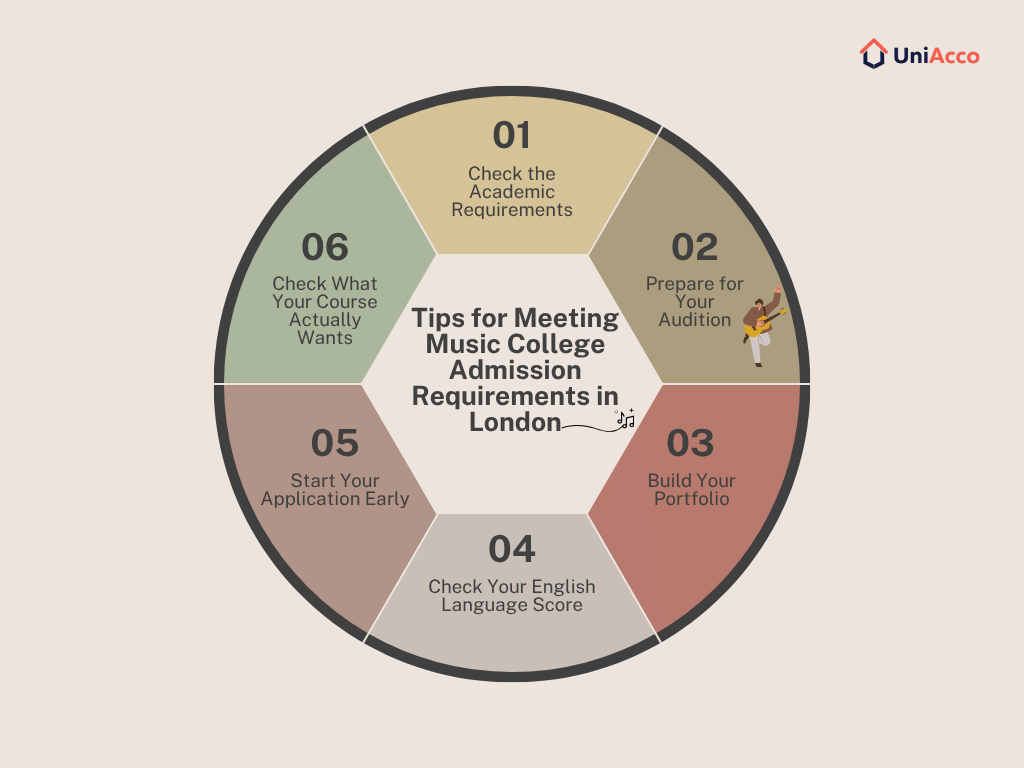
Auditions form the most important part of the selection process for performance-based courses. Candidates may be asked to attend a live audition (in person or online) or submit recorded performances.
Assessors focus on musicality, technique, interpretation, and long-term potential rather than flawless execution. For composition, production, or songwriting programmes, auditions are often replaced with creative assessments.
Portfolio submissions
Portfolios are commonly required for courses in composition, songwriting, music production, and in some cases music business. These usually include original compositions, recordings, scores, or production projects, often accompanied by brief written explanations outlining creative intent, process, and influences.
A well-curated portfolio allows selectors at colleges with good music programs to evaluate an applicant’s creative thinking, technical ability, and artistic development, offering insight into how ideas are conceived, refined, and executed beyond formal assessments.
Interviews
Shortlisted applicants are usually invited to an interview, held either online or on campus. Interviews help institutions assess a candidate’s motivation, understanding of the course, and readiness for conservatoire-level study.
Selectors look for clarity of goals, commitment to the discipline, and the ability to reflect on one’s musical or creative development, alongside an awareness of the intensive, practice-led nature of the training.
Academic eligibility
Although musical ability is the priority, applicants must still meet minimum academic requirements. UK students usually need A-levels or equivalent, while international students are assessed based on qualifications such as the IB Diploma or national high school certificates.
Indian students typically need Class 12 completion, assessed for UK equivalency. Most undergraduate music degrees require the equivalent of 64–80 UCAS tariff points, though exceptional auditions can sometimes compensate for lower academic scores.
English language requirements for international students
International applicants must demonstrate English proficiency unless exempt. Most music colleges require an IELTS Academic score of 6.0–6.5 overall, with no band below 5.5. Some institutions also accept alternatives such as PTE Academic or TOEFL iBT.
This ensures students can actively participate in rehearsals, written assessments, and collaborative projects throughout the course.
Many students explore music opportunities beyond London, with cities like Manchester offering strong creative communities and performance venues. UniAcco offers verified student accommodation in Manchester, helping you find safe, convenient homes so you can focus on your studies and creative journey from day one.
🏡 Explore Student Accommodation in ManchesterTips to Choose the Right Music College in London
Consider proximity to performance venues and cultural hubs
London is one of the world’s most active music capitals, home to major concert halls, recording studios, theatres and creative industries. Choosing a college close to these venues makes it easier to attend professional events, network, and integrate into the city’s music ecosystem an advantage that conservatoires like RCM and RAM emphasise as part of the student experience.
Factor in overall study and living costs in London
Studying music in London can be significantly more expensive than other UK cities, as both tuition fees and living expenses tend to be higher. Conservatoires advise applicants to budget not just for tuition, but also for instrument costs, practice materials, accommodation, travel and daily living, since London rental and lifestyle costs are among the highest in the UK. Estimates for student living costs alone can range from £1,250 to over £1,600 per month depending on housing choice and personal expenses.
Check rehearsal, studio and technical facilities
High-quality rehearsal spaces, recording studios and practice rooms are essential for professional training. Top London music colleges invest in dedicated facilities that reflect industry standards, enabling students to develop both performance and technical skills as part of their everyday curriculum.
Analyse collaboration and cross-disciplinary opportunities
London’s music colleges often encourage collaboration across performance, composition, production and media disciplines. This mirrors the creative industries where teamwork with dancers, actors, producers and sound engineers is common, helping students gain broader practical experience before graduation.
Review alumni outcomes and industry connections
Alumni success is an indicator of how well a college prepares students for real-world careers. Many London conservatoires maintain partnerships with professional organisations, orchestras, broadcasters and creative companies, providing performance opportunities and industry links that can lead to early career placements.
Wrapping Up!
London stands out as a global music capital where elite education, live performance culture, and industry access come together. From historic conservatoires to contemporary music schools, the city offers diverse pathways for performers, composers, producers and music professionals to train, collaborate and build real careers. As you shortlist options, it’s important to compare musical theatre colleges in London based on course structure, audition requirements, fees, facilities, and long-term career outcomes, ensuring the institution aligns with your musical goals and budget.
Once you have chosen the right music college, finding the right student accommodation is the next crucial step. With verified student housing options close to London’s top music schools, UniAcco helps you secure safe, convenient accommodation, so you can focus fully on your music journey from day one.


0 Comments