
You’ve got a list open on one tab, a visa requirements page on another, and a WhatsApp group where everyone claims to have inside information about which university is “the best.” Meanwhile, you still haven’t decided which country, which course, or which campus feels right. Sound familiar?
That overwhelm is real and completely understandable.
Here is the thing, though: there are a handful of universities around the world that consistently rise above the noise. The ones that graduates swear by. The ones that open doors before you have even graduated.
According to the OECD, the global international student population was projected to reach 8 million by 2025, up from around 2 million in 2000. And more than half of all internationally mobile students choose just five countries: the United States, the United Kingdom, Germany, France, and Australia. The US alone hosted nearly 1.2 million international students during the 2024/25 academic year, a 5% increase on the previous year.
In this blog, we cover the 10 best universities in the world for international students in 2026, according to the QS World University Rankings. You will find everything from location and travel tips to courses, eligibility criteria, tuition fees, and the alumni who walked these halls before you. Let’s get into it.
10 Best Universities in the World at a Glance (QS Rankings 2026)
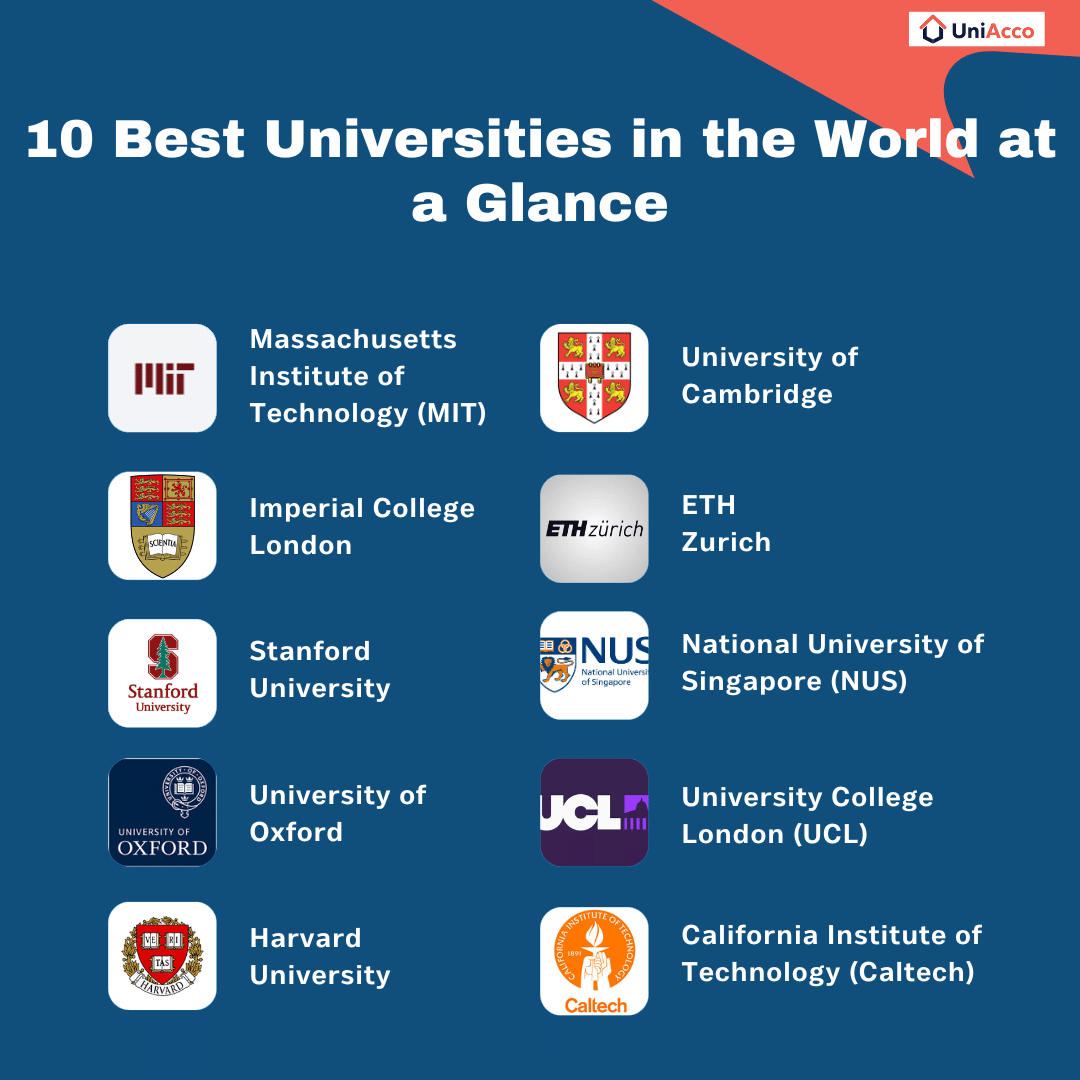
| QS Rank 2026 | University | Country | Key Highlights | Approx. Annual Tuition (International) |
| 1 | Massachusetts Institute of Technology (MIT) | USA | 14-year #1 streak; STEM, AI, engineering powerhouse | ~$61,990 – $64,310 |
| 2 | Imperial College London | UK | Only UK uni focused solely on STEM, Medicine & Business | ~£37,900 – £53,700 |
| 3 | Stanford University | USA | Silicon Valley’s academic heartbeat rose from #6 this year | ~$62,484 – $67,000 |
| 4 | University of Oxford | UK | Oldest English-speaking university; tutorial-based learning | ~£28,950 – £50,700 |
| 5 | Harvard University | USA | Global brand; need-blind financial aid for all nationalities | ~$59,950 – $82,000 |
| 6 | University of Cambridge | UK | Collegiate system; 121 Nobel Prize affiliates | ~£24,507 – £58,038 |
| 7 | ETH Zurich | Switzerland | Most affordable top-10 uni; 22 Nobel laureates | ~CHF 730/semester (rising to CHF 2,190 from Autumn 2025) |
| 8 | National University of Singapore (NUS) | Singapore | Asia’s gateway; consistent #8 for three years running | ~SGD 20,000 – 38,000 |
| 9 | University College London (UCL) | UK | London’s most international university; 150+ nationalities | ~£22,000 – £38,000 |
| 10 | California Institute of Technology (Caltech) | USA | Tiny campus, enormous research output; STEM only | ~$63,000 – $65,000 |
Wanna know what students think about the top universities in the world? Read this Reddit thread to learn what students think about the top universities in the world.
What are the global T10 universities? – r/ApplyingToCollege
10 Best Universities in the World for International Students
1. Massachusetts Institute of Technology (MIT)
QS World University Ranking 2026: #1
There are universities that are famous. And then there is MIT. But what does it actually mean to study here?
It means sharing a campus with faculty who have won 105 Nobel Prizes and 26 Turing Awards. It means working in labs where AI, quantum computing, and clean energy research are not just buzzwords; they are the curriculum. And it means joining an alumni network of 147,000 people across the world who have collectively founded companies worth trillions.
MIT is located in Cambridge, Massachusetts, directly across the Charles River from Boston. It sits in one of the most academically dense zip codes on earth, sharing a city with Harvard, Tufts, and dozens of biotech and tech companies that actively recruit on campus.
| Where To Visit | Distance (Miles) | Travel Time | How to Reach |
| Harvard Square | 1.2 miles | ~7 mins | T (Red Line – Harvard Station) |
| Boston City Centre | 3.5 miles | ~15 mins | T (Red Line – Park Street) |
| Boston Logan Airport | 4.5 miles | ~20 mins | T + Silver Line or Taxi/Uber |
Acceptance Rate – Undergraduate: ~4% | Postgraduate: ~10.6%, MIT does not offer merit scholarships. All aid is need-based, and if your family earns under $200,000 (USD), tuition is free.
UG & PG Courses To Study
| Course Name | Key Course Highlights | Eligibility Criteria | Avg. Fees (International) |
| BSc Computer Science & Engineering | No.1 globally in CS/AI; research-integrated from Year 1 | SAT/ACT + IELTS 7.0 / TOEFL 100+; strong Maths background | ~$61,990 – $64,310/yr |
| BSc Electrical Engineering | Core focus on robotics, semiconductors, and systems | SAT/ACT; strong Physics & Maths | ~$61,990 – $64,310/yr |
| MEng / MS Mechanical Engineering | NASA, Tesla, and SpaceX collaborate on MIT research projects | GRE + IELTS 7.0 / TOEFL 100; relevant UG degree | ~$57,000 – $75,000/yr |
| MBA (Sloan School of Management) | Top 5 globally for MBA; quantitative focus, strong finance track | GMAT 720+; IELTS 7.0 / TOEFL 100; 3+ yrs work experience | ~$82,000/yr |
Notable Alumni: Buzz Aldrin (Apollo 11 astronaut), Kofi Annan (former UN Secretary-General), and Sundar Pichai (CEO, Google).
2. Imperial College London
QS World University Ranking 2026: #2 (up from #6)
What makes Imperial unusual among the world’s elite universities is its laser focus. It does not try to be everything. It is science, engineering, medicine, and business, that is it. No literature department, no history faculty, no humanities wing. Just the disciplines where Imperial has decided to be the best in the world.
Imperial’s main campus sits in South Kensington, arguably London’s most culturally rich postcode. The Natural History Museum and the Victoria & Albert Museum are a two-minute walk. Hyde Park is just across the road.
| Where To Visit | Distance (Miles) | Travel Time | How to Reach |
| Natural History Museum | 0.2 miles | ~3 mins | Walk |
| Hyde Park | 0.3 miles | ~5 mins | Walk |
| Heathrow Airport | 14 miles | ~30 mins | Piccadilly Line direct |
Acceptance Rate – Undergraduate: ~14–15% | Postgraduate: ~10–30% depending on programme. Over 60% of Imperial’s students are from outside the UK.
UG & PG Courses To Study
| Course Name | Key Course Highlights | Eligibility Criteria | Avg. Fees (International) |
| MEng Computing (BEng/MEng) | Top 10 globally for CS; strong machine learning and security track | A-Levels or equiv; IELTS 6.5 / TOEFL 92+ | ~£37,900 – £42,000/yr |
| BEng/MEng Electrical & Electronic Engineering | Leading programme for semiconductors, embedded systems, and comms | A-Levels Maths & Physics; IELTS 6.5 / TOEFL 92+ | ~£37,900 – £42,000/yr |
| MBBS Medicine | One of the UK’s top medical programmes; 6-year integrated course | UCAT + IELTS 7.5; A-Levels in Biology and Chemistry | ~£46,800 – £53,700/yr |
Notable Alumni: Brian May (astrophysicist and Queen guitarist), H.G. Wells (author), Rajiv Gandhi (former Prime Minister of India).
Ready to study at Imperial College London? Explore verified student accommodation near the campus with UniAcco and enjoy fully furnished rooms, modern amenities, and all-inclusive bills—trusted by thousands of students worldwide.
🔍 Explore Housing Near Imperial College London3. Stanford University
QS World University Ranking 2026: #3 (up from #6)
It is also almost physically impossible to separate Stanford from Silicon Valley. The university sits at the top of the San Francisco Bay Area, and the tech ecosystem did not just grow near it; Stanford helped build it.
Stanford’s academic model rewards intellectual breadth. There are over 65 undergraduate majors across seven schools, and a strong culture of double-majoring, interdisciplinary research, and building actual products during your degree.
Stanford’s main campus, “The Farm,” is located in Palo Alto, between San Francisco and San Jose. The campus itself is one of the most beautiful in the world, covering over 8,000 acres with Spanish-colonial architecture and California sunshine.
| Where To Visit | Distance (Miles) | Travel Time | How to Reach |
| Palo Alto Town Centre | 2 miles | ~10 mins | Bike or free campus shuttle |
| San Francisco | 35 miles | ~1 hr | Caltrain from Palo Alto Station |
| San Francisco Airport (SFO) | 25 miles | ~35 mins | Caltrain or Uber/Lyft |
Acceptance Rate – Undergraduate: ~4.3% | Postgraduate: ~6–12% depending on programme. International students are considered in the same pool as domestic applicants.
UG & PG Courses To Study
| Course Name | Key Course Highlights | Eligibility Criteria | Avg. Fees (International) |
| BS Computer Science | Ranked #1 in the US for CS; major options include AI, systems, and HCI | SAT/ACT; IELTS 7.0 / TOEFL 100+; strong Maths | ~$62,484 – $67,000/yr |
| BS Bioengineering | Bridge between biology, medicine, and engineering; excellent graduate outcomes | SAT/ACT; strong Biology and Chemistry | ~$62,484 – $67,000/yr |
| MBA (Stanford GSB) | Consistently #1 or #2 globally; cohort of ~400; deeply entrepreneurial | GMAT 720+ or GRE; IELTS 7.0 / TOEFL 100; 3–5 yrs work exp | ~$80,000/yr |
Notable Alumni: Elon Musk (CEO, Tesla & SpaceX, attended graduate school), Larry Page and Sergey Brin (co-founders, Google), Peter Thiel (co-founder, PayPal).
4. University of Oxford
QS World University Ranking 2026: #4
Oxford has been educating students since the 12th century. The tutorial system is Oxford’s defining feature and its greatest selling point. Rather than sitting in 200-person lectures, you meet weekly with your tutor, usually a leading academic in their field, to defend an essay you have written that week.
Oxford also offers access to one of the world’s richest libraries (the Bodleian), over 1,000 student societies, and a collegiate structure that means your social and academic life are genuinely intertwined.
Oxford is located in the county of Oxfordshire, about 60 miles north-west of London. It is a compact city, most students cycle everywhere, with one of the UK’s most architecturally stunning city centres.
| Where To Visit | Distance (Miles) | Travel Time | How to Reach |
| Bodleian Library | 0.1 miles | ~2 mins walk | Walk from any central college |
| Covered Market (shopping & food) | 0.2 miles | ~4 mins walk | Walk |
| London (Paddington) | 60 miles | ~1 hr | Oxford Express coach or GWR train |
Acceptance Rate – Undergraduate: ~17% | Postgraduate: ~12–30% by programme. International students make up around 45% of the student body.
UG & PG Courses To Study
| Course Name | Key Course Highlights | Eligibility Criteria | Avg. Fees (International) |
| BA Philosophy, Politics & Economics (PPE) | Oxford’s most famous degree; alumni include countless world leaders | A-Levels AAA; TSA test; IELTS 7.5 / TOEFL 110+ | ~£28,950/yr |
| MSc in Financial Economics | Prestigious one-year programme; strong City of London connections | High 2:1 or First UG degree; GMAT 650+; IELTS 7.5 / TOEFL 110+ | ~£33,000 – £37,000/yr |
| MSc Computer Science | Research-intensive; strong AI and machine learning track | First-class or high 2:1; GRE recommended; IELTS 7.5 / TOEFL 110+ | ~£33,000 – £37,000/yr |
Notable Alumni: Stephen Hawking (physicist), Bill Clinton (former US President), Malala Yousafzai (Nobel Peace Prize laureate).
5. Harvard University
QS World University Ranking 2026: #5
Harvard is the most famous university in the world. But beyond the name, Harvard has a legitimate claim to being the best research university on the planet for breadth. It is world-class across law, medicine, business, government, public health, and the arts and sciences, simultaneously, not just in pockets.
Harvard attracts driven people, which is both its strength and its cultural reality. The question is whether that environment energises you or exhausts you.
Harvard’s main campus is in Cambridge, Massachusetts, a short distance from MIT. The Harvard Kennedy School and Medical School are spread across Cambridge and the Longwood Medical Area in Boston.
| Where To Visit | Distance (Miles) | Travel Time | How to Reach |
| Harvard Square (shops & cafés) | On campus | ~1 min walk | Walk |
| MIT Campus | 1.5 miles | ~8 mins | T (Red Line) |
| Boston City Centre | 3.5 miles | ~15 mins | T (Red Line – Park Street) |
Acceptance Rate – Undergraduate: ~3.6% | Postgraduate: ~4–15% depending on school. International students make up approximately 25% of the student body.
UG & PG Courses To Study
| Course Name | Key Course Highlights | Eligibility Criteria | Avg. Fees (International) |
| AB Economics | World-renowned department; consistent Nobel Prize output | SAT/ACT; IELTS 7.0 / TOEFL 100+ | ~$59,950 – $63,000/yr |
| JD (Law) | Ranked #1–3 globally; most powerful legal alumni network on earth | LSAT 174+; IELTS 7.5 / TOEFL 105+; strong UG degree | ~$70,500/yr |
| MBA (Harvard Business School) | Consistently #1 globally for MBA; case study method | GMAT 740+ recommended; IELTS 7.5 / TOEFL 109+; 3–5 yrs work exp | ~$76,000 – $82,000/yr |
Notable Alumni: Barack Obama (former US President), Mark Zuckerberg (founder, Meta, dropped out), Natalie Portman (actress and neuroscientist).
6. University of Cambridge
QS World University Ranking 2026: #6
Oxford and Cambridge are often spoken of as a pair, Oxbridge, as though they are interchangeable. They are not. Cambridge has historically been stronger in the sciences, and the statistics back it up.
The academic pace here is genuinely fast. Cambridge terms are only eight weeks long, which means there is no time to ease in or wind down. Every week is intensive. Students often describe it as the most demanding environment they have ever worked in but also the most rewarding.
Cambridge sits in a small city in eastern England, about 60 miles north of London. It is beautiful and walkable, with punting on the River Cam and centuries of architectural history at every turn. It is also quieter than London, a trade-off worth thinking about if you are used to city living.
Location and Accessibility
| Where To Visit | Distance (Miles) | Travel Time | How to Reach |
| King’s College Chapel | City centre | ~5 mins walk | Walk |
| The Backs (riverside gardens) | 0.3 miles | ~5 mins | Walk |
| London King’s Cross | 60 miles | ~50 mins | Great Northern train |
Acceptance Rate – Undergraduate: ~21% | Postgraduate: ~15–25% by programme. International students make up approximately 40% of the student body.
UG & PG Courses To Study
| Course Name | Key Course Highlights | Eligibility Criteria | Avg. Fees (International) |
| BA Natural Sciences (NatSci) | Cambridge’s signature science degree; broad first year, specialise later | A-Levels A*AA; IELTS 7.5 / TOEFL 110+ | ~£24,507 – £37,575/yr |
| LLM Law | World’s most prestigious law postgraduate; global alumni in top judicial roles | First-class UG law degree; IELTS 7.5 / TOEFL 110+ | ~£35,000 – £40,000/yr |
| MBA (Cambridge Judge Business School) | One-year programme; strong entrepreneurship and finance tracks | GMAT 700+; IELTS 7.5 / TOEFL 110+; min 3 yrs work experience | ~£58,038/yr |
Notable Alumni: Charles Darwin (naturalist), Isaac Newton (physicist and mathematician), and Stephen Hawking (cosmologist).
7. ETH Zurich (Swiss Federal Institute of Technology)
QS World University Ranking 2026: #7
Most students have heard of MIT, Harvard, and Oxford. Far fewer have seriously considered ETH Zurich, and that is genuinely their loss.
ETH Zurich is the only continental European university in the QS global top 10, and it has held that position for three consecutive years.
The main caveat: undergraduate programmes are primarily taught in German or Swiss German. If you are aiming for a Master’s, which ETH is particularly excellent for, English-taught programmes are widely available. Plan your language preparation accordingly.
ETH Zurich is located in Zurich, Switzerland’s largest city and one of the most liveable cities in the world, consistently ranked in the global top 3 for quality of life. The main campus sits on a hill overlooking the city centre.
| Where To Visit | Distance (Miles) | Travel Time | How to Reach |
| Zurich City Centre (Bahnhofstrasse) | 1 mile | ~10 mins | Tram 6 or 10 |
| Lake Zurich | 1.5 miles | ~12 mins | Tram + walk |
| Zurich International Airport | 7 miles | ~15 mins | Direct train from Hauptbahnhof |
Acceptance Rate – Undergraduate: ~27% (higher than US elite, but academically rigorous) | Masters: ~20–30% by programme. Certain fields, such as Computer Science, are significantly more competitive.
UG & PG Courses To Study
| Course Name | Key Course Highlights | Eligibility Criteria | Avg. Fees (International) |
| BSc Computer Science | Taught in German; strong theory and applied AI focus | Matura or equivalent; German C1; Mathematics entrance exam | ~CHF 2,190/semester (~£1,950) |
| BSc Mechanical Engineering | World-class lab facilities; strong industry placement with Swiss firms | Matura or equivalent; German C1; Mathematics entrance exam | ~CHF 2,190/semester |
| MSc Robotics, Systems & Control | Taught in English; at the frontier of autonomous systems | Strong UG in Engineering/CS; IELTS 7.0 / TOEFL 95+; GRE recommended | ~CHF 2,190/semester |
Notable Alumni: Albert Einstein (physicist), John von Neumann (mathematician and computer scientist), Wilhelm Röntgen (discoverer of X-rays), Fritz Haber (Nobel Prize in Chemistry).
8. National University of Singapore (NUS)
QS World University Ranking 2026: #8
A decade ago, NUS was the answer to “which Asian university should I consider if I cannot get into a Western elite?” That framing no longer holds. NUS sits at #8 globally, ahead of UCL and Caltech and has held that position for three consecutive years. It does not need to be compared to anything else.
Singapore itself changes the equation. It is one of the cleanest, safest, most connected cities in Asia, home to the regional headquarters of Google, Meta, JPMorgan, Goldman Sachs, and virtually every other major multinational.
NUS occupies a large, verdant campus in the Kent Ridge area of Singapore, in the south-western part of the island. It is about 20 minutes by MRT from the city centre.
| Where To Visit | Distance (Miles) | Travel Time | How to Reach |
| Clementi Town (local food & shops) | 1.5 miles | ~10 mins | Bus 96 / 151 |
| Orchard Road (shopping) | 7 miles | ~20 mins | MRT – Kent Ridge + interchange |
| Singapore Changi Airport | 18 miles | ~40 mins | MRT East-West Line |
Acceptance Rate – Undergraduate: ~5–10% | Postgraduate: ~10–30% by programme. NUS enrols students from over 100 countries; 26% of the student body is international.
UG & PG Courses To Study
| Course Name | Key Course Highlights | Eligibility Criteria | Avg. Fees (International) |
| BComp Computer Science | Ranked top 20 globally for CS, AI, systems, and software engineering tracks | SAT/ACT or A-Levels; IELTS 6.5 / TOEFL 85+; strong Maths | ~SGD 20,000 – 22,100/yr |
| BBA Business Administration | Top 3 in Asia for business, strong finance and consulting placement | SAT/ACT; IELTS 6.5 / TOEFL 85+ | ~SGD 20,000 – 22,100/yr |
| MBBS Medicine | Joint programme with NUH; rigorous clinical training across Singapore | A-Levels; BMAT; IELTS 7.0 / TOEFL 100+; MOE Tuition Grant eligibility | ~SGD 37,600+/yr |
Notable Alumni: Goh Chok Tong (former Prime Minister of Singapore), Mahathir Mohamad (former Prime Minister of Malaysia), Sim Wong Hoo (founder, Creative Technology).
9. University College London (UCL)
QS World University Ranking 2026: #9
“Let all come who by merit deserve the most favour” is UCL’s motto. It was a daring declaration when the school opened in 1826, making it the first university in England to accept students of any race, creed, or gender. That principle is still important to its culture.
It is also one of the few institutions in this list that offers genuine breadth across both sciences and humanities at an elite level. If you want a world-class research university in central London that doesn’t force you to specialise too early, UCL is worth a serious look.
UCL’s main campus is in Bloomsbury, Central London, Zone 1 on the tube, surrounded by academic institutions, law firms, hospitals, and cultural landmarks.
| Where To Visit | Distance (Miles) | Travel Time | How to Reach |
| British Museum | 0.2 miles | ~4 mins walk | Walk |
| King’s Cross & St Pancras Int. | 0.6 miles | ~12 mins walk | Walk or tube |
| Heathrow Airport | 15 miles | ~45 mins | Tube (Piccadilly Line) |
Acceptance Rate – Undergraduate: ~16% | Postgraduate: ~15–30% by programme. Over 41% of UCL’s student body is international — one of the highest proportions in the UK.
UG & PG Courses To Study
| Course Name | Key Course Highlights | Eligibility Criteria | Avg. Fees (International) |
| BSc Computer Science | Strong AI, vision, and systems focus; active start-up culture | A-Levels AAA; Maths required; IELTS 6.5 / TOEFL 92+ | ~£35,300 – £38,000/yr |
| MBBS Medicine | One of the UK’s most prestigious medical programmes; UCH teaching hospital | A-Levels AAA; UCAT; IELTS 7.5 / TOEFL 110+ | ~£38,000/yr |
| LLB Law | Russell Group law school; mooting culture; strong barrister and solicitor pipelines | A-Levels AAA; LNAT; IELTS 7.5 / TOEFL 110+ | ~£25,200 – £29,000/yr |
Notable Alumni: Mahatma Gandhi (studied law at UCL), Alexander Graham Bell (inventor of the telephone), Francis Crick (co-discoverer of DNA structure).
10. California Institute of Technology (Caltech)
QS World University Ranking 2026: #10
Caltech enrolls approximately 2,200 students. That number alone tells you most of what you need to know about what studying here feels like.
It is tiny. It is intensely focused on STEM. And it produces a disproportionate volume of the world’s most important scientific research per faculty member of any institution on earth.
The culture here is unusual. There is a student-run honour code that has been in place for over a century, which means take-home exams, collaborative problem-solving, and a social trust that shapes daily campus life.
Location and Accessibility
| Where To Visit | Distance (Miles) | Travel Time | How to Reach |
| Old Pasadena (dining & shops) | 1.5 miles | ~8 mins | Walk or bike |
| Jet Propulsion Laboratory (NASA/Caltech) | 4 miles | ~10 mins | Car or shuttle |
| Los Angeles City Centre | 11 miles | ~25 mins | Car or Metro Gold Line |
Acceptance Rate – Undergraduate: ~3% | Postgraduate: ~5–8%. Caltech is among the most selective universities in the world. All admitted students receive financial aid consideration, and Caltech meets 100% of demonstrated financial need for undergraduates.
UG & PG Courses To Study
| Course Name | Key Course Highlights | Eligibility Criteria | Avg. Fees (International) |
| BS Computer Science | Small cohort, high research intensity; links to JPL and Silicon Valley | SAT/ACT (high range); IELTS 7.0 / TOEFL 100+; strong Maths | ~$63,000 – $65,000/yr |
| BS Physics | Rigorous theoretical programme; graduates frequently enter top PhD programmes globally | SAT/ACT; IELTS 7.0 / TOEFL 100+; strong Maths and Physics | ~$63,000 – $65,000/yr |
| BS/MS Electrical Engineering | Deep research links with JPL; semiconductors, photonics, quantum computing | SAT/ACT; IELTS 7.0 / TOEFL 100+; strong STEM background | ~$63,000 – $65,000/yr |
Notable Alumni: Linus Pauling (two Nobel Prizes — Chemistry and Peace), Frank Capra (Oscar-winning film director), Harrison Schmitt (Apollo 17 astronaut and US Senator).
Found your dream university? Don’t leave accommodation to the last minute. Explore verified student accommodation in London with UniAcco, compare rooms, read reviews, and book with confidence.
🔍 Explore Student Housing in LondonTips to Choose the Right University for You
1. Identify Your Course and Career Goals First
Don’t start with rankings; start with your goals. If you want to end up in a certain place, choose the university that is best for that subject.
2. Check Rankings, but Understand What They Measure
QS, THE, and other rankings evaluate different factors. They’re useful, but not the full picture; use them alongside other criteria.
3. Evaluate the Curriculum and Specialisations Available
Look past the name of the programme. The same degree can be very different at different universities, so check the modules and focus areas.
4. Consider Location and Lifestyle Seriously
You will live there for a long time. Consider the differences between living in a city and on campus, as well as the cultural environment and even the weather. These things will all affect your experience.
5. Compare Tuition Fees and Cost of Living Together
Don’t just look at the fees. A university fee may be cheaper in an expensive city, and vice versa.
6. Look at Internship and Placement Opportunities
Look into help in finding a job, internships, and employer connections. You can get a good idea of what will happen once you graduate.
7. Review Campus Facilities and Support for International Students
Check for services like accommodation help, visa support, and mental health resources; these can make a big difference during your stay.
8. Explore Scholarships and Financial Aid Options Early
A lot of scholarships close before the deadlines for admissions. As soon as you make a list of universities you want to apply to, start looking into ways to pay for them.
9. Check Entry Requirements and Acceptance Rates Honestly
Be realistic about your profile. You should choose universities that are secure, match your interests and are reputable.
10. Research Alumni Success and Career Outcomes
Look beyond stats. Check alumni profiles to see where graduates are a few years later; it’s a strong indicator of long-term value.
The UK is calling—make sure you have a place to come home to. Explore fully furnished and verified student accommodation across the UK with UniAcco, complete with all utility bills included.
🔍 Explore UK Student HousingConclusion
Every university on this list represents something exceptional and something different. Your next step is not to pick the highest-ranked name on this list. It is to find the programme, campus culture, city, and financial structure that genuinely fits your plans, your budget, and who you are. Start there. Do your research. And when you are ready to make the move, UniAcco can help you find the right place to live, near any of the universities above, in any of the cities that matter to you.


 LinkedIn





0 Comments