

When weighing your options for studying abroad, few debates are as exciting or as close as study in New Zealand vs Australia. Both countries consistently rank among the world’s best for international education, offering diverse programmes, world-class universities, and student-friendly lifestyles.
In 2024 alone, Australia hosted over 1.3 lakh international students, while New Zealand welcomed nearly 60,000, which is a clear sign of their global appeal. But choosing between the two goes beyond numbers. Course duration, overall expenses, scholarships, lifestyle, post-study work rights, and PR pathways all influence which destination suits you best.
This blog breaks down these key factors side by side, helping you decide where your academic goals, financial plans, and career ambitions will find the strongest foundation in 2026.
Study in New Zealand vs Australia: Key Differences at a Glance
| Aspect | Level | New Zealand | Australia |
| Degree Duration | Undergraduate (UG) | 3 years | 3-4 years |
| Postgraduate (PG) | 1-2 years | 1-2 years | |
| Tuition Fees | Undergraduate (UG) | USD 20,000 – 40,000 per year | USD 20,000 – 65,000 per year |
| Postgraduate (PG) | USD 20,000 – 45,000 per year | USD 22,000 – 65,000 per year | |
| Degree Structure | — | Flexible and research-oriented, with strong focus on practical and real-world learning | Structured and coursework-focused, offering both professional and research pathways |
| Assessment Style | — | Continuous assessment through projects, assignments, and presentations | Combination of exams, assignments, and group projects |
Understanding Academic Pathways: Study in New Zealand vs Australia
New Zealand Education System Overview
The New Zealand education system blends academic excellence with a practical, student-focused approach. Rooted in the UK model, it offers globally recognised degrees with shorter course durations, three years for undergraduate and one to two years for postgraduate programs.
With small class sizes, research-driven learning, and a focus on real-world application, it nurtures both skill and individuality. In the study in New Zealand vs Australia debate, New Zealand stands out for its affordability, innovation, and personalised learning experience.
The universities in New Zealand, such as the University of Auckland, University of Otago, and Victoria University of Wellington, further strengthen the nation’s reputation for quality education and strong global employability.
Also Read: Conjoint degrees in New Zealand
Types of Universities in New Zealand
When comparing New Zealand vs Australia for international students, one of the biggest differences lies in how the education systems are structured. Australia offers a broad selection of universities across both public and private sectors, while New Zealand has a smaller number of universities, allowing for more close-knit campus communities and a strong focus on cultural integration.
1. Public Universities
New Zealand has eight public universities, all of which are government-funded and globally ranked. These universities focus on research, academic excellence, and innovation across disciplines like science, business, arts, engineering, and medicine. They follow the British-based education system, meaning degrees are internationally recognised and highly valued.
| University Name | Location | Known For |
| University of Auckland | Auckland | New Zealand’s top-ranked university, strong research output |
| University of Otago | Dunedin | Health sciences, humanities, and medical research |
| Victoria University of Wellington | Wellington | Law, political studies, and creative disciplines |
| University of Canterbury | Christchurch | Engineering, environmental science, and innovation |
| Massey University | Palmerston North, Auckland, Wellington | Applied sciences, aviation, and business |
| Lincoln University | Lincoln (near Christchurch) | Agriculture, environmental science, and sustainability |
| University of Waikato | Hamilton | Business, education, and management |
| Auckland University of Technology (AUT) | Auckland | Technology, communication, and design innovation |
2. Institutes of Technology and Polytechnics (ITPs)
New Zealand’s ITPs focus on skill-based education, offering diplomas, bachelor’s, and postgraduate programs in fields like engineering, hospitality, design, and business.
These institutes are now part of Te Pūkenga – New Zealand Institute of Skills and Technology, a nationwide network that brings together all ITPs for consistent quality and flexibility.
| Institute Name | Location | Known For |
| Otago Polytechnic | Dunedin | Design, nursing, and culinary arts |
| Ara Institute of Canterbury | Christchurch | Engineering, business, and health programs |
| Waikato Institute of Technology (Wintec) | Hamilton | Applied management and media arts |
| Southern Institute of Technology (SIT) | Invercargill | Low tuition fees, business, and trades |
| Unitec Institute of Technology | Auckland | Architecture, construction, and creative industries |
3. Wānanga
Wānanga are special higher education institutions in New Zealand that are based on Māori culture and traditions. Unlike regular universities, they focus not just on academics but also on connecting learning with community, spirituality, and cultural identity. Studying at a wānanga is about both gaining knowledge and understanding your place within the broader cultural and social community.
| Wānanga Name | Location | Known For |
| Te Wānanga o Aotearoa | Nationwide | Māori education, community development, and arts |
| Te Wānanga o Raukawa | Ōtaki | Māori language and cultural studies |
| Te Whare Wānanga o Awanuiārangi | Whakatāne | Indigenous leadership, education, and research |
Also read: The Top Universities of New Zealand- A Complete Guide
Australia Education System Overview
Australia’s education system is globally admired for its diversity, innovation, and strong industry links. With 40+ universities, most of which are public and ranked among the world’s best, students can choose from a wide range of programs focused on research, employability, and global exposure.
Known for its flexible course structures and advanced learning facilities, Australia provides a future-ready education experience. When comparing Australia vs New Zealand for international students, the former stands out for its scale, research excellence, and extensive post-study opportunities in global industries.
Types of Universities in Australia
1. The 1960s-1970s Universities
Established between the 1960s and 1970s by Australian state governments, these universities were created to meet the rising demand for higher education. They were designed not merely as teaching institutions but as progressive centres of learning, redefining the purpose and scope of a modern university through research, innovation, and broader community engagement.
| University | Location | Known For |
| Macquarie University | Sydney, NSW | Innovative teaching models and strong business/tech links |
| La Trobe University | Melbourne, VIC | Research strength, socially aware programs |
| Flinders University | Adelaide, SA | Close community feel, strong science & health programs |
| Griffith University | Brisbane & Gold Coast, QLD | Environmental science, film/media, vibrant campus life |
| University of Newcastle | Newcastle, NSW | Engineering & tech, regional-based campus |
| James Cook University | Townsville/Queensland & Cairns | Tropical research, marine biology |
| Deakin University | Melbourne, VIC & regional campuses | Flexible study, strong industry connections |
| Murdoch University | Perth, WA | Environmental/ecological research, newer urban campus |
| University of Wollongong | Wollongong, NSW | Strong engineering, seaside campus lifestyle |
2. The Australian Technology Network (ATN)
Formally established in 1999, the Australian Technology Network is a coalition of universities with a strong emphasis on innovation, industry engagement, and applied research. These institutions are recognised for bridging the gap between academia and the professional world, fostering partnerships that translate research into real-world solutions and driving Australia’s technological and economic growth.
| University | Location | Known For |
| Deakin University | Melbourne & regional VIC | Tech-infused degrees, industry placements |
| Curtin University | Perth, WA | Mining, resources, applied science excellence |
| RMIT University | Melbourne, VIC | Design + tech combo, city centre edge |
| University of South Australia | Adelaide, SA | Business, health, applied research culture |
| University of Technology Sydney (UTS) | Sydney, NSW | Urban campus, tech & innovation focus |
3. The Group of Eight (Go8)
Representing Australia’s most prestigious and research-intensive universities, the Group of Eight (Go8) forms the cornerstone of the country’s higher education excellence. These institutions are globally recognised for their academic rigour, influential research output, and strong industry linkages.
The Go8 universities distinctly stand out for their international rankings, particularly in postgraduate and MBA programmes, making them a prime destination for students seeking academic distinction and global career opportunities.
| University | Location | Known For |
| University of Melbourne | Melbourne, VIC | World-class research, huge global reputation |
| Australian National University (ANU) | Canberra, ACT | Strong in social sciences, policy, research leadership |
| University of Sydney | Sydney, NSW | Historic legacy, broad course offer, strong alumni network |
| University of Queensland | Brisbane, QLD | STEM strength, global partnerships |
| Monash University | Melbourne, VIC | Large student body, wide range of degrees, strong research |
| University of New South Wales (UNSW) | Sydney, NSW | Engineering & tech excellence, global outlook |
| University of Western Australia | Perth, WA | Research-intensive in WA, strong regional connections |
| University of Adelaide | Adelaide, SA | Long tradition, strong in health & sciences |
4. Regional Universities
These institutions are located outside major metropolitan areas, focusing on serving regional communities and promoting local development.
| University | Location | Known For |
| CQ University Australia | Queensland | Regional access, inclusive programs |
| Charles Sturt University | NSW/ACT & regional campuses | Strong health, teaching, community focus |
| Southern Cross University | NSW (regional) | Creative industries, environment, lifestyle |
| University of New England | Armidale, NSW | Research-intensive university outside major metro |
| Federation University | Victoria (regional) | Affordable degrees, learner support culture |
| University of Southern Queensland | Toowoomba, QLD | Regional leadership in teaching & research |
| University of the Sunshine Coast (UniSC) | Sunshine Coast, QLD | Coastal lifestyle, emerging research presence |
5. New Generation Universities
These are relatively newer institutions established to introduce modern, industry-aligned approaches to higher education. They emphasise flexibility, innovation, and practical learning experiences, while steadily strengthening their research capabilities to compete on a global scale.
| University | Location | Known For |
| Australian Catholic University (ACU) | Various campuses | Social purpose, inclusive culture |
| Bond University | Gold Coast, QLD | Small cohorts, fast-track degrees |
| University of Canberra | Canberra, ACT | Close to the policy/administration world, strong applied focus |
| Edith Cowan University (ECU) | Perth, WA | Creative industries, sport & health innovation |
| The University of Notre Dame Australia | Sydney & Fremantle | Liberal arts focus, personalised experience |
| Victoria University | Melbourne, VIC | Strong industry-links, urban campus |
| Western Sydney University | Greater Western Sydney, NSW | Diverse student body, rapid growth |
From university halls to private studios, find a space that suits your lifestyle and budget across New Zealand. Focus on studying and living fully UniAcco has got your back.
🏠 Browse Verified New Zealand AccommodationsComparing Student Life: New Zealand vs Australia
When you’re standing at the crossroads of New Zealand vs Australia study abroad, it’s not just about choosing a course; it’s about choosing a life. In two very different but equally rich worlds, you’ll find your study path entwined with lifestyle, friendships, discoveries, and growth.
| Factor | New Zealand | Australia |
| Travel & mobility | Compact and easy to explore; weekend trips to scenic spots are simple and spontaneous. | Efficient city transport but longer travel distances; trips need more planning. |
| Safety | Consistently ranked among the safest study destinations with strong student wellbeing. | Generally safe, though conditions vary by city; strong safety systems in place. |
| Diversity & inclusion | Close-knit, welcoming communities that make it easy to connect and belong. | Highly multicultural with large international student networks and global exposure. |
| Lifestyle & social life | Relaxed pace, nature-focused living, ideal for students who prefer calm surroundings. | Fast-paced, vibrant, with rich social and cultural experiences in major cities. |
| Healthcare & support | Personalised student support and community-driven wellbeing initiatives. | Excellent healthcare and services, though experiences can feel more large-scale. |
Curious about what student life in the USA really feels like?
This Quora thread features firsthand experiences from international students sharing what it’s like to study, live, and adapt in the country.

Cost of Studying in New Zealand vs Australia
Tuition fees often become the deciding factor for students weighing their options to study in New Zealand vs Australia. The cost difference between the two destinations can significantly influence overall affordability.
In New Zealand, undergraduate degrees generally cost between NZD 20,000 and 40,000 per year, while postgraduate programmes range from NZD 20,000 to 45,000. In comparison, Australian universities charge AUD 20,000 to 65,000 annually for undergraduate courses and around AUD 22,000 to 65,000 for postgraduate study.
| Country | Average Annual Tuition (UG) | Average Annual Tuition (PG) |
| New Zealand | NZD 20,000 – 45,000 | NZD 22,000 – 45,000 |
| Australia | AUD 20,000 – 65,000 | AUD 22,000 – 65,000 |
Scholarships in New Zealand for International Students
Each year, many international students benefit from scholarships that make studying in New Zealand more affordable and rewarding. There are various types of scholarships for international students in New Zealand. Some are merit-based, rewarding exceptional academic performance or leadership potential, while others are university-specific, designed to attract bright minds to particular courses or fields of study. A few are also need-based, helping students with limited financial means pursue their dreams without compromise.
| Scholarship Name | Coverage | Applicable To |
| Manaaki New Zealand Scholarships | Full tuition, living allowance & travel (for eligible countries) | International tertiary students from specified regions |
| University of Auckland International Student Excellence Scholarship | Up to NZD 10,000 towards tuition fees | New international students (UG or PG) at University of Auckland |
| University of Waikato Vice Chancellor’s International Excellence Scholarship | Up to NZD 15,000 towards tuition fees | Undergraduate or postgraduate international students at University of Waikato |
| University of Otago International Academic Excellence Scholarship | Up to NZD 35,000 for high-achieving undergraduate students | New international undergraduate entrants at University of Otago |
Scholarships in Australia for International Students
Australia not only delivers world-class education but also provides a wide range of scholarships that make it more attainable. From prestigious government programs to merit-based university awards, these scholarships empower international students to pursue their goals without financial strain.
Here are some of the standout scholarship opportunities for international students in Australia:
| Scholarship Name | Coverage | Applicable To |
| Australia Awards Scholarships | Fully funded tuition, living allowance, travel costs for eligible partner-country students | Bachelor’s, Master’s, PhD for students from selected developing countries |
| Destination Australia Scholarships | AUD 15,000 or more per year for international students in regional campuses | UG/PG/PhD students choosing regional Australian universities |
| Global Excellence Scholarship – University of Western Australia | Up to AU D 48,000 over undergrad studies, or up to AU D 24,000 for PG coursework | High-achieving international UG/PG students at UWA |
| University of Adelaide Global Academic Excellence Scholarship | 15-30% reduction in tuition fees for international UG/PG coursework students | Commencing international students at University of Adelaide |
Cost of Living: New Zealand vs Australia For International Students
Both New Zealand and Australia offer world-class education, exceptional quality of life, and some of the most breathtaking landscapes on the planet. Yet, when comparing study in New Zealand vs Australia, the cost of living often becomes a deciding factor for many students.
The cost of living in New Zealand ranges between NZD 1,500 and 3,000 per month, depending on the city, type of student housing, and lifestyle choices. While major hubs like Auckland and Wellington are more expensive, smaller towns offer a calmer and more affordable experience.
In contrast, Australia’s average living expenses range from AUD 1,500–2,200 per month. Living costs in Sydney and Melbourne are higher, driven by rent and transport, but cities such as Adelaide, Brisbane, or Perth strike a better balance between affordability and city life.
Also Read: Cost of Living in Perth for Students in 2026 – UniAcco
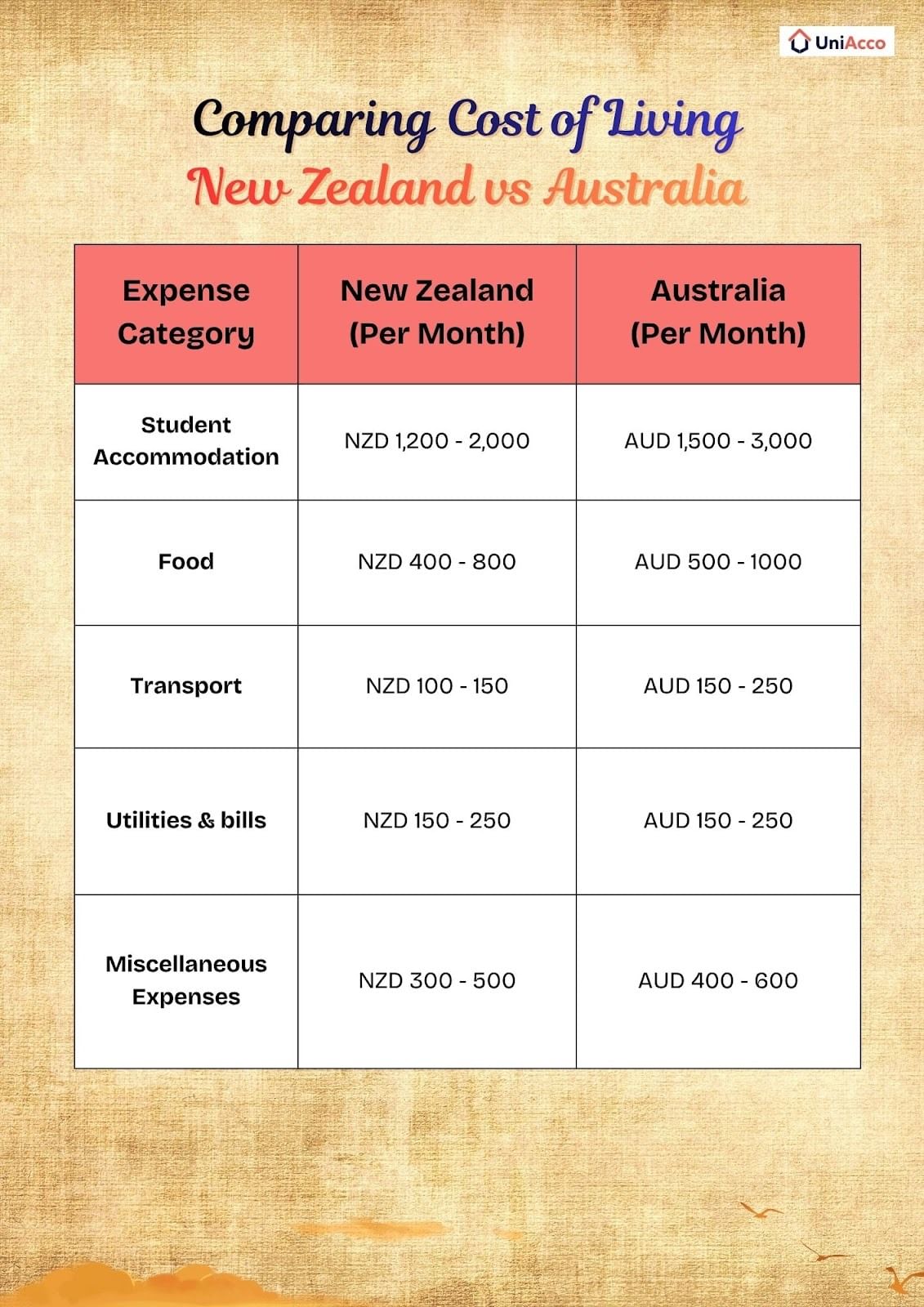
Curious about what the cost of living in Australia for students really looks like? This Reddit thread features firsthand experiences from international students sharing real insights on budgeting, expenses, and adjusting to daily life in Australia.
How are students affording Australia? Weekly expenses – r/Indians_StudyAbroad from r/Indians_StudyAbroad
Work Visa & PR Pathways After Graduation: New Zealand vs Australia
Deciding to study in New Zealand vs Australia isn’t just about earning a degree; it’s about what happens next. Both countries offer post-study work visas that let you take your first professional steps abroad and even pave the way to permanent residency (PR).
New Zealand: Post-Study Work Visa → Resident Visa → Permanent Resident (PR) Visa
Immediate Post-Study Work
After completing your qualification, New Zealand allows you to stay and gain professional experience through the Post Study Work Visa, a vital bridge between study and residency. It allows you to work for any employer in your field, helping you build the skills and experience necessary to qualify for permanent residence.
| Feature | Details |
| Eligibility | Completed a Level 7+ qualification (full-time, at least 30 weeks) at a recognised NZ institution. |
| Duration | Up to 3 years, depending on your qualification level and region of study. |
| Fees | From NZD $1,670 (approx). |
| Application Process | Apply online via Immigration New Zealand after completing your course. |
| Key Update | Students with Level 7 or below non-degree qualifications must work in occupations listed on New Zealand’s Green List. |
Pathways to PR (Permanent Residency)
For international students comparing study in New Zealand vs Australia, the PR pathways in New Zealand are structured yet achievable. Most routes begin after gaining local work experience on a Post-Study Work Visa and depend on your skills, occupation, and employer type.
| Pathway | Key Highlights | Ideal For |
| Skilled Migrant Category (SMC) | Points-based system assessing age, qualifications, and skilled work. A job offer in New Zealand is usually required. | Skilled graduates aiming for long-term settlement. |
| Accredited Employer Work Visa → Residence | Work full-time for 2 years with an accredited employer to qualify for residence. | Graduates employed by approved NZ employers. |
| Green List Residence Pathway | Direct or 2-year route to residency for roles in high-demand sectors like healthcare, IT, and engineering. | Graduates in priority occupations. |
| Work to Residence Visa | Residency eligibility after 24 months in a skilled role with a recognised employer. | Professionals with steady post-study work. |
| Long-Term Skill Shortage Route | For continuous employment in critical shortage areas that support NZ’s economy. | Skilled workers in key industries such as construction or agriculture. |
Australia: Graduate Route → Work Visa → PR
Immediate Post-Study Work
In Australia, the Temporary Graduate Visa (subclass 485) gives international students a bridge between graduation and professional life. Depending on your course and location, you can stay back to gain valuable experience, a crucial step for future PR opportunities.
| Feature | Details |
| Eligibility | Must have completed a CRICOS-registered course and previously held a Student Visa. |
| Duration | Typically 2-4 years (up to 6 years for PhD holders); regional graduates receive extensions. |
| Fees | From AUD $1,895 (approx). |
| Application Process | Apply online through your ImmiAccount under the Graduate Work or Post-Study Work stream. |
| Key Update | From July 2023, select STEM and regional degrees offer an additional 2 years of post-study stay. |
Pathways to PR (Permanent Residency)
For students weighing study in New Zealand vs Australia, Australia offers multiple PR routes that reward skills, work experience, and regional contribution. Most graduates begin with the Temporary Graduate Visa (subclass 485) to gain experience and then move to one of the PR categories below.
| Pathway | Key Highlights | Ideal For |
| Skilled Independent Visa (subclass 189) | Points-based PR for skilled workers without employer or state sponsorship. | Graduates with strong qualifications and work profiles. |
| Skilled Nominated Visa (subclass 190) | Requires nomination by a state or territory based on in-demand occupations. | Graduates targeting specific regions or industries. |
| Skilled Work Regional Visa (subclass 491) | Live and work in regional Australia for 3 years to qualify for PR. | Students open to regional settlement with extra PR incentives. |
| Employer Nomination Scheme (subclass 186) | PR through sponsorship from an Australian employer in a full-time skilled role. | Graduates with long-term job offers. |
| Global Talent Visa | Fast-tracked PR for exceptional talent in innovation-led fields. | High achievers in tech, research, or specialised sectors. |
| Business Innovation and Investment Visa (subclass 188) | For entrepreneurs or investors establishing businesses in Australia. | Graduates aiming to build or invest in ventures. |
Quick Comparison Table: Australia vs New Zealand
| Category | Australia | New Zealand | Verdict |
| Global Rankings | Generally higher-ranked universities overall | Smaller system with selective strong performers | Australia leads in global rankings |
| Tuition Cost | Higher upper range across UG/PG | More affordable on average | New Zealand is more cost-effective |
| Visa Processing | Streamlined and structured | Fast and straightforward | Comparable – varies slightly by profile |
| Job Opportunities | Larger job market with wider industry spread | Moderate opportunities in key sectors | Australia offers broader options |
| PR Pathways | Multiple, flexible PR routes | Structured rules with occupation focus | Australia offers more pathways |
| Lifestyle & Safety | Vibrant urban environments with diverse communities | Relaxed, nature-focused, highly safe | Depends entirely on lifestyle preference |
From university halls to private studios, find a space that suits your lifestyle and budget. Focus on studying and living fully — UniAcco has got your back.
🏠 Browse Verified Sydney AccommodationsWrapping up!
Ultimately, choosing where to study in New Zealand vs Australia comes down to what feels right for your future. If you’re looking for a calm, community-driven environment with affordable tuition and excellent teaching quality, New Zealand offers a nurturing space to learn and grow. On the other hand, if you thrive in a fast-paced, globally connected setting with top-ranked universities, diverse career options, and generous post-study work opportunities, Australia might be your perfect match.
Both countries offer world-class education, global recognition, and unforgettable student experiences. The difference lies in what you value more – balance or bustle, serenity or scale.
And as you take that next big step, UniAcco is here to make your transition smoother, helping you discover safe, verified, and fully furnished student accommodation in your dream study city.


 LinkedIn








0 Comments