
It’s past midnight, and instead of Netflix and chill, your laptop has somehow turned into a psychology study-abroad research centre. With tabs piling up, one question keeps circling back: which country actually makes sense for you?
Perhaps clinical psychology is your calling. Or you’re inclined towards behavioural science, counselling or research. Your career goal can change the destination that fits you best. The best country to study psychology depends on more than university rankings. Your budget, course preferences, career plans and the type of psychology you want to pursue all matter.
This blog compares popular destinations for international psychology students, from their universities and tuition fees to courses, career options and student life.
Top Countries To Study Psychology Abroad: An Overview
| Country | Best known for | Top psychology universities | Popular specialisations |
| USA | Research, specialisations and academic flexibility | HarvardStanfordUCLA | Clinical, neuroscience, cognitive, I-O psychology |
| UK | Strong universities and recognised psychology programmes | CambridgeOxfordUCL | Clinical, counselling, developmental, social psychology |
| Australia | Structured psychology education and professional pathways | MelbourneSydneyUNSW | Clinical, counselling, organisational psychology |
| Canada | Research opportunities and diverse student communities | TorontoUBCMcGill | Clinical, counselling, developmental psychology |
| Netherlands | English-taught programmes and research-led education | University of AmsterdamLeiden University | Cognitive, social, behavioural neuroscience |
| Germany | Lower-cost public university options | LMU MunichHeidelberg University | Cognitive, clinical, research psychology |
Why Study Psychology Abroad?
Access to specialised psychology programmes
Universities abroad often offer psychology modules that let you explore specific interests. You could start with a broad psychology degree and later focus on areas such as neuroscience, clinical psychology, cognitive psychology or organisational psychology.
Experience psychology across cultures
Human behaviour does not look the same everywhere. A group discussion about anxiety, family relationships, or workplace behaviour can bring completely different viewpoints into the room. Living abroad gives you daily exposure to those differences instead of learning about them only through case studies. That experience can prove useful if you later work with international teams, communities or clients.
Better access to research opportunities
Research plays a big role in psychology, especially if you plan to pursue a master’s or PhD. At some universities, you may assist with research projects, collect survey data, analyse behavioural patterns or work with specialist equipment. You might even discover an area of psychology you want to pursue further through a research project.
More opportunities to specialise
Your first idea of psychology may not be your final one. You might arrive interested in counselling and discover that consumer behaviour or neuroscience suits you better. Studying abroad can give you access to different modules, electives and research areas before you commit to a long-term specialisation.
International career exposure
A psychology degree can open doors beyond traditional psychology roles. Your understanding of behaviour could prove useful in HR, where companies study employee engagement and workplace wellbeing. It can support UX research, where teams observe how people interact with an app or website. You could also explore market research, behavioural science, education, public policy, research or social services.
Skills that stay useful beyond psychology
You’ll spend a lot of time analysing information, interpreting research, understanding people and presenting your findings. Those skills can travel with you into careers that have little to do with traditional psychology.
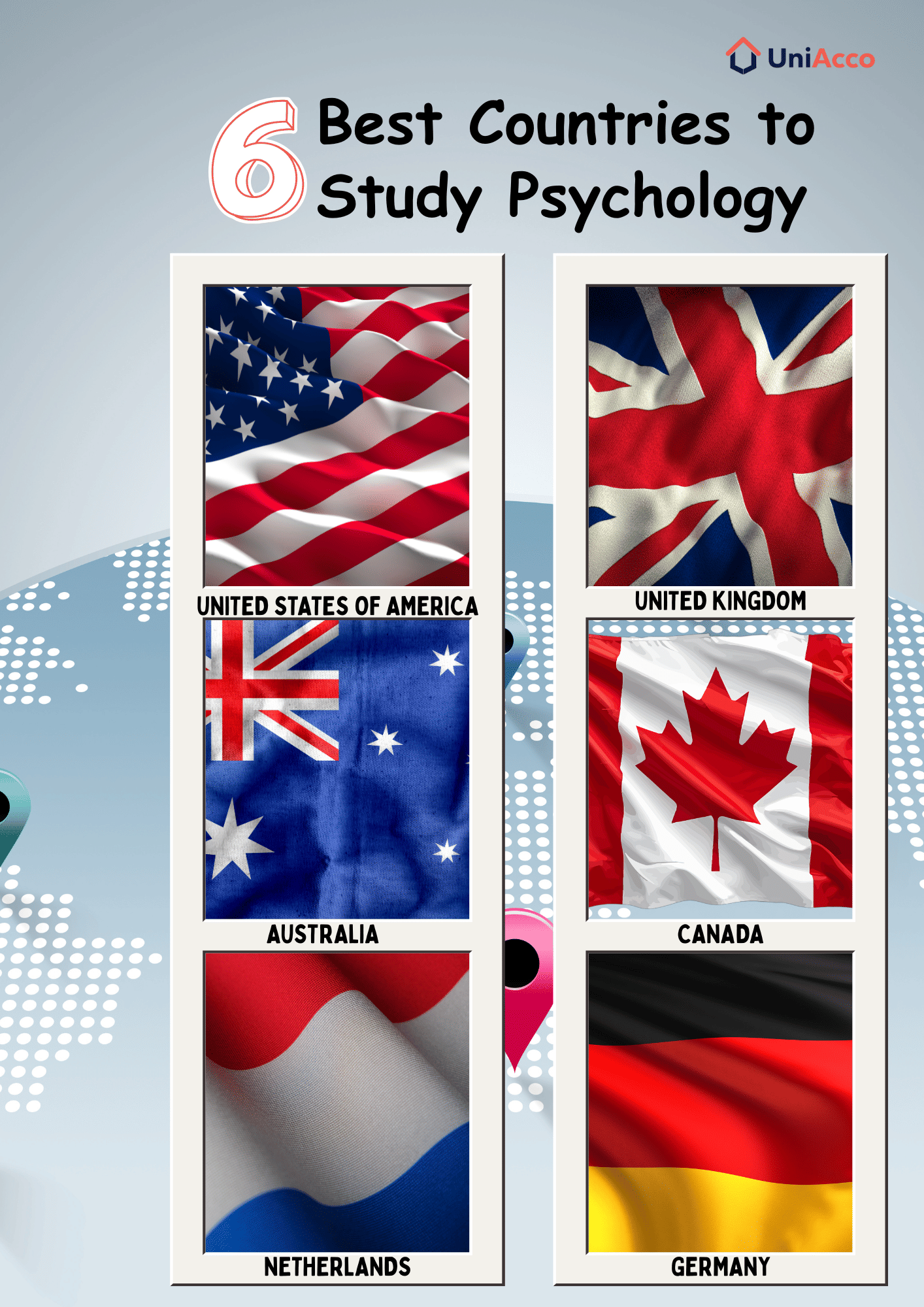
6 Best Countries to Study Psychology
USA
Why study psychology in the USA?
Psychology goes well beyond the traditional route
At top US universities, psychology can connect with neuroscience, cognitive science, biology and even technology. Harvard, for example, offers three tracks within its Psychology concentration: the General Track, the combined Cognitive Neuroscience and Evolutionary Psychology (CNEP) Track, and the Mind, Brain, and Behaviour (Cognitive Science) Track. That gives you more room to build a degree around the questions you actually care about.
Undergraduate research can start earlier than you expect
Research does not have to wait until postgraduate study. Most Yale psychology majors gain research experience during their degree. Its labs take students at different stages, including first-year and second-year students. At Stanford, psychology students can take research and independent-study units. The department also offers an honours route with three quarters of supervised research and a thesis. That experience can strengthen your academic profile if you are considering a psychology master’s abroad or PhD later.
You can test different areas before settling on one
A psychology degree in the USA does not have to box you into one narrow subject from day one. Stanford’s psychology major includes areas such as perception, learning and memory, cognitive neuroscience, developmental psychology, social psychology, cultural psychology and clinical psychology. It also offers pathways in health psychology, judgement and decision-making, neuroscience, and mind, culture and society. That flexibility can be useful if you know you love psychology but have not yet picked your specialisation.
Psychology connects well with other career routes
A psychology degree can work as a foundation for careers beyond clinical practice. Stanford specifically lists business, education, law, medicine and social work among areas where psychology can provide useful preparation. UCLA also points to postgraduate routes in psychology, law, education, government, public policy, business and health-related fields. So, if you are still deciding between psychology, UX research, behavioural science, HR or policy, the degree can leave several options open.
The USA has serious subject strength, not just famous university names
The QS World University Rankings by Subject 2026 place Harvard first globally for Psychology. Stanford ranks joint third, followed by Yale at sixth and Columbia at seventh. MIT, UCLA and Berkeley also make the global top 12. That concentration of highly ranked psychology departments gives you plenty of strong options beyond the usual Harvard-Stanford shortlist.
Best psychology universities in the USA
| University | QS Psychology Ranking 2026 | Popular courses | Tuition Fees |
| Harvard University | #1 | Cognitive neuroscienceClinical scienceDevelopmental psychologySocial psychology | UG: US$62,226/yearPG: PhD funded. |
| Stanford University | =#3 | Cognitive psychologyHealth psychologyNeuroscienceSocial psychology | UG: US$67,731/year for three academic quartersPG: PhD funded |
| Yale University | #6 | Clinical psychologyCognitive psychologyNeuroscienceSocial psychology | UG: US$72,500/yearPG: PhD funded |
| Columbia University | #7 | CognitionNeurosciencePerceptionSocial & personality psychology | UG: US$72,800/yearPG: PhD funded |
| Massachusetts Institute of Technology | #10 | Brain & cognitive sciencesNeuroscienceCognitionBehavioural research | UG: US$66,720/yearPG: BCS PhD funded |
Admission requirements to study Psychology in the USA
For undergraduate psychology:
- A recognised secondary school qualification that makes you eligible for undergraduate study. Stanford requires an equivalent secondary school diploma before enrolment.
- Academic transcripts showing your school performance and subjects.
- SAT or ACT scores where required. Stanford currently requires the SAT or ACT for first-year applicants.
- English proficiency evidence where required. Policies differ by university. Stanford does not require an English proficiency exam, though it expects applicants to demonstrate English fluency.
- Personal essays and recommendation letters, depending on the university’s application requirements.
- A strong academic profile. Psychology itself may not require specific school subjects, but subjects such as biology, mathematics or statistics can give you useful preparation.
For master’s or PhD psychology programmes:
- A relevant bachelor’s degree or its international equivalent. Stanford’s Psychology PhD accepts applicants with an undergraduate degree and does not require a psychology major.
- Academic transcripts and strong grades.
- Research experience, especially for research-heavy PhD programmes. Stanford says admitted Psychology PhD students often have independent research experience.
- A statement of purpose explaining your research interests and academic direction.
- Letters of recommendation. Stanford requires three for its Psychology PhD.
- English proficiency scores required. Stanford’s Psychology PhD requires TOEFL or IELTS for non-native English speakers, subject to its stated exemptions.
UK
Why study psychology in the UK?
A three-year psychology degree can save you time and money
Most full-time UK undergraduate degrees take three years in England, Wales and Northern Ireland. Scotland commonly follows a four-year structure. That can make the UK an attractive option if you want to complete your psychology degree abroad without adding an extra year.
BPS accreditation matters if you want a professional psychology career
Spotting BPS accreditation on a psychology course is worth noting. An accredited degree can give eligible graduates Graduate Basis for Chartered Membership (GBC), which supports the next stages of professional training. It does not mean you can start practising as a psychologist after graduation. Clinical psychology requires further study and supervised professional training. So, before you commit to a university, check where its accreditation can take you after your degree.
Psychology is treated as a science, not simply a people-focused subject
UK psychology degrees usually include research methods, statistics and scientific approaches to human behaviour. Edinburgh, for example, includes statistical analysis, programming and qualitative research methods in its Psychology BSc. So, if statistics make you nervous, do not ignore that part of the course. You will encounter it.
You can connect psychology with other subjects
UK universities offer routes that let you combine psychology with another discipline. Edinburgh offers Psychology and Sociology, for example. UCL also offers Psychology and Language Sciences. That can suit you if your interests sit between psychology and education, language, sociology or neuroscience.
The UK punches above its weight in global psychology rankings
Oxford and Cambridge may grab the headlines, but they are far from your only strong options. Cambridge ranks #2 for Psychology in QS 2026, with Oxford and Stanford tied at #3. UCL follows at #5, while King’s, LSE and Edinburgh rank =#15, #19 and #23 respectively. So, if your dream university does not involve an Oxbridge name, you still have plenty of serious contenders.
Your university choice is only one part of the move. Where you live matters too. Compare student accommodation across the UK by location, price and amenities with UniAcco to find a place that suits your needs and budget.
🔍 Compare Student Accommodation in the UKBest psychology universities in the UK
| University | QS Psychology Ranking 2026 | Popular courses | Tuition Fees |
| University of Cambridge | #2 | Psychological & Behavioural SciencesEvolution & BehaviourNeurobiology | UG: £44,214/yearPG: Varies by course |
| University of Oxford | =#3 | Experimental PsychologyCognitive psychologyDevelopmental psychologySocial psychology | UG: £54,990/yearMSc by Research and DPhil in Experimental Psychology: £34,700/year |
| UCL | #5 | PsychologyPsychology & Language SciencesPsychology with Education | UG: £42,700/yearPG: £35,400–£42,700/year |
| King’s College London | #=15 | PsychologyHealth PsychologyMental HealthPsychology & Neuroscience | UG: £37,200/yearPG: £40,450–£42,800/year |
| London School of Economics and Political Science (LSE) | #19 | Psychological & Behavioural ScienceBehavioural ScienceSocial & Cultural Psychology | UG: £30,700/yearPG: £30,400/year |
| University of Edinburgh | #23 | PsychologySocial PsychologyCognitive NeuropsychologyPsychology of Mental Health | UG: £38,900/yearPG: £32,000–£33,200/year |
Admission requirements to study Psychology in the UK
For undergraduate psychology:
- A recognised school-leaving qualification to meet the university’s academic entry standard.
- Strong academic grades depending on the qualification route opted for. Oxford also asks for one or more science subjects, including Psychology or Mathematics for Psychology.
- Relevant subjects such as Psychology, Biology, Chemistry, Mathematics or Physics.
- English language proficiency. International students may need an approved English language qualification.
- UCAS application: Most UK undergraduate applications go through UCAS.
- Admissions tests: Check your chosen university carefully. Oxford University has replaced the TSA with a new admissions test, the TARA (Thinking and Reasoning Assessment); Psychology, Philosophy and Linguistics and Experimental Psychology applicants now sit the TARA rather than the TSA.
- Personal statement: Your application should show genuine academic interest in psychology and evidence behind that interest.
- Qualification-specific documents: Indian students should check the university’s requirements for their exact board and qualification.
For master’s or PhD psychology programmes:
- A relevant bachelor’s degree
- Strong academic results
- Academic transcripts
- English language evidence where required
- Personal statement or statement of purpose
- Academic references
- CV or résumé
- Evidence of research experience for research-heavy courses
- Additional prerequisites for specialist or clinical programmes
Australia
Why study psychology in Australia?
Australia has several psychology universities with strong global subject rankings
Sydney and Melbourne may be the first cities that come to mind, but Australia gives you more options for psychology. QS Psychology 2026 ranks the University of Melbourne #20 globally, followed by UNSW Sydney at #26 and the University of Queensland at #27. The University of Sydney ranks #37, while Monash sits at #45. So, your shortlist can stretch beyond the two biggest student cities.
The professional pathway is structured around a four-year psychology sequence
The Psychology Board of Australia states that students seeking general registration typically complete a four-year sequence of psychology study before further professional training. The current routes include a fifth-year qualification followed by an internship, or a higher degree such as a Master’s or Doctorate. So, if your end goal is professional psychology, do not budget for only three years of university.
You can build towards professional psychology through postgraduate study
Your bachelor’s degree gives you the foundation. Further study can lead you to professional practice or to a specific area of psychology. The University of Melbourne, for example, offers postgraduate psychology study that includes professional placement subjects. Its 2026 international subject fees show dedicated clinical placement units within its professional psychology training. This matters if you are considering clinical psychology abroad rather than a general psychology degree.
The Australian route gives research-focused students room to go further
Psychology degrees can lead towards research, postgraduate study and academic careers. This can suit you if you enjoy statistics, research projects and asking why people behave in certain ways. Australia’s strong QS performance also reflects research indicators such as citations per paper and H-index citations. QS uses these alongside academic reputation, employer reputation and international research networks.
Best psychology universities in Australia
| University | QS Psychology Ranking 2026 | Popular courses | Tuition Cost |
| University of Melbourne | #20 | PsychologyBehavioural scienceCognitive psychologyProfessional psychology | UG: ~AUD 54,000–58,000/yearPG: ~AUD 50,000–55,000/year |
| UNSW Sydney | #26 | PsychologyClinical psychologyCognitive scienceSocial psychology | UG: ~AUD 56,000–58,000/yearPG: ~AUD 55,000–60,000/year |
| University of Queensland | #27 | PsychologyClinical psychologyDevelopmental psychologySocial psychology | UG: ~AUD 53,000–56,000/yearPG: ~AUD 42,000–55,000/year |
| University of Sydney | #37 | PsychologyBehavioural scienceCognitive psychologyClinical psychology | UG: ~AUD 56,000–60,000/yearPG: ~AUD 54,000–60,000/year |
| Monash University | #45 | PsychologyClinical psychologyDevelopmental psychologyCognitive psychology | UG: ~AUD 48,000–55,000/yearPG: ~AUD 45,000–55,000/year |
Admission requirements to study Psychology in Australia
For undergraduate psychology:
- A recognised school-leaving qualification: Your qualification must meet the university’s academic entry standard.
- Competitive academic results: Highly ranked universities can have demanding entry scores.
- English language proficiency: International applicants may need IELTS, TOEFL or another approved qualification.
- Subject prerequisites: Some courses require specific subjects or assumed knowledge.
- Academic transcripts: Universities assess your previous studies before making an offer.
- Additional documents: Some universities may request personal information, portfolios or other supporting documents.
- Visa and financial evidence: You need to meet the relevant Australian student visa requirements after receiving an offer.
For master’s or PhD psychology programmes:
- A recognised bachelor’s degree
- A psychology major or equivalent sequence
- Specific psychology subjects
- Research methods and statistics
- Academic transcripts
- English language evidence
- Personal statement
- References
- Evidence of research experience for some programmes
- Additional selection requirements for professional psychology courses
Also Read: Top 10 Best Courses to Study in Australia in 2026 for International Students
Canada
Why study psychology in Canada?
You can get serious research exposure as an undergraduate
Psychology in Canada is closely tied to research. At the University of Toronto Scarborough, psychology students can work with faculty on research projects and take supervised thesis courses. Specialist students can also consider a co-op option with up to 12 months of work experience. That can be useful if you see yourself pursuing a psychology master’s abroad, a PhD or a research career later.
Psychology can connect with health, neuroscience and other fields
Psychology can take you far beyond the usual clinical route. At UBC, you can explore behavioural neuroscience, cognition, clinical, health, developmental, social and personality psychology. The programme also builds your quantitative skills, which can prove useful if you plan to move into research or data-led psychology careers.
Some Canadian programmes offer unusual undergraduate options
At U of T Scarborough, students can study clinical psychology at the UG level through one of its psychology programmes. The curriculum covers areas including clinical, developmental, personality and social psychology.
You can build practical experience alongside your degree
Co-op can make a difference when you are looking beyond grades. If you want to enter the job market with some workplace experience, check co-op availability before comparing courses.
Canada gives you strong options outside Toronto
Toronto gets plenty of attention, but it is not your only serious option. UBC and McGill also sit inside the global top 30 for Psychology in QS 2026.
Best psychology universities in Canada
| University | QS Psychology Ranking 2026 | Popular courses | Tuition Fee |
| University of Toronto | #8 | PsychologyClinical psychologyCognitive psychologyDevelopmental psychologySocial psychology | UG: CAD 60,000–68,000/yearPG: CAD 30,000–60,000/year |
| University of British Columbia | #21 | PsychologyBehavioural neuroscienceCognitive psychologyClinical psychologyHealth psychology | UG: CAD 46,000–50,000/yearPG: CAD 10,000–35,000/year |
| McGill University | #22 | PsychologyNeuroscienceCognitionBehavioural research | UG: CAD 30,000–65,000/yearPG: CAD 20,000–45,000/year |
| Western University | #90 | PsychologyCognitive scienceDevelopmental psychologySocial psychology | UG: CAD 40,000–50,000/yearPG: CAD 20,000–35,000/year |
Admission requirements to study Psychology in Canada
For undergraduate psychology
- A recognised secondary-school qualification that meets the university’s entry standard.
- Strong academic grades, particularly in required subjects.
- English language proficiency if you do not meet the university’s language exemption.
- Subject prerequisites, which can include English, mathematics or science subjects.
- Official academic transcripts from your school.
- Country-specific documents if your qualification comes from outside Canada.
- Proof of identity and immigration documents after admission when required.
For postgraduate psychology
- A relevant bachelor’s degree
- Required undergraduate psychology courses
- Strong academic results
- Research methods and statistics
- Academic transcripts
- English language proof where required
- References
- Statement of purpose
- CV or résumé
- Research experience for research-heavy programmes
Netherlands
Why study psychology in the Netherlands?
You can study psychology in English from your first year
This is a major reason the Netherlands attracts international students. The University of Amsterdam offers a full-time, English-taught Psychology bachelor’s programme. Lectures, study materials and exams are in English. That can make the Netherlands a practical option if you want to study psychology abroad without learning Dutch before starting university.
Psychology programmes can give you a genuine choice
At UvA, psychology students can choose two specialisations from seven options. The programme also includes practical training and scientific methods. Your interests can therefore develop as you study. You might start with social psychology and later become more interested in clinical psychology, behavioural science or brain and cognition.
Research and statistics are part of the deal
Dutch psychology degrees take the scientific side seriously. UvA expects students to have a mathematics foundation because psychology involves research methods and statistics. So, if you chose psychology because you dislike maths, pause here. You will still encounter data, research design and statistical analysis.
Psychology bachelor’s admissions can be surprisingly competitive
This is where the Netherlands differs from many students’ expectations. UvA’s Psychology bachelor’s programme has a numerus fixus. For 2026-27, it offered 330 places on the English track. The university received 1,934 applications, with 1,320 applicants taking part in the selection process. Erasmus University Rotterdam also limits its English-taught International Bachelor in Psychology to 600 places in total.
You may face a selection test before getting a place
At UvA, applicants take part in a selection procedure covering psychology topics, analytical thinking and study skills. The university provides study material before the test, so prior university-level psychology knowledge is not required. Erasmus uses an online knowledge test, alongside questions about motivation and study approach. Your assessment result and GPA contribute to the ranking. That gives you something concrete to prepare for instead of treating admission as a paperwork exercise.
Best psychology universities in the Netherlands
| University | QS Psychology Ranking 2026 | Popular courses | Tuition fee |
| University of Amsterdam | #9 | Psychology BScBehavioural Data ScienceClinical psychologySocial psychologyCognitive psychology | UG: €17,500/yearPG: €25,900/year* |
| Vrije Universiteit Amsterdam | #38 | PsychologyClinical psychologySocial psychologyOrganisational psychology | UG: €14,000–€16,000/yearPG: €20,000–€25,000/year |
| Erasmus University Rotterdam | #=49 | International Bachelor in PsychologyClinical psychologyEducational psychology | UG: €13,500/yearPG: €21,000/year* |
| Leiden University | #65 | Psychology BScClinical psychologyEconomic & Consumer PsychologySocial psychology | UG: €14,300/yearPG: €22,300/year* |
| Maastricht University | #=62 | PsychologyCognitive neuroscienceDevelopmental psychologyClinical psychology | UG: €13,200/yearPG: €21,500/year* |
* PG figures apply to selected one-year psychology-related master’s programmes. Fees vary by programme.
Admission requirements to study Psychology in the Netherlands
For undergraduate psychology
- A secondary-school qualification equivalent to Dutch VWO level: Your qualification must meet the university’s research-university entry standard.
- Mathematics: This matters more than many international students expect. UvA requires mathematics through the final year and accepts alternatives such as OMPT-A, with a required score of 70%.
- English proficiency: Requirements vary. UvA currently lists IELTS Academic 6.5 overall, with 6.0 in each component, or TOEFL iBT 92 with 22 per sub-score.
- Studielink registration: International applicants start the application through the Dutch national registration system.
- University application: You may need to upload transcripts, diploma documents, passport details and language evidence.
- Selection procedure: Numerus-fixus programmes can require an additional selection assessment.
- Early application: Psychology programmes with numerus fixus usually have an earlier deadline.
For postgraduate psychology
- A relevant bachelor’s degree
- Specific psychology modules from your previous degree
- Research methods and statistics
- Academic transcripts
- English language evidence
- CV or résumé
- Motivation letter or statement
- References for some programmes
- Additional prerequisites for clinical or research-focused master’s programmes
Germany
Why study psychology in Germany?
Germany has a surprisingly large presence in global psychology rankings
Germany places several universities in the QS Psychology 2026 ranking. Ludwig-Maximilians-Universität München (LMU) is actually the country’s highest-ranked school for Psychology, tied for 41st globally — ahead of Humboldt-Universität zu Berlin at 53rd, Freie Universität Berlin (tied 74th), and Heidelberg University (tied 91st). So you have more options than the usual Heidelberg-first shortlist suggests, and LMU in particular ranks well ahead of where it’s often placed.
Public universities can make your degree more affordable
Germany’s public university system can be significantly cheaper than studying psychology in the USA, the UK or Australia. But do not interpret that as “0 cost”. Students still pay semester contributions, and some states charge tuition to certain non-EU students. Heidelberg University lists €189.80 per semester in fees and contributions for its Psychology BSc. €1,500/semester is an additional tuition fee charged specifically to non-EU/non-EEA students at all Baden-Württemberg universities.
German matters more than many international students expect
LMU Munich’s Psychology BSc lists German as the language of instruction. Its department also states that teaching and course materials are in German, although English may be used for some theses and individual courses. Heidelberg’s Psychology BSc is also primarily taught in German, with some content in English. The university requires very good German language skills for applicants with non-German qualifications.
Psychology is treated as an empirical science
German psychology programmes put a good amount of emphasis on research methods and evidence. Heidelberg’s BSc introduces students to empirical psychology, research methods, different theoretical approaches and practical fields of psychology. That suits you if you enjoy understanding how psychologists test ideas rather than simply memorising theories.
Some bachelor’s programmes have competitive selection
Lower tuition does not mean easy admission. Heidelberg’s Psychology BSc has 90 places. Its selection process awards points for academic performance, the BaPsy-DGP’s aptitude test and certain other achievements. Only 8% of places are allocated to international applicants. For the 2025/26 intake, the university reports a selection score of 44.4 points as a reference for the final admission process. It warns that previous scores only provide guidance for future intakes.
Best psychology universities in Germany
| University | QS Psychology Ranking 2026 | Popular courses | Tuition Cost |
| Humboldt-Universität zu Berlin | #53 | PsychologyCognitive psychologySocial psychologyBehavioural research | UG: No tuition fee*PG: No tuition fee*Semester contribution applies |
| Ludwig-Maximilians-Universität München (LMU) | #=41 | Psychology BScClinical Psychology & PsychotherapyNeuro-Cognitive Psychology | UG: No tuition fee*PG: No tuition fee*Semester contribution applies |
| Heidelberg University | #=91 | Psychology BScClinical Psychology & PsychotherapyResearch psychology | UG: €1,500/semester + feesPG: €1,500/semester + fees |
| Freie Universität Berlin | #=74 | PsychologyClinical psychologyCognitive psychologySocial psychology | UG: No tuition fee*PG: No tuition fee*Semester contribution applies |
Admission requirements to study Psychology in Germany
For undergraduate psychology
- A recognised university entrance qualification: Your school qualification must give you access to higher education in Germany.
- Academic transcripts: Universities assess your previous grades and qualification.
- German language proficiency: This is essential for many psychology bachelor’s programmes.
- Required language certificate: The exact qualification and level depend on the university.
- Subject prerequisites: Some universities can require specific prior knowledge.
- Entrance or aptitude tests: Certain psychology programmes use selection tests.
- Application through the correct route: Depending on your qualification and university, you may apply directly, through uni-assist or another application system.
- Certified translations: Documents may need translation into German or another accepted language.
- Proof of finances: You need to meet the financial requirements connected with your student residence process.
For postgraduate psychology
- A relevant bachelor’s degree
- Specific psychology credits from your previous degree
- Research methods and statistics
- Academic transcripts
- English or German language proficiency, depending on the course
- CV or résumé
- Motivation letter
- References for some programmes
- Research experience for research-heavy degrees
- Proof that your previous qualification meets German academic requirements
Top Universities for Psychology in the World
| QS Psychology Rank 2026 | University | Country | Why study psychology here? |
| 1 | Harvard University | USA | • 85%+ of Psychology concentrators do research in a lab at some point. • Four research areas: cognition, brain & behaviour; developmental; clinical science; social psychology. • Undergraduate research can include study design, data collection, coding and analysis. |
| 2 | University of Cambridge | UK | • Psychology sits within the broader Psychological and Behavioural Sciences degree. • You can combine psychology with neuroscience, anthropology, philosophy and sociology. • Final-year students complete a 7,000-word research dissertation. • The course is BPS-accredited. |
| =3 | Stanford University | USA | • The major allows 10 units outside the Psychology Department, giving you room to combine subjects. • Dedicated pathways include cognitive science, health psychology, neuroscience and judgement and decision-making. • You can count undergraduate research towards the major. • The programme also includes a senior capstone. |
| =3 | University of Oxford | UK | • Psychology is taught through Experimental Psychology, giving the degree a strong scientific focus. • Students study areas such as cognition, developmental psychology, neuroscience and social psychology. • The course includes substantial research and experimental work. |
| 5 | UCL | UK | • Start writing research lab reports from Year 1. • Students learn R for data analysis alongside research methods. • Final-year options include cognitive neuroscience, organisational psychology, educational psychology and computer programming. • The BSc is BPS-accredited. |
| 6 | Yale University | USA | • The standard major combines statistics, research methods, social science and natural science. • Students can take independent research courses before the senior year. • A senior requirement includes advanced psychology coursework and a substantial final paper. • Yale also offers a dedicated Neuroscience track within the psychology major. |
| 7 | Columbia University | USA | • The curriculum covers perception, cognition, psychobiology, neuroscience, social and personality psychology and abnormal psychology. • Statistics and research methods form part of the foundation. • You can pursue a Psychology major or a lighter Psychology concentration alongside another subject. • An honours route and supervised research are available. |
| 8 | University of Toronto | Canada | • The Scarborough campus offers a Psychology Specialist with an optional co-op route. • The co-op option can provide up to 12 months of work experience. • Students can take supervised research courses and work with faculty research teams. |
| 9 | University of Amsterdam | Netherlands | • The Psychology BSc is available as a fully English-taught programme. • Students can select two specialisations from seven options. • The programme combines psychology with scientific methods and practical training. • The English track has limited places, making admission competitive. |
| 10 | Massachusetts Institute of Technology (MIT) | USA | • Psychology sits within MIT’s Department of Brain and Cognitive Sciences. • The focus suits students interested in the link between behaviour, cognition and the brain. • Strong fit if your interests sit closer to cognitive science or neuroscience than traditional counselling psychology. |
| 11 | University of California, Los Angeles (UCLA) | USA | • Psychology students can explore areas including behavioural neuroscience, cognitive psychology, developmental psychology and social psychology. • UCLA also offers a dedicated Psychology Applied Science route. • The programme gives students access to a large research university environment. |
| 12 | University of California, Berkeley | USA | • Six major research areas include behavioural and systems neuroscience, cognition, developmental, clinical science, cognitive neuroscience and social-personality psychology. • The major requires research methods and quantitative training. • Berkeley also offers a Clinical & Counseling Psychology minor covering mental health, clinical professions and global mental health. |
| 13 | New York University (NYU) | USA | • NYU’s psychology programme offers routes into areas such as social psychology, clinical psychology, cognitive psychology and behavioural neuroscience. • Its location gives students access to a large research and professional ecosystem in New York. |
| 14 | University of Michigan-Ann Arbor | USA | • Students can study psychology alongside areas such as biopsychology, cognition and development, personality and social contexts. • Undergraduate students can take part in faculty research and independent study. • The department offers several routes for students considering graduate research. |
| =15 | King’s College London | UK | • Psychology sits close to King’s strong mental health and neuroscience research environment. • Students can explore psychology alongside areas such as neuroscience, clinical science and behavioural research. • London gives students access to major healthcare, research and public-sector organisations. |
Pros and Cons of Studying Psychology Abroad
A psychology degree abroad can give you a broader academic and cultural experience, but it comes with a few realities worth knowing before you apply. Your choice of country can affect your course structure, professional options, budget and even the language you need for practice.
| Pros | Cons |
| Access to specialised coursesYou can explore areas such as cognitive psychology, neuroscience, clinical psychology and behavioural science. | Course options vary by countryA specialisation you want may require a master’s or professional training after your bachelor’s. |
| Exposure to different culturesYou study human behaviour around classmates with different cultural backgrounds and experiences. | Cultural differences can take adjustmentIdeas about mental health, family and social behaviour can differ greatly across countries. |
| Strong research opportunitiesTop psychology universities may offer labs, research projects, statistics training and supervised research. | Research-heavy courses can be demandingExpect coursework involving statistics, research methods, data analysis and academic writing. |
| International career exposurePsychology skills can support careers in UX research, HR, behavioural science, market research and research. | A psychology degree does not guarantee professional practiceClinical and counselling roles usually require additional qualifications, supervised training and registration. |
| English-taught optionsCountries such as the UK, Australia and Canada offer many psychology programmes in English. | Language can still affect your careerLocal language skills may matter for clinical work and roles involving direct client support. |
| Broader academic experienceYou can study psychology alongside neuroscience, sociology, education, business or other subjects. | The degree structure may differ from homeCheck credit systems, course length and postgraduate entry requirements before applying. |
| Potential post-study opportunitiesSome destinations offer routes for graduates to gain work experience after completing their degree. | Visa rules can changeCheck current post-study work rules instead of relying on information from older student forums. |
| Personal growthLiving abroad can build independence, communication skills and confidence in unfamiliar situations. | Living costs can add up quicklyRent, insurance, transport and food can change your total psychology degree cost significantly. |
| International networkYou can build friendships and professional connections across different countries and industries. | Moving abroad can feel isolating at firstLook for universities with active international student support and student communities. |
| Potentially strong career flexibilityPsychology graduates can move into several fields beyond traditional psychology roles. | Some careers need much more studyResearch, clinical and academic careers often require postgraduate qualifications. |
How to Choose the Best Country to Study Psychology?
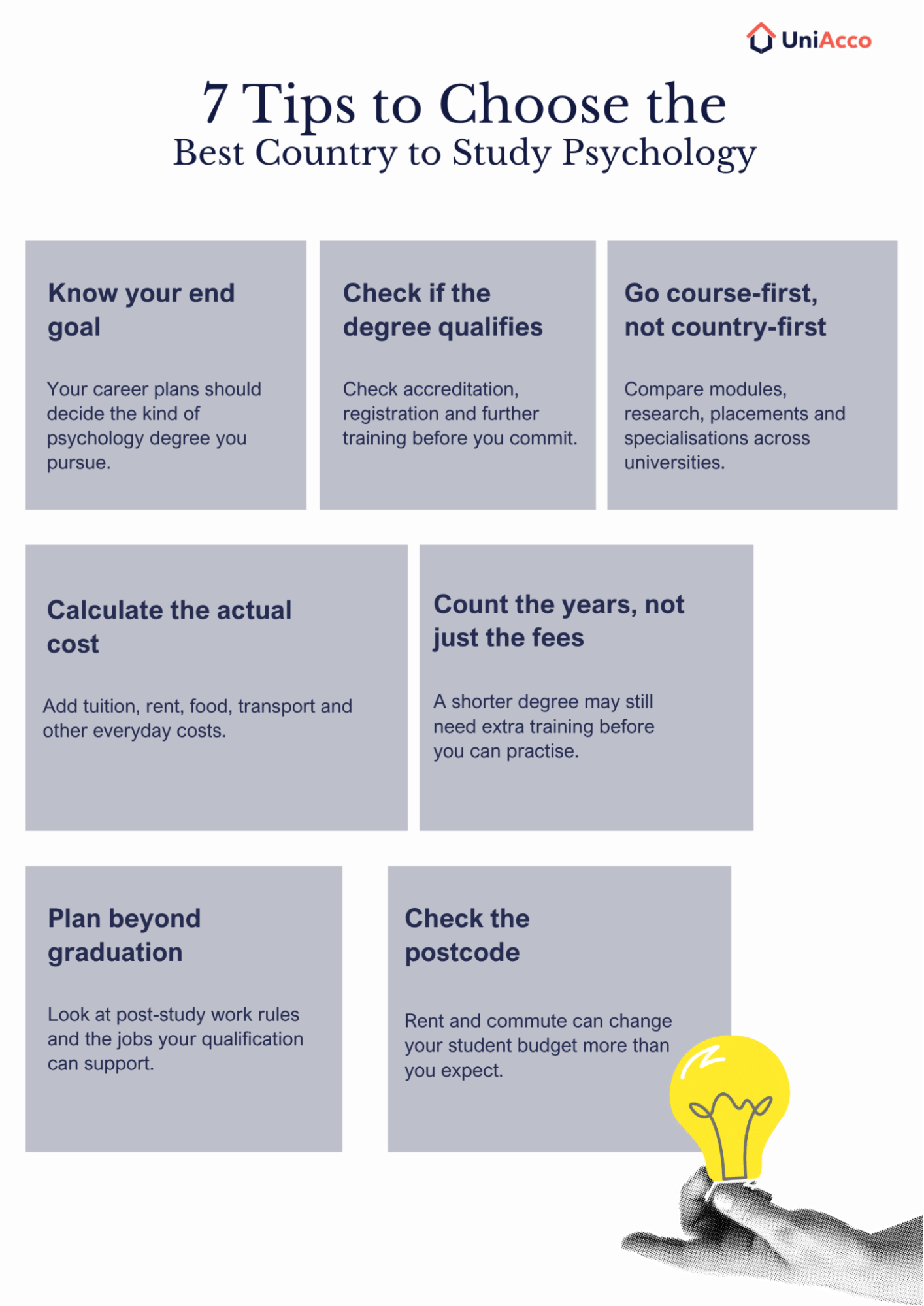
Decide what you want to do with psychology
Start with the career, then work backwards to the degree. Want to become a clinical psychologist? You’ll need a specific professional training route. Interested in UX research or behavioural science? Research methods, statistics and practical experience may matter more. Your academic goal can change which psychology courses abroad make sense.
Check professional accreditation
This step can save you from an expensive mistake. A psychology degree does not automatically qualify you to practise as a psychologist. Countries have different rules for registration, supervised training and professional qualifications. If you want clinical psychology abroad, check the professional body in your target country. Then confirm that your chosen degree fits the required pathway.
Compare universities, not just countries
“Psychology in the UK” or “psychology in Australia” tells you very little. Compare the actual universities and courses. Look at modules, research areas, assessment methods, placements, accreditation and postgraduate options. Two universities in the same city can offer very different psychology experiences.
Compare the full cost of studying
Tuition is only one part of your budget. Add accommodation, food, transport, insurance, visa costs, study materials and everyday spending. A university with lower tuition can still cost more if rent is high. Check your student accommodation before you calculate your final budget. It can change your monthly spending more than you expect.
Check course duration
A three-year bachelor’s may sound better than a four-year course. The cheaper option is not always the better one. Some countries require additional study before you can enter professional psychology training. Australia, for example, has a four-year psychology sequence before further professional training. Check the complete timeline, especially if you plan to become a practising psychologist.
Look at post-study work options
Your plans should not stop at graduation. Check the current post-study work rules for international graduates in your target country. Look at eligible jobs, visa duration and any restrictions linked to your qualification. These rules can change, so use official government sources rather than relying on an old Reddit thread.
Research where you’ll live
Your university may look perfect until you check the rent. Compare student accommodation, commute times, food costs and transport around the campus. London, Sydney, Toronto and Amsterdam can have very different living costs from smaller university cities. Also, check how long it takes to reach campus. Saving £2,000 on rent means little if your daily commute eats two hours.
Which Country Should You Choose?
| Your profile | Country worth considering | Why it may suit you |
| I want a research-heavy psychology career | USA | • Harvard ranks #1 globally for Psychology in QS 2026.• US universities dominate the top of the ranking.• Strong options exist across clinical science, neuroscience, cognition and behavioural research. |
| I want a shorter psychology master’s | UK | • Many universities offer one-year full-time master’s programmes.• UCL’s Psychological Sciences MSc runs for one calendar year for eligible students.• BPS-accredited conversion courses can provide Graduate Basis for Chartered Membership. |
| I want a clearly defined professional psychology route | Australia | • General registration requires a minimum six-year education and training sequence.• The route starts with a four-year accredited psychology sequence.• You can then choose a higher-degree route or the 5+1 internship pathway. |
| I want strong research and a multicultural study environment | Canada | • The University of Toronto ranks #8 globally for Psychology in QS 2026.• UBC and McGill also rank highly.• Some programmes offer research placements and co-op options. |
| I want an English-taught psychology degree in Europe | Netherlands | • The University of Amsterdam ranks #9 globally for Psychology in QS 2026.• Its Psychology BSc is taught in English.• Students can choose two specialisations from seven options. |
| I want lower-cost European options | Germany | • Selected public universities can offer more cost-conscious routes.• Fees can depend on nationality, university and household income.• Check the language of instruction carefully before applying. |
Wrapping Up!
Psychology can take you into a research lab, hospital, classroom, HR team or UX research role. It can even lead to behavioural science, where psychology shapes real-world decisions.
A high ranking can catch your eye, but it cannot tell you if a course fits your plans. Look at the modules, career route, total cost and qualifications you may need later. The USA, UK, Australia, Canada, the Netherlands and Germany each approach psychology differently. Your idea of the best country to study psychology should come from what you want to do after university, not from a number beside a university name.
Your psychology degree may decide where you study, but you get to choose where you live. Compare student accommodation by location, price and amenities with UniAcco to find a home that fits your lifestyle and budget.
🔍 Compare Student Accommodation in the UK

 LinkedIn







0 Comments