

I think we’ve all taken that BuzzFeed quiz to see if we belong to Gryffindor, Hufflepuff, or Slytherin. That’s where our passion to study at UK started. But when we reach the UK, suddenly everything starts feeling strange. Not everything in the UK is the same as we see in movies and shows.
Around 656,795 international students study every year in the UK, and all of them struggle with budgeting, missing visa updates and last-minute student accommodation decisions. To help you avoid this struggle, in this blog, we have highlighted some common mistakes students make and how you can avoid them during your time in the UK.
Common Mistakes That Most Students Make In The UK: An Overview
| Mistakes | What Usually Goes Wrong? | What You Should Do Instead? |
| Financial Planning | Struggling with creating a proper budget and controlling expenses | Create a monthly budget before arrival and track your spending consistently |
| Visa and Immigration Compliance | Missing updates or overlooking essential UKVI regulations | Check official university/UKVI sources regularly and reach out to the International Student Office when unsure. |
| English Preparation | Overlooking the importance of English language tests such as IELTS, TOEFL, etc | Start test prep 2–3 months earlier to strengthen admissions, scholarships, and visa approvals. |
| Accommodation and Research | High risk of scams when searching for student housing in the UK independently | Verify options through your university or trusted partners like UniAcco to avoid unsafe or overpriced listings. |
| Mental Health and Balance | Ignoring emotional well-being and allowing stress to build up | Use campus counselling services, stay socially connected, and balance work hours with rest & hobbies |
| Cultural Adaptation and Networking | Hesitating to connect with locals, peers, and faculty | Join student groups, participate in class, attend events, and initiate conversations to build your network. |
6 Common Mistakes Students Make in the UK
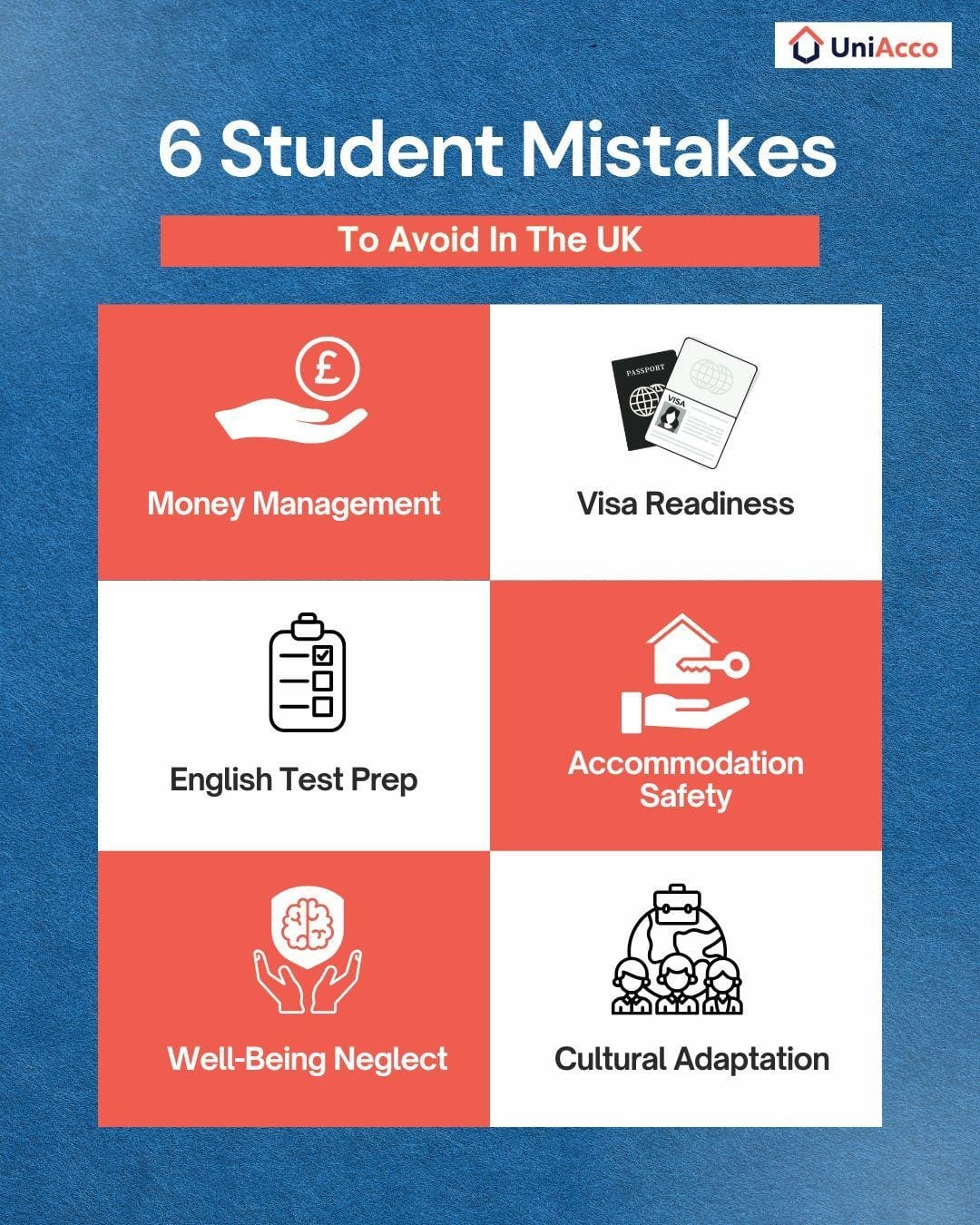
Weak Money Management Before & After Arrival
Making mistakes is human, but when they cost us our dreams, it can sting. Maybe studying in the UK is a big part of your dream, and you achieved that dream by actually going there. Now, as an international student, you should understand that money works differently here. In the UK. 37.6% of students report needing financial support. As a student, you now know you spend your money on rent, travel, groceries, study materials, and stationery items. You wouldn’t want to be among the 11.2% that consider moving back home due to money pressure. So, yeah, don’t make one of those common mistakes students make, of not fully understanding how to manage your monthly expenses.
What Goes Wrong?
- Underestimating UK-Specific Monthly Living Costs
You must have seen your parents discuss running the month. Back then, you must not have thought it was a big deal. But now that you’re finally experiencing it for yourself, you know
rent isn’t the only bill that matters in the UK. Often, it is the small monthly costs that quietly drain your student budget. That’s why it is not considered wise to underestimate your rent expenses , your everyday or recurring expenses such as food, heating, and council tax exemptions.
- Relying solely on education loans without a backup income
Your future depends entirely on how well you prepare for it. You should always come prepared to find some alternate sources of income when you plan your study abroad journey. One of the most common mistakes students make is relying on their educational loans. These loans are only meant to cover your tuition. They are not meant to cover your living expenses. Due to this, sometimes you may be tempted to resort to your emergency fund. One of the common mistakes that students make in such situations is resorting to credit cards, which, in most cases, leads to a debt cycle.
- Poor spending habits during the first three months
We know the feeling of being in a new place and having freedom may lead to impulsive purchases. You may end up spending some money on eating out, maybe on a new pair of jackets or some electronics. This ends up being one of the most common mistakes students make, as this creates an imbalance in the overall monthly budget you calculate for yourself.
- Not tracking expenses
You know what would help you track your monthly expenses? Making an Excel sheet of every little thing you’ve spent your money on. This may seem unnecessary at the moment, but it ends up helping you understand what and where you spent your money on. Eventually saving you from those mid-month shocks when you decide to check your balance.
- Overusing credit cards
A surprising percent of 8.2% of students consider dropping out of their chosen university because they fall into debt cycles. This happens because you end up overusing your credit cards. You don’t realise, but one swipe becomes ten, and interest tends to build up. It’s not a joke to underestimate the repayment timelines of these foreign country transactions.
Practical Ways to Avoid This Mistake
Here’s a simple way to help you stay on track. Checklist to follow:
| Problem | What To Do? |
| Unclear monthly cost expectations | Research actual living costs for the UK city you’re based in; create a realistic pre-arrival budget |
| Loan money is running out too quickly | Combine loans with part-time work, scholarships, or campus assistant roles |
| Overspending in the early months | Limit discretionary spending for the first 90 days to stabilise your routine budget |
| No tracking system | Use budgeting apps like Splitwise, Emma, Monzo Pots, or Wallet to track daily spending |
| Credit card overuse | Prefer debit cards; set monthly spending limits on your card app; avoid BNPL options |
Planning to study in Edinburgh but unsure about finances? Explore verified, affordable student accommodation in Edinburgh on UniAcco and secure a place that fits your budget.
🏡 Browse Edinburgh Student HousingIgnoring Visa and Immigration Rules
Now that you’re actually living your dream of studying here in the UK, don’t fall for the common mistakes students make, which is not taking immigration compliance seriously. As of June 2025, Indian students’ detentions in the UK went up to 108%. This was mainly due to breaches in visa rules. Be on top of your game when it comes to visa and immigration rules. Keep yourself updated with your university’s student office at all times. Ask them to share clear instructions on these rules with you at all times. Also refer to official sources like UKVI.
What Goes Wrong?
- Misreading or Skipping UKVI Updates
The most common mistakes students make are relying solely on outdated articles on the internet or WhatsApp forwards that generally misstate crucial information.
- Missing or Mixing Important Documents
Make sure to keep track of every penny you spend before, during and while you’re studying in the UK. Keep a soft and hard copy of your bank statements, BRP, and CAS records. Create a separate folder on your email, gallery or WhatsApp folder, so you can quickly refer to all of them in case of any emergency.
- Not Updating Personal Details
Let’s say you change your phone number or your address, but forget to inform UKVI. You should know they consider this a non-compliance issue. You will simply fall into trouble for not reporting these minute but crucial pieces of information within the 10-day time frame.
Practical Ways to Avoid This Mistake
| Problem | What To Do? |
| Rule Updates | Check the UKVI website monthly; subscribe to your university’s immigration updates |
| Document Mismanagement | Maintain a dedicated digital and physical immigration folder |
| Work Restrictions | Confirm work hours with employer and university; avoid any work without formal documentation |
| Personal/Academic Changes | Inform UKVI within 10 days and update your university records immediately |
Not Prioritising English Language Preparation
Don’t think you’d be able to get by in the UK without actually being fluent in English. One of the common mistakes students make is not focusing enough on their English language communication skills. A survey done by the British Council has shown that students who are weaker when it comes to speaking and writing in English have struggled both academically and socially. The UK has about 23% of the international student population, so make sure to prep yourself well and prioritise your communication skills if you are studying in the UK. Take a visit to the libraries, pick up video tutorials on YouTube to learn phrases and common slang used in the UK, and watch some old classics on Netflix to improve your language. You cannot be fumbling during your group discussions, in interviews, and even in simple conversations at the supermarket, when in the UK.
What Goes Wrong?
- Underestimating Academic English Requirements
Just knowing enough to get by does not work when it comes to understanding or speaking English. A common mistake students make is thinking their basic understanding of the English language will suffice in their journey abroad. Be aware that university lectures go by quickly, your professors may end up being locals ,and their vocab and use of specific words may go off the top of your head.
- Preparing Late for IELTS/TOEFL/PTE
Start your prep weeks before deadlines. IELTS, TOEFL, and PTE not only measure your language skills, but also understand how to think critically. Waiting until the last minute may lead to you taking repeated attempts, stress, and you may end up missing your university intake timeline entirely.
- Focusing on “Fancy English” Instead of Strong Foundations
Don’t try to learn difficult words, but instead focus on improving your grammar, your sentence structure, your pronunciation and how you say your words with clarity.
- Not Practising Real-World Situations
The best way to improve your English communication skills is by practising them daily. If English is not your first language, try using English in your daily communication. Don’t just say, you even start thinking in English. Create an imaginary situation in your mind and try explaining a situation entirely in English; you will realise how strongly you can communicate clearly without hesitation.
Practical Ways to Avoid This Mistake
| Problem | What To Do? |
| Weak understanding of the importance of academic English | Research UK classroom styles, assignment formats, and feedback expectations; review sample lectures on YouTube |
| Starting preparations too late | Begin 2–3 months early; follow structured study plans from British Council, ETS, or Pearson |
| Relying on vocabulary instead of fundamentals | Strengthen grammar, sentence clarity, and academic writing basics with Cambridge resources and past papers |
| Minimal daily interaction with English | Read news daily, listen to podcasts, watch English content without subtitles, and practise short speaking exercises |
| No real-world speaking practice | Join local speaking clubs, practise with friends, and attempt mock interviews regularly |
Rushing the Accommodation Search Without Proper Research
Nothing makes one more desperate than not having a place to live. Sometimes, that desperation can lead to one of the common mistakes students make. We understand that choosing student accommodation is the most important part of this UK journey. But do you know, 57% of students encounter accommodation fraud in the UK, and we don’t want you to add one more number to it. That’s why rushing the accommodation search without proper research can increase the risk of getting scammed.
What Goes Wrong?
- Beginning the search after the visa arrives
Sometimes we think we will jinx our luck if we start preparing early. But let me clarify: the earlier you start, the better deal you will get. Sometimes, students wait till the last minute to book accommodation because of the visa delay. And then student accommodations in cities like London, Manchester and Edinburgh start filling up fast. Because someone else was faster than you. The UK already has a high demand when it comes to student flats, so preparing before you get a visa is important.
- Relying on unverified listings
Imagine you got the confirmation letter from the university, booked the flight and reached the UK. But, as you reach the location, you don’t find anything. And that’s what happens if you book a student accommodation from an unverified listing.
- Choosing low rent over a safe neighbourhood
We are living in a world where, without money, you can’t even get water, so how can we expect good student accommodation for a few bucks? I understand you want to save money, but that money might cost you your life. Your classes someday might stretch into the evening, and then going back to your low-rent accommodation will become unsafe. That’s why choosing a safe neighbourhood is more important than money.
- Not comparing contract terms
We know reading a contract is overwhelming, because that’s not the English we have grown up speaking and reading. Even Shakespeare writes more easily than these contracts. But that’s how they get you. It’s always good to hire a lawyer or send your lawyer friend a contract before signing. Once you sign this contract, there won’t be any going back, and you might even lose your hundreds of thousands.
- Misjudging commute and transport
The times were simpler when people used to navigate us. But now, maps do that for us. And sometimes it takes us to the place where there is nothing but an abandoned building or a small lake. That’s exactly what happens when we search on Google about commuting, even though the blog you read said it’s just 5 minutes, you don’t believe it. It’s better to be sure, call the university and cross-check with the official websites.
Practical Ways to Avoid This Mistake
| Problem | What To Do? |
| Late accommodation planning | Start shortlisting 5–6 months before arrival, especially for cities like London, Manchester, Birmingham, and Edinburgh |
| Unverified or risky listings | Use trusted sources: university housing portals or verified student accommodation platforms such as UniAcco |
| Confusion about price vs. location | Compare multiple neighbourhoods. Prioritise safety, commute time, and amenities over just the lowest price. |
| Unclear contract terms | Read the full contract; check utility caps, deposit rules, cancellation policies, and extra fees |
| Long commute times | Map the distance to campus using Google Maps. Aim for a maximum of 20–30 minutes commute for a manageable daily routine. |
Want to stay safe from student accommodation scams in the UK? Explore top verified listings on UniAcco and book secure, trusted student housing with confidence.
🔑 Secure Your UK Student StayUnderestimating Mental Health and Work Balance
Staying away from home, friends and your siblings sounds exciting. The thrill of starting a new life in a new country fills us with an adrenaline rush, but as soon as we reach the UK, we start feeling a pang in the heart. Suddenly, we end up calling home 5 times in an hour. On top of that, exam stress, attending lectures every day, and last-minute assignment struggles can mess up our whole schedule. Which is why, according to PCM 1,823 university students in the UK deal with mental struggle. That’s why neglecting your mental health is not a good idea.
What Goes Wrong?
- Ignoring Early Signs of Burnout
Do you ever suddenly feel you don’t want to finish an assignment, the roommate you are living with is annoying, or even though you went to bed early still can’t sleep? These may seem normal, but they are early signs of burnout. And whenever you feel anxiety, insomnia, irritability or emotional detachment, you should step back, take a break and do some self-care to bring your main character energy back.
- Taking on More Work Hours Than You Can Handle
It’s normal to worry about finance especially when you are studying abroad. But letting that anxiety eat you up internally can lead to more working hours than you can handle. This is the most common mistake students make: they let their anxiety take over them and think they can handle everything. Taking up an extra shift is not a solution; instead, you can start by saving money on food or going out unnecessarily.
- Academic Pressure Without a Support System
Not having a guardian with you in a new country can be lonely, especially during exam time. Students may become absent-minded during this time because of the pressure to study well. But the pressure will only make it worse. That’s why staying calm is important.
- Not Using University Support Services
When you are studying abroad, you become more vigilant about how you act or what you do. And because of that, students end up ignoring their mental health. The best universities in the UK support international students by providing counselling centres, wellbeing teams, academic advisors and peer-support programs. These facilities are there for you to use.
Practical Ways to Avoid This Mistake
| Problem | What To Do? |
| Constant stress, low energy, or frequent overwhelm | Build micro-breaks into your day. Take out 5–10 minutes every few hours for stretching, walking, or a quick reset to prevent mental fatigue. |
| Taking on too many work hours | Keep your part-time schedule aligned with your course load. If your semester is intensive, reduce hours temporarily instead of pushing through exhaustion. |
| Feeling isolated or detached | Join societies, attend campus events, or connect with cultural/student groups. Regular interaction reduces homesickness and builds a support network. |
| Skipping university wellbeing resources | Use counselling services, wellbeing check-ins, and academic advisors early for real relief, and not just generic motivation. |
| Difficulty maintaining routine | Set anchor habits, like fixed meal times, a weekly study plan, and digital boundaries (no screens 30 minutes before sleep) to stabilise your day and reduce mental clutter. |
Overlooking Cultural Adaptation and Professional Networking
Each country has their own culture and traditions, ignoring them can create challenges later. Not learning how UK students get jobs or how they submit an assignment can lower your chances of growing internationally. This is the most common mistake students make in the UK. Not learning about their accent, different classroom etiquette, and peer culture can hold you back from bigger opportunities. Which is why students should research before moving to the UK, read blogs and watch videos on their culture and professional networking.
What Goes Wrong?
- Not engaging beyond familiar communities
Everyone loves their comfort, but sometimes great things happen when you come out of that comfort zone. Instead of just hanging out with your community, students should approach everywhere. This can lead to internship opportunities and academic information.
- Hesitation to speak due to accent or confidence issues
All of us have a certain accent, and as an Indian, it becomes even tougher with ongoing stereotypes. But believe us, once they realise Indians don’t talk like how Hollywood shows in movies, their perspective will change, and it will help you with gaining confidence as well. And no smart person would judge anyone for their accent.
- Missing university societies and faculty-led events
Remember how writers from the 19th century used say romanticise your college life? They didn’t ask to find love, but instead to fall in love with college life. Take part in all possible events, student societies, and meet alumni. This will help students build strong professional networks.
- Avoiding cultural experiences due to unfamiliarity
In India, cricket is not a sport; it’s an emotion. Similarly, in the UK, football is their emotions, and avoiding their culture because of your unfamiliarity can become a problem for you. Students start feeling a sense of disconnection from everyday UK life.
Practical Ways to Avoid This Mistake
| Problem | What To Do? |
| Staying within only known communities | Join at least one mixed student society (sports, debate, subject-specific, volunteering). This widens your comfort zone steadily. |
| Hesitating to speak due to accent or fluency concerns | Practise conversational English daily. Talk to classmates, attend speaking clubs, and engage in seminars. |
| Skipping networking opportunities | Attend university mixers, alumni talks, and career fairs. One meaningful conversation can lead to future referrals. |
| Lack of exposure to UK culture | Try local events, like football matches, food markets, theatre, and seasonal festivals, to improve confidence naturally. |
| Not building a balanced network | Connect with locals for cultural understanding and industry insights; maintain international friendships for shared support. |
Use this quick checklist to stay prepared. Here’s exactly what to do (and avoid) as an international student in the UK.
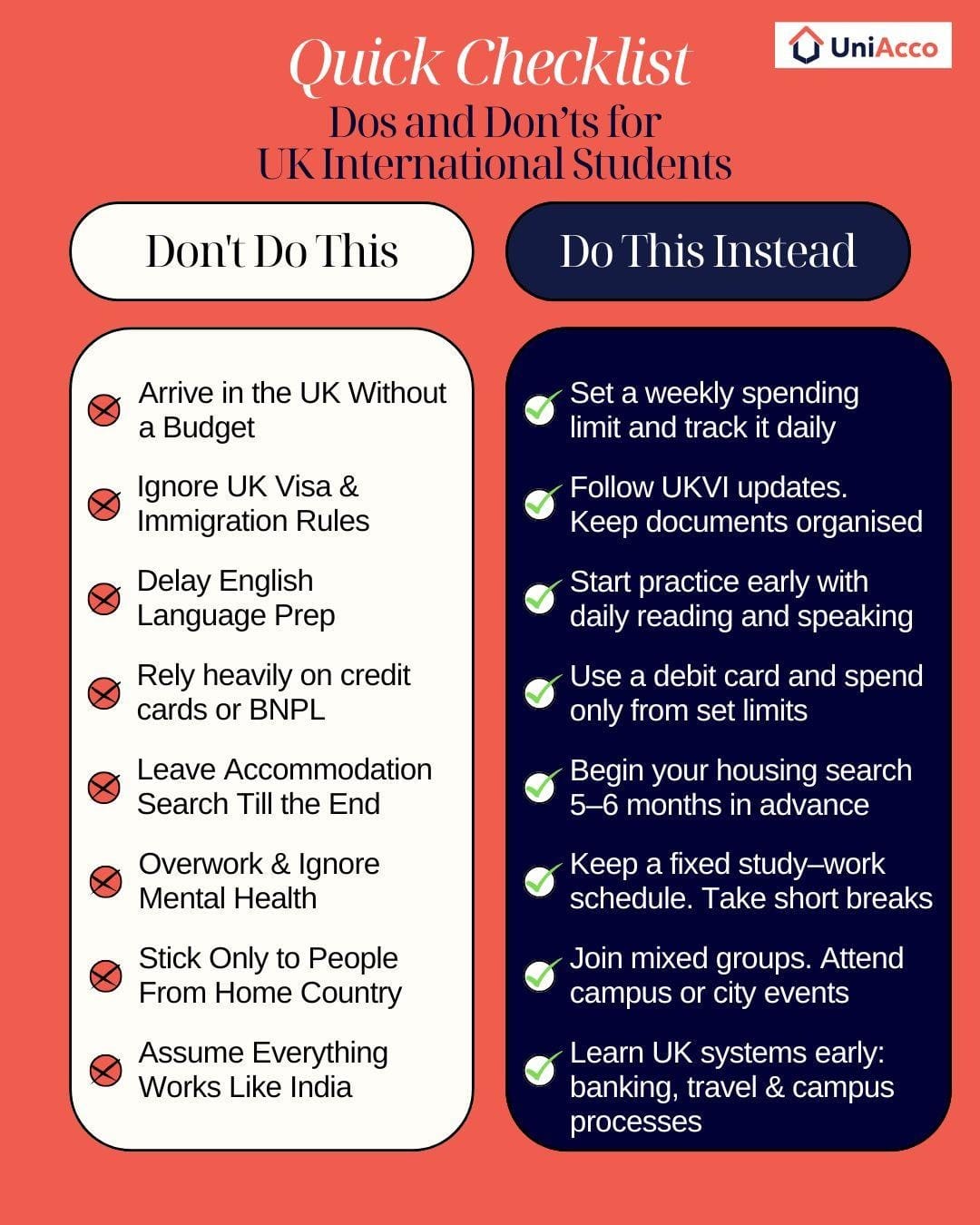
To round off your preparation, listed below are a few more high-impact mistakes students make and quick fixes that actually help.
Other Critical Mistakes Students Overlook
| Commonly Overlooked Mistake | What You Should Do Instead? |
| Delaying GP (doctor) registration | Register with an NHS GP within the first 2–3 weeks to avoid long wait times during emergencies. |
| Ignoring academic referencing rules | Learn your course’s citation style early and use your university’s library workshops to avoid plagiarism warnings. |
| Arriving without a UK bank account plan | Open a student bank account immediately upon arrival to avoid FX charges and simplify rent deposits. |
| Underestimating travel and transport costs | Use travel cards (16–25 Railcard, Oyster Card discounts) and plan monthly passes to reduce commuting expenses. |
| Taking too many part-time shifts | Stick to legal working hours and keep at least two study days free to maintain grades and visa compliance. |
| Missing course registration deadlines | Set calendar reminders and check your student portal weekly to avoid losing modules or paying late fees. |
| Struggling with independent learning expectations | Follow weekly self-study targets.UK universities expect learning beyond lectures, not spoon-feeding. |

Wrapping Up!
To wrap up, you must have realised that the common mistakes students make and don’t realise usually pile up into huge ones by the end. From money slips to rushed accommodation choices, from ignoring visa rules to letting stress pile up, each misstep takes you one step back from the life you’re trying to build in the UK for yourself.
The key here is to be prepared at all times. Be open to how things work in the UK, surely you’ll have a lot more fun and also learn a lot on this journey. You might not always make perfect choices, but picking the right place to live is important from the beginning.UniAcco makes it easy, get personalised student housing options in just 20 seconds!
Got the city figured out? Lock in verified student accommodation in London with top facilities, modern amenities, and 24/7 support so you can focus on what actually matters.
🔑 Explore Student Housing in London

 LinkedIn










0 Comments