

Introduction
If your bank statement just humbled your dreams of studying abroad, you might want to read this before shutting that tab. More than half of students at Ivy League institutions receive some form of financial aid. Governments, universities, charities, and private organisations offer hundreds of thousands of scholarships and funding opportunities to help students study overseas. Yet many aspiring students miss out because they don’t understand the education funding options.
If you’re also confused about whether to apply for a scholarship or a grant, you might want to read. Knowing the difference can save you hours and improve your chances of securing the right option available in financial aid for students. In this blog, we break down scholarships vs. grants, helping you cut through the confusion and choose the funding option that could save you time, effort, and thousands in tuition fees.
What are Grants?
When an organisation offers grant funding, it is money the recipient can use toward a particular project, effort, or endeavour. You aren’t obligated to repay a grant, unlike a loan, which requires repayment of the funds plus interest. Grants are commonly awarded by organisations seeking to achieve specific goals in fields they champion. For instance, a community can fund a local cause, such as creating a playground or planting a tree. Grants aren’t awarded solely on academic and athletic performance, as many scholarships are, and can be used for financial aid to support education and a variety of goals, such as scientific research, the arts, and healthcare initiatives.
What is Scholarship?
The scholarship money is awarded by an institution or individual to cover the costs of supporting someone’s studies and research. Unlike grants, which are tied to achieving an end goal or purpose, scholarships are merit-based awards given to those who have demonstrated great academic achievement, skills, artistic performance, or leadership qualities in their field of study. Certain scholarships are difficult to apply for, highly competitive, and offer only a few spots. Depending on each scholarship’s policy, some scholarships cover not only the student’s tuition but also housing, learning materials, and even travel costs for the student’s research projects.
Types of Scholarships and Grants
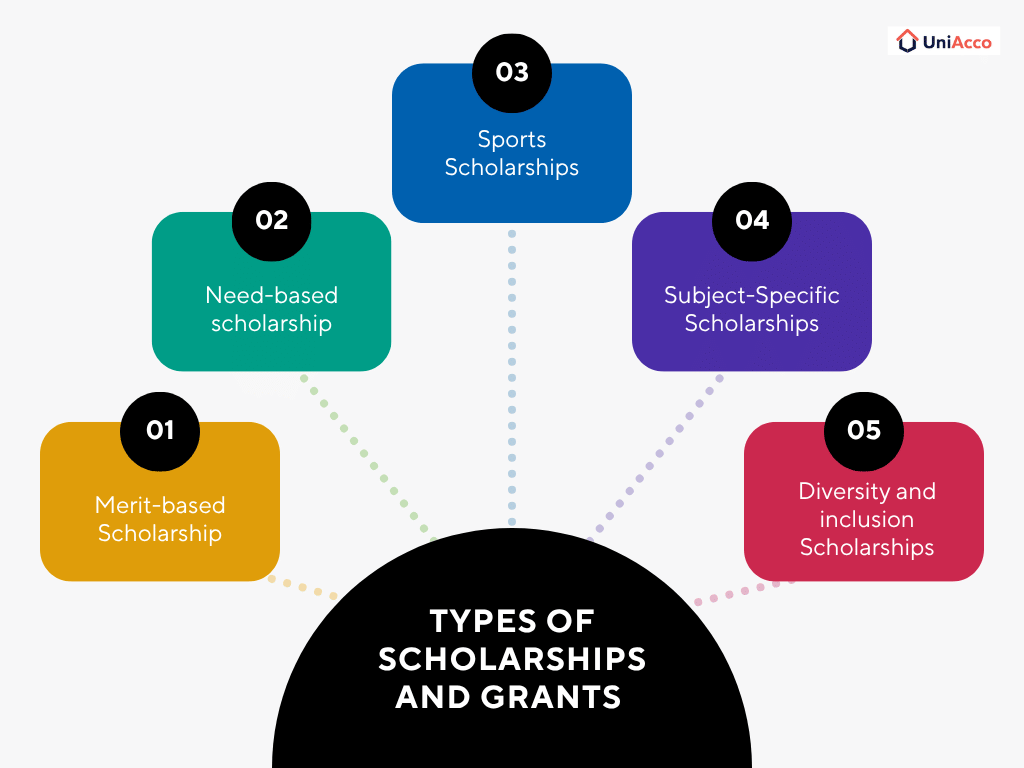
So, you’re probably wondering what types of awards there are out there. You may have a general idea, but all scholarships and grants are not created equal. They all have very different requirements and guidelines.
Here are some of the most common types of scholarships:
Whether you excel in the classroom, have an incredible portfolio in one of the arts, or have the drive to succeed despite financial obstacles, there exists a separate scholarship for you. Fortunately, there’s a scholarship for every type of student based on their profile.
Merit-based Scholarship:
Your achievements can literally fund your education. These scholarships go to students with strong grades, leadership skills, or special accomplishments. If you have done well in school, won awards, or built a strong profile, your efforts could be rewarded here.
Need-based scholarship:
While the fee shoots through the roof, institutions also understand the financial toll it can take on a student, depending on their background. Hence, some universities award financial aid to students on a need-based appeal. The scholarship criteria and award are very profile-specific and case-dependent. They are usually awarded to students who display promise but require financial assistance to continue their studies.
Sports Scholarships:
If you have always loved spending more time on the field than in the library, athletic scholarships might just come to your rescue. Athletic scholarships support students who perform at a high level in sports and can represent their university in competitions while pursuing their degree.
Subject-Specific Scholarships:
These are opportunities open to students interested in pursuing particular courses or fields. These are usually offered based on your performance or interest in the course and can involve subjects, tests in specific fields like science or maths for engineers, or even portfolio submissions for arts and creative students. A number of government bodies, companies, or universities offer these scholarships.
Diversity and inclusion Scholarships:
These scholarships intend to expand access to higher education for students facing financial obstacles. Applications may consider your nationality, ethnicity, gender identity, ability status, immigration status (including refugee status), or whether your family has no prior history of university attendance. Organisations, governments, and universities offer these programs.
Here are five types of education grants you may be eligible to apply for:
Grants are intended to assist students with varying financial, academic, and research support needs. Whether you are seeking assistance with tuition fees, funding for research, or to tide you over a period of monetary difficulty, you could potentially apply for one of the types of educational grants discussed here.
Need-Based Grants:
Most need-based grants are awarded to applicants based on their financial need, not on academic records. If your largest roadblock to higher education has been money alone, you would look for a need-based grant that covers your tuition or daily living expenses while in education. Unlike student loans, need-based grants don’t need to be paid back.
Research Grants:
If your degree involves more than lectures and exams, a research grant can help fund the work behind it. These grants are awarded to students and researchers conducting research in a specific field, most commonly at the postgraduate or doctoral level. They can be used to cover expenses such as fieldwork, laboratory equipment, travel, data collection, or other research-related costs.
Government Grants
These may be issued on a local, state, or country level; they generally cover some or all of your costs of education and grant assistance to students who have met the required criteria for the government-supported course or program. Government grants can be put towards tuition and/or living costs.
Institutional Grants:
Sometimes, the best funding opportunities come directly from your university. Institutional grants are offered by colleges and universities to help students manage the cost of education. While many are awarded based on financial need, others may be granted based on academic performance, leadership, community involvement, or other eligibility criteria set by the institution.
Emergency Grants
For most students, unforeseen costs can affect their ability to complete their degree. An emergency grant is a mechanism for quickly receiving funding to address unforeseen problems, such as medical, familial, and financial issues.
Save on living costs without compromising on comfort. With UniAcco, explore verified and affordable student accommodation abroad featuring fully furnished rooms, all-inclusive bills, and student-friendly amenities. Find your ideal home before you fly and make your study abroad experience stress-free.
🔍 Explore Student Accommodation AbroadDifference Between Grants and Scholarships
It is true that both scholarships and grants help reduce college expenses and generally don’t have to be repaid. However, if you’re wondering what is the difference between a grant and a scholarship, the answer lies in the eligibility criteria, the target, and the manner in which these monies are provided, as reflected in the chart.
| Basis | Scholarship | Grants |
| Purpose | Reward academic excellence, talent, leadership, or other achievements. | Provide financial support based on need, research, or a specific purpose. |
| Academic Level | Commonly available for undergraduate, postgraduate, and professional programmes. | Available across all study levels, with many focused on postgraduate and research students. |
| Funding Coverage | May cover partial or full tuition, accommodation, travel, books, or living expenses. | Can fund tuition, research, living costs, equipment, travel, or emergency financial needs. |
| Focus Area | Merit, talent, sports, leadership, or subject-specific achievements. | Financial need, research, institutional support, or government initiatives. |
| Selection Criteria | Based on academic performance, extracurricular achievements, leadership, or specific eligibility requirements. | Primarily based on financial need, research proposals, or programme-specific eligibility, some also consider merit. |
| Obligations | May require maintaining a minimum GPA, full-time enrolment, or participation in programme activities. | May require research progress reports, project completion, or continued eligibility based on the grant terms. |
| Duration | Can be a one-time award or cover an entire degree programme. | May be awarded as a one-time payment, annually, or for the duration of a project or programme. |
| Flexibility | Often restricted to education-related expenses defined by the provider. | Usually tied to a specific purpose, though some grants allow broader use within approved educational expenses. |
| Examples | Merit scholarships, sports scholarships, subject-specific scholarships, and diversity scholarships. | Need-based grants, research grants, government grants, institutional grants, and emergency grants. |
Who Should Apply for a Scholarship?
Scholarships are a good option for students who have shown strong academics, leadership, talent, or other achievements. Some scholarships also help students with financial need, depending on the program. If you meet the requirements, a scholarship may considerably reduce your education costs.
Undergraduate students:
More than 50% of undergraduates at Ivy League institutions receive some form of financial aid. If you’re planning to pursue a bachelor’s degree, scholarships are one of the best ways to make studying abroad more affordable. Since most scholarship programs are aimed at undergraduate students, you’ll find plenty of opportunities worth applying for.
Students applying for taught master’s programs:
A master’s can cost a pretty hefty amount, but that does not mean you have to break the bank. Students aiming for a taught Master’s can apply for a scholarship. A number of universities and companies provide scholarships for their master’s programs to worthy candidates.
Merit-based or need-based applicants:
Not every student has achieved perfection academically. There are a number of scholarships that consider overall merit, such as leadership potential, accomplishments, extra-curricular achievements, community service, or even finances in some cases. So, the best Scholarship for you is determined by your overall academic background, not just your marks.
Students looking to reduce tuition costs:
If paying for university is your biggest concern, scholarships can produce a considerable change. Depending on the award, they may cover part or all of your tuition fees, and some may similarly contribute towards accommodation, travel, books, or living expenses.
Who Should Apply for Grants?
Grants work well for students who need financial help or are studying research, specialised subjects, or other qualifying areas. Most grants are awarded based on financial need, but some also consider academic achievement, research ability, or personal circumstances.
Undergraduate Students:
Grants aren’t just for researchers or PhD students. Many universities and governments award grants to undergraduate students from their very first year to help cover tuition, books, accommodation, and other study expenses.
Postgraduate Students:
The higher you study, the more funding opportunities tend to open up. Many master’s and doctoral students rely on grants to support their tuition, research, travel, or day-to-day living costs.
International Students:
Many students assume grants are only for domestic applicants, but that’s not always true. Universities, governments, and global organisations offer grants specifically for international students.
Students from Low-Income Backgrounds:
Don’t assume you need perfect grades to receive funding. Many grants are awarded primarily on the basis of financial need, making them among the most available forms of aid.
Research Students and PhD Candidates:
Research-oriented courses generally have separate grants allocated to fund students, which are likely to cover costs such as laboratory equipment, field research, travel to conferences and publication of papers.
Students Confronting Unexpected Financial Hardship:
Lost a family income? Faced a medical emergency? Many universities have hardship grants that students don’t discover until they ask, which don’t need to be repaid.
Students with Exceptional Academic Merit:
If your grades have done the talking for you so far, it may be helpful to note that many universities and research organisations offer grants to students with strong academic records, particularly for those pursuing research or high-impact fields.
Students Pursuing High-Impact Fields:
Planning to study healthcare, engineering, climate science, education, or public policy? These sectors frequently receive dedicated funding because governments and industries want to attract more professionals to these fields.
Students from Underrepresented Communities:
Many funding bodies actively invest in creating more diverse classrooms. If you belong to an underrepresented group, there may be grants specifically created to support your educational journey.
Students Involved in Community Service, Leadership, or Extracurricular Activities:
Many grants consider leadership, volunteer work, and extracurricular activities, especially those focused on social impact and community development.
Students with Disabilities or Additional Support Needs:
Higher education must be accessible to everyone. Many grants help cover assistive technology, learning support, accessibility services, or other additional costs.
Mature and Returning Learners:
Taking a break from education doesn’t mean you’ve missed your chance. Many grants are designed for professionals changing careers, parents returning to study, or anyone who is resuming studies.
Funding sorted? Let UniAcco take care of the next big step. Explore verified and affordable student accommodation abroad with fully furnished rooms, all-inclusive bills, and student-friendly amenities. Book with confidence and start your study abroad journey with the right home.
🔍 Explore Student Accommodation AbroadHow to choose the right option
With many funding options available, it can be hard to decide which to apply for based on your personal aims and situations. The factors below come in handy when you decide to choose which opportunity best fits your academic and financial needs.
Know your academic stage:
Don’t underestimate the importance of your stage of study. While students in undergraduate degrees and taught master’s programs are more likely to receive scholarships than those with research degrees, those with research programs may still have access to a wider range of grants.
Understand your end goal:
Are you primarily hoping to finance your tuition, or do you still want financial support for housing, flights, research, or other expenses? This can help limit your choice.
Check what the funding covers:
Not all scholarships are “fully funded”; they may only cover your course fees, not anything else. For some, it can even provide a stipend and cover your travel, accommodation, and other expenses, including books. Before applying, make sure you know what is offered in this scholarship.
Look at the expectations involved:
The funding you get may also come with other expectations. It can be expected that you achieve certain academic results, submit research reports, and possibly work part-time on extracurricular university projects.
Assess your profile strength:
Instead of applying to a grant or scholarship randomly, consider applying for those opportunities that are ideal for your unique qualifications. Checking student grants eligibility and scholarship criteria beforehand can save you a lot of time. Strong academic results, high financial needs, a solid research background, and a commitment to your community are all characteristics that strengthen your application.
Consider the duration and flexibility:
Check for duration, flexibility, and deferred admission. Scholarships can be a one-off, or they could cover the full extent of your chosen degree. It may be wise to consider deferring an awarded Scholarship or merging multiple Scholarships to fund the entire course.
Think about long-term benefits:
The most noticeable benefit is the cost savings, but beyond this, you might also be eligible for other rewards that could be even more significant. There might be programs available, such as guest lectures, internships, a mentoring system, or an alumni network, to guide you towards career success.
Confused about how and where to find scholarships and grants? Read this Reddit discussion to discover helpful resources, practical advice, and tips shared by students who’ve successfully searched for financial aid.
What ways can I find grants/scholarships? – r/communitycollege
Common Mistakes Students Make
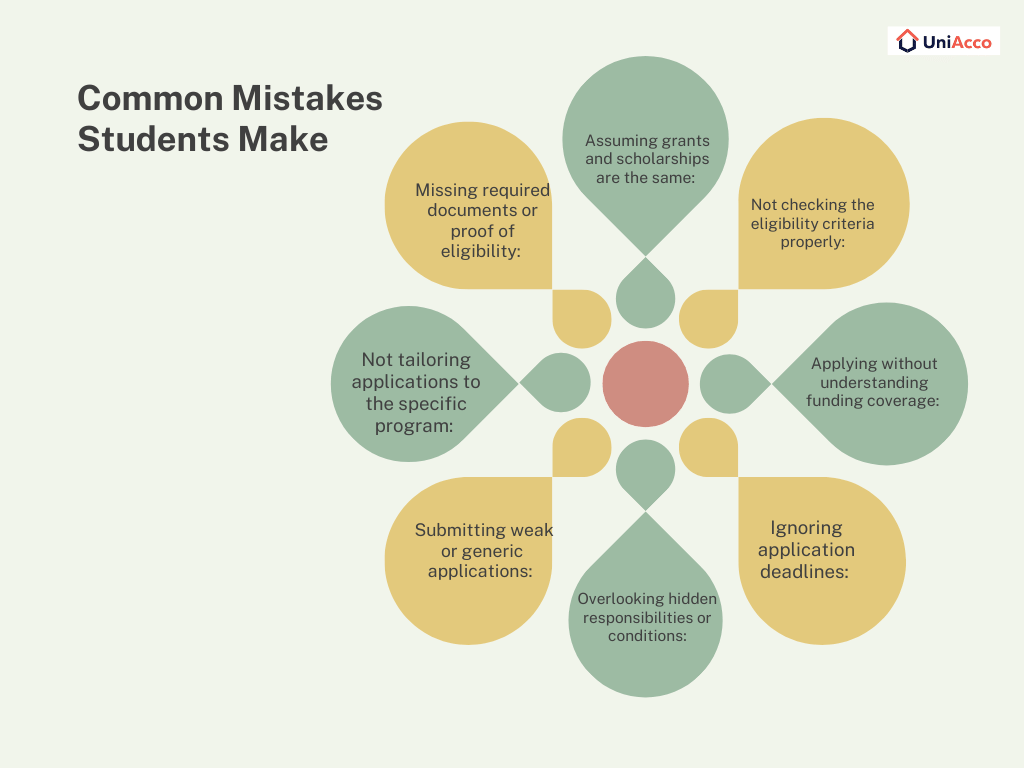
Even top applicants sometimes miss out on funding because of simple mistakes. Applying for the wrong opportunity or failing to meet eligibility requirements can really hurt your chances. If you know about these common pitfalls, you can submit stronger applications and improve your chances of getting financial aid.
Assuming grants and scholarships are the same:
A frequent blunder is treating awards and scholarships interchangeably and applying for an award that isn’t a perfect match. For instance, merit vs need based aid could have an entirely different approach to applications. Not understanding them could waste your time as you apply for opportunities because you’re not pursuing awards that suit your profile.
Not checking the eligibility criteria properly:
It takes you 2 minutes to understand them. By the time you’ve completed the entire application, there could be some very expensive and time-consuming lessons to learn. Saving two minutes at the outset may cost you hours and significant money.
Applying without understanding funding coverage:
Most award funds don’t go into your checking account. Some cover only a student’s tuition; others pay for the student’s room and board, the student’s and roommate’s airfare to school, the student’s insurance, or the student’s living costs. Before the deadline hits, ensure you understand exactly what is covered.
Ignoring application deadlines:
There is nothing more embarrassing and costly than submitting a brilliant application one day past the deadline. Since funding is competitive, most scholarships and grants have strict application deadlines. Very few offer extensions, and if they do, extensions are typically a week or two at the most.
Overlooking hidden responsibilities or conditions:
Even scholarship and grant funding can come with strings attached. With many student awards come strings of conditions or obligations. A student may have to maintain a certain GPA throughout the school year, attend school full-time, or write a report every semester about their academic or career progress in the field.
Submitting weak or generic applications:
According to college career counsellors, one of the most frustrating problems they see is when a student submits what might feel like a great application, but, to a selection committee, is no better than 10 or even 100 other applicants. Please avoid cookie-cutter personal statement templates and focus more on storytelling as you write your application.
Not tailoring applications to the specific program:
One of the mistakes students make, of course, is that they write one personal essay or one essay about themselves, or one statement of intent for every grant and loan, and these vary, not just on subject matter but on the perspective of the sponsor, the program’s values, and the target recipient. Researching the organisation that awards the prize allows the student to customize his/her essays to reflect those values. It can make their applications seem much better tailored to the award sponsor’s needs.
Missing required documents or proof of eligibility:
For any and all college financial aid, whether scholarships, grants, or loans, having and submitting all essential documents and eligibility proof, such as academic transcripts, proof of income, proof of enrollment, recommendations, etc., can make or break a successful application. Not submitting a document and submitting just about everything else can result in a ‘denial’ or being put at the end of the application line. While a scholarship gets you there, UniAcco helps you live there affordably. Find budget-friendly student accommodations abroad through UniAcco.
Conclusion
Scholarships and grants are great ways for students to get financial help, since they usually do not have to be paid back like student loans. Loans can help pay for school, but they often accrue interest and may lead to long-term debt after graduation. Scholarships are often awarded for good grades, talent, leadership, or meeting certain requirements. Grants are usually based on financial need. Each year, many scholarships and grants go unclaimed because students either do not know about them or do not apply. If you spend some time looking for these opportunities and sending in applications, you can lower your education costs and worry less about debt, so you can focus on your studies and future career.












0 Comments