

Introduction
There is always that one person in every group chat that shares their LinkedIn job post at 1 am with the caption “manifesting this.” Chances are, you are that person: your dissertation halfway through, third cup of coffee lukewarm, trying to figure out if there are any jobs in Britain for you or if you are becoming the cautionary tale of some other person’s career TikTok.
Here’s the catch. The Office for National Statistics recorded a total of 712,000 jobs available throughout the UK in the period between April and June 2026, and Skills England predicts that close to one-quarter of the jobs are difficult to fill simply because the companies cannot find skilled employees. That is precisely what The Most Demanding Jobs in the UK are all about. Here, we will cover everything from the types of jobs they are, their salaries, whether they sponsor visas, and which part of the country they are available.
UK’s Most In-Demand Jobs at a Glance
| Job type | Industry | Average Annual Salary | Demand Level |
| Software Developer | Technology | £30k-£75k+ | Very High |
| AI & Machine Learning Engineer | Technology | £55k-£110k+ | Very High |
| Cybersecurity Specialist | Technology | £40k-£90k+ | Very High |
| Data Scientist | Data & Analytics | £38k-£85k | High |
| IT Business Analyst | Technology | £35k-£65k | High |
| Registered Nurse | Healthcare | £31k-£56k | Very High |
| Care Worker (domestic) | Social Care | £23k-£27k | Very High |
| Civil/Mechanical/Electrical Engineer | Engineering | £30k-£80k | Very High |
| Construction Project Manager | Construction | £45k-£90k | High |
| Secondary School Teacher (STEM) | Education | £34k-£53k | Very High |
Want a reality check on this list? This Reddit thread offers a useful snapshot of what workers on the ground are actually seeing, alongside the official data below.
What kind of jobs do you believe are highly paid in the UK? – r/UKJobs
How We Identified the Most Demanding Jobs in the UK
Imagine two graduates who graduated in the same week. One picked his course because the pictures in the prospectus looked like Hollywood movies. The other graduate ensured he chose a course that was in demand in the labour market. One year down the line, only one of the graduates has a job offer, and it is not the one whose pictures in the prospectus looked good. This is the whole idea of this section – this list is backed by facts and figures, not feelings. All the jobs below have been cross-verified from three main sources.
UK Labour Market Trends
According to the latest ONS data, the UK unemployment rate was 4.9% between March and May 2026. There were around 2.5 unemployed people for every available job, with 712,000 job vacancies between April and June 2026. Although the number of vacancies has fallen, there are still many jobs available.
Skills Shortages
The Skills England Annual Skills Report 2026 says that more than one in four job vacancies are difficult to fill. The biggest skills shortages are in areas such as construction, education and manufacturing. These shortages have continued even after the hiring boom that followed the pandemic.
Government Occupation Lists
The Immigration Salary List replaced the old Shortage Occupation List in April 2024. Since 22 July 2025, most new Skilled Worker visa jobs must be at RQF Level 6 or above, which usually means a degree-level job. Some jobs below this level can still qualify if they are included on the Immigration Salary List or the Temporary Shortage List. The Temporary Shortage List includes a smaller number of jobs at RQF Levels 3–5, such as some construction jobs, but these are only included for a limited period.
Employer Demand
Skills England’s 2026 report shows that employers are still looking for workers in many different industries. Demand is particularly high for certain jobs where employers are finding it difficult to recruit enough people. This data has been used to choose the jobs listed below.
Future job outlook:
Priority occupations in digital, engineering and care are projected to grow by around 24% by 2035, per the Skills England Annual Skills Report 2026, creating close to 1.8 million additional jobs, with construction, digital and technologies, and creative industries seeing the largest increases in raw numbers.
Most Demanding Jobs in the UK (2026-27)
Software Developer
Every bank, retailer and hospital now runs on custom software, whether they call themselves a tech company or not. That makes software development one of the most reliable entry points into the UK job market for graduates, and one of the roles most consistently named among the Most Demanding Jobs in the UK. Recruiters increasingly weigh a real GitHub project or open-source contribution more heavily than a first-class degree, which levels the playing field for self-taught candidates.
| Feature | Details |
| Average Salary | £30,000 to £75,000+ |
| Required Qualifications | Computer Science degree, coding bootcamp, or a strong self-taught portfolio |
| Key Skills | JavaScript, Python or Java, Git, cloud platforms (AWS/Azure), agile delivery |
| Top Hiring Industries | Finance, retail, healthtech, consultancy |
| Career Outlook | Strong and broadening as more sectors digitise |
| Why It’s in Demand | Digital and technology occupations are named a priority in seven of the eight Industrial Strategy sectors, more than any other occupation group. |

AI & Machine Learning Engineer
Not long ago, working in AI was a talking point at networking events. It is now a formally recognised national shortage. Adoption is outrunning the talent pool so quickly that AI jobs UK postings currently carry the sharpest salary premiums of any tech role, and the gap shows no sign of narrowing before 2027.
| Feature | Details |
| Average Salary | £55,000 to £110,000+ |
| Required Qualifications | STEM or Computer Science degree, often a postgraduate qualification; strong mathematics |
| Key Skills | Python, TensorFlow/PyTorch, MLOps, data engineering, responsible AI practice |
| Top Hiring Industries | Technology, financial services, healthcare, defence |
| Career Outlook | Fastest-evolving demand of any professional role |
| Why It’s in Demand | Only 2.2% of UK job postings required AI skills in 2025, yet nearly every large employer is now competing to hire for it at once.[C3] |
Cybersecurity Specialist
Ransomware doesn’t care about the economy, and that alone ensures that cybersecurity jobs in the UK are secure even during times when hiring is slow in other sectors. With certification and a home lab, you can get into the field as well as you could with a degree.
| Feature | Details |
| Average Salary | £40,000 to £90,000+ |
| Required Qualifications | Certifications (CompTIA Security+, CISSP) or a relevant degree |
| Key Skills | Threat detection, penetration testing, incident response, regulatory compliance |
| Top Hiring Industries | Financial services, government, critical infrastructure, retail |
| Career Outlook | Consistently strong, largely recession-proof |
| Why It’s in Demand | New regulation and a rising volume of attacks keep demand steady regardless of wider market conditions. |
Data Scientist
The era of being hired purely for knowing pandas is over. Both data analyst and full data scientist roles now reward people who can explain why the model is telling the business to stop doing the thing it loves. Building the model was never really the hard part.
| Feature | Details |
| Average Salary | £38,000 to £85,000 |
| Required Qualifications | Degree in maths, statistics or computer science |
| Key Skills | Python or R, SQL, machine learning, stakeholder communication |
| Top Hiring Industries | Retail, financial services, technology, healthcare |
| Career Outlook | High, shifting toward interpretation and business impact |
| Why It’s in Demand | Data scientist and analyst roles sit among the ten occupations most commonly flagged as priorities across UK growth sectors. |
IT Business Analyst
This is the ingredient that keeps digital projects from quietly falling apart. Graduates with a business or humanities degree who do not mind picking up SQL often find this one of the smoothest routes into tech, acting as the translator between engineers and the rest of the business.
| Feature | Details |
| Average Salary | £35,000 to £65,000 |
| Required Qualifications | Business, humanities or related degree; SQL and process-mapping skills; BCS certification is a bonus |
| Key Skills | Stakeholder management, requirements gathering, SQL, process design |
| Top Hiring Industries | Banking, insurance, retail, public sector |
| Career Outlook | High and steady as digital transformation continues |
| Why It’s in Demand | IT business analysts, architects and systems designers are named a priority occupation across six of the eight Industrial Strategy sectors. |
Sorted the job? Now sort the room. Landed a role in a UK city? Book verified student accommodation with UniAcco, with bills included and no hidden fees. Find a comfortable place close to work, so your daily commute is one less thing to worry about.
🔍 Find Student Accommodation in the UKRegistered Nurse
Nursing has been in shortage in the UK for longer than almost all the other occupations listed here. One reason for this is that NHS Agenda for Change banding is consistent and does not suddenly change in the middle of one’s career, but the training is rigorous, with about half the program dedicated to clinical placement.
| Feature | Details |
| Average Salary | £31,000 to £56,000+[C4] |
| Required Qualifications | Nursing degree plus registration with the Nursing and Midwifery Council (NMC) |
| Key Skills | Clinical care, triage, communication under pressure, resilience |
| Top Hiring Industries | NHS trusts, private hospitals, home healthcare |
| Career Outlook | Sustained long-term shortage |
| Why It’s in Demand | Health and social care has the largest number of workers in high-demand occupations of any UK industry. |
Care Worker
The demand in this field is massive; however, entry into the field has become more difficult. Since 22 July 2025, new sponsorship of care workers from overseas has been closed; providers can no longer issue entry-clearance visas to bring workers in from abroad. Recruitment is now effectively limited to people already in the UK with the right to work, whatever visa route brought them here. Existing care worker visa holders can continue to extend or switch employers under transitional rules until 22 July 2028.
| Feature | Details |
| Average Salary | £23,000 to £27,000 |
| Required Qualifications | Care Certificate and structured on-the-job training |
| Key Skills | Empathy, patience, basic clinical support, record-keeping |
| Top Hiring Industries | Adult social care, home care agencies, residential care |
| Career Outlook | Very high domestic demand, sponsorship route closed to new overseas hires |
| Why It’s in Demand | Care workers and home carers are projected to be the single fastest-growing occupation group in the UK to 2035. |
Civil/Mechanical/Electrical Engineer
Chartered engineers are one of the most difficult positions to fill in the nation. There is a generation of workers that is retiring at a rate quicker than they are being replaced, and it takes five to seven years to become chartered.
| Feature | Details |
| Average Salary | £30,000 to £80,000 |
| Required Qualifications | Engineering degree; chartership through ICE or IMechE over five to seven years |
| Key Skills | CAD, technical calculation, project delivery, regulatory compliance |
| Top Hiring Industries | Construction, infrastructure, energy, manufacturing |
| Career Outlook | Strong, underpinned by long-term infrastructure investment |
| Why It’s in Demand | Government has committed at least £725 billion to infrastructure over the next decade, creating sustained demand for engineers.[C5] |
Construction Project Manager
The postings for UK construction require someone who can juggle a program, a budget, and a dozen subcontractors all at once. This sector is handling much more complicated projects with fewer experienced middle managers than ever before in the past ten years, and it is precisely this situation that ensures continued salary increases.
| Feature | Details |
| Average Salary | £45,000 to £90,000 |
| Required Qualifications | Construction management degree or equivalent site experience, plus APM or RICS accreditation |
| Key Skills | Budgeting, scheduling, risk management, stakeholder coordination |
| Top Hiring Industries | Construction, housebuilding, infrastructure |
| Career Outlook | High, tied directly to the government’s housebuilding targets |
| Why It’s in Demand | Construction is projected to need more additional workers than any other UK sector over the next decade. |
Secondary School Teacher (STEM)
The shortage of teachers affects the subject areas of mathematics, physics, chemistry, and computing. This is quite obvious because graduates from these subject areas have better employment opportunities elsewhere. This problem has been solved by paying retention payments up to £4,000.
| Feature | Details |
| Average Salary | £34,000 to £53,000 (plus retention bursaries up to £4,000) |
| Required Qualifications | Relevant degree plus a PGCE or other route to Qualified Teacher Status (QTS) |
| Key Skills | Subject expertise, classroom management, curriculum planning, communication |
| Top Hiring Industries | State schools, academies, sixth-form colleges |
| Career Outlook | Sharp, subject-specific shortage set to continue |
| Why It’s in Demand | Skills England names education among the sectors where skills shortages remain most stubborn, alongside construction and manufacturing. |
Skills Employers Are Looking For in 2026-27
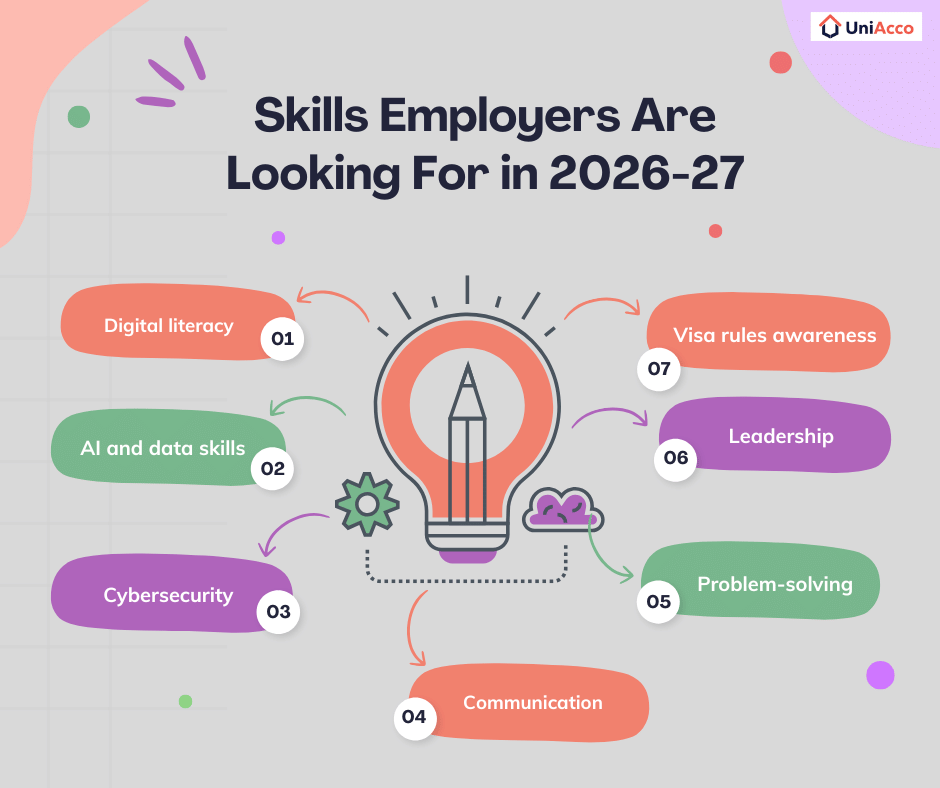
Skills England’s own analysis does not soften the message: the skills system is not keeping pace with technological change. Robert Half’s 2026 UK hiring research backs this up, finding that 67% of employers say specialised skills now directly influence how much they are willing to pay, which is exactly why closing the gap yourself puts you first in line for the roles above.
Digital literacy
Not only tech-related jobs but also the ability to use various kinds of software is no longer required just for tech-oriented positions. It is rather considered an essential technical skill, according to the benchmark provided by Skills England for the AI foundational skills for work.
AI and data skills
UK job postings for specialist AI roles rose 61% in a single year, from 112,000 to 180,000 in 2025, and now make up 2.2% of the entire job market, according to PwC’s 2026 AI Jobs Barometer. Reading, questioning and applying AI-generated output responsibly is fast becoming as fundamental as spreadsheet literacy was a decade ago.
Cybersecurity
Now expected in most industries, not only IT departments, due to increasing compliance standards and attacks faced by organisations.
Communication
Explaining technical work to non-technical stakeholders, in writing and in person, remains one of the most consistently cited gaps employers report. Robert Half’s research places core people skills alongside data and AI capability as the two pillars now shaping pay decisions across sectors.
Problem-solving
Employers are hiring for judgement over routine execution, since routine tasks are exactly what AI tools are absorbing first. PwC’s Jobs Barometer shows demand for advanced human skills such as judgement and creativity rising fastest in the most AI-exposed roles.
Leadership
Even at an early level, employers are beginning to demand that individuals be proactive and lead a project rather than just follow directions.
Project management
Expected much earlier than most students think; commonly around the third year after graduation, as teams become flatter and more responsibility is pushed down.
Adaptability
Employers are recruiting in uncertainty because AI is redefining the job description at a faster pace than any curriculum can cope. The benchmark groups of Skills England are adapting the AI system to understand its risks in the same skill set.
Starting your job search? Get your home base sorted first. Find verified student accommodation in Manchester with UniAcco and explore rooms across other major UK graduate hubs. With your stay taken care of, you can focus on applications, interviews, and landing your next opportunity.
🔍 Explore Student Accommodation in ManchesterFactors to Consider Before Choosing a Career in the UK
Picking a career off a salary table alone is how people end up disappointed eighteen months in. These are the seven factors worth weighing side by side before you commit.
Salary expectations
Do not let a flashy London number distract you. A £45,000 offer in the capital can leave you with less spending money than a £38,000 role in Manchester once rent is cleared, so weigh any offer against the cost of living in the UK, not just the figure on the contract.
Qualification requirements
Some of the most difficult occupations in the UK, such as nursing and chartered engineering, require several years of training and registration before gaining professional qualifications. Some others, such as software development and business analysis in IT, equally value experience gained in a portfolio as they do a university education.
Demand in various regions
A job may be oversaturated in London but critically undersaturated in Manchester or Glasgow. Looking at regional vacancy rates before taking the decision on where to work could be as important as looking into the job itself.
Career prospects
Think about what is beyond your starting salary. Both nursing and engineering have well-defined career prospects and predictable salary growth, whereas tech and consulting have faster career progressions but with less clarity on year-five prospects.
Work-life balance
The shift patterns in nursing and care, the delivery deadlines in construction, and the constant availability expected from tech jobs all involve different types of sacrifice in terms of how you use your free time. It might be worthwhile considering what trade-off you are ready for.
Visa sponsorship opportunities
Before putting all your hopes in a specific company, you can just do one little thing to test their validity: does the company really have a sponsor licence? You may have found yourself an amazing job offer, but there would be no use for that if the company itself cannot support your visa application, so make sure of that before signing it. If you plan on settling down permanently, this article on applying for a PR visa in the UK will help you out.
Future industry growth
A role that is in demand today is not guaranteed to stay that way for a full career. Sectors tied to long-term government investment, such as clean energy, digital infrastructure and healthcare, tend to offer more durable demand than roles more exposed to short-term economic swings.
Ready to step into the UK job market? Find verified student accommodation in the UK with UniAcco and enjoy fully furnished rooms with all utility bills included. With your accommodation sorted, you can focus on acing your exams, building your skills, and preparing for your dream career.
🔍 Explore Student Accommodation in the UKConclusion
Early action pays off when it comes to employment in the UK. Technology, healthcare, engineering, and teaching are industries with the most opportunities available for recruitment, and with stricter sponsor requirements starting July 2025 and the Graduate Route shrinking as of January 2027, now is the time to begin looking.
Target the sweet spot where high demand, solid pay and visa sponsorship meet. AI, cybersecurity, engineering and nursing lead that list right now among the most demanding jobs in the UK.
The graduates who land these roles do not wait for graduation; they read the fine print early and move while everyone else hesitates. Know what the market pays before you walk into any interview.


 LinkedIn










0 Comments