

Every year, nearly 2.5 million Indians pack their dreams into suitcases and move abroad.
Some chase career growth, some seek global exposure, and others simply want a better quality of life. With over 35 million Indians already living overseas, finding the best countries to migrate to from India has never been more relevant. But between the thrill of new beginnings lies the not-so-glamorous reality: visa paperwork, endless approvals, and the anxiety of starting over.
That’s where choosing the right country makes all the difference. The best destinations for migrating promise strong job markets, fair immigration pathways, and a lifestyle worth the leap.
This guide explores the best countries to migrate from India in 2026-27, breaking down visa policies, work opportunities, and what makes each destination truly welcoming.
A Look at Top Migration Destinations for Indians
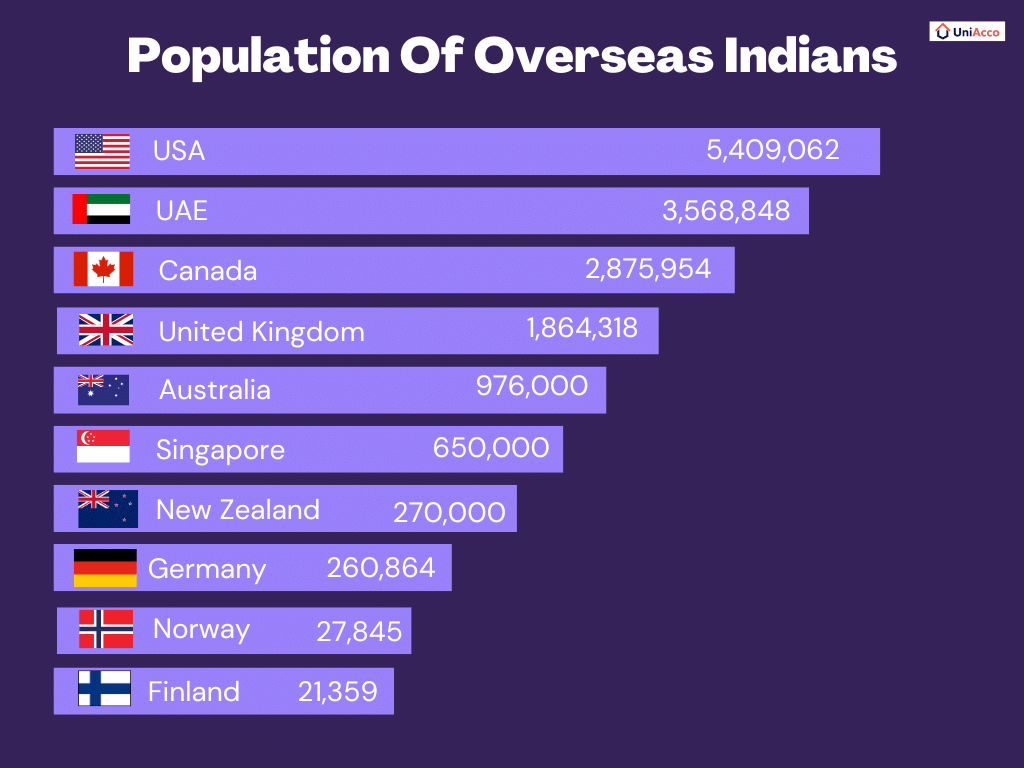
In recent years, a growing number of Indians have chosen to relocate to destinations like Canada, the United States, and several European nations, often driven by limited domestic opportunities and job dissatisfaction at home.
| Country | Indian Population | Key Insights | US News Rank 2024-25* |
| USA | 5,409,062 | Largest Indian diaspora, strong student inflow in STEM, Business, Healthcare. | #3 |
| UAE | 3,568,848 | Major hub for Indian professionals, especially in finance, healthcare, construction. | #17 |
| Canada | 2,875,954 | Fast-growing Indian community; popular for PR pathways and post-study work. | #4 |
| United Kingdom | 1,864,318 | Home to top universities; strong Indo-UK academic ties attract students. | #8 |
| Australia | 976,000 | Rising destination for Indian students; strong graduate employability and lifestyle. | #5 |
| Singapore | 650,000 | Preferred for management, finance, and tech studies with proximity to India. | #14 |
| New Zealand | 270,000 | Popular for students seeking smaller class-sizes and PR-friendly migration. | #9 |
| Germany | 260,864 | Increasing Indian student enrolment due to low/tuition-free education and STEM focus. | #7 |
| Norway | 27,845 | Smaller but growing Indian professional community in engineering and IT. | #11 |
| Finland | 21,359 | Emerging study destination with high-quality education and innovation economy. | #20 |
Also read: List of Top 5 Easiest Countries to Get a Work Visa
How to Choose the Best Country to Migrate from India?
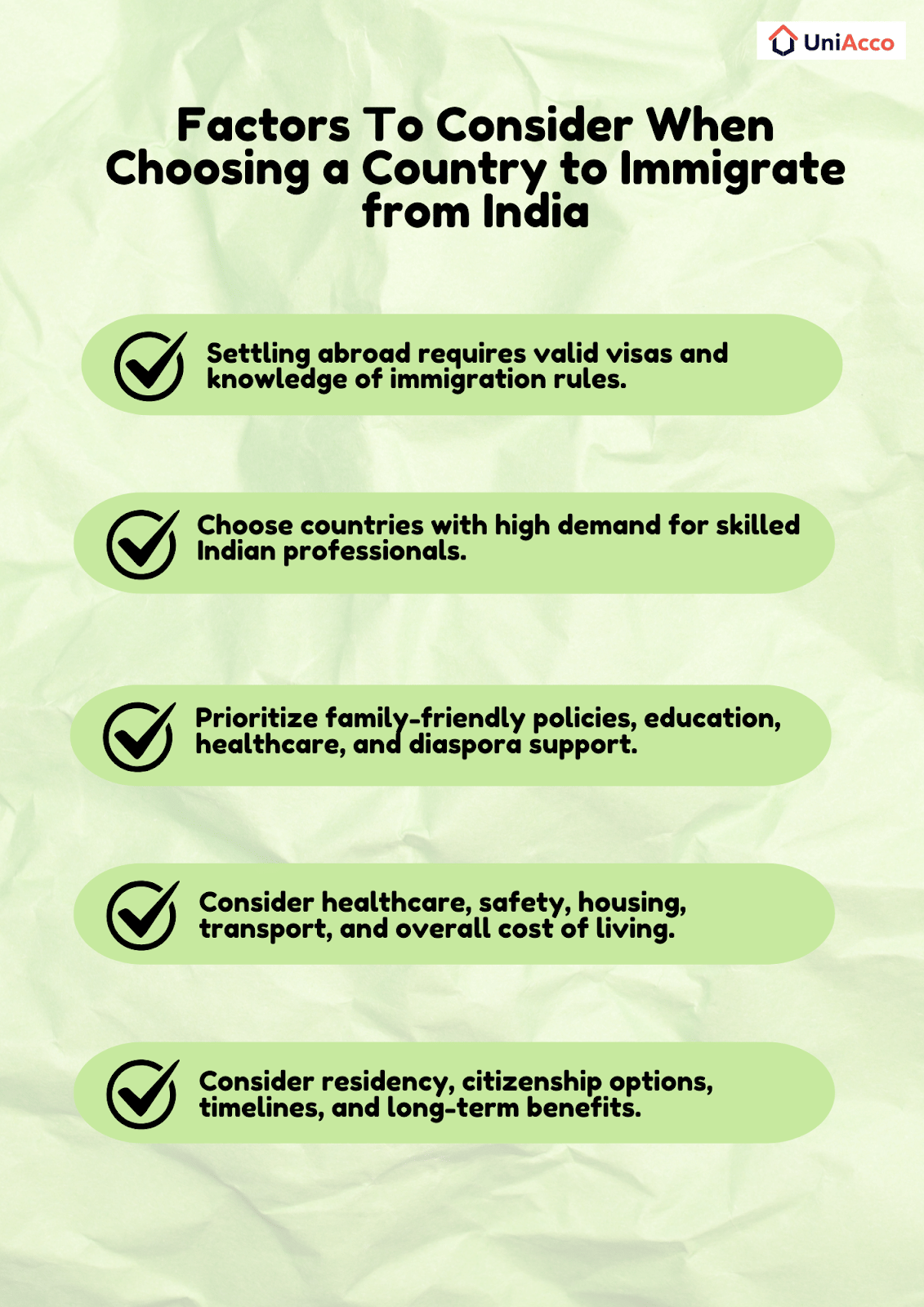
1. Ease of Migration and Visa Accessibility
For most Indian students, studying abroad is the first step toward long-term migration. But every country has its own visa rules, timelines, and post-study work options that shape this journey.
Nations like Canada, Australia, and the UK are among the most immigration-friendly countries for Indian students, thanks to smoother visa processes and student-to-PR pathways. In contrast, others may require multiple renewals before offering residency. Understanding each country’s entry and stay policies early on helps you plan your move strategically, whether through education, skilled work, or investment programs.
2. Job Market and Career Opportunities
A country’s job market often defines how rewarding your migration journey becomes. For Indian students, it’s smart to target destinations that actively seek skilled professionals in fields like tech, engineering, healthcare, and finance. These are the areas where Indian talent already thrives.
Canada, Australia, and Germany offer transparent work visa pathways and recognise Indian qualifications, making the transition from classroom to career smoother.
3. Family Support Systems and Indian Community Presence
For many Indian students, moving abroad is as much about setting up a stable life for their family as it is about personal growth. Look for countries offering dependent visas, family reunification policies, and inclusive public services. Key factors include whether spouses can work, children can access quality education, and healthcare is easily available.
Countries like Canada, Australia, and the UK shine here, with strong Indian communities, multicultural environments, and reliable schooling systems that make settling in easier and more welcoming.
4. Quality of Life and Everyday Living Standards
Sustainable migration is about living well day-to-day. Consider healthcare access, cost of living, housing, transport, and safety. Canada and Australia offer high living standards with universal healthcare, while Germany combines affordable education with efficient public services.
For Indian students, English-speaking countries often make social and professional integration easier. Always weigh local expenses, like rent, groceries, and utilities, against average wages, since a higher salary doesn’t always translate into more savings.
5. Permanent Residency and Citizenship Pathways
Long-term prospects are as important as your first step abroad. Countries like Canada and Australia let skilled migrants apply for permanent residency within a few years, unlocking healthcare, education, and social security benefits. The UK typically requires a five-year wait for indefinite leave to remain, while the U.S. has longer naturalisation timelines.
Some European nations, like Portugal, offer faster pathways through residency-by-investment or long-term stay programs. Knowing these timelines and rules helps Indian students plan for stability, career growth, and a sense of belonging overseas.
Also Read: The World’s Top 10 Countries With The Most Immigrants
Top 10 Best Countries to Migrate from India with Easy Immigration
| Country | Popular Visa Types | Average Living Costs (Monthly) | Permanent Residency Pathway |
| United Kingdom | Student Visa, Graduate Visa, Skilled Worker Visa, ILR | £1,000–2,500 | Study → Graduate/Skilled Worker Visa → Indefinite Leave to Remain |
| New Zealand | Student Visa, Post-Study Work Visa, Skilled Migrant Category | NZD 1,200–2,800 | Study → Post-Study Work → Skilled Migrant PR |
| Singapore | Student Pass, Employment Pass, S Pass, EntrePass | SGD 1,200–3,000 | Study → Employment Pass → PR via Professional/Economic Contribution |
| Norway | Student Residence Permit, Skilled Worker Visa, Seasonal Work Permit | NOK 10,000–15,000 | Study → Work Experience → PR after 3 years |
| United Arab Emirates | Student Visa, Employment Visa, Freelancer Permit, Golden Visa | AED 3,500–6,000 | Study → Employment → Golden Visa / Long-term Residency |
| Australia | Student Visa, Temporary Graduate Visa, Skilled Migration PR | AUD 1,200–3,000 | Study → Temporary Graduate Visa → Skilled Migration / State Nomination |
| Canada | Student Permit, Work Permit, PR (Express Entry, PNP) | CAD 1,000–2,800 | Study → PGWP → Canadian Experience Class / PNP |
| United States | F-1 Student Visa, H-1B, OPT, Employment-based Green Card | USD 1,000–4,000 | Study → OPT → H-1B → Employment-based Green Card |
| Germany | Student Visa, EU Blue Card, Job Seeker Visa | €900–1,200 | Study → Blue Card → Long-term Residence |
| Finland | Student Residence Permit, Work Permit, Startup Permit | €900–1,500 | Study → Work Permit → PR after 4 years |
Read an Indian migrant’s story to discover which country is easiest to move to
As an Indian, which country would be the easiest? – r/immigration from r/immigration
United Kingdom
The United Kingdom continues to attract Indian students and professionals with its unmatched academic standards, global career exposure, and cultural vibrancy. As one of the most student-friendly migration countries, it welcomed over 33,000 Indian students in 2024 through Tier-4 visas, reaffirming India’s strong presence in UK universities.
While recent updates to post-study work and settlement policies call for closer attention, the UK stands tall as the best country to migrate to from India Indians seeking a world-class education and international career growth.
Immigration Process
| Visa Type | Eligibility | Key Benefits | Processing Time |
| Student Visa (Tier 4) | Offer from a recognised UK institution, proof of funds, health & character requirements | Allows part-time work (20 hrs/week) and full-time during holidays | 3–6 weeks |
| Graduate Visa | Completion of a UK degree | Stay & work full-time for 2 years post-graduation | 2–3 months |
| Skilled Worker Visa | Job offer from licensed sponsor, English proficiency, salary threshold | Long-term employment leading to ILR eligibility | 2–4 months |
| Indefinite Leave to Remain (ILR) | 5 years of eligible residence and work, clean record | Permanent residency with access to full rights | Several months |
Also Read: Breaking Down UK PR Visa Requirements Step-by-Step
Language Requirements
English is the primary language for study and work. Most programs require IELTS, TOEFL, or equivalent tests. Universities also offer foundation courses or language support to help international students meet requirements and adjust academically.
Job Market and Career Opportunities
- High-Demand Sectors: Significant opportunities in IT & digital tech, healthcare, finance, engineering, and creative industries.
- Student Work Rights: International students on a Student visa can work up to 20 hours per week during term and full-time during holidays.
- Post-Graduation Work: The Graduate Route allows full-time work or job-hunting for two years post-graduation, aiding eligibility for a Skilled Worker visa and eventual Indefinite Leave to Remain (ILR).
- Upcoming Changes: From 2027, the post-study work period may be reduced to 18 months, per the UK government’s indications.
Cost and Quality of Life
Living costs in the UK vary widely: students outside London typically budget around £1,000–1,500 per month, while those in London may spend between £1,500–2,500, depending on accommodation type and lifestyle. The UK provides a safe environment, extensive public transport networks, and vibrant student life with strong Indian communities in cities such as Manchester, Birmingham and London. The clear study-to-work routes, global education brands and cultural diversity remain major draws for Indian students.
Discover verified, fully-furnished student accommodations near universities across the UK. Comfort, safety, and convenience — all in one click with UniAcco.
🔍 Explore Housing OptionsNew Zealand
New Zealand has become one of the most sought-after destinations for Indian students who want a world-class education in a peaceful, scenic, and inclusive environment. Known for its transparent immigration system, post-study work opportunities, and strong career prospects, the country provides an excellent balance between academic life and lifestyle.
Immigration Process
| Visa Type | Eligibility | Key Benefits | Processing Time |
| Student Visa | Offer from a recognised NZ institution, proof of funds, health & character clearance | Study full-time and work up to 20 hrs/week during term | 2–4 weeks |
| Post-Study Work Visa | Completion of an eligible NZ qualification | Work full-time for up to 3 years after graduation | 1–3 months |
| Skilled Migrant Category | Skilled work experience, qualifications, English proficiency, age criteria | Pathway to permanent residency and long-term stay | Several months |
| Permanent Residency (PR) | Sufficient points under Skilled Migrant Category or employer sponsorship | Live, work, and study indefinitely in New Zealand | Several months |
Language Requirements
English is the primary language for education and work. Proof of proficiency through IELTS, TOEFL, or equivalent tests is required, and many institutions offer support programs to help international students improve their English skills.
Job Market and Career Opportunities
- High-Demand Sectors: Strong opportunities in healthcare, IT, engineering, construction, agriculture, and trades.
- Student Work Rights: Students can work up to 20 hours per week during term and full-time during holidays.
- Post-Study Work: The Post-Study Work Visa allows graduates to stay for up to 3 years, depending on their qualifications and region, and to gain local experience.
- Skilled Migration Priority: In-demand professions such as software engineering, nursing, agricultural management, and electrical trades appear on the Green List, boosting eligibility for permanent residency through the Skilled Migrant Category.
Cost and Quality of Life
The cost of living in NZ ranges from NZD 1,200-1,800 per month in smaller cities and NZD 1,800-2,800 in Auckland or Wellington. The country offers a safe environment, reliable transport, excellent healthcare, and a relaxed lifestyle. Easy study-to-work pathways and a welcoming international community make New Zealand stand out as one of the best countries to migrate for Indians.
Singapore
Singapore has fast become one of the most immigration-friendly countries for Indian students, offering global education standards without straying far from home. With a strong economy, innovation-led industries, and world-ranked universities, it strikes the perfect balance between learning and opportunity.
In 2024 alone, over 14,500 Indian students chose Singapore for its academic rigour, cultural comfort, and student-friendly migration policies. Its proximity, safety, and growing Indian diaspora make it a smart, future-ready choice for students and professionals alike.
Immigration Process
| Visa Type | Eligibility | Key Benefits | Processing Time |
| Student Pass | Offer from a recognised Singaporean institution, proof of funds, health clearance | Study full-time and work up to 16 hrs/week during semester | 2–4 weeks |
| Employment Pass | Degree holders with job offer meeting salary criteria | Work full-time, gain professional experience in Singapore | 1–3 months |
| S Pass | Mid-skilled professionals with job offer and minimum salary | Work in Singapore with employer sponsorship | 1–3 months |
| EntrePass | Entrepreneurs with innovative business proposals | Start and operate a business in Singapore | 1–3 months |
| Permanent Residency (PR) | Professionals, technical experts, or investors with work experience | Live, work, and study indefinitely in Singapore | Several months |
Language Requirements
English is the main language for education and work in Singapore. Most programs require proof of English proficiency through IELTS, TOEFL, or equivalent tests, while many institutions offer preparatory or bridging courses to support international students.
Job Market and Career Opportunities
- High-Demand Sectors: Finance, technology, logistics, engineering, and biomedical sciences dominate Singapore’s job market.
- Student Work Rights: Students on a valid Student Pass can work up to 16 hours per week during the semester and full-time during holidays.
- Post-Graduation Work: Graduates can transition to full-time roles via the Graduate Employment Scheme or through university career services.
- Skill Alignment: Promising fields include fintech, data analytics, and healthcare, offering strong regional and global career prospects.
- Work Pass Options: Graduates can apply for an Employment Pass or an S Pass to gain valuable local experience.
Cost and Quality of Life
Average monthly living costs range from SGD 1,200-2,000 for students in smaller cities or shared housing and SGD 2,000-3,000 in central areas. Singapore offers a safe environment, excellent public transport, world-class healthcare, and a vibrant student lifestyle. Its strong job market, clear visa processes, and international exposure make it an appealing destination for Indian students.
Also Read: Study Abroad Consultancies For Dubai/Singapore
Norway
Norway is quietly becoming one of the most student-friendly migration countries for Indians who dream of a balanced, purposeful life. With its world-class education, progressive work culture, and deep commitment to equality, it offers more than just academic growth — it offers a sense of belonging and is one of the best countries to migrate for Indians.
In 2024, over 2,300 Indian students chose Norway for its quality education, sustainability focus, and strong sense of community. For those drawn to Indian diaspora-friendly countries that prioritise well-being over rush, Norway feels like a calm, promising new chapter.
Immigration Process
| Visa Type | Eligibility | Key Benefits | Processing Time |
| Student Residence Permit | Offer from a recognised Norwegian institution, proof of funds, health clearance | Study full-time and work part-time (up to 20 hrs/week) | 2–4 weeks |
| Skilled Worker Visa | Job offer in Norway meeting skill and salary criteria | Full-time work, pathway to permanent residency | 1–3 months |
| Seasonal Worker Permit | Employment in seasonal industries such as tourism or agriculture | Temporary work with legal status in Norway | 1–3 months |
| Permanent Residency (PR) | 3 years of residence and work under eligible visas, language proficiency, integration | Live, work, and settle permanently in Norway | Several months |
Language Requirements
Norwegian is the official language, but most higher education programs are offered in English. Proof of English proficiency through IELTS, TOEFL, or equivalent tests is generally required, and some institutions offer Norwegian language courses to help students integrate.
While English is widely spoken, learning basic Norwegian is strongly encouraged, especially for those planning long-term settlement or employment in local sectors like healthcare or public service. Many universities, such as the University of Oslo and Norwegian University of Science and Technology (NTNU), offer free or low-cost Norwegian language courses to help students integrate socially and professionally.
Job Market and Career Opportunities
- High-Demand Sectors: Engineering, renewable energy, IT, maritime technology, and healthcare.
- Sustainability Focus: Strong investments in green energy and environmental sciences create emerging opportunities.
- Student Work Rights: International students can work up to 20 hours per week during studies and full-time during holidays.
- Post-Graduation Work: Many transition to full-time roles through the Skilled Worker Visa.
- Salary & Benefits: Average annual wages for skilled professionals range NOK 600,000–700,000, with high taxes supporting extensive welfare services.
- Networking Advantage: Internships and university partnerships are key, as employers often value local experience and connections.
Cost and Quality of Life
Living costs range from NOK 10,000-15,000 per month, depending on city and lifestyle. Norway offers a safe environment, excellent healthcare, reliable transport, and a high standard of living. Transparent visa processes, a strong focus on work-life balance, and quality education make it an attractive option for Indian students and professionals.
United Arab Emirates (UAE)
The United Arab Emirates (UAE) has become a prominent destination for Indian students and professionals seeking a combination of career growth, modern lifestyle, and tax-free income.
As one of the most Indian diaspora friendly countries, the UAE is home to over 3.5 million Indians as of 2024, hosting the largest Indian community outside India. Known for its cosmopolitan cities, world-class infrastructure, and strategic location in the Middle East, the UAE offers opportunities in education, business, and innovation-driven sectors.
Immigration Process
| Visa Type | Eligibility | Key Benefits | Processing Time |
| Student Visa | Admission to recognised UAE institution, proof of funds, health requirements | Full-time study, part-time work allowed | 2–4 weeks |
| Employment Visa | Job offer from UAE employer, relevant qualifications | Full-time employment, pathway to Golden Visa | 1–2 months |
| Freelancer Permit | Proof of skills/portfolio, freelance eligibility | Independent work, residence in UAE | 1–2 months |
| Golden Visa (Long-term Residency) | Skilled professional, investor, or outstanding talent | 5–10 years residency, family sponsorship, multiple renewals | Several months |
Language Requirements
English is widely used in education and the workplace. Most universities require proof of English proficiency through IELTS, TOEFL, or an equivalent test. Knowledge of Arabic is not mandatory, but can be advantageous for daily life and professional networking.
Job Market and Career Opportunities
- High-Demand Sectors: IT, finance, healthcare, tourism, logistics, and engineering.
- Student Work Rights: Part-time work allowed during studies.
- Post-Graduation Opportunities: Full-time employment enables practical experience and eligibility for long-term residency programs.
- Career Advantages: Dubai and Abu Dhabi offer multinational exposure, free zones, and innovation hubs. Networking, certifications, and experience boost prospects for Golden Visa or long-term residency.
Cost and Quality of Life
Average monthly living costs range from AED 3,500-6,000, depending on the city and lifestyle. The UAE offers a safe environment, modern infrastructure, excellent healthcare, and a cosmopolitan lifestyle. Its tax-free salaries, strong job opportunities, and diverse international community make it an attractive destination for Indian students and professionals.
The UAE’s tax-free income, modern lifestyle, and robust expat community make it one of the best countries to migrate for Indians seeking global exposure. However, it offers residency stability rather than citizenship.
Also Read: Which Are The Countries For Immigration For Students?
Australia
Australia remains one of the most immigration friendly countries for Indians, known for its thriving job market, quality education, and multicultural energy. With over 115,000 Indian students enrolled in 2024, it’s clear that the country continues to attract young talent seeking both academic excellence and global exposure, being one of the best place to migrate for Indian students.
Australia’s streamlined visa system and strong skilled migration programs make it an ideal choice for those aiming to study, work, and eventually settle abroad.
Immigration Process
| Visa Type | Purpose | Eligibility | Processing Time | Validity / Extension |
| Student Visa (Subclass 500) | To study full-time at a recognised Australian institution | Confirmation of Enrolment (CoE), proof of funds (~AUD 24,505/year), OSHC health cover, English proficiency (IELTS/TOEFL) | 4–6 weeks | Duration of course + additional stay (up to 2 months) |
| Temporary Graduate Visa (Subclass 485) | To work after completing studies in Australia | Recent graduate from an Australian institution, age under 50, valid health insurance, English proficiency | 1–3 months | 2–4 years depending on qualification level |
| Skilled Independent Visa (Subclass 189) | Permanent residency through points-based system | Skilled occupation on MLTSSL, minimum 65 points, skills assessment, English test | 6–9 months | PR (Permanent) |
| Skilled Nominated Visa (Subclass 190) | PR via state/territory nomination | Occupation in demand in nominating state, points test, English proficiency | 6–9 months | PR (Permanent) |
| Employer-Sponsored Visa (Subclass 186 / 482) | Work in Australia under employer sponsorship | Valid job offer from approved employer, relevant skills & English level | 2–6 months | 2–4 years; can lead to PR |
Language Requirements
English is the primary language for study and work. Universities require proof of proficiency through IELTS, TOEFL, or equivalent tests. Many institutions also offer English pathway programs to help students meet language requirements and integrate smoothly.
Job Market and Career Opportunities
- High-Demand Sectors: Australia offers strong opportunities in healthcare, IT, engineering, finance, and skilled trades.
- Student Work Rights: International students on a Subclass 500 visa can work up to 48 hours per fortnight during academic sessions and full-time during breaks.
- Post-Graduation Work: The Temporary Graduate visa (Subclass 485) allows full work rights after graduation, helping gain local experience and improving eligibility for permanent residency.
Also Read: Part Time Jobs For Indian Students In Australia
Cost and Quality of Life
Average monthly living costs range from AUD 1,200-2,000 in smaller cities and AUD 2,000-3,000 in Sydney or Melbourne. Australia offers a safe environment, excellent healthcare, efficient transport, and an active student lifestyle. Transparent visa processes, work opportunities, and a supportive international community make it an attractive choice among the best countries to migrate for Indians.
Discover verified, fully-furnished student accommodations near universities across Australia. Comfort, safety, and convenience — all in one click with UniAcco.
🔍 Explore Housing OptionsCanada
Among the best countries to migrate for Indians, Canada stands out for its blend of opportunity, inclusivity, and stability. Its immigration-friendly policies, world-class universities, and thriving Indian diaspora make it one of the most student-friendly migration countries in the world.
In the first half of 2025 alone, Canada approved over 31,500 study permits. This is a testament to its global appeal, even as approval rates become more selective. For Indian students and young professionals seeking quality education, strong career prospects, and an easy cultural transition, Canada remains a clear frontrunner among countries with easy migration for Indians.
Immigration Process
| Visa Type | Purpose | Eligibility | Processing Time | Validity / Extension |
| Study Permit | To study at a Designated Learning Institution (DLI) | Letter of acceptance, proof of funds (~CAD 20,635/year), medical & police clearance | 4–7 weeks | Duration of study + 90 days |
| Post-Graduation Work Permit (PGWP) | To gain work experience after graduation | Completed program at eligible DLI, full-time study for at least 8 months | 2–4 months | 8 months to 3 years (based on course length) |
| Work Permit (Employer-Specific / Open) | To work in Canada legally | Valid job offer or open permit eligibility (e.g., spouse of student/worker) | 2–4 months | Based on employment contract |
| Express Entry (Permanent Residency) | Skilled immigration through points-based system | Skilled work experience, IELTS/CELPIP, ECA, CRS score ~470+ | ~6 months (after ITA) | PR (Permanent) |
| Provincial Nominee Program (PNP) | PR via specific province | Job offer or connection to province, skill match to demand list | 6–12 months | PR (Permanent) |
Also Read: Difference Between Canada SDS And Non-SDS Visa Applications
Language Requirements
English and French are Canada’s official languages. Most programs require English proficiency through IELTS or TOEFL, and many provinces and institutions offer language support and pathway courses. For work and PR, higher language scores improve eligibility and CRS points.
Job Market and Career Opportunities
- Strong Sectors: Canada has high demand in technology, healthcare (nursing & allied health), engineering, finance, and skilled trades.
- Student Work Rights: International students can work up to 24 hours/week during term and full-time during scheduled breaks.
- Post-Graduation Advantage: Gaining full-time Canadian work experience through a PGWP boosts your profile for permanent residency applications.
Cost and Quality of Life
Average student living costs in Canada range from CAD 1,000-1,800 in smaller cities and CAD 1,800-2,800 in Toronto or Vancouver. Canada is safe, has reliable public transport, and offers a vibrant student lifestyle. Transparent immigration processes, a large Indian community, and easy pathways from study to work make it a top choice for Indian students.
Also Read: Cost of Living in Quebec For Students
United States of America
The United States remains one of the most student-friendly migration countries, attracting ambitious Indian students and professionals alike. Its globally ranked universities, thriving innovation hubs, and diverse career avenues in tech, healthcare, finance, and engineering make it a land of opportunity.
In 2024, over 225,000 Indian students studied across U.S. institutions, which is the highest number ever recorded. While immigration pathways can be intricate, the U.S. continues to stand out among Indian diaspora-friendly countries, offering a rewarding journey from education to meaningful, long-term career growth.
Immigration Process
| Visa Type | Eligibility | Key Benefits | Processing Time |
| F-1 Student Visa | Admission to SEVP-certified institution, proof of funds, health clearance | Full-time study, on-campus work (up to 20 hrs/week) | 3–6 weeks |
| Optional Practical Training (OPT) | F-1 students after graduation | Work full-time in field of study, gain U.S. experience | Several weeks–months |
| H-1B Work Visa | Job offer from U.S. employer, relevant qualifications | Full-time professional work, pathway to Green Card | Several months |
| Employment-Based Green Card | Eligibility via work, family sponsorship, or Diversity Visa | Permanent residency, live and work indefinitely | Years (depends on category) |
Update on the H‑1B work visa (United States)
A major change was introduced by the United States Citizenship and Immigration Services (USCIS) via a proclamation effective from September 21, 2025: employers filing new H-1B petitions on behalf of beneficiaries outside the U.S. without a valid H-1B visa will now be required to pay a one-time fee of US $100,000.
Key clarifications include:
- The hefty fee applies only to new petitions filed on or after the effective date and for beneficiaries “outside the United States” who do not already hold a valid H-1B.
- Current H-1B visa-holders in the U.S., extensions of stay, changes of status, or petitions filed prior to the effective date are exempt from the fee.
- Industry estimates indicate this fee could reduce new H-1B authorisations by ~5,500 per month, disproportionately affecting Indian-origin tech professionals.
This means for Indian students or professionals planning to transition from a student visa (e.g., F-1) to H-1B via a petition filed within the U.S., the fee does not apply. But for those seeking entry from abroad under a new H-1B petition, the cost burden is significant.
Language Requirements
English is the primary language for study and work. Most programs require proof of proficiency through TOEFL, IELTS, or equivalent tests, and many universities offer preparatory courses for students who need language support.
Job Market and Career Opportunities
- High-Demand Sectors: Technology, healthcare, finance, engineering, research, and entrepreneurship.
- Student Work Rights: On-campus work up to 20 hours per week during semesters; full-time work possible through OPT/CPT programs.
- Post-Graduation Opportunities: Gaining work experience is key for H-1B visas and eventual permanent residency.
- Innovation & Growth: Strong opportunities in startups, research labs, and corporate leadership programs.
- Networking Advantage: Internships, university career services, and professional connections are critical for long-term employment.
Cost and Quality of Life
The cost of living in the States varies widely depending on the city, with smaller cities averaging USD 1,000-2,000 per month and major cities like New York or San Francisco USD 2,500-4,000 per month. The US offers high-quality education, diverse cultural experiences, excellent healthcare options, and extensive career opportunities. Transparent visa pathways, student work opportunities, and vibrant Indian communities make it a top choice for Indian students.
Also Read: Universities In The USA With Most Indian Students
Germany
Germany has firmly established itself as one of the most student-friendly countries in Europe for migration. With over 28,000 Indian students enrolled in 2024, its appeal lies in a blend of academic rigour, affordable education, and a robust job market. Renowned for its engineering prowess, research-driven universities, and progressive work culture, Germany continues to attract ambitious Indian talent, especially in STEM, technology, and innovation-led fields.
Immigration Process
| Visa Type | Eligibility | Key Benefits | Processing Time |
| Student Visa | Admission to a recognised German university, blocked account (~€11,208/year), health insurance | Full-time study, part-time work (120 full/240 half days per year) | 6–12 weeks |
| Job-Seeker Visa | Bachelor’s or master’s degree from a recognised institution | 6–12 months to find a relevant job in Germany | 2–3 months |
| EU Blue Card | Job offer with minimum salary (~€56,800/yr or €44,304 for shortage professions), qualifications | Highly skilled work, pathway to permanent residency in 2 years | 2–3 months |
| Permanent Residency | 5 years of residence (or 2 years for Blue Card holders), stable income, integration proof | Long-term residence, work and social benefits | Several months |
Language Requirements
While German is the official language, most master’s programs and many bachelor’s programs are offered in English. Students must show English proficiency through IELTS or TOEFL. For work and daily life, learning German is advantageous, and language proficiency often strengthens PR eligibility.
However, learning German is highly recommended for daily life, internships, and professional integration, as most companies require at least a basic level of German for full-time employment. Proficiency in German also strengthens applications for permanent residency and broadens career options outside strictly English-speaking sectors.
Job Market and Career Opportunities
- High-Demand Sectors: Engineering, automotive, IT, healthcare, research, and green technologies.
- Student Work Rights: Up to 120 full days or 240 half days per year for practical experience.
- Post-Graduation Opportunities: Graduates can stay up to 18 months to find a relevant job; EU Blue Card enables highly skilled professionals to work and pursue PR.
- Career Boosters: Internships, university-industry collaborations, and vocational training programs strengthen employability and long-term career prospects.
Cost and Quality of Life
Germany is among the most affordable European destinations for international students. Living costs typically range from €900–1,200 per month, covering rent, food, transport, and personal expenses. Most public universities charge no tuition fees, though semester contributions of €200–350 may apply.
The country offers efficient public transport, universal healthcare, high safety standards, and a rich cultural life. Cities like Berlin, Munich, and Hamburg provide diverse international communities, while smaller towns offer quieter, more affordable living. The combination of low-cost education, strong industrial job opportunities, and quality of life makes Germany particularly attractive for Indian students and skilled professionals.
Also Read: Top 10 Biggest Culture Shocks for International Students in Germany
Finland
Finland is emerging as a top choice for Indian students and professionals seeking a blend of quality education, career opportunities, and lifestyle balance. In 2024, nearly 1,800 Indian students enrolled in Finnish universities, reflecting growing interest from India.
Known for its progressive education system, thriving tech sector, and focus on work-life balance, Finland offers more than academics. It offers a future-friendly lifestyle. With transparent immigration pathways and post-study work options, it stands out as a truly student-friendly migration country and one of the most Indian diaspora-friendly countries in Europe.
Immigration Process
| Visa Type | Eligibility | Key Benefits | Processing Time |
| Student Residence Permit | Admission to recognised university/UAS, proof of funds, health insurance | Full-time study, part-time work up to 30 hours/week | 2–4 weeks |
| Employee/ Specialist Work Permit | Job offer from Finnish employer, relevant qualifications | Full-time employment, pathway to PR | 2–6 months |
| Startup Permit | Innovative business idea, meeting Finnish startup criteria | Run a business, gain residence | 2–6 months |
| Permanent Residency | 4 years continuous residence, stable income, basic Finnish/Swedish | Long-term stay, work and social benefits | 2–6 months |
Language Requirements
Finnish and Swedish are the official languages, but most higher education programs are offered in English. Applicants must provide proof of English proficiency (IELTS, TOEFL, or equivalent). While it’s possible to study and work in English, learning Finnish improves employability and social integration.
Although it is possible to study and work in English, learning Finnish significantly enhances employability, integration into local culture, and eligibility for certain permanent residency benefits. Universities often provide English-language preparatory courses and integration support to help international students adapt both academically and socially.
Job Market and Career Opportunities
- High-Demand Sectors: IT, healthcare, education, and engineering.
- Student Work Rights: Part-time work up to 30 hours per week during studies.
- Post-Graduation Opportunities: Graduates can extend their residence to search for work.
- Career Advantages: Employers value technical expertise, innovation, and strong English skills, making Finland ideal for skilled Indian graduates.
Cost and Quality of Life
Average monthly living costs range from €900-1,500 depending on location. While living costs are slightly higher, Finland offers exceptional safety, healthcare, education, and public infrastructure. The work-life balance, sustainable lifestyle, and straightforward residence process make it a peaceful yet progressive choice for Indian migrants and students.
Key Tips for Indian Students Choosing Immigration-Friendly Countries
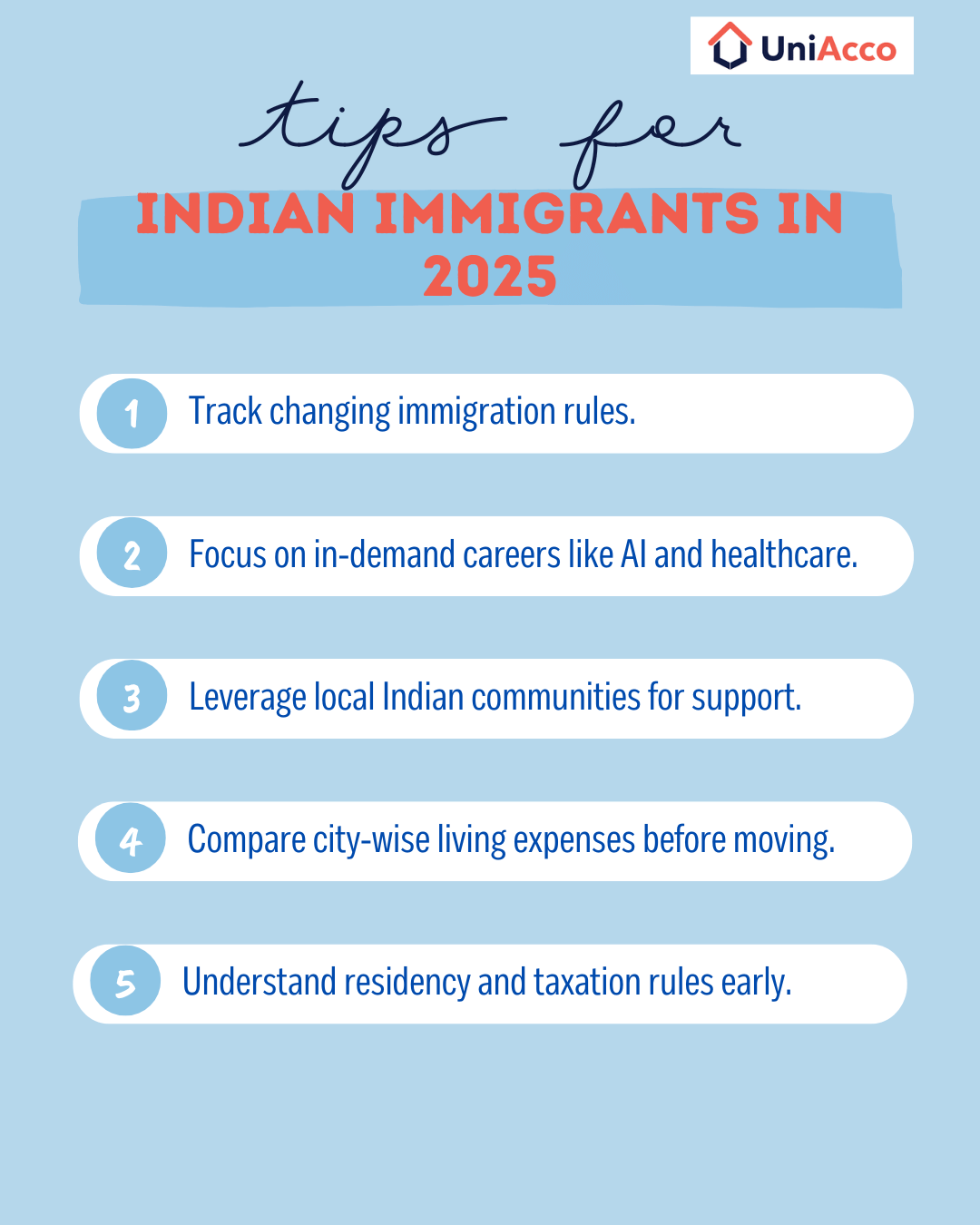
Immigrating in 2025 requires more than just securing a visa; it’s about making informed, strategic choices that ensure long-term stability abroad. Here are five key tips every Indian should keep in mind before taking the leap.
- Stay Ahead of Visa Updates
Immigration rules are changing rapidly. Canada and Australia are leaning on points-based systems for skilled migrants, while the UK is revising post-study work visas. Track official government updates to avoid last-minute surprises.
- Align With Globally In-Demand Skills
Fields like AI, renewable energy, data analytics, and healthcare are driving demand for migration. Choosing courses and specialisations in these areas boosts your employability, visa success, and career trajectory abroad.
- Leverage Indian Diaspora Networks
Strong communities can ease your transition. From Canada’s Punjabi hubs to Germany’s growing student networks, local Indian communities help with housing, jobs, and cultural integration, turning a new country into a familiar home.
- Factor in Cost of Living Wisely
Expenses can vary drastically within a country. Living in Manchester is cheaper than in London, and Adelaide is far more affordable than Sydney. Understanding local costs helps you plan budgets realistically and avoid financial stress.
- Understand Long-Term Residency & Taxation
Each country has unique rules on permanent residency, taxation, and dual citizenship. Clarifying these early ensures smooth pathways to PR, citizenship, and financial compliance.
Take a quick look at insights from locals for more tips:

Conclusion
2026 opens a world of possibilities for Indian students seeking to study, work, or build a life abroad. Each destination offers a unique blend of education, career opportunities, and lifestyle benefits, but the key is to choose wisely. Focusing on the best countries to migrate to from India and carefully planning finances, accommodation, and local support networks can transform your international journey from a challenge into a life-changing experience.
Your journey abroad starts with the right place to stay. UniAcco offers verified student accommodation listings and trusted insights, so you can choose confidently and focus on making the most of your international experience.
Discover verified, fully-furnished student accommodations near universities globally. Comfort, safety, and convenience — all in one click with UniAcco.
🔍 Explore Housing Options

 LinkedIn






0 Comments