

The Chartered Financial Analyst (CFA) credential is like an Oscar award in the investment world. It is one of the highest-paying jobs in the finance sector. Have you ever wondered why? The answer lies in the difficulty of the comprehensive curriculum. When you have cleared all the 3 levels of the program, employers know that they are hiring an expert in portfolio management and complex asset valuation. For these hard-earned skill sets, the marketplace compensates with fat salaries.
The United Kingdom is considered to be a primary destination for top-tier finance professionals worldwide. If you are planning your professional path, you need to understand the typical benchmarks for a CFA salary in the UK. According to a recently published report under the name Robert Half 2026 Salary Guide, overall salaries for highly qualified financial analysts in the UK saw an increase from 2.1% to 3.7% from 2025 to 2026. In this blog, we will share with you the latest data as of 2026 regarding the overall salaries that CFA professionals earn.
CFA Salary in the UK: An Overview
The table below will give you an overview of the CFA salary in the UK.
| Factor | Average |
| Average CFA salary in the UK | £85,000 base per annum |
| Entry-level salary | £55,000 – £80,000 base per annum |
| Mid-level salary | £80,000 – £150,000 base per annum |
| Senior salary | £200,000 – £400,000 + base per annum |
| Highest-paying city | London |
| Highest-paying sector | Hedge Funds and Private Equity |
| Top recruiters | J P Morgan, Goldman Sachs, BlackRock, Barclays, HSBC, PwC |
| Typical annual bonus | 20% to 100%+ of base pay |
How Much Does a CFA Make in the UK?
The average base salary for a CFA in the UK currently sits at around £85,000 per annum. However, looking at a single figure does not give us a full picture. To gain a broader perspective, it’s important to look at the median salary, which is close to £80,000. The median represents the exact middle point of the compensation spectrum, thus reflecting the earnings of a majority of the cohort.
The overall salary range is quite broad. For instance, a junior who has passed Level 1 or Level 2 might start at about £55,000, while a veteran asset allocation expert or a CIO (Chief Investment Officer) may earn a base salary between £250,000 and £400,000 per year. If you ask any seasoned professional – How much does a CFA make? They’ll often refer to this term called the bonus potential.
In front office jobs, discretionary bonuses are tied directly to investment alpha, corporate deal volumes, or fund performance. A middle-office position may offer a 15% to 30% annual bonus, but if you step into private equity or hedge fund management, your variable bonuses may double your base salary too!
Why do the salaries vary? When you analyse how much a CFA makes, you will realise that the salaries vary due to a dynamic mix of elements. For instance, the asset class plays a major role, plus the sheer scale of Assets Under Management (AUM) at the firm dictates their fee income, which directly controls the size of the compensation pool.
Wondering how much a fully furnished student room costs in London? Explore verified and affordable student accommodation in London with UniAcco. Choose from fully furnished rooms with all-inclusive bills, modern amenities, and convenient locations close to top universities.
🔍 Explore Student Accommodation in LondonCFA Salary in UK by Experience Level
The professional journey of a CFA in the UK is typically categorised into 3 distinct phases as described below. Let’s understand how a CFA salary in the UK develops across these different levels.
Entry-Level CFA Salary
This is the launch stage where the industry understands your technical agility and capacity to handle a heavy analytical workload. A passing score on Levels 1 and 2 helps you stand out over thousands of applicants. If you’re a recent university graduate, or an early career switcher, or a professional who has cleared CFA Level 1 or 2 with 0 to 3 years of hands-on experience, then you can expect a salary between £55,000 – £80,000 per year. The typical roles you’ll be hired for include Graduate Investment Analyst, Equity Research Analyst, Data Analyst, or Junior Risk Associate.
Mid-Level CFA Salary
This is the stage where you’ll see the sharpest rise in CFA average salary in the UK. You’ve gone beyond maintaining models; you will now be building them up from scratch. You’ll be pitching real investment ideas to committees and negotiating corporate transaction structures. This is the chance for you to make lateral market moves. If you’re a full charter holder or an advanced candidate with 4 to 8 years of dedicated experience who has the potential to work independently to drive project workflows, expect a salary between £80,000 – £150,000 per year. Typical roles you’ll be hired for include Portfolio Manager, Senior Equity Research Analyst, Investment Banking Associate, or Senior Risk Manager.
Senior CFA Salary
This is the executive apex, which means your daily routine will focus on risk allocation, macro strategy, and high-value investor relationships. Your true value lies in strategic execution. At this stage, your salary shifts into the realm of direct equity participation and net fund returns. If you’re an industry veteran with 9+ years of proven experience, or you’re an established leader over key corporate advisory groups, expect a salary between £200,000 – £400,000+ per year. Your role will be that of a Managing Director, CIO (Chief Investment Officer), Senior Fund Manager, Head of Capital Markets, etc.
Thinking of working in London but not sure how much you’ll be earning? Read this Reddit discussion to explore salary expectations, negotiation tips, and insights shared by CFA charterholders and finance professionals.
Salary Expectations in London, UK – r/CFA
CFA Salary in the UK by City
| City | Average Salary |
| London | £95,000 |
| Manchester | £70,000 |
| Leeds | £67,000 |
| Edinburgh | £75,000 |
| Birmingham | £64,000 |
| Bristol | £66,000 |
If you’re wondering why London pays more, it’s because London acts as a huge global clearing house for international capital. It is the primary European base for global institutions, which means the scale of transaction volumes, fund sizes, and corporate advisory fees is far superior compared to the other countries. In order to prevent their top performers from being poached by rivals in New York, Zurich or Singapore, London firms are forced to calculate their compensation bands on a global scale. The hyper-competitive system drives the baseline CFA salary in the UK to premium heights.
That being said, you must weigh these raw figures against real-world purchasing power, as inflation plays a huge role. London is super expensive; residential properties, daily commute, and lifestyle choices are key factors to be considered. A CFA’s average salary in the UK (£95,000) in London can feel surprisingly low after accounting for the lifestyle choices and substantial mortgage.
On the other hand, cities like Edinburgh or Manchester have accessible housing costs. While evaluating your strategy, always consider the net savings potential rather than just the raw figure on your offer letter.
CFA Salary by Job Role
Corporate finance functions or a standard chartered financial accountant salary builds upward based on regulatory responsibilities, market speculation roles and active portfolio management. If you’re wondering how much a chartered financial analyst earns, look at front-office portfolio design where compensation scales exponentially.
| Role | Average Salary |
| Investment Analyst | £72,000 |
| Equity Research Analyst | £82,000 |
| Portfolio Manager | £115,000 |
| Risk Analyst | £74,000 |
| Financial Analyst | £62,000 |
| Asset Manager | £88,000 |
| Investment Banker | £125,000 |
| Wealth Manager | £78,000 |
Industries That Pay CFA Professionals the Most
The top industries that drive the CFA salary in the UK to maximum limits depend on where you apply your analytical skills as much as your job title. If you want to bag the long-term earnings, you must target fields that operate on high-performance margins. Some of them are mentioned below.
Investment Banking
This is the high-intensity path in the world of finance. IBD (Investment Banking Divisions) reward charter holders for bringing to the table their capital-raising expertise, underwriting precision, along with corporate M&A execution skills. It’s a highly demanding industry, which is why the pay is exceptionally rewarding.
Asset Management
If you’re looking for an industry that offers incredible pay with manageable working hours, this is it. You’ll be managing pension funds or sovereign allocations that involve a long-term approach, and the compensation is supported by stable asset management fees.
Private Equity (PE)
Private Equity demands exceptional valuation skills and structural diligence as they thrive on buying private enterprises, optimising them operationally, and exiting for major gains. They don’t just offer great base packages, but senior PE specialists get a direct percentage of the fund’s total investment profits.
Hedge Funds
If you want to explore the variable earnings potential, this is it. Hedge Funds intensely focus on absolute returns and operate on fee structures that reward based on top-tier performance. You might realise that your performance bonus exceeds your base salary if your long or short stock selections or quantitative strategies generate massive alpha.
Corporate Finance
Helping international corporations to direct their internal capital structure, handle cross-border expansions, and evaluate corporate acquisitions will offer you a direct pathway to senior executive roles, which are highly rewarding.
Consulting
Consulting opportunities offer specialised advisory roles within the Big 4 or top-tier strategy firms. Your role will include guiding corporate turnarounds, independent valuations, and structural transformations. You will easily get a package which has a high base value and consistent corporate bonuses.
Wondering how much a fully furnished student room costs in London? Explore verified and affordable student accommodation in London with UniAcco. Choose from fully furnished rooms with all-inclusive bills, modern amenities, and convenient locations close to top universities.
🔍 Explore Student Accommodation in LondonTop UK Companies Hiring CFA Professionals
| Company | Roles | Avg Expected Salary (Per Year) |
| JP Morgan | Portfolio Management, Investment Banking, Risk Management | £90,000 – £140,000 |
| Goldman Sachs | Equity Research, Asset Management, M&A | £95,000 – £145,000 |
| HSBC | Quantitative Risk Analysis, Global Markets | £78,000 – £120,000 |
| BlackRock | Portfolio Manager, Fixed Income Analyst | £88,000 – £135,000 |
| Barclays | Debt Capital Markets, Investment Banking | £80,000 – £125,000 |
| Deloitte | Financial Advisory, Valuations Specialist | £65,000 – £95,000 |
| EY | Capital Risk, Transaction Advisory Services | £63,000 – £93,000 |
| PwC | Deals Strategy, Corporate Finance Advisory | £66,000 – £96,000 |
Factors That Affect CFA Salary in the UK
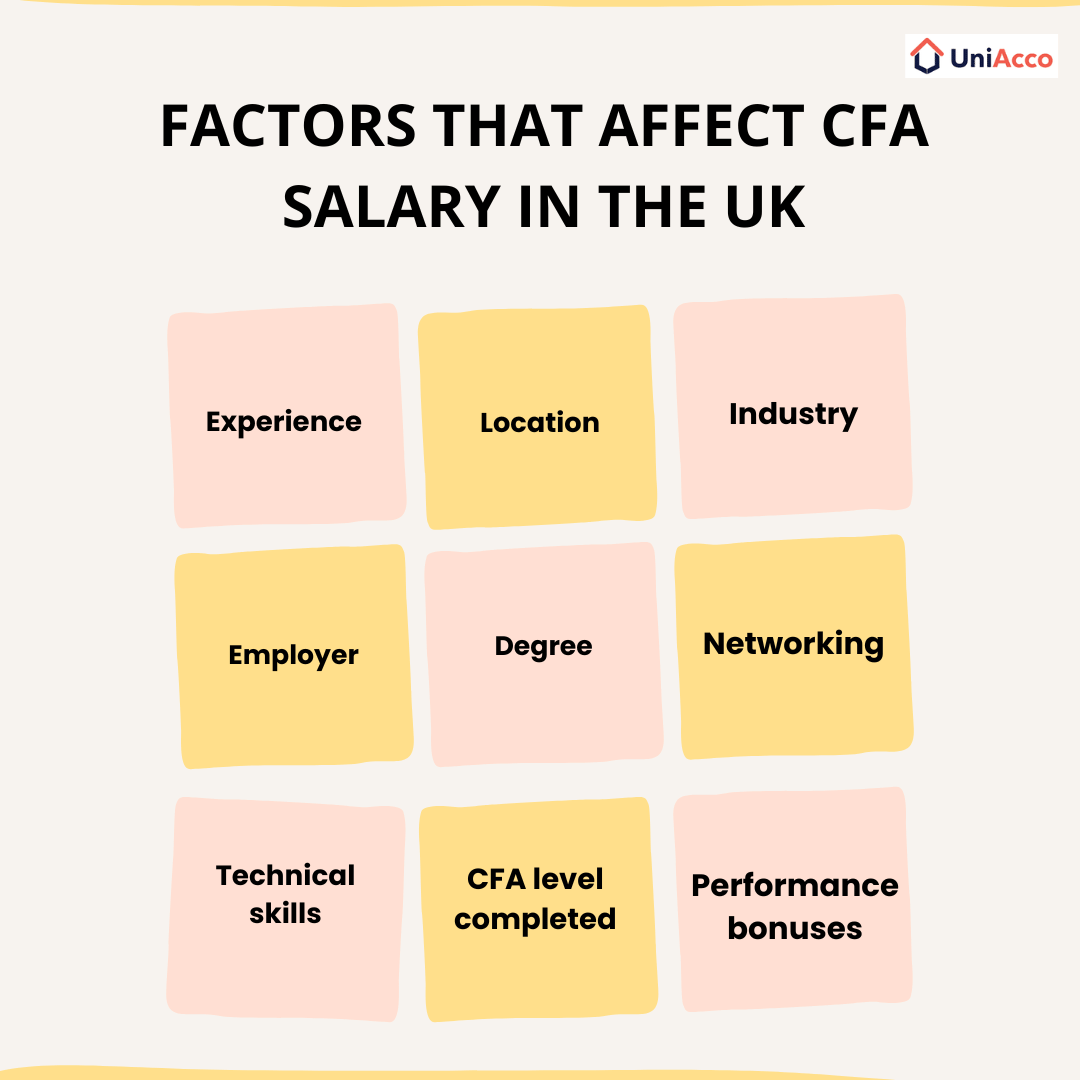
It’s not simply about having the charter certificate that makes the difference in the salary, but quite a few other factors that are taken into consideration.
- Experience
Two key factors while considering experience are your tenure on a desk and your track record of navigating through market volatility. These two factors give you an edge over your competitors because the proven record of hands-on work experience and the capability to handle volatile situations is of utmost importance in the finance sector. In the current hiring market, there is a distinct shortage of mid-level professionals with 4-8 years of experience. So the chances of having a better pay scale in these mid-level jobs are also quite high. When you move up from data execution to independent investment decision-making, your compensation drastically shoots up.
- Location
Geography plays a crucial determinant of your gross earnings. Working in big cities, especially like London, which is the primary destination for top-tier finance professionals, automatically grants you a premium salary because of the strategic location of the place as well as the high cost of living. On the other hand, working in Leeds or Edinburgh will have a lower pay scale compared to the big cities. However, you must always look at the gross number to calculate your local purchasing power.
- Industry
If you’re in a front-office role of wealth creation like Private Equity or Hedge Funds, your yearly yield will be much higher than back-office functions. Plus, you will make a massive bonus over your base salary. The higher your performance, the higher your pay scale. Traditional asset management roles offer financial stability with consistent management fees, while investment banking rewards you for your intense deal advisory work. You must know your risk appetite to maximise your financial compensation.
- Employer
Global investment firms and big asset management companies like JP Morgan or a Big 4 manage multi-billion-dollar portfolios. This sets a benchmark to maintain a compensation scale in line with Wall Street and Singapore. In short, the company’s balance sheet decides the size of the talent compensation pool.
- Degree
In the initial phase of your career, your educational degree plays an important role alongside your CFA charter. With a first-class degree from a target university, you’ll get an immediate advantage while applying for analyst jobs in the city. As you climb up the ladder, your professional exam details fade away and are replaced by practical hands-on experience like a proven track record of managing risk and analysing investments.
- Networking
Networking can turn out to be one of the key deciding factors to get an entry in the financial sector of the United Kingdom. In fact, this applies to all industries. A good word of mouth can do wonders for your resume. In fact, if you look closely, the senior, high-paying jobs are never posted on public forums but are hired based on networks. You must actively be a part of industry events where you get an opportunity to build authentic connections with seniors and industry leaders. If you wish to make lateral moves in the system, networking will help you bypass the traditional corporate application ladder.
- Technical skills
In the age of AI, the baseline requirement for a financial analyst has seen a sharp change. Someone who relies on traditional spreadsheet models might find themselves in a crisis-like situation. Employers place huge value on tech-enabled charter holders who have the skill set to integrate data science toolkits into modern investment frameworks. You’ll get an upper hand if you master programming languages like Python or SQL, which help in automating risk tracking and utilise advanced data analytics, which drives the CFA’s average salary in the UK.
- CFA level completed
Level 1 proves your dedication and basic technical capacity to employers. Level 2 proves your ability to manage advanced equity and corporate accounting and analytical skills. And Level 3 completely shifts you to an apex level, which proves your advanced portfolio theory and ethical training, which is a key requirement to manage institutional capital independently. As you clear all the 3 levels of the curriculum, your salary keeps developing.
- Performance bonuses
How much does a chartered financial analyst make at the top level? While seeking an answer to this question, you have to look beyond just the base salary to evaluate the variable bonus structure of a firm. Discretionary bonuses can range from 20% at mid-senior levels to well over 100% of the base pay in front-office roles like Private Equity and Hedge Funds.
Is Studying CFA Worth It in the UK?
Studying CFA is worth it if you’re targeting investment management, equity research, or portfolio management as a career. If you’re applying to a firm where the CFA is standard or required at senior levels, it’s an absolute necessity. From a financial standpoint, studying CFA has huge benefits for long-term ROI (Return on Investment). If you calculate how much a CFA makes over a multiple-decade career span compared to an uncertified analyst, the earnings gap can scale into thousands of pounds. The CFA qualification acts as a massive filter for the majority of employers in the initial stage. Institutional demand for charter holders is still high. Because the charter is recognised globally. If you decide to move countries from London to New York, your credentials hold the full authority to sit for local conversion exams.
On the other hand, the CFA is probably not worth it if your career is in accounting practice, audit, tax, or corporate finance, where ACCA/ACA is the standard. If you’re in a treasury or operational role where risk or banking-specific credentials are more relevant, then the CFA certificate holds less value. If you’re looking for a quick credential, the CFA is a 4 to 6 year commitment. And if you’re planning to pursue an entrepreneurial journey, the certificate wouldn’t matter much.
Career Opportunities After Completing CFA in the UK
- Investment Banking
Investment bankers help companies raise capital by issuing stocks and bonds. They also provide advisory services on mergers and acquisitions, as well as corporate restructuring. Some of the industries include investment banks, boutique advisory firms, and private equity firms. The technical skills required are Financial Modelling, Valuation Techniques, M&A Knowledge, Capital Markets, Excel and Financial Tools, Legal and Regulatory Knowledge, Presentation Skills, Risk Assessment, Market Knowledge.
- Equity Research
Equity research analysts provide analysis on stocks and other securities to help investors make informed decisions. They analyse company performance, industry trends, and economic data to predict future stock prices. Some of the industries include Investment banks, research firms, and asset management companies. The technical skills required are Advanced financial modelling, Excel (data manipulation, financial formulas), Valuation techniques, Market and industry analysis, writing research reports and presentations, and statistical tools for data analysis (SAS, Python).
- Private Equity
Private equity analysts evaluate investment opportunities in private companies. They conduct financial due diligence, perform valuation analysis, and assist in structuring and executing deals. Some of the industries include Private equity firms, venture capital firms, and investment banks. Technical skills required include Valuation techniques (DCF, precedent transactions, LBO modelling), Financial modeling and due diligence, M&A transaction structuring, Investment committee presentations, Excel, Knowledge of the private equity market, etc.
- Corporate Finance
Corporate Finance professionals work in corporate finance departments, handling budgeting, forecasting, capital raising, financial reporting, and strategic planning. They analyse financial data to guide business decision-making and ensure optimal capital structure. Some of the industries include corporations, investment banks, and financial consulting firms. The technical skills required would be Financial analysis and modelling, Knowledge of capital structure, Financing strategies, M&A modeling, Capital budgeting, Financial forecasting and strategic planning, Tax planning and compliance, and advanced Excel skills.
- Private Equity Analyst
Private equity analysts evaluate investment opportunities in private companies. They conduct financial due diligence, perform valuation analysis, and assist in structuring and executing deals. Some of the key industries include private equity firms, venture capital firms, and investment banks. The technical skillset required would be Valuation techniques, Financial modeling and due diligence, M&A transaction structuring, Investment committee presentations, Excel, Bloomberg, and financial data tools, and knowledge of the private equity market and deal flow.
- Portfolio Manager
Portfolio managers are responsible for managing investment portfolios for clients, ranging from individual investors to institutional clients. They analyse markets, develop investment strategies, and allocate assets based on the client’s financial goals and risk tolerance. The industries to look for include asset management firms, hedge funds, pension funds, and private equity firms. Technical skills required are Asset allocation strategies, Investment research and analysis, Financial modeling, Performance attribution analysis, Risk management tools, Knowledge of fixed income, equities, alternatives, and derivatives; Use of Bloomberg, Reuters, or Morningstar for data.
- Risk Manager
Risk managers are responsible for identifying, analysing, and mitigating financial risks within an organisation. They use quantitative models and qualitative judgment to evaluate potential risks and implement risk management strategies. The industries include banks, insurance companies, hedge funds, consulting firms, and large corporations. Technical skills required would be Risk management software, Risk measurement techniques, Stress testing and scenario analysis, Knowledge of regulatory frameworks, Proficiency in financial modelling and analysis, Risk reporting and metrics creation, Quantitative techniques for risk analysis, etc.

CFA vs ACCA vs CA: Salary Comparison
| Qualification | CFA | ACCA | CA |
| Average Salary | £85,000 per year | £62,000 per year | £34,876 per year |
| Industries | AUM, Hedge Funds, M&A | Audit, Tax Control, Corporate Auditing | Corporate Leadership, Audit, Public Practice |
| Difficulty | Extremely Difficult | Highly Difficult | Highly Difficult |
| Best For | Fund Designing, Capital Allocation | Corporate Finance | CFOs, External Auditing |
| Global Recognition | Yes | Yes | Yes |
| Career Growth | Performance-based, Variable Bonus | Structured and predictable Corporate Ascent | Pathway to Executive Directorship |
How International Students Can Build a High-Paying CFA Career in the UK?
- Choosing finance universities
While choosing a university, choose the UK universities that are officially recognised as CFA Program Partners. Alternatively, look for campus recruitments with major firms in London City.
- Internships
Do not wait for the completion of the final year. Apply for summer analyst positions during your undergraduate years, especially the second year. These programs will help you secure graduate offers and help in building a network in the system.
- Networking
Sign up for industry panel discussions that happen offline and online, join local investment groups, and connect with university alumni via LinkedIn and other social platforms.
- Graduate Visas
The UK’s Graduate Visa route helps international students to live and work in the country for 2 years on completion of their degrees. Make use of this to pass your initial CFA levels to demonstrate your value in the market.
- Professional Memberships
Join the local CFA Society of the UK as a member. This will give you access to specialised job boards, industry panels, and professional networks.
Prepare for a successful career while keeping your living costs under control. Explore affordable student accommodation in Manchester with UniAcco. Choose from verified, fully furnished rooms with all-inclusive bills, modern amenities, and convenient locations close to universities and major student hubs.
🔍 Explore Student Accommodation in ManchesterConclusion
As you progress through the CFA levels, you gain a deeper understanding of finance, investment management, and risk analysis. This knowledge will help you move into higher-paying jobs, especially in senior positions like Chief Investment Officer or Financial Director. The CFA certification is a valuable investment in your future, offering strong career growth and the opportunity to reach top-level positions in the finance industry.
Finally, we’ll part ways with a burning question — Will AI language models make the CFA charter obsolete? ChatGPT and similar language models are nowhere close to being able to perform the tasks that CFA charterholders do on a daily basis. Remember that to become a CFA charterholder, you will need on-the-job experience, which cannot be replicated by any AI model. So, start preparing today at your student accommodation in the UK at UniAcco.












0 Comments