

Making a decision to study abroad can be one of the most daunting things you will ever do, whether you are 18 and heading off for an undergrad degree or someone further along who wants to build on their skills and pursue a postgrad in a completely new country. Regardless of where you are in life, the feeling is the same: leaving everything behind, your people, your comfort zone, your routine, to figure it all out from scratch somewhere you have never lived before. This is not a decision you can take lightly, and anyone who tells you otherwise has probably never actually done it.
The numbers heading into 2026 tell a clear story. According to the OECD’s Education at a Glance 2025 report, over 6 million students are currently studying abroad. HESA reports that the UK alone hosts over 680,000 international students and four of its universities now sit in the QS World University Rankings 2026 top ten. Students aren’t just going for the degree; they are going for the career benefits of studying abroad, the global exposure, and the independence that only comes from navigating a new country entirely on your own terms. The advantages of studying abroad go way beyond the classroom, and in this blog, we break down the top 10 benefits of studying abroad in 2026, plus 8 things you genuinely need to think through before you go.
Top 10 Benefits of Studying Abroad for Students
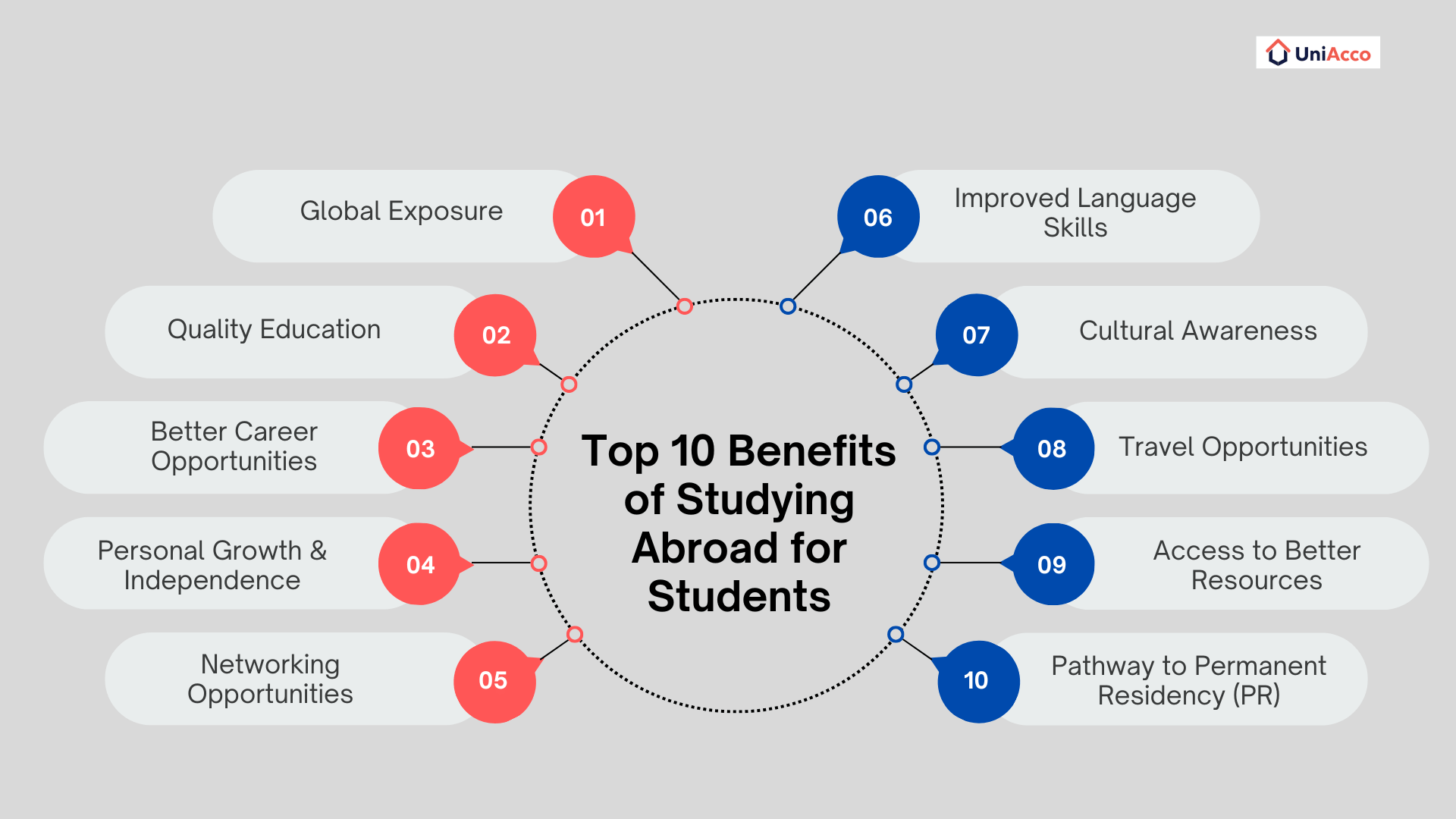
Global Exposure
Most people go through their entire education surrounded by people who largely think, speak and see the world the same way they do. Studying abroad breaks that open. You are in a classroom with people from fifty different countries, all approaching the same problem from completely different starting points. That shift is hard to explain, but for sure it does not leave you. According to research from NAFSA, global skills developed through study abroad appear in over 31 million job postings worldwide. Being the person in the room who actually has that experience is a genuine advantage.
Quality Education
Countries like the UK, Australia, Germany and Canada have built education systems around independent thinking, practical application and real industry exposure. It is not just about exam performance. You start understanding how people in different parts of the world approach the same problem, what drives their ranking, and how their context shapes what they come up with. That kind of intellectual range is hard to develop when everyone in the room has grown up inside the same system.
Found your university in the UK? Now let’s secure your accommodation. Compare prices, explore verified listings, and book fully furnished student rooms with UniAcco.
🔍 Explore UK Student HousingBetter Career Opportunities
This one is probably the reason most of you are even reading this blog. According to compiled statistics from CIES, 97% of students who studied abroad found employment within 12 months of graduation, compared to 49% of those who did not. That gap is too wide to ignore. Employers want adaptability and cross cultural communication that come from having actually studied in a different country, and those things show up in how you work, not just what you say in an interview.
Personal Growth & Independence
Nobody warns you about the moment you are trying to cook a simple meal in a new country and realise you cannot find a single ingredient you actually recognise on the shelves. That is roughly where independence starts. Living overseas means managing your own money, sorting out your own problems and building a life from scratch in a place where you don’t know anyone. According to IES Abroad’s long-term alumni survey, over 96% of students said studying abroad increased their self-confidence, and 97% said they came back noticeably more mature than when they left.
Networking Opportunities
The person sitting next to you in your seminar might end up being a founder, a future employer or just someone who opens a door for you fifteen years from now. Studying at an internationally diverse university means your network does not stay confined to just one city or industry. Professors at top universities are often active professionals with decades of their own connections. When they see potential in a student, they give out recommendations and those carry weight that a CV alone simply cannot.
Improved Language Skills
Even if you are studying in an English-speaking country, you are navigating different accents, communication styles and new vocabularies every single day, and without even realising, you become a far more effective communicator than you were before. For students studying in a non-English-speaking country, the gains are even bigger. In a world where employers across industries are actively looking for staff with language skills beyond English, this is one of the most practical perks of studying abroad you can come back with.
Cultural Awareness
Knowing how to work with, communicate with and understand people from different backgrounds is no longer a soft skill. It is a professional requirement. Studying overseas builds it in a way that a simple module cannot. When you have navigated real cultural misunderstandings, celebrated festivals you did not grow up with and made friends with people who see the world completely differently from you, your perspective shifts permanently. You come back not just more informed, but different.
Travel Opportunities
This is one of the perks of studying abroad that does not get talked about enough. A student based in the UK is a two-hour flight from Barcelona, Prague or Lisbon. A student in Germany is a train ride from Switzerland and France. Most students factor in at least a few weekend trips, and those experiences end up being one of the most cherished memories of their university life. The world becomes smaller and a lot more accessible when you are already living in the middle of it.
Access to Better Resources
World-class universities invest heavily in their facilities because they are competing globally for the best students. That means better-equipped labs, stronger placement programmes, career centres with real employer networks and academic staff who are actively publishing at the frontiers of their fields. For anyone in science, engineering or medicine, access to that kind of research infrastructure can be career-changing.
Pathway to Permanent Residency (PR)
For a lot of students, studying abroad is not just about the degree. It is the first deliberate step towards building a life somewhere new. The UK’s Graduate Route gives you 2 years post-study to find work and transition to a Skilled Worker Visa. Australia offers post-study work visas of up to 4 years, depending on your field and location. For students in STEM, healthcare or finance, these routes are more accessible since there is consistent demand for skilled workers across all of these markets.
Wanna hear from students why they go abroad to study? Read this Reddit thread and find the answers.
Why do people study abroad? – r/college
8 Things to Consider Before Moving Abroad to Study
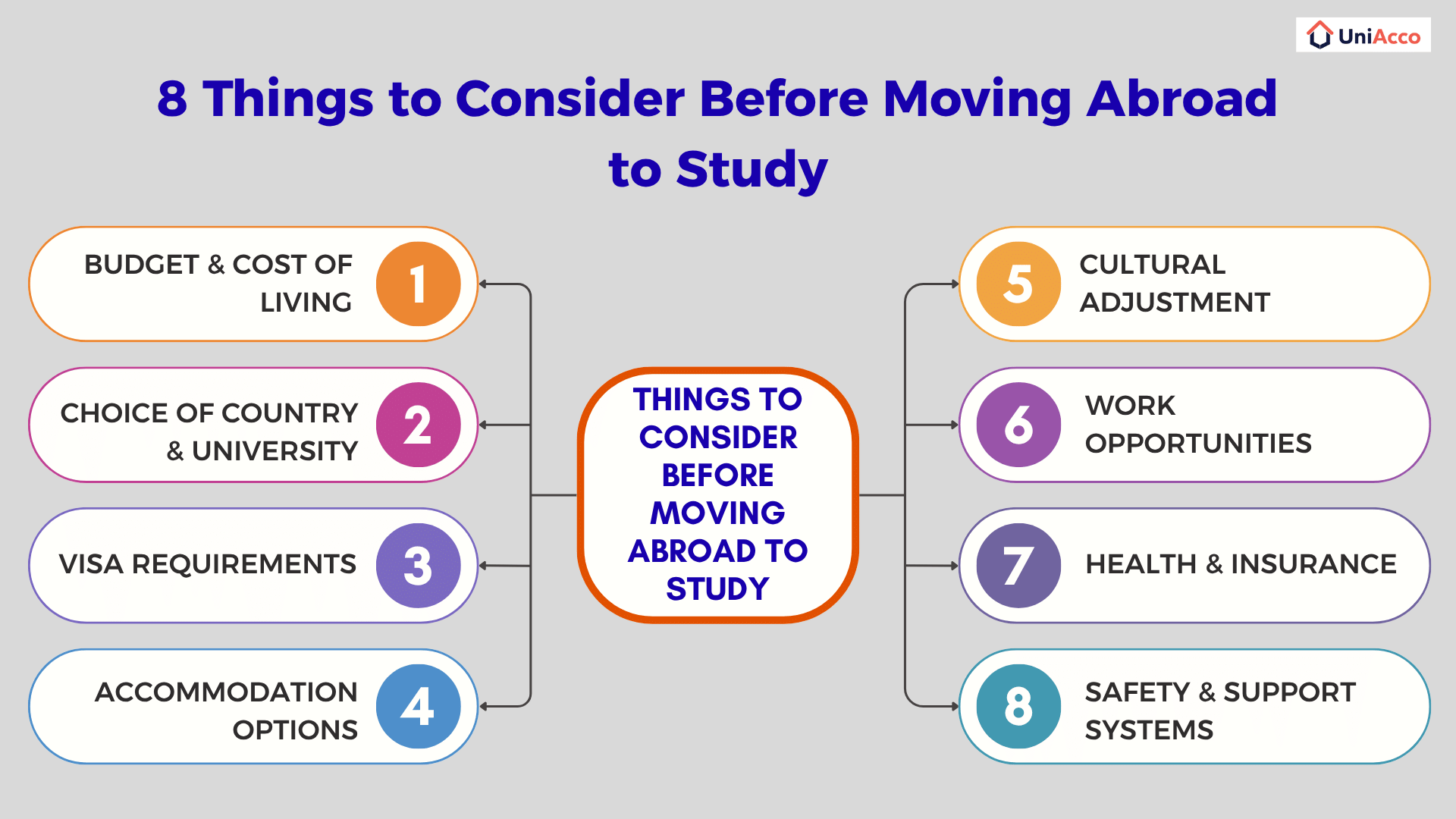
- Budget & Cost of Living
Tuition fees are just the starting point. Rent, food, transport and daily expenses add up quickly and can vary massively depending on where you study. According to Numbeo, a single person in London spends around £1100 per month, excluding rent and a one-bedroom apartment in the city averages around £2300 per month. Cities like Berlin are significantly more affordable, with one-bedroom apartments in the city centre averaging around €1200 per month. If budget is a real factor, choosing a city like Manchester or Sheffield over London can make a significant difference without compromising on the quality of education. It is also wise to look into scholarships early, too; many are merit-based and specifically available to international students.
Choosing Germany to reduce your study costs? Cut down on living expenses too by booking student accommodation with UniAcco. Discover affordable, fully equipped rooms designed for comfortable student living.
🔍 Explore Student Housing in Germany- Choice of Country & University
The university and the country you want to study in should be chosen based on your course, your career goals and where you actually want to be five years after graduation. The QS World University Rankings by Subject 2026 is a good place to check how your specific programme ranks, rather than just looking at the overall institution ranking. Two universities might have the same global top 100 ranking but have completely different rankings for your particular field. One thing to consider is post-study work visa options and whether the country gives you a realistic route to settling there long-term after you graduate.
- Visa Requirements
This is the part most students leave too late and then panic about. Every country has different rules, timelines and documents and getting this wrong can derail everything else. For the UK, the student visa costs around £500 and comes with an Immigration Health Surcharge of around £700 per year, as confirmed by Gov.uk. You also need to show proof of at least around £1529 per month in maintenance funds if studying in London or around £1171 outside London. Processing of the visa can take several weeks, so start way earlier than you think you need to. Always check the official government immigration website for your country.
- Accommodation Options
University halls fill up fast, and trying to find a flat in London or any major city from abroad while also juggling visa paperwork and course applications is a lot to handle at once. Look into your options well in advance. According to Numbeo, London rent is on average over 100% higher than Berlin, so city choice alone can change your monthly budget dramatically. UniAcco is a great place to start. We offer verified student accommodation near top universities across the UK, Australia, Ireland, Canada, New Zealand and Germany with flexible options for every budget and 24/7 support so you are never figuring it out alone. Get that sorted before you board the flight, and you will land with one less thing to worry about.
Want to make sure you get the best room, no matter what? Explore student accommodation in London with UniAcco and choose your preferred room type with all-inclusive bills and fully equipped amenities.
🔍 Explore London Student Housing- Cultural Adjustment
Almost every student who has studied abroad will tell you the same thing: the first few weeks feel exciting, and then somewhere around week three or four, it gets quiet. The novelty wears off, home feels far, and the reality of starting from scratch in a new country sets in. That feeling is completely normal, and it does pass. Joining a student society early, staying in touch with people back home and connecting with your university’s international student office make a real difference.
- Work Opportunities
Most student visas let you work part-time during term and full-time during holidays, which can help you with your living costs. In the UK, degree-level students can work up to 20 hours per week during term time. Whereas in Australia, the limit is 48 hours per fortnight. In Germany, students can work up to 140 full days per year. Part-time work not only helps with your living expenses, but it also builds local experience, grows your network in a new country and adds genuine substance to your CV. However, just know the exact rules of your visa before you begin. Breaking them can have serious consequences, including cancellation of your visa entirely.
- Health & Insurance
This one catches students off guard more than almost anything else. The rules are different in every country, and sorting it out at the last minute is not a good idea. In the UK, the Immigration Health Surcharge paid as part of your visa gives you access to the NHS. In Australia, Overseas Student Health Cover is a mandatory visa requirement. In Germany, you need to be enrolled in a recognised health insurance scheme before you can even register at your university. Also check whether your policy also covers dental, mental health support and emergency repatriation as these are often excluded from standard plans.
- Safety & Support Systems
Most reputable universities offer a dedicated international student office, 24/7 welfare helplines, academic mentors and counselling services. It is also worth looking at your chosen city’s safety record, too. According to HESA, the UK welcomed around 685,000 international students in 2024/25, and that reflects how well-established the student support infrastructure is across most major UK cities.
Still confused about what to consider when moving miles away? Hear from students in this Quora discussion and find out what they usually miss.

Conclusion
The real benefits of studying abroad aren’t just found in a lecture hall or on a CV; they live in a version of yourself that comes back: the one who has figured out how to build a life somewhere new, and sit with uncertainty long enough to grow through it. In 2026, being well-educated means more than having a degree. It means having the range to operate in a world that is wider than one you started in.
You have done the research, and you know why studying abroad matters. Now, it’s about making the move work so you can actually focus on the experience. Once you have picked your university, let UniAcco take care of where you live. We offer private student apartments and furnished housing right near your university, with all-inclusive rent and 24/7 expert support across the UK, Australia, Ireland, Canada, New Zealand, France and Germany.


 LinkedIn






0 Comments